Passenger NISSAN ARMADA 2017 2.G Owner's Manual
[x] Cancel search | Manufacturer: NISSAN, Model Year: 2017, Model line: ARMADA, Model: NISSAN ARMADA 2017 2.GPages: 614, PDF Size: 2.87 MB
Page 64 of 614
rear seats or in the front passenger seat:
1.If you must install a child restraint in
the front seat, it should be placed in a
forward-facing direction only. Move the
seat to the rearmost position. Child
restraints for infants must be used in
the rear-facing direction and, therefore,
must not be used in the front seat.
2. Position the child restraint on the seat. Always follow the child restraint manufac-
turer’s instructions.
The back of the child restraint should be
secured against the vehicle seatback.
If necessary, adjust or remove the head
restraint or headrest to obtain the correct
child restraint fit. If the head restraint or
headrest is removed, store it in a secure
place. Be sure to reinstall the head
restraint or headrest when the child
restraint is removed. See “Head re-
straints/headrests” (P.1-13) for head re-
straint or headrest adjustment, removal and
installation information.
If the seating position does not have an
adjustable head restraint or a headrest and it
is interfering with the proper child restraint
fit, try another seating position or a different
child restraint.
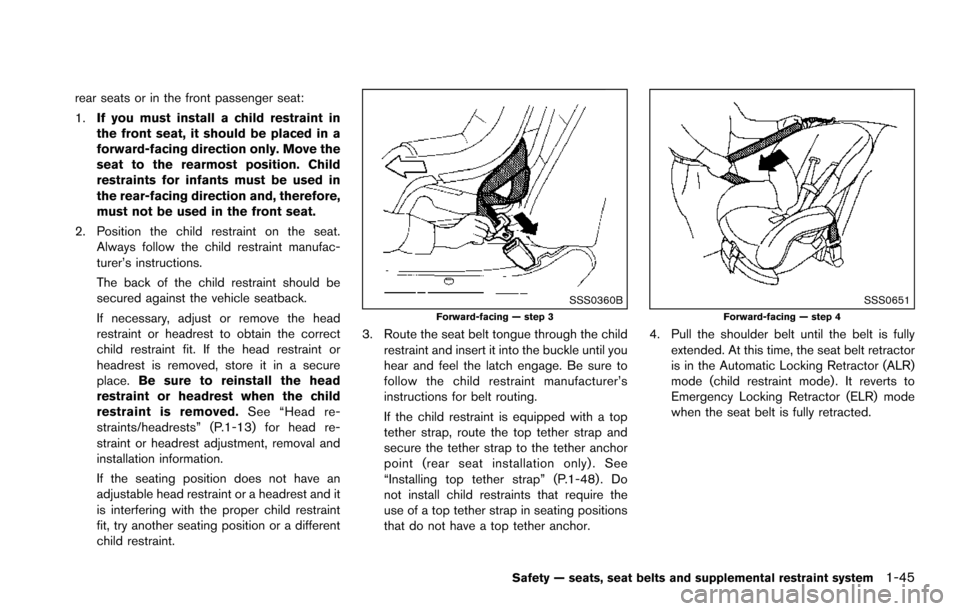
SSS0360BForward-facing — step 3
3. Route the seat belt tongue through the child restraint and insert it into the buckle until you
hear and feel the latch engage. Be sure to
follow the child restraint manufacturer’s
instructions for belt routing.
If the child restraint is equipped with a top
tether strap, route the top tether strap and
secure the tether strap to the tether anchor
point (rear seat installation only) . See
“Installing top tether strap” (P.1-48) . Do
not install child restraints that require the
use of a top tether strap in seating positions
that do not have a top tether anchor.
SSS0651Forward-facing — step 4
4. Pull the shoulder belt until the belt is fullyextended. At this time, the seat belt retractor
is in the Automatic Locking Retractor (ALR)
mode (child restraint mode) . It reverts to
Emergency Locking Retractor (ELR) mode
when the seat belt is fully retracted.
Safety — seats, seat belts and supplemental restraint system1-45
Page 66 of 614
seat belt is not locked, repeat steps 2
through 8.
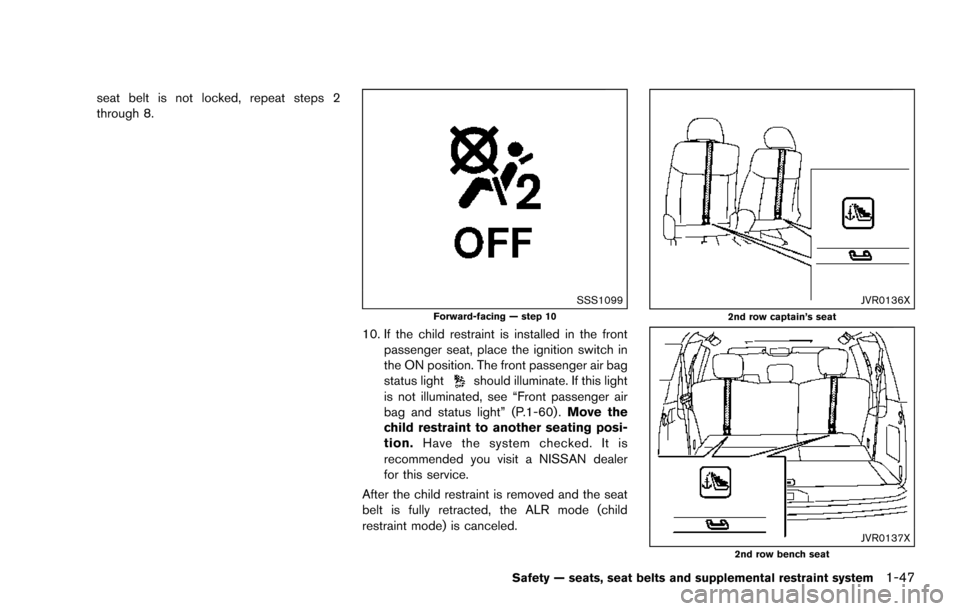
SSS1099Forward-facing — step 10
10. If the child restraint is installed in the frontpassenger seat, place the ignition switch in
the ON position. The front passenger air bag
status light
should illuminate. If this light
is not illuminated, see “Front passenger air
bag and status light” (P.1-60) . Move the
child restraint to another seating posi-
tion. Have the system checked. It is
recommended you visit a NISSAN dealer
for this service.
After the child restraint is removed and the seat
belt is fully retracted, the ALR mode (child
restraint mode) is canceled.
JVR0136X2nd row captain’s seat
JVR0137X2nd row bench seat
Safety — seats, seat belts and supplemental restraint system1-47
Page 68 of 614
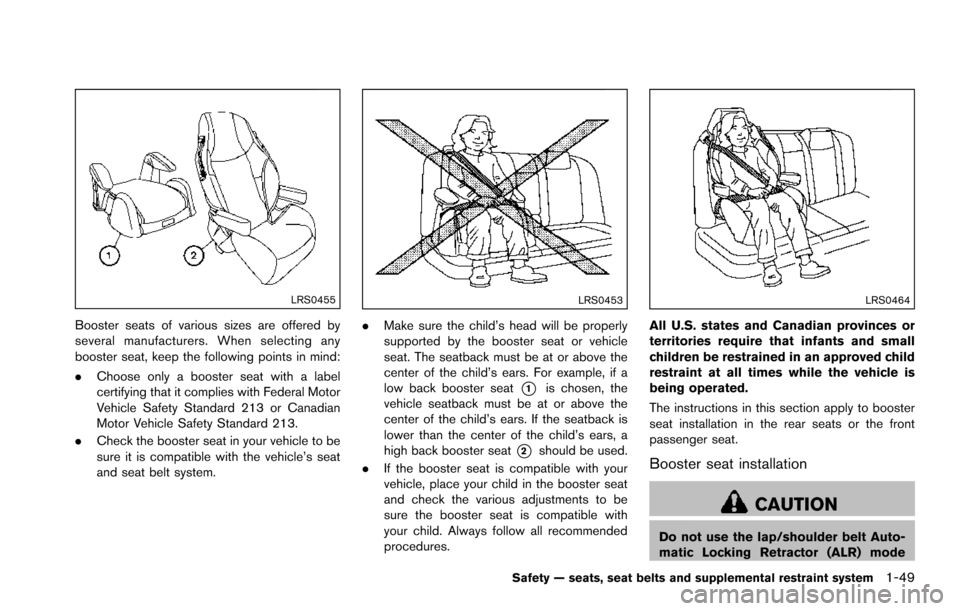
LRS0455
Booster seats of various sizes are offered by
several manufacturers. When selecting any
booster seat, keep the following points in mind:
.Choose only a booster seat with a label
certifying that it complies with Federal Motor
Vehicle Safety Standard 213 or Canadian
Motor Vehicle Safety Standard 213.
. Check the booster seat in your vehicle to be
sure it is compatible with the vehicle’s seat
and seat belt system.
LRS0453
.Make sure the child’s head will be properly
supported by the booster seat or vehicle
seat. The seatback must be at or above the
center of the child’s ears. For example, if a
low back booster seat
*1is chosen, the
vehicle seatback must be at or above the
center of the child’s ears. If the seatback is
lower than the center of the child’s ears, a
high back booster seat
*2should be used.
. If the booster seat is compatible with your
vehicle, place your child in the booster seat
and check the various adjustments to be
sure the booster seat is compatible with
your child. Always follow all recommended
procedures.
LRS0464
All U.S. states and Canadian provinces or
territories require that infants and small
children be restrained in an approved child
restraint at all times while the vehicle is
being operated.
The instructions in this section apply to booster
seat installation in the rear seats or the front
passenger seat.
Booster seat installation
CAUTION
Do not use the lap/shoulder belt Auto-
matic Locking Retractor (ALR) mode
Safety — seats, seat belts and supplemental restraint system1-49
Page 69 of 614
1-50Safety — seats, seat belts and supplemental restraint system
when using a booster seat with the seat
belts.
Refer to all Warnings and Cautions in the “Child
safety”, “Child restraints” and “Booster seats”
sections earlier in this section before installing a
child restraint.
Follow these steps to install a booster seat in the
rear seat or in the front passenger seat:
SSS0640
1. If you must install a booster seat in the
front seat, move the seat to the rear-
most position.
2. Position the booster seat on the seat. Only place it in a forward-facing direction. Always
follow the booster seat manufacturer’s
instructions.
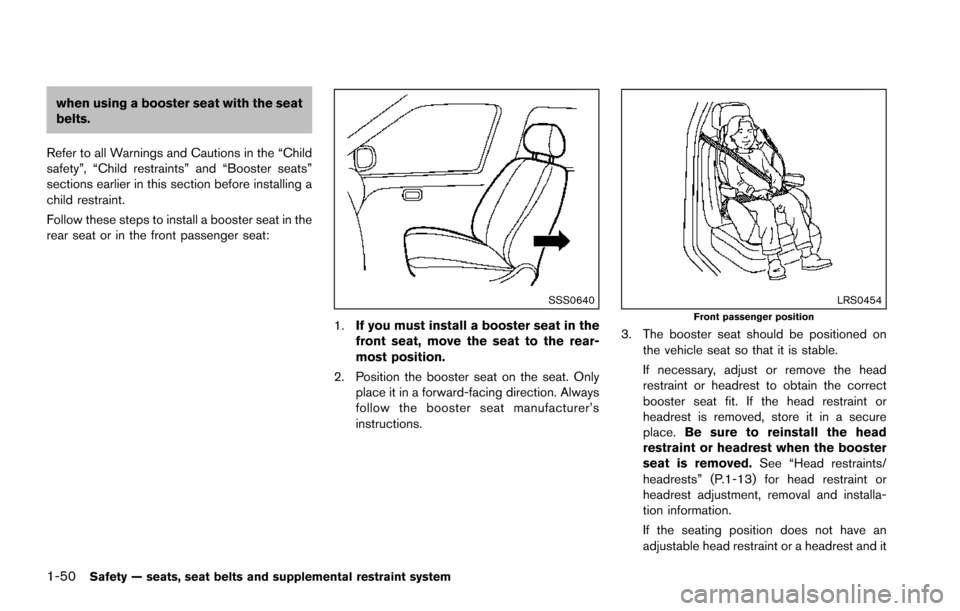
LRS0454Front passenger position
3. The booster seat should be positioned onthe vehicle seat so that it is stable.
If necessary, adjust or remove the head
restraint or headrest to obtain the correct
booster seat fit. If the head restraint or
headrest is removed, store it in a secure
place. Be sure to reinstall the head
restraint or headrest when the booster
seat is removed. See “Head restraints/
headrests” (P.1-13) for head restraint or
headrest adjustment, removal and installa-
tion information.
If the seating position does not have an
adjustable head restraint or a headrest and it
Page 70 of 614
is interfering with the proper booster seat fit,
try another seating position or a different
booster seat.
4. Position the lap portion of the seat belt low and snug on the child’s hips. Be sure to
follow the booster seat manufacturer’s
instructions for adjusting the seat belt
routing.
5. Pull the shoulder belt portion of the seat belt toward the retractor to take up extra slack.
Be sure the shoulder belt is positioned
across the top, middle portion of the child’s
shoulder. Be sure to follow the booster seat
manufacturer’s instructions for adjusting the
seat belt routing.
6. Follow the warnings, cautions and instruc- tions for properly fastening a seat belt
shown in “Seat belts” (P.1-18) .
SSS1099
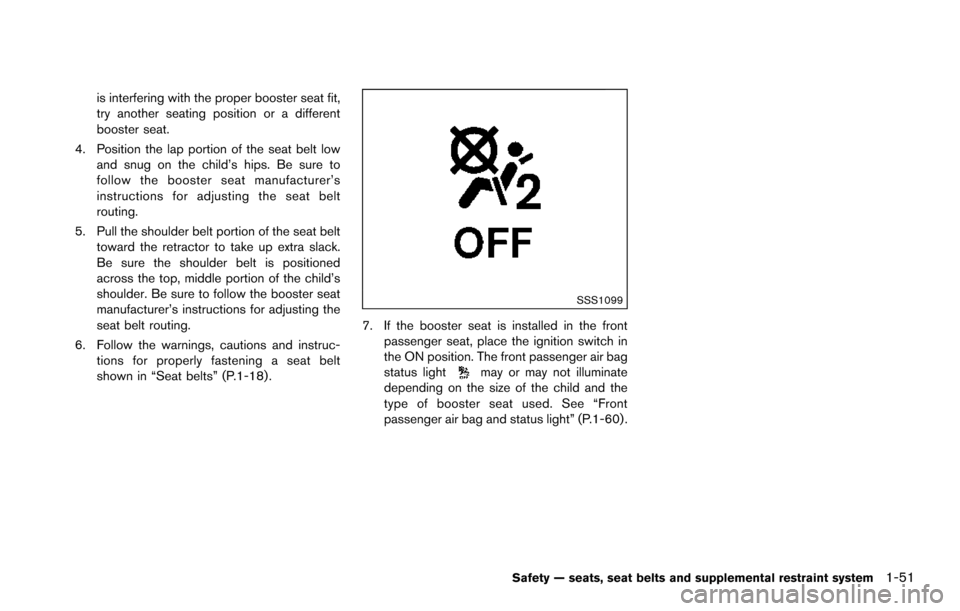
7. If the booster seat is installed in the front
passenger seat, place the ignition switch in
the ON position. The front passenger air bag
status light
may or may not illuminate
depending on the size of the child and the
type of booster seat used. See “Front
passenger air bag and status light” (P.1-60) .
Safety — seats, seat belts and supplemental restraint system1-51
Page 71 of 614
1-52Safety — seats, seat belts and supplemental restraint system
PRECAUTIONS ON SUPPLEMENTAL
RESTRAINT SYSTEM
This Supplemental Restraint System (SRS)
section contains important information concern-
ing the following systems.
.Driver and passenger supplemental front-
impact air bag (NISSAN Advanced Air Bag
System)
. Front seat-mounted side-impact supple-
mental air bag
. Roof-mounted curtain side-impact and roll-
over supplemental air bag
. Seat belt with pretensioner
Supplemental front-impact air bag system:
The NISSAN Advanced Air Bag System can
help cushion the impact force to the head and
chest of the driver and front passenger in certain
frontal collisions.
Front seat-mounted side-impact supple-
mental air bag system: This system can help
cushion the impact force to the chest and pelvis
area of the driver and front passenger in certain
side impact collisions. The supplemental side air
bag is designed to inflate on the side where the
vehicle is impacted.
Roof-mounted curtain side-impact and
rollover supplemental air bag system: This
system can help cushion the impact force to the head of occupants in front and rear (2nd and
3rd) outboard seating positions in certain side
impact or rollover collisions. In a side impact, the
curtain air bags are designed to inflate on the
side where the vehicle is impacted. In a rollover,
the curtain air bags on both sides are designed
to inflate. Under both side-impact and rollover
situations, the curtain air bags will remain
inflated for a short period of time.
These supplemental restraint systems are de-
signed to
supplement the crash protection
provided by the driver and passenger seat belts
and are not a substitute for them. Seat belts
should always be correctly worn and the
occupant seated a suitable distance away from
the steering wheel, instrument panel and door
finishers. (See “Seat belts” (P.1-18) for instruc-
tions and precautions on seat belt usage.)
The supplemental air bags operate only
when the ignition switch is in the ON
position.
After placing the ignition switch in the ON
position, the supplemental air bag warning
light illuminates. The supplemental air bag
warning light will turn off after about 7
seconds if the systems are operational.
SUPPLEMENTAL RESTRAINT
SYSTEM
Page 72 of 614
SSS0131
SSS0132
WARNING
.The front air bags ordinarily will not
inflate in the event of a side impact,
rear impact, rollover, or lower se-
verity frontal collision. Always wear
your seat belts to help reduce the
risk or severity of injury in various
kinds of accidents.
. The front passenger air bag will not
inflate if the passenger air bag
status light is lit or if the front
passenger seat is unoccupied. See
“Front passenger air bag and status
light” (P.1-60) .
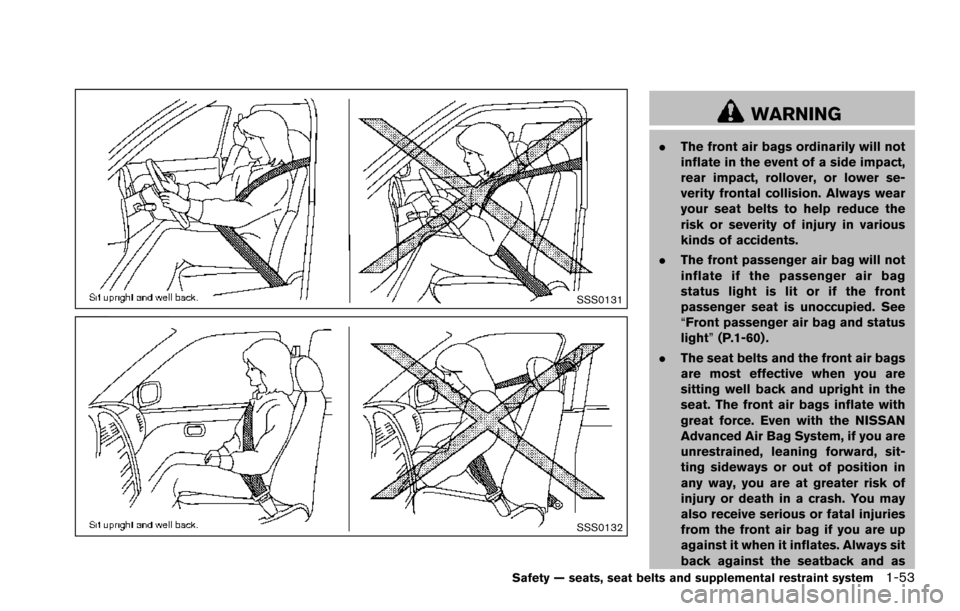
. The seat belts and the front air bags
are most effective when you are
sitting well back and upright in the
seat. The front air bags inflate with
great force. Even with the NISSAN
Advanced Air Bag System, if you are
unrestrained, leaning forward, sit-
ting sideways or out of position in
any way, you are at greater risk of
injury or death in a crash. You may
also receive serious or fatal injuries
from the front air bag if you are up
against it when it inflates. Always sit
back against the seatback and as
Safety — seats, seat belts and supplemental restraint system1-53
Page 73 of 614
1-54Safety — seats, seat belts and supplemental restraint system
far-away as practical from the steer-
ing wheel or instrument panel. Al-
ways use the seat belts.
. The driver and front passenger seat
belt buckles are equipped with
sensors that detect if the seat belts
are fastened. The Advanced Air Bag
System monitors the severity of a
collision and seat belt usage then
inflates the air bags. Failure to
properly wear seat belts can in-
crease the risk or severity of injury
in an accident.
. The front passenger seat is
equipped with occupant classifica-
tion sensors (weight sensors) that
turn the front passenger air bag
OFF under some conditions. This
sensor is only used in this seat.
Failure to be properly seated and
wearing the seat belt can increase
the risk or severity of injury in an
accident. See “Front passenger air
bag and status light” (P.1-60) .
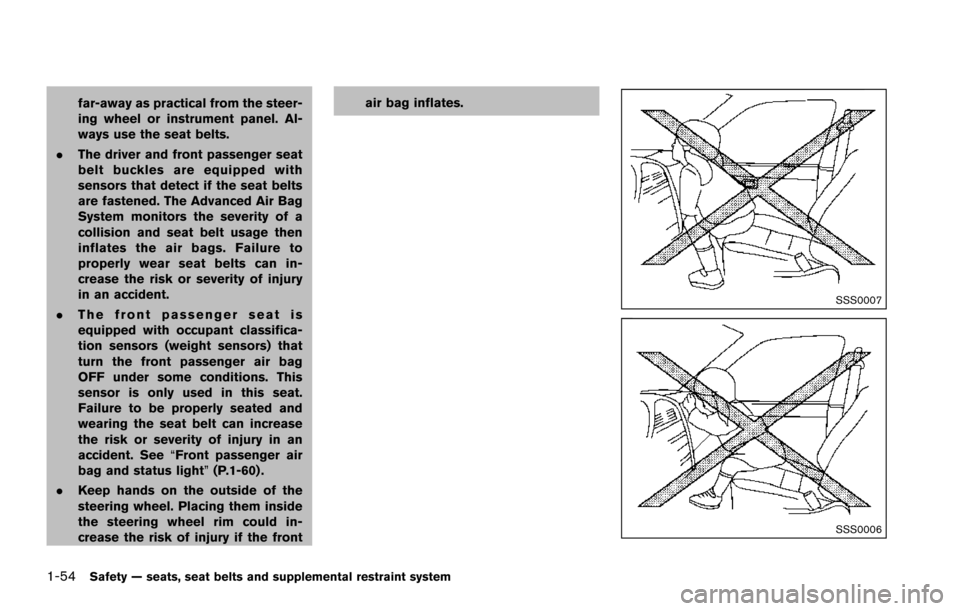
. Keep hands on the outside of the
steering wheel. Placing them inside
the steering wheel rim could in-
crease the risk of injury if the front air bag inflates.
SSS0007
SSS0006
Page 77 of 614
1-58Safety — seats, seat belts and supplemental restraint system
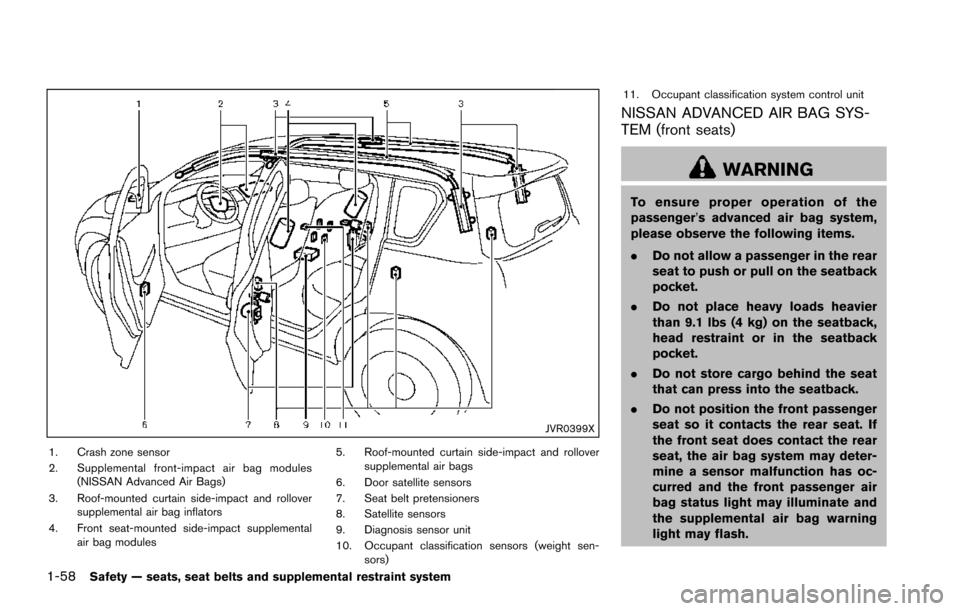
JVR0399X
1. Crash zone sensor
2. Supplemental front-impact air bag modules(NISSAN Advanced Air Bags)
3. Roof-mounted curtain side-impact and rollover supplemental air bag inflators
4. Front seat-mounted side-impact supplemental air bag modules 5. Roof-mounted curtain side-impact and rollover
supplemental air bags
6. Door satellite sensors
7. Seat belt pretensioners
8. Satellite sensors
9. Diagnosis sensor unit
10. Occupant classification sensors (weight sen- sors) 11. Occupant classification system control unit
NISSAN ADVANCED AIR BAG SYS-
TEM (front seats)
WARNING
To ensure proper operation of the
passenger’s advanced air bag system,
please observe the following items.
.
Do not allow a passenger in the rear
seat to push or pull on the seatback
pocket.
. Do not place heavy loads heavier
than 9.1 lbs (4 kg) on the seatback,
head restraint or in the seatback
pocket.
. Do not store cargo behind the seat
that can press into the seatback.
. Do not position the front passenger
seat so it contacts the rear seat. If
the front seat does contact the rear
seat, the air bag system may deter-
mine a sensor malfunction has oc-
curred and the front passenger air
bag status light may illuminate and
the supplemental air bag warning
light may flash.
Page 78 of 614
.If a forward facing child restraint is
installed in the front passenger
seat, do not position the front
passenger seat so the child restraint
contacts the instrument panel. If the
child restraint does contact the in-
strument panel, the system may
determine the seat is occupied and
the passenger air bag may deploy in
a collision. Also the front passenger
air bag status light may not illumi-
nate. See “Child restraints” (P.1-31)
for information about installing and
using child restraints.
. Confirm the operating condition
with the front passenger air bag
status light.
. If you notice that the front passen-
ger air bag status light is not
operating as described in this sec-
tion, it is recommended you visit a
NISSAN dealer to check the passen-
ger seat Advanced Air Bag System.
. Until you have confirmed with your
dealer that your passenger seat
advanced air bag is working prop-
erly, position the occupants in the
rear seating positions. This vehicle is equipped with the NISSAN
Advanced Air Bag System for the driver and
front passenger seats. This system is designed
to meet certification requirements under U.S.
regulations. It is also permitted in Canada.
All of
the information, cautions and warnings in
this manual apply and must be followed.
The driver supplemental front-impact air bag is
located in the center of the steering wheel. The
passenger supplemental front-impact air bag is
mounted in the instrument panel above the glove
box. The front air bags are designed to inflate in
higher severity frontal collisions, although they
may inflate if the forces in another type of
collision are similar to those of a higher severity
frontal impact. They may not inflate in certain
frontal collisions. Vehicle damage (or lack of it) is
not always an indication of proper front air bag
operation.
The NISSAN Advanced Air Bag System moni-
tors information from the Air bag Control Unit
(ACU) , seat belt buckle sensors and the
occupant classification sensors (weight sen-
sors) . Inflator operation is based on the severity
of a collision and seat belt usage for the driver.
For the front passenger, the occupant classifi-
cation sensors are also monitored. Based on
information from the sensors, only one front air
bag may inflate in a crash, depending on the
crash severity and whether the front occupants are belted or unbelted. Additionally, the front
passenger air bag may be automatically turned
OFF under some conditions, depending on the
information provided by the occupant classifica-
tion sensors. If the front passenger air bag is
OFF, the front passenger air bag status light will
be illuminated (if the seat is unoccupied, the
light will not be illuminated, but the air bag will
be off) . (See “Front passenger air bag and
status light” (P.1-60) for further details.) One
front air bag inflating does not indicate improper
performance of the system.
If you have any questions about your air bag
system, it is recommended you visit a NISSAN
dealer to obtain information about the system. If
you are considering modification of your vehicle
due to a disability, you may also contact
NISSAN. Contact information is contained in
the front of this Owner’s Manual.
When a front air bag inflates, a fairly loud noise
may be heard, followed by release of smoke.
This smoke is not harmful and does not indicate
a fire. Care should be taken not to inhale it, as it
may cause irritation and choking. Those with a
history of a breathing condition should get fresh
air promptly.
Front air bags, along with the use of seat belts,
help to cushion the impact force on the head
and chest of the front occupants. They can help
Safety — seats, seat belts and supplemental restraint system1-59