cruise control NISSAN ARMADA 2017 2.G Owner's Manual
[x] Cancel search | Manufacturer: NISSAN, Model Year: 2017, Model line: ARMADA, Model: NISSAN ARMADA 2017 2.GPages: 614, PDF Size: 2.87 MB
Page 436 of 614
NOTE:
.The stop lights of the vehicle come on
when braking is performed by the DCA
system.
. When the brake operates, a noise may
be heard and/or vibration may be felt.
This is not a malfunction.
Overriding the system:
The following driver’s operation overrides the
system operation.
. When the driver depresses the accelerator
pedal even further while the system is
moving the accelerator pedal upward, the
DCA system control of the accelerator pedal
is canceled.
. When the driver’s foot is on the accelerator
pedal, the brake control by the system is not
operated.
. When the driver’s foot is on the brake pedal,
neither the brake control nor the alert by the
system operates.
. When the Intelligent Cruise Control (ICC)
system is set, the DCA system will be
inactive.Approach warning
If your vehicle comes closer to the vehicle ahead
due to rapid deceleration of that vehicle or if
another vehicle cuts in, the system warns the
driver with the chime and DCA system display.
Decelerate by depressing the brake pedal to
maintain a safe vehicle distance if:
.The chime sounds.
. The vehicle ahead detection indicator blinks.
The warning chime may not sound in some
cases when there is a short distance between
vehicles. Some examples are:
. When the vehicles are traveling at the same
speed and the distance between vehicles is
not changing
. When the vehicle ahead is traveling faster
and the distance between vehicles is
increasing
. When a vehicle cuts in near your vehicle
The warning chime will not sound when your
vehicle approaches vehicles that are parked or
moving slowly.
NOTE:
The approach warning chime may sound
and the system display may blink when the
radar sensor detects objects on the side of
the vehicle or on the side of the road. This
may cause the DCA system to decelerate or accelerate the vehicle. The radar sensor
may detect these objects when the vehicle
is driven on winding roads, narrow roads,
hilly roads or when entering or exiting a
curve. In these cases you will have to
manually control the proper distance
ahead of your vehicle.
Also, the sensor sensitivity can be affected by
vehicle operation (steering maneuver or driving
position in the lane) or traffic or vehicle condition
(for example, if a vehicle is being driven with
some damage) .
Starting and driving5-95
Page 437 of 614
5-96Starting and driving
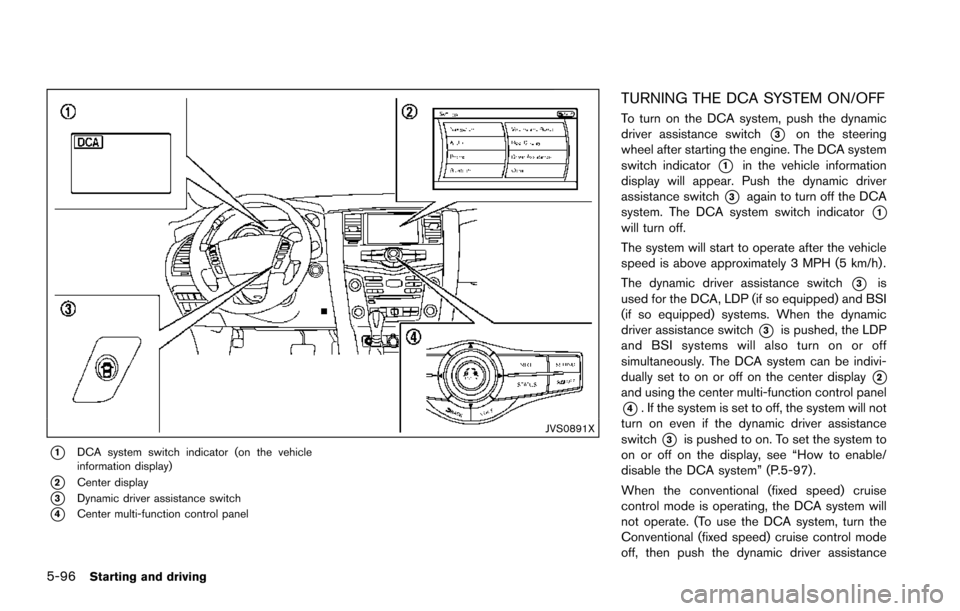
JVS0891X
*1DCA system switch indicator (on the vehicle
information display)
*2Center display
*3Dynamic driver assistance switch
*4Center multi-function control panel
TURNING THE DCA SYSTEM ON/OFF
To turn on the DCA system, push the dynamic
driver assistance switch
*3on the steering
wheel after starting the engine. The DCA system
switch indicator
*1in the vehicle information
display will appear. Push the dynamic driver
assistance switch
*3again to turn off the DCA
system. The DCA system switch indicator
*1will turn off.
The system will start to operate after the vehicle
speed is above approximately 3 MPH (5 km/h) .
The dynamic driver assistance switch
*3is
used for the DCA, LDP (if so equipped) and BSI
(if so equipped) systems. When the dynamic
driver assistance switch
*3is pushed, the LDP
and BSI systems will also turn on or off
simultaneously. The DCA system can be indivi-
dually set to on or off on the center display
*2and using the center multi-function control panel
*4. If the system is set to off, the system will not
turn on even if the dynamic driver assistance
switch
*3is pushed to on. To set the system to
on or off on the display, see “How to enable/
disable the DCA system” (P.5-97) .
When the conventional (fixed speed) cruise
control mode is operating, the DCA system will
not operate. (To use the DCA system, turn the
Conventional (fixed speed) cruise control mode
off, then push the dynamic driver assistance
Page 438 of 614
switch*3.)
For details about the conventional (fixed speed)
cruise control mode, see “Intelligent Cruise
Control (ICC)” (P.5-69) .
When the engine is turned off, the system is
automatically turned off.
SSD0959
SSD1102
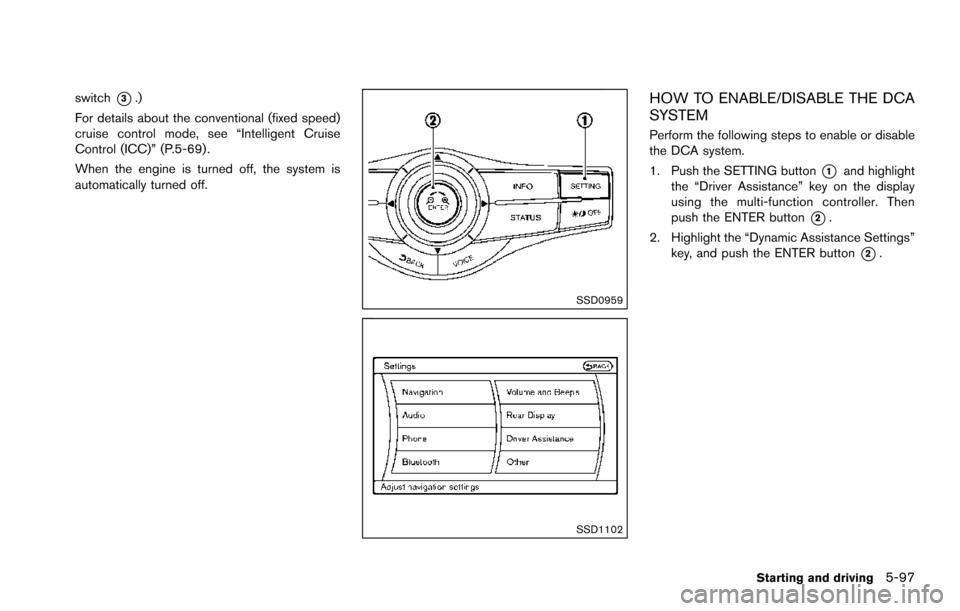
HOW TO ENABLE/DISABLE THE DCA
SYSTEM
Perform the following steps to enable or disable
the DCA system.
1. Push the SETTING button
*1and highlight
the “Driver Assistance” key on the display
using the multi-function controller. Then
push the ENTER button
*2.
2. Highlight the “Dynamic Assistance Settings” key, and push the ENTER button
*2.
Starting and driving5-97
Page 463 of 614
5-122Starting and driving
.Recirculating the cool air in the cabinwhen the A/C is on reduces cooling load.
4. Drive at economical speeds and distances.
.Observing the speed limit and not ex- ceeding 60 MPH (97 km/h) (where
legally allowed) can improve fuel effi-
ciency due to reduced aerodynamic
drag.
.Maintaining a safe following distancebehind other vehicles reduces unneces-
sary braking.
.Safely monitoring traffic to anticipatechanges in speed permits reduced brak-
ing and smooth acceleration changes.
.Select a gear range suitable to road conditions.
5. Use cruise control.
.Using cruise control during highway driving helps maintain a steady speed.
.Cruise control is particularly effective in providing fuel savings when driving on
flat terrains.
6. Plan for the shortest route.
.Utilize a map or navigation system to determine the best route to save time.
7. Avoid idling.
.Shutting off your engine when safe for stops exceeding 30-60 seconds saves fuel and reduces emissions.
8. Buy an automated pass for toll roads.
.Automated passes permit drivers to use special lanes to maintain cruising speed
through the toll and avoid stopping and
starting.
9. Winter warm up.
.Limit idling time to minimize impact to fuel economy.
.Vehicles typically need no more than 30seconds of idling at start-up to effectively
circulate the engine oil before driving.
.Your vehicle will reach its ideal operatingtemperature more quickly while driving
versus idling.
10. Keeping your vehicle cool.
.Park your vehicle in a covered parking area or in the shade whenever possible.
.When entering a hot vehicle, opening thewindows will help to reduce the inside
temperature faster, resulting in reduced
demand on your A/C system. .
Keep your engine tuned up.
. Follow the recommended scheduled main-
tenance.
. Keep the tires inflated to the correct
pressure. Low tire pressure increases tire
wear and lowers fuel economy.
. Keep the wheels in correct alignment.
Improper alignment increases tire wear and
lowers fuel economy.
. Use the recommended viscosity engine oil.
(See “Engine oil and oil filter recommenda-
tion” (P.10-6) .)
INCREASING FUEL ECONOMY
Page 482 of 614
TIRE EQUIPMENT
SUMMER tires have a tread designed to provide
superior performance on dry pavement. How-
ever, the performance of these tires will be
substantially reduced in snowy and icy condi-
tions. If you operate your vehicle on snowy or icy
roads, NISSAN recommends the use of MUD &
SNOW or ALL SEASON tires on all four wheels.
It is recommended you consult a NISSAN dealer
for the tire type, size, speed rating and
availability information.
For additional traction on icy roads, studded
tires may be used. However, some U.S. states
and Canadian provinces prohibit their use.
Check local, state and provincial laws before
installing studded tires.
Skid and traction capabilities of studded
snow tires, on wet or dry surfaces, may be
poorer than that of non-studded snow
tires.
Tire chains may be used. For details, see “Tire
chains” (P.8-36) .
For four-wheel drive
If you install snow tires, they must also be the
same size, brand, construction and tread pattern
on all four wheels.
SPECIAL WINTER EQUIPMENT
It is recommended that the following items be
carried in the vehicle during winter:
.A scraper and stiff-bristled brush to remove
ice and snow from the windows and wiper
blades.
. A sturdy, flat board to be placed under the
jack to give it firm support.
. A shovel to dig the vehicle out of snowdrifts.
. Extra window washer fluid to refill the
reservoir tank.
DRIVING ON SNOW OR ICE
WARNING
.Wet ice (328F, 0 8C and freezing rain) ,
very cold snow or ice can be slick
and very hard to drive on. The
vehicle will have much less traction
or “grip” under these conditions. Try
to avoid driving on wet ice until the
road is salted or sanded.
. Whatever the condition, drive with
caution. Accelerate and slow down
with care. If accelerating or down-
shifting too fast, the drive wheels
will lose even more traction. .
Allow more stopping distance under
these conditions. Braking should be
started sooner than on dry pave-
ment.
. Allow greater following distances
on slippery roads.
. Watch for slippery spots (glare ice) .
These may appear on an otherwise
clear road in shaded areas. If a
patch of ice is seen ahead, brake
before reaching it. Try not to brake
while on the ice, and avoid any
sudden steering maneuvers.
. Do not use the cruise control on
slippery roads.
. Snow can trap dangerous exhaust
gases under your vehicle. Keep
snow clear of the exhaust pipe and
from around your vehicle.
ENGINE BLOCK HEATER (if so
equipped)
Engine block heaters are used to assist in cold
temperature starting.
The engine block heater should be used when
the outside temperature is 208F( í78C) or lower.
Starting and driving5-141
Page 599 of 614
10-28Technical and consumer information
can safely change lanes.
. Use the Tow mode or downshift the
transmission to a lower gear for engine
braking when driving down steep or long
hills. This will help slow the vehicle without
applying the brakes.
. Avoid holding the brake pedal down too
long or too frequently. This could cause the
brakes to overheat, resulting in reduced
braking efficiency.
. Increase your following distance to allow for
greater stopping distances while towing a
trailer. Anticipate stops and brake gradually.
. NISSAN recommends that the cruise con-
trol not be used while towing a trailer.
. While towing a trailer, do not use the
following systems (if so equipped):
— the Lane Departure Warning (LDW)
system
— the Lane Departure Prevention (LDP) system
— the Blind Spot Warning (BSW) system
— the Blind Spot Intervention
Š(BSI) sys-
tem
— the Back-up Collision Intervention (BCI) system
— the Intelligent Cruise Control (ICC) system — the Distance Control Assist (DCA) sys-
tem
— the Forward Emergency Braking (FEB) system
— the Predictive Forward Collision Warning (PFCW) system
. Some states or provinces have specific
regulations and speed limits for vehicles
that are towing trailers. Obey the local
speed limits.
. Check your hitch, trailer wiring harness
connections, and trailer wheel lug nuts after
50 miles (80 km) of travel and at every
break.
. When launching a boat, do not allow the
water level to go over the exhaust tail pipe or
rear bumper.
. Make sure you disconnect the trailer lights (if
so equipped) before backing the trailer into
the water or the trailer lights may burn out.
When towing a trailer, the transmission
fluid should be changed more frequently.
For additional information, see the "9.
Maintenance and schedules" section.
TOW mode
Using TOW mode is recommended when pull-
ing a heavy trailer or hauling a heavy load. Push
the TOW MODE switch to activate tow mode.
The TOW MODE indicator light in the meter
illuminates when TOW mode is selected. Push
the TOW MODE switch again to turn TOW
mode off. TOW mode is automatically cancelled
when the ignition switch is placed in the OFF
position.
TOW mode includes the following features:
. Grade logic — Adjusts transmission shifts
when pulling a trailer or hauling a load up a
grade.
. Downhill Speed Control (DSC) — automa-
tically downshifts when driving down a
grade with a trailer or heavy load to help
control vehicle speed.
Driving the vehicle in the TOW mode with no
trailer/load or light trailer/light load will not cause
any damage. However, fuel economy may be
reduced and the transmission/engine driving
characteristics may feel unusual.
When towing a trailer, the transmission
fluid should be changed more frequently.
For additional information, see the "9.
Maintenance and schedules" section.
Page 607 of 614
11-2
Seat belt warning light and chime .................. 2-16
Circuit breaker, Fusible link ..................................... 8-19
Cleaning exterior and interior ........................... 7-2, 7-4
Climate control ............................................................ 4-52
Coat hooks ................................................................... 2-55
Cockpit ............................................................................ 2-3
Cold weather driving .............................................. 5-140
Compact Disc (CD) player (See
audio system) .............................................................. 4-72
Console box ................................................................. 2-54
Controller, Center multi-function control panel .... 4-5
Controls Control panel button .............................................. 4-4
Multi-function controller ........................................ 4-5
Coolant Capacities and
recommended fluids/lubricants ........................ 10-2
Changing engine coolant ..................................... 8-5
Checking engine coolant level ............................ 8-5
Corrosion protection .................................................... 7-7
Cruise control .............................................................. 5-67 Fixed speed cruise control (on
ICC system) .......................................................... 5-87
Intelligent Cruise Control (ICC) ..................... 5-69
Cup holders ................................................................. 2-50
D
Daytime running light system .................................. 2-40
Dimensions ................................................................... 10-9
Distance Control Assist (DCA) .............................. 5-91
Distance Control Assist (DCA) system
warning light ................................................................ 2-13
Drive belts .................................................................... 8-13
Drive positioner ........................................................... 3-33
Driving Cold weather driving ........................................ 5-140 Driving with automatic transmission ............... 5-18
On-pavement and off-road driving ..................... 5-9
Precautions when starting and driving ............. 5-4
Safety precautions .............................................. 5-10
DVD (Digital Versatile Disc) player operation ..... 4-74
DVD Entertainment System ..................................... 4-92
E
Economy, Fuel .......................................................... 5-122
Elapsed time ................................................................ 2-28
Emission control information label ...................... 10-11
Emission control system maintenance .................... 9-8
Emission control system warranty ....................... 10-30
Engine Before starting the engine ................................ 5-15
Break-in schedule .............................................. 5-121
Capacities and
recommended fluids/lubricants ........................ 10-2
Changing engine coolant ..................................... 8-5
Changing engine oil and filter ............................. 8-6
Checking engine coolant level ............................ 8-5
Checking engine oil level ..................................... 8-6
Coolant temperature gauge ................................. 2-7
Emergency engine shut off ............................... 5-14
Engine block heater .......................................... 5-141
Engine compartment check locations ............... 8-3
Engine cooling system .......................................... 8-4
Engine oil .................................................................. 8-6
Engine oil and oil filter recommendation ....... 10-6
Engine oil replacement indicator ..................... 2-26
Engine oil viscosity .............................................. 10-7
Engine serial number ........................................ 10-11
Engine specifications .......................................... 10-8
Engine start operation indicator ...................... 2-23
If your vehicle overheats .................................... 6-14
Oil pressure gauge ................................................ 2-8 Protection mode .................................................. 5-17
Remote engine start operation indicator ....... 2-23
Starting the engine ............................................. 5-16
Entry/exit function, Automatic drive positioner .... 3-33
Event Data Recorders (EDR) ............................... 10-33
Exhaust gas (carbon monoxide) ............................... 5-4
Explanation of scheduled maintenance items ....... 9-5
Extended storage fuse warning .............................. 2-24
Extended storage switch .......................................... 8-21F
F.M.V.S.S./C.M.V.S.S. certification label ............ 10-11
Filter Air cleaner housing filter .................................... 8-15
Changing engine oil and filter ............................. 8-6
Flashers (See hazard warning flasher switch) ...... 6-2
Flat tire ............................................................................ 6-3
Flat towing ................................................................. 10-29
Flexible seating ............................................................ 1-11
Floor mat cleaning ........................................................ 7-5
Fluid Automatic Transmission Fluid (ATF) .................. 8-8
Brake fluid ................................................................ 8-9
Capacities and
recommended fluids/lubricants ........................ 10-2
Engine coolant ........................................................ 8-4
Engine oil .................................................................. 8-6
Power steering fluid ............................................... 8-8
Window washer fluid .......................................... 8-10
FM-AM-SAT radio with Compact Disc
(CD) player ................................................................... 4-70
Fog light switch .......................................................... 2-42
Forward Emergency Braking (FEB) .................. 5-105
Forward Emergency Braking system
warning light ................................................................ 2-14
Front auxiliary input jacks ......................................... 4-88
Page 608 of 614
Front passenger air bag and status light ............. 1-60
Front power seat adjustment .................................... 1-3
Front seatFront seat adjustment ................................ 1-3, 1-10
Front-seat active head restraint .............................. 1-17
Fuel Capacities and
recommended fluids/lubricants ........................ 10-2
Fuel economy ..................................................... 5-122
Fuel economy information (display) ................ 4-10
Fuel information .................................................... 10-4
Fuel octane rating ............................................... 10-4
Fuel-filler cap ........................................................ 3-26
Fuel-filler door ...................................................... 3-26
Gauge ........................................................................ 2-8
LOOSE FUEL CAP warning ............................. 3-28
Fuel efficient driving tips ........................................ 5-121
Fuses ............................................................................. 8-18
Fusible links ................................................................. 8-19
G
Garage door opener
HomeLinkŠUniversal Transceiver ................... 2-67
Gas cap ........................................................................ 3-26
Gauge .............................................................................. 2-5 Engine coolant temperature gauge ................... 2-7
Engine oil pressure gauge ................................... 2-8
Fuel gauge ............................................................... 2-8
Odometer ................................................................. 2-6
Speedometer ........................................................... 2-6
Tachometer ............................................................... 2-7
Trip computer ....................................................... 2-27
General maintenance .................................................. 9-2
Glove box ..................................................................... 2-53
H
Hands-Free Phone System, BluetoothŠ............ 4-106
Hazard warning flasher switch .................................. 6-2
Head restraints/headrests ........................................ 1-13
Headlights Aiming control ...................................................... 2-39
Bulb replacement ................................................ 8-25
Headlight switch .................................................. 2-37
Headphones ................................................................ 4-94
Heated seats ............................................................... 2-43
Heated steering wheel .............................................. 2-42
Heater Automatic air conditioner .................................. 4-54
Engine block heater .......................................... 5-141
Heater and air conditioner operation ............. 4-52
Hill start assist system ........................................... 5-130
HomeLink
ŠUniversal Transceiver .......................... 2-67
Hood release ............................................................... 3-21
Hook Coat hooks ............................................................ 2-55
Luggage hook ...................................................... 2-56
Horn ............................................................................... 2-43
I
Ignition switch (Push-button) .................................. 5-12
Immobilizer system ..................................................... 2-31
In-cabin microfilter ...................................................... 4-58
Indicator Lights ...................................................................... 2-17
Vehicle information display ................................ 2-20
INFO button ................................................................... 4-9
Inside mirror ................................................................. 3-30
Inspection/Maintenance (I/M) test ...................... 10-32
Instrument brightness control .................................. 2-40
Instrument panel ........................................................... 2-4 Intelligent Cruise Control (ICC) ............................ 5-69
Intelligent cruise control (ICC) system
Main switch indicator ......................................... 2-25
Intelligent Cruise Control (ICC) system
warning light ................................................................ 2-14
Intelligent Key ................................................................ 3-2
Intelligent Key system .................................................. 3-7 Battery replacement ............................................ 8-21
Key operating range .............................................. 3-9
Key operation ........................................................ 3-10
Warning light ........................................................ 2-14
Warning signals ................................................... 3-12
Intelligent Key warning light ..................................... 2-14
Interior light control switch ...................................... 2-65
Interior light replacement .......................................... 8-26
Interior lights ................................................................ 2-65
iPod
Šplayer operation .............................................. 4-86
ISOFIX child restraint ................................................ 1-33
J
Jump starting ............................................................... 6-12
K
Keyless entry (See remote keyless
entry system) ............................................................... 3-15
Keys ................................................................................. 3-2 For Intelligent Key system .................................... 3-7
L
LabelsAir bag warning labels ....................................... 1-68
Air conditioner specification label ................. 10-12
Emission control information label ................ 10-11
Engine serial number ........................................ 10-11
11-3
Page 610 of 614
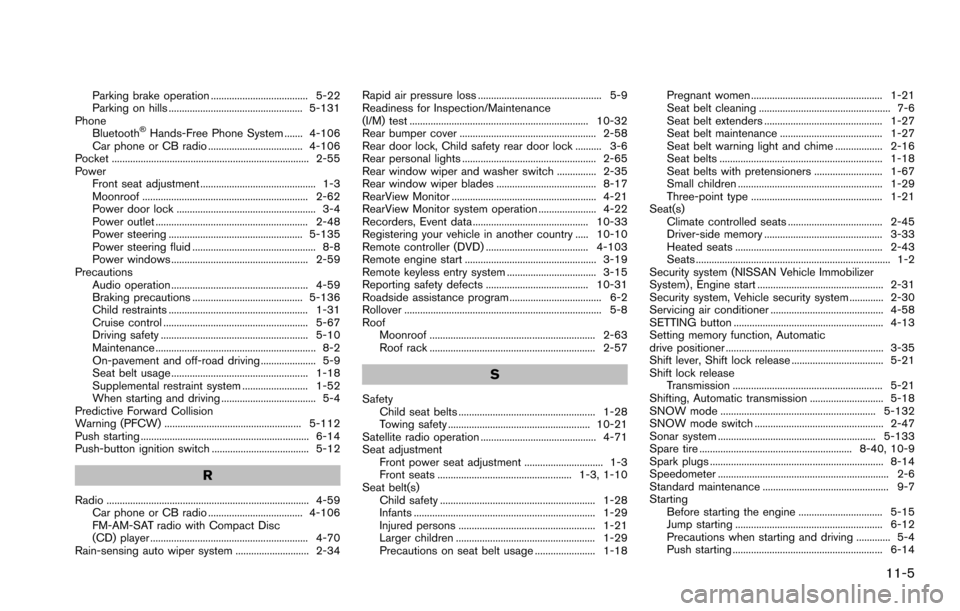
Parking brake operation ..................................... 5-22
Parking on hills ................................................... 5-131
Phone Bluetooth
ŠHands-Free Phone System ....... 4-106
Car phone or CB radio .................................... 4-106
Pocket ........................................................................... 2-55
Power Front seat adjustment ............................................ 1-3
Moonroof ............................................................... 2-62
Power door lock ..................................................... 3-4
Power outlet .......................................................... 2-48
Power steering ................................................... 5-135
Power steering fluid ............................................... 8-8
Power windows .................................................... 2-59
Precautions Audio operation .................................................... 4-59
Braking precautions .......................................... 5-136
Child restraints ..................................................... 1-31
Cruise control ....................................................... 5-67
Driving safety ........................................................ 5-10
Maintenance ............................................................. 8-2
On-pavement and off-road driving ..................... 5-9
Seat belt usage .................................................... 1-18
Supplemental restraint system ......................... 1-52
When starting and driving .................................... 5-4
Predictive Forward Collision
Warning (PFCW) .................................................... 5-112
Push starting ................................................................ 6-14
Push-button ignition switch ..................................... 5-12
R
Radio ............................................................................. 4-59 Car phone or CB radio .................................... 4-106
FM-AM-SAT radio with Compact Disc
(CD) player ............................................................ 4-70
Rain-sensing auto wiper system ............................ 2-34 Rapid air pressure loss ............................................... 5-9
Readiness for Inspection/Maintenance
(I/M) test .................................................................... 10-32
Rear bumper cover .................................................... 2-58
Rear door lock, Child safety rear door lock .......... 3-6
Rear personal lights ................................................... 2-65
Rear window wiper and washer switch ............... 2-35
Rear window wiper blades ...................................... 8-17
RearView Monitor ....................................................... 4-21
RearView Monitor system operation ...................... 4-22
Recorders, Event data ............................................ 10-33
Registering your vehicle in another country ..... 10-10
Remote controller (DVD) ....................................... 4-103
Remote engine start .................................................. 3-19
Remote keyless entry system .................................. 3-15
Reporting safety defects ....................................... 10-31
Roadside assistance program ................................... 6-2
Rollover ........................................................................... 5-8
Roof
Moonroof ............................................................... 2-63
Roof rack ............................................................... 2-57
S
SafetyChild seat belts .................................................... 1-28
Towing safety ...................................................... 10-21
Satellite radio operation ............................................ 4-71
Seat adjustment Front power seat adjustment .............................. 1-3
Front seats ................................................... 1-3, 1-10
Seat belt(s) Child safety ........................................................... 1-28
Infants ..................................................................... 1-29
Injured persons .................................................... 1-21
Larger children ..................................................... 1-29
Precautions on seat belt usage ....................... 1-18 Pregnant women .................................................. 1-21
Seat belt cleaning .................................................. 7-6
Seat belt extenders ............................................. 1-27
Seat belt maintenance ....................................... 1-27
Seat belt warning light and chime .................. 2-16
Seat belts .............................................................. 1-18
Seat belts with pretensioners .......................... 1-67
Small children ....................................................... 1-29
Three-point type .................................................. 1-21
Seat(s) Climate controlled seats .................................... 2-45
Driver-side memory ............................................. 3-33
Heated seats ........................................................ 2-43
Seats .......................................................................... 1-2
Security system (NISSAN Vehicle Immobilizer
System) , Engine start ................................................ 2-31
Security system, Vehicle security system ............. 2-30
Servicing air conditioner ........................................... 4-58
SETTING button ......................................................... 4-13
Setting memory function, Automatic
drive positioner ............................................................ 3-35
Shift lever, Shift lock release ................................... 5-21
Shift lock release Transmission ......................................................... 5-21
Shifting, Automatic transmission ............................ 5-18
SNOW mode ........................................................... 5-132
SNOW mode switch ................................................. 2-47
Sonar system ............................................................ 5-133
Spare tire .......................................................... 8-40, 10-9
Spark plugs .................................................................. 8-14
Speedometer ................................................................. 2-6
Standard maintenance ................................................ 9-7
Starting Before starting the engine ................................ 5-15
Jump starting ........................................................ 6-12
Precautions when starting and driving ............. 5-4
Push starting ......................................................... 6-14
11-5