trailer NISSAN ARMADA 2017 2.G Owner's Manual
[x] Cancel search | Manufacturer: NISSAN, Model Year: 2017, Model line: ARMADA, Model: NISSAN ARMADA 2017 2.GPages: 614, PDF Size: 2.87 MB
Page 572 of 614
10 Technical and consumer information
Capacities and recommended fluids/lubricants ............. 10-2Fuel information ................................................................ 10-4
Engine oil and oil filter recommendation .................... 10-6
Air conditioning system refrigerant and
lubricant recommendations ............................................ 10-7
Specifications ........................................................................\
.. 10-8
Engine ........................................................................\
......... 10-8
Wheels and tires .............................................................. 10-9
Dimensions ........................................................................\
10-9
When traveling or registering in another country ....... 10-10
Vehicle identification ........................................................... 10-10 Vehicle Identification Number (VIN) plate ............... 10-10
Vehicle identification number (chassis number) .... 10-10
Engine serial number .................................................... 10-11
F.M.V.S.S./C.M.V.S.S. certification label ................. 10-11
Emission control information label ............................ 10-11
Tire and loading information label ............................. 10-12
Air conditioner specification label ............................. 10-12
Installing front license plate .............................................. 10-12
Vehicle loading information ............................................... 10-13
Terms ........................................................................\
........ 10-13 Vehicle load capacity ................................................. 10-14
Securing the load ....................................................... 10-15
Loading tips .................................................................. 10-16
Measurement of weights ........................................... 10-16
Towing a trailer .................................................................... 10-17 Maximum load limits ................................................... 10-17
Maximum Gross Vehicle Weight (GVW)/maximum
Gross Axle Weight (GAW) ...................................... 10-19
Towing load/specification ......................................... 10-20
Towing safety .............................................................. 10-21
Flat towing .................................................................... 10-29
Uniform tire quality grading .............................................. 10-29 Treadwear ..................................................................... 10-29
Traction AA, A, B and C ........................................... 10-29
Temperature A, B and C ........................................... 10-30
Emission control system warranty .................................. 10-30
Reporting safety defects .................................................. 10-31
Readiness for Inspection/Maintenance (I/M) test ...... 10-32
Event Data Recorders (EDR) .......................................... 10-33
Owner’s Manual/Service Manual
order information ................................................................ 10-33
Page 584 of 614
WARNING
.It is extremely dangerous to
ride in a cargo area inside the
vehicle. In a collision, people
riding in these areas are more
likely to be seriously injured or
killed.
.Do not allow people to ride in
any area of vehicle that is not
equipped with seats and seat
belts.
.Be sure everyone in your ve-
hicle is in a seat and using a
seat belt properly.
TERMS
It is important to familiarize yourself with
the following terms before loading your
vehicle:
. Curb Weight (actual weight of your
vehicle) - vehicle weight including:
standard and optional equipment,
fluids, emergency tools, and spare tire assembly. This weight
does not
include passengers and cargo.
. GVW (Gross Vehicle Weight) - curb
weight plus the combined weight of
passengers and cargo.
. GVWR (Gross Vehicle Weight Rat-
ing) - maximum total combined
weight of the unloaded vehicle, pas-
sengers, luggage, hitch, trailer tongue
load and any other optional equip-
ment. This information is located on
the F.M.V.S.S./C.M.V.S.S. label.
. GAWR (Gross Axle Weight Rating) -
maximum weight (load) limit specified
for the front or rear axle. This informa-
tion is located on the F.M.V.S.S./C.M.
V.S.S. label.
. GCWR (Gross Combined Weight
Rating) - The maximum total weight
rating of the vehicle, passengers,
cargo, and trailer.
. Vehicle Capacity Weight, Load limit,
Total load capacity - maximum total
weight limit specified of the load
(passengers and cargo) for the vehi- cle. This is the maximum combined
weight of occupants and cargo that
can be loaded into the vehicle. If the
vehicle is used to tow a trailer, the
trailer tongue weight must be in-
cluded as part of the cargo load. This
information is located on the Tire and
Loading Information label.
. Cargo capacity - permissible weight
of cargo, the weight of total occu-
pants weight subtracted from the
load limit.
Technical and consumer information10-13
VEHICLE LOADING INFORMATION
Page 586 of 614
4. The resulting figure equals the avail-able amount of cargo and luggage
load capacity. For example, if the XXX
amount equals 1400 lbs. and there
will be five 150 lb. passengers in your
vehicle, the amount of available cargo
and luggage load capacity is 650 lbs.
(1400 í750 (5 x 150) = 650 lbs) or
(640 í340 (5 x 70) = 300 kg.)
5. Determine the combined weight of luggage and cargo being loaded on
the vehicle. That weight may not
safely exceed the available cargo
and luggage load capacity calculated
in Step 4.
6. If your vehicle will be towing a trailer, load from your trailer will be trans-
ferred to your vehicle. Consult this
manual to determine how this re-
duces the available cargo and lug-
gage load capacity of your vehicle.
Before driving a loaded vehicle, confirm
that you do not exceed the Gross Vehicle
Weight Rating (GVWR) or the Gross
Axle Weight Rating (GAWR) for your vehicle. (See “Measurement of weights”
(P.10-16) .)
Also check tires for proper inflation
pressures. See the Tire and Loading
Information label.
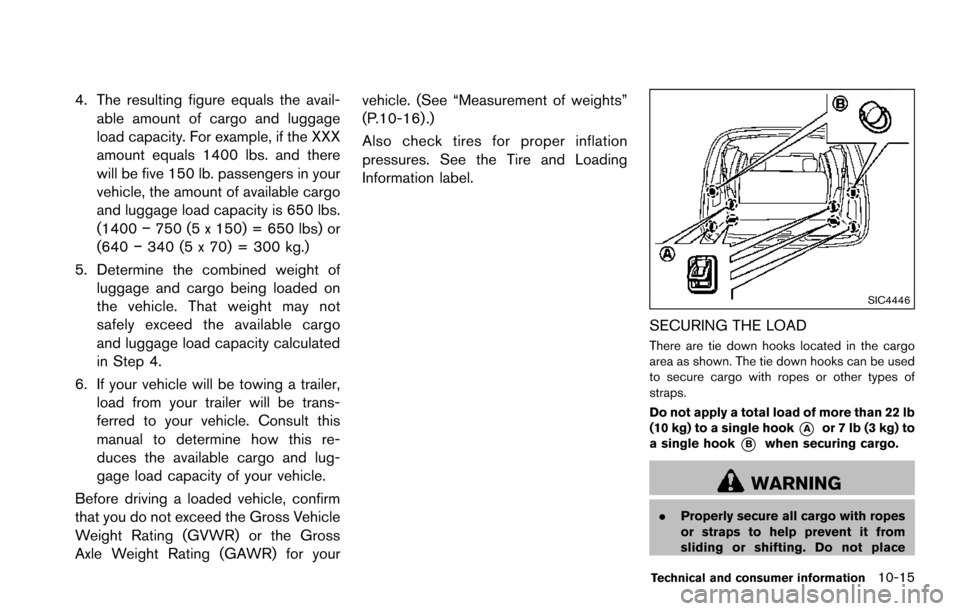
SIC4446
SECURING THE LOAD
There are tie down hooks located in the cargo
area as shown. The tie down hooks can be used
to secure cargo with ropes or other types of
straps.
Do not apply a total load of more than 22 lb
(10 kg) to a single hook
*Aor 7 lb (3 kg) to
a single hook
*Bwhen securing cargo.
WARNING
. Properly secure all cargo with ropes
or straps to help prevent it from
sliding or shifting. Do not place
Technical and consumer information10-15
Page 588 of 614
WARNING
Overloading or improper loading of a
trailer and its cargo can adversely affect
vehicle handling, braking and perfor-
mance and may lead to accidents.
CAUTION
.Do not tow a trailer or haul a heavy
load for the first 500 miles (800 km) .
Your engine, axle or other parts
could be damaged.
. For the first 500 miles (800 km) that
you tow a trailer, do not drive over
50 MPH (80 km/h) and do not make
starts at full throttle. This helps the
engine and other parts of your
vehicle wear in at the heavier loads.
Your new vehicle was designed to be used
primarily to carry passengers and cargo. Re-
member that towing a trailer places additional
loads on your vehicle’s engine, drivetrain, steer-
ing, braking and other systems.
A NISSAN Towing Guide (U.S. only) is available
on the website at www.nissanusa.com. This guide includes infor-
mation on trailer towing capability and the
special equipment required for proper towing.
MAXIMUM LOAD LIMITS
Maximum trailer loads
Never allow the total trailer load to exceed the
value specified in the “Towing load/specifica-
tion” (P.10-20) . The total trailer load equals
trailer weight plus its cargo weight.
.
When towing a trailer load of 3,500 lbs
(1,587 kg) or more, trailers with a brake
system MUST be used.
The maximum Gross Combined Weight Rating
(GCWR) should not exceed the value specified
in the following “Towing Load/Specification”
chart.
STI0541
The GCWR equals the combined weight of the
towing vehicle (including passengers and cargo)
plus the total trailer load. Towing loads greater
than these or using improper towing equipment
could adversely affect vehicle handling, braking
and performance.
The ability of your vehicle to tow a trailer is not
only related to the maximum trailer loads, but
also the places you plan to tow. Tow weights
appropriate for level highway driving may have to
be reduced on very steep grades or for low
traction situations (for example, on slippery boat
ramps) .
Temperature conditions can also affect towing.
For example, towing a heavy trailer in high
Technical and consumer information10-17
TOWING A TRAILER
Page 589 of 614
10-18Technical and consumer information
outside temperatures on graded roads can
affect engine performance and cause overheat-
ing. The transmission high fluid temperature and
engine protection mode, which helps reduce the
chance of transmission and engine damage,
could activate and automatically decrease en-
gine power. Vehicle speed may decrease under
high load. Plan your trip carefully to account for
trailer and vehicle load, weather and road
conditions.
WARNING
Overheating can result in reduced en-
gine power and vehicle speed. The
reduced speed may be lower than other
traffic, which could increase the chance
of a collision. Be especially careful
when driving. If the vehicle cannot
maintain a safe driving speed, pull to
the side of the road in a safe area.
Allow the engine to cool and return to
normal operation. See“If your vehicle
overheats” (P.6-14) .
CAUTION
Vehicle damage resulting from impro-
per towing procedures is not covered by
NISSAN warranties.
STI0542
Tongue load
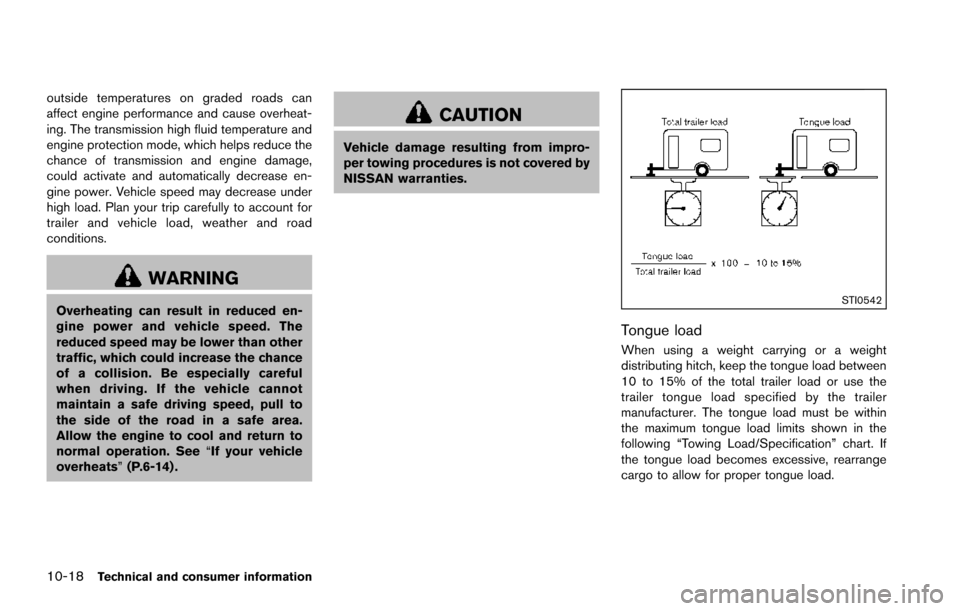
When using a weight carrying or a weight
distributing hitch, keep the tongue load between
10 to 15% of the total trailer load or use the
trailer tongue load specified by the trailer
manufacturer. The tongue load must be within
the maximum tongue load limits shown in the
following “Towing Load/Specification” chart. If
the tongue load becomes excessive, rearrange
cargo to allow for proper tongue load.
Page 590 of 614
TI1012M
MAXIMUM GROSS VEHICLE WEIGHT
(GVW)/MAXIMUM GROSS AXLE
WEIGHT (GAW)
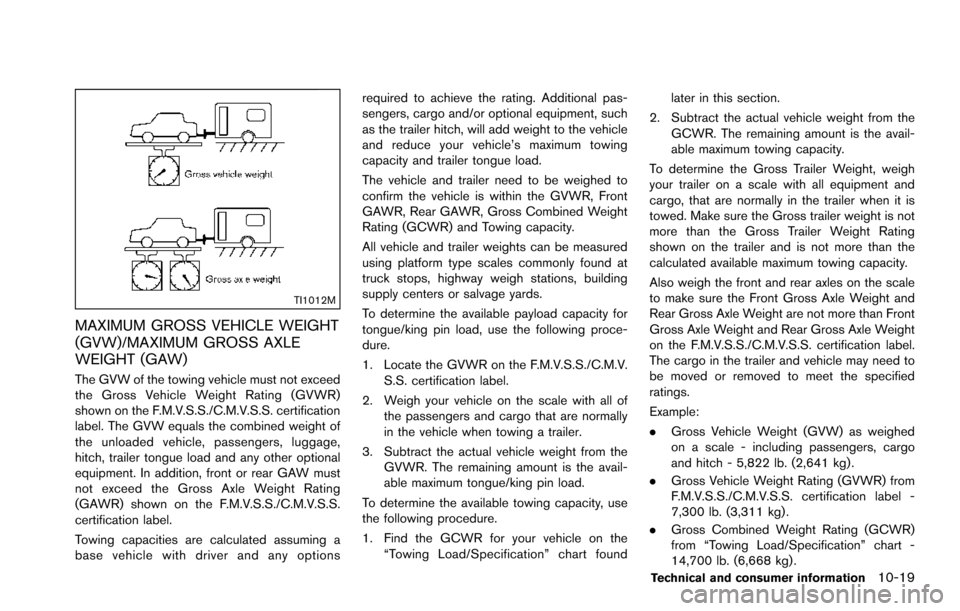
The GVW of the towing vehicle must not exceed
the Gross Vehicle Weight Rating (GVWR)
shown on the F.M.V.S.S./C.M.V.S.S. certification
label. The GVW equals the combined weight of
the unloaded vehicle, passengers, luggage,
hitch, trailer tongue load and any other optional
equipment. In addition, front or rear GAW must
not exceed the Gross Axle Weight Rating
(GAWR) shown on the F.M.V.S.S./C.M.V.S.S.
certification label.
Towing capacities are calculated assuming a
base vehicle with driver and any optionsrequired to achieve the rating. Additional pas-
sengers, cargo and/or optional equipment, such
as the trailer hitch, will add weight to the vehicle
and reduce your vehicle’s maximum towing
capacity and trailer tongue load.
The vehicle and trailer need to be weighed to
confirm the vehicle is within the GVWR, Front
GAWR, Rear GAWR, Gross Combined Weight
Rating (GCWR) and Towing capacity.
All vehicle and trailer weights can be measured
using platform type scales commonly found at
truck stops, highway weigh stations, building
supply centers or salvage yards.
To determine the available payload capacity for
tongue/king pin load, use the following proce-
dure.
1. Locate the GVWR on the F.M.V.S.S./C.M.V.
S.S. certification label.
2. Weigh your vehicle on the scale with all of the passengers and cargo that are normally
in the vehicle when towing a trailer.
3. Subtract the actual vehicle weight from the GVWR. The remaining amount is the avail-
able maximum tongue/king pin load.
To determine the available towing capacity, use
the following procedure.
1. Find the GCWR for your vehicle on the “Towing Load/Specification” chart found later in this section.
2. Subtract the actual vehicle weight from the GCWR. The remaining amount is the avail-
able maximum towing capacity.
To determine the Gross Trailer Weight, weigh
your trailer on a scale with all equipment and
cargo, that are normally in the trailer when it is
towed. Make sure the Gross trailer weight is not
more than the Gross Trailer Weight Rating
shown on the trailer and is not more than the
calculated available maximum towing capacity.
Also weigh the front and rear axles on the scale
to make sure the Front Gross Axle Weight and
Rear Gross Axle Weight are not more than Front
Gross Axle Weight and Rear Gross Axle Weight
on the F.M.V.S.S./C.M.V.S.S. certification label.
The cargo in the trailer and vehicle may need to
be moved or removed to meet the specified
ratings.
Example:
. Gross Vehicle Weight (GVW) as weighed
on a scale - including passengers, cargo
and hitch - 5,822 lb. (2,641 kg) .
. Gross Vehicle Weight Rating (GVWR) from
F.M.V.S.S./C.M.V.S.S. certification label -
7,300 lb. (3,311 kg) .
. Gross Combined Weight Rating (GCWR)
from “Towing Load/Specification” chart -
14,700 lb. (6,668 kg) .
Technical and consumer information10-19
Page 591 of 614
10-20Technical and consumer information
.Maximum Trailer towing capacity from “Tow-
ing Load/Specification” chart - 8,500 lb.
(3,856 kg) .
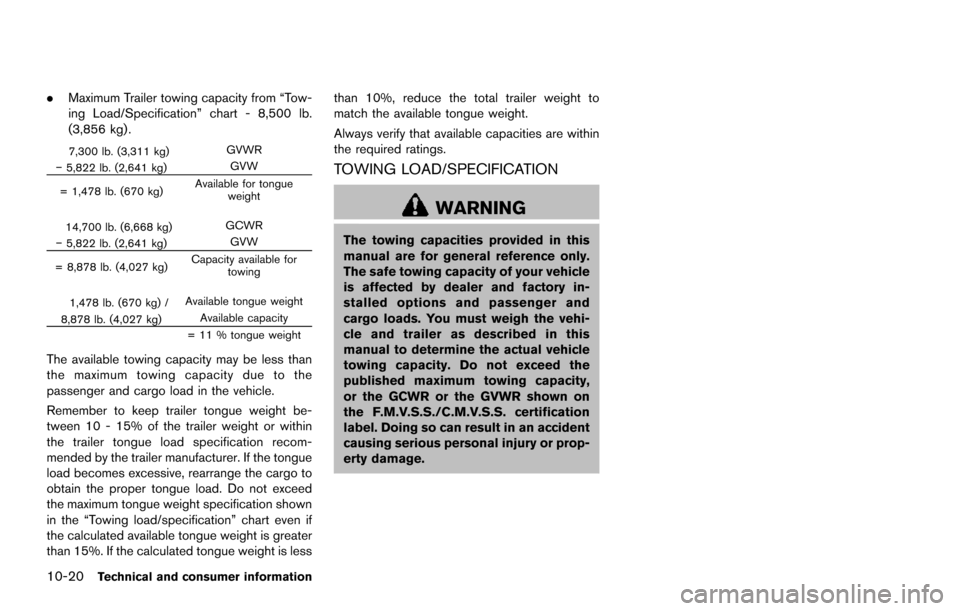
7,300 lb. (3,311 kg) GVWR
í 5,822 lb. (2,641 kg) GVW
= 1,478 lb. (670 kg) Available for tongue
weight
14,700 lb. (6,668 kg) GCWR
í 5,822 lb. (2,641 kg) GVW
= 8,878 lb. (4,027 kg) Capacity available for
towing
1,478 lb. (670 kg) / Available tongue weight
8,878 lb. (4,027 kg) Available capacity
= 11 % tongue weight
The available towing capacity may be less than
the maximum towing capacity due to the
passenger and cargo load in the vehicle.
Remember to keep trailer tongue weight be-
tween 10 - 15% of the trailer weight or within
the trailer tongue load specification recom-
mended by the trailer manufacturer. If the tongue
load becomes excessive, rearrange the cargo to
obtain the proper tongue load. Do not exceed
the maximum tongue weight specification shown
in the “Towing load/specification” chart even if
the calculated available tongue weight is greater
than 15%. If the calculated tongue weight is less than 10%, reduce the total trailer weight to
match the available tongue weight.
Always verify that available capacities are within
the required ratings.
TOWING LOAD/SPECIFICATION
WARNING
The towing capacities provided in this
manual are for general reference only.
The safe towing capacity of your vehicle
is affected by dealer and factory in-
stalled options and passenger and
cargo loads. You must weigh the vehi-
cle and trailer as described in this
manual to determine the actual vehicle
towing capacity. Do not exceed the
published maximum towing capacity,
or the GCWR or the GVWR shown on
the F.M.V.S.S./C.M.V.S.S. certification
label. Doing so can result in an accident
causing serious personal injury or prop-
erty damage.
Page 592 of 614
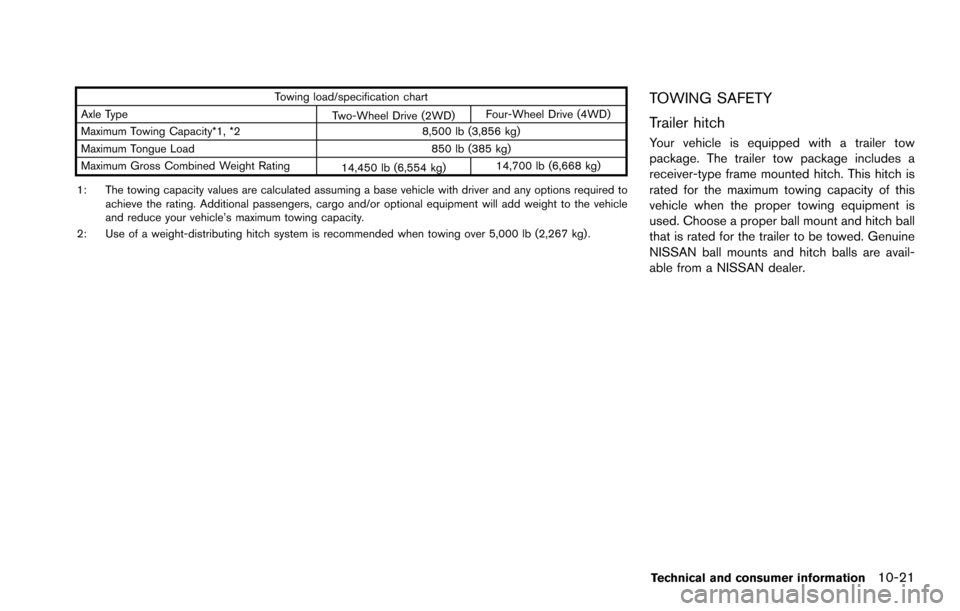
Towing load/specification chart
Axle Type Two-Wheel Drive (2WD)Four-Wheel Drive (4WD)
Maximum Towing Capacity*1, *2 8,500 lb (3,856 kg)
Maximum Tongue Load 850 lb (385 kg)
Maximum Gross Combined Weight Rating 14,450 lb (6,554 kg)14,700 lb (6,668 kg)
1: The towing capacity values are calculated assuming a base vehicle with driver and any options required to achieve the rating. Additional passengers, cargo and/or optional equipment will add weight to the vehicle
and reduce your vehicle’s maximum towing capacity.
2: Use of a weight-distributing hitch system is recommended when towing over 5,000 lb (2,267 kg) .TOWING SAFETY
Trailer hitch
Your vehicle is equipped with a trailer tow
package. The trailer tow package includes a
receiver-type frame mounted hitch. This hitch is
rated for the maximum towing capacity of this
vehicle when the proper towing equipment is
used. Choose a proper ball mount and hitch ball
that is rated for the trailer to be towed. Genuine
NISSAN ball mounts and hitch balls are avail-
able from a NISSAN dealer.
Technical and consumer information10-21
Page 593 of 614
10-22Technical and consumer information
JVT0457X
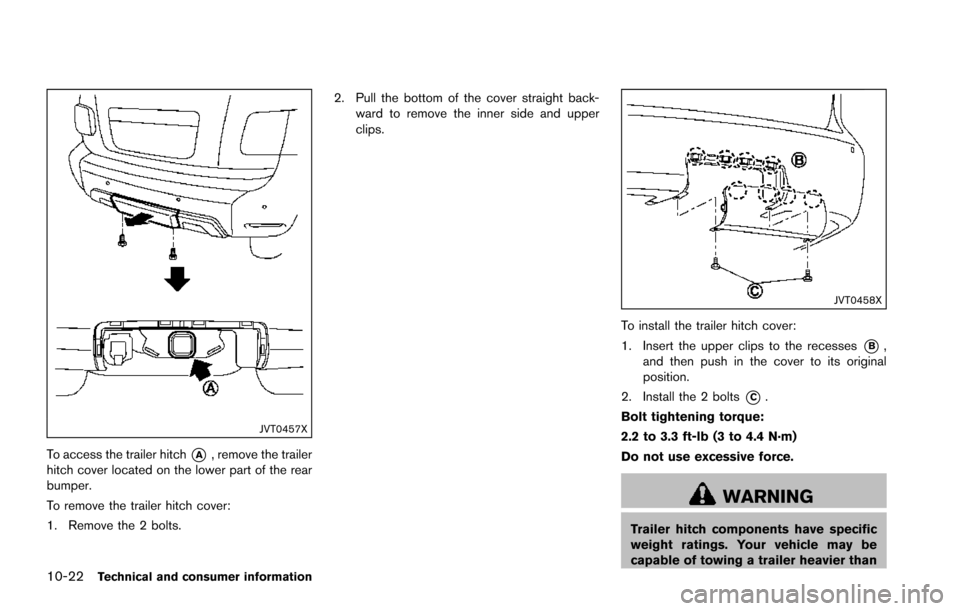
To access the trailer hitch*A, remove the trailer
hitch cover located on the lower part of the rear
bumper.
To remove the trailer hitch cover:
1. Remove the 2 bolts. 2. Pull the bottom of the cover straight back-
ward to remove the inner side and upper
clips.
JVT0458X
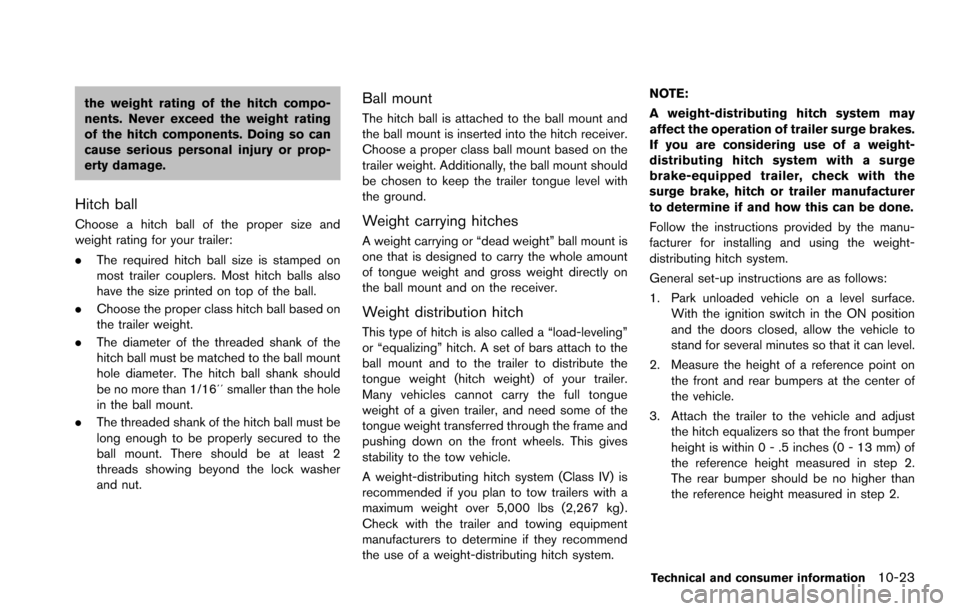
To install the trailer hitch cover:
1. Insert the upper clips to the recesses
*B,
and then push in the cover to its original
position.
2. Install the 2 bolts
*C.
Bolt tightening torque:
2.2 to 3.3 ft-lb (3 to 4.4 N·m)
Do not use excessive force.
WARNING
Trailer hitch components have specific
weight ratings. Your vehicle may be
capable of towing a trailer heavier than
Page 594 of 614
the weight rating of the hitch compo-
nents. Never exceed the weight rating
of the hitch components. Doing so can
cause serious personal injury or prop-
erty damage.
Hitch ball
Choose a hitch ball of the proper size and
weight rating for your trailer:
.The required hitch ball size is stamped on
most trailer couplers. Most hitch balls also
have the size printed on top of the ball.
. Choose the proper class hitch ball based on
the trailer weight.
. The diameter of the threaded shank of the
hitch ball must be matched to the ball mount
hole diameter. The hitch ball shank should
be no more than 1/16´´ smaller than the hole
in the ball mount.
. The threaded shank of the hitch ball must be
long enough to be properly secured to the
ball mount. There should be at least 2
threads showing beyond the lock washer
and nut.
Ball mount
The hitch ball is attached to the ball mount and
the ball mount is inserted into the hitch receiver.
Choose a proper class ball mount based on the
trailer weight. Additionally, the ball mount should
be chosen to keep the trailer tongue level with
the ground.
Weight carrying hitches
A weight carrying or “dead weight” ball mount is
one that is designed to carry the whole amount
of tongue weight and gross weight directly on
the ball mount and on the receiver.
Weight distribution hitch
This type of hitch is also called a “load-leveling”
or “equalizing” hitch. A set of bars attach to the
ball mount and to the trailer to distribute the
tongue weight (hitch weight) of your trailer.
Many vehicles cannot carry the full tongue
weight of a given trailer, and need some of the
tongue weight transferred through the frame and
pushing down on the front wheels. This gives
stability to the tow vehicle.
A weight-distributing hitch system (Class IV) is
recommended if you plan to tow trailers with a
maximum weight over 5,000 lbs (2,267 kg) .
Check with the trailer and towing equipment
manufacturers to determine if they recommend
the use of a weight-distributing hitch system. NOTE:
A weight-distributing hitch system may
affect the operation of trailer surge brakes.
If you are considering use of a weight-
distributing hitch system with a surge
brake-equipped trailer, check with the
surge brake, hitch or trailer manufacturer
to determine if and how this can be done.
Follow the instructions provided by the manu-
facturer for installing and using the weight-
distributing hitch system.
General set-up instructions are as follows:
1. Park unloaded vehicle on a level surface.
With the ignition switch in the ON position
and the doors closed, allow the vehicle to
stand for several minutes so that it can level.
2. Measure the height of a reference point on the front and rear bumpers at the center of
the vehicle.
3. Attach the trailer to the vehicle and adjust the hitch equalizers so that the front bumper
height is within 0 - .5 inches (0 - 13 mm) of
the reference height measured in step 2.
The rear bumper should be no higher than
the reference height measured in step 2.
Technical and consumer information10-23