ECU NISSAN ARMADA 2017 2.G Repair Manual
[x] Cancel search | Manufacturer: NISSAN, Model Year: 2017, Model line: ARMADA, Model: NISSAN ARMADA 2017 2.GPages: 614, PDF Size: 2.87 MB
Page 486 of 614
To shut off the engine in an emergency situation
while driving, perform the following procedure:
.Rapidly push the push-button ignition switch
3 consecutive times in less than 1.5
seconds, or
. Push and hold the push-button ignition
switch for more than 2 seconds.TIRE PRESSURE MONITORING SYS-
TEM (TPMS)
This vehicle is equipped with the Tire Pressure
Monitoring System (TPMS) . It monitors tire
pressure of all tires except the spare. When
the low tire pressure warning light is lit and the
CHECK TIRE PRESSURE warning appears in
the vehicle information display, one or more of
your tires is significantly under-inflated. If the
vehicle is being driven with low tire pressure, the
TPMS will activate and warn you of it by the low
tire pressure warning light. This system will
activate only when the vehicle is driven at
speeds above 16 MPH (25 km/h) . For more
details, see “Warning lights, indicator lights and
audible reminders” (P.2-10) , “TIRE PRESSURE
information” (P.4-10) and “Tire Pressure Mon-
itoring System (TPMS)” (P.5-5) .
WARNING
.If the low tire pressure warning light
illuminates or LOW PRESSURE in-
formation is displayed on the moni-
tor screen while driving, avoid
sudden steering maneuvers or
abrupt braking, reduce vehicle
speed, pull off the road to a safe
location and stop the vehicle as soon as possible. Driving with un-
der-inflated tires may permanently
damage the tires and increase the
likelihood of tire failure. Serious
vehicle damage could occur and
may lead to an accident and could
result in serious personal injury.
Check the tire pressure for all four
tires. Adjust the tire pressure to the
recommended COLD tire pressure
shown on the Tire and Loading
Information label to turn the low
tire pressure warning light OFF. If
the light still illuminates while driv-
ing after adjusting the tire pressure,
a tire may be flat. If you have a flat
tire, replace it with a spare tire as
soon as possible.
. Since the spare tire is not equipped
with the TPMS, when a spare tire is
mounted or a wheel is replaced, the
TPMS will not function and the low
tire pressure warning light will flash
for approximately 1 minute. The
light will remain on after 1 minute.
Have your tires replaced and/or
TPMS system reset as soon as
possible. It is recommended you
visit a NISSAN dealer for these
services.
In case of emergency6-3
EMERGENCY ENGINE SHUT OFF FLAT TIRE
Page 487 of 614
6-4In case of emergency
.Replacing tires with those not ori-
ginally specified by NISSAN could
affect the proper operation of the
TPMS.
. Do not inject any tire liquid or
aerosol tire sealant into the tires,
as this may cause a malfunction of
the tire pressure sensors.
CHANGING A FLAT TIRE
If you have a flat tire, follow the instructions
below.
Stopping the vehicle
1. Safely move the vehicle off the road and
away from traffic.
2. Turn on the hazard warning flashers.
3. Park on a level surface and apply the parking brake. Move the shift lever to the P (Park)
position.
4. Turn off the engine.
5. Raise the hood to warn other traffic, and to signal professional road assistance person-
nel that you need assistance.
6. Have all passengers get out of the vehicle and stand in a safe place, away from traffic
and clear of the vehicle.
WARNING
.Make sure the parking brake is
securely applied and the automatic
transmission is in the P (Park)
position.
. Never change tires when the vehicle
is on a slope, ice or slippery areas.
This is hazardous.
. Never change tires if oncoming
traffic is close to your vehicle. Wait
for professional road assistance.
MCE0001A
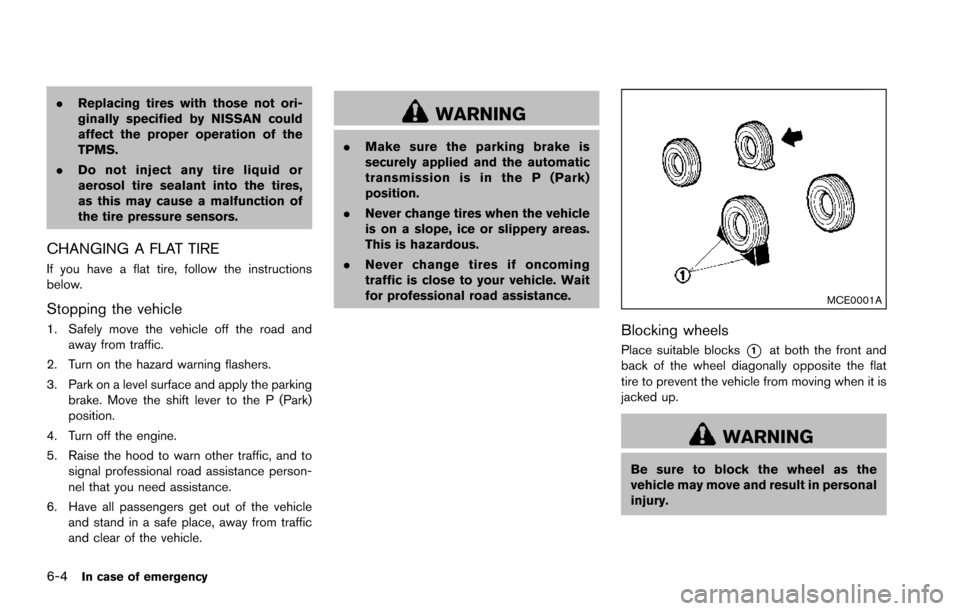
Blocking wheels
Place suitable blocks*1at both the front and
back of the wheel diagonally opposite the flat
tire to prevent the vehicle from moving when it is
jacked up.
WARNING
Be sure to block the wheel as the
vehicle may move and result in personal
injury.
Page 489 of 614
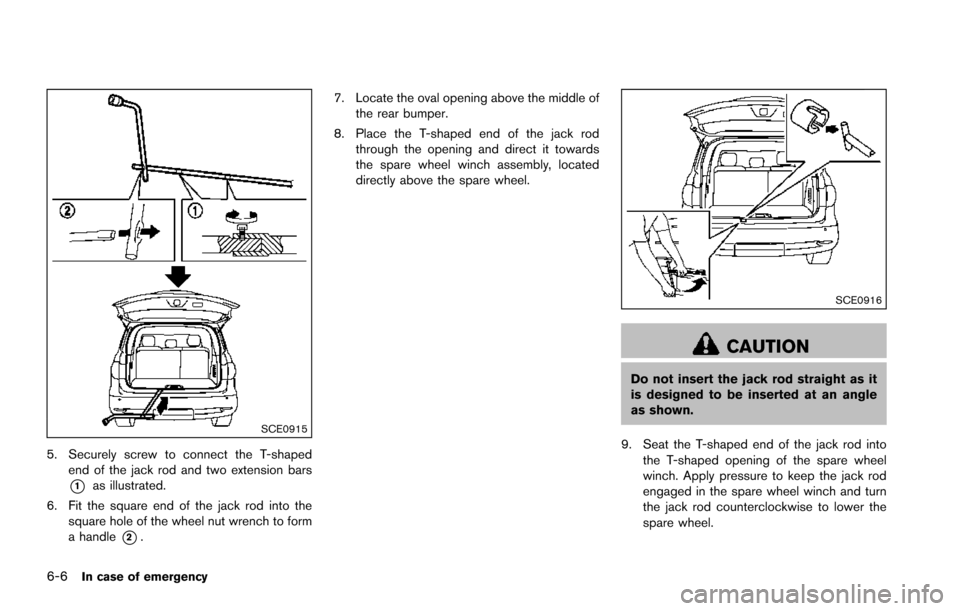
6-6In case of emergency
SCE0915
5. Securely screw to connect the T-shapedend of the jack rod and two extension bars
*1as illustrated.
6. Fit the square end of the jack rod into the square hole of the wheel nut wrench to form
a handle
*2. 7. Locate the oval opening above the middle of
the rear bumper.
8. Place the T-shaped end of the jack rod through the opening and direct it towards
the spare wheel winch assembly, located
directly above the spare wheel.
SCE0916
CAUTION
Do not insert the jack rod straight as it
is designed to be inserted at an angle
as shown.
9. Seat the T-shaped end of the jack rod into the T-shaped opening of the spare wheel
winch. Apply pressure to keep the jack rod
engaged in the spare wheel winch and turn
the jack rod counterclockwise to lower the
spare wheel.
Page 490 of 614
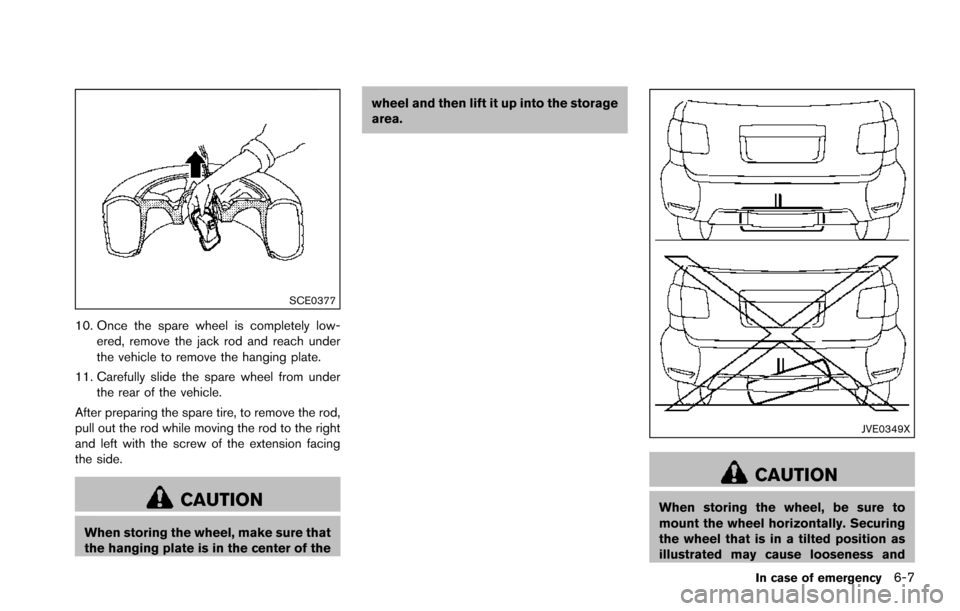
SCE0377
10. Once the spare wheel is completely low-ered, remove the jack rod and reach under
the vehicle to remove the hanging plate.
11. Carefully slide the spare wheel from under the rear of the vehicle.
After preparing the spare tire, to remove the rod,
pull out the rod while moving the rod to the right
and left with the screw of the extension facing
the side.
CAUTION
When storing the wheel, make sure that
the hanging plate is in the center of the wheel and then lift it up into the storage
area.
JVE0349X
CAUTION
When storing the wheel, be sure to
mount the wheel horizontally. Securing
the wheel that is in a tilted position as
illustrated may cause looseness and
In case of emergency6-7
Page 492 of 614
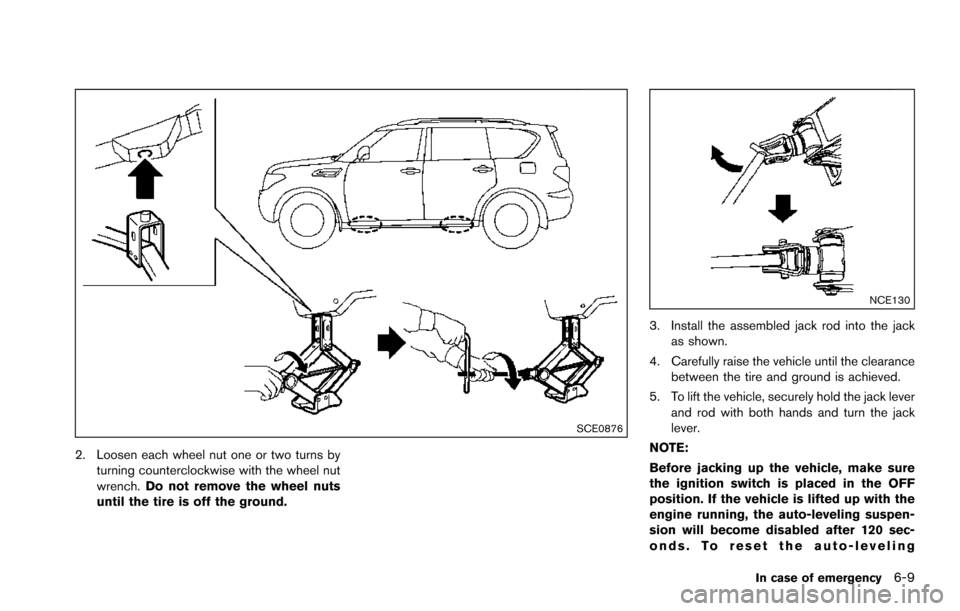
SCE0876
2. Loosen each wheel nut one or two turns byturning counterclockwise with the wheel nut
wrench. Do not remove the wheel nuts
until the tire is off the ground.
NCE130
3. Install the assembled jack rod into the jack
as shown.
4. Carefully raise the vehicle until the clearance between the tire and ground is achieved.
5. To lift the vehicle, securely hold the jack lever and rod with both hands and turn the jack
lever.
NOTE:
Before jacking up the vehicle, make sure
the ignition switch is placed in the OFF
position. If the vehicle is lifted up with the
engine running, the auto-leveling suspen-
sion will become disabled after 120 sec-
onds. To reset the auto-leveling
In case of emergency6-9
Page 493 of 614
6-10In case of emergency
suspension, cycle the ignition switch ON/
OFF one time.
SCE0910
Installing the spare tire
1. Clean any mud or dirt from the surfacebetween the wheel and hub.
2. Carefully put the spare tire on and tighten the wheel nuts finger tight.
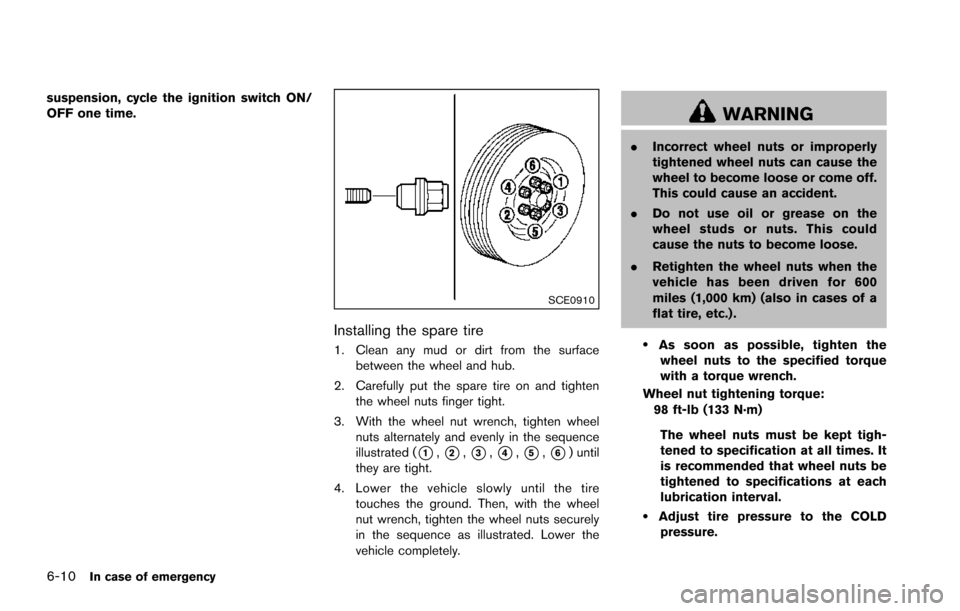
3. With the wheel nut wrench, tighten wheel nuts alternately and evenly in the sequence
illustrated (
*1,*2,*3,*4,*5,*6) until
they are tight.
4. Lower the vehicle slowly until the tire touches the ground. Then, with the wheel
nut wrench, tighten the wheel nuts securely
in the sequence as illustrated. Lower the
vehicle completely.
WARNING
.Incorrect wheel nuts or improperly
tightened wheel nuts can cause the
wheel to become loose or come off.
This could cause an accident.
. Do not use oil or grease on the
wheel studs or nuts. This could
cause the nuts to become loose.
. Retighten the wheel nuts when the
vehicle has been driven for 600
miles (1,000 km) (also in cases of a
flat tire, etc.) .
.As soon as possible, tighten the
wheel nuts to the specified torque
with a torque wrench.
Wheel nut tightening torque: 98 ft-lb (133 N·m)
The wheel nuts must be kept tigh-
tened to specification at all times. It
is recommended that wheel nuts be
tightened to specifications at each
lubrication interval.
.Adjust tire pressure to the COLDpressure.
Page 494 of 614
COLD pressure:
After the vehicle has been parked
for three hours or more or driven
less than 1 mile (1.6 km) .
COLD tire pressures are shown on
the Tire and Loading Information
label affixed to the driver side center
pillar.
After adjusting tire pressure to the COLD tire
pressure, the display of the tire pressure
information may show higher pressure than the
COLD tire pressure after the vehicle has been
driven more than 1 mile (1.6 km). This is
because the tire pressurizes as the tire tem-
perature rises. This does not indicate a system
malfunction.
Stowing the damaged tire and tools
1. Securely store the damaged tire, jack and tools in the storage area.
2. Close the cargo floor cover.
3. Replace the cargo floor board.
4. Close the liftgate.
WARNING
Always make sure that the spare tire
and jacking equipment are properly
secured after use. Such items can
become dangerous projectiles in an
accident or sudden stop.
In case of emergency6-11
Page 500 of 614
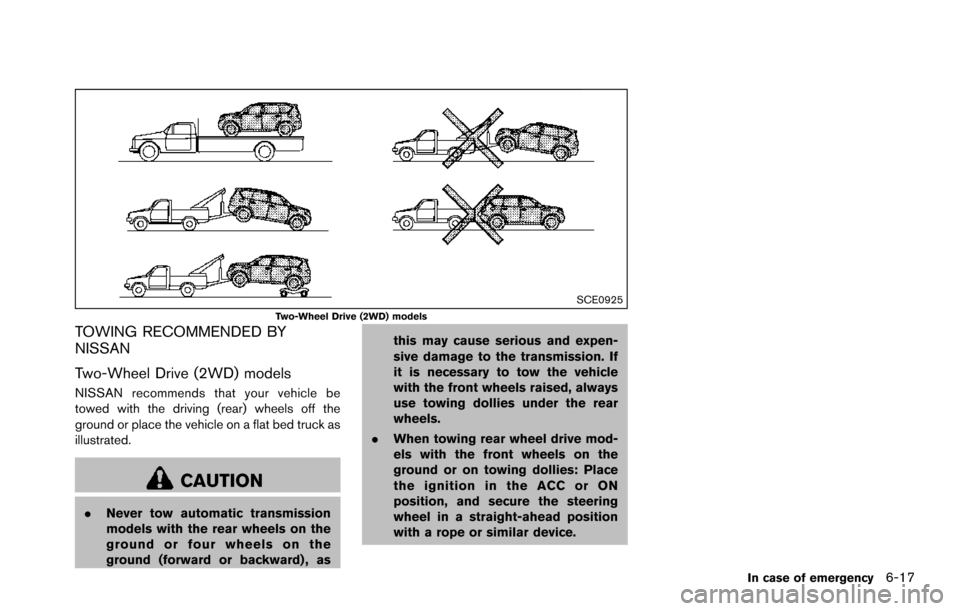
SCE0925Two-Wheel Drive (2WD) models
TOWING RECOMMENDED BY
NISSAN
Two-Wheel Drive (2WD) models
NISSAN recommends that your vehicle be
towed with the driving (rear) wheels off the
ground or place the vehicle on a flat bed truck as
illustrated.
CAUTION
.Never tow automatic transmission
models with the rear wheels on the
ground or four wheels on the
ground (forward or backward) , as this may cause serious and expen-
sive damage to the transmission. If
it is necessary to tow the vehicle
with the front wheels raised, always
use towing dollies under the rear
wheels.
. When towing rear wheel drive mod-
els with the front wheels on the
ground or on towing dollies: Place
the ignition in the ACC or ON
position, and secure the steering
wheel in a straight-ahead position
with a rope or similar device.
In case of emergency6-17
Page 505 of 614
6-22In case of emergency
ference with other parts.
SCE0961
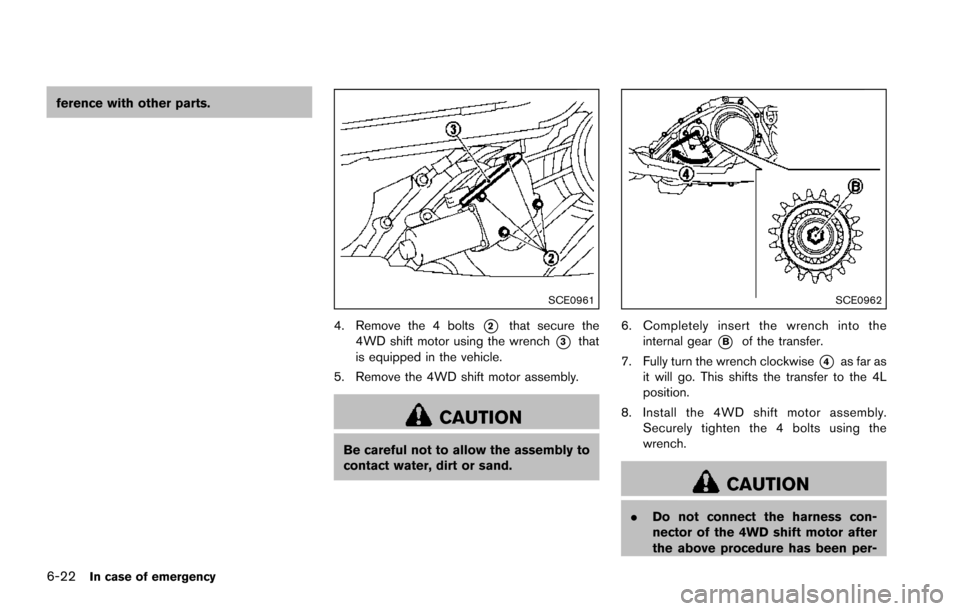
4. Remove the 4 bolts*2that secure the
4WD shift motor using the wrench
*3that
is equipped in the vehicle.
5. Remove the 4WD shift motor assembly.
CAUTION
Be careful not to allow the assembly to
contact water, dirt or sand.
SCE0962
6. Completely insert the wrench into the internal gear
*Bof the transfer.
7. Fully turn the wrench clockwise
*4as far as
it will go. This shifts the transfer to the 4L
position.
8. Install the 4WD shift motor assembly. Securely tighten the 4 bolts using the
wrench.
CAUTION
.Do not connect the harness con-
nector of the 4WD shift motor after
the above procedure has been per-
Page 513 of 614
7-6Appearance and care
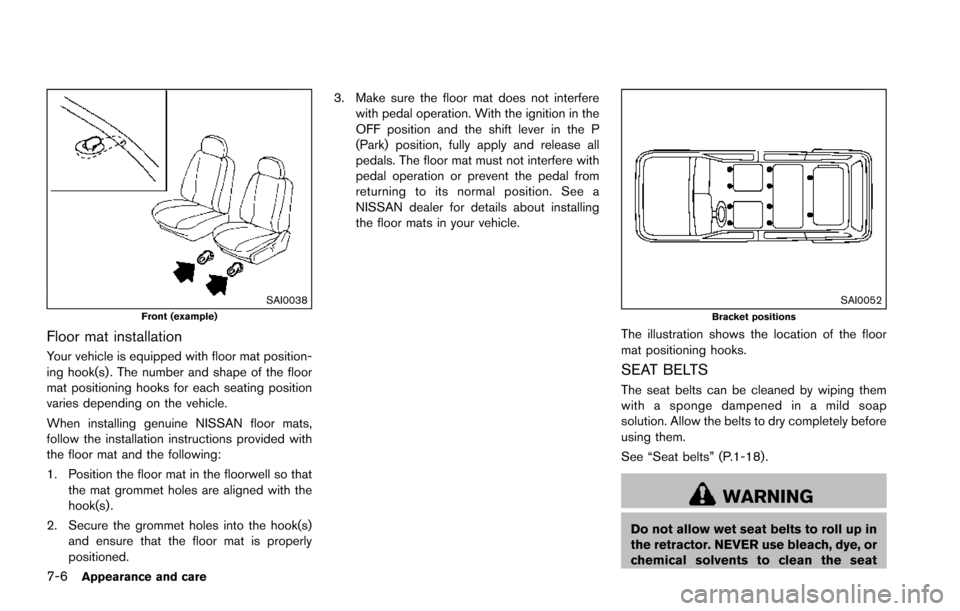
SAI0038Front (example)
Floor mat installation
Your vehicle is equipped with floor mat position-
ing hook(s) . The number and shape of the floor
mat positioning hooks for each seating position
varies depending on the vehicle.
When installing genuine NISSAN floor mats,
follow the installation instructions provided with
the floor mat and the following:
1. Position the floor mat in the floorwell so thatthe mat grommet holes are aligned with the
hook(s) .
2. Secure the grommet holes into the hook(s) and ensure that the floor mat is properly
positioned. 3. Make sure the floor mat does not interfere
with pedal operation. With the ignition in the
OFF position and the shift lever in the P
(Park) position, fully apply and release all
pedals. The floor mat must not interfere with
pedal operation or prevent the pedal from
returning to its normal position. See a
NISSAN dealer for details about installing
the floor mats in your vehicle.
SAI0052Bracket positions
The illustration shows the location of the floor
mat positioning hooks.
SEAT BELTS
The seat belts can be cleaned by wiping them
with a sponge dampened in a mild soap
solution. Allow the belts to dry completely before
using them.
See “Seat belts” (P.1-18).
WARNING
Do not allow wet seat belts to roll up in
the retractor. NEVER use bleach, dye, or
chemical solvents to clean the seat