roof NISSAN ARMADA 2017 2.G Owners Manual
[x] Cancel search | Manufacturer: NISSAN, Model Year: 2017, Model line: ARMADA, Model: NISSAN ARMADA 2017 2.GPages: 614, PDF Size: 2.87 MB
Page 9 of 614
0-2Illustrated table of contents
SSI0728
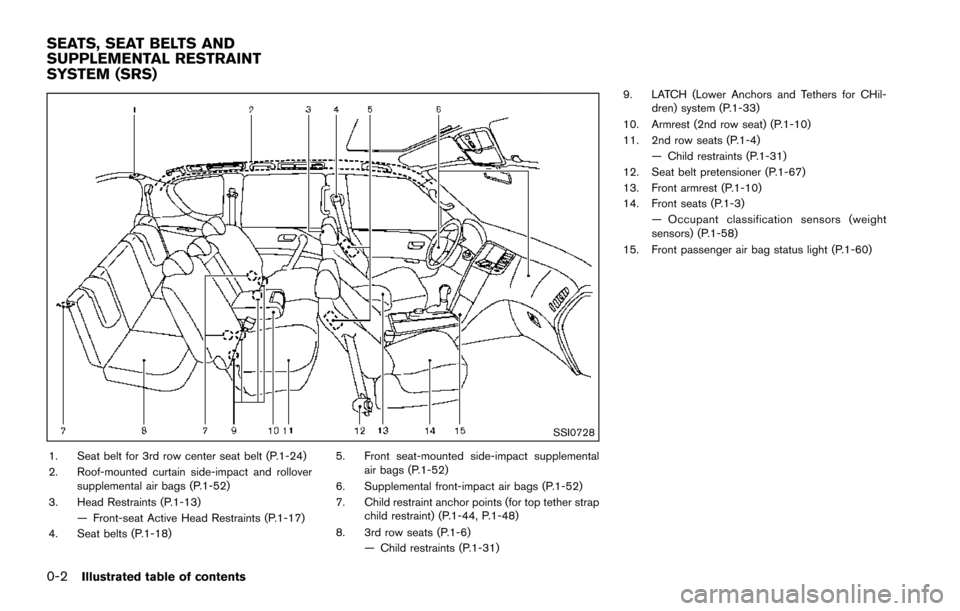
1. Seat belt for 3rd row center seat belt (P.1-24)
2. Roof-mounted curtain side-impact and rolloversupplemental air bags (P.1-52)
3. Head Restraints (P.1-13) — Front-seat Active Head Restraints (P.1-17)
4. Seat belts (P.1-18) 5. Front seat-mounted side-impact supplemental
air bags (P.1-52)
6. Supplemental front-impact air bags (P.1-52)
7. Child restraint anchor points (for top tether strap child restraint) (P.1-44, P.1-48)
8. 3rd row seats (P.1-6) — Child restraints (P.1-31) 9. LATCH (Lower Anchors and Tethers for CHil-
dren) system (P.1-33)
10. Armrest (2nd row seat) (P.1-10)
11. 2nd row seats (P.1-4) — Child restraints (P.1-31)
12. Seat belt pretensioner (P.1-67)
13. Front armrest (P.1-10)
14. Front seats (P.1-3) — Occupant classification sensors (weight
sensors) (P.1-58)
15. Front passenger air bag status light (P.1-60)
SEATS, SEAT BELTS AND
SUPPLEMENTAL RESTRAINT
SYSTEM (SRS)
Page 10 of 614
JVC0953X
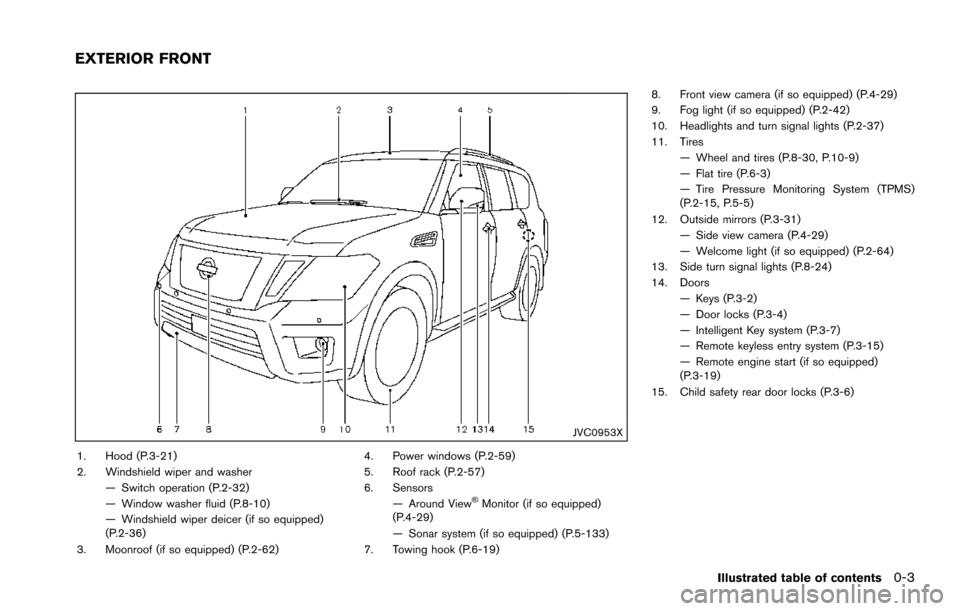
1. Hood (P.3-21)
2. Windshield wiper and washer— Switch operation (P.2-32)
— Window washer fluid (P.8-10)
— Windshield wiper deicer (if so equipped)
(P.2-36)
3. Moonroof (if so equipped) (P.2-62) 4. Power windows (P.2-59)
5. Roof rack (P.2-57)
6. Sensors
— Around View
ŠMonitor (if so equipped)
(P.4-29)
— Sonar system (if so equipped) (P.5-133)
7. Towing hook (P.6-19) 8. Front view camera (if so equipped) (P.4-29)
9. Fog light (if so equipped) (P.2-42)
10. Headlights and turn signal lights (P.2-37)
11. Tires
— Wheel and tires (P.8-30, P.10-9)
— Flat tire (P.6-3)
— Tire Pressure Monitoring System (TPMS)
(P.2-15, P.5-5)
12. Outside mirrors (P.3-31) — Side view camera (P.4-29)
— Welcome light (if so equipped) (P.2-64)
13. Side turn signal lights (P.8-24)
14. Doors
— Keys (P.3-2)
— Door locks (P.3-4)
— Intelligent Key system (P.3-7)
— Remote keyless entry system (P.3-15)
— Remote engine start (if so equipped)
(P.3-19)
15. Child safety rear door locks (P.3-6)
Illustrated table of contents0-3
EXTERIOR FRONT
Page 12 of 614
JVC0955X
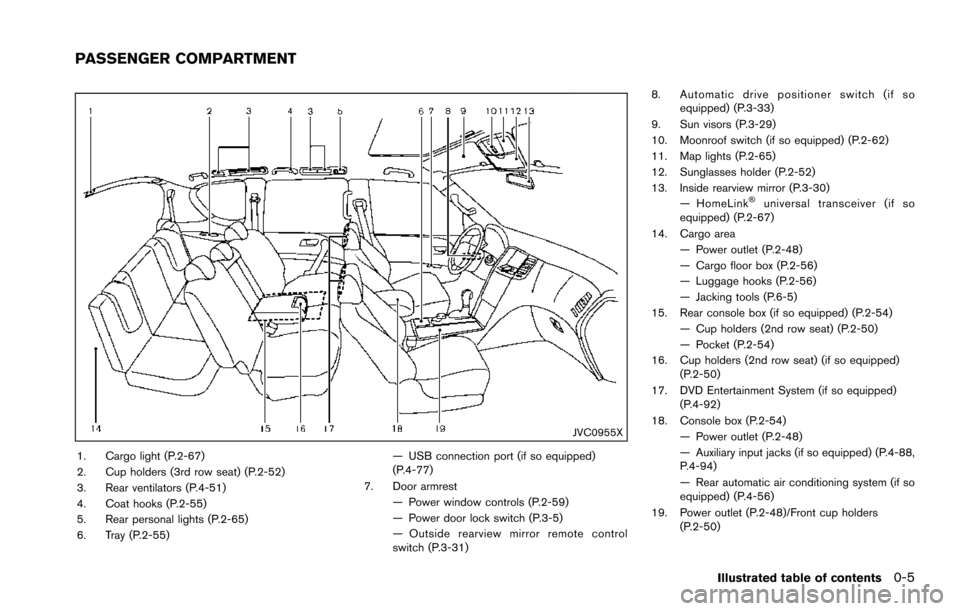
1. Cargo light (P.2-67)
2. Cup holders (3rd row seat) (P.2-52)
3. Rear ventilators (P.4-51)
4. Coat hooks (P.2-55)
5. Rear personal lights (P.2-65)
6. Tray (P.2-55)— USB connection port (if so equipped)
(P.4-77)
7. Door armrest — Power window controls (P.2-59)
— Power door lock switch (P.3-5)
— Outside rearview mirror remote control
switch (P.3-31) 8. Automatic drive positioner switch (if so
equipped) (P.3-33)
9. Sun visors (P.3-29)
10. Moonroof switch (if so equipped) (P.2-62)
11. Map lights (P.2-65)
12. Sunglasses holder (P.2-52)
13. Inside rearview mirror (P.3-30) — HomeLink
Šuniversal transceiver (if so
equipped) (P.2-67)
14. Cargo area — Power outlet (P.2-48)
— Cargo floor box (P.2-56)
— Luggage hooks (P.2-56)
— Jacking tools (P.6-5)
15. Rear console box (if so equipped) (P.2-54) — Cup holders (2nd row seat) (P.2-50)
— Pocket (P.2-54)
16. Cup holders (2nd row seat) (if so equipped) (P.2-50)
17. DVD Entertainment System (if so equipped) (P.4-92)
18. Console box (P.2-54) — Power outlet (P.2-48)
— Auxiliary input jacks (if so equipped) (P.4-88,
P.4-94)
— Rear automatic air conditioning system (if so
equipped) (P.4-56)
19. Power outlet (P.2-48)/Front cup holders (P.2-50)
Illustrated table of contents0-5
PASSENGER COMPARTMENT
Page 20 of 614

1 Safety — seats, seat belts and supplementalrestraint system
Seats ........................................................................\
.................... 1-2
Front seats ........................................................................\
.... 1-3
2nd row seats ...................................................................... 1-4
3rd row seats ....................................................................... 1-6
Armrest ........................................................................\
........ 1-10
Flexible seating ................................................................. 1-11
Head restraints/headrests .................................................... 1-13 Adjustable head restraint/headrest components ..... 1-14
Non-adjustable head
restraint/headrest components ..................................... 1-15
Remove ........................................................................\
....... 1-15
Install ........................................................................\
........... 1-16
Adjust ........................................................................\
.......... 1-16
Front-seat Active Head Restraint ................................. 1-17
Seat belts ........................................................................\
......... 1-18 Precautions on seat belt usage .................................... 1-18
Pregnant women .............................................................. 1-21
Injured persons ................................................................. 1-21
Three-point type seat belt .............................................. 1-21
Seat belt extenders .......................................................... 1-27
Seat belt maintenance .................................................... 1-27
Child safety ........................................................................\
...... 1-28 Infants ........................................................................\
.......... 1-29
Small children .................................................................... 1-29
Larger children .................................................................. 1-29 Child restraints ....................................................................... 1-31
Precautions on child restraints ................................... 1-31
Lower Anchors and Tethers for CHildren
System (LATCH) ............................................................ 1-33
Top tether strap child restraint ................................... 1-36
Rear-facing child restraint installation
using LATCH ................................................................... 1-36
Rear-facing child restraint installation using the
seat belts ........................................................................\
.. 1-38
Forward-facing child restraint installation
using LATCH ................................................................... 1-41
Forward-facing child restraint installation using the
seat belts ........................................................................\
.. 1-44
Booster seats .................................................................. 1-48
Supplemental restraint system ........................................... 1-52 Precautions on supplemental restraint system ....... 1-52
NISSAN Advanced Air Bag System
(front seats) ..................................................................... 1-58
Front seat-mounted side-impact supplemental
air bag and roof-mounted curtain side-impact and
rollover supplemental air bag systems ..................... 1-65
Seat belts with pretensioners (front seats) ............. 1-67
Supplemental air bag warning labels ....................... 1-68
Supplemental air bag warning light .......................... 1-68
Repair and replacement procedure .......................... 1-69
Page 71 of 614
1-52Safety — seats, seat belts and supplemental restraint system
PRECAUTIONS ON SUPPLEMENTAL
RESTRAINT SYSTEM
This Supplemental Restraint System (SRS)
section contains important information concern-
ing the following systems.
.Driver and passenger supplemental front-
impact air bag (NISSAN Advanced Air Bag
System)
. Front seat-mounted side-impact supple-
mental air bag
. Roof-mounted curtain side-impact and roll-
over supplemental air bag
. Seat belt with pretensioner
Supplemental front-impact air bag system:
The NISSAN Advanced Air Bag System can
help cushion the impact force to the head and
chest of the driver and front passenger in certain
frontal collisions.
Front seat-mounted side-impact supple-
mental air bag system: This system can help
cushion the impact force to the chest and pelvis
area of the driver and front passenger in certain
side impact collisions. The supplemental side air
bag is designed to inflate on the side where the
vehicle is impacted.
Roof-mounted curtain side-impact and
rollover supplemental air bag system: This
system can help cushion the impact force to the head of occupants in front and rear (2nd and
3rd) outboard seating positions in certain side
impact or rollover collisions. In a side impact, the
curtain air bags are designed to inflate on the
side where the vehicle is impacted. In a rollover,
the curtain air bags on both sides are designed
to inflate. Under both side-impact and rollover
situations, the curtain air bags will remain
inflated for a short period of time.
These supplemental restraint systems are de-
signed to
supplement the crash protection
provided by the driver and passenger seat belts
and are not a substitute for them. Seat belts
should always be correctly worn and the
occupant seated a suitable distance away from
the steering wheel, instrument panel and door
finishers. (See “Seat belts” (P.1-18) for instruc-
tions and precautions on seat belt usage.)
The supplemental air bags operate only
when the ignition switch is in the ON
position.
After placing the ignition switch in the ON
position, the supplemental air bag warning
light illuminates. The supplemental air bag
warning light will turn off after about 7
seconds if the systems are operational.
SUPPLEMENTAL RESTRAINT
SYSTEM
Page 75 of 614
1-56Safety — seats, seat belts and supplemental restraint system
SSS0832
SSS0833
SSS0140
SSS0162
SSS0159
WARNING
Front seat-mounted side-impact sup-
plemental air bags and roof-mounted
curtain side-impact and rollover supple-
mental air bags:
.The side air bags ordinarily will not
inflate in the event of a front impact,
rear impact, rollover, or lower se-
verity side collision. Always wear
your seat belts to help reduce the
risk or severity of injury in various
kinds of accidents.
Page 76 of 614
.The curtain air bags ordinarily will
not inflate in the event of a front
impact, rear impact, or lower sever-
ity side collision. Always wear your
seat belts to help reduce the risk or
severity of injury in various kinds of
accidents.
. The seat belts, the side air bags and
curtain air bags are most effective
when you are sitting well back and
upright in the seat. The side air bags
and curtain air bags inflate with
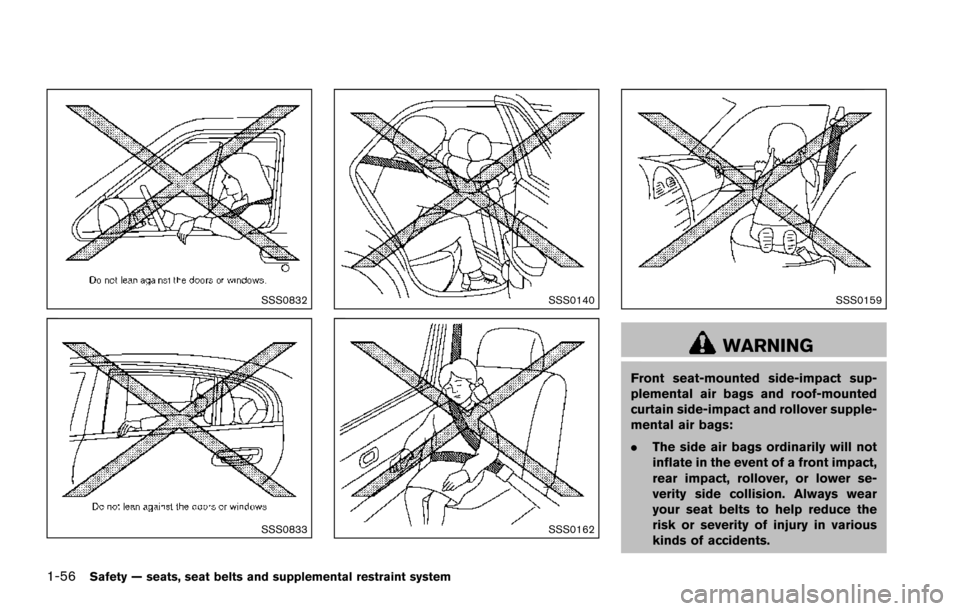
great force. Do not allow anyone to
place their hand, leg or face near the
side air bags on the side of the
seatback of the front seat or near
the side roof rails. Do not allow
anyone sitting in the front seats or
rear outboard seats to extend their
hand out of the window or lean
against the door. Some examples of
dangerous riding positions are
shown in the previous illustrations.
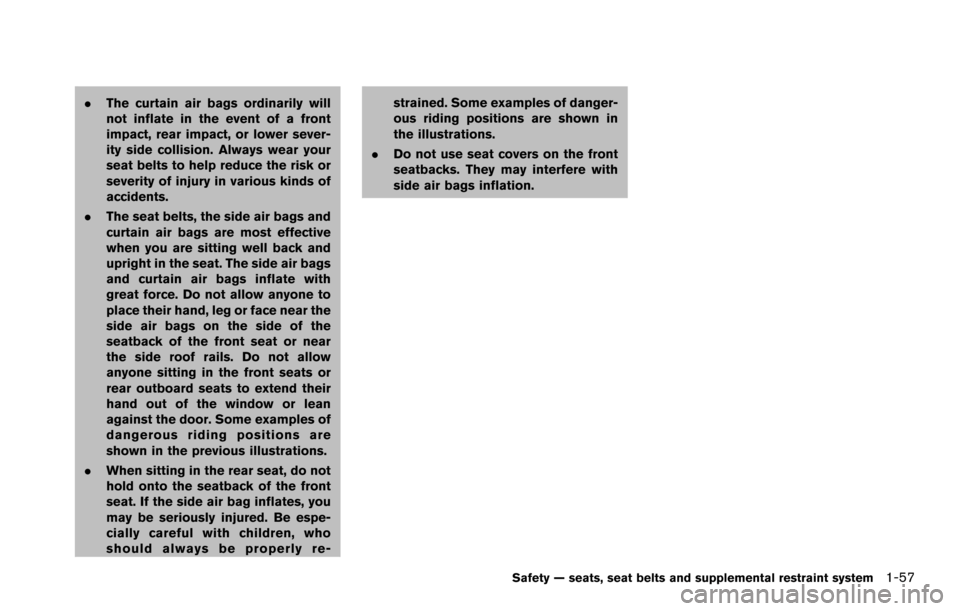
. When sitting in the rear seat, do not
hold onto the seatback of the front
seat. If the side air bag inflates, you
may be seriously injured. Be espe-
cially careful with children, who
should always be properly re- strained. Some examples of danger-
ous riding positions are shown in
the illustrations.
. Do not use seat covers on the front
seatbacks. They may interfere with
side air bags inflation.
Safety — seats, seat belts and supplemental restraint system1-57
Page 77 of 614
1-58Safety — seats, seat belts and supplemental restraint system
JVR0399X
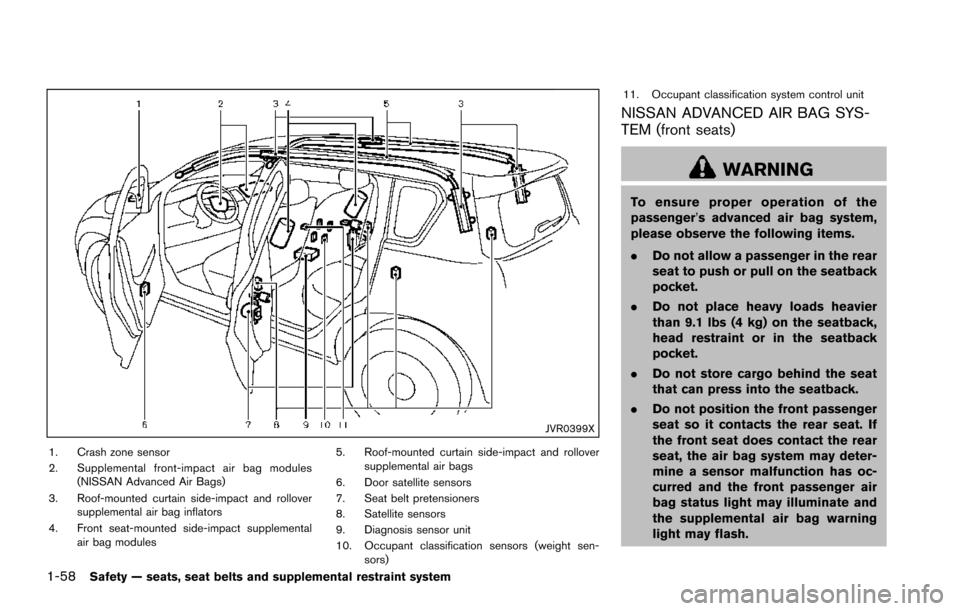
1. Crash zone sensor
2. Supplemental front-impact air bag modules(NISSAN Advanced Air Bags)
3. Roof-mounted curtain side-impact and rollover supplemental air bag inflators
4. Front seat-mounted side-impact supplemental air bag modules 5. Roof-mounted curtain side-impact and rollover
supplemental air bags
6. Door satellite sensors
7. Seat belt pretensioners
8. Satellite sensors
9. Diagnosis sensor unit
10. Occupant classification sensors (weight sen- sors) 11. Occupant classification system control unit
NISSAN ADVANCED AIR BAG SYS-
TEM (front seats)
WARNING
To ensure proper operation of the
passenger’s advanced air bag system,
please observe the following items.
.
Do not allow a passenger in the rear
seat to push or pull on the seatback
pocket.
. Do not place heavy loads heavier
than 9.1 lbs (4 kg) on the seatback,
head restraint or in the seatback
pocket.
. Do not store cargo behind the seat
that can press into the seatback.
. Do not position the front passenger
seat so it contacts the rear seat. If
the front seat does contact the rear
seat, the air bag system may deter-
mine a sensor malfunction has oc-
curred and the front passenger air
bag status light may illuminate and
the supplemental air bag warning
light may flash.
Page 84 of 614
.Removing or modifying the front
passenger seat may affect the func-
tion of the air bag system and result
in serious personal injury.
. Modifying or tampering with the
front passenger seat may result in
serious personal injury. For exam-
ple, do not change the front seats by
placing material on the seat cushion
or by installing additional trim ma-
terial, such as seat covers, on the
seat that is not specifically designed
to assure proper air bag operation.
Additionally, do not stow any ob-
jects under the front passenger seat
or the seat cushion and seatback.
Such objects may interfere with the
proper operation of the occupant
classification sensors.
. No unauthorized changes should be
made to any components or wiring
of the seat belt system. This may
affect the front air bag system.
Tampering with the seat belt system
may result in serious personal in-
jury.
. It is recommended you visit a
NISSAN dealer for work on and
around the front air bag. It is also recommended you visit a NISSAN
dealer for installation of electrical
equipment. The Supplemental Re-
straint System (SRS) wiring har-
nesses* should not be modified or
disconnected. Unauthorized electri-
cal test equipment and probing
devices should not be used on the
air bag system.
. A cracked windshield should be
replaced immediately by a qualified
repair facility. A cracked windshield
could affect the function of the
supplemental air bag system.
* The SRS wiring harness connectors are
yellow and orange for easy identification.
When selling your vehicle, we request that you
inform the buyer about the front air bag system
and guide the buyer to the appropriate sections
in this Owner’s Manual.
SSS1092
FRONT SEAT-MOUNTED SIDE-IM-
PACT SUPPLEMENTAL AIR BAG AND
ROOF-MOUNTED CURTAIN SIDE-IM-
PACT AND ROLLOVER SUPPLEMEN-
TAL AIR BAG SYSTEMS
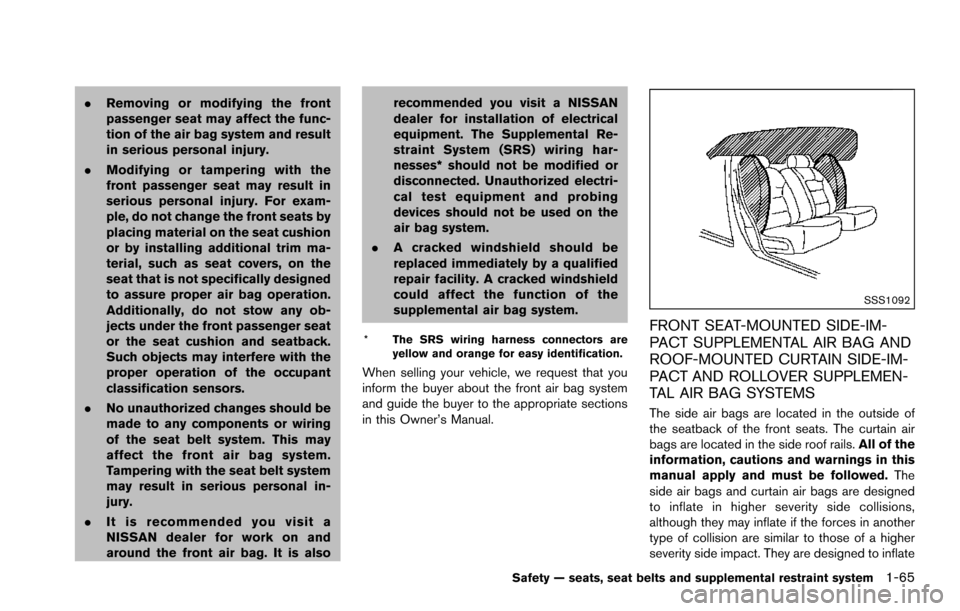
The side air bags are located in the outside of
the seatback of the front seats. The curtain air
bags are located in the side roof rails. All of the
information, cautions and warnings in this
manual apply and must be followed. The
side air bags and curtain air bags are designed
to inflate in higher severity side collisions,
although they may inflate if the forces in another
type of collision are similar to those of a higher
severity side impact. They are designed to inflate
Safety — seats, seat belts and supplemental restraint system1-65
Page 85 of 614
1-66Safety — seats, seat belts and supplemental restraint system
on the side where the vehicle is impacted. They
may not inflate in certain side collisions on the
side where the vehicle is impacted.
Curtain air bags are also designed to inflate in
certain types of rollover collisions or near
rollovers. As a result, certain vehicle movements
(for example, during severe off roading) may
cause the curtain air bags to inflate.
Vehicle damage (or lack of it) is not always an
indication of proper side air bag and curtain air
bag operation.
When side air bags and curtain air bags inflate, a
fairly loud noise may be heard, followed by
release of smoke. This smoke is not harmful and
does not indicate a fire. Care should be taken
not to inhale it, as it may cause irritation and
choking. Those with a history of a breathing
condition should get fresh air promptly.
Side air bags, along with the use of seat belts,
help to cushion the impact force on the chest
and pelvis of the front occupants. Curtain air
bags help to cushion the impact force to the
head of occupants in the front and rear (2nd and
3rd) outboard seating positions. They can help
save lives and reduce serious injuries. However,
an inflating side air bags and curtain air bags
may cause abrasions or other injuries. Side air
bags and curtain air bags do not provide
restraint to the lower body.The seat belts should be correctly worn and the
driver and passenger seated upright as far as
practical away from the side air bag. Rear seat
passengers should be seated as far away as
practical from the door finishers and side roof
rails. The side air bags and curtain air bags
inflate quickly in order to help protect the
occupants. Because of this, the force of the
side air bags and curtain air bags inflating can
increase the risk of injury if the occupant is too
close to, or is against, these air bag modules
during inflation. In a rollover, the curtain air bags
on both sides are designed to inflate. Under
both side-impact situations, the curtain air bags
will remain inflated for a short period of time.
The side air bags and curtain air bags
operate only when the ignition switch is in
the ON position.
After placing the ignition switch in the ON
position, the supplemental air bag warning
light illuminates. The air bag warning light
will turn off after about 7 seconds if the
systems are operational.
WARNING
.
Do not place any objects near the
seatback of the front seats. Also, do
not place any objects (an umbrella, bag, etc.) between the front door
finisher and the front seat. Such
objects may become dangerous
projectiles and cause injury if side
air bag inflates.
. Right after inflation, several side air
bags and curtain air bag system
components will be hot. Do not
touch them; you may severely burn
yourself.
. No unauthorized changes should be
made to any components or wiring
of side air bag and curtain air bags.
This is to prevent damage to or
accidental inflation of the side air
bag and curtain air bag systems.
. Do not make unauthorized changes
to your vehicle’s electrical system,
suspension system or side panel.
This could affect proper operation
of the side air bag and curtain air
bag systems.
. Tampering with the air bag system
may result in serious personal in-
jury. For example, do not change the
front seats by placing material near
the seatback or by installing addi-
tional trim material, such as seat
covers, around the side air bags.