power steering NISSAN ARMADA 2018 Owner´s Manual
[x] Cancel search | Manufacturer: NISSAN, Model Year: 2018, Model line: ARMADA, Model: NISSAN ARMADA 2018Pages: 532, PDF Size: 2.3 MB
Page 395 of 532
5-140Starting and driving
The Vehicle Dynamic Control (VDC) sys-
tem uses various sensors to monitor
driver inputs and vehicle motion. Under
certain driving conditions, the VDC sys-
tem helps to perform the following func-
tions.
.Controls brake pressure to reduce
wheel slip on one slipping drive wheel
so power is transferred to a non
slipping drive wheel on the same axle.
. Controls brake pressure and engine
output to reduce drive wheel slip
based on vehicle speed (traction con-
trol function).
. Controls brake pressure at individual
wheels and engine output to help the
driver maintain control of the vehicle
in the following conditions:
— understeer (vehicle tends to not
follow the steered path despite
increased steering input)
— oversteer (vehicle tends to spin due to certain road or driving condi-
tions).
The VDC system can help the driver to
maintain control of the vehicle, but it
cannot prevent loss of vehicle control in
all driving situations.
When the VDC system operates, the VDC
warning light
in the instrument panel
flashes so note the following: .
The road may be slippery or the
system may determine some action
is required to help keep the vehicle on
the steered path.
. You may feel a pulsation in the brake
pedal and hear a noise or vibration
from under the hood. This is normal
and indicates that the VDC system is
working properly.
. Adjust your speed and driving to the
road conditions.
If a malfunction occurs in the system, the
VDC warning light
illuminates in the
instrument panel. The VDC system auto-
matically turns off.
The VDC OFF switch is used to turn off the
VDC system. The VDC off indicator
illuminates to indicate the VDC system is
off. When the VDC switch is used to turn
off the system, the VDC system still
operates to prevent one drive wheel from
slipping by transferring power to a non
slipping drive wheel. The VDC warning
light
flashes if this occurs. All other
VDC functions are off, and the VDC
warning light
will not flash. The VDC
system is automatically reset to on when
the ignition switch is placed in the OFF
position then back to the ON position.
When the 4L position is selected with the
4WD shift switch, the VDC system is
disabled and the VDC off indicator light illuminates (for 4WD models).
See “Vehicle Dynamic Control (VDC) warn-
ing light” (P.2-17) and “Vehicle Dynamic
Control (VDC) off indicator light” (P.2-20).
The computer has a built-in diagnostic
feature that tests the system each time
you start the engine and move the vehicle
forward or in reverse at a slow speed.
When the self-test occurs, you may hear a
“clunk” noise and/or feel a pulsation in the
brake pedal. This is normal and is not an
indication of a malfunction.
WARNING
.
The VDC system is designed to
help improve driving stability but
does not prevent accidents due
to abrupt steering operation at
high speeds or by careless or
dangerous driving techniques.
Reduce vehicle speed and be
especially careful when driving
and cornering on slippery sur-
faces and always drive carefully.
. Do not modify the vehicle’s sus-
pension. If suspension parts such
as shock absorbers, struts,
springs, stabilizer bars, bushings
and wheels are not NISSAN re-
commended for your vehicle or
VEHICLE DYNAMIC CONTROL (VDC) SYSTEM
Page 415 of 532
6-16In case of emergency
When towing your vehicle, all State (Pro-
vincial in Canada) and local regulations
for towing must be followed. Incorrect
towing equipment could damage your
vehicle. Towing instructions are available
from a NISSAN dealer. Local service op-
erators are familiar with the applicable
laws and procedures for towing. To
assure proper towing and to prevent
accidental damage to your vehicle,
NISSAN recommends that you have a
service operator tow your vehicle. It is
advisable to have the service operator
carefully read the following precautions.
WARNING
.Never ride in a vehicle that is
being towed.
. Never get under your vehicle after
it has been lifted by a tow truck.
CAUTION
.When towing, make sure that the
transmission, axles, steering sys-
tem and powertrain are in work-
ing condition. If any of these
conditions apply, dollies or a
flatbed tow truck must be used. .
Always attach safety chains be-
fore towing.
For information about towing your vehi-
cle behind a recreational vehicle (RV), see
“Flat towing” (P.10-30).
TOWING YOUR VEHICLE
Page 432 of 532

8 Do-it-yourself
Maintenance precautions ...................................................... 8-2
Engine compartment check locations ........................ 8-3VK56VD engine ....................................................................... 8-3
Engine cooling system ............................................................. 8-4 Checking engine coolant level .................................... 8-5
Changing engine coolant ................................................ 8-5
Engine oil ........................................................................\
..................... 8-6 Checking engine oil level ................................................. 8-6
Changing engine oil and filter ..................................... 8-6
Automatic Transmission Fluid (ATF) ............................. 8-8
Power steering fluid ................................................................... 8-8
Brake fluid ........................................................................\
.................. 8-9
Window washer fluid .............................................................. 8-10
Battery ........................................................................\
........................ 8-11 Jump starting ........................................................................\
. 8-13
Variable voltage control system ................................... 8-13
Drive belts ........................................................................\
................ 8-13
Spark plugs ........................................................................\
............. 8-14 Replacing spark plugs ..................................................... 8-14
Air cleaner ........................................................................\
............... 8-15 Windshield wiper blades ..................................................... 8-16
Cleaning ........................................................................\
........... 8-16
Replacing ........................................................................\
........ 8-16
Rear window wiper blades ............................................... 8-17
Brakes ........................................................................\
........................ 8-17 Self-adjusting brakes ..................................................... 8-17
Brake pad wear warning ............................................ 8-17
Brake booster ...................................................................... 8-17
Fuses ........................................................................\
........................... 8-18 Engine compartment .................................................... 8-18
Passenger compartment ........................................... 8-20
Intelligent Key battery replacement .......................... 8-21
Lights ........................................................................\
.......................... 8-24
Headlights ........................................................................\
...... 8-24
Exterior and interior lights ........................................ 8-26
Wheels and tires ........................................................................\
8-30
Tire pressure ........................................................................\
8-30
Tire labeling ........................................................................\
.. 8-34
Types of tires ....................................................................... 8-36
Tire chains ........................................................................\
...... 8-37
Changing wheels and tires ...................................... 8-37
Page 434 of 532
could affect your warranty coverage.If in
doubt about any servicing, it is recom-
mended you have it done by a NISSAN
dealer.
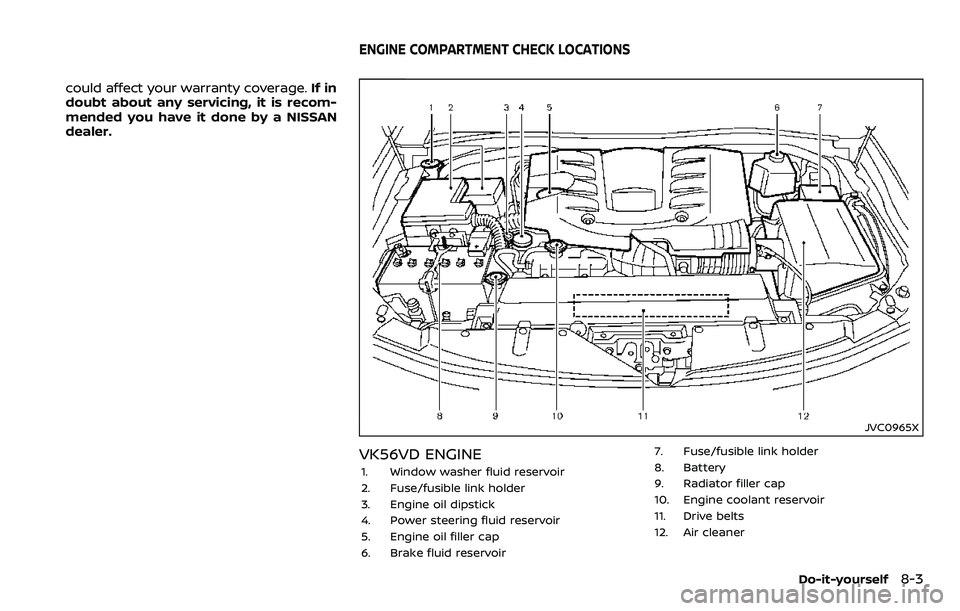
JVC0965X
VK56VD ENGINE
1. Window washer fluid reservoir
2. Fuse/fusible link holder
3. Engine oil dipstick
4. Power steering fluid reservoir
5. Engine oil filler cap
6. Brake fluid reservoir 7. Fuse/fusible link holder
8. Battery
9. Radiator filler cap
10. Engine coolant reservoir
11. Drive belts
12. Air cleaner
Do-it-yourself8-3
ENGINE COMPARTMENT CHECK LOCATIONS
Page 439 of 532
8-8Do-it-yourself
After the operation
1. Install the engine undercover intoposition using the bolts.
2. Lower the vehicle carefully to the ground.
3. Dispose of waste oil and filter properly.
WARNING
. Prolonged and repeated contact
with used engine oil may cause
skin cancer.
. Try to avoid direct skin contact
with used oil. If skin contact is
made, wash thoroughly with soap
or hand cleaner as soon as pos-
sible.
. Keep used engine oil out of reach
of children. When checking or replacement is re-
quired, we recommend a NISSAN dealer
for servicing.
CAUTION
.
It is recommended that you use
only Genuine NISSAN Matic S ATF.
Do not mix with other fluids.
. Using automatic transmission
fluid (ATF) other than Genuine
NISSAN Matic S ATF may cause
deterioration in driveability and
automatic transmission durabil-
ity, and may damage the auto-
matic transmission. Damage
caused by use of fluids other than
as recommended is not covered
by the NISSAN new vehicle limited
warranty.
SDI1765A
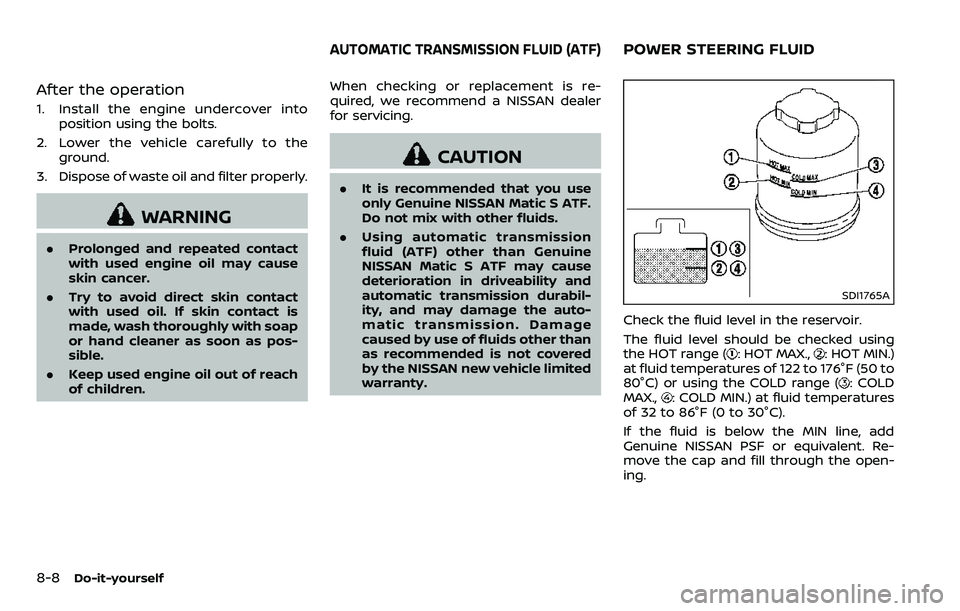
Check the fluid level in the reservoir.
The fluid level should be checked using
the HOT range (
: HOT MAX.,: HOT MIN.)
at fluid temperatures of 122 to 176°F (50 to
80°C) or using the COLD range (
: COLD
MAX.,: COLD MIN.) at fluid temperatures
of 32 to 86°F (0 to 30°C).
If the fluid is below the MIN line, add
Genuine NISSAN PSF or equivalent. Re-
move the cap and fill through the open-
ing.
AUTOMATIC TRANSMISSION FLUID (ATF)POWER STEERING FLUID
Page 444 of 532
JUMP STARTING
If jump starting is necessary, see “Jump
starting” (P.6-12). If the engine does not
start by jump starting, the battery may
have to be replaced. It is recommended
you visit a NISSAN dealer for this service.CAUTION
.Do not ground accessories di-
rectly to the battery terminal.
Doing so will bypass the variable
voltage control system and the
vehicle battery may not charge
completely.
. Use electrical accessories with
the engine running to avoid dis-
charging the vehicle battery.
The variable voltage control system mea-
sures the amount of electrical discharge
from the battery and controls voltage
generated by the generator.
SDI2533
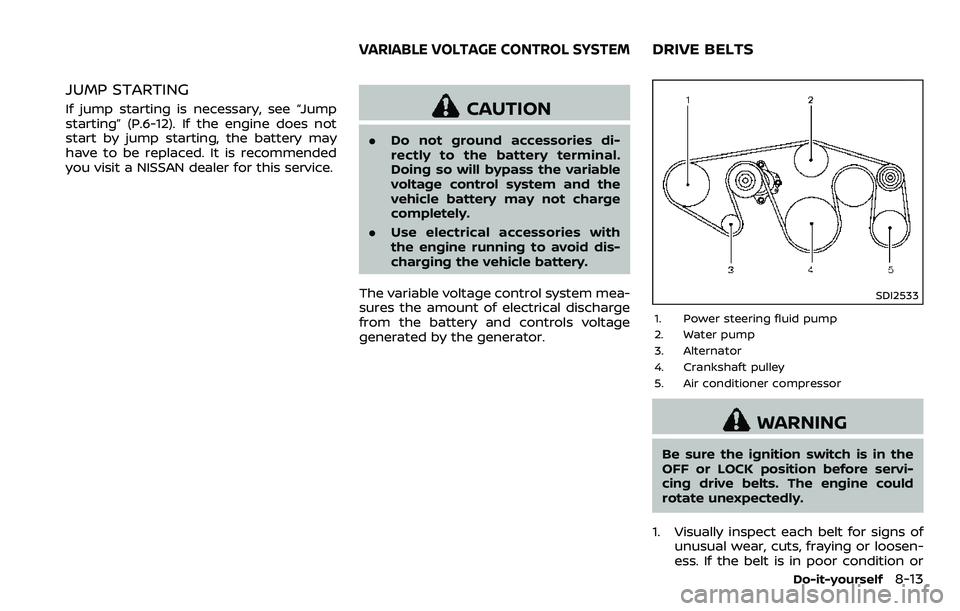
1. Power steering fluid pump
2. Water pump
3. Alternator
4. Crankshaft pulley
5. Air conditioner compressor
WARNING
Be sure the ignition switch is in the
OFF or LOCK position before servi-
cing drive belts. The engine could
rotate unexpectedly.
1. Visually inspect each belt for signs of unusual wear, cuts, fraying or loosen-
ess. If the belt is in poor condition or
Do-it-yourself8-13
VARIABLE VOLTAGE CONTROL SYSTEMDRIVE BELTS
Page 475 of 532
9-4Maintenance and schedules
Steering wheel:Check for changes in the
steering conditions, such as excessive
free play, hard steering or strange noises.
Warning lights and chimes: Make sure
that all warning lights and chimes are
operating properly.
Windshield defroster: Check that the air
comes out of the defroster outlets prop-
erly and in sufficient quantity when oper-
ating the heater or air conditioner.
Windshield wiper and washer*: Check
that the wipers and washer operate
properly and that the wipers do not
streak.
Under the hood and vehicle
The maintenance items listed here should
be checked periodically (for example,
each time you check the engine oil or
refuel).
Battery*: Check the fluid level in each cell.
It should be between the MAX and MIN
lines. Vehicles operated in high tempera-
tures or under severe condition require
frequent checks of the battery fluid level.
NOTE:
Care should be taken to avoid situations
that can lead to potential battery dis-
charge and potential no-start condi-
tions such as: 1.
Installation or extended use of elec-
tronic accessories that consume
battery power when the engine is
not running (Phone chargers, GPS,
DVD players, etc.)
2. Vehicle is not driven regularly and/
or only driven short distances.
In these cases, the battery may need to
be charged to maintain battery health.
Brake fluid level*: Make sure that the
brake fluid level is between the MAX and
MIN lines on the reservoir.
Engine coolant level*: Check the coolant
level when the engine is cold.
Engine drive belts*: Make sure that no
belt is frayed, worn, cracked or oily.
Engine oil level*: Check the level after
parking the vehicle on a level spot and
turning off the engine. Wait more than 15
minutes for the oil to drain back into the
oil pan.
Exhaust system: Make sure there are no
loose supports, cracks or holes. If the
sound of the exhaust seems unusual or
there is a smell of exhaust fumes, im-
mediately have the exhaust system in-
spected. It is recommended you visit a
NISSAN dealer for this service. (See “Pre-
cautions when starting and driving” (P.5-
4) for exhaust gas (carbon monoxide).) Fluid leaks:
Check under the vehicle for
fuel, oil, water or other fluid leaks after the
vehicle has been parked for a while. Water
dripping from the air conditioner after use
is normal. If you should notice any leaks
or if gasoline fumes are evident, check for
the cause and have it corrected immedi-
ately.
Power steering fluid level* and lines:
Check the level when the fluid is cold, with
the engine off. Check the lines for proper
attachment, leaks, cracks, etc.
Radiator and hoses: Check the front of
the radiator and clean off any dirt, insects,
leaves, etc., that may have accumulated.
Make sure the hoses have no cracks,
deformation, rot or loose connections.
Underbody: The underbody is frequently
exposed to corrosive substances such as
those used on icy roads or to control
dust. It is very important to remove these
substances, otherwise rust will form on
the floor pan, frame, fuel lines and around
the exhaust system. At the end of winter,
the underbody should be thoroughly
flushed with plain water, being careful to
clean those areas where mud and dirt
may accumulate. For additional informa-
tion, see “Cleaning exterior” (P.7-2).
Windshield washer fluid*: Check that
there is adequate fluid in the reservoir.
Page 489 of 532
10-2Technical and consumer information
The following are approximate capacities. The actual refill capacities may be a little different. When refilling, follow the
procedure instructed in the “8. Do-it-yourself” section to determine the proper refill capacity.
Fluid typeCapacity (approximate)
Recommended Fluids/Lubricants
Metric
Measure US
Measure Imperial
Measure
Fuel 98.4 L 26 gal 21-5/8 gal ÂSee “Fuel information” (P.10-4).
Engine oil*1 With oil filter change 6.5 L6-7/8 qt 5-3/4 qtÂGenuine “Nissan Motor Oil 0W-20 SN” is recommended.
 If the above motor oil is not available, use an equivalent motor oil
that matches the above grade and viscosity. For additional
information, see “Engine oil and oil filter recommendation” (P.10-
6).
Drain and refill
*1: For additional informa-
tion, see “Changing engine
oil and filter” (P.8-6).
Without oil filter change
6.2 L6-1/2 qt 5-1/2 qt
Engine coolant with reservoir 16.3 L17-1/4 qt 14-3/8 qt ÂPre-diluted Genuine NISSAN Long Life Antifreeze/Coolant (blue)
or equivalent
Automatic transmission fluid (ATF) —— —ÂGenuine NISSAN Matic S ATF
 NISSAN recommends using Genuine NISSAN Matic S ATF ONLY in
NISSAN automatic transmissions. Do not mix with other fluids.
Using fluids that are not equivalent to Genuine NISSAN Matic S
ATF may damage the automatic transmission. Damage caused
by the use of fluids other than as recommended is not covered
under the NISSAN’s New Vehicle Limited Warranty.
Transfer fluid —— —ÂGenuine NISSAN Transfer Fluid for ATX90A transfer
 Using transfer fluid other than Genuine NISSAN Transfer Fluid
may damage the transfer. Damage caused by use of other fluids
is not covered by the NISSAN new vehicle limited warranty.
Front differential gear oil —— —ÂGenuine NISSAN Differential Oil Hypoid Super GL-5 80W-90 or
equivalent conventional (non-synthetic) oil
Rear differential gear oil —— —ÂGenuine NISSAN Differential Oil Hypoid Super-S GL-5 synthetic
75W-90 or equivalent
Power steering fluid (PSF) Refill to the proper oil level according to the
instructions in the “8. Do-it-yourself” section. Â
Genuine NISSAN PSF or equivalent
 DEXRON
TMVI type ATF may also be used.
Brake fluid ÂGenuine NISSAN Super Heavy Duty Brake Fluid*2 or equivalent
DOT 3
*2: Available in mainland U.S.A through a NISSAN dealer.
Suspension fluid —— —ÂGenuine NISSAN Hydraulic Suspension Fluid
 Using Hydraulic Suspension fluid other than Genuine NISSAN
Hydraulic Suspension fluid will damage the Hydraulic Suspension,
which is not covered by the NISSAN new vehicle limited warranty.
It is recommended that you see a NISSAN dealer for recom-
mended hydraulic suspension fluid.
Multi-purpose grease —— —ÂNLGI No. 2 (Lithium soap base)
CAPACITIES AND RECOMMENDED
FLUIDS/LUBRICANTS
Page 525 of 532
11-2
Cold weather driving ............................................. 5-142
Console box ..................................................................... 2-54
CoolantCapacities and
recommended fluids/lubricants............... 10-2
Changing engine coolant ................................. 8-5
Checking engine coolant level...................... 8-5
Corrosion protection .................................................... 7-7
Cruise control ................................................................. 5-67 Fixed speed cruise control (on
ICC system)................................................................ 5-87
Intelligent Cruise Control (ICC) ................. 5-69
Cup holders...................................................................... 2-51
D
Daytime running light system........................... 2-40
Dimensions .................................................................... 10-10
Drive belts...................................................................\
....... 8-13
Drive positioner............................................................. 3-40
Driving Cold weather driving ..................................... 5-142
Driving with
automatic transmission .................................. 5-18
On-pavement and off-road driving .......... 5-9
Precautions when starting
and driving.................................................................... 5-4
Safety precautions .............................................. 5-10
E
Economy, Fuel............................................................. 5-123
Elapsed time.................................................................... 2-28
Emission control information label............ 10-12
Emission control system maintenance ......... 9-8
Emission control system warranty ............ 10-32 Engine
Before starting the engine............................ 5-16
Break-in schedule ............................................ 5-122
Capacities and
recommended fluids/lubricants............... 10-2
Changing engine coolant ................................. 8-5
Changing engine oil and filter ...................... 8-6
Checking engine coolant level...................... 8-5
Checking engine oil level................................... 8-6
Coolant temperature gauge .......................... 2-7
Emergency engine shut off.......................... 5-15
Engine block heater ....................................... 5-143
Engine compartment
check locations ......................................................... 8-3
Engine cooling system ........................................ 8-4
Engine oil.....................................................................\
... 8-6
Engine oil and oil
filter recommendation ..................................... 10-6
Engine oil replacement indicator ............ 2-26
Engine oil viscosity .............................................. 10-7
Engine serial number .................................... 10-12
Engine specifications......................................... 10-8
Engine start operation indicator.............. 2-23
If your vehicle overheats ................................ 6-14
Oil pressure gauge ................................................. 2-8
Protection mode ................................................... 5-17
Remote engine start
operation indicator ............................................. 2-23
Starting the engine............................................. 5-16
Entry/exit function, Automatic
drive positioner ............................................................. 3-40
Event Data Recorders (EDR)............................. 10-34
Exhaust gas (carbon monoxide) ......................... 5-4
Explanation of scheduled
maintenance items ........................................................ 9-5
Extended storage fuse warning ...................... 2-24
Extended storage switch ...................................... 8-21
F
F.M.V.S.S./C.M.V.S.S. certification label ...... 10-12
Filter Air cleaner housing filter ................................ 8-15
Changing engine oil and filter ...................... 8-6
Flashers (See hazard warning
flasher switch).................................................................... 6-2
Flat tire........................................................................\
............. 6-3
Flat towing..................................................................... 10-30
Flexible seating.............................................................. 1-12
Floor mat cleaning ......................................................... 7-5
Fluid Automatic Transmission Fluid (ATF) ........ 8-8
Brake fluid ..................................................................... 8-9
Capacities and
recommended fluids/lubricants............... 10-2
Engine coolant........................................................... 8-4
Engine oil.....................................................................\
... 8-6
Power steering fluid .............................................. 8-8
Window washer fluid ......................................... 8-10
Fog light switch ............................................................ 2-42
Four-Wheel Drive (4WD) NISSAN all-mode 4WD®................................ 5-123
Front passenger air bag and
status light........................................................................\
1-62
Front power seat adjustment ............................... 1-4
Front seat Front seat adjustment ......................... 1-4, 1-11
Front-seat active head restraint..................... 1-19
Fuel Capacities and
recommended fluids/lubricants............... 10-2
Fuel economy...................................................... 5-123
Fuel information.................................................... 10-4
Fuel octane rating ............................................... 10-4
Page 528 of 532
Owner’s Manual/Service Manual
order information..................................................... 10-35
P
Panic alarm....................................................................... 3-17
ParkingBrake break-in .................................................... 5-138
Parking brake operation................................. 5-22
Parking on hills................................................... 5-132
Phone Car phone or CB radio ..................................... 4-43
Pocket........................................................................\
........... 2-55
Power Front seat adjustment ........................................ 1-4
Moonroof..................................................................... 2-63
Power door lock ....................................................... 3-4
Power outlet ............................................................. 2-48
Power steering ................................................... 5-137
Power steering fluid .............................................. 8-8
Power windows ..................................................... 2-60
Precautions Braking precautions....................................... 5-137
Child restraints ....................................................... 1-33
Cruise control .......................................................... 5-67
Driving safety ........................................................... 5-10
Maintenance................................................................ 8-2
On-pavement and off-road driving .......... 5-9
Seat belt usage ...................................................... 1-20
Supplemental restraint system................. 1-54
When starting and driving................................ 5-4
Push starting................................................................\
... 6-14
Push-button ignition switch............................... 5-13
R
Radio Car phone or CB radio ..................................... 4-43
Rain-sensing auto wiper system .................... 2-34
Rapid air pressure loss................................................ 5-9
Readiness for Inspection/Maintenance
(I/M) test........................................................................\
... 10-33
Rear bumper cover .................................................... 2-58
Rear door lock, Child safety rear
door lock ........................................................................\
........ 3-6
Rear personal lights .................................................. 2-66
Rear window wiper and washer switch .... 2-35
Rear window wiper blades .................................. 8-17
RearView Monitor............................................................ 4-3
RearView Monitor system operation ............... 4-4
Recorders, Event data .......................................... 10-34
Registering your vehicle in
another country ........................................................ 10-11
Remote engine start................................................. 3-19
Remote keyless entry system ........................... 3-15
Reporting safety defects .................................... 10-32
Roadside assistance program .............................. 6-2
Rollover ........................................................................\
............ 5-8
Roof Moonroof..................................................................... 2-64
Roof rack ..................................................................... 2-57
S
SafetyChild seat belts....................................................... 1-30
Towing safety...................................................... 10-23
Seat adjustment Front power seat adjustment ....................... 1-4
Front seats..................................................... 1-4, 1-11 Seat belt(s)
Child safety................................................................ 1-30
Infants.................................................................\
........... 1-31
Injured persons ...................................................... 1-22
Larger children ....................................................... 1-31
Precautions on seat belt usage................ 1-20
Pregnant women.................................................. 1-22
Seat belt cleaning ................................................... 7-7
Seat belt extenders............................................. 1-29
Seat belt maintenance..................................... 1-29
Seat belt warning light and chime......... 2-17
Seat belts .................................................................... 1-20
Seat belts with pretensioners .................... 1-69
Small children .......................................................... 1-31
Three-point type ................................................... 1-22
Seat(s) Climate controlled seats................................. 2-45
Driver-side memory ............................................ 3-40
Heated seats ............................................................ 2-43
Seats ........................................................................\
.......... 1-3
Security system (NISSAN Vehicle
Immobilizer System), Engine start ................. 2-31
Security system, Vehicle
security system ............................................................. 2-30
Servicing air conditioner........................................ 4-42
Setting memory function, Automatic
drive positioner ............................................................. 3-42
Shift lever, Shift lock release............................... 5-22
Shift lock release Transmission............................................................ 5-22
Shifting, Automatic transmission ................... 5-18
SNOW mode.................................................................. 5-134
SNOW mode switch ................................................... 2-47
Sonar system............................................................... 5-134
Spare tire............................................................. 8-40, 10-9
Spark plugs....................................................................... 8-14
Speedometer ...................................................................... 2-6
11-5