engine cover NISSAN ARMADA 2018 Owner´s Manual
[x] Cancel search | Manufacturer: NISSAN, Model Year: 2018, Model line: ARMADA, Model: NISSAN ARMADA 2018Pages: 532, PDF Size: 2.3 MB
Page 434 of 532
could affect your warranty coverage.If in
doubt about any servicing, it is recom-
mended you have it done by a NISSAN
dealer.
JVC0965X
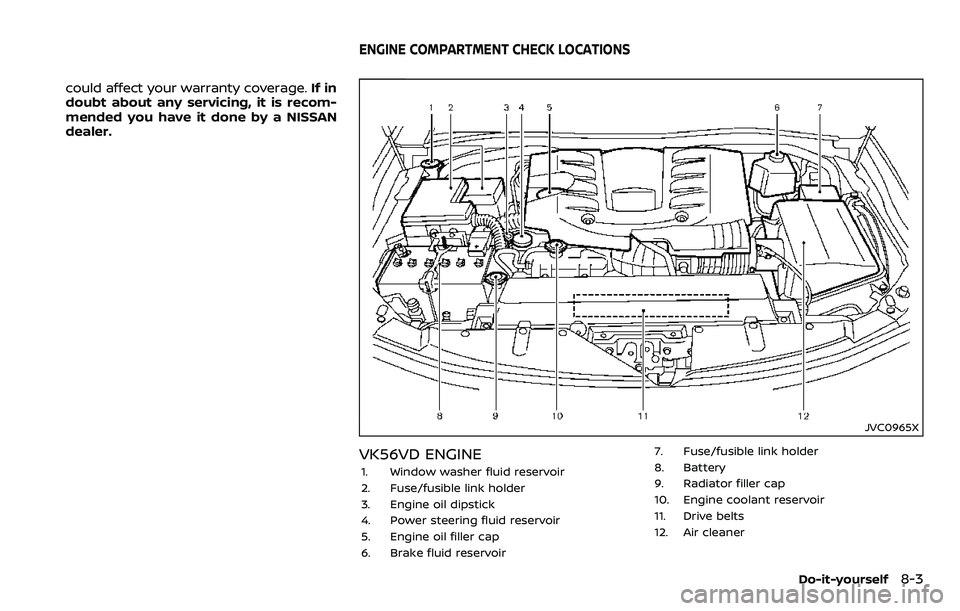
VK56VD ENGINE
1. Window washer fluid reservoir
2. Fuse/fusible link holder
3. Engine oil dipstick
4. Power steering fluid reservoir
5. Engine oil filler cap
6. Brake fluid reservoir 7. Fuse/fusible link holder
8. Battery
9. Radiator filler cap
10. Engine coolant reservoir
11. Drive belts
12. Air cleaner
Do-it-yourself8-3
ENGINE COMPARTMENT CHECK LOCATIONS
Page 437 of 532
8-6Do-it-yourself
JVM0728X
CHECKING ENGINE OIL LEVEL
1. Park the vehicle on a level surface andapply the parking brake.
2. Run the engine until it reaches oper- ating temperature.
3. Turn off the engine. Wait more than
15 minutes for the oil to drain back
into the oil pan.
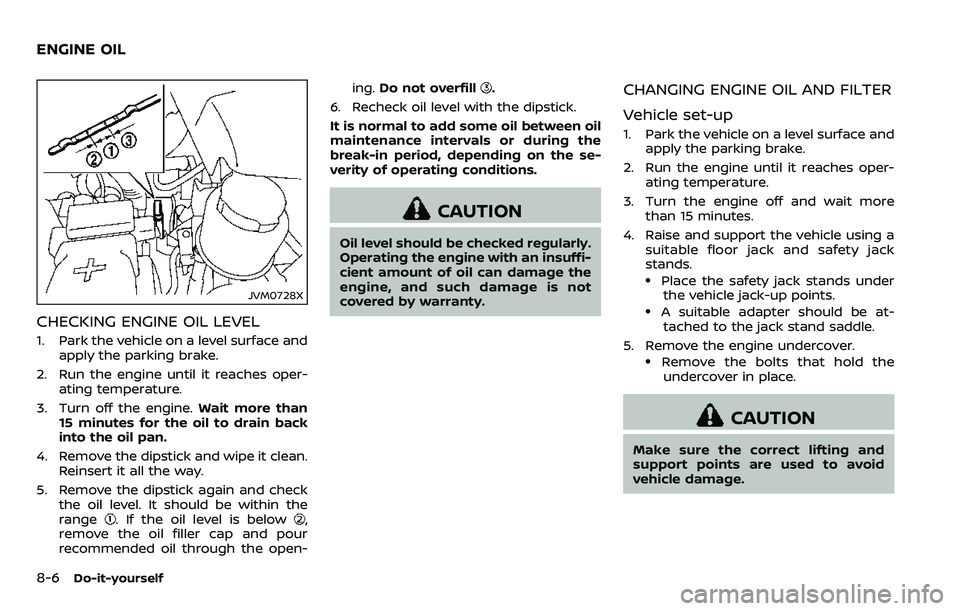
4. Remove the dipstick and wipe it clean. Reinsert it all the way.
5. Remove the dipstick again and check the oil level. It should be within the
range
. If the oil level is below,
remove the oil filler cap and pour
recommended oil through the open- ing.
Do not overfill
.
6. Recheck oil level with the dipstick.
It is normal to add some oil between oil
maintenance intervals or during the
break-in period, depending on the se-
verity of operating conditions.
CAUTION
Oil level should be checked regularly.
Operating the engine with an insuffi-
cient amount of oil can damage the
engine, and such damage is not
covered by warranty.
CHANGING ENGINE OIL AND FILTER
Vehicle set-up
1. Park the vehicle on a level surface and apply the parking brake.
2. Run the engine until it reaches oper- ating temperature.
3. Turn the engine off and wait more than 15 minutes.
4. Raise and support the vehicle using a suitable floor jack and safety jack
stands.
.Place the safety jack stands underthe vehicle jack-up points.
.A suitable adapter should be at-
tached to the jack stand saddle.
5. Remove the engine undercover.
.Remove the bolts that hold the undercover in place.
CAUTION
Make sure the correct lifting and
support points are used to avoid
vehicle damage.
ENGINE OIL
Page 439 of 532
8-8Do-it-yourself
After the operation
1. Install the engine undercover intoposition using the bolts.
2. Lower the vehicle carefully to the ground.
3. Dispose of waste oil and filter properly.
WARNING
. Prolonged and repeated contact
with used engine oil may cause
skin cancer.
. Try to avoid direct skin contact
with used oil. If skin contact is
made, wash thoroughly with soap
or hand cleaner as soon as pos-
sible.
. Keep used engine oil out of reach
of children. When checking or replacement is re-
quired, we recommend a NISSAN dealer
for servicing.
CAUTION
.
It is recommended that you use
only Genuine NISSAN Matic S ATF.
Do not mix with other fluids.
. Using automatic transmission
fluid (ATF) other than Genuine
NISSAN Matic S ATF may cause
deterioration in driveability and
automatic transmission durabil-
ity, and may damage the auto-
matic transmission. Damage
caused by use of fluids other than
as recommended is not covered
by the NISSAN new vehicle limited
warranty.
SDI1765A
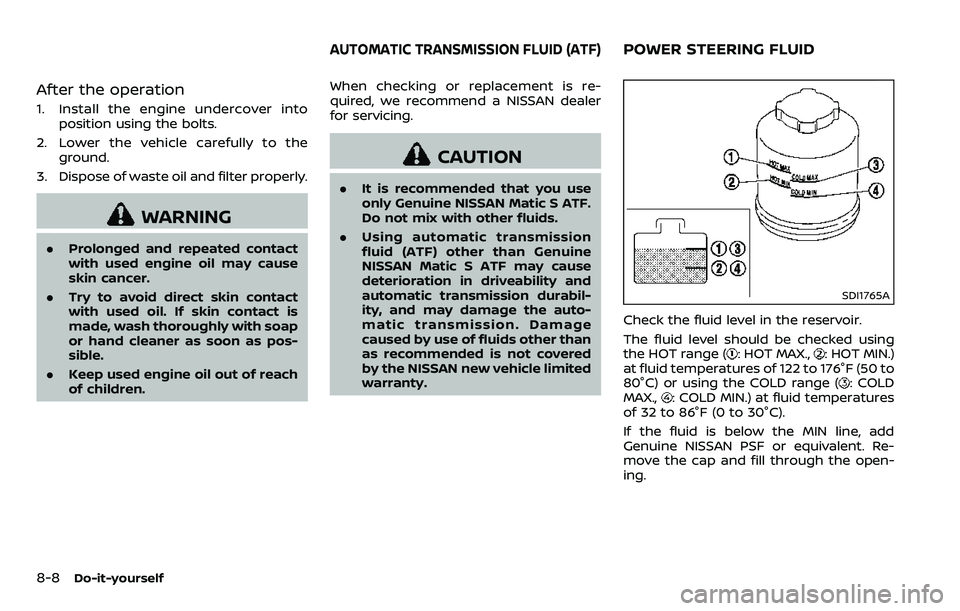
Check the fluid level in the reservoir.
The fluid level should be checked using
the HOT range (
: HOT MAX.,: HOT MIN.)
at fluid temperatures of 122 to 176°F (50 to
80°C) or using the COLD range (
: COLD
MAX.,: COLD MIN.) at fluid temperatures
of 32 to 86°F (0 to 30°C).
If the fluid is below the MIN line, add
Genuine NISSAN PSF or equivalent. Re-
move the cap and fill through the open-
ing.
AUTOMATIC TRANSMISSION FLUID (ATF)POWER STEERING FLUID
Page 446 of 532
SDI2515
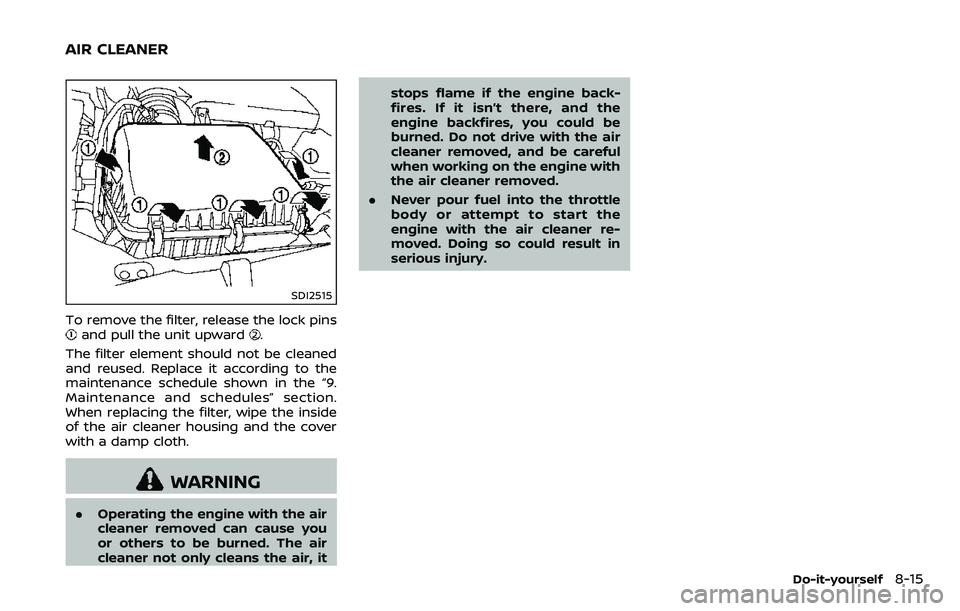
To remove the filter, release the lock pinsand pull the unit upward.
The filter element should not be cleaned
and reused. Replace it according to the
maintenance schedule shown in the “9.
Maintenance and schedules” section.
When replacing the filter, wipe the inside
of the air cleaner housing and the cover
with a damp cloth.
WARNING
. Operating the engine with the air
cleaner removed can cause you
or others to be burned. The air
cleaner not only cleans the air, it stops flame if the engine back-
fires. If it isn’t there, and the
engine backfires, you could be
burned. Do not drive with the air
cleaner removed, and be careful
when working on the engine with
the air cleaner removed.
. Never pour fuel into the throttle
body or attempt to start the
engine with the air cleaner re-
moved. Doing so could result in
serious injury.
Do-it-yourself8-15
AIR CLEANER
Page 449 of 532
8-18Do-it-yourself
each depression as the hydraulic
pressure decreases.
If the brakes do not operate properly,
have the brakes checked. It is recom-
mended that you visit a NISSAN dealer for
repair.
SDI2518
SDI2532
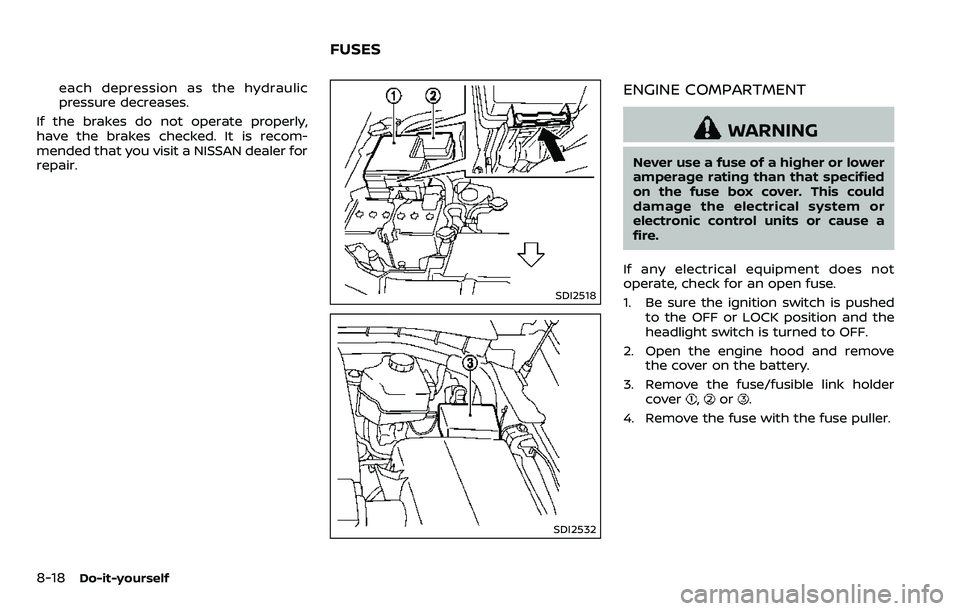
ENGINE COMPARTMENT
WARNING
Never use a fuse of a higher or lower
amperage rating than that specified
on the fuse box cover. This could
damage the electrical system or
electronic control units or cause a
fire.
If any electrical equipment does not
operate, check for an open fuse.
1. Be sure the ignition switch is pushed to the OFF or LOCK position and the
headlight switch is turned to OFF.
2. Open the engine hood and remove the cover on the battery.
3. Remove the fuse/fusible link holder cover
,or.
4. Remove the fuse with the fuse puller.
FUSES
Page 489 of 532
10-2Technical and consumer information
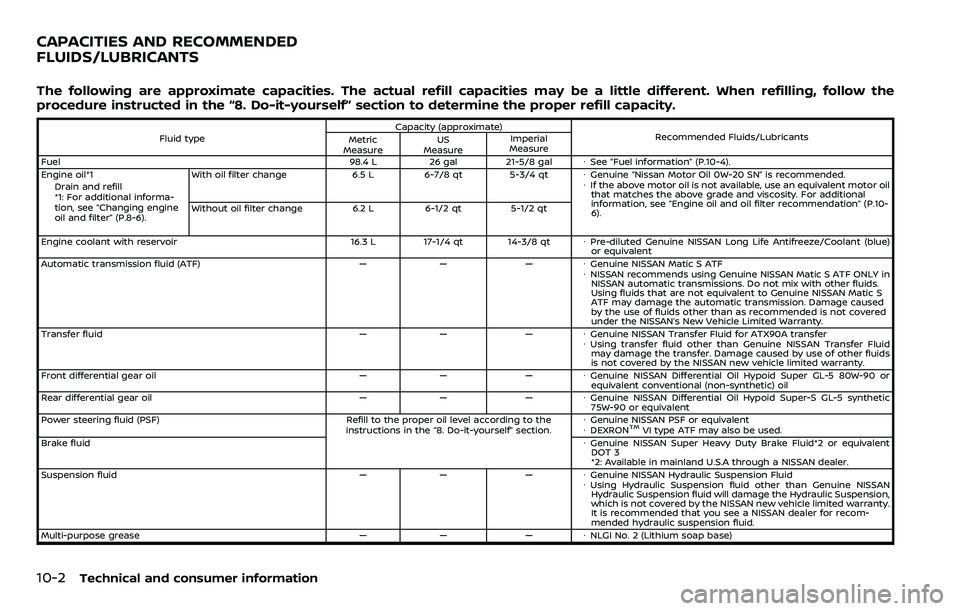
The following are approximate capacities. The actual refill capacities may be a little different. When refilling, follow the
procedure instructed in the “8. Do-it-yourself” section to determine the proper refill capacity.
Fluid typeCapacity (approximate)
Recommended Fluids/Lubricants
Metric
Measure US
Measure Imperial
Measure
Fuel 98.4 L 26 gal 21-5/8 gal ÂSee “Fuel information” (P.10-4).
Engine oil*1 With oil filter change 6.5 L6-7/8 qt 5-3/4 qtÂGenuine “Nissan Motor Oil 0W-20 SN” is recommended.
 If the above motor oil is not available, use an equivalent motor oil
that matches the above grade and viscosity. For additional
information, see “Engine oil and oil filter recommendation” (P.10-
6).
Drain and refill
*1: For additional informa-
tion, see “Changing engine
oil and filter” (P.8-6).
Without oil filter change
6.2 L6-1/2 qt 5-1/2 qt
Engine coolant with reservoir 16.3 L17-1/4 qt 14-3/8 qt ÂPre-diluted Genuine NISSAN Long Life Antifreeze/Coolant (blue)
or equivalent
Automatic transmission fluid (ATF) —— —ÂGenuine NISSAN Matic S ATF
 NISSAN recommends using Genuine NISSAN Matic S ATF ONLY in
NISSAN automatic transmissions. Do not mix with other fluids.
Using fluids that are not equivalent to Genuine NISSAN Matic S
ATF may damage the automatic transmission. Damage caused
by the use of fluids other than as recommended is not covered
under the NISSAN’s New Vehicle Limited Warranty.
Transfer fluid —— —ÂGenuine NISSAN Transfer Fluid for ATX90A transfer
 Using transfer fluid other than Genuine NISSAN Transfer Fluid
may damage the transfer. Damage caused by use of other fluids
is not covered by the NISSAN new vehicle limited warranty.
Front differential gear oil —— —ÂGenuine NISSAN Differential Oil Hypoid Super GL-5 80W-90 or
equivalent conventional (non-synthetic) oil
Rear differential gear oil —— —ÂGenuine NISSAN Differential Oil Hypoid Super-S GL-5 synthetic
75W-90 or equivalent
Power steering fluid (PSF) Refill to the proper oil level according to the
instructions in the “8. Do-it-yourself” section. Â
Genuine NISSAN PSF or equivalent
 DEXRON
TMVI type ATF may also be used.
Brake fluid ÂGenuine NISSAN Super Heavy Duty Brake Fluid*2 or equivalent
DOT 3
*2: Available in mainland U.S.A through a NISSAN dealer.
Suspension fluid —— —ÂGenuine NISSAN Hydraulic Suspension Fluid
 Using Hydraulic Suspension fluid other than Genuine NISSAN
Hydraulic Suspension fluid will damage the Hydraulic Suspension,
which is not covered by the NISSAN new vehicle limited warranty.
It is recommended that you see a NISSAN dealer for recom-
mended hydraulic suspension fluid.
Multi-purpose grease —— —ÂNLGI No. 2 (Lithium soap base)
CAPACITIES AND RECOMMENDED
FLUIDS/LUBRICANTS
Page 491 of 532
10-4Technical and consumer information
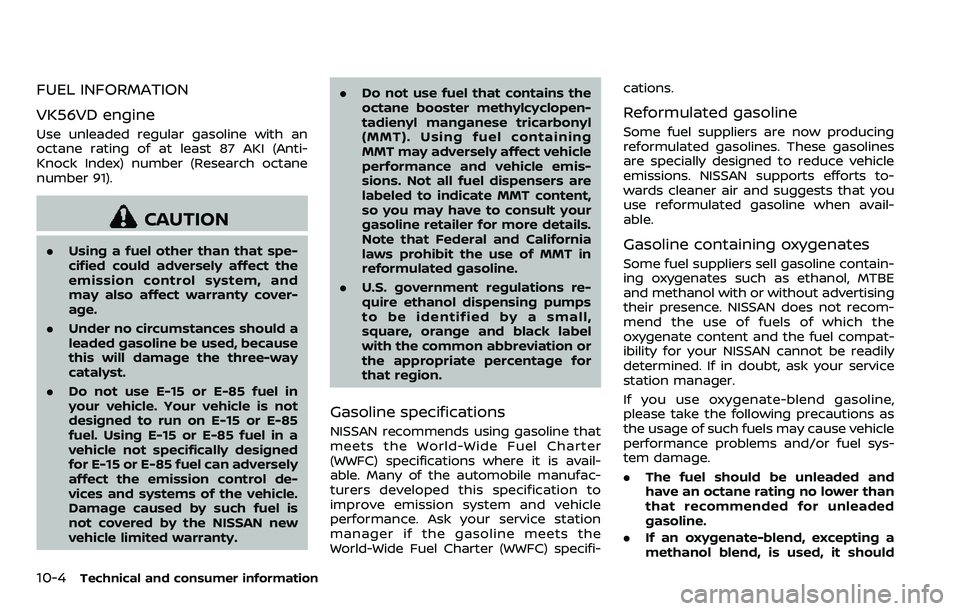
FUEL INFORMATION
VK56VD engine
Use unleaded regular gasoline with an
octane rating of at least 87 AKI (Anti-
Knock Index) number (Research octane
number 91).
CAUTION
.Using a fuel other than that spe-
cified could adversely affect the
emission control system, and
may also affect warranty cover-
age.
. Under no circumstances should a
leaded gasoline be used, because
this will damage the three-way
catalyst.
. Do not use E-15 or E-85 fuel in
your vehicle. Your vehicle is not
designed to run on E-15 or E-85
fuel. Using E-15 or E-85 fuel in a
vehicle not specifically designed
for E-15 or E-85 fuel can adversely
affect the emission control de-
vices and systems of the vehicle.
Damage caused by such fuel is
not covered by the NISSAN new
vehicle limited warranty. .
Do not use fuel that contains the
octane booster methylcyclopen-
tadienyl manganese tricarbonyl
(MMT). Using fuel containing
MMT may adversely affect vehicle
performance and vehicle emis-
sions. Not all fuel dispensers are
labeled to indicate MMT content,
so you may have to consult your
gasoline retailer for more details.
Note that Federal and California
laws prohibit the use of MMT in
reformulated gasoline.
. U.S. government regulations re-
quire ethanol dispensing pumps
to be identified by a small,
square, orange and black label
with the common abbreviation or
the appropriate percentage for
that region.
Gasoline specifications
NISSAN recommends using gasoline that
meets the World-Wide Fuel Charter
(WWFC) specifications where it is avail-
able. Many of the automobile manufac-
turers developed this specification to
improve emission system and vehicle
performance. Ask your service station
manager if the gasoline meets the
World-Wide Fuel Charter (WWFC) specifi- cations.
Reformulated gasoline
Some fuel suppliers are now producing
reformulated gasolines. These gasolines
are specially designed to reduce vehicle
emissions. NISSAN supports efforts to-
wards cleaner air and suggests that you
use reformulated gasoline when avail-
able.
Gasoline containing oxygenates
Some fuel suppliers sell gasoline contain-
ing oxygenates such as ethanol, MTBE
and methanol with or without advertising
their presence. NISSAN does not recom-
mend the use of fuels of which the
oxygenate content and the fuel compat-
ibility for your NISSAN cannot be readily
determined. If in doubt, ask your service
station manager.
If you use oxygenate-blend gasoline,
please take the following precautions as
the usage of such fuels may cause vehicle
performance problems and/or fuel sys-
tem damage.
.
The fuel should be unleaded and
have an octane rating no lower than
that recommended for unleaded
gasoline.
. If an oxygenate-blend, excepting a
methanol blend, is used, it should
Page 492 of 532
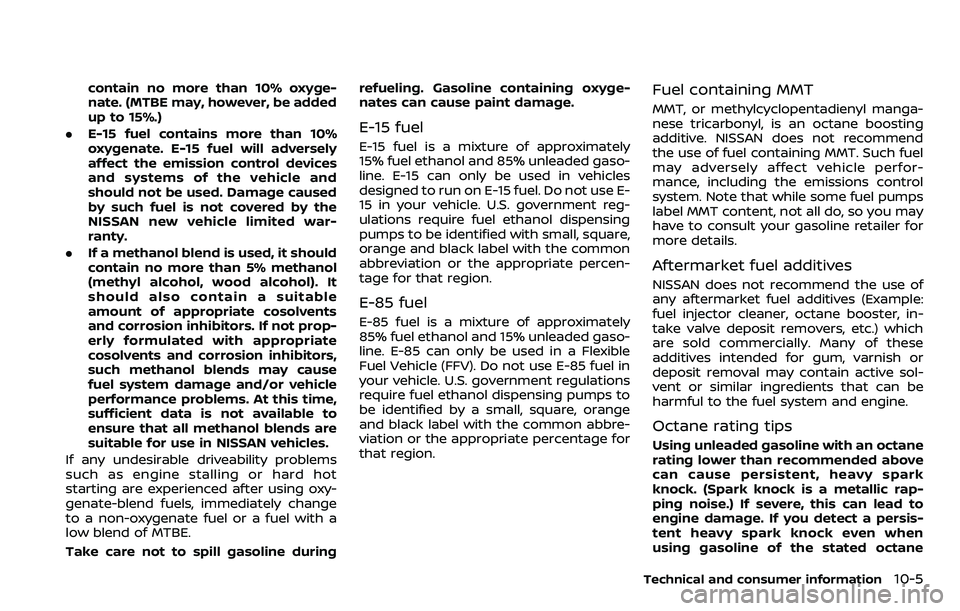
contain no more than 10% oxyge-
nate. (MTBE may, however, be added
up to 15%.)
. E-15 fuel contains more than 10%
oxygenate. E-15 fuel will adversely
affect the emission control devices
and systems of the vehicle and
should not be used. Damage caused
by such fuel is not covered by the
NISSAN new vehicle limited war-
ranty.
. If a methanol blend is used, it should
contain no more than 5% methanol
(methyl alcohol, wood alcohol). It
should also contain a suitable
amount of appropriate cosolvents
and corrosion inhibitors. If not prop-
erly formulated with appropriate
cosolvents and corrosion inhibitors,
such methanol blends may cause
fuel system damage and/or vehicle
performance problems. At this time,
sufficient data is not available to
ensure that all methanol blends are
suitable for use in NISSAN vehicles.
If any undesirable driveability problems
such as engine stalling or hard hot
starting are experienced after using oxy-
genate-blend fuels, immediately change
to a non-oxygenate fuel or a fuel with a
low blend of MTBE.
Take care not to spill gasoline during refueling. Gasoline containing oxyge-
nates can cause paint damage.
E-15 fuel
E-15 fuel is a mixture of approximately
15% fuel ethanol and 85% unleaded gaso-
line. E-15 can only be used in vehicles
designed to run on E-15 fuel. Do not use E-
15 in your vehicle. U.S. government reg-
ulations require fuel ethanol dispensing
pumps to be identified with small, square,
orange and black label with the common
abbreviation or the appropriate percen-
tage for that region.
E-85 fuel
E-85 fuel is a mixture of approximately
85% fuel ethanol and 15% unleaded gaso-
line. E-85 can only be used in a Flexible
Fuel Vehicle (FFV). Do not use E-85 fuel in
your vehicle. U.S. government regulations
require fuel ethanol dispensing pumps to
be identified by a small, square, orange
and black label with the common abbre-
viation or the appropriate percentage for
that region.
Fuel containing MMT
MMT, or methylcyclopentadienyl manga-
nese tricarbonyl, is an octane boosting
additive. NISSAN does not recommend
the use of fuel containing MMT. Such fuel
may adversely affect vehicle perfor-
mance, including the emissions control
system. Note that while some fuel pumps
label MMT content, not all do, so you may
have to consult your gasoline retailer for
more details.
Aftermarket fuel additives
NISSAN does not recommend the use of
any aftermarket fuel additives (Example:
fuel injector cleaner, octane booster, in-
take valve deposit removers, etc.) which
are sold commercially. Many of these
additives intended for gum, varnish or
deposit removal may contain active sol-
vent or similar ingredients that can be
harmful to the fuel system and engine.
Octane rating tips
Using unleaded gasoline with an octane
rating lower than recommended above
can cause persistent, heavy spark
knock. (Spark knock is a metallic rap-
ping noise.) If severe, this can lead to
engine damage. If you detect a persis-
tent heavy spark knock even when
using gasoline of the stated octane
Technical and consumer information10-5
Page 494 of 532
Oil viscosity
The engine oil viscosity or thickness
changes with temperature. Because of
this, it is important that the engine oil
viscosity be selected based on the tem-
peratures at which the vehicle will be
operated before the next oil change.
Choosing an oil viscosity other than that
recommended could cause serious en-
gine damage.
Selecting the correct oil filter
Your new vehicle is equipped with a high-
quality genuine NISSAN oil filter. When
replacing, use the genuine oil filter or its
equivalent for the reason described in
change intervals.
Change intervals
The oil and oil filter change intervals for
your engine are based on the use of the
specified quality oils and filters. Oil and
filter other than the specified quality, or
oil and filter change intervals longer than
recommended could reduce engine life.
Damage to engines caused by improper
maintenance or use of incorrect oil and
filter quality and/or viscosity is not cov-
ered by the new NISSAN vehicle limited
warranties.
Your engine was filled with a high quality
engine oil when it was built. You do nothave to change the oil before the first
recommended change interval. Oil and
filter change intervals depend upon how
you use your vehicle.
AIR CONDITIONING SYSTEM RE-
FRIGERANT AND LUBRICANT RE-
COMMENDATIONS
The air conditioning system in your
NISSAN vehicle must be charged with
the refrigerant HFC-134a (R-134a) and
the lubricant, NISSAN A/C system oil
Type S or the exact equivalents.
CAUTION
The use of any other refrigerant or
lubricant may cause severe damage
to the air conditioning system and
may require the replacement of all
air conditioner system components.
The refrigerant HFC-134a (R-134a) in your
NISSAN vehicle will not harm the earth’s
ozone layer. Although this refrigerant
does not affect the earth’s atmosphere,
certain governmental regulations require
the recovery and recycling of any refrig-
erant during automotive air conditioning
system service. Your NISSAN dealer has
the trained technicians and equipment
needed to recover and recycle your air conditioning system refrigerant.
It is recommended you visit a NISSAN
dealer when servicing your air condition-
ing system.
Technical and consumer information10-7
Page 506 of 532
towing. For example, towing a heavy
trailer in high outside temperatures on
graded roads can affect engine perfor-
mance and cause overheating. The trans-
mission high fluid temperature and
engine protection mode, which helps
reduce the chance of transmission and
engine damage, could activate and auto-
matically decrease engine power. Vehicle
speed may decrease under high load.
Plan your trip carefully to account for
trailer and vehicle load, weather and road
conditions.
WARNING
Overheating can result in reduced
engine power and vehicle speed.
The reduced speed may be lower
than other traffic, which could in-
crease the chance of a collision. Be
especially careful when driving. If the
vehicle cannot maintain a safe driv-
ing speed, pull to the side of the road
in a safe area. Allow the engine to
cool and return to normal operation.
See “If your vehicle overheats” (P.6-
14).
CAUTION
Vehicle damage resulting from im-
proper towing procedures is not
covered by NISSAN warranties.
STI0542
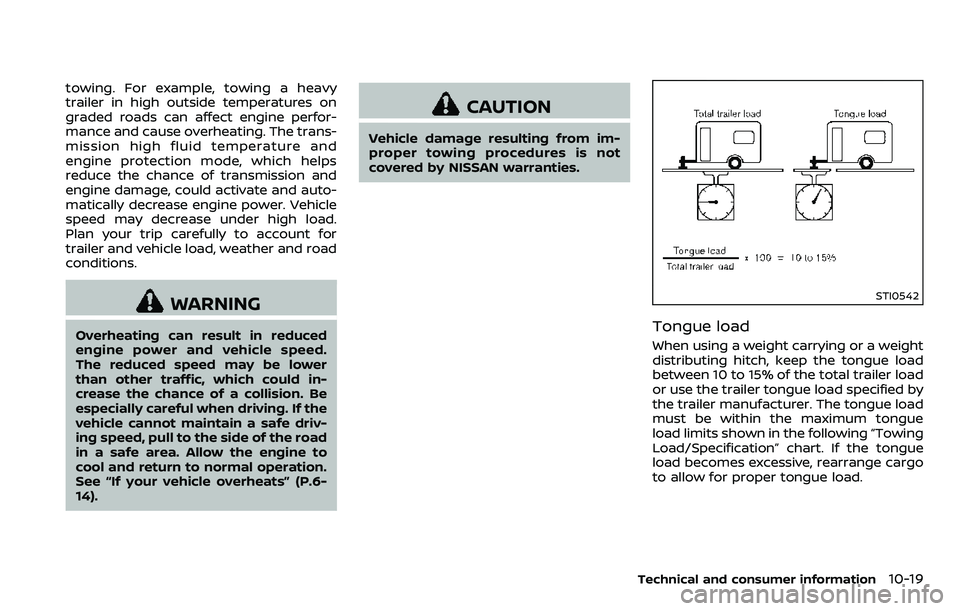
Tongue load
When using a weight carrying or a weight
distributing hitch, keep the tongue load
between 10 to 15% of the total trailer load
or use the trailer tongue load specified by
the trailer manufacturer. The tongue load
must be within the maximum tongue
load limits shown in the following “Towing
Load/Specification” chart. If the tongue
load becomes excessive, rearrange cargo
to allow for proper tongue load.
Technical and consumer information10-19