4WD NISSAN ARMADA 2018 Owner´s Manual
[x] Cancel search | Manufacturer: NISSAN, Model Year: 2018, Model line: ARMADA, Model: NISSAN ARMADA 2018Pages: 532, PDF Size: 2.3 MB
Page 417 of 532
6-18In case of emergency
SCE0907
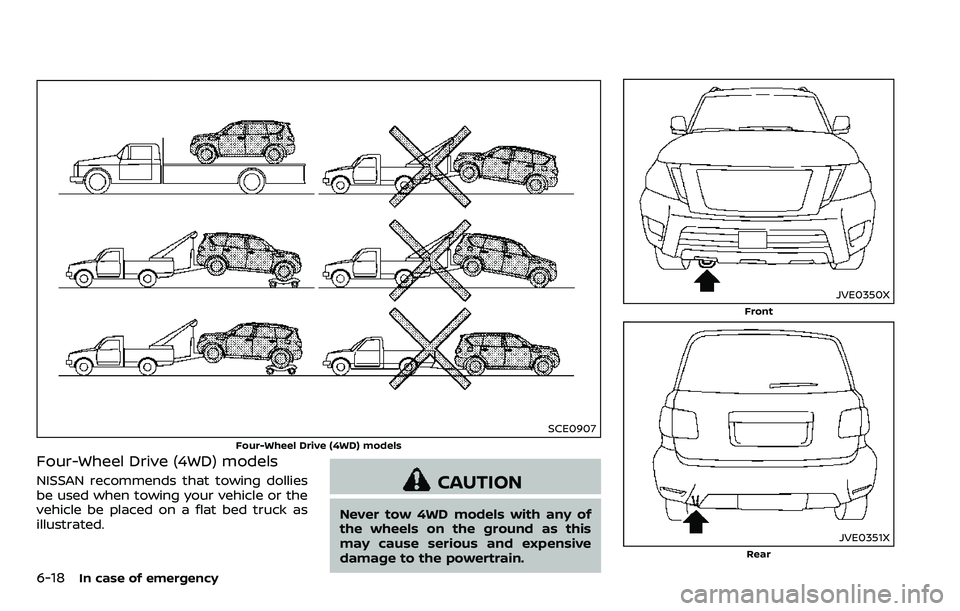
Four-Wheel Drive (4WD) models
Four-Wheel Drive (4WD) models
NISSAN recommends that towing dollies
be used when towing your vehicle or the
vehicle be placed on a flat bed truck as
illustrated.CAUTION
Never tow 4WD models with any of
the wheels on the ground as this
may cause serious and expensive
damage to the powertrain.
JVE0350X
Front
JVE0351X
Rear
Page 419 of 532
6-20In case of emergency
This section describes the procedure for
manually shifting the vehicle into the 4WD
mode (4L position) in case of an emer-
gency.
WHEN 4WD WARNING LIGHT ILLU-
MINATES
If the 4WD warning light illuminates while
driving, there may be a malfunction in the
4WD system. Stop the vehicle and have
the vehicle checked as soon as possible. It
is recommended you contact a NISSAN
dealer for this service. (See “NISSAN all-
mode 4WD®” (P.5-123).)
When the vehicle is stuck on an uneven
road (desert, mud, etc.) and the 4WD
warning light is illuminated, be sure to
place the 4WD shift switch in the 4L
position. If only the rear wheels are
spinning, this means that the transfer
has not switched to the 4L position
electrically.
If this situation occurs, contact a dealer or
road assistance service for help. If an
immediate service is not available, per-
form the following procedure to switch to
the 4L position manually and free the
vehicle.
CAUTION
Only perform this procedure in an
emergency.
If the vehicle is driven for a long
period of time over a long distance
with a component detached, foreign
material such as water, sand, etc.
may enter from the opening and this
may cause a malfunction in the
drivetrain system. After freeing a
vehicle that has become stuck, it is
recommended you contact a NISSAN
dealer for inspection and repair.
WARNING
.Ensure your safety before per-
forming the operations. The ve-
hicle may move unexpectedly.
. Place the ignition switch in the
OFF position, apply the parking
brake and let the vehicle cool
down.
. Do not perform the following
procedure immediately after
driving the vehicle. Parts such as
exhaust components, the trans- mission, etc. are very hot and
may cause a burn injury.
. Make sure that the parts that will
be operated as well as related
parts cool down before perform-
ing the operation.
. Burrs or projecting portions of
metal components may cause
unexpected injury to your fingers
or arms. Pay special attention in
regard to your safety while re-
moving and installing these
parts. Wear work gloves and pro-
tective arm covers.
CAUTION
While removing and installing the
parts, prevent the removed parts
from getting dirty with water, dirt or
sand. Protect the parts using a cover
such as a clean cloth, etc.
FOUR-WHEEL DRIVE (4WD)
MANUAL SHIFTING (4WD models)
Page 420 of 532
OPERATING PROCEDURE
Place the ignition switch in the OFF
position and apply the parking brake. Let
the vehicle cool down before performing
the following procedure.
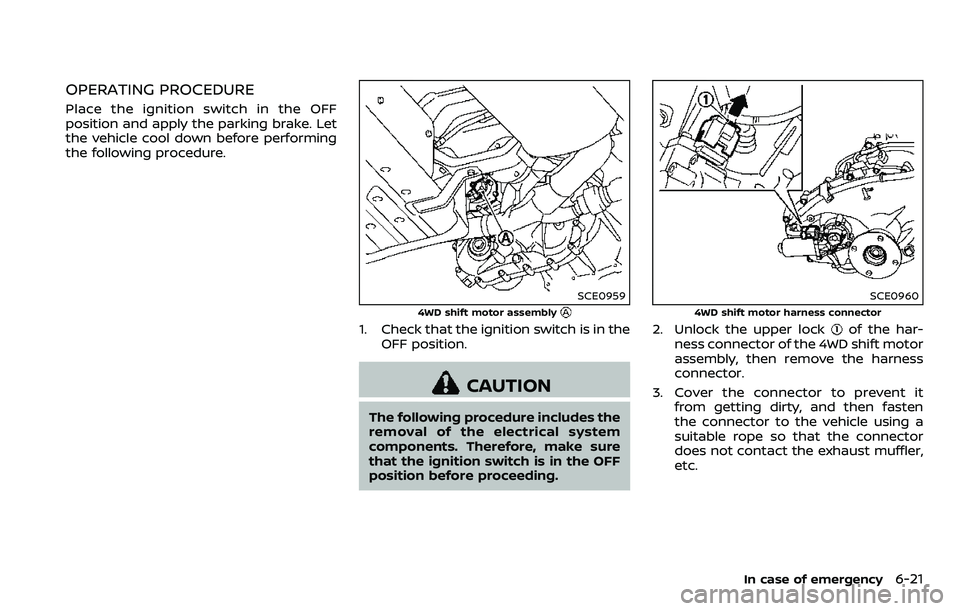
SCE0959
4WD shift motor assembly
1. Check that the ignition switch is in theOFF position.
CAUTION
The following procedure includes the
removal of the electrical system
components. Therefore, make sure
that the ignition switch is in the OFF
position before proceeding.
SCE0960
4WD shift motor harness connector
2. Unlock the upper lockof the har-
ness connector of the 4WD shift motor
assembly, then remove the harness
connector.
3. Cover the connector to prevent it from getting dirty, and then fasten
the connector to the vehicle using a
suitable rope so that the connector
does not contact the exhaust muffler,
etc.
In case of emergency6-21
Page 421 of 532
6-22In case of emergency
CAUTION
The connector must be fastened
securely. Not doing so may result in
damage to the connector due to
interference with other parts.
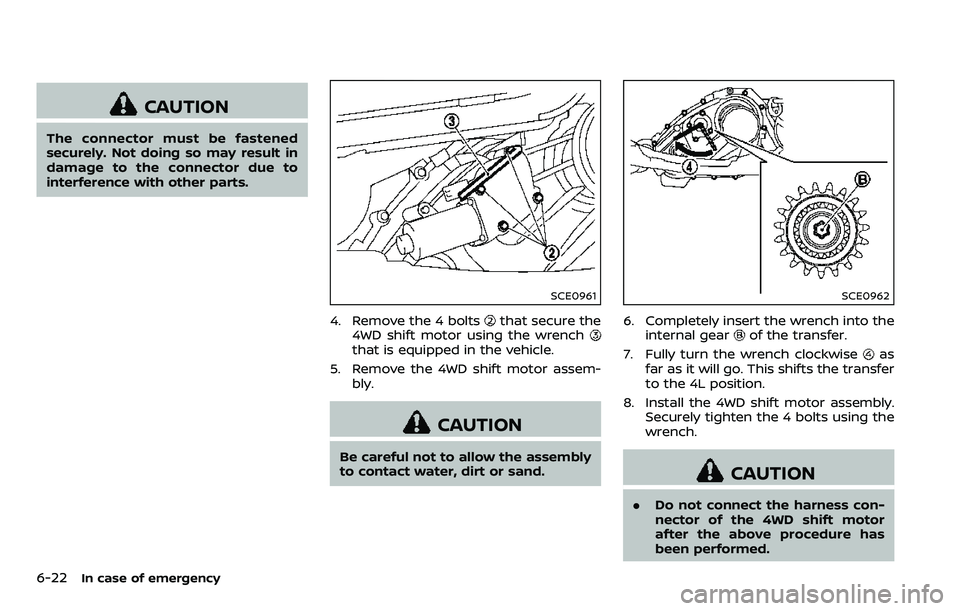
SCE0961
4. Remove the 4 boltsthat secure the
4WD shift motor using the wrench
that is equipped in the vehicle.
5. Remove the 4WD shift motor assem- bly.
CAUTION
Be careful not to allow the assembly
to contact water, dirt or sand.
SCE0962
6. Completely insert the wrench into the
internal gearof the transfer.
7. Fully turn the wrench clockwise
as
far as it will go. This shifts the transfer
to the 4L position.
8. Install the 4WD shift motor assembly. Securely tighten the 4 bolts using the
wrench.
CAUTION
.Do not connect the harness con-
nector of the 4WD shift motor
after the above procedure has
been performed.
Page 422 of 532
.The 4 bolts are tightened to
temporarily install the 4WD shift
motor so that water, dirt or sand
does not enter inside the system.
Therefore, they should only be
tightened to the proper tighten-
ing torque. It is recommended
you contact a NISSAN dealer for
inspection and repair.
9. With the 4WD system in the 4L posi- tion, free the stuck vehicle. (See “Ve-
hicle recovery (freeing a stuck vehicle)”
(P.6-19) for details.)
CAUTION
After manually shifting the vehicle to
the 4L position, it is recommended
you contact a NISSAN dealer for
inspection and repair as soon as
possible.
In case of emergency6-23
Page 471 of 532
8-40Do-it-yourself
.The use of retread tire is not
recommended.
. For additional information re-
garding tires, refer to “Important
Tire Safety Information” (US) or
“Tire Safety Information” (Cana-
da) in the Warranty Information
Booklet.
Four-Wheel Drive (4WD) models
CAUTION
.Always use tires of the same type,
size, brand, construction (bias,
bias-belted or radial), and tread
pattern on all four wheels. Failure
to do so may result in a circum-
ference difference between tires
on the front and rear axles which
will cause excessive tire wear and
may damage the transmission,
transfer case and differential
gears.
. ONLY use spare tires specified for
the 4WD model.
If excessive tire wear is found, it is
recommended that all four tires be re-
placed with tires of the same size, brand, construction and tread pattern. The tire
pressure and wheel alignment should
also be checked and corrected as neces-
sary. It is recommended you visit a
NISSAN dealer for this service.
Wheel balance
Unbalanced wheels may affect vehicle
handling and tire life. Even with regular
use, wheels can get out of balance.
Therefore, they should be balanced as
required.
Wheel balance service should be per-
formed with the wheels off the vehicle.
Spin balancing the wheels on the vehi-
cle could lead to mechanical damage.
For additional information regarding tires,
refer to “Important Tire Safety Informa-
tion” (US) or “Tire Safety Information”
(Canada) in the NISSAN Warranty Infor-
mation Booklet.
Care of wheels
See “Cleaning exterior” (P.7-2) for details
about care of the wheels.
Spare tire
Since the spare tire is not equipped with
the Tire Pressure Monitoring System
(TPMS), when a spare tire is mounted,
the TPMS will not function.
A conventional tire is supplied with your
vehicle as a spare tire.
Page 482 of 532
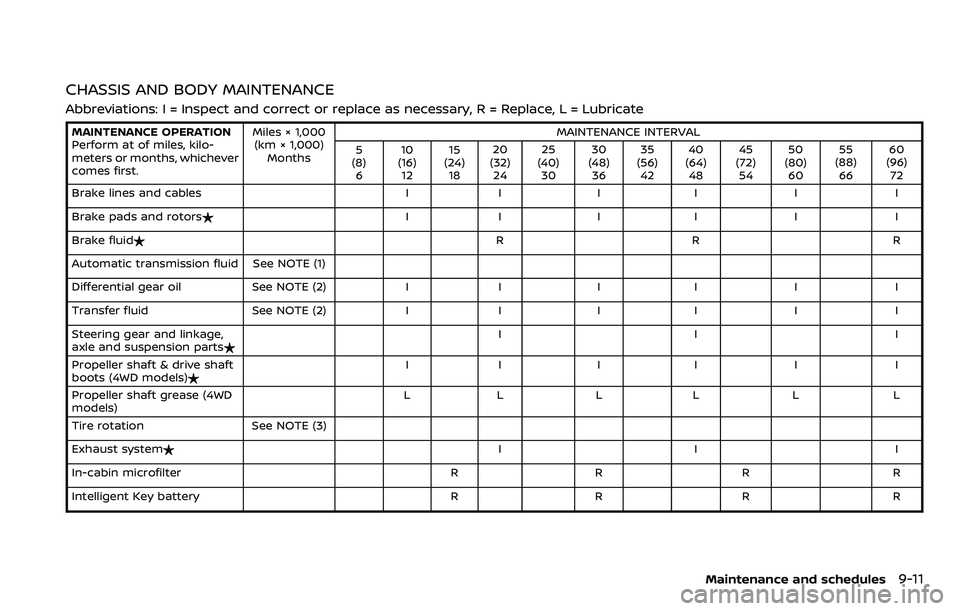
CHASSIS AND BODY MAINTENANCE
Abbreviations: I = Inspect and correct or replace as necessary, R = Replace, L = Lubricate
MAINTENANCE OPERATION
Perform at of miles, kilo-
meters or months, whichever
comes first.Miles × 1,000
(km × 1,000) Months MAINTENANCE INTERVAL
5
(8) 6 10
(16) 12 15
(24) 18 20
(32) 24 25
(40) 30 30
(48) 36 35
(56) 42 40
(64) 48 45
(72) 54 50
(80) 60 55
(88) 66 60
(96) 72
Brake lines and cables II II I I
Brake pads and rotors$ II I I I I
Brake fluid$ RR R
Automatic transmission fluid See NOTE (1)
Differential gear oil See NOTE (2)II II I I
Transfer fluid See NOTE (2)II II I I
Steering gear and linkage,
axle and suspension parts$ II I
Propeller shaft & drive shaft
boots (4WD models)$ II I I I I
Propeller shaft grease (4WD
models) LL L L L L
Tire rotation See NOTE (3)
Exhaust system$ II I
In-cabin microfilter RR R R
Intelligent Key battery RR R R
Maintenance and schedules9-11
Page 483 of 532
9-12Maintenance and schedules
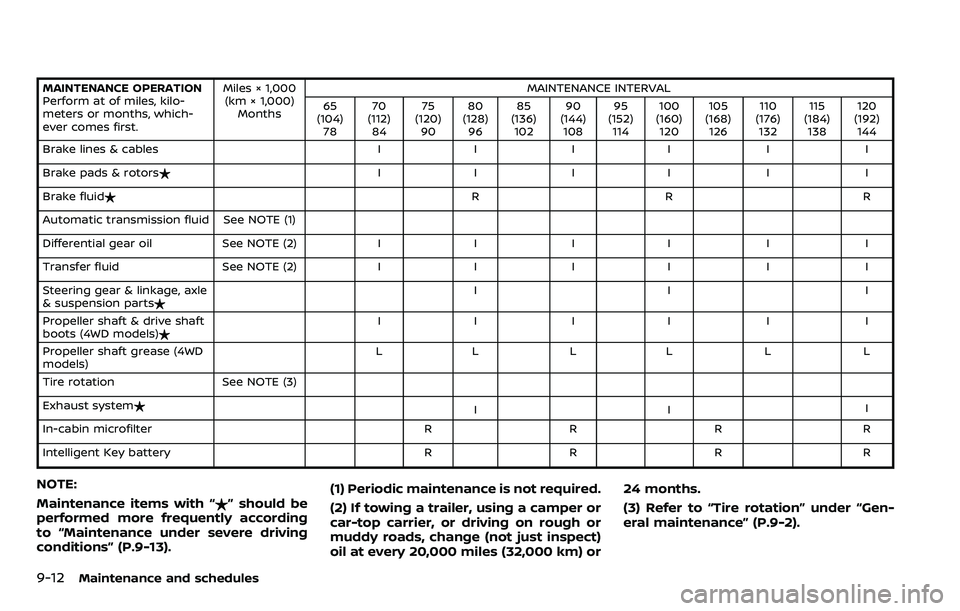
MAINTENANCE OPERATION
Perform at of miles, kilo-
meters or months, which-
ever comes first.Miles × 1,000
(km × 1,000) Months MAINTENANCE INTERVAL
65
(104) 78 70
(112) 84 75
(120) 90 80
(128) 96 85
(136) 102 90
(144) 108 95
(152) 114 100
(160) 120 105
(168) 126 110
(176) 132 115
(184) 138 120
(192) 144
Brake lines & cables II II I I
Brake pads & rotors$ II II I I
Brake fluid$ RR R
Automatic transmission fluid See NOTE (1)
Differential gear oil See NOTE (2)II II I I
Transfer fluid See NOTE (2)II II I I
Steering gear & linkage, axle
& suspension parts$ II I
Propeller shaft & drive shaft
boots (4WD models)$ II II I I
Propeller shaft grease (4WD
models) LL LL L L
Tire rotation See NOTE (3)
Exhaust system$ III
In-cabin microfilter RRR R
Intelligent Key battery RRR R
NOTE:
Maintenance items with “$” should be
performed more frequently according
to “Maintenance under severe driving
conditions” (P.9-13). (1) Periodic maintenance is not required.
(2) If towing a trailer, using a camper or
car-top carrier, or driving on rough or
muddy roads, change (not just inspect)
oil at every 20,000 miles (32,000 km) or24 months.
(3) Refer to “Tire rotation” under “Gen-
eral maintenance” (P.9-2).
Page 484 of 532
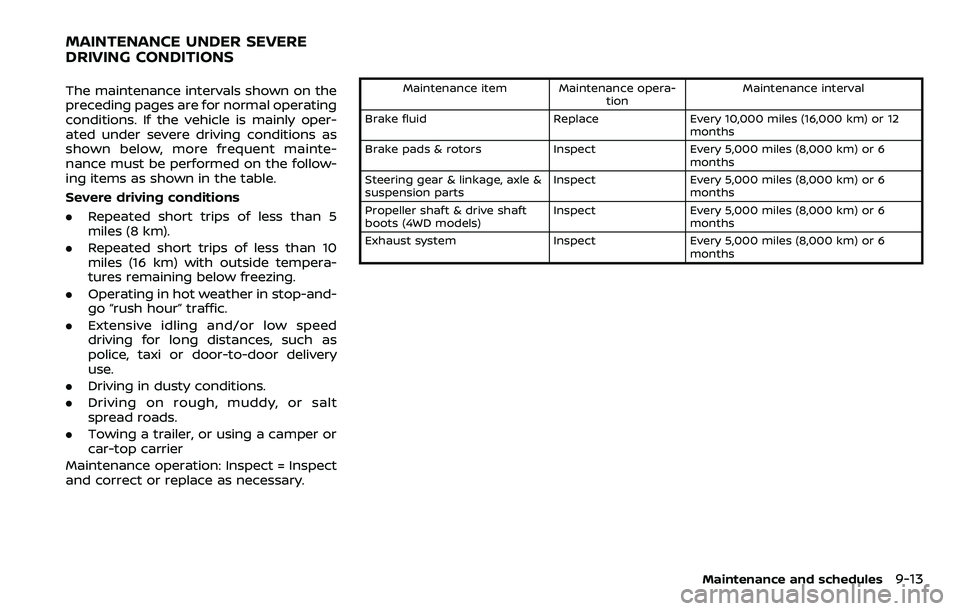
The maintenance intervals shown on the
preceding pages are for normal operating
conditions. If the vehicle is mainly oper-
ated under severe driving conditions as
shown below, more frequent mainte-
nance must be performed on the follow-
ing items as shown in the table.
Severe driving conditions
.Repeated short trips of less than 5
miles (8 km).
. Repeated short trips of less than 10
miles (16 km) with outside tempera-
tures remaining below freezing.
. Operating in hot weather in stop-and-
go “rush hour” traffic.
. Extensive idling and/or low speed
driving for long distances, such as
police, taxi or door-to-door delivery
use.
. Driving in dusty conditions.
. Driving on rough, muddy, or salt
spread roads.
. Towing a trailer, or using a camper or
car-top carrier
Maintenance operation: Inspect = Inspect
and correct or replace as necessary.Maintenance item Maintenance opera- tionMaintenance interval
Brake fluid ReplaceEvery 10,000 miles (16,000 km) or 12
months
Brake pads & rotors InspectEvery 5,000 miles (8,000 km) or 6
months
Steering gear & linkage, axle &
suspension parts Inspect
Every 5,000 miles (8,000 km) or 6
months
Propeller shaft & drive shaft
boots (4WD models) Inspect
Every 5,000 miles (8,000 km) or 6
months
Exhaust system InspectEvery 5,000 miles (8,000 km) or 6
months
Maintenance and schedules9-13
MAINTENANCE UNDER SEVERE
DRIVING CONDITIONS
Page 509 of 532
10-22Technical and consumer information
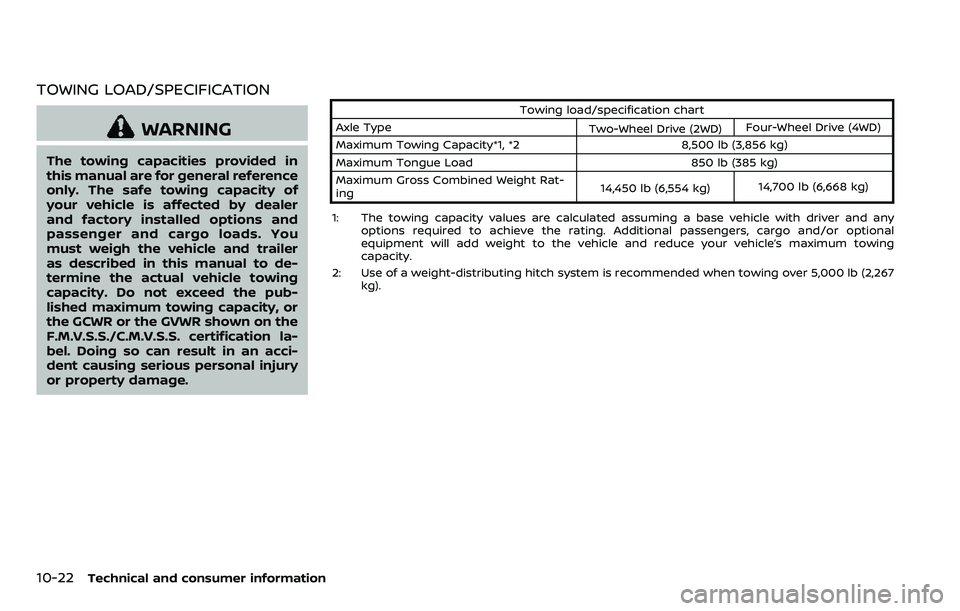
TOWING LOAD/SPECIFICATION
WARNING
The towing capacities provided in
this manual are for general reference
only. The safe towing capacity of
your vehicle is affected by dealer
and factory installed options and
passenger and cargo loads. You
must weigh the vehicle and trailer
as described in this manual to de-
termine the actual vehicle towing
capacity. Do not exceed the pub-
lished maximum towing capacity, or
the GCWR or the GVWR shown on the
F.M.V.S.S./C.M.V.S.S. certification la-
bel. Doing so can result in an acci-
dent causing serious personal injury
or property damage.
Towing load/specification chart
Axle Type Two-Wheel Drive (2WD)Four-Wheel Drive (4WD)
Maximum Towing Capacity*1, *2 8,500 lb (3,856 kg)
Maximum Tongue Load 850 lb (385 kg)
Maximum Gross Combined Weight Rat-
ing 14,450 lb (6,554 kg)
14,700 lb (6,668 kg)
1: The towing capacity values are calculated assuming a base vehicle with driver and any options required to achieve the rating. Additional passengers, cargo and/or optional
equipment will add weight to the vehicle and reduce your vehicle’s maximum towing
capacity.
2: Use of a weight-distributing hitch system is recommended when towing over 5,000 lb (2,267 kg).