weight NISSAN ARMADA 2022 Owner´s Manual
[x] Cancel search | Manufacturer: NISSAN, Model Year: 2022, Model line: ARMADA, Model: NISSAN ARMADA 2022Pages: 604, PDF Size: 2.97 MB
Page 579 of 604
WAJ0219X
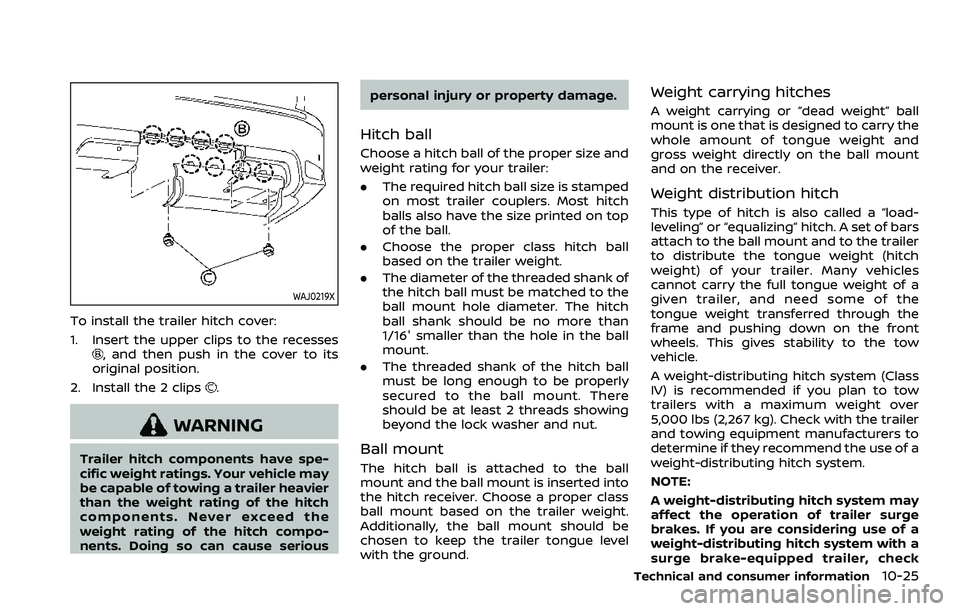
To install the trailer hitch cover:
1. Insert the upper clips to the recesses
, and then push in the cover to its
original position.
2. Install the 2 clips
.
WARNING
Trailer hitch components have spe-
cific weight ratings. Your vehicle may
be capable of towing a trailer heavier
than the weight rating of the hitch
components. Never exceed the
weight rating of the hitch compo-
nents. Doing so can cause serious personal injury or property damage.
Hitch ball
Choose a hitch ball of the proper size and
weight rating for your trailer:
.
The required hitch ball size is stamped
on most trailer couplers. Most hitch
balls also have the size printed on top
of the ball.
. Choose the proper class hitch ball
based on the trailer weight.
. The diameter of the threaded shank of
the hitch ball must be matched to the
ball mount hole diameter. The hitch
ball shank should be no more than
1/16″ smaller than the hole in the ball
mount.
. The threaded shank of the hitch ball
must be long enough to be properly
secured to the ball mount. There
should be at least 2 threads showing
beyond the lock washer and nut.
Ball mount
The hitch ball is attached to the ball
mount and the ball mount is inserted into
the hitch receiver. Choose a proper class
ball mount based on the trailer weight.
Additionally, the ball mount should be
chosen to keep the trailer tongue level
with the ground.
Weight carrying hitches
A weight carrying or “dead weight” ball
mount is one that is designed to carry the
whole amount of tongue weight and
gross weight directly on the ball mount
and on the receiver.
Weight distribution hitch
This type of hitch is also called a “load-
leveling” or “equalizing” hitch. A set of bars
attach to the ball mount and to the trailer
to distribute the tongue weight (hitch
weight) of your trailer. Many vehicles
cannot carry the full tongue weight of a
given trailer, and need some of the
tongue weight transferred through the
frame and pushing down on the front
wheels. This gives stability to the tow
vehicle.
A weight-distributing hitch system (Class
IV) is recommended if you plan to tow
trailers with a maximum weight over
5,000 lbs (2,267 kg). Check with the trailer
and towing equipment manufacturers to
determine if they recommend the use of a
weight-distributing hitch system.
NOTE:
A weight-distributing hitch system may
affect the operation of trailer surge
brakes. If you are considering use of a
weight-distributing hitch system with a
surge brake-equipped trailer, check
Technical and consumer information10-25
Page 580 of 604
10-26Technical and consumer information
with the surge brake, hitch or trailer
manufacturer to determine if and how
this can be done.
Follow the instructions provided by the
manufacturer for installing and using the
weight-distributing hitch system.
General set-up instructions are as follows:
1. Park unloaded vehicle on a level sur-face. With the ignition switch in the ON
position and the doors closed, allow
the vehicle to stand for several min-
utes so that it can level.
2. Measure the height of a reference point on the front and rear bumpers
at the center of the vehicle.
3. Attach the trailer to the vehicle and adjust the hitch equalizers so that the
front bumper height is within 0 - .5
inches (0 - 13 mm) of the reference
height measured in step 2. The rear
bumper should be no higher than the
reference height measured in step 2.
WARNING
Properly adjust the weight distribut-
ing hitch so the rear of the bumper is
no higher than the measured refer-
ence height when the trailer is at-
tached. If the rear bumper is higher than the measured reference height
when loaded, the vehicle may handle
unpredictably which could cause a
loss of vehicle control and cause
serious personal injury or property
damage.
Sway control device
Sudden maneuvers, wind gusts and buf-
feting caused by other vehicles can affect
trailer handling. Sway control devices
may be used to help control these affects.
If you choose to use one, contact a
reputable trailer hitch supplier to make
sure the sway control device will work
with the vehicle, hitch, trailer and the
trailer’s brake system. Follow the instruc-
tions provided by the manufacturer for
installing and using the sway control
device.
Class I hitch
Class I trailer hitch equipment (receiver,
ball mount and hitch ball) can be used to
tow trailers of a maximum weight of
2,000 lb (907 kg).
Class II hitch
Class II trailer hitch equipment (receiver,
ball mount and hitch ball) can be used to
tow trailers of a maximum weight of
3,500 lb (1,588 kg).
Class III hitch
Class III trailer hitch equipment (receiver,
ball mount and hitch ball) can be used to
tow trailers of a maximum weight of
5,000 lb (2,267 kg).
Class IV hitch
Class IV trailer hitch equipment (receiver,
ball mount and hitch ball) can be used to
tow trailers of a maximum weight of
10,000 lb (4,545 kg). A weight distributing
hitch should be used to tow trailers that
weigh over 5,000 lb (2,267 kg).
Your vehicle may be equipped with Class
IV trailer hitch equipment that has a
10,000 lb (4,545 kg) maximum weight
rating, but your vehicle is only capable of
towing the maximum trailer weights
shown in the “Towing Load/Specification”
chart earlier in this section.
CAUTION
.
Do not use axle-mounted hitches.
Page 581 of 604
.Do not modify the vehicle ex-
haust system, brake system, etc.
. Do not attach any additional
hitches to your vehicle because
a hitch is already mounted to
your vehicle frame.
Tire pressures
.When towing a trailer, inflate the
vehicle tires to the recom-
mended cold tire pressure indi-
cated on the Tire and Loading
Information label.
. Trailer tire condition, size, load
rating and proper inflation pres-
sure should be in accordance
with the trailer and tire manu-
facturers’ specifications.
Safety chains
Always use a suitable chain between your
vehicle and the trailer. The safety chains
should be crossed and should be at-
tached to the hitch, not to the vehicle
bumper or axle. Be sure to leave enough
slack in the chains to permit turning
corners.
STI0745
Trailer lights (if so equipped)
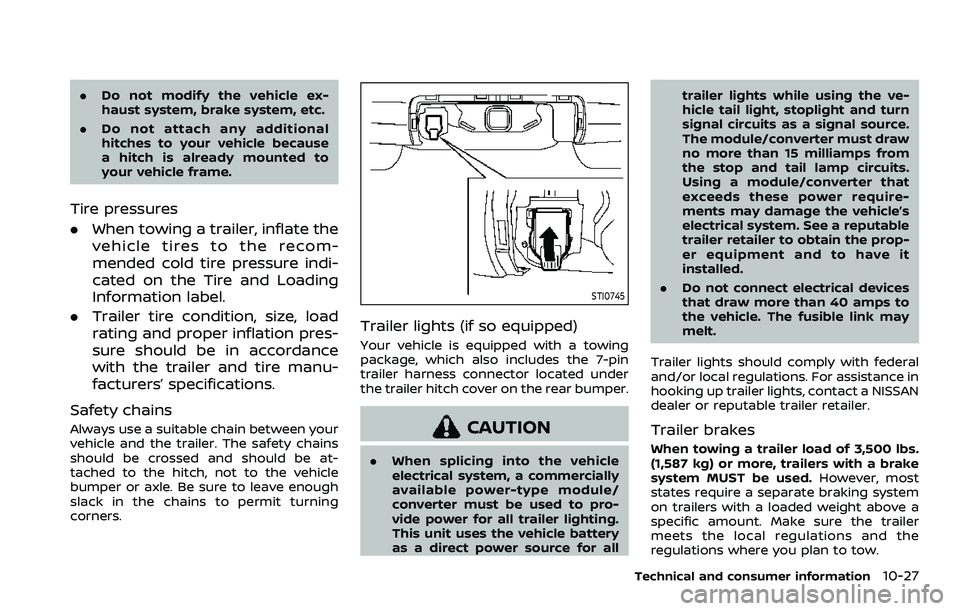
Your vehicle is equipped with a towing
package, which also includes the 7-pin
trailer harness connector located under
the trailer hitch cover on the rear bumper.
CAUTION
. When splicing into the vehicle
electrical system, a commercially
available power-type module/
converter must be used to pro-
vide power for all trailer lighting.
This unit uses the vehicle battery
as a direct power source for all trailer lights while using the ve-
hicle tail light, stoplight and turn
signal circuits as a signal source.
The module/converter must draw
no more than 15 milliamps from
the stop and tail lamp circuits.
Using a module/converter that
exceeds these power require-
ments may damage the vehicle’s
electrical system. See a reputable
trailer retailer to obtain the prop-
er equipment and to have it
installed.
. Do not connect electrical devices
that draw more than 40 amps to
the vehicle. The fusible link may
melt.
Trailer lights should comply with federal
and/or local regulations. For assistance in
hooking up trailer lights, contact a NISSAN
dealer or reputable trailer retailer.
Trailer brakes
When towing a trailer load of 3,500 lbs.
(1,587 kg) or more, trailers with a brake
system MUST be used. However, most
states require a separate braking system
on trailers with a loaded weight above a
specific amount. Make sure the trailer
meets the local regulations and the
regulations where you plan to tow.
Technical and consumer information10-27
Page 585 of 604
WAJ0208X
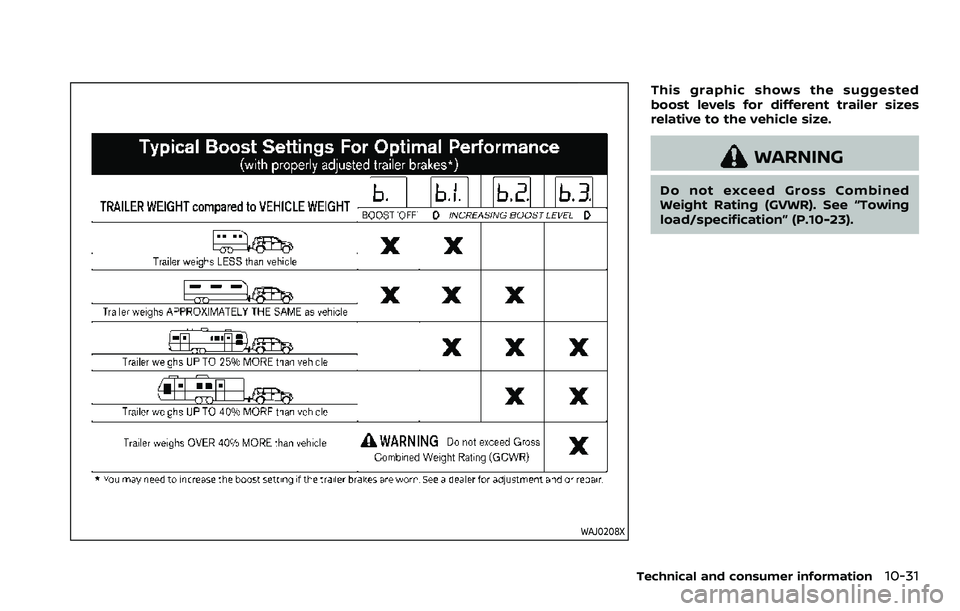
This graphic shows the suggested
boost levels for different trailer sizes
relative to the vehicle size.
WARNING
Do not exceed Gross Combined
Weight Rating (GVWR). See “Towing
load/specification” (P.10-23).
Technical and consumer information10-31
Page 587 of 604
2. Start the engine.
3. Shift the transmission into gear.
4. Release the parking brake.
5. Drive slowly until the vehicle andtrailer are clear from the blocks.
6. Apply and hold the brake pedal.
7. Have someone retrieve and store the blocks.
. While going downhill, the weight of the
trailer pushing on the tow vehicle may
decrease overall stability. Therefore, to
maintain adequate control, reduce
your speed and shift to a lower gear.
Avoid long or repeated use of the
brakes when descending a hill, as this
reduces their effectiveness and could
cause overheating. Shifting to a lower
gear instead provides “engine braking”
and reduces the need to brake as
frequently.
. If the engine coolant temperature
rises to a high temperature, see “If
your vehicle overheats” (P.6-14).
. Trailer towing requires more fuel than
normal circumstances.
. Avoid towing a trailer for your vehicle’s
first 500 miles (800 km).
. Have your vehicle serviced more often
than at intervals specified in the
recommended maintenance schedule
shown in the "9. Maintenance and schedules" section.
. When making a turn, your trailer
wheels will be closer to the inside of
the turn than your vehicle wheels. To
compensate for this, make a larger
than normal turning radius during the
turn.
. Crosswinds and rough roads will ad-
versely affect vehicle/trailer handling,
possibly causing vehicle sway. When
being passed by larger vehicles, be
prepared for possible changes in
crosswinds that could affect vehicle
handling.
Do the following if the trailer begins to
sway:
1. Take your foot off the accelerator pedal to allow the vehicle to coast
and steer as straight ahead as the
road conditions allow. This combina-
tion will help stabilize the vehicle.
.Do not correct trailer sway bysteering or applying the brakes.
2. When the trailer sway stops, gently apply the brakes and pull to the side
of the road in a safe area.
3. Try to rearrange the trailer load so it is balanced as described earlier in this
section.
. Be careful when passing other vehi-
cles. Passing while towing a trailer requires considerably more distance
than normal passing. Remember the
length of the trailer must also pass the
other vehicle before you can safely
change lanes.
. Use the Tow mode or downshift the
transmission to a lower gear for en-
gine braking when driving down steep
or long hills. This will help slow the
vehicle without applying the brakes.
. Avoid holding the brake pedal down
too long or too frequently. This could
cause the brakes to overheat, result-
ing in reduced braking efficiency.
. Increase your following distance to
allow for greater stopping distances
while towing a trailer. Anticipate stops
and brake gradually.
. NISSAN recommends that the cruise
control not be used while towing a
trailer.
. While towing a trailer, do not use the
following systems (if so equipped):
— the Lane Departure Warning (LDW)
system
(See “How to enable/disable the
LDW system” (P.5-28).)
— the Intelligent Lane Intervention (I- LI) system
(See “How to enable/disable the I-LI
system” (P.5-34).)
Technical and consumer information10-33