engine overheat NISSAN ARMADA 2023 User Guide
[x] Cancel search | Manufacturer: NISSAN, Model Year: 2023, Model line: ARMADA, Model: NISSAN ARMADA 2023Pages: 604, PDF Size: 2.97 MB
Page 497 of 604
JVM0733X
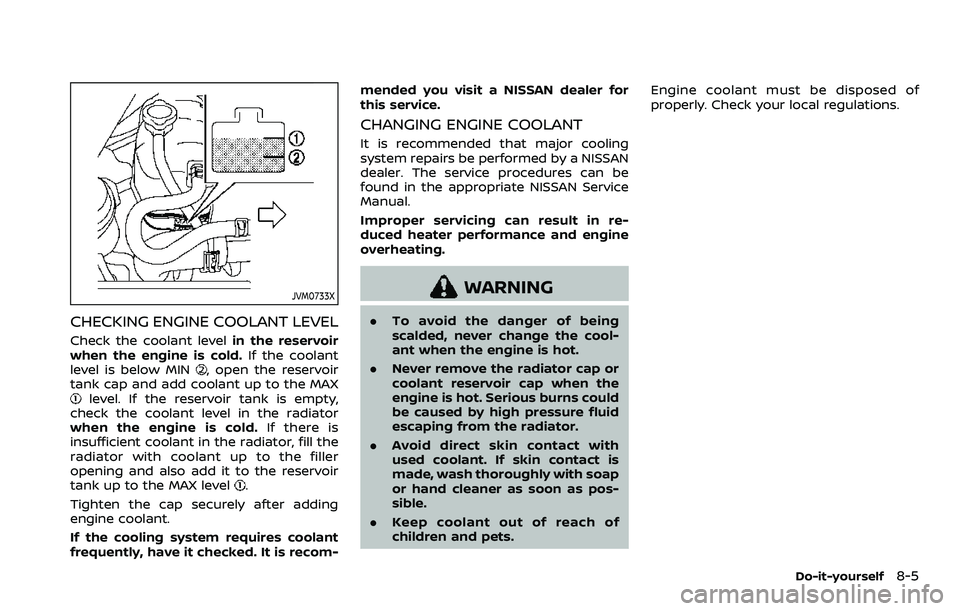
CHECKING ENGINE COOLANT LEVEL
Check the coolant levelin the reservoir
when the engine is cold. If the coolant
level is below MIN
, open the reservoir
tank cap and add coolant up to the MAX
level. If the reservoir tank is empty,
check the coolant level in the radiator
when the engine is cold. If there is
insufficient coolant in the radiator, fill the
radiator with coolant up to the filler
opening and also add it to the reservoir
tank up to the MAX level
.
Tighten the cap securely after adding
engine coolant.
If the cooling system requires coolant
frequently, have it checked. It is recom- mended you visit a NISSAN dealer for
this service.
CHANGING ENGINE COOLANT
It is recommended that major cooling
system repairs be performed by a NISSAN
dealer. The service procedures can be
found in the appropriate NISSAN Service
Manual.
Improper servicing can result in re-
duced heater performance and engine
overheating.
WARNING
.
To avoid the danger of being
scalded, never change the cool-
ant when the engine is hot.
. Never remove the radiator cap or
coolant reservoir cap when the
engine is hot. Serious burns could
be caused by high pressure fluid
escaping from the radiator.
. Avoid direct skin contact with
used coolant. If skin contact is
made, wash thoroughly with soap
or hand cleaner as soon as pos-
sible.
. Keep coolant out of reach of
children and pets. Engine coolant must be disposed of
properly. Check your local regulations.
Do-it-yourself8-5
Page 560 of 604
10-6Technical and consumer information
Octane rating tips
Using unleaded gasoline with an octane
rating lower than recommended above
can cause persistent, heavy spark
knock. (Spark knock is a metallic rap-
ping noise.) If severe, this can lead to
engine damage. If you detect a persis-
tent heavy spark knock even when
using gasoline of the stated octane
rating, or if you hear steady spark knock
while holding a steady speed on level
roads, it is recommended you have a
NISSAN dealer correct the condition.
Failure to correct the condition is mis-
use of the vehicle, for which NISSAN is
not responsible.
Incorrect ignition timing will result in
knocking, after-run or overheating. This
in turn may cause excessive fuel con-
sumption or damage to the engine. If any
of the above symptoms are encountered,
have your vehicle checked. It is recom-
mended you visit a NISSAN dealer for
servicing.
However, now and then you may notice
light spark knock for a short time while
accelerating or driving up hills. This is
no cause for concern, because you get
the greatest fuel benefit when there is
light spark knock for a short time under
heavy engine load.
JVT0342X
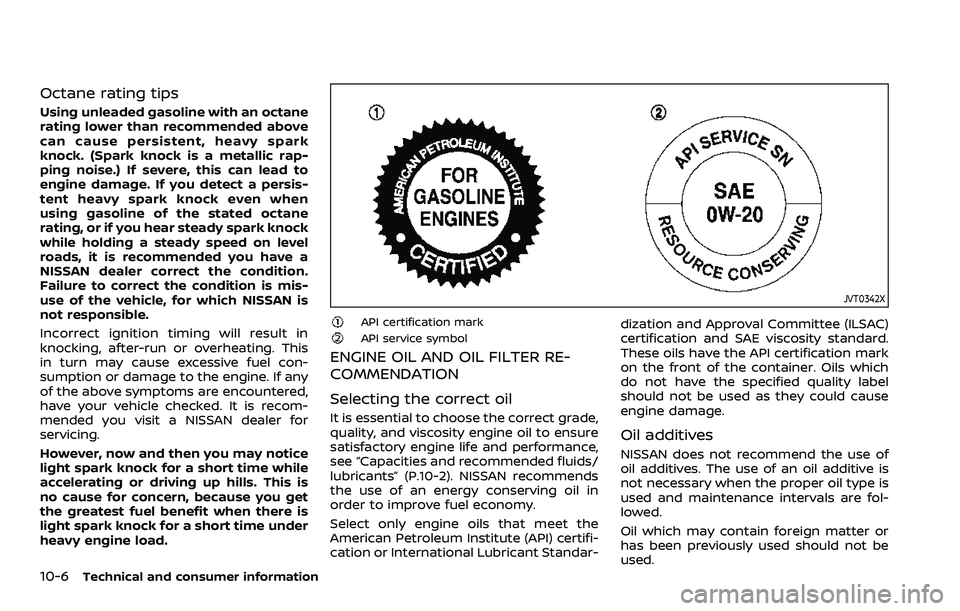
API certification markAPI service symbol
ENGINE OIL AND OIL FILTER RE-
COMMENDATION
Selecting the correct oil
It is essential to choose the correct grade,
quality, and viscosity engine oil to ensure
satisfactory engine life and performance,
see “Capacities and recommended fluids/
lubricants” (P.10-2). NISSAN recommends
the use of an energy conserving oil in
order to improve fuel economy.
Select only engine oils that meet the
American Petroleum Institute (API) certifi-
cation or International Lubricant Standar-dization and Approval Committee (ILSAC)
certification and SAE viscosity standard.
These oils have the API certification mark
on the front of the container. Oils which
do not have the specified quality label
should not be used as they could cause
engine damage.
Oil additives
NISSAN does not recommend the use of
oil additives. The use of an oil additive is
not necessary when the proper oil type is
used and maintenance intervals are fol-
lowed.
Oil which may contain foreign matter or
has been previously used should not be
used.
Page 574 of 604
10-20Technical and consumer information
STI0541
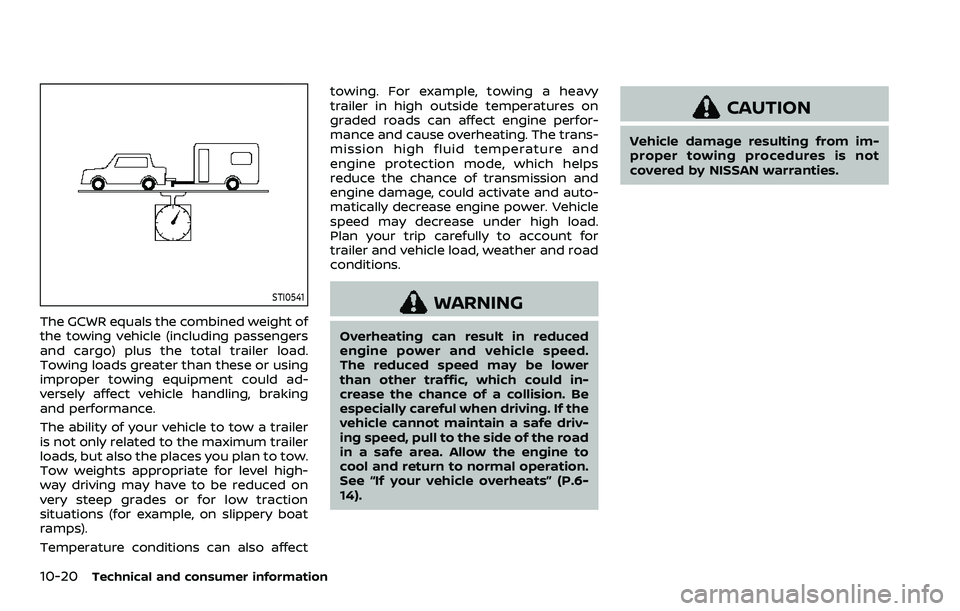
The GCWR equals the combined weight of
the towing vehicle (including passengers
and cargo) plus the total trailer load.
Towing loads greater than these or using
improper towing equipment could ad-
versely affect vehicle handling, braking
and performance.
The ability of your vehicle to tow a trailer
is not only related to the maximum trailer
loads, but also the places you plan to tow.
Tow weights appropriate for level high-
way driving may have to be reduced on
very steep grades or for low traction
situations (for example, on slippery boat
ramps).
Temperature conditions can also affecttowing. For example, towing a heavy
trailer in high outside temperatures on
graded roads can affect engine perfor-
mance and cause overheating. The trans-
mission high fluid temperature and
engine protection mode, which helps
reduce the chance of transmission and
engine damage, could activate and auto-
matically decrease engine power. Vehicle
speed may decrease under high load.
Plan your trip carefully to account for
trailer and vehicle load, weather and road
conditions.
WARNING
Overheating can result in reduced
engine power and vehicle speed.
The reduced speed may be lower
than other traffic, which could in-
crease the chance of a collision. Be
especially careful when driving. If the
vehicle cannot maintain a safe driv-
ing speed, pull to the side of the road
in a safe area. Allow the engine to
cool and return to normal operation.
See “If your vehicle overheats” (P.6-
14).
CAUTION
Vehicle damage resulting from im-
proper towing procedures is not
covered by NISSAN warranties.
Page 587 of 604
2. Start the engine.
3. Shift the transmission into gear.
4. Release the parking brake.
5. Drive slowly until the vehicle andtrailer are clear from the blocks.
6. Apply and hold the brake pedal.
7. Have someone retrieve and store the blocks.
. While going downhill, the weight of the
trailer pushing on the tow vehicle may
decrease overall stability. Therefore, to
maintain adequate control, reduce
your speed and shift to a lower gear.
Avoid long or repeated use of the
brakes when descending a hill, as this
reduces their effectiveness and could
cause overheating. Shifting to a lower
gear instead provides “engine braking”
and reduces the need to brake as
frequently.
. If the engine coolant temperature
rises to a high temperature, see “If
your vehicle overheats” (P.6-14).
. Trailer towing requires more fuel than
normal circumstances.
. Avoid towing a trailer for your vehicle’s
first 500 miles (800 km).
. Have your vehicle serviced more often
than at intervals specified in the
recommended maintenance schedule
shown in the "9. Maintenance and schedules" section.
. When making a turn, your trailer
wheels will be closer to the inside of
the turn than your vehicle wheels. To
compensate for this, make a larger
than normal turning radius during the
turn.
. Crosswinds and rough roads will ad-
versely affect vehicle/trailer handling,
possibly causing vehicle sway. When
being passed by larger vehicles, be
prepared for possible changes in
crosswinds that could affect vehicle
handling.
Do the following if the trailer begins to
sway:
1. Take your foot off the accelerator pedal to allow the vehicle to coast
and steer as straight ahead as the
road conditions allow. This combina-
tion will help stabilize the vehicle.
.Do not correct trailer sway bysteering or applying the brakes.
2. When the trailer sway stops, gently apply the brakes and pull to the side
of the road in a safe area.
3. Try to rearrange the trailer load so it is balanced as described earlier in this
section.
. Be careful when passing other vehi-
cles. Passing while towing a trailer requires considerably more distance
than normal passing. Remember the
length of the trailer must also pass the
other vehicle before you can safely
change lanes.
. Use the Tow mode or downshift the
transmission to a lower gear for en-
gine braking when driving down steep
or long hills. This will help slow the
vehicle without applying the brakes.
. Avoid holding the brake pedal down
too long or too frequently. This could
cause the brakes to overheat, result-
ing in reduced braking efficiency.
. Increase your following distance to
allow for greater stopping distances
while towing a trailer. Anticipate stops
and brake gradually.
. NISSAN recommends that the cruise
control not be used while towing a
trailer.
. While towing a trailer, do not use the
following systems (if so equipped):
— the Lane Departure Warning (LDW)
system
(See “How to enable/disable the
LDW system” (P.5-28).)
— the Intelligent Lane Intervention (I- LI) system
(See “How to enable/disable the I-LI
system” (P.5-34).)
Technical and consumer information10-33
Page 596 of 604
11-2
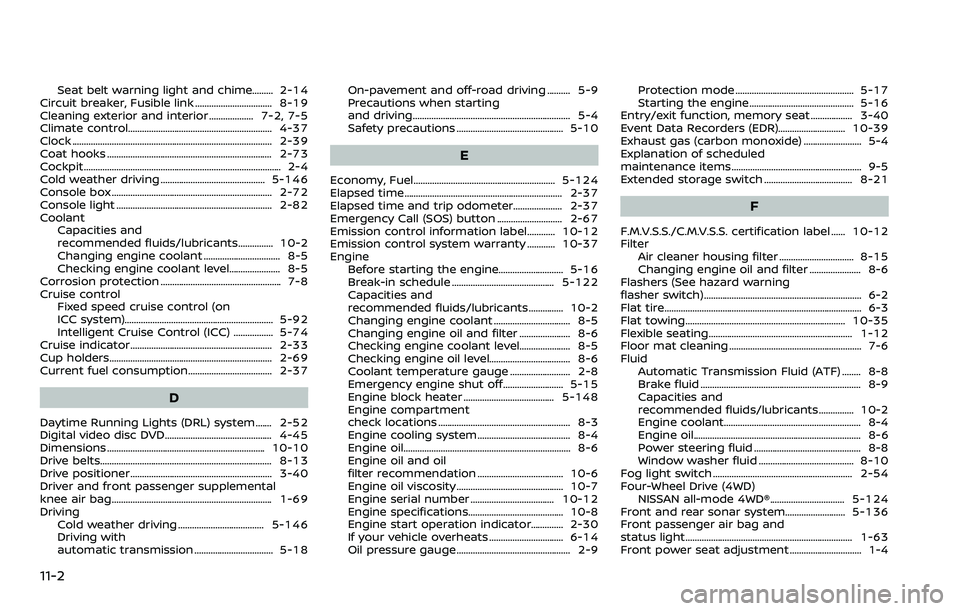
Seat belt warning light and chime......... 2-14
Circuit breaker, Fusible link ................................. 8-19
Cleaning exterior and interior ................... 7-2, 7-5
Climate control.............................................................. 4-37
Clock ........................................................................\
.............. 2-39
Coat hooks ....................................................................... 2-73
Cockpit ........................................................................\
............. 2-4
Cold weather driving ............................................. 5-146
Console box ..................................................................... 2-72
Console light ................................................................... 2-82
Coolant Capacities and
recommended fluids/lubricants............... 10-2
Changing engine coolant ................................. 8-5
Checking engine coolant level...................... 8-5
Corrosion protection .................................................... 7-8
Cruise control Fixed speed cruise control (on
ICC system)................................................................ 5-92
Intelligent Cruise Control (ICC) ................. 5-74
Cruise indicator............................................................. 2-33
Cup holders...................................................................... 2-69
Current fuel consumption.................................... 2-37
D
Daytime Running Lights (DRL) system....... 2-52
Digital video disc DVD.............................................. 4-45
Dimensions .................................................................... 10-10
Drive belts...................................................................\
....... 8-13
Drive positioner............................................................. 3-40
Driver and front passenger supplemental
knee air bag..................................................................... 1-69
Driving Cold weather driving ..................................... 5-146
Driving with
automatic transmission .................................. 5-18 On-pavement and off-road driving .......... 5-9
Precautions when starting
and driving.................................................................... 5-4
Safety precautions .............................................. 5-10
E
Economy, Fuel............................................................. 5-124
Elapsed time.................................................................... 2-37
Elapsed time and trip odometer..................... 2-37
Emergency Call (SOS) button ............................ 2-67
Emission control information label............ 10-12
Emission control system warranty ............ 10-37
Engine
Before starting the engine............................ 5-16
Break-in schedule ............................................ 5-122
Capacities and
recommended fluids/lubricants............... 10-2
Changing engine coolant ................................. 8-5
Changing engine oil and filter ...................... 8-6
Checking engine coolant level...................... 8-5
Checking engine oil level................................... 8-6
Coolant temperature gauge .......................... 2-8
Emergency engine shut off.......................... 5-15
Engine block heater ....................................... 5-148
Engine compartment
check locations ......................................................... 8-3
Engine cooling system ........................................ 8-4
Engine oil.....................................................................\
... 8-6
Engine oil and oil
filter recommendation ..................................... 10-6
Engine oil viscosity .............................................. 10-7
Engine serial number .................................... 10-12
Engine specifications......................................... 10-8
Engine start operation indicator.............. 2-30
If your vehicle overheats ................................ 6-14
Oil pressure gauge ................................................. 2-9 Protection mode ................................................... 5-17
Starting the engine............................................. 5-16
Entry/exit function, memory seat .................. 3-40
Event Data Recorders (EDR)............................. 10-39
Exhaust gas (carbon monoxide) ......................... 5-4
Explanation of scheduled
maintenance items ........................................................ 9-5
Extended storage switch ...................................... 8-21
F
F.M.V.S.S./C.M.V.S.S. certification label ...... 10-12
Filter Air cleaner housing filter ................................ 8-15
Changing engine oil and filter ...................... 8-6
Flashers (See hazard warning
flasher switch).................................................................... 6-2
Flat tire........................................................................\
............. 6-3
Flat towing..................................................................... 10-35
Flexible seating.............................................................. 1-12
Floor mat cleaning ......................................................... 7-6
Fluid Automatic Transmission Fluid (ATF) ........ 8-8
Brake fluid ..................................................................... 8-9
Capacities and
recommended fluids/lubricants............... 10-2
Engine coolant........................................................... 8-4
Engine oil.....................................................................\
... 8-6
Power steering fluid .............................................. 8-8
Window washer fluid ......................................... 8-10
Fog light switch ............................................................ 2-54
Four-Wheel Drive (4WD) NISSAN all-mode 4WD®................................ 5-124
Front and rear sonar system.......................... 5-136
Front passenger air bag and
status light........................................................................\
1-63
Front power seat adjustment ............................... 1-4
Page 598 of 604
11-4
Engine serial number .................................... 10-12
F.M.V.S.S./C.M.V.S.S.
certification label .............................................. 10-12
Tire and Loading
information label................................ 8-30, 10-13
Vehicle identification number (VIN) .... 10-11
Lane Departure Warning (LDW) ........................ 5-26
LATCH system ................................................................ 1-35
License plate, Installing front
license plate.................................................................. 10-15
Liftgate........................................................................\
......... 3-22
Light Air bag warning light......................................... 1-74
Bulb replacement ................................................. 8-24
Cargo light ................................................................. 2-83
Fog light switch ..................................................... 2-54
Headlight switch ................................................... 2-47
Headlights bulb replacement ..................... 8-25
Indicator lights........................................................ 2-15
Interior light switch............................................. 2-81
Interior lights............................................................ 2-81
Map lights ................................................................... 2-82
Replacement ............................................................ 8-24
Vanity mirror lights ............................................. 2-83
Warning/indicator lights and
audible reminders ................................................ 2-12
Lights, Exterior and interior
light replacement ........................................................ 8-26
Linking Intelligent Key (air conditioner)..... 4-43
Loading information (See vehicle
loading information) .............................................. 10-15
Lock Automatic door locks........................................... 3-6
Door locks...................................................................... 3-4
Liftgate lock .............................................................. 3-22
Power door lock ....................................................... 3-4
Locking with mechanical key ................................ 3-4 Loose Fuel Cap warning........................................ 3-26
Low tire pressure warning light ...................... 2-16
Low tire pressure warning system
(See Tire Pressure Monitoring
System (TPMS)).................................................................. 5-5
Luggage hooks ............................................................. 2-73
M
Maintenance........................................................................\
9-2
Battery........................................................................\
... 8-11
General maintenance........................................... 9-2
Inside the vehicle..................................................... 9-3
Maintenance precautions................................. 8-2
Maintenance requirements ............................. 9-2
Maintenance schedules...................................... 9-7
Outside the vehicle ................................................ 9-2
Seat belt maintenance..................................... 1-29
Maintenance schedules.............................................. 9-7
Malfunction Indicator Light (MIL) .................... 2-18
Map lights ........................................................................\
.. 2-82
Master warning light.................................. 2-14, 2-18
Mechanical key (Intelligent Key system) ....... 3-3
Memory seat ................................................................... 3-40
Memory storage, memory seat........................ 3-41
Meter Trip computer ......................................................... 2-37
Meters and gauges ........................................................ 2-6 Instrument brightness control .................. 2-53
Mirror Inside mirror ............................................................. 3-30
Intelligent Rear View Mirror.......................... 3-31
Outside mirrors ...................................................... 3-38
Vanity mirror ............................................................ 3-40
Monitor Intelligent Around View® Monitor............ 4-12
Monitor, RearView Monitor ...................................... 4-4 Moonroof........................................................................\
.... 2-78
Moving Object Detection (MOD) ...................... 4-31
N
New vehicle break-in ............................................. 5-122
NISSAN all-mode 4WD®........................................ 5-124
NISSAN Vehicle Immobilizer System ............ 2-41
NissanConnect® Owner’s Manual....................... 4-3
O
Odometer........................................................................\
....... 2-7
Off-road recovery ............................................................ 5-9
Oil
Capacities and
recommended fluids/lubricants............... 10-2
Changing engine oil and filter ...................... 8-6
Checking engine oil level................................... 8-6
Engine oil.....................................................................\
... 8-6
Engine oil pressure gauge ............................... 2-9
Engine oil viscosity .............................................. 10-7
Operation, operational indicators .................. 2-30
Other lights....................................................................... 2-19
Outside air temperature ........................................ 2-39
Outside mirrors ............................................................. 3-38
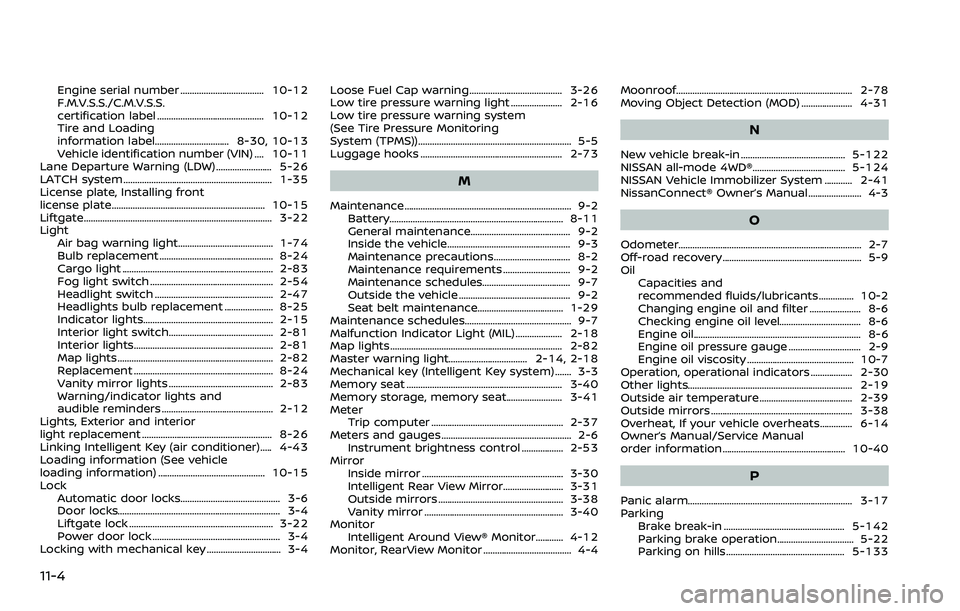
Overheat, If your vehicle overheats.............. 6-14
Owner’s Manual/Service Manual
order information..................................................... 10-40
P
Panic alarm....................................................................... 3-17
Parking Brake break-in .................................................... 5-142
Parking brake operation................................. 5-22
Parking on hills................................................... 5-133