seats NISSAN CUBE 2009 Repair Manual
[x] Cancel search | Manufacturer: NISSAN, Model Year: 2009, Model line: CUBE, Model: NISSAN CUBE 2009Pages: 321, PDF Size: 4.99 MB
Page 87 of 321
Black plate (85,1)
Model "Z12-D" EDITED: 2009/ 1/ 28
WARNING
If the supplemental air bag warning
light is on, it could mean that the front
air bag, side air bag, curtain air bag
and/or pretensioner systems will not
operate in an accident. To help avoid
injury to yourself or others, have your
vehicle checked by a NISSAN dealer as
soon as possible.INDICATOR LIGHTS
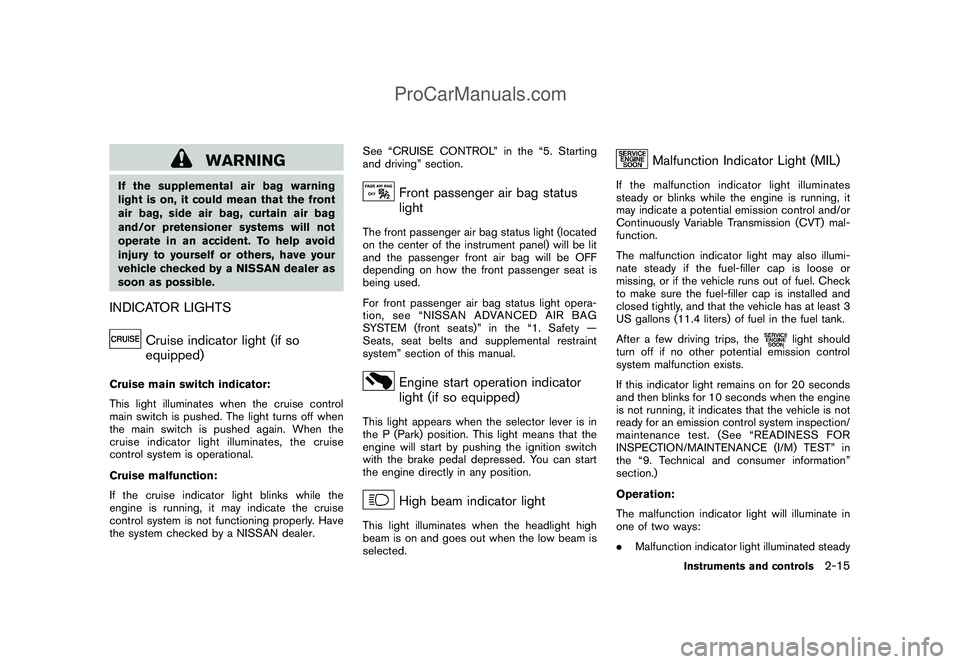
Cruise indicator light (if so
equipped)
Cruise main switch indicator:
This light illuminates when the cruise control
main switch is pushed. The light turns off when
the main switch is pushed again. When the
cruise indicator light illuminates, the cruise
control system is operational.
Cruise malfunction:
If the cruise indicator light blinks while the
engine is running, it may indicate the cruise
control system is not functioning properly. Have
the system checked by a NISSAN dealer.See “CRUISE CONTROL” in the “5. Starting
and driving” section.
Front passenger air bag status
light
The front passenger air bag status light (located
on the center of the instrument panel) will be lit
and the passenger front air bag will be OFF
depending on how the front passenger seat is
being used.
For front passenger air bag status light opera-
tion,see“NISSANADVANCEDAIRBAG
SYSTEM (front seats)” in the “1. Safety —
Seats, seat belts and supplemental restraint
system” section of this manual.
Engine start operation indicator
light (if so equipped)
This light appears when the selector lever is in
the P (Park) position. This light means that the
engine will start by pushing the ignition switch
with the brake pedal depressed. You can start
the engine directly in any position.
High beam indicator light
This light illuminates when the headlight high
beam is on and goes out when the low beam is
selected.
Malfunction Indicator Light (MIL)
If the malfunction indicator light illuminates
steady or blinks while the engine is running, it
may indicate a potential emission control and/or
Continuously Variable Transmission (CVT) mal-
function.
The malfunction indicator light may also illumi-
nate steady if the fuel-filler cap is loose or
missing, or if the vehicle runs out of fuel. Check
to make sure the fuel-filler cap is installed and
closed tightly, and that the vehicle has at least 3
US gallons (11.4 liters) of fuel in the fuel tank.
After a few driving trips, the
light should
turn off if no other potential emission control
system malfunction exists.
If this indicator light remains on for 20 seconds
and then blinks for 10 seconds when the engine
is not running, it indicates that the vehicle is not
ready for an emission control system inspection/
maintenance test. (See “READINESS FOR
INSPECTION/MAINTENANCE (I/M) TEST” in
the “9. Technical and consumer information”
section.)
Operation:
The malfunction indicator light will illuminate in
one of two ways:
. Malfunction indicator light illuminated steady
Instruments and controls
2-15
ProCarManuals.com
Page 195 of 321

Black plate (193,1)
Model "Z12-D" EDITED: 2009/ 1/ 28
pressure sensors, and the TPMS will
not function properly.
Some devices and transmitters may temporarily
interfere with the operation of the TPMS and
cause the low tire pressure warning light to
illuminate. Some examples are:
.Facilities or electric devices using similar
radio frequencies are near the vehicle.
.If a transmitter set to similar frequencies is
being used in or near the vehicle.
.If a computer (or similar equipment) or a DC/
AC converter is being used in or near the
vehicle.
FCC Notice:
Changes or modifications not expressly
approved by the party responsible for
compliance could void the user’s authority
to operate the equipment.
This device complies with Part 15 of the
FCC Rules and RSS-210 of Industry Cana-
da.
Operation is subject to the following two
conditions: (1) This device may not cause
harmful interference, and (2) this device
must accept any interference received,
including interference that may cause un-
desired operation of the device.
AVOIDING COLLISION AND ROLL-
OVER
WARNING
Failure to operate this vehicle in a safe
and prudent manner may result in loss
of control or an accident.
Be alert and drive defensively at all times. Obey
all traffic regulations. Avoid excessive speed,
high speed cornering, or sudden steering
maneuvers, because these driving practices
could cause you to lose control of your vehicle.
As with any vehicle, a loss of control could
result in a collision with other vehicles or
objects, or cause the vehicle to rollover,
particularly if the loss of control causes the
vehicle to slide sideways.Be attentive at all
times, and avoid driving when tired. Never drive
when under the influence of alcohol or drugs
(including prescription or over-the-counter
drugs which may cause drowsiness) . Always
wear your seat belt as outlined in the “SEAT
BELTS” in the “1. Safety — Seats, seat belts and
supplemental restraint system” section of this
manual, and also instruct your passengers to do
so.
Seat belts help reduce the risk of injury in
collisions and rollovers.In a rollover crash, an
unbelted or improperly belted person issignificantly more likely to be injured or
killed than a person properly wearing a
seat belt.
OFF-ROAD RECOVERYWhile driving, the right side or left side wheels
may unintentionally leave the road surface. If this
occurs, maintain control of the vehicle by
following the procedure below. Please note that
this procedure is only a general guide. The
vehicle must be driven as appropriate based on
the conditions of the vehicle, road and traffic.
1. Remain calm and do not overreact.
2. Do not apply the brakes.
3. Maintain a firm grip on the steering wheel
with both hands and try to hold a straight
course.
4. When appropriate, slowly release the accel-
erator pedal to gradually slow the vehicle.
5. If there is nothing in the way, steer the
vehicle to follow the road while the vehicle
speed is reduced. Do not attempt to drive
the vehicle back onto the road surface until
vehicle speed is reduced.
6. When it is safe to do so, gradually turn the
steering wheel until both tires return to the
road surface. When all tires are on the road
surface, steer the vehicle to stay in the
Starting and driving
5-5
ProCarManuals.com
Page 247 of 321

Black plate (245,1)
Model "Z12-D" EDITED: 2009/ 1/ 28
Occasionally remove loose dust from the interior
trim, plastic parts and seats using a vacuum
cleaner or soft bristled brush. Wipe the vinyl and
leather surfaces with a clean, soft cloth dam-
pened in mild soap solution, then wipe clean
with a dry soft cloth.
Regular care and cleaning is required in order to
maintain the appearance of the leather.
Before using any fabric protector, read the
manufacturer’s recommendations. Some fabric
protectors contain chemicals that may stain or
bleach the seat material.
Use a cloth dampened only with water, to clean
the meter and gauge lens.
WARNING
Do not use water or acidic cleaners (hot
steam cleaners) on the seat. This can
damage the seat or occupant classifica-
tion sensors. This can also affect the
operation of the air bag system and
result in serious personal injury.
CAUTION
.Never use benzine, thinner, or any
similar material.
.Small dirt particles can be abrasiveand damaging to the leather sur-
faces and should be removed
promptly. Do not use saddle soap,
car waxes, polishes, oils, cleaning
fluids, solvents, detergents or am-
monia-based cleaners as they may
damage the leather’s natural finish.
.Never use fabric protectors unless
recommended by the manufacturer.
.Do not use glass or plastic cleaner
on meter or gauge lens covers. It
may damage the lens cover.
AIR FRESHENERSMost air fresheners use a solvent that could
affect the vehicle interior. If you use an air
freshener, take the following precautions:
.Hanging-type air fresheners can cause
permanent discoloration when they contact
vehicle interior surfaces. Place the air
freshener in a location that allows it to hang
free and not contact an interior surface.
.Liquid-type air fresheners typically clip on
the vents. These products can cause
immediate damage and discoloration when
spilled on interior surfaces.
Carefully read and follow the manufacturer’s
instructions before using air fresheners.
FLOOR MATSThe use of genuine NISSAN floor mats can
extend the life of your vehicle carpet and make it
easier to clean the interior.No matter what
mats are used, be sure they are fitted for
your vehicle and are properly positioned in
the footwell to prevent interference with
pedal operation.Mats should be maintained
with regular cleaning and replaced if they
become excessively worn.
CLEANING INTERIOR
Appearance and care
7-5
ProCarManuals.com
Page 248 of 321
Black plate (246,1)
Model "Z12-D" EDITED: 2009/ 1/ 28
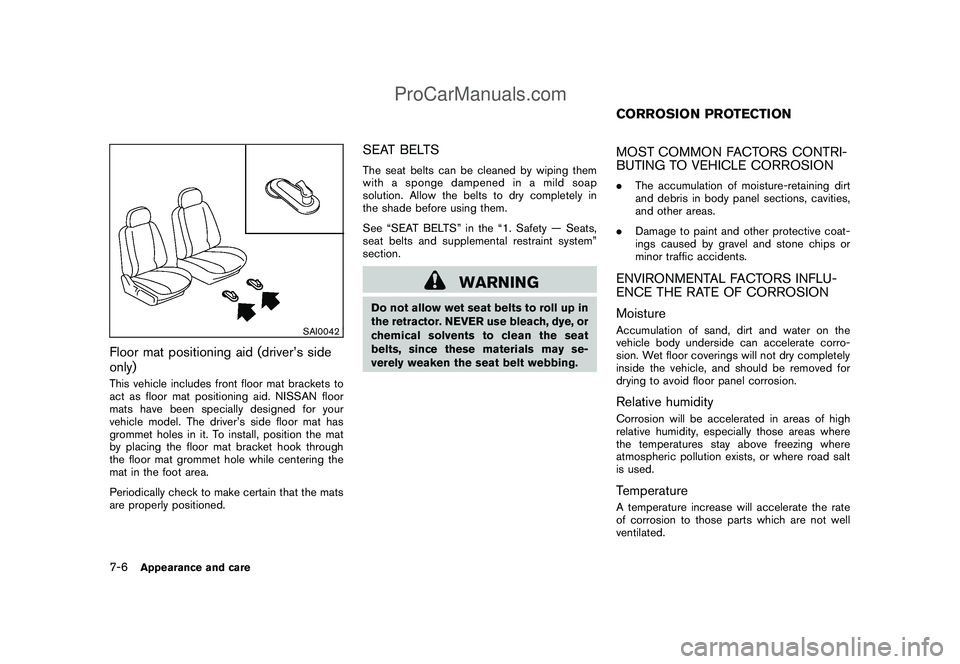
SAI0042
Floor mat positioning aid (driver’s side
only)This vehicle includes front floor mat brackets to
act as floor mat positioning aid. NISSAN floor
mats have been specially designed for your
vehicle model. The driver’s side floor mat has
grommet holes in it. To install, position the mat
by placing the floor mat bracket hook through
the floor mat grommet hole while centering the
mat in the foot area.
Periodically check to make certain that the mats
are properly positioned.
SEAT BELTSThe seat belts can be cleaned by wiping them
with a sponge dampened in a mild soap
solution. Allow the belts to dry completely in
the shade before using them.
See “SEAT BELTS” in the “1. Safety — Seats,
seat belts and supplemental restraint system”
section.
WARNING
Do not allow wet seat belts to roll up in
the retractor. NEVER use bleach, dye, or
chemical solvents to clean the seat
belts, since these materials may se-
verely weaken the seat belt webbing.
MOST COMMON FACTORS CONTRI-
BUTING TO VEHICLE CORROSION.The accumulation of moisture-retaining dirt
and debris in body panel sections, cavities,
and other areas.
.Damage to paint and other protective coat-
ings caused by gravel and stone chips or
minor traffic accidents.ENVIRONMENTAL FACTORS INFLU-
ENCE THE RATE OF CORROSION
MoistureAccumulation of sand, dirt and water on the
vehicle body underside can accelerate corro-
sion. Wet floor coverings will not dry completely
inside the vehicle, and should be removed for
drying to avoid floor panel corrosion.Relative humidityCorrosion will be accelerated in areas of high
relative humidity, especially those areas where
the temperatures stay above freezing where
atmospheric pollution exists, or where road salt
is used.TemperatureA temperature increase will accelerate the rate
of corrosion to those parts which are not well
ventilated.CORROSION PROTECTION
7-6
Appearance and care
ProCarManuals.com
Page 253 of 321
Black plate (251,1)
Model "Z12-D" EDITED: 2009/ 1/ 28
Lights*:Clean the headlights on a regular basis.
Make sure that the headlights, stop lights, tail
lights, turn signal lights, and other lights are all
operating properly and installed securely. Also
check headlight aim.
Road wheel nuts (lug nuts)*:When checking
the tires, make sure no wheel nuts are missing,
and check for any loose wheel nuts. Tighten if
necessary.
Tire rotation*:Tires should be rotated every
7,500 miles (12,000 km).
Tires*:Check the pressure with a gauge often
and always prior to long distance trips. If
necessary, adjust the pressure in all tires,
including the spare, to the pressure specified.
Check carefully for damage, cuts or excessive
wear.
Tire Pressure Monitoring System (TPMS)
transmitter components:Replace the TPMS
transmitter grommet seal, valve core and cap
when the tires are replaced due to wear or age.
Wheel alignment and balance:If the vehicle
should pull to either side while driving on a
straight and level road, or if you detect uneven or
abnormal tire wear, there may be a need for
wheel alignment.
If the steering wheel or seat vibrates at normal
highway speeds, wheel balancing may be
needed.For additional information regarding tires, refer
to “Important Tire Safety Information” (US) or
“Tire Safety Information” (Canada) in the War-
ranty Information Booklet.
Windshield:Clean the windshield on a regular
basis. Check the windshield at least every six
months for cracks or other damage. Have a
damaged windshield repaired by a qualified
repair facility.
Windshield wiper blades*:Check for cracks
or wear if they do not wipe properly.
Inside the vehicleThe maintenance items listed here should be
checked on a regular basis, such as when
performing scheduled maintenance, cleaning
the vehicle, etc.
Accelerator pedal:Check the pedal for
smooth operation and make sure the pedal
does not catch or require uneven effort. Keep
the floor mat away from the pedal.
Brake pedal:Check the pedal for smooth
operation. If the brake pedal suddenly goes
down further than normal, the pedal feels
spongy or the vehicle seems to take longer to
stop, see a NISSAN dealer immediately. Keep
the floor mat away from the pedal.
Brakes:Check that the brakes do not pull the
vehicle to one side when applied.Continuously Variable Transmission (CVT)
P (Park) position mechanism:On a fairly
steep hill, check that the vehicle is held securely
with the selector lever in the P (Park) position
without applying any brakes.
Parking brake:Check the parking brake
operation regularly. The vehicle should be
securely held on a fairly steep hill with only the
parking brake applied. If the parking brake needs
adjusted, see a NISSAN dealer.
Seat belts:Check that all parts of the seat belt
system (for example, buckles, anchors, adjusters
and retractors) operate properly and smoothly,
and are installed securely. Check the belt
webbing for cuts, fraying, wear or damage.
Seats:Check seat position controls such as
seat adjusters, seatback recliners, etc. to ensure
they operate smoothly and that all latches lock
securely in every position. Check that the head
restraints move up and down smoothly and that
the locks (if so equipped) hold securely in all
latched positions.
Steering wheel:Check for changes in the
steering conditions, such as excessive free play,
hard steering or strange noises.
Warning lights and chimes:Make sure that
all warning lights and chimes are operating
properly.
Maintenance and do-it-yourself
8-3
ProCarManuals.com
Page 302 of 321
Black plate (300,1)
Model "Z12-D" EDITED: 2009/ 1/ 28
7. Insert a flat-blade screwdriver into the
grommet hole to add a 908turn onto the
part
*E.
8. Insert a J-nut into the license plate bracket
before placing the license plate bracket on
the fascia.
9. Install the license plate bracket with the
screws.
10. Install the license plate with bolts that are
not longer than 0.55 in (14 mm) .
WARNING
.
It is extremely dangerous to ride
in a cargo area inside the vehi-
cle. In a collision, people riding
in these areas are more likely to
be seriously injured or killed.
.
Do not allow people to ride in
any area of your vehicle that is
not equipped with seats and
seat belts.
.
Be sure everyone in your vehicle
is in a seat and using a seat belt
properly.
TERMSIt is important to familiarize yourself with the
following terms before loading your vehicle:.
Curb Weight (actual weight of your
vehicle) - vehicle weight including:
standard and optional equipment,
fluids, emergency tools, and spare tire
assembly. This weightdoes notin-
clude passengers and cargo.
.
GVW (Gross Vehicle Weight) - curb
weight plus the combined weight of
passengers and cargo.
.
GVWR (Gross Vehicle Weight Rating)
- maximum total combined weight of the
unloaded vehicle, passengers, luggage,
hitch, trailer tongue load and any other
optional equipment. This information is
located on the F.M.V.S.S./C.M.V.S.S.
label.
.
GAWR (Gross Axle Weight Rating) -
maximum weight (load) limit specified
for the front or rear axle. This informa-
tion is located on the F.M.V.S.S./C.M.V.
S.S. label.
.
GCWR (Gross Combined Weight Rat-
ing) - The maximum total weight rating
of the vehicle, passengers, cargo, and
trailer.
.
Vehicle Capacity Weight, Load limit,
Total load capacity - maximum total
weight limit specified of the load
(passengers and cargo) for the vehicle.
This is the maximum combined weight
of occupants and cargo that can be
loaded into the vehicle. If the vehicle is
used to tow a trailer, the trailer tongue
weight must be included as part of the
cargo load. This information is located
on the Tire and Loading Information
label.
VEHICLE LOADING INFORMATION
9-14
Technical and consumer information
ProCarManuals.com
Page 313 of 321
Black plate (1,1)
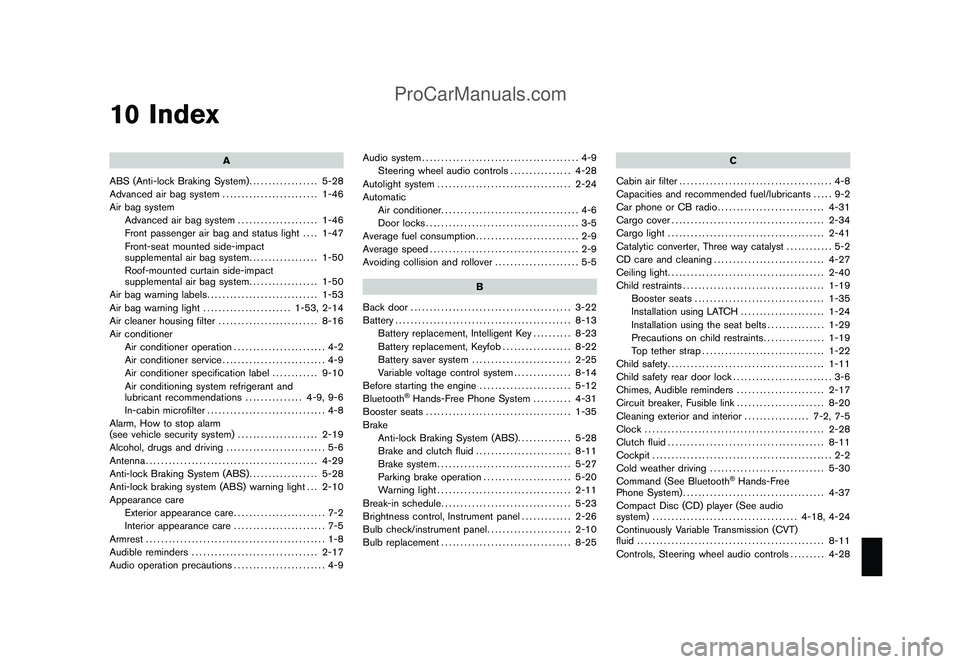
10 Index
A
ABS (Anti-lock Braking System).................. 5-28
Advanced air bag system......................... 1-46
Air bag system
Advanced air bag system..................... 1-46
Front passenger air bag and status light.... 1-47
Front-seat mounted side-impact
supplemental air bag system.................. 1-50
Roof-mounted curtain side-impact
supplemental air bag system.................. 1-50
Air bag warning labels............................. 1-53
Air bag warning light....................... 1-53, 2-14
Air cleaner housing filter.......................... 8-16
Air conditioner
Air conditioner operation........................ 4-2
Air conditioner service........................... 4-9
Air conditioner specification label............ 9-10
Air conditioning system refrigerant and
lubricant recommendations............... 4-9, 9-6
In-cabin microfilter............................... 4-8
Alarm, How to stop alarm
(see vehicle security system)..................... 2-19
Alcohol, drugs and driving.......................... 5-6
Antenna............................................. 4-29
Anti-lock Braking System (ABS).................. 5-28
Anti-lock braking system (ABS) warning light . . . 2-10
Appearance care
Exterior appearance care........................ 7-2
Interior appearance care........................ 7-5
Armrest............................................... 1-8
Audible reminders ................................. 2-17
Audio operation precautions........................ 4-9Audio system......................................... 4-9
Steering wheel audio controls................ 4-28
Autolight system................................... 2-24
Automatic
Air conditioner.................................... 4-6
Door locks........................................ 3-5
Average fuel consumption........................... 2-9
Average speed....................................... 2-9
Avoiding collision and rollover...................... 5-5
B
Back door .......................................... 3-22
Battery.............................................. 8-13
Battery replacement, Intelligent Key.......... 8-23
Battery replacement, Keyfob.................. 8-22
Battery saver system.......................... 2-25
Variable voltage control system............... 8-14
Before starting the engine........................ 5-12
Bluetooth
®Hands-Free Phone System.......... 4-31
Booster seats...................................... 1-35
Brake
Anti-lock Braking System (ABS).............. 5-28
Brake and clutch fluid......................... 8-11
Brake system................................... 5-27
Parking brake operation....................... 5-20
Warning light................................... 2-11
Break-in schedule.................................. 5-23
Brightness control, Instrument panel............. 2-26
Bulb check/instrument panel...................... 2-10
Bulb replacement.................................. 8-25C
Cabin air filter........................................ 4-8
Capacities and recommended fuel/lubricants..... 9-2
Car phone or CB radio............................ 4-31
Cargo cover........................................ 2-34
Cargo light......................................... 2-41
Catalytic converter, Three way catalyst............ 5-2
CD care and cleaning............................. 4-27
Ceiling light......................................... 2-40
Child restraints..................................... 1-19
Booster seats .................................. 1-35
Installation using LATCH...................... 1-24
Installation using the seat belts............... 1-29
Precautions on child restraints................ 1-19
Top tether strap................................ 1-22
Child safety......................................... 1-11
Child safety rear door lock.......................... 3-6
Chimes, Audible reminders....................... 2-17
Circuit breaker, Fusible link ....................... 8-20
Cleaning exterior and interior................. 7-2, 7-5
Clock............................................... 2-28
Clutch fluid......................................... 8-11
Cockpit............................................... 2-2
Cold weather driving.............................. 5-30
Command (See Bluetooth
®Hands-Free
Phone System)..................................... 4-37
Compact Disc (CD) player (See audio
system)...................................... 4-18, 4-24
Continuously Variable Transmission (CVT)
fluid................................................. 8-11
Controls, Steering wheel audio controls......... 4-28
Model "MASTER" EDITED: 2009/ 1/ 28
ProCarManuals.com
Page 316 of 321
Black plate (4,1)
10-4
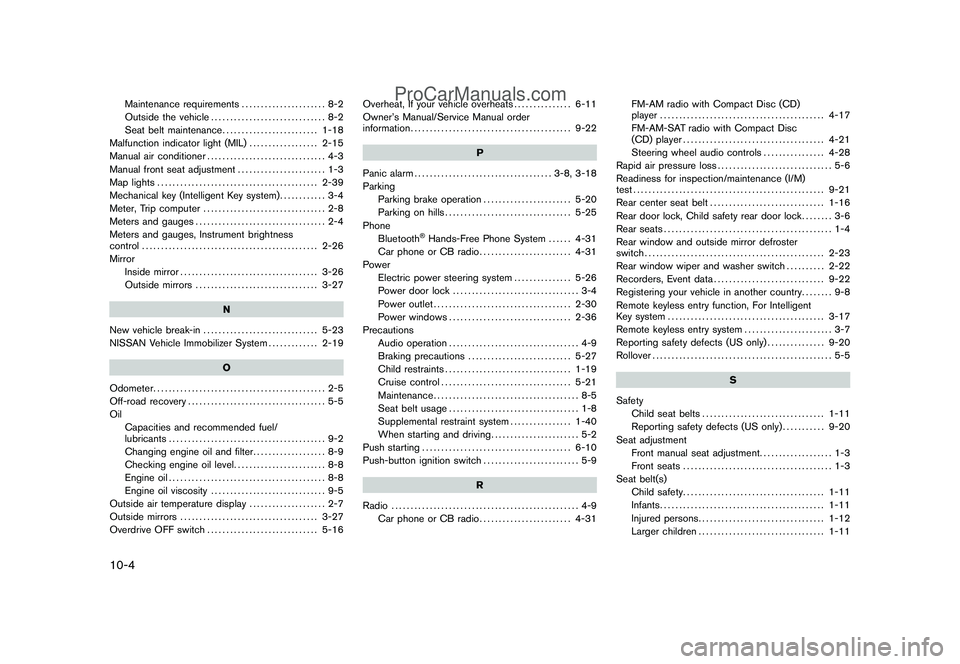
Maintenance requirements...................... 8-2
Outside the vehicle.............................. 8-2
Seat belt maintenance......................... 1-18
Malfunction indicator light (MIL).................. 2-15
Manual air conditioner............................... 4-3
Manual front seat adjustment....................... 1-3
Map lights .......................................... 2-39
Mechanical key (Intelligent Key system)............ 3-4
Meter, Trip computer................................ 2-8
Meters and gauges.................................. 2-4
Meters and gauges, Instrument brightness
control.............................................. 2-26
Mirror
Inside mirror.................................... 3-26
Outside mirrors................................ 3-27
N
New vehicle break-in.............................. 5-23
NISSAN Vehicle Immobilizer System............. 2-19
O
Odometer............................................. 2-5
Off-road recovery.................................... 5-5
Oil
Capacities and recommended fuel/
lubricants......................................... 9-2
Changing engine oil and filter................... 8-9
Checking engine oil level........................ 8-8
Engine oil......................................... 8-8
Engine oil viscosity.............................. 9-5
Outside air temperature display.................... 2-7
Outside mirrors.................................... 3-27
Overdrive OFF switch............................. 5-16Overheat, If your vehicle overheats............... 6-11
Owner’s Manual/Service Manual order
information.......................................... 9-22
P
Panic alarm.................................... 3-8, 3-18
Parking
Parking brake operation....................... 5-20
Parking on hills................................. 5-25
Phone
Bluetooth
®Hands-Free Phone System...... 4-31
Car phone or CB radio........................ 4-31
Power
Electric power steering system............... 5-26
Power door lock ................................. 3-4
Power outlet.................................... 2-30
Power windows................................ 2-36
Precautions
Audio operation.................................. 4-9
Braking precautions........................... 5-27
Child restraints................................. 1-19
Cruise control.................................. 5-21
Maintenance...................................... 8-5
Seat belt usage.................................. 1-8
Supplemental restraint system................ 1-40
When starting and driving....................... 5-2
Push starting....................................... 6-10
Push-button ignition switch......................... 5-9
R
Radio................................................. 4-9
Car phone or CB radio........................ 4-31FM-AM radio with Compact Disc (CD)
player........................................... 4-17
FM-AM-SAT radio with Compact Disc
(CD) player..................................... 4-21
Steering wheel audio controls ................ 4-28
Rapid air pressure loss.............................. 5-6
Readiness for inspection/maintenance (I/M)
test.................................................. 9-21
Rear center seat belt .............................. 1-16
Rear door lock, Child safety rear door lock........ 3-6
Rear seats............................................ 1-4
Rear window and outside mirror defroster
switch............................................... 2-23
Rear window wiper and washer switch.......... 2-22
Recorders, Event data............................. 9-22
Registering your vehicle in another country........ 9-8
Remote keyless entry function, For Intelligent
Key system......................................... 3-17
Remote keyless entry system....................... 3-7
Reporting safety defects (US only)............... 9-20
Rollover............................................... 5-5
S
Safety
Child seat belts................................ 1-11
Reporting safety defects (US only)........... 9-20
Seat adjustment
Front manual seat adjustment................... 1-3
Front seats ....................................... 1-3
Seat belt(s)
Child safety..................................... 1-11
Infants........................................... 1-11
Injured persons................................. 1-12
Larger children ................................. 1-11
Model "MASTER" EDITED: 2009/ 1/ 28
ProCarManuals.com
Page 317 of 321
Black plate (5,1)
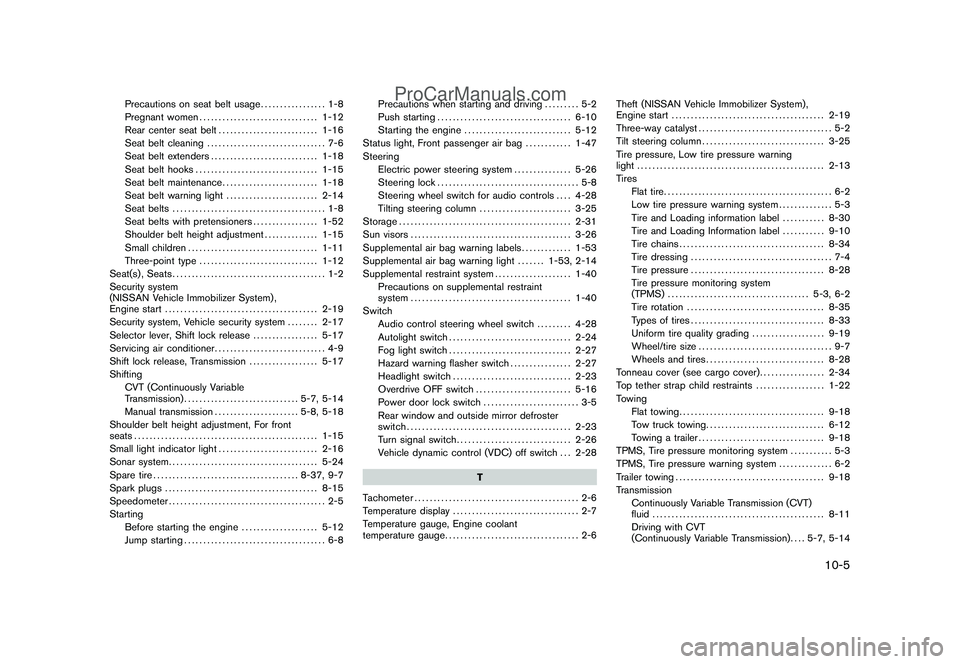
Precautions on seat belt usage................. 1-8
Pregnant women............................... 1-12
Rear center seat belt.......................... 1-16
Seat belt cleaning............................... 7-6
Seat belt extenders............................ 1-18
Seat belt hooks................................ 1-15
Seat belt maintenance......................... 1-18
Seat belt warning light........................ 2-14
Seat belts........................................ 1-8
Seat belts with pretensioners................. 1-52
Shoulder belt height adjustment.............. 1-15
Small children.................................. 1-11
Three-point type............................... 1-12
Seat(s) , Seats........................................ 1-2
Security system
(NISSAN Vehicle Immobilizer System) ,
Engine start........................................ 2-19
Security system, Vehicle security system........ 2-17
Selector lever, Shift lock release................. 5-17
Servicing air conditioner............................. 4-9
Shift lock release, Transmission.................. 5-17
Shifting
CVT (Continuously Variable
Transmission).............................. 5-7, 5-14
Manual transmission...................... 5-8, 5-18
Shoulder belt height adjustment, For front
seats................................................ 1-15
Small light indicator light.......................... 2-16
Sonar system....................................... 5-24
Spare tire...................................... 8-37, 9-7
Spark plugs ........................................ 8-15
Speedometer......................................... 2-5
Starting
Before starting the engine.................... 5-12
Jump starting..................................... 6-8Precautions when starting and driving......... 5-2
Push starting................................... 6-10
Starting the engine............................ 5-12
Status light, Front passenger air bag............ 1-47
Steering
Electric power steering system............... 5-26
Steering lock..................................... 5-8
Steering wheel switch for audio controls.... 4-28
Tilting steering column........................ 3-25
Storage............................................. 2-31
Sun visors.......................................... 3-26
Supplemental air bag warning labels............. 1-53
Supplemental air bag warning light....... 1-53, 2-14
Supplemental restraint system.................... 1-40
Precautions on supplemental restraint
system.......................................... 1-40
Switch
Audio control steering wheel switch......... 4-28
Autolight switch................................ 2-24
Fog light switch................................ 2-27
Hazard warning flasher switch................ 2-27
Headlight switch............................... 2-23
Overdrive OFF switch......................... 5-16
Power door lock switch......................... 3-5
Rear window and outside mirror defroster
switch........................................... 2-23
Turn signal switch.............................. 2-26
Vehicle dynamic control (VDC) off switch . . . 2-28
T
Tachometer........................................... 2-6
Temperature display................................. 2-7
Temperature gauge, Engine coolant
temperature gauge................................... 2-6Theft (NISSAN Vehicle Immobilizer System) ,
Engine start ........................................ 2-19
Three-way catalyst................................... 5-2
Tilt steering column................................ 3-25
Tire pressure, Low tire pressure warning
light................................................. 2-13
Tires
Flat tire............................................ 6-2
Low tire pressure warning system.............. 5-3
Tire and Loading information label........... 8-30
Tire and Loading Information label........... 9-10
Tire chains...................................... 8-34
Tire dressing..................................... 7-4
Tire pressure................................... 8-28
Tire pressure monitoring system
(TPMS)..................................... 5-3, 6-2
Tire rotation.................................... 8-35
Types of tires................................... 8-33
Uniform tire quality grading................... 9-19
Wheel/tire size................................... 9-7
Wheels and tires............................... 8-28
Tonneau cover (see cargo cover)................. 2-34
Top tether strap child restraints.................. 1-22
Towing
Flat towing...................................... 9-18
Tow truck towing............................... 6-12
Towing a trailer................................. 9-18
TPMS, Tire pressure monitoring system........... 5-3
TPMS, Tire pressure warning system.............. 6-2
Trailer towing....................................... 9-18
Transmission
Continuously Variable Transmission (CVT)
fluid............................................. 8-11
Driving with CVT
(Continuously Variable Transmission).... 5-7, 5-14
10-5
Model "MASTER" EDITED: 2009/ 1/ 28
ProCarManuals.com