roof NISSAN CUBE 2012 3.G Owners Manual
[x] Cancel search | Manufacturer: NISSAN, Model Year: 2012, Model line: CUBE, Model: NISSAN CUBE 2012 3.GPages: 331, PDF Size: 2.55 MB
Page 10 of 331

0-2Illustrated table of contents
SSI0659
1. Supplemental front-impact air bags (Page 1-40)
2. Front seat-mounted side-impact supplementalair bags (P.1-40)
3. Seat belts (P.1-10)
4. Front head restraints (P.1-6) — Front-seat Active Head Restraints (P.1-8)
5. Roof-mounted curtain side-impact supplemental air bags (P.1-40)
6. Rear head restraints* (P.1-6)
7. Rear center seat belt* (P.1-16)
8. Occupant classification sensors (weight sen- sors)
— Advanced Air Bag System (P.1-46)
9. Front seats (P.1-3) 10. Seat belt with pretensioners (P.1-52)
11. Rear seats* (P.1-4)
— Child restraints (P.1-21)
12. LATCH (Lower Anchors and Tethers for CHil- dren) system* (P.1-23)
*: except for Cargo Van models
SEATS, SEAT BELTS AND
SUPPLEMENTAL RESTRAINT
SYSTEM (SRS)
Page 19 of 331

1 Safety — Seats, seat belts and supplementalrestraint system
Seats ........................................................................\
.................... 1-2
Front seats ........................................................................\
.... 1-3
Rear seats (if so equipped) .............................................. 1-4
Head restraints .................................................................... 1-6
Armrest (if so equipped) ................................................... 1-9
Seat belts ........................................................................\
......... 1-10
Precautions on seat belt usage .................................... 1-10
Pregnant women .............................................................. 1-12
Injured persons ................................................................. 1-12
Three-point type seat belt .............................................. 1-12
Seat belt extenders .......................................................... 1-18
Seat belt maintenance .................................................... 1-19
Child safety ........................................................................\
...... 1-19
Infants ........................................................................\
.......... 1-20
Small children .................................................................... 1-20
Larger children .................................................................. 1-20
Child restraints ........................................................................\
1-21 Precautions on child restraints ..................................... 1-21
Lower Anchors and Tethers for CHildren System
(LATCH) (except for Cargo Van models) .................. 1-23 Rear-facing child restraint installation
using LATCH ................................................................... 1-27
Rear-facing child restraint installation using the
seat belts ........................................................................\
.. 1-29
Forward-facing child restraint installation
using LATCH ................................................................... 1-31
Forward-facing child restraint installation using the
seat belts ........................................................................\
.. 1-33
Installing top tether strap ............................................. 1-36
Booster seats .................................................................. 1-37
Supplemental restraint system ........................................... 1-40 Precautions on supplemental restraint system ....... 1-40
NISSAN Advanced Air Bag System
(front seats) ..................................................................... 1-46
Front seat-mounted side-impact supplemental
air bag and roof-mounted curtain side-impact
supplemental air bag systems .................................... 1-50
Seat belts with pretensioners (front seats) ............. 1-52
Supplemental air bag warning labels ....................... 1-53
Supplemental air bag warning light .......................... 1-53
Repair and replacement procedure .......................... 1-54
Page 58 of 331
1-40Safety — Seats, seat belts and supplemental restraint system
PRECAUTIONS ON SUPPLEMENTAL
RESTRAINT SYSTEM
This Supplemental Restraint System (SRS)
section contains important information concern-
ing the following systems:
.Driver and passenger supplemental front-
impact air bag (NISSAN Advanced Air Bag
System)
. Front seat-mounted side-impact supple-
mental air bag
. Roof-mounted curtain side-impact supple-
mental air bag
. Seat belt with pretensioner
Supplemental front-impact air bag system:
The NISSAN Advanced Air Bag System can
help cushion the impact force to the head and
chest of the driver and front passenger in certain
frontal collisions.
Front seat-mounted side-impact supple-
mental air bag system: This system can help
cushion the impact force to the chest and pelvic
area of the driver and front passenger in certain
side impact collisions. The side air bag is
designed to inflate on the side where the vehicle
is impacted.
Roof-mounted curtain side-impact supple-
mental air bag system: This system can help
cushion the impact force to the head of occupants in front and rear outboard seating
positions in certain side impact collisions. The
curtain air bags are designed to inflate on the
side where the vehicle is impacted.
These supplemental restraint systems are de-
signed to
supplement the crash protection
provided by the driver and passenger seat belts
and are not a substitute for them. Seat belts
should always be correctly worn and the
occupant seated a suitable distance away from
the steering wheel, instrument panel and door
finishers. (See “Seat belts” (P.1-10) for instruc-
tions and precautions on seat belt usage.)
The supplemental air bags operate only
when the ignition switch is in the ON
position.
After the ignition is placed in the ON
position, the supplemental air bag warning
light illuminates. The supplemental air bag
warning light will turn off after about 7
seconds if the systems are operational.
SUPPLEMENTAL RESTRAINT
SYSTEM
Page 62 of 331
1-44Safety — Seats, seat belts and supplemental restraint system
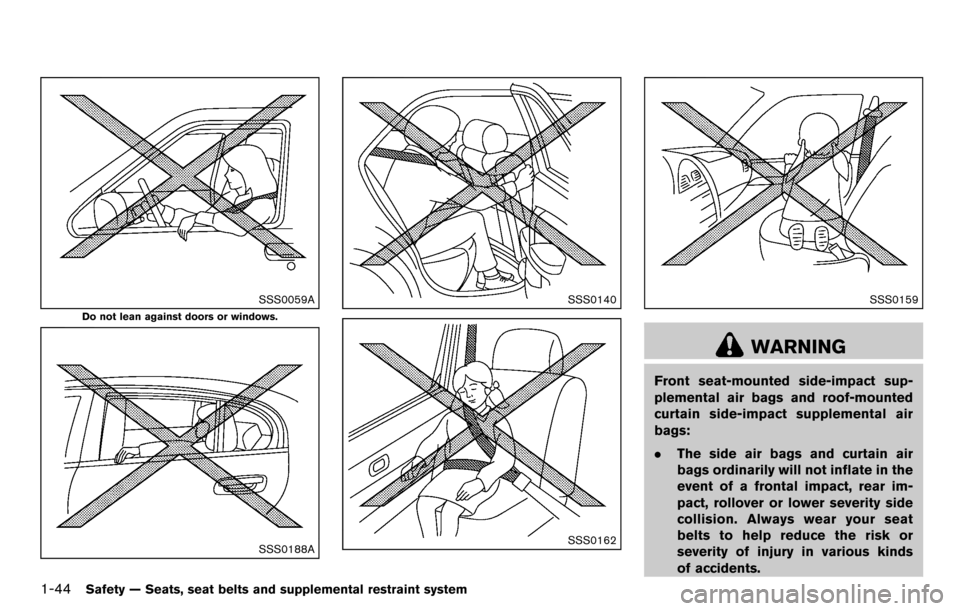
SSS0059A
Do not lean against doors or windows.
SSS0188A
SSS0140
SSS0162
SSS0159
WARNING
Front seat-mounted side-impact sup-
plemental air bags and roof-mounted
curtain side-impact supplemental air
bags:
.The side air bags and curtain air
bags ordinarily will not inflate in the
event of a frontal impact, rear im-
pact, rollover or lower severity side
collision. Always wear your seat
belts to help reduce the risk or
severity of injury in various kinds
of accidents.
Page 63 of 331
.The seat belts, the side air bags and
curtain air bags are most effective
when you are sitting well back and
upright in the seat. The side air bag
and curtain air bag inflate with great
force. Do not allow anyone to place
their hand, leg or face near the side
air bag on the side of the seatback
of the front seat or near the side
roof rails. Do not allow anyone
sitting in the front seats or rear
outboard seats to extend their hand
out of the window or lean against
the door. Some examples of dan-
gerous riding positions are shown
in the previous illustrations.
. When sitting in the rear seat, do not
hold onto the seatback of the front
seat. If the side air bag inflates, you
may be seriously injured. Be espe-
cially careful with children, who
should always be properly re-
strained. Some examples of danger-
ous riding positions are shown in
the illustrations.
. Do not use seat covers on the front
seatbacks. They may interfere with
side air bag inflation.
SSS1049
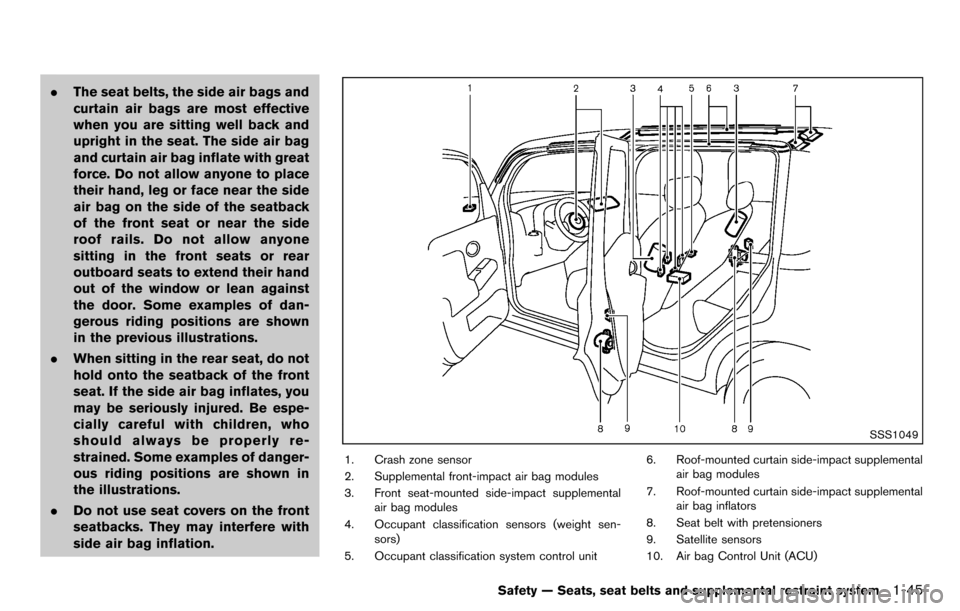
1. Crash zone sensor
2. Supplemental front-impact air bag modules
3. Front seat-mounted side-impact supplemental
air bag modules
4. Occupant classification sensors (weight sen- sors)
5. Occupant classification system control unit 6. Roof-mounted curtain side-impact supplemental
air bag modules
7. Roof-mounted curtain side-impact supplemental air bag inflators
8. Seat belt with pretensioners
9. Satellite sensors
10. Air bag Control Unit (ACU)
Safety — Seats, seat belts and supplemental restraint system1-45
Page 68 of 331
1-50Safety — Seats, seat belts and supplemental restraint system
jects under the front passenger seat
or the seat cushion and seatback.
Such objects may interfere with the
proper operation of the occupant
classification sensors.
. No unauthorized changes should be
made to any components or wiring
of the seat belt system. This may
affect the front air bag system.
Tampering with the seat belt system
may result in serious personal in-
jury.
. Work on and around the front air
bag system should be done by a
NISSAN dealer. Installation of elec-
trical equipment should also be
done by a NISSAN dealer. The
Supplemental Restraint System
(SRS) wiring harnesses* should not
be modified or disconnected. Un-
authorized electrical test equipment
and probing devices should not be
used on the air bag system.
. A cracked windshield should be
replaced immediately by a qualified
repair facility. A cracked windshield
could affect the function of the
supplemental air bag system. *The SRS wiring harness connectors are
yellow and orange for easy identification.
When selling your vehicle, we request that you
inform the buyer about the front air bag system
and guide the buyer to the appropriate sections
in this Owner’s Manual.
SSS0978
FRONT SEAT-MOUNTED SIDE-IM-
PACT SUPPLEMENTAL AIR BAG AND
ROOF-MOUNTED CURTAIN SIDE-IM-
PACT SUPPLEMENTAL AIR BAG SYS-
TEMS
The side air bags are located in the outside of
the seatback of the front seats. The curtain air
bags are located in the side roof rails. These
systems are designed to meet voluntary guide-
lines to help reduce the risk of injury to out-of-
position occupants.
However, all of the
information, cautions and warnings in this
manual still apply and must be followed.
The side air bags and curtain air bags are
designed to inflate in higher severity side
Page 69 of 331
collisions, although they may inflate if the forces
in another type of collision are similar to those of
a higher severity side impact. They are designed
to inflate on the side where the vehicle is
impacted. They may not inflate in certain side
collisions on the side where the vehicle is
impacted.
Vehicle damage (or lack of it) is not always an
indication of proper side air bag and curtain air
bag operation.
When the side air bags and curtain air bags
inflate, a fairly loud noise may be heard, followed
by release of smoke. This smoke is not harmful
and does not indicate a fire. Care should be
taken not to inhale it, as it may cause irritation
and choking. Those with a history of a breathing
condition should get fresh air promptly.
Side air bags, along with the use of seat belts,
help to cushion the impact force on the chest
and pelvic area of the front occupants. Curtain
air bags help to cushion the impact force to the
head of occupants in the front and rear outboard
seating positions. They can help save lives and
reduce serious injuries. However, side air bags
and curtain air bags may cause abrasions or
other injuries. Side air bags and curtain air bags
do not provide restraint to the lower body.
The seat belts should be correctly worn and the
driver and passenger seated upright as far aspractical away from the side air bags. Rear seat
passengers should be seated as far away as
practical from the door finishers and side roof
rails. The side air bags and curtain air bags
inflate quickly in order to help protect the
occupants in the outboard seating positions.
Because of this, the force of the side air bags
and curtain air bags inflating can increase the
risk of injury if the occupant is too close to, or is
against, these air bag modules during inflation.
The side air bags and curtain air bags will deflate
quickly after the collision is over.
The side air bags and curtain air bags
operate only when the ignition switch is in
the ON position.
After turning the ignition switch to the ON
position, the supplemental air bag warning
light illuminates. The supplemental air bag
warning light will turn off after about 7
seconds if the systems are operational.
WARNING
.
Do not place any objects near the
seatback of the front seats. Also, do
not place any objects (an umbrella,
bag, etc.) between the front door
finisher and the front seat. Such
objects may become dangerous projectiles and cause injury if a side
air bag inflates.
. Right after inflation, several side air
bag and curtain air bag system
components will be hot. Do not
touch them; you may severely burn
yourself.
. No unauthorized changes should be
made to any components or wiring
of the side air bag and curtain air
bag systems. This is to prevent
damage to or accidental inflation
of the side air bag and curtain air
bag systems.
. Do not make unauthorized changes
to your vehicle’s electrical system,
suspension system or side panel.
This could affect proper operation
of the side air bag and curtain air
bag systems.
. Tampering with the side air bag
system may result in serious perso-
nal injury. For example, do not
change the front seats by placing
material near the seatbacks or by
installing additional trim material,
such as seat covers, around the side
air bag.
Safety — Seats, seat belts and supplemental restraint system1-51
Page 71 of 331
When selling your vehicle, we request that you
inform the buyer about the pretensioner system
and guide the buyer to the appropriate sections
in this Owner’s Manual.
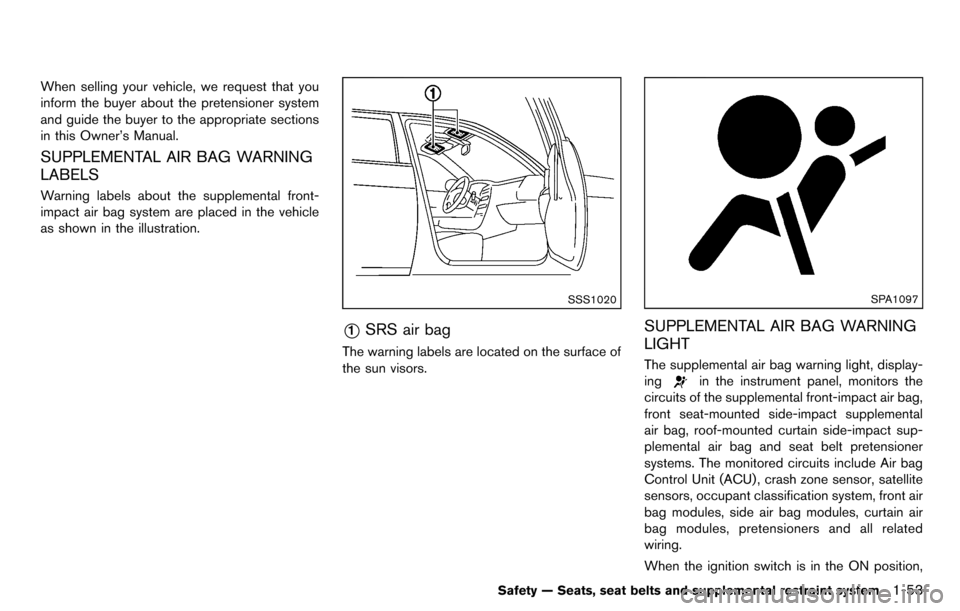
SUPPLEMENTAL AIR BAG WARNING
LABELS
Warning labels about the supplemental front-
impact air bag system are placed in the vehicle
as shown in the illustration.
SSS1020
*1SRS air bag
The warning labels are located on the surface of
the sun visors.
SPA1097
SUPPLEMENTAL AIR BAG WARNING
LIGHT
The supplemental air bag warning light, display-
ing
in the instrument panel, monitors the
circuits of the supplemental front-impact air bag,
front seat-mounted side-impact supplemental
air bag, roof-mounted curtain side-impact sup-
plemental air bag and seat belt pretensioner
systems. The monitored circuits include Air bag
Control Unit (ACU) , crash zone sensor, satellite
sensors, occupant classification system, front air
bag modules, side air bag modules, curtain air
bag modules, pretensioners and all related
wiring.
When the ignition switch is in the ON position,
Safety — Seats, seat belts and supplemental restraint system1-53
Page 161 of 331
Static and flutter: During signal interference from
buildings, large hills or due to antenna position,
usually in conjunction with increased distance
from the station transmitter, static or flutter can
be heard. This can be reduced by lowering the
treble setting to reduce the treble response.
Multipath reception: Because of the reflective
characteristics of FM signals, direct and re-
flected signals reach the receiver at the same
time. The signals may cancel each other,
resulting in momentary flutter or loss of sound.
AM radio reception:
AM signals, because of their low frequency, can
bend around objects and skip along the ground.
In addition, the signals can be bounced off the
ionosphere and bent back to earth. Because of
these characteristics. AM signals are also
subject to interference as they travel from
transmitter to receiver.
Fading: Occurs while the vehicle is passing
through freeway underpasses or in areas with
many tall buildings. It can also occur for several
seconds during ionospheric turbulence even in
areas where no obstacles exist.
Static: Caused by thunderstorms, electrical
power lines, electric signs and even traffic lights.Satellite radio reception (if so equipped):
When the satellite radio is first installed or the
battery has been replaced, the satellite radio
may not work properly. This is not a malfunction.
Wait more than 10 minutes with the satellite
radio ON and the vehicle away from any metal or
large buildings for the satellite radio to receive all
of the necessary data.
The satellite radio mode requires an active XM
®
Satellite Radio subscription. The satellite radio is
not available in Alaska, Hawaii and Guam.
Satellite radio performance may be affected if
cargo carried on the roof blocks the satellite
radio signal.
If possible, do not put cargo near the satellite
antenna.
A buildup of ice on the satellite radio antenna
can affect satellite radio performance. Remove
the ice to restore satellite radio reception.
SAA0480
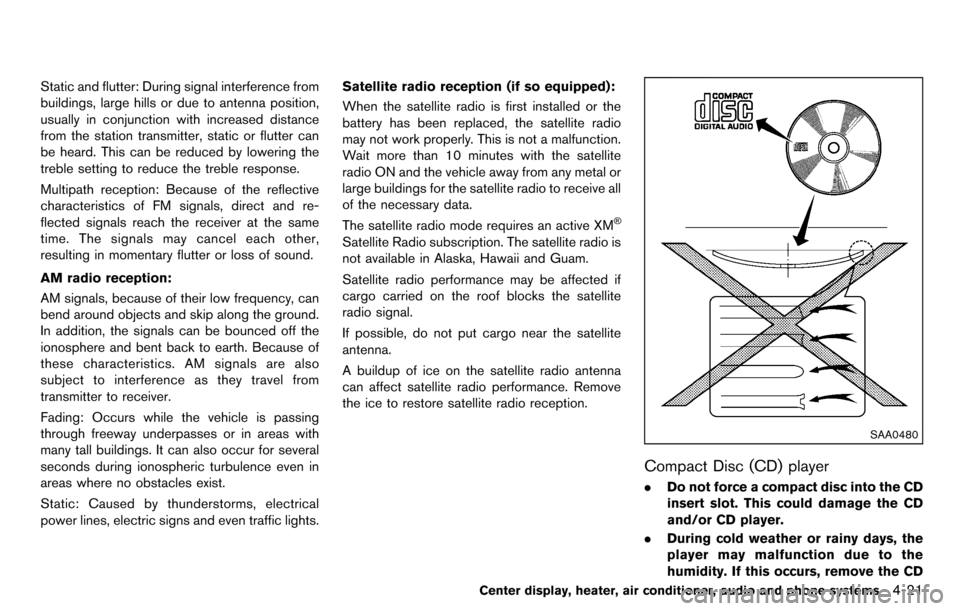
Compact Disc (CD) player
. Do not force a compact disc into the CD
insert slot. This could damage the CD
and/or CD player.
. During cold weather or rainy days, the
player may malfunction due to the
humidity. If this occurs, remove the CD
Center display, heater, air conditioner, audio and phone systems4-21
Page 323 of 331
10 Index
A
A/C (Air Conditioner) operation.............................. 4-15
ABS (Anti-lock Braking System) ............................ 5-26
Advanced air bag system ......................................... 1-46
Air bag system Advanced air bag system .................................. 1-46
Front passenger air bag and status light....... 1-47
Front-seat mounted side-impact
supplemental air bag system ............................ 1-50
Roof-mounted curtain side-impact
supplemental air bag system ............................ 1-50
Air bag warning labels............................................... 1-53
Air bag warning light...................................... 1-53, 2-15
Air cleaner housing filter ........................................... 8-17
Air conditioner Air conditioner operation.................................... 4-13
Air conditioner service ........................................ 4-19
Air conditioner specification label.................... 9-10
Air conditioning system refrigerant and
lubricant recommendations....................... 4-19, 9-6
In-cabin microfilter ............................................... 4-19
Alarm, How to stop alarm (see vehicle
security system)........................................................... 2-20
Alcohol, drugs and driving.......................................... 5-7
Antenna.......................................................................... 4-50
Anti-lock Braking System (ABS) ............................ 5-26
Anti-lock braking system (ABS) warning light..... 2-12
Appearance care Exterior appearance care ...................................... 7-2
Interior appearance care ....................................... 7-4
Armrest ............................................................................ 1-9
Audible reminders....................................................... 2-18
Audio operation precautions.................................... 4-20
Audio setup .................................................................... 4-5
Audio system................................................................ 4-20 Steering wheel audio controls.......................... 4-49
Autolight system.......................................................... 2-25
Automatic Air conditioner....................................................... 4-17
Door locks................................................................. 3-6
AUX (Auxiliary) button........................ 4-34, 4-41, 4-45
AUX (Auxiliary) input........................... 4-34, 4-41, 4-45
Average fuel consumption ........................................ 2-10
Average speed............................................................. 2-10
Avoiding collision and rollover ................................... 5-6
B
Back door...................................................................... 3-20
Battery............................................................................ 8-13 Battery replacement, Intelligent Key................ 8-25
Battery replacement, Keyfob............................. 8-24
Battery saver system........................................... 2-26
Variable voltage control system........................ 8-15
Before starting the engine........................................ 5-12
Bluetooth
®Hands-Free Phone System ................ 4-52
Booster seats............................................................... 1-37
Brake Anti-lock Braking System (ABS) ..................... 5-26
Brake and clutch fluid......................................... 8-12
Brake system......................................................... 5-26
Parking brake operation ..................................... 5-20
Warning light......................................................... 2-12
Break-in schedule ....................................................... 5-23
Brightness control Display ON/OFF button ........................................ 4-5
Instrument panel................................................... 2-27
Bulb check/instrument panel ................................... 2-12
Bulb replacement........................................................ 8-26
C
Cabin air filter............................................................... 4-19
Capacities and recommended fuel/lubricants ....... 9-2
Car phone or CB radio ............................................. 4-51
Cargo light.................................................................... 2-40
Catalytic converter, Three way catalyst................... 5-3
CD/USB memory care and cleaning ..................... 4-49
Ceiling light................................................................... 2-39
Check tire pressure warning...................................... 2-6
Child restraints............................................................. 1-21 Booster seats........................................................ 1-37
Precautions on child restraints......................... 1-21
Child safety................................................................... 1-19
Child safety rear door lock ......................................... 3-6
Chimes, Audible reminders ...................................... 2-18
Circuit breaker, Fusible link...................................... 8-21
Cleaning exterior and interior............................ 7-2, 7-4
Clock (models with navigation system)................... 4-7
Clutch fluid.................................................................... 8-12
Cockpit ............................................................................ 2-2
Cold weather driving.................................................. 5-29
Compact Disc (CD) player
(See audio system) ............................ 4-33, 4-38, 4-43
Continuously Variable Transmission
(CVT) fluid..................................................................... 8-11
Control panel buttons — color screen with
navigation system.......................................................... 4-2
Controls, Steering wheel audio controls............... 4-49
Coolant Capacities and
recommended fuel/lubricants............................... 9-2
Changing engine coolant...................................... 8-8
Checking engine coolant level............................. 8-8
Corrosion protection .................................................... 7-6
Cruise control............................................................... 5-21