warning NISSAN FRONTIER 1996 D22 / 1.G Workshop Manual
[x] Cancel search | Manufacturer: NISSAN, Model Year: 1996, Model line: FRONTIER, Model: NISSAN FRONTIER 1996 D22 / 1.GPages: 198, PDF Size: 1.3 MB
Page 128 of 198
If the cooling system frequently requires
coolant, have it checked by your NISSAN
dealer.
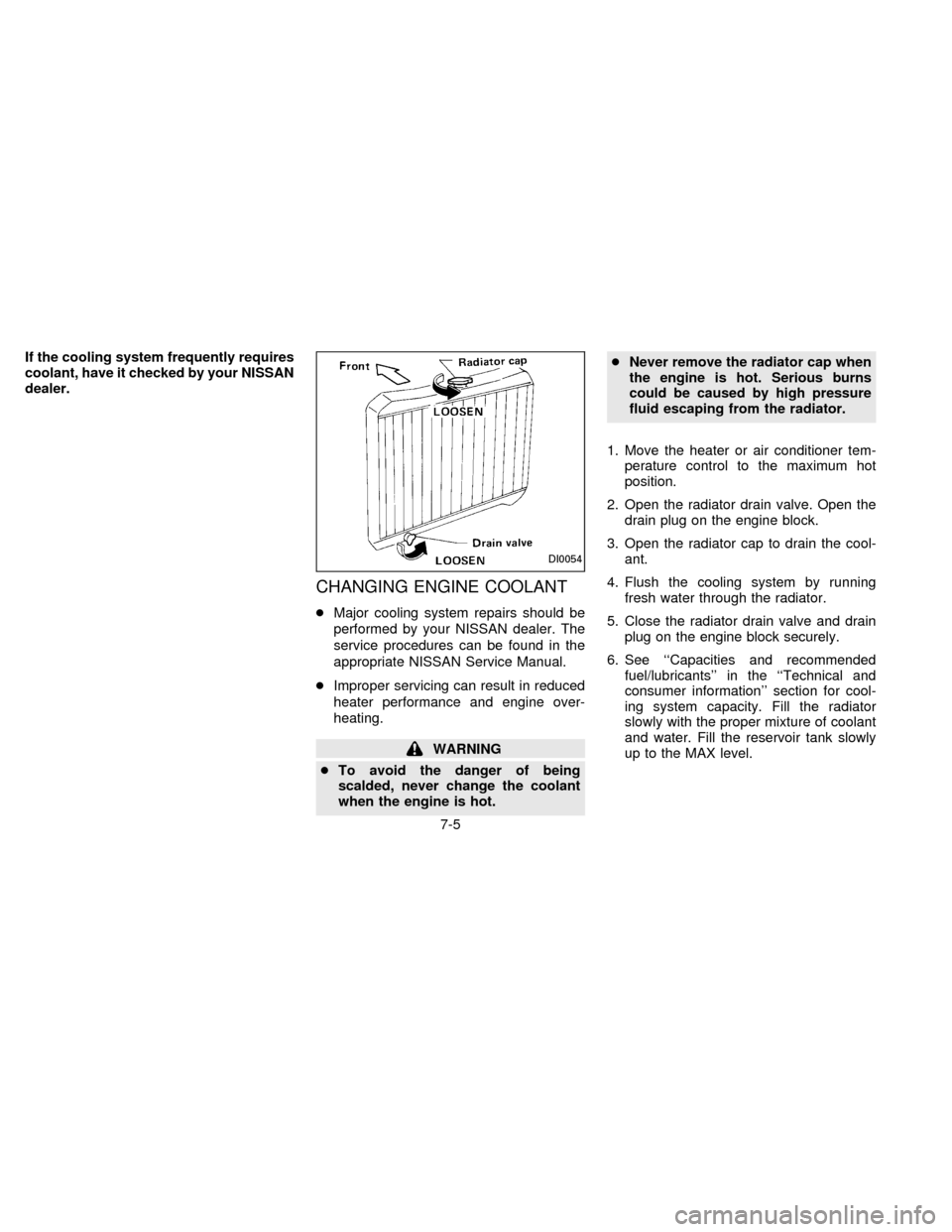
CHANGING ENGINE COOLANT
cMajor cooling system repairs should be
performed by your NISSAN dealer. The
service procedures can be found in the
appropriate NISSAN Service Manual.
cImproper servicing can result in reduced
heater performance and engine over-
heating.
WARNING
cTo avoid the danger of being
scalded, never change the coolant
when the engine is hot.cNever remove the radiator cap when
the engine is hot. Serious burns
could be caused by high pressure
fluid escaping from the radiator.
1. Move the heater or air conditioner tem-
perature control to the maximum hot
position.
2. Open the radiator drain valve. Open the
drain plug on the engine block.
3. Open the radiator cap to drain the cool-
ant.
4. Flush the cooling system by running
fresh water through the radiator.
5. Close the radiator drain valve and drain
plug on the engine block securely.
6. See ``Capacities and recommended
fuel/lubricants'' in the ``Technical and
consumer information'' section for cool-
ing system capacity. Fill the radiator
slowly with the proper mixture of coolant
and water. Fill the reservoir tank slowly
up to the MAX level.
DI0054
7-5
ZX
Page 131 of 198
WARNING
cProlonged and repeated contact with
used engine oil may cause skin
cancer.
cTry to avoid direct skin contact with
used oil. If skin contact is made,
wash thoroughly with soap or hand
cleaner as soon as possible.
cKeep used engine oil out of reach of
children.
cBe careful not to burn yourself, as
the engine oil is hot.
CAUTION
Waste oil must be disposed of prop-
erly. Check your local regulations.
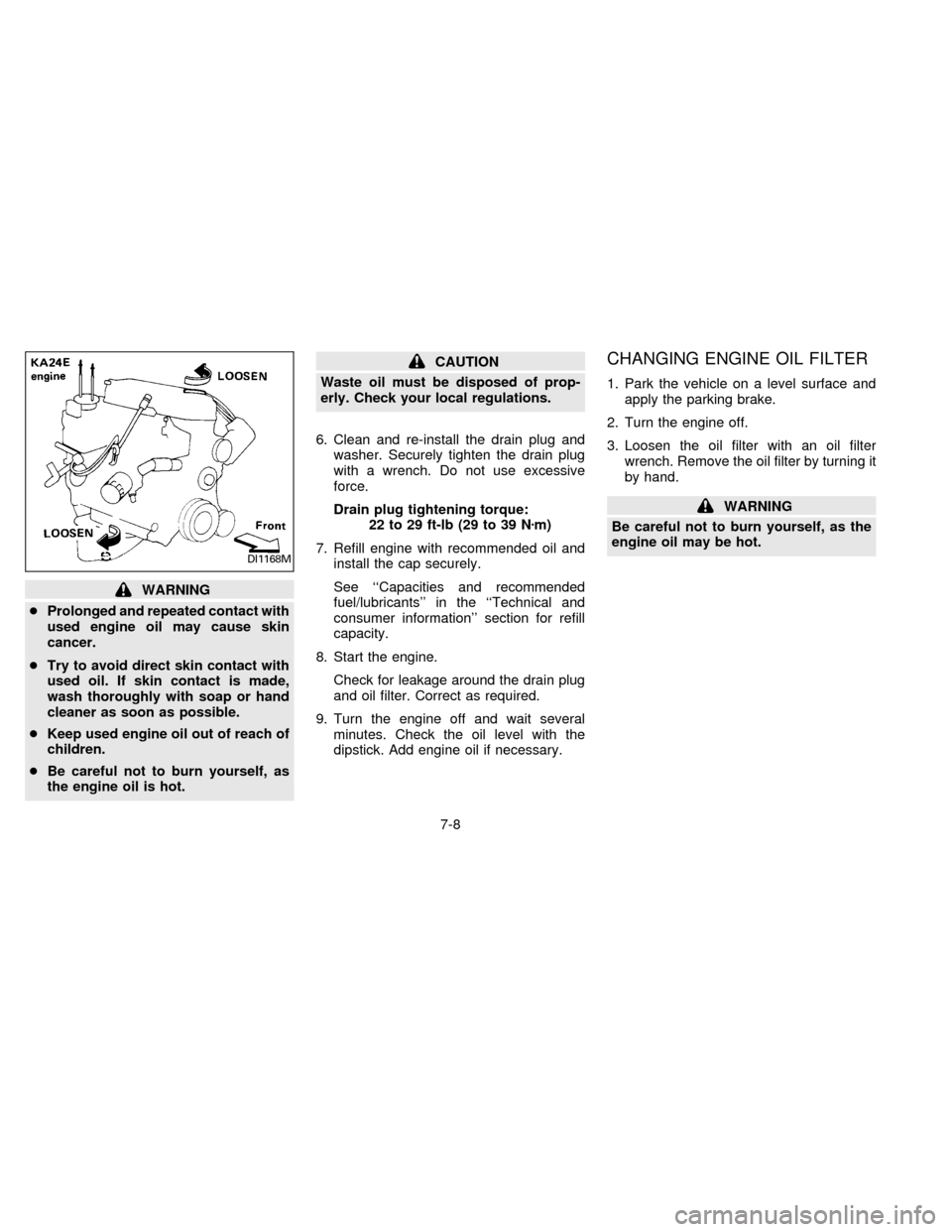
6. Clean and re-install the drain plug and
washer. Securely tighten the drain plug
with a wrench. Do not use excessive
force.
Drain plug tightening torque:
22 to 29 ft-lb (29 to 39 Nzm)
7. Refill engine with recommended oil and
install the cap securely.
See ``Capacities and recommended
fuel/lubricants'' in the ``Technical and
consumer information'' section for refill
capacity.
8. Start the engine.
Check for leakage around the drain plug
and oil filter. Correct as required.
9. Turn the engine off and wait several
minutes. Check the oil level with the
dipstick. Add engine oil if necessary.CHANGING ENGINE OIL FILTER
1. Park the vehicle on a level surface and
apply the parking brake.
2. Turn the engine off.
3. Loosen the oil filter with an oil filter
wrench. Remove the oil filter by turning it
by hand.
WARNING
Be careful not to burn yourself, as the
engine oil may be hot.
DI1168M
7-8
ZX
Page 132 of 198
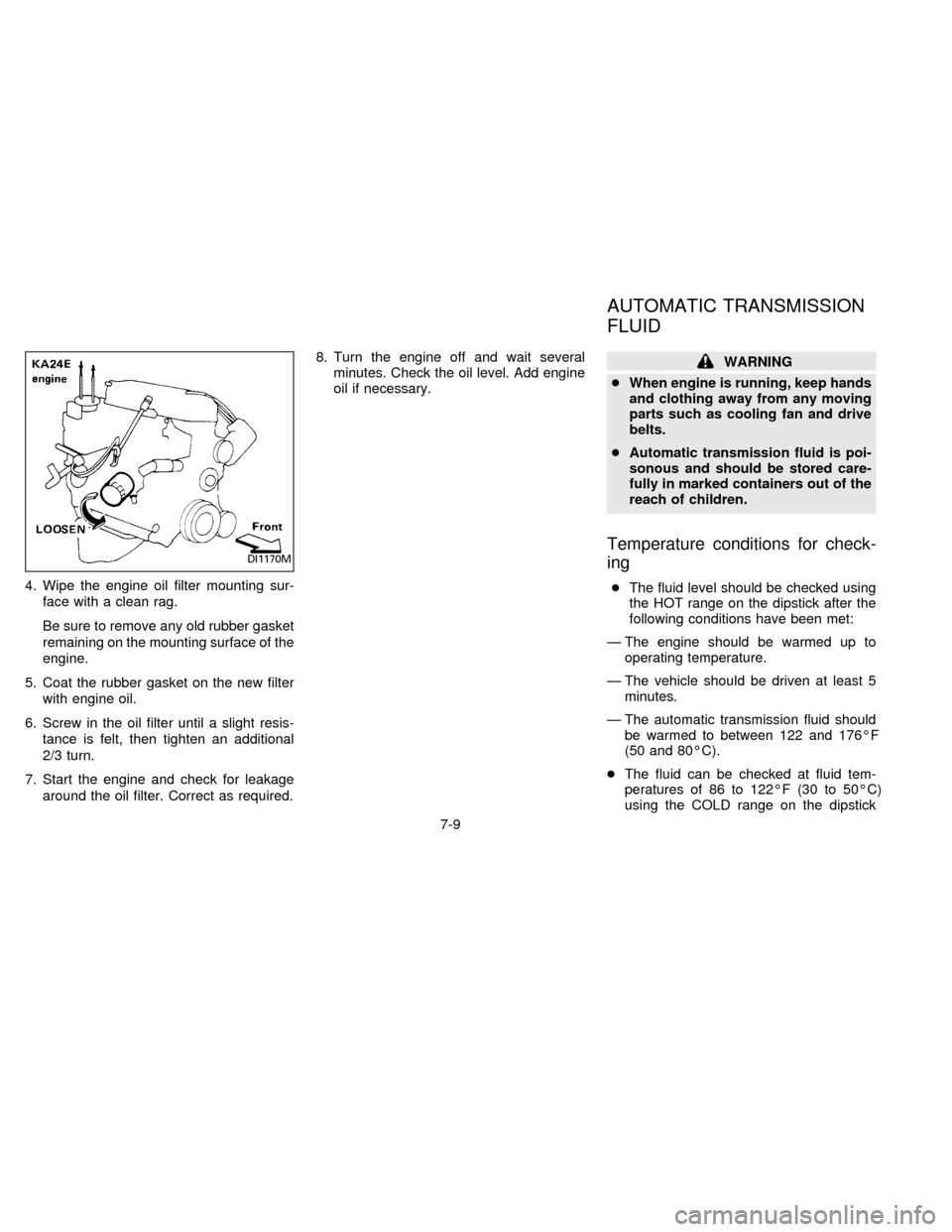
4. Wipe the engine oil filter mounting sur-
face with a clean rag.
Be sure to remove any old rubber gasket
remaining on the mounting surface of the
engine.
5. Coat the rubber gasket on the new filter
with engine oil.
6. Screw in the oil filter until a slight resis-
tance is felt, then tighten an additional
2/3 turn.
7. Start the engine and check for leakage
around the oil filter. Correct as required.8. Turn the engine off and wait several
minutes. Check the oil level. Add engine
oil if necessary.
WARNING
cWhen engine is running, keep hands
and clothing away from any moving
parts such as cooling fan and drive
belts.
cAutomatic transmission fluid is poi-
sonous and should be stored care-
fully in marked containers out of the
reach of children.
Temperature conditions for check-
ing
cThe fluid level should be checked using
the HOT range on the dipstick after the
following conditions have been met:
Ð The engine should be warmed up to
operating temperature.
Ð The vehicle should be driven at least 5
minutes.
Ð The automatic transmission fluid should
be warmed to between 122 and 176ÉF
(50 and 80ÉC).
cThe fluid can be checked at fluid tem-
peratures of 86 to 122ÉF (30 to 50ÉC)
using the COLD range on the dipstick
DI1170M
AUTOMATIC TRANSMISSION
FLUID
7-9
ZX
Page 134 of 198
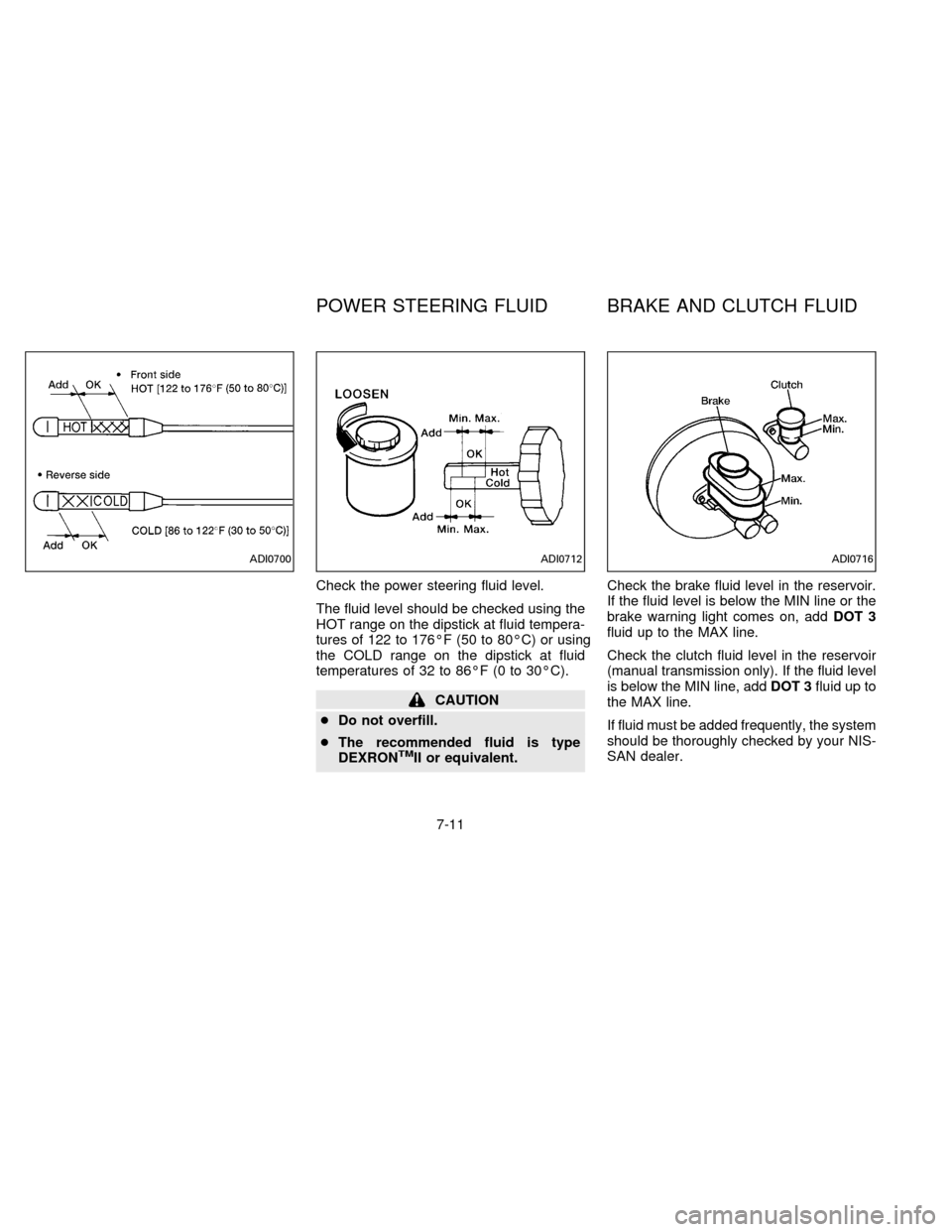
Check the power steering fluid level.
The fluid level should be checked using the
HOT range on the dipstick at fluid tempera-
tures of 122 to 176ÉF (50 to 80ÉC) or using
the COLD range on the dipstick at fluid
temperatures of 32 to 86ÉF (0 to 30ÉC).
CAUTION
cDo not overfill.
cThe recommended fluid is type
DEXRON
TMII or equivalent.Check the brake fluid level in the reservoir.
If the fluid level is below the MIN line or the
brake warning light comes on, addDOT 3
fluid up to the MAX line.
Check the clutch fluid level in the reservoir
(manual transmission only). If the fluid level
is below the MIN line, addDOT 3fluid up to
the MAX line.
If fluid must be added frequently, the system
should be thoroughly checked by your NIS-
SAN dealer.
ADI0700ADI0712ADI0716
POWER STEERING FLUID BRAKE AND CLUTCH FLUID
7-11
ZX
Page 135 of 198
For further brake and clutch fluid specifica-
tion information, refer to ``Capacities and
recommended fuel/lubricants'' in the ``Tech-
nical and consumer information'' section of
this manual.
CAUTION
cUse only new fluid from a sealed
container. Old, inferior or contami-
nated fluid may damage the brake
and clutch systems. The use of im-
proper fluids can damage the brake
system and affect the vehicle's stop-
ping ability.
cDo not spill the fluid on any painted
surfaces. This will damage the paint.
If fluid is spilled, wash with water.
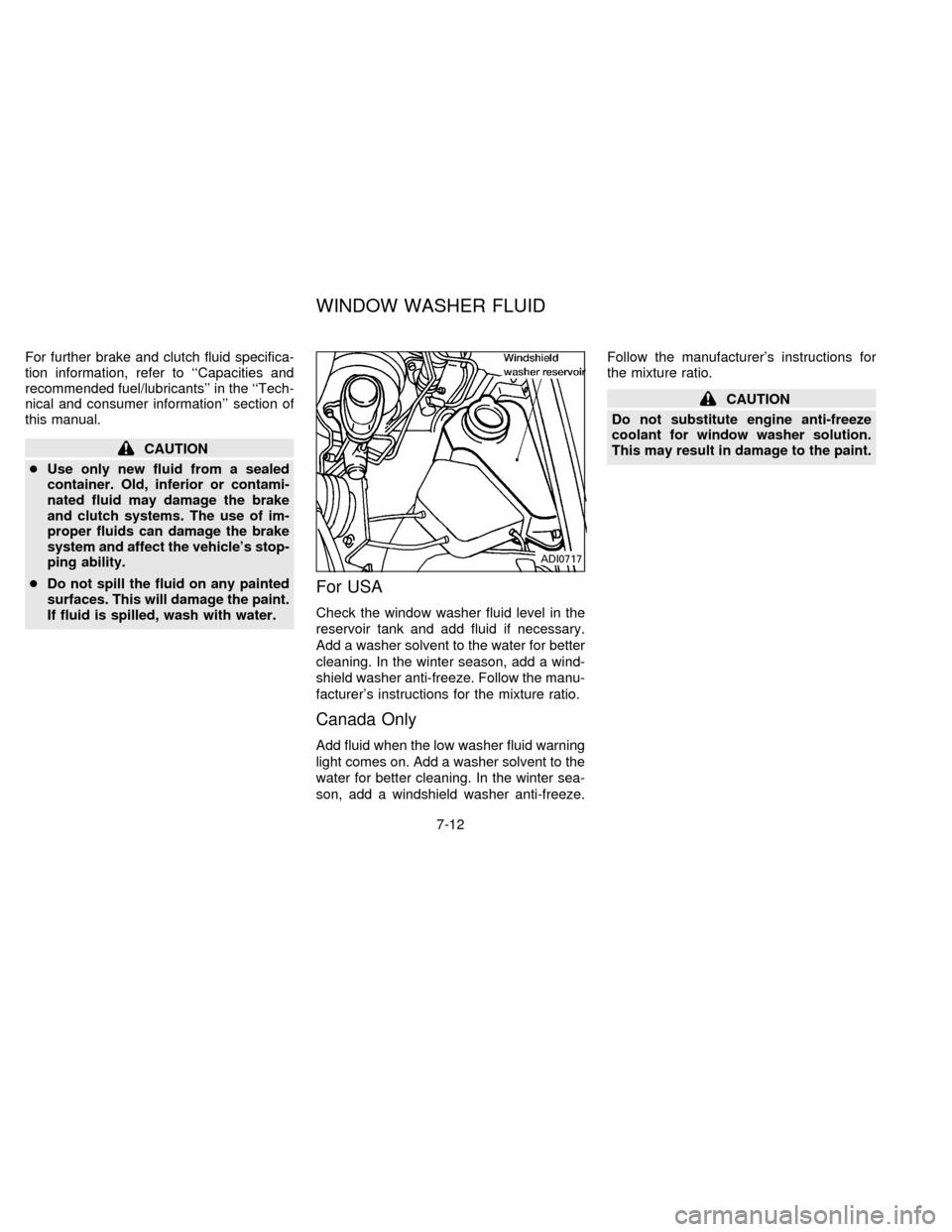
For USA
Check the window washer fluid level in the
reservoir tank and add fluid if necessary.
Add a washer solvent to the water for better
cleaning. In the winter season, add a wind-
shield washer anti-freeze. Follow the manu-
facturer's instructions for the mixture ratio.
Canada Only
Add fluid when the low washer fluid warning
light comes on. Add a washer solvent to the
water for better cleaning. In the winter sea-
son, add a windshield washer anti-freeze.Follow the manufacturer's instructions for
the mixture ratio.
CAUTION
Do not substitute engine anti-freeze
coolant for window washer solution.
This may result in damage to the paint.
ADI0717
WINDOW WASHER FLUID
7-12
ZX
Page 136 of 198
cKeep the battery surface clean and dry.
Any corrosion should be washed off with
a solution of baking soda and water.
cMake certain the terminal connections
are clean and securely tightened.
c
If the vehicle is not to be used for 30 days
or longer, disconnect the negative (þ) bat-
tery terminal cable to prevent discharge.
WARNING
Do not expose the battery to flames or
electrical sparks. Hydrogen gas gener-
ated by battery action is explosive. Do
not allow battery fluid to contact your
skin, eyes, fabrics, or painted surfaces.
After touching a battery or battery cap,
do not touch or rub your eyes. Thor-
oughly wash your hands. If the acid
contacts your eyes, skin or clothing,
immediately flush with water for at least
15 minutes and seek medical attention.
JUMP STARTING
If jump starting is necessary, see ``Jump
starting'' in the ``In case of emergency''
section. If the engine does not start by jump
starting, the battery may have to be re-
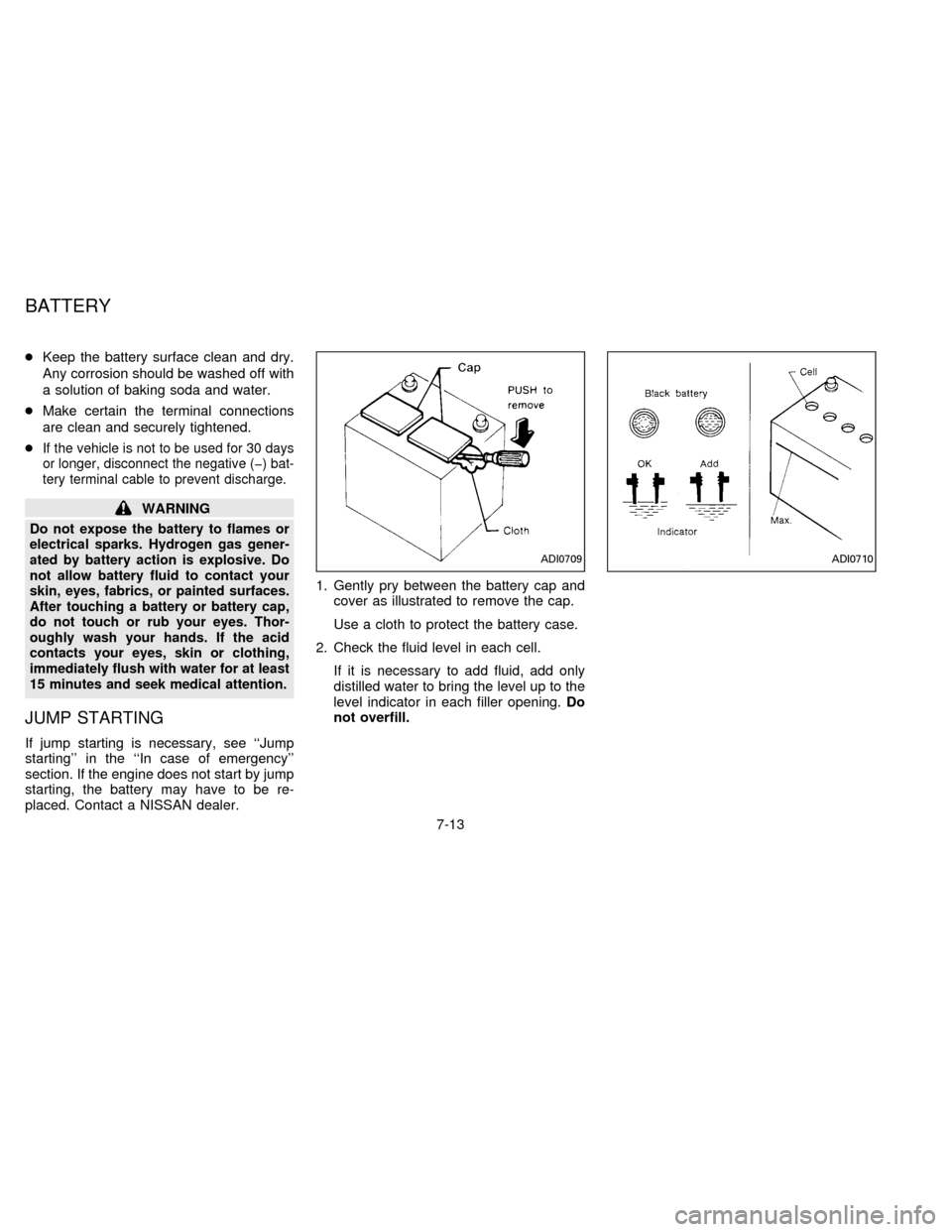
placed. Contact a NISSAN dealer.1. Gently pry between the battery cap and
cover as illustrated to remove the cap.
Use a cloth to protect the battery case.
2. Check the fluid level in each cell.
If it is necessary to add fluid, add only
distilled water to bring the level up to the
level indicator in each filler opening.Do
not overfill.
ADI0709ADI0710
BATTERY
7-13
ZX
Page 137 of 198
WARNING
Be sure the ignition key is OFF.
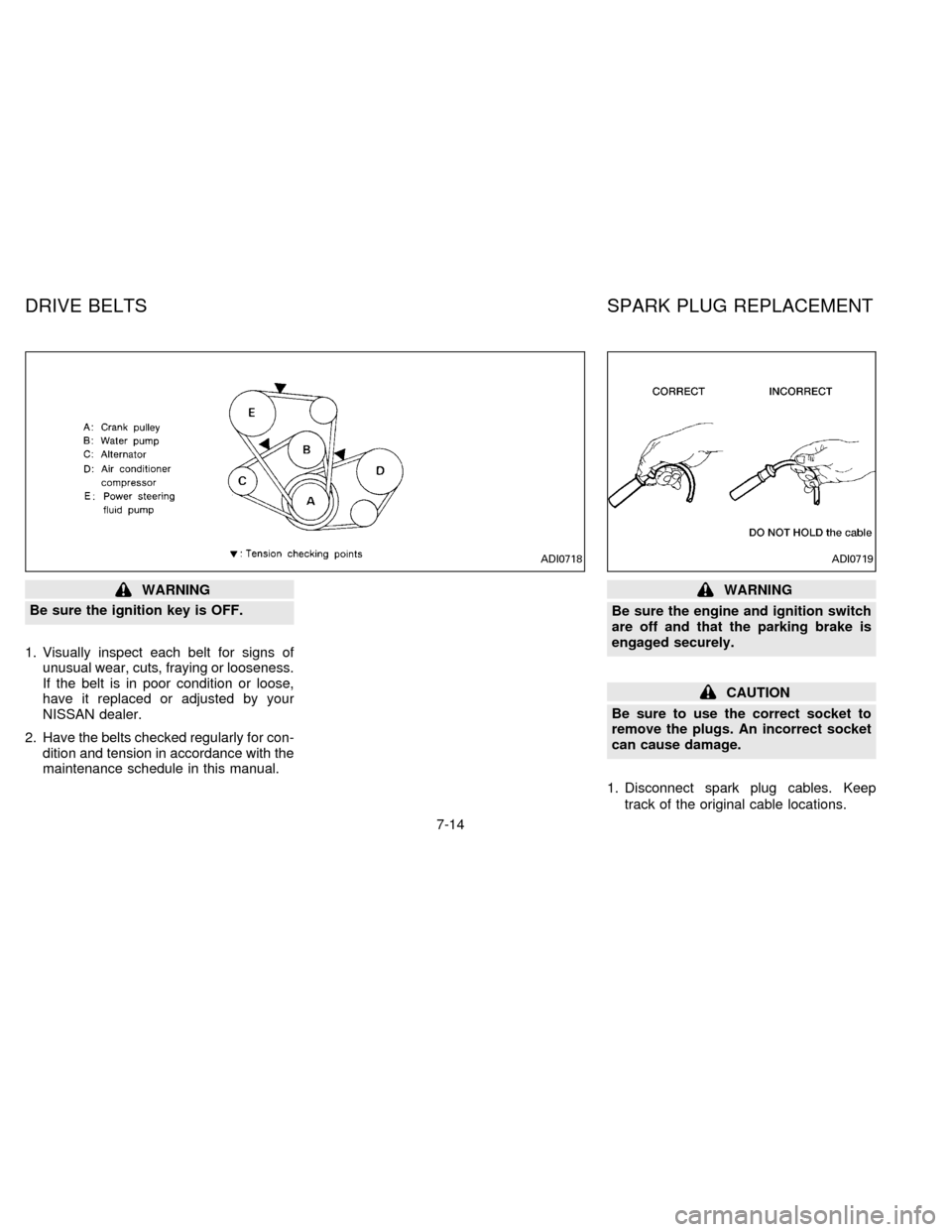
1. Visually inspect each belt for signs of
unusual wear, cuts, fraying or looseness.
If the belt is in poor condition or loose,
have it replaced or adjusted by your
NISSAN dealer.
2. Have the belts checked regularly for con-
dition and tension in accordance with the
maintenance schedule in this manual.WARNING
Be sure the engine and ignition switch
are off and that the parking brake is
engaged securely.
CAUTION
Be sure to use the correct socket to
remove the plugs. An incorrect socket
can cause damage.
1. Disconnect spark plug cables. Keep
track of the original cable locations.
ADI0718ADI0719
DRIVE BELTS SPARK PLUG REPLACEMENT
7-14
ZX
Page 138 of 198
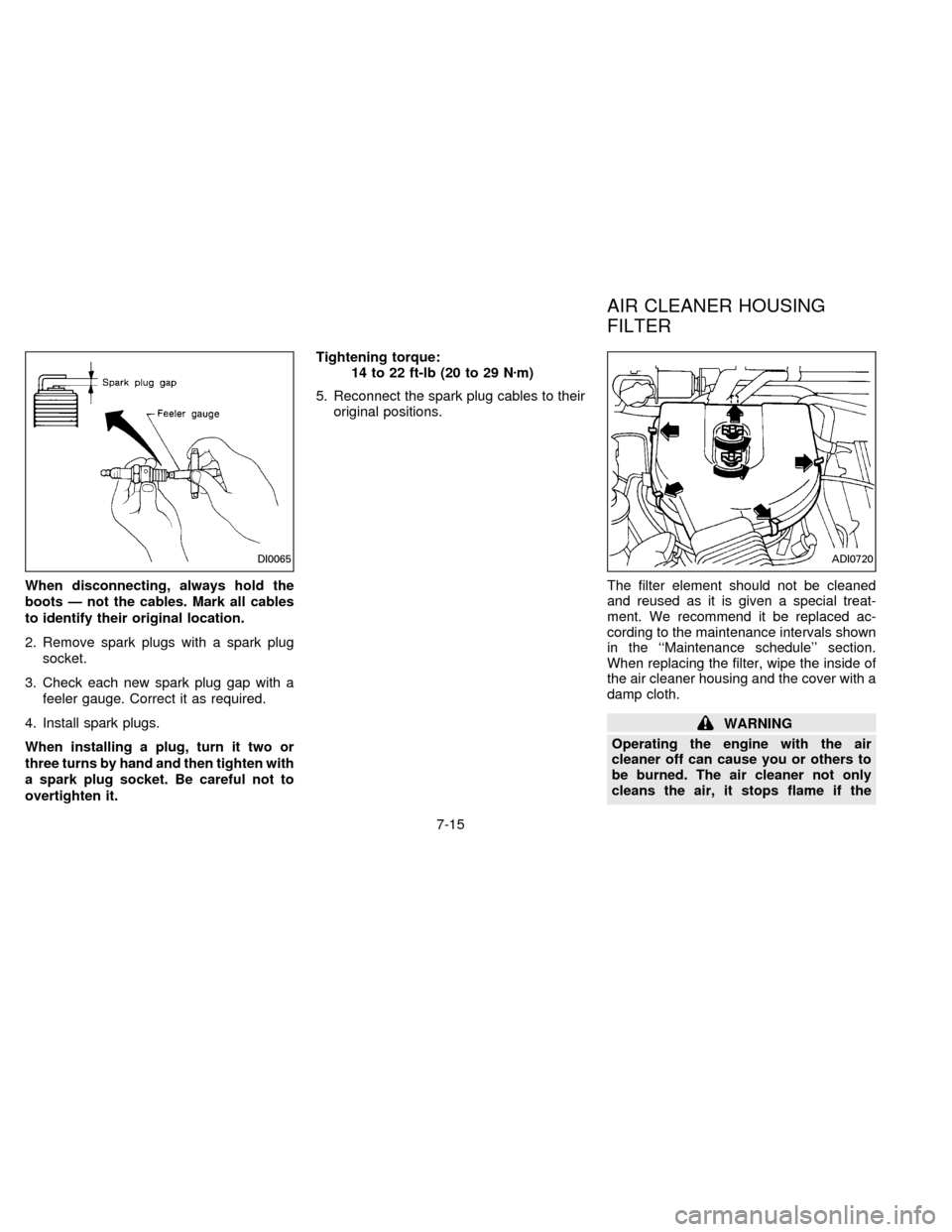
When disconnecting, always hold the
boots Ð not the cables. Mark all cables
to identify their original location.
2. Remove spark plugs with a spark plug
socket.
3. Check each new spark plug gap with a
feeler gauge. Correct it as required.
4. Install spark plugs.
When installing a plug, turn it two or
three turns by hand and then tighten with
a spark plug socket. Be careful not to
overtighten it.Tightening torque:
14 to 22 ft-lb (20 to 29 Nzm)
5. Reconnect the spark plug cables to their
original positions.
The filter element should not be cleaned
and reused as it is given a special treat-
ment. We recommend it be replaced ac-
cording to the maintenance intervals shown
in the ``Maintenance schedule'' section.
When replacing the filter, wipe the inside of
the air cleaner housing and the cover with a
damp cloth.
WARNING
Operating the engine with the air
cleaner off can cause you or others to
be burned. The air cleaner not only
cleans the air, it stops flame if the
DI0065ADI0720
AIR CLEANER HOUSING
FILTER
7-15
ZX
Page 141 of 198
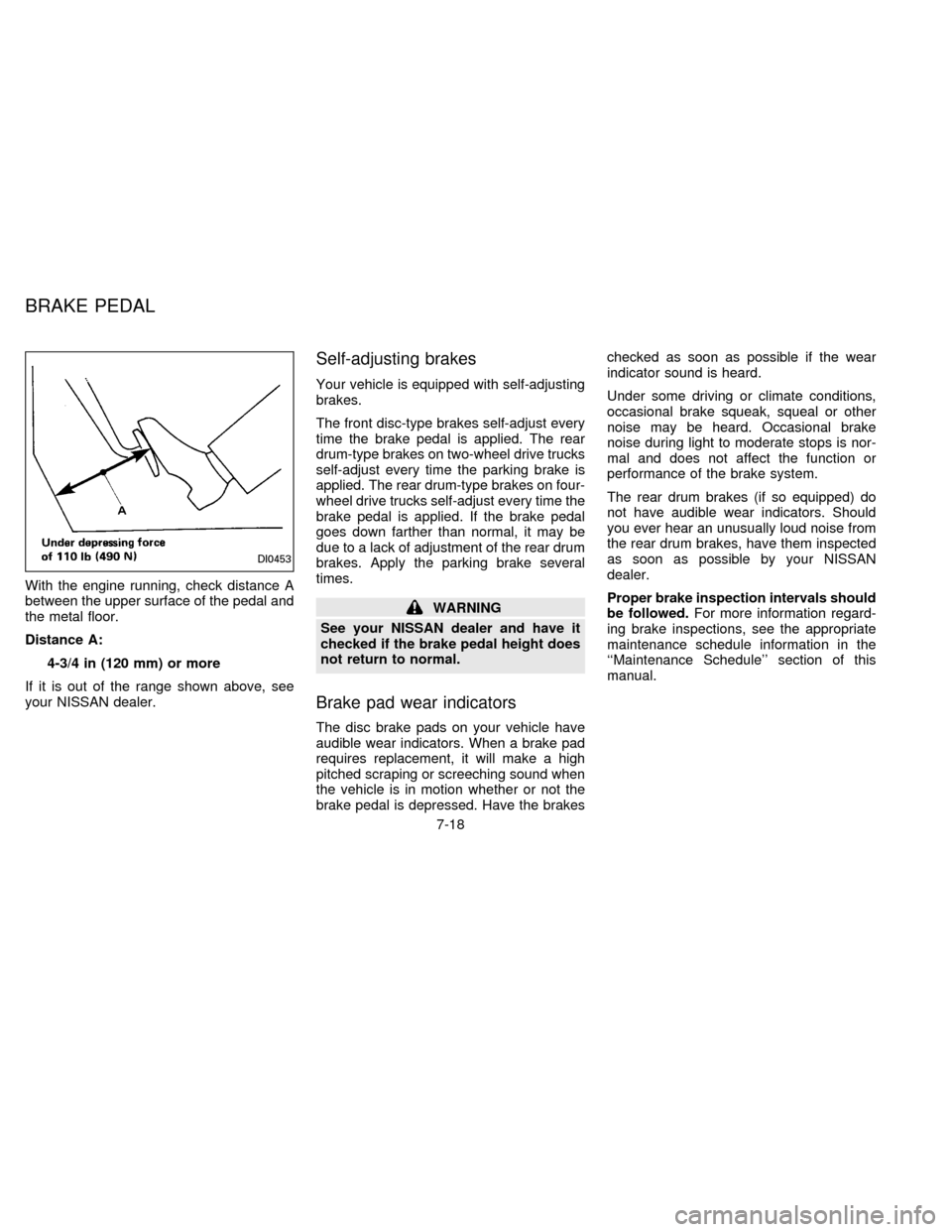
With the engine running, check distance A
between the upper surface of the pedal and
the metal floor.
Distance A:
4-3/4 in (120 mm) or more
If it is out of the range shown above, see
your NISSAN dealer.
Self-adjusting brakes
Your vehicle is equipped with self-adjusting
brakes.
The front disc-type brakes self-adjust every
time the brake pedal is applied. The rear
drum-type brakes on two-wheel drive trucks
self-adjust every time the parking brake is
applied. The rear drum-type brakes on four-
wheel drive trucks self-adjust every time the
brake pedal is applied. If the brake pedal
goes down farther than normal, it may be
due to a lack of adjustment of the rear drum
brakes. Apply the parking brake several
times.
WARNING
See your NISSAN dealer and have it
checked if the brake pedal height does
not return to normal.
Brake pad wear indicators
The disc brake pads on your vehicle have
audible wear indicators. When a brake pad
requires replacement, it will make a high
pitched scraping or screeching sound when
the vehicle is in motion whether or not the
brake pedal is depressed. Have the brakeschecked as soon as possible if the wear
indicator sound is heard.
Under some driving or climate conditions,
occasional brake squeak, squeal or other
noise may be heard. Occasional brake
noise during light to moderate stops is nor-
mal and does not affect the function or
performance of the brake system.
The rear drum brakes (if so equipped) do
not have audible wear indicators. Should
you ever hear an unusually loud noise from
the rear drum brakes, have them inspected
as soon as possible by your NISSAN
dealer.
Proper brake inspection intervals should
be followed.For more information regard-
ing brake inspections, see the appropriate
maintenance schedule information in the
``Maintenance Schedule'' section of this
manual.
DI0453
BRAKE PEDAL
7-18
ZX
Page 150 of 198
cImproper service for a TEMPORARY
USE ONLY spare tire may result in
serious personal injury. If it is nec-
essary to repair the TEMPORARY
USE ONLY spare tire, contact your
NISSAN dealer.
Changing tires and wheels
When replacing a tire, use the same size,
speed rating and load carrying capacity as
originally equipped. Recommended types
and sizes are shown in ``Wheel/tire size'' in
the ``Technical and consumer information''
section. The use of tires other than those
recommended or the mixed use of tires of
different brands, construction (bias, bias-
belted or radial), or tread patterns can ad-
versely affect the ride, braking, handling,
ground clearance, body-to-tire clearance,
snow chain clearance, speedometer cali-
bration, headlight aim and bumper height.
Some of these effects may lead to acci-
dents and could result in serious per-
sonal injury.
If the wheels are changed for any reason,
always replace with wheels which have the
same offset dimension. Wheels of a differ-ent offset could cause early tire wear, poor
vehicle handling characteristics and/or in-
terference with the brake discs/drums. Such
interference can lead to decreased braking
efficiency and/or early brake pad/shoe
wear.
CAUTION
Do not install a deformed wheel or tire
even if it has been repaired. Such
wheels or tires could have structural
damage and could fail without warning.
4-WHEEL DRIVE MODELS
CAUTION
Always use tires of the same size,
brand, construction (bias, bias-belted
or radial), and tread pattern on all four
wheels. Failure to do so may result in a
circumference difference between tires
on the front and rear axles which will
cause excessive tire wear and may
damage the transmission, transfer
case and differential gears.
If excessive tire wear is found, it is recom-mended that all four tires be replaced with
tires of the same size, brand, construction
and tread pattern. The tire pressure and
wheel alignment should also be checked
and corrected as necessary. Contact your
NISSAN dealer.
CAUTION
ONLY use spare tires specified for each
4-wheel drive model.
Wheel balance
Unbalanced wheels may affect vehicle han-
dling and tire life. Even with regular use,
wheels can get out of balance. Therefore,
they should be balanced as required.
Wheel balance service should be performed
with the wheels off the vehicle. Spin balanc-
ing the front wheels on the vehicle could
lead to transmission damage.
Care of wheels
cWash the wheels when washing the ve-
hicle to maintain their appearance.
cClean the inner side of the wheels when
the wheel is changed or the underside of
the vehicle is washed.
7-27
ZX