child restraint NISSAN FRONTIER 1998 D22 / 1.G Owners Manual
[x] Cancel search | Manufacturer: NISSAN, Model Year: 1998, Model line: FRONTIER, Model: NISSAN FRONTIER 1998 D22 / 1.GPages: 224, PDF Size: 1.7 MB
Page 1 of 224
Foreword
Welcome to the growing family of new NISSAN owners. This vehicle has been delivered to you with confidence. It was produced using the
latest techniques and strict quality control.
This manual was prepared to help you understand the operation and maintenance of your vehicle so that you may enjoy many miles of
driving pleasure. Please read through this manual before operating your vehicle.
A separate Warranty Information and Maintenance Log Booklet explains details about the warranties covering your vehicle and
vehicle maintenance schedules. Additionally, a separate Customer Care/Lemon Law Booklet will explain how to resolve any
concerns you may have with your vehicle, as well as clarify your rights under your state's lemon law.
Your NISSAN dealership knows your vehicle best. When you require any service or have any questions, they will be glad to assist you with
the extensive resources available to them.
WARNING
IMPORTANT SAFETY INFORMATION
REMINDERS FOR SAFETY!
Follow these important driving rules to help ensure a safe and
complete trip for you and your passengers
²NEVER drive under the influence of alcohol or drugs.
²ALWAYS observe posted speed limits and never drive too
fast for conditions.
²ALWAYS use your seat belts and appropriate child restraint
systems.
²ALWAYS provide information about the proper use of
vehicle safety features to all occupants of the vehicle.
²ALWAYS review this owner's manual for important safety
information.NOTES ON THE INFORMATION CONTAINED IN
THIS OWNER'S MANUAL
This owner's manual contains descriptions and operating in-
structions for all systems, features and optional equipment that
might appear in any model of this vehicle built for any destina-
tion in North America, including the continental United States,
Canada and Hawaii. Therefore, you may find information in this
manual that does not apply to your vehicle.
For descriptions specified for four-wheel drive models, a
mark is placed at the beginning of the applicable
sections/items.
As with other vehicles with features for off-road use, failure to
operate four-wheel drive models correctly may result in loss of
control or an accident. Be sure to read ``Driving your four-wheel
drive safely'' in the ``Starting and driving'' section of this
manual.
The inside pages of this manual contain
a minimum of 50% recycled fibers,
including 10% post-consumer fibers.
Page 8 of 224

1 Seats, restraints and supplemental air
bag systems
Front bucket seats..................................................1-2
Seat adjustment .....................................................1-2
Head restraints .......................................................1-3
Tilting front bucket seat ..........................................1-4
Bench seat .............................................................1-4
Seat adjustment .....................................................1-4
Tilting bench seat ...................................................1-5
Jump seats .............................................................1-6
Supplemental restraint system (supplemental
air bag system).......................................................1-7
Supplemental air bag system...............................1-10
Passenger supplemental air bag on/off switch
and light. ...............................................................1-12
Warning labels......................................................1-15
Supplemental air bag warning light......................1-15
Seat belts .............................................................1-17Precautions on seat belt usage ...........................1-17
Child safety...........................................................1-18
Pregnant women ..................................................1-19
Injured persons ....................................................1-19
Three-point type with retractor .............................1-20
Two-point type without retractor (jump seat
and center of bench seat) ....................................1-22
Seat belt extenders ..............................................1-25
Seat belt maintenance .........................................1-25
Child restraints .....................................................1-25
Front facing installation on front passenger
seat (three-point type with retractor) ....................1-27
Rear facing installation on front passenger
seat (three-point type with retractor) ....................1-30
Top strap child restraint .......................................1-33
ZX
Page 11 of 224
TILTING FRONT BUCKET SEAT
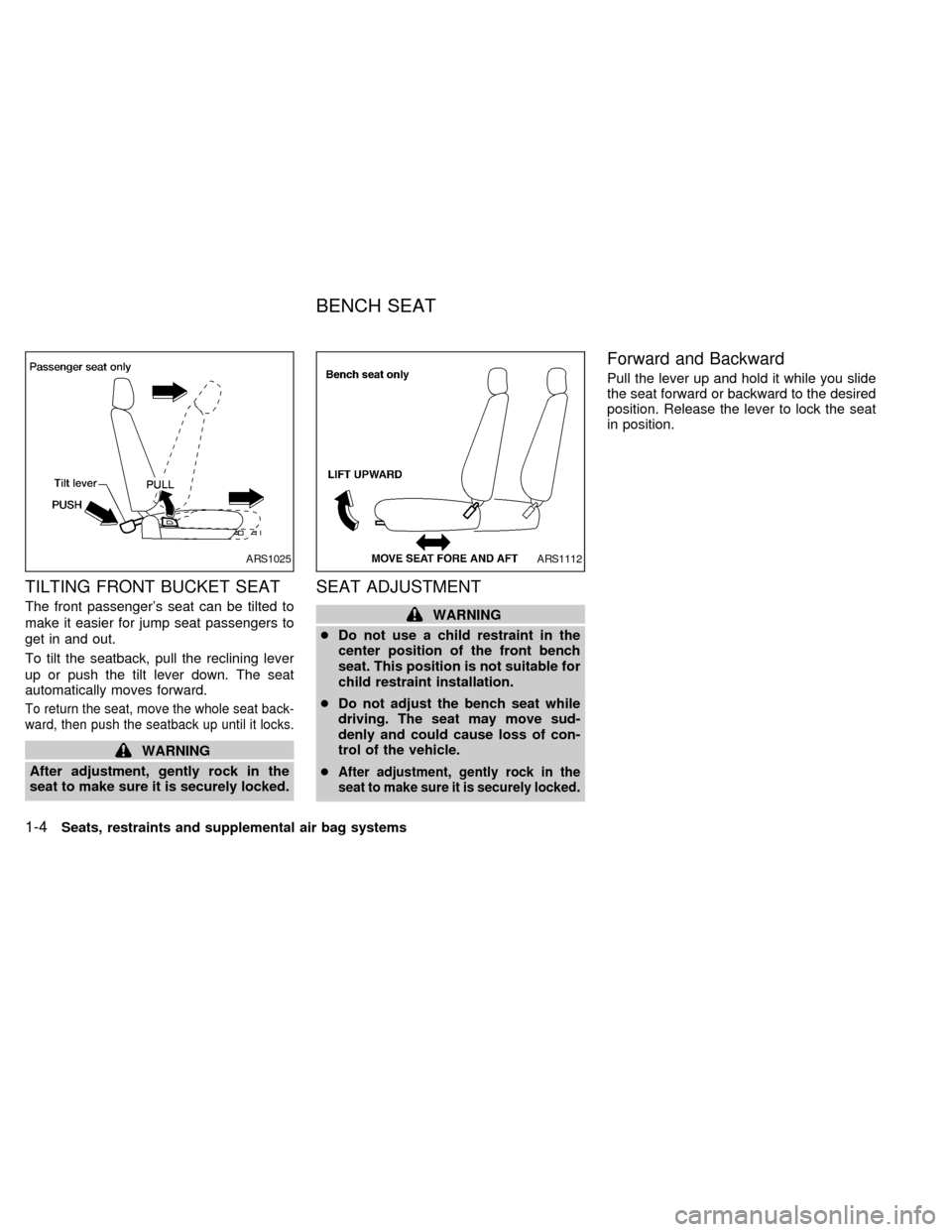
The front passenger's seat can be tilted to
make it easier for jump seat passengers to
get in and out.
To tilt the seatback, pull the reclining lever
up or push the tilt lever down. The seat
automatically moves forward.
To return the seat, move the whole seat back-
ward, then push the seatback up until it locks.
WARNING
After adjustment, gently rock in the
seat to make sure it is securely locked.
SEAT ADJUSTMENT
WARNING
cDo not use a child restraint in the
center position of the front bench
seat. This position is not suitable for
child restraint installation.
cDo not adjust the bench seat while
driving. The seat may move sud-
denly and could cause loss of con-
trol of the vehicle.
c
After adjustment, gently rock in the
seat to make sure it is securely locked.
Forward and Backward
Pull the lever up and hold it while you slide
the seat forward or backward to the desired
position. Release the lever to lock the seat
in position.
ARS1025ARS1112
BENCH SEAT
1-4Seats, restraints and supplemental air bag systems
ZX
Page 13 of 224
WARNING
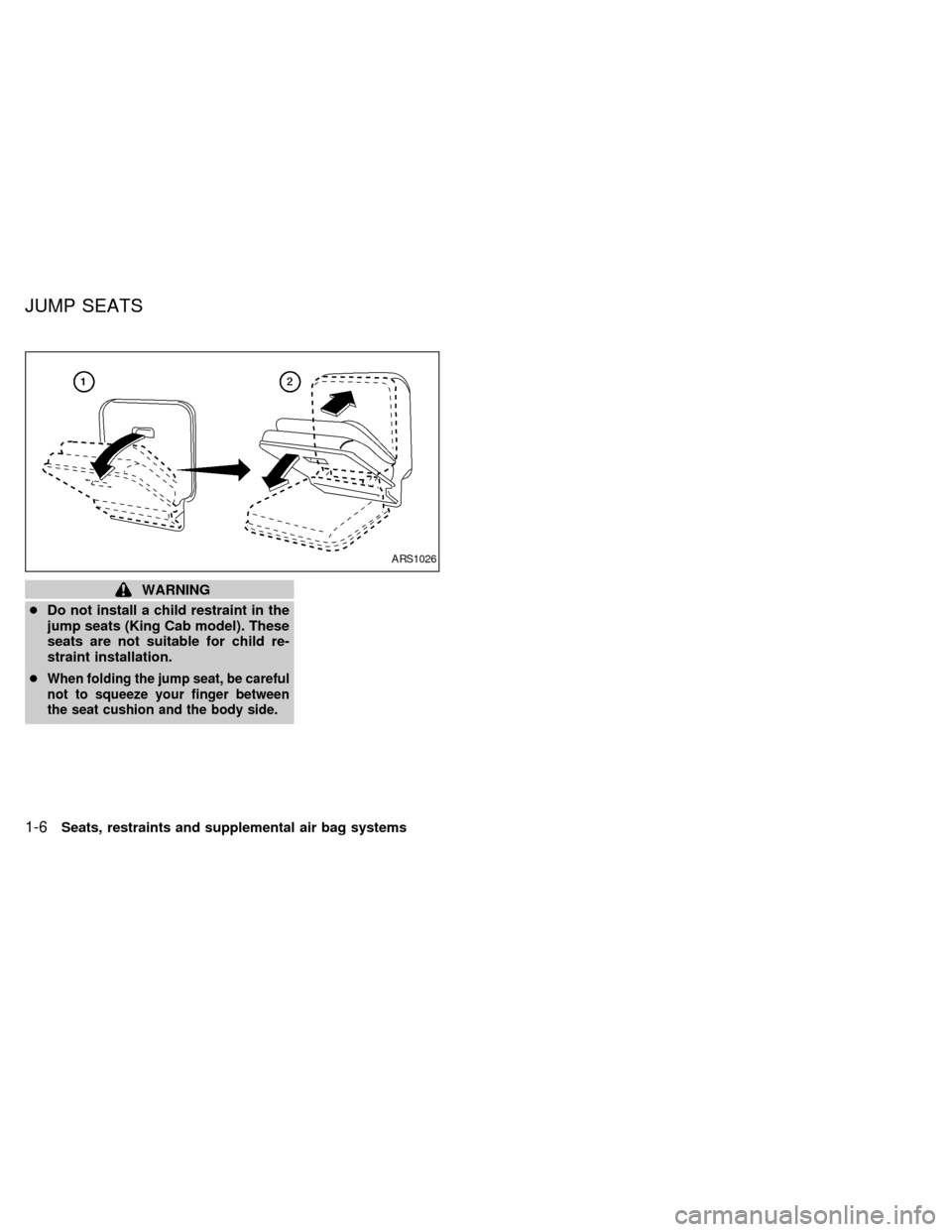
cDo not install a child restraint in the
jump seats (King Cab model). These
seats are not suitable for child re-
straint installation.
c
When folding the jump seat, be careful
not to squeeze your finger between
the seat cushion and the body side.
ARS1026
JUMP SEATS
1-6Seats, restraints and supplemental air bag systems
ZX
Page 16 of 224
WARNING
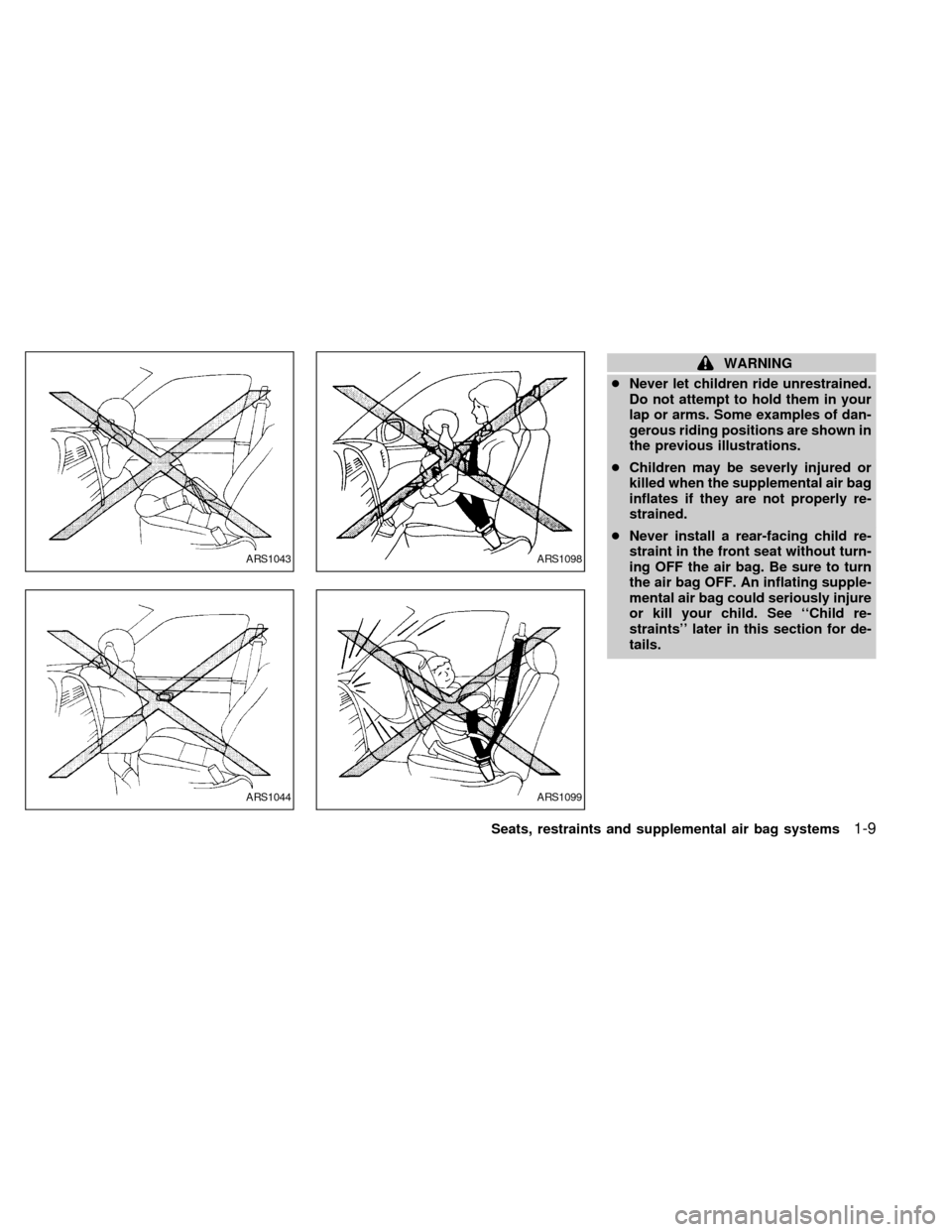
cNever let children ride unrestrained.
Do not attempt to hold them in your
lap or arms. Some examples of dan-
gerous riding positions are shown in
the previous illustrations.
cChildren may be severly injured or
killed when the supplemental air bag
inflates if they are not properly re-
strained.
cNever install a rear-facing child re-
straint in the front seat without turn-
ing OFF the air bag. Be sure to turn
the air bag OFF. An inflating supple-
mental air bag could seriously injure
or kill your child. See ``Child re-
straints'' later in this section for de-
tails.
ARS1043
ARS1044
ARS1098
ARS1099
Seats, restraints and supplemental air bag systems1-9
ZX
Page 17 of 224

The driver's supplemental air bag is located in
the center of the steering wheel. The passen-
ger's supplemental air bag is located in the top
right section of the instrument panel.
These systems are designed to meet optional
certification requirements under U.S. regula-tions. They are also permitted in Canada. The
optional certification allows air bags to be
designed to inflate somewhat less forcefully
than previously.However, all of the infor-
mation, cautions and warnings in this
manual still apply and must be followed.
The supplemental air bag system is designed
to inflate in higher severity frontal collisions,
although it may inflate if the forces in another
type of collision are similar to those of a higher
severity frontal impact. It may not inflate in
certain frontal collisions. Vehicle damage (or
lack of it) is not always an indication of proper
supplemental air bag operation.
The front passenger supplemental air bag is
equipped with an ON/OFF switch. Because
no rear seat exists where a rear facing child
restraint can be secured, the switch is de-
signed to turn OFF the passenger supple-
mental air bag so that a rear facing child
restraint can be used in the front passenger
seat. See ``Passenger supplemental air bag
ON/OFF switch and light'' later in this section
for details.
When the supplemental air bag inflates, a
fairly loud noise may be heard, followed by
the release of smoke. This smoke is not
harmful and does not indicate a fire, but
care should be taken not to unintentionally
inhale it, as it may cause irritation and
choking. Those with a history of a breathing
condition should get fresh air promptly.
The supplemental air bags, along with the use
of the seat belt, helps to cushion the impact
force on the face and chest of the occupant.
ARS1116
SUPPLEMENTAL AIR BAG
SYSTEM
1-10Seats, restraints and supplemental air bag systems
ZX
Page 20 of 224
The ON/OFF switch should ONLYbe used
to turn the passenger supplemental air bag
OFF when the following government criteria
exist:
cInfants (less than 1 year old) in rear
facing child restraints MUST
be placed
in the front passenger seat.
cChildren ages 1-12 years MUST
be
placed in the front passenger seat.
c
The passenger has a medical condition
which, according to a physician, causes
the air bag to pose a special risk and
makes the potential harm from the air
bag greater than the potential harm
from turning off the air bag.
Seat belts and child restraints should al-
ways be properly used. See ªPrecautions
on seat belt usageº and ªChild restraintsº
later in this section for details.
To turn the passenger supplemental air bag
OFF, insert the ignition key in the passenger
supplemental air bag ON/OFF switch and
turn the switch clockwise to the OFF posi-
tion. Then remove the key. When the igni-
tion is turned to the ON or START position
the passenger air bag OFF indicator light
will illuminate to indicate the air bag is OFF.To turn the passenger supplemental air bag
ON, insert the ignition key in the passenger
supplemental air bag ON/OFF switch and
turn the switch counter clockwise to the ON
position. Then remove the key. When the
ignition is turned to the ON or START
position the passenger air bag OFF indica-
tor light will illuminate for 7 seconds to
indicate the system is working properly and
then go out to indicate that the passenger
supplemental air bag is ON.
When the switch is turned to the ON posi-
tion, the passenger supplemental air bag is
enabled and could inflate in a frontal colli-
sion. When the switch is turned to the OFF
position, the passenger supplemental air
bag is disabled and will not inflate in a
frontal collision. The passenger supplemen-
tal air bag OFF indicator light on the instru-
ment panel illuminates when the passenger
supplemental air bag ON/OFF switch is
turned to the OFF position. The driver's side
supplemental air bag always remains en-
abled and is not affected by the passenger
supplemental air bag ON/OFF switch.
The passenger supplemental air bag light,
displaying OFF in the center of the instru-
ment panel, monitors the position of thepassenger supplemental air bag ON/OFF
switch. When the ignition key is in the ON or
START position, the light illuminates for
about 7 seconds and then turns off if the air
bag is ON, or stays on if the air bag is OFF.
WARNING
cDo not switch the air bag OFF unless
you meet the federal government cri-
teria outlined below. This vehicle is
equipped with seat belts with a ``load
limiter'' feature. The seat belts are
designed to work with the air bags to
reduce the risk of injury in a colli-
sion. The seat belts are designed to
release additional belt webbing dur-
ing some collisions to reduce the
concentration of force on the occu-
pant's chest area. In a collision with
the air bag turned OFF, the seat belt
may allow the occupant enough for-
ward movement to incur serious or
fatal injuries.
Seats, restraints and supplemental air bag systems
1-13
ZX
Page 21 of 224
cKeep the passenger supplemental
air bag ON/OFF switch turned ON
unless
a rear-facing child restraint
must be used in the front seat, if
children ages 1-12 must be placed in
the front seat, or if the passenger
has a medical condition, which, ac-
cording to a physician, causes the
air bag to pose a special risk of harm
(the federal government criteria). If
the switch is OFF, the air bag will not
inflate in a collision as designed and
the extra protection provided by the
air bag may be lost.
c
Be sure to turn the passenger supple-
mental air bag ON/OFF switch OFF
when using a rear facing child re-
straint in the front passenger seat. If
it is not OFF, the air bag may inflate in
a collision. The force of the rapidly
inflating air bag could cause serious
injury or kill the child in the child
restraint. Children ages 1-12 and per-
sons with special medical conditions
may also be at risk from an inflating
air bag.cIf the supplemental air bag warning
light located in the instrument panel
next to the speedometer comes on
when the passenger supplemental air
bag OFF light is also illuminated,
something may be wrong with the air
bag system. Infants, children ages
1-12 or persons with special medical
conditions should not use the front
passenger seat until the system is
checked by your NISSAN dealer.
1-14Seats, restraints and supplemental air bag systems
ZX
Page 24 of 224
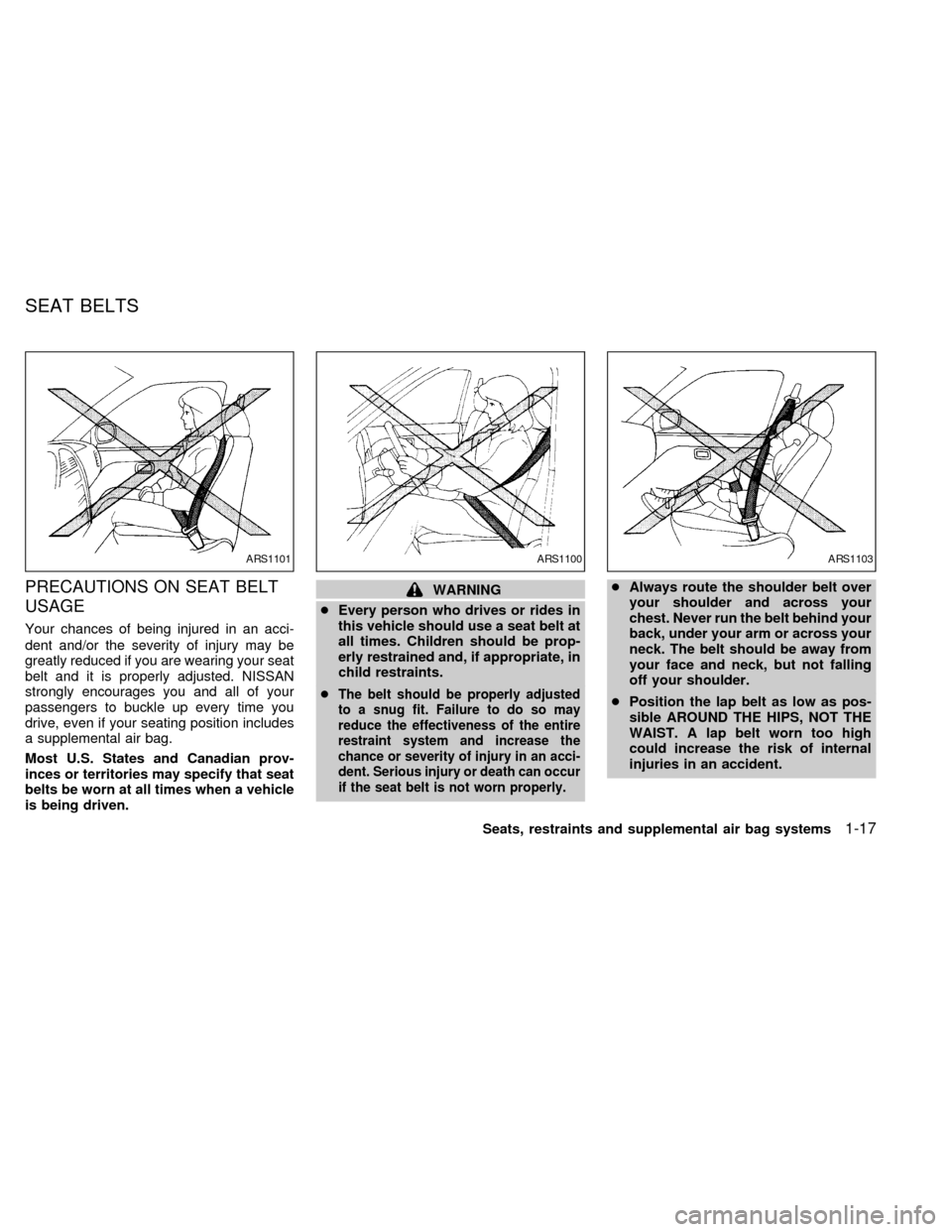
PRECAUTIONS ON SEAT BELT
USAGE
Your chances of being injured in an acci-
dent and/or the severity of injury may be
greatly reduced if you are wearing your seat
belt and it is properly adjusted. NISSAN
strongly encourages you and all of your
passengers to buckle up every time you
drive, even if your seating position includes
a supplemental air bag.
Most U.S. States and Canadian prov-
inces or territories may specify that seat
belts be worn at all times when a vehicle
is being driven.
WARNING
cEvery person who drives or rides in
this vehicle should use a seat belt at
all times. Children should be prop-
erly restrained and, if appropriate, in
child restraints.
c
The belt should be properly adjusted
to a snug fit. Failure to do so may
reduce the effectiveness of the entire
restraint system and increase the
chance or severity of injury in an acci-
dent. Serious injury or death can occur
if the seat belt is not worn properly.
cAlways route the shoulder belt over
your shoulder and across your
chest. Never run the belt behind your
back, under your arm or across your
neck. The belt should be away from
your face and neck, but not falling
off your shoulder.
cPosition the lap belt as low as pos-
sible AROUND THE HIPS, NOT THE
WAIST. A lap belt worn too high
could increase the risk of internal
injuries in an accident.
ARS1101ARS1100ARS1103
SEAT BELTS
Seats, restraints and supplemental air bag systems1-17
ZX
Page 25 of 224
cBe sure the seat belt tongue is se-
curely fastened to the proper buckle.
cDo not wear the belt inside out or
twisted. Doing so may reduce its
effectiveness.
cDo not allow more than one person
to use the same belt.
cNever carry more people in the ve-
hicle than there are seat belts.
c
Never allow anyone to ride in the cargo
area or in a slide-in camper or other
type cargo area cover while the vehicle
is in motion. These areas do not con-
tain seat belts. It is not designed for
passengers. They could be injured in
sudden braking or a collision.
cIf the seat belt warning lamp glows
continuously while the ignition is
turned ON with all doors closed and
all seat belts fastened, it may indi-
cate a malfunction in the system.
Have the system checked by an au-
thorized NISSAN dealer.
c
All seat belt assemblies including
retractors and attaching hardware
should be inspected after any colli-
sion at an authorized NISSAN dealer.NISSAN recommends that all seat-
belt assemblies in use during a colli-
sion be replaced unless the collision
was minor and the belts show no
damage and continue to operate
properly. Seat belt assemblies not in
use during a collision should also be
inspected and replaced if either dam-
age or improper operation is noted.
CHILD SAFETY
Children need adults to help protect them.
They need to be properly restrained.
The proper restraint depends on the
child's size. Generally, infants (up to
about 1 year and less than 20 pounds)
should be placed in rear facing child
restraints. Front facing child restraints
are available for children who outgrow
rear facing child restraints.
WARNING
cBe sure to turn the passenger
supplemental air bag ON/OFF switch
OFF when using a rear facing child
restraint in the front passenger seat.
If it is not OFF, the air bag may inflatein a collision. The force of the rapidly
inflating air bag could cause serious
injury or kill the child in the child
restraint.
cDo not install a child restraint in the
jump seats (King Cab model). These
seats are not suitable for child re-
straint installation.
cDo not install a child restraint in the
center position of the front bench
seat. This position is not suitable for
child restraint installation.
c
Infants and children need special pro-
tection. The vehicle's seat belts may
not fit them properly. The shoulder
belt may come too close to the face or
neck. The lap belt may not fit over
their small hip bones. In an accident,
an improperly fitting seat belt could
cause serious or fatal injury. Always
use appropriate child restraints.
All U.S. states and Canadian provinces
require the use of approved child restraints
for infants and small children. See ``Child
restraints'' later in this section for more
information.
In addition, there are many types of child
1-18Seats, restraints and supplemental air bag systems
ZX