key NISSAN FRONTIER 1999 D22 / 1.G Owner's Guide
[x] Cancel search | Manufacturer: NISSAN, Model Year: 1999, Model line: FRONTIER, Model: NISSAN FRONTIER 1999 D22 / 1.GPages: 247, PDF Size: 1.89 MB
Page 136 of 247
hill grade, place the gearshift lever in the
1st position.
Automatic transmission models:
Move the gearshift lever to the P (Park)
position.
3. To help prevent the vehicle from rolling
into the street when parked on an incline,
it is a good practice to turn the wheels as
illustrated.
IHEADED DOWNHILL WITH CURB:À
1
Turn the wheels into the curb and move
the vehicle forward until the curb side
wheel gently touches the curb.
IHEADED UPHILL WITH CURB:Á
2
Turn the wheels away from the curb and
move the vehicle back until the curb side
wheel gently touches the curb.
IHEADED UPHILL OR DOWNHILL, NO
CURB:Â
3
Turn the wheels toward the side of the
road so the vehicle will move away from
the center of the road if it moves.
4. Turn the ignition key to the LOCK posi-
tion and remove the key.The power assisted steering is designed to
use a hydraulic pump, driven by the engine,
to assist steering.
If the engine stops or drive belt breaks, you
will still have control of the vehicle. How-
ever, much greater steering effort is needed,
especially in sharp turns and at low speeds.
WARNING
If the engine is not running or is turned
off while driving, the power assist for
the steering will not work. Steering will
be much harder to operate.The brake system has two separate hydrau-
lic circuits. If one circuit develops a problem,
you will still have braking at two wheels.
Vacuum assisted brakes
The brake booster aids braking by using
engine vacuum. If the engine stops, you can
stop the vehicle by depressing the brake
pedal. However, greater foot pressure on
the brake pedal will be required to stop the
vehicle and stopping distance will be longer.
Wet brakes
When the vehicle is washed or driven
through water, the brakes may get wet. As a
result, your braking distance will be longer
and the vehicle may pull to one side during
braking.
To dry the brakes, drive the vehicle at a safe
speed while lightly pressing the brake pedal
to heat the brakes. Do this until the brakes
return to normal. Avoid driving the vehicle at
high speeds until the brakes function cor-
rectly.
POWER STEERING SYSTEM BRAKE SYSTEM
5-28Starting and driving
ZX
Page 138 of 247
Using the system, 2WD Vehicles
(2 wheel rear ABS)
Depress the brake pedal and hold it down.
With the rear anti-lock brake system, the
front wheels can still lock. If this happens,
release the brake pedal slightly and then
reapply pressure.
WARNING
The anti-lock brake system is a sophis-
ticated device. But it cannot prevent
accidents resulting from careless or
dangerous driving techniques. It can
help maintain vehicle control under
some conditions, but remember that
the stopping distance on slippery sur-
faces will be longer than on normal
surfaces even with ABS. Stopping dis-
tances may also be longer on rough,
gravel, or snow covered roads, or if you
are using tire chains. Always maintain a
safe distance from the vehicle in front
of you. Ultimately, the responsibility for
safety of self and others rests in the
hands of the driver.Tire type and condition may also affect
braking effectiveness.
IWhen replacing tires, install the
specified size of tires on all four
wheels.
IWhen installing a spare tire, make
sure it is the proper size and type as
specified on the tire placard. See
``Tire placard'' in the ``Technical and
consumer information'' section.
Freeing a frozen door lock
To prevent a door lock from freezing, apply
de-icer or glycerin through the key hole. If
the lock becomes frozen, heat the key be-
fore inserting it in the key hole.
Anti-freeze
In the winter when it is anticipated that the
temperature will drop below 32ÉF (0ÉC),
check anti-freeze (ethylene glycol base) to
assure proper winter protection. For details,
see ``Engine cooling system'' in the ``Do-it-
yourself'' section of this manual.
Battery
If the battery is not fully charged during
extremely cold weather conditions, the bat-
tery fluid may freeze and damage the bat-
tery. To maintain maximum efficiency, the
battery should be checked regularly. For
details, see ``Battery'' in the ``Do-it-yourself''
section of this manual.
Draining of coolant water
If the vehicle is to be left outside without
anti-freeze, drain the cooling system by
opening the drain valves located under the
radiator and on the engine block. Refill
COLD WEATHER DRIVING
5-30Starting and driving
ZX
Page 149 of 247
4. Connect jumper cables in the sequence
as illustrated.
CAUTION
IAlways connect positive (+) to posi-
tive (+) and negative (þ) to body
ground (e.g., strut mounting bolt,
etc.Ðnot to the battery).
IMake sure that cables do not touch
moving parts in the engine compart-
ment and that clamps do not contact
any other metal.
5. Start the engine of the booster vehicle
and let it run for a few minutes.
6. Keep the engine speed of the booster
vehicle at about 2,000 r/min, and start the
engine of the vehicle being jump started.
CAUTION
Do not keep the starter motor engaged
for more than 10 seconds. If the engine
does not start right away, turn the key
off and wait 3 to 4 seconds before
trying again.7. After starting your engine, carefully dis-
connect the negative cable and then the
positive cable.
8. Replace the vent caps (if so equipped).
Be sure to dispose of the cloth used to
cover the vent holes as it may be con-
taminated with corrosive acid.
CAUTION
IAutomatic transmission models can-
not be started by pushing. This may
cause transmission damage.
IThree-way catalyst equipped models
should not be started by pushing
since the three-way catalyst may be
damaged.
INever try to start the vehicle by tow-
ing it. When the engine starts, the
forward surge could cause the ve-
hicle to collide with the tow vehicle.
PUSH STARTING
In case of emergency6-9
ZX
Page 151 of 247
When towing your vehicle, U.S. States, Ca-
nadian provinces and local regulations for
towing must be followed. Incorrect towing
equipment could damage your vehicle. Tow-
ing instructions are available from an autho-
rized NISSAN dealer. Local service operators
are generally familiar with the applicable laws
and procedures for towing. To assure proper
towing and to prevent accidental damage to
your vehicle, NISSAN recommends having a
service operator tow your vehicle. It is advis-
able to have the service operator carefully
read the following precautions:
WARNING
INever ride in a vehicle that is being
towed.
INever get under your vehicle after it
has been lifted by a tow truck.
CAUTION
IWhen towing, make sure that the
transmission, axles, steering system
and powertrain are in working con-
dition. If any unit is damaged, a dolly
must be used.IWhen towing with the front wheels
on the ground:
Turn the ignition key to the OFF
position and secure the steering
wheel in a straight-ahead position
with a rope or similar device. Never
place the ignition key in the LOCK
position. This will result in damage
to the steering lock mechanism.
IWhen towing with the rear wheels on
the ground:
Release the parking brake and move
the gearshift lever to the N (Neutral)
position.
On automatic transmission models,
to move the shift lever to N (Neutral),
turn the ignition key to the ACC po-
sition. After moving the shift lever to
N (neutral), be sure to turn the igni-
tion key to the OFF position.
IFor four-wheel drive models:
Set the free-running hubs to the free
position. See ``
Auto-lock free-
running hubsº or ``Manual-lock
free-running hubsº as appropriate in
the ``Starting and driving'' section.Move the transfer case shift lever
into the 2H position and the trans-
mission shift lever into the N (Neu-
tral) position.
IAttach safety chains for all towing.
TOW TRUCK TOWING
In case of emergency6-11
ZX
Page 162 of 247
When performing any inspection or mainte-
nance work on your vehicle, always take
care to prevent serious accidental injury to
yourself or damage to the vehicle. The
following are general precautions which
should be closely observed.
WARNING
IPark the vehicle on a level surface,
apply the parking brake securely and
block the wheels to prevent the ve-
hicle from moving. For a manual
transmission, move the shift lever to
N (Neutral). For an automatic trans-
mission, move the shift lever to P
(Park).
IBe sure the ignition key is OFF when
performing any parts replacement or
repairs.
IIf you must work with the engine
running, keep your hands, clothing,
hair and tools away from moving
fans, belts, and any other moving
parts.
IIt is advisable to remove ties and any
jewelry, such as rings, watches, etc.,
before working on your vehicle.IAlways wear eye protection when-
ever you work on your vehicle.
IIf you must run the engine in an
enclosed space such as a garage, be
sure there is proper ventilation for
exhaust gases.
INever get under the vehicle while it
is supported only by a jack. If it is
necessary to work under the vehicle,
support it with safety stands.
IKeep smoking materials, flame and
sparks away from fuel and battery.
IOn gasoline engine models with the
Multiport Fuel Injection (MFI) sys-
tem, the fuel filter or fuel lines
should be serviced by an authorized
NISSAN dealer because the fuel
lines are under high pressure even
when the engine is off.
CAUTION
IDo not work under the hood while
the engine is hot. Turn the engine off
and wait until it cools down.INever connect or disconnect either
the battery or any transistorized
component connector while the igni-
tion is on.
IAvoid contact with used motor oil.
Improperly disposed motor oil
and/or other vehicle fluids can hurt
the environment. Always conform to
local regulations for disposal of ve-
hicle fluid.
This ``Do-it-yourself'' section gives instruc-
tions regarding only those items which are
relatively easy for an owner to perform.
You should be aware that incomplete or
improper servicing may result in operating
difficulties or excessive emissions, and
could affect your warranty coverage.If in
doubt about any servicing, have it done
by an authorized NISSAN dealer.
MAINTENANCE
PRECAUTIONS
8-2Do-it-yourself
ZX
Page 178 of 247
WARNING
Be sure the ignition key is OFF. The
engine could rotate unexpectedly.
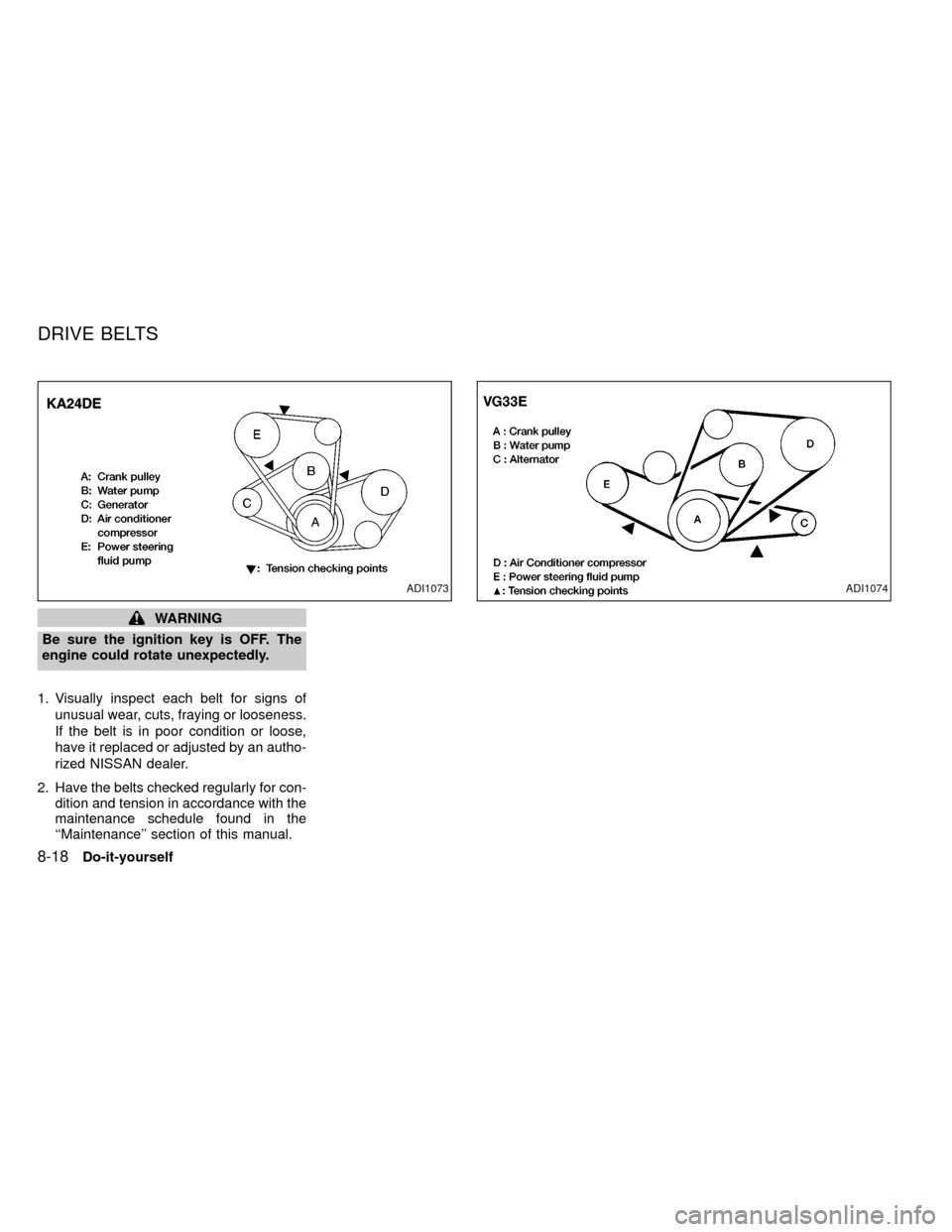
1. Visually inspect each belt for signs of
unusual wear, cuts, fraying or looseness.
If the belt is in poor condition or loose,
have it replaced or adjusted by an autho-
rized NISSAN dealer.
2. Have the belts checked regularly for con-
dition and tension in accordance with the
maintenance schedule found in the
``Maintenance'' section of this manual.
ADI1074ADI1073
DRIVE BELTS
8-18Do-it-yourself
ZX
Page 187 of 247
Passenger compartment
CAUTION
Never use a fuse of higher amperage
rating than that specified on the fuse
box cover. This could damage the elec-
trical system or cause a fire.
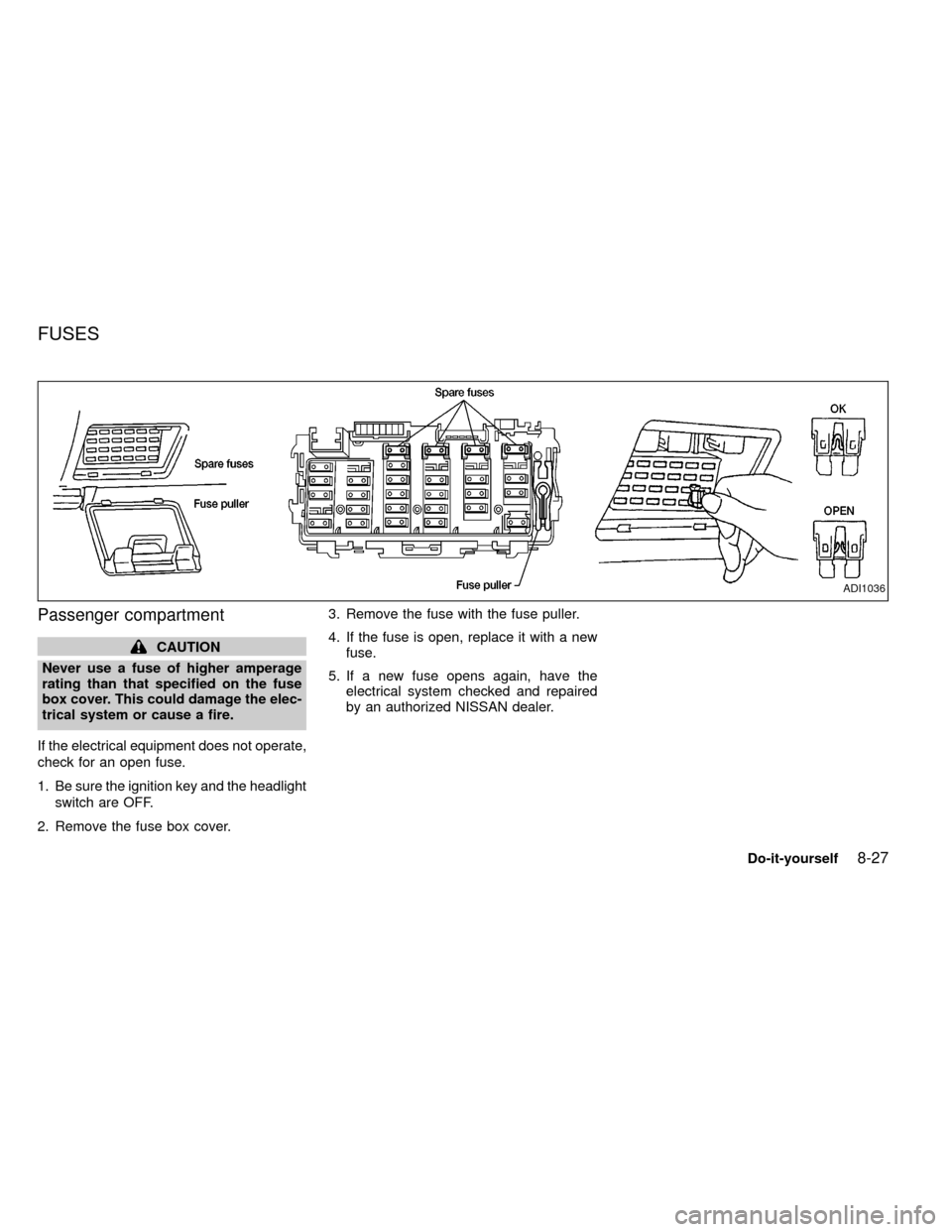
If the electrical equipment does not operate,
check for an open fuse.
1. Be sure the ignition key and the headlight
switch are OFF.
2. Remove the fuse box cover.3. Remove the fuse with the fuse puller.
4. If the fuse is open, replace it with a new
fuse.
5. If a new fuse opens again, have the
electrical system checked and repaired
by an authorized NISSAN dealer.
ADI1036
FUSES
Do-it-yourself8-27
ZX
Page 243 of 247

Heater operation ..................................... 4-4
Heater operation .......................................... 4-4
Hood release ............................................... 3-8
Hubs
Auto-lock free-running hubs ................. 5-20
Manual-lock free-running hubs ............. 5-22
I
Ignition switch .............................................. 5-4
Indicator lights and chimes (See warning/
indicator lights and chimes) ......................... 2-7
Inside mirror ............................................... 3-14
Instrument brightness control .................... 2-17
Interior light and cargo light ....................... 2-21
J
Jack
Pantograph type ..................................... 6-5
Jump seat .................................................... 1-8
Jump starting ............................................... 6-8
K
Key ............................................................... 3-2
Keyless entry system (See multi-remote control
system) ........................................................ 3-4L
Labels
Air conditioner specification label ....... 10-14
Emission control information label...... 10-14
Engine serial number ......................... 10-13
F.M.V.S.S. certification label ............... 10-13
Vehicle identification number (VIN)
plate .................................................... 10-12
Warning labels (for SRS)...................... 1-17
Light
Air bag warning light............................. 1-17
Brake light (See stop light) ................... 8-29
Bulb check/instrument panel .................. 2-7
Bulb replacement.................................. 8-29
Headlight and turn signal switch .......... 2-15
Headlights ............................................. 8-28
Interior light and cargo light .................. 2-21
Light bulbs ............................................ 8-28
Passenger supplemental air bag ON/OFF
switch and light ..................................... 1-14
Spotlights (See map light) .................... 2-21
Warning/indicator lights and chimes....... 2-7
Lock
Door locks............................................... 3-2
Power door lock...................................... 3-3
Luggage (See vehicle loading
information ............................................... 10-15
M
MaintenanceGeneral maintenance ............................. 9-2
Inside the vehicle.................................... 9-3
Maintenance precautions ....................... 8-2
Outside the vehicle ................................. 9-2
Periodic maintenance schedules ............ 9-5
Seat belt maintenance.......................... 1-27
Under the hood and vehicle ................... 9-4
Malfunction indicator light .......................... 2-11
Manual windows ........................................ 2-22
Manual-lock free-running hubs .................. 5-22
Map light .................................................... 2-21
Meters and gauges ...................................... 2-2
Mirror
Inside mirror.......................................... 3-14
Outside mirror control ........................... 3-13
Outside mirrors ..................................... 3-14
Vanity mirror.......................................... 3-15
Multi-remote control system ........................ 3-4
O
Octane rating (See fuel octane rating) ...... 10-5
Odometer ..................................................... 2-3
Oil
Capacities and recommended fuel/
lubricants .............................................. 10-2
Changing engine oil.............................. 8-10
Changing engine oil filter...................... 8-12
Checking engine oil level ....................... 8-9
Engine oil ................................................ 8-9
Engine oil and oil filter
recommendation ................................... 10-6
11-3
ZX
Page 244 of 247

Engine oil viscosity ............................... 10-7
Outside mirror control ................................ 3-13
Outside mirrors .......................................... 3-14
Overdrive switch ........................................ 5-11
Overheat
If your vehicle overheats ...................... 6-10
Owner's manual order form ..................... 10-29
P
Pantograph type jack ................................... 6-5
Parking
Parking brake check ............................. 8-24
Parking brake operation ....................... 5-14
Parking/parking on hills ........................ 5-27
Passenger supplemental air bag ON/OFF
switch and light
Passenger supplemental air bag ON/OFF
switch and light ..................................... 1-14
Periodic maintenance schedules ................. 9-5
Power
Power antenna ..................................... 4-23
Power door lock...................................... 3-3
Power steering fluid .............................. 8-14
Power steering system ......................... 5-28
Power windows..................................... 2-22
Precautions
Maintenance precautions ....................... 8-2
On-pavement and off-road driving
precautions ............................................. 5-3
Precautions on seat belt usage............ 1-19
Precautions when starting and driving ... 5-2Push starting ................................................ 6-9
R
Radio
AM-FM radio with cassette player ........ 4-11
AM-FM radio with cassette player, compact
disc player and sub-woofer .................. 4-16
CB radio or car phone .......................... 4-23
Readiness for inspection maintenance (I/M)
test ........................................................... 10-28
Rear anti-lock brake warning light ............. 2-10
Rear sliding window................................... 2-23
Registering your vehicle in another
country ..................................................... 10-12
Remote keyless entry system (See
multi-remote control system) ....................... 3-4
Reporting safety defects (USA) ............... 10-27
S
Safety
Reporting safety defects (USA) .......... 10-27
Seat
Jump seat ............................................... 1-8
Seat belt
2-point type without retractor................ 1-25
3-point type with retractor..................... 1-22
Precautions on seat belt usage............ 1-19
Seat belt extenders .............................. 1-27
Seat belt maintenance.......................... 1-27
Seat belts.............................................. 1-19Seat belt warning light ................................. 2-8
Seats
Adjustment .............................................. 1-2
Bench seat.............................................. 1-6
Separate seats ....................................... 1-2
Service manual order form ...................... 10-29
Shifting
Automatic transmission .......................... 5-7
Manual transmission............................. 5-13
Spark plug replacement............................. 8-19
Speedometer ............................................... 2-3
Spotlights (See map light) ......................... 2-21
SRS warning label ..................................... 1-17
Starting
Before starting the engine ...................... 5-6
Jump starting .......................................... 6-8
Precautions when starting and driving ... 5-2
Push starting........................................... 6-9
Starting the engine ............................... 5-14
Steering
Power steering fluid .............................. 8-14
Power steering system ......................... 5-28
Tilting steering wheel ............................ 3-13
Stop light .................................................... 8-29
Sun shade.................................................. 2-25
Sunroof ...................................................... 2-24
Supplemental restraint system (Supplemental
air bag system) ............................................ 1-9
Switch
Automatic power window switch .......... 2-23
Hazard warning flasher switch ............. 2-18
Headlight and turn signal switch .......... 2-15
11-4
ZX