check transmission fluid NISSAN FRONTIER 1999 D22 / 1.G Owners Manual
[x] Cancel search | Manufacturer: NISSAN, Model Year: 1999, Model line: FRONTIER, Model: NISSAN FRONTIER 1999 D22 / 1.GPages: 247, PDF Size: 1.89 MB
Page 49 of 247
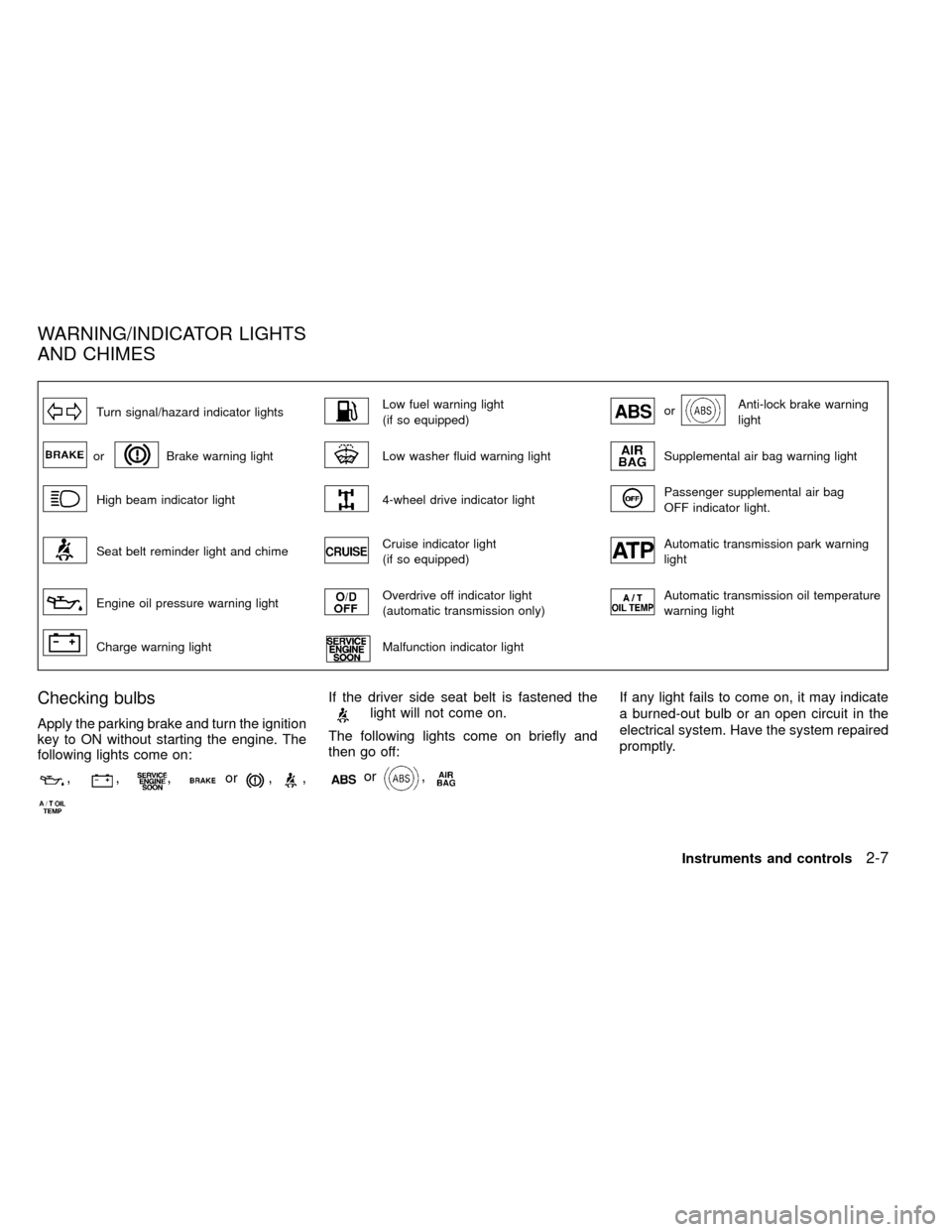
Turn signal/hazard indicator lightsLow fuel warning light
(if so equipped)orAnti-lock brake warning
light
orBrake warning lightLow washer fluid warning lightSupplemental air bag warning light
High beam indicator light4-wheel drive indicator lightPassenger supplemental air bag
OFF indicator light.
Seat belt reminder light and chimeCruise indicator light
(if so equipped)Automatic transmission park warning
light
Engine oil pressure warning lightOverdrive off indicator light
(automatic transmission only)Automatic transmission oil temperature
warning light
Charge warning lightMalfunction indicator light
Checking bulbs
Apply the parking brake and turn the ignition
key to ON without starting the engine. The
following lights come on:
,,,or,,
If the driver side seat belt is fastened thelight will not come on.
The following lights come on briefly and
then go off:
or,
If any light fails to come on, it may indicate
a burned-out bulb or an open circuit in the
electrical system. Have the system repaired
promptly.
WARNING/INDICATOR LIGHTS
AND CHIMES
Instruments and controls2-7
ZX
Page 52 of 247
There will be a small reserve of fuel
remaining in the tank when the fuel
gauge needle reaches E (Empty).
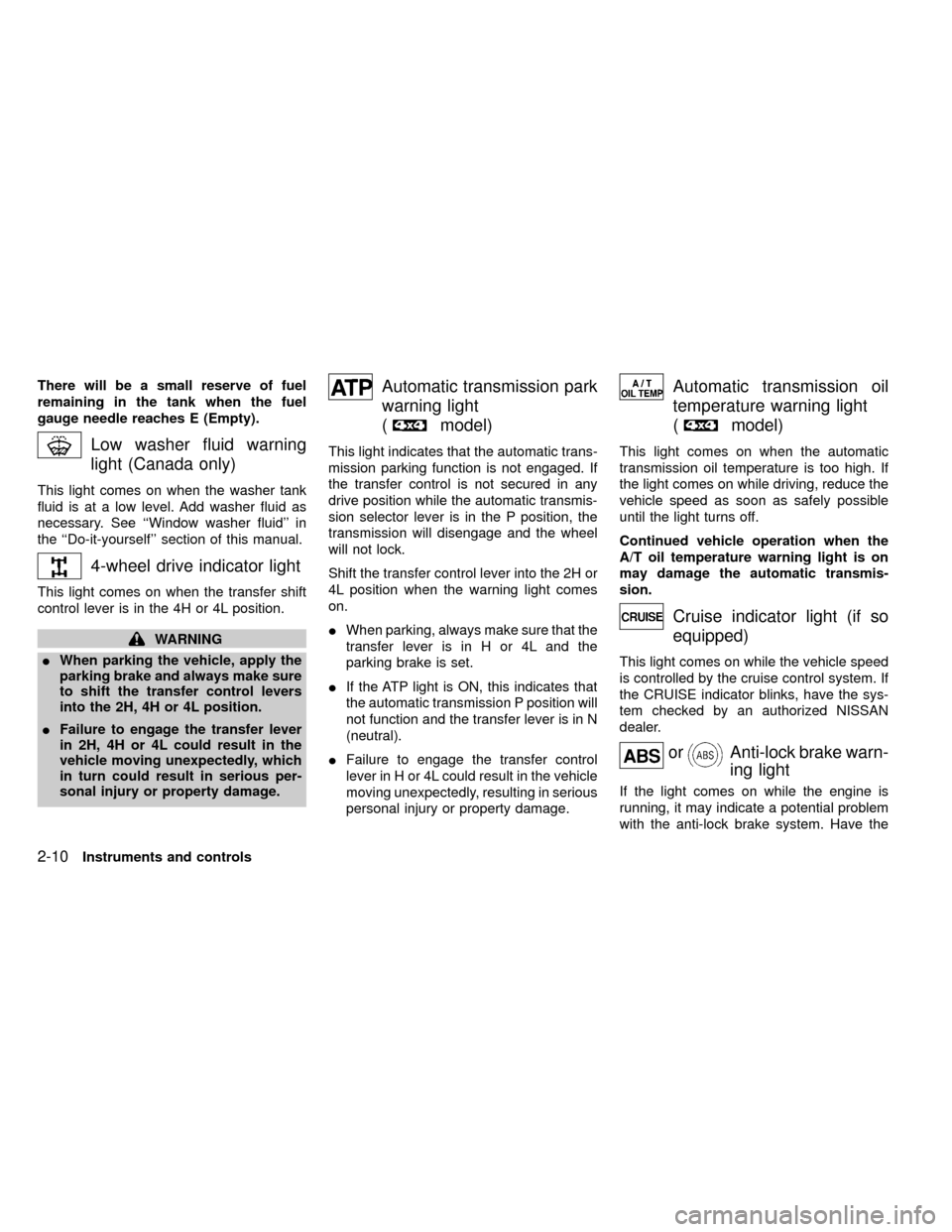
Low washer fluid warning
light (Canada only)
This light comes on when the washer tank
fluid is at a low level. Add washer fluid as
necessary. See ``Window washer fluid'' in
the ``Do-it-yourself'' section of this manual.
4-wheel drive indicator light
This light comes on when the transfer shift
control lever is in the 4H or 4L position.
WARNING
IWhen parking the vehicle, apply the
parking brake and always make sure
to shift the transfer control levers
into the 2H, 4H or 4L position.
IFailure to engage the transfer lever
in 2H, 4H or 4L could result in the
vehicle moving unexpectedly, which
in turn could result in serious per-
sonal injury or property damage.
Automatic transmission park
warning light
(
model)
This light indicates that the automatic trans-
mission parking function is not engaged. If
the transfer control is not secured in any
drive position while the automatic transmis-
sion selector lever is in the P position, the
transmission will disengage and the wheel
will not lock.
Shift the transfer control lever into the 2H or
4L position when the warning light comes
on.
IWhen parking, always make sure that the
transfer lever is in H or 4L and the
parking brake is set.
IIf the ATP light is ON, this indicates that
the automatic transmission P position will
not function and the transfer lever is in N
(neutral).
IFailure to engage the transfer control
lever in H or 4L could result in the vehicle
moving unexpectedly, resulting in serious
personal injury or property damage.
Automatic transmission oil
temperature warning light
(
model)
This light comes on when the automatic
transmission oil temperature is too high. If
the light comes on while driving, reduce the
vehicle speed as soon as safely possible
until the light turns off.
Continued vehicle operation when the
A/T oil temperature warning light is on
may damage the automatic transmis-
sion.
Cruise indicator light (if so
equipped)
This light comes on while the vehicle speed
is controlled by the cruise control system. If
the CRUISE indicator blinks, have the sys-
tem checked by an authorized NISSAN
dealer.
orAnti-lock brake warn-
ing light
If the light comes on while the engine is
running, it may indicate a potential problem
with the anti-lock brake system. Have the
2-10Instruments and controls
ZX
Page 114 of 247
START (4)
This position starts the engine. As soon as
the engine has started, release the key. It
automatically returns to the ON position.IMake sure the area around the vehicle is
clear.
ICheck fluid levels such as engine oil,
coolant, brake and clutch fluid, and win-
dow washer fluid as frequently as pos-
sible, at least whenever you refuel.
ICheck that all windows and lights are
clean.
IVisually inspect tires for their appearance
and condition. Also check tires for proper
inflation.
ILock all doors.
IPosition seat and adjust head restraints.
IAdjust inside and outside mirrors.
IFasten seat belts and ask all passengers
to do likewise.
ICheck the operation of warning lights
when key is turned to the ON (3) position.
See²Warning/Indicator lights and
chimes²in the²Instruments and con-
trols²section.WARNING
IDo not depress the accelerator pedal
while shifting from P (Park) or N
(Neutral) to R (Reverse), D (Drive), 2
or 1. Always depress the brake pedal
until shifting is completed. Failure to
do so could cause you to lose con-
trol and have an accident.
ICold engine idle speed is high, so
use caution when shifting into a for-
ward or reverse gear before the en-
gine has warmed up.
INever shift to P (Park) or R (Reverse)
while the vehicle is moving. This
could cause an accident.
CAUTION
IWhen stopping the vehicle on an
uphill grade, do not hold the vehicle
by depressing the accelerator pedal.
The foot brake should be used for
this purpose.
IOn slippery roads, do not downshift.
This may cause a loss of control.
BEFORE STARTING THE
ENGINEDRIVING WITH AUTOMATIC
TRANSMISSION (if so
equipped)
5-6Starting and driving
ZX
Page 161 of 247

8 Do-it-yourself
Maintenance precautions .......................................8-2
Engine compartment check locations ....................8-3
Engine cooling system ...........................................8-5
Checking engine coolant level ...............................8-5
Changing engine coolant .......................................8-6
Engine oil ...............................................................8-9
Checking engine oil level .......................................8-9
Changing engine oil .............................................8-10
Changing engine oil filter .....................................8-12
Automatic transmission fluid (atf) .........................8-13
Temperature conditions for checking atf..............8-13
Power steering fluid..............................................8-14
Brake and clutch fluid ...........................................8-15
Window washer fluid ............................................8-15
Battery ..................................................................8-16
Jump starting ........................................................8-17
Drive belts ............................................................8-18Spark plug replacement .......................................8-19
Air cleaner housing filter ......................................8-21
Wiper blades ........................................................8-23
Parking brake check.............................................8-24
Brake pedal ..........................................................8-24
Brake booster .......................................................8-25
Clutch pedal .........................................................8-26
Fuses ....................................................................8-27
Light bulbs ............................................................8-28
Headlights ............................................................8-28
Bulb replacement .................................................8-29
Front fog light bulb replacement (if so
equipped) .............................................................8-31
Wheels and tires...................................................8-32
Four-wheel drive models ......................................8-35
Clutch housing .....................................................8-37
ZX
Page 173 of 247
WARNING
IWhen engine is running, keep
hands, jewelry and clothing away
from any moving parts such as cool-
ing fan and drive belts.
IAutomatic transmission fluid is poi-
sonous and should be stored care-
fully in marked containers out of the
reach of children.
TEMPERATURE CONDITIONS
FOR CHECKING ATF
IThe fluid level should be checked using
the HOT range on the dipstick after the
following conditions have been met:
Ð The engine should be warmed up to
operating temperature.
Ð The vehicle should be driven at least 5
minutes.
Ð The ATF should be warmed to between
122 and 176ÉF (50 and 80ÉC).
IThe ATF can be checked at fluid tem-
peratures of 86 to 122ÉF (30 to 50ÉC)
using the COLD range on the dipstickafter the engine is warmed up and before
driving. However, the fluid should be
re-checked using the HOT range.
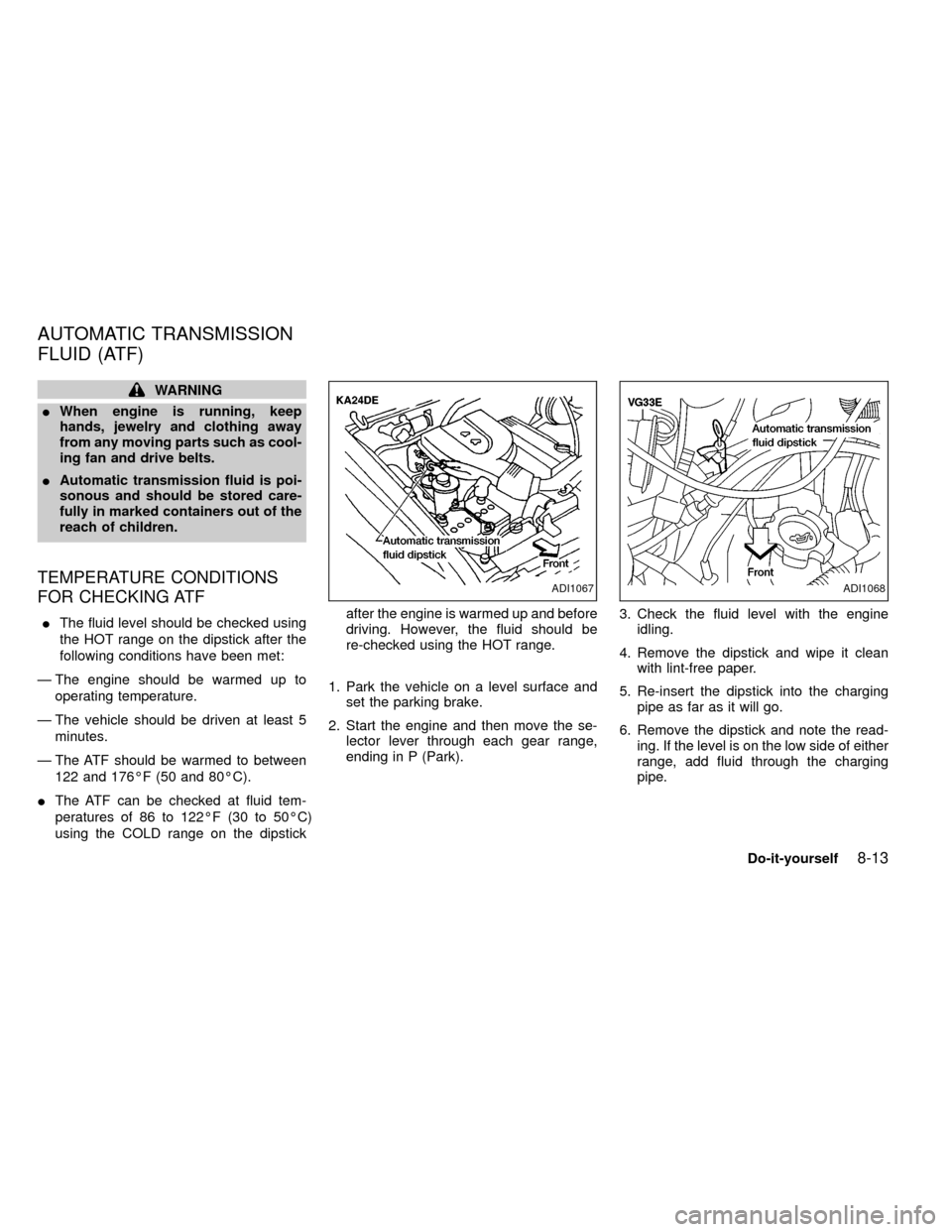
1. Park the vehicle on a level surface and
set the parking brake.
2. Start the engine and then move the se-
lector lever through each gear range,
ending in P (Park).3. Check the fluid level with the engine
idling.
4. Remove the dipstick and wipe it clean
with lint-free paper.
5. Re-insert the dipstick into the charging
pipe as far as it will go.
6. Remove the dipstick and note the read-
ing. If the level is on the low side of either
range, add fluid through the charging
pipe.
ADI1067ADI1068
AUTOMATIC TRANSMISSION
FLUID (ATF)
Do-it-yourself8-13
ZX
Page 174 of 247
CAUTION
IDO NOT OVERFILL.
I
Use ONLY NISSAN Matic `D' (Conti-
nental U.S. and Alaska) or genuine
NISSAN Automatic Transmission
Fluid (Canada). Dexron
TMIII/MerconTM
or equivalent may also be used. Out-
side the continental United States and
Alaska contact an authorized NISSAN
dealership for more information re-
garding suitable fluids, including rec-
ommended brands of Dexron
TM
III/MerconTM.
NOTE:
If the vehicle has been driven for a long
time at high speeds, or in city traffic in
hot weather, or if it is being used to pull
a trailer, the fluid level cannot be read
accurately. You should wait until the fluid
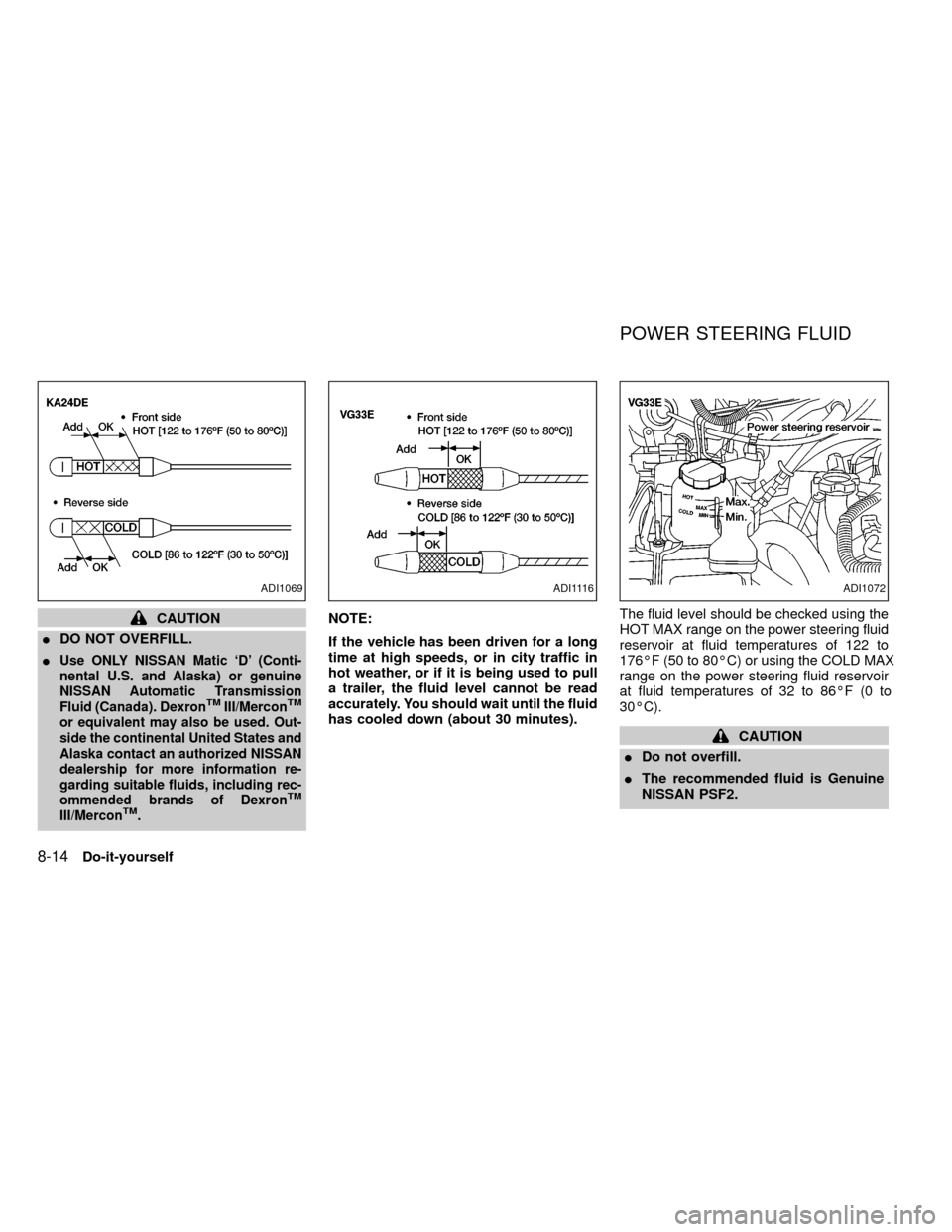
has cooled down (about 30 minutes).The fluid level should be checked using the
HOT MAX range on the power steering fluid
reservoir at fluid temperatures of 122 to
176ÉF (50 to 80ÉC) or using the COLD MAX
range on the power steering fluid reservoir
at fluid temperatures of 32 to 86ÉF (0 to
30ÉC).
CAUTION
IDo not overfill.
IThe recommended fluid is Genuine
NISSAN PSF2.
ADI1069ADI1116ADI1072
POWER STEERING FLUID
8-14Do-it-yourself
ZX
Page 175 of 247
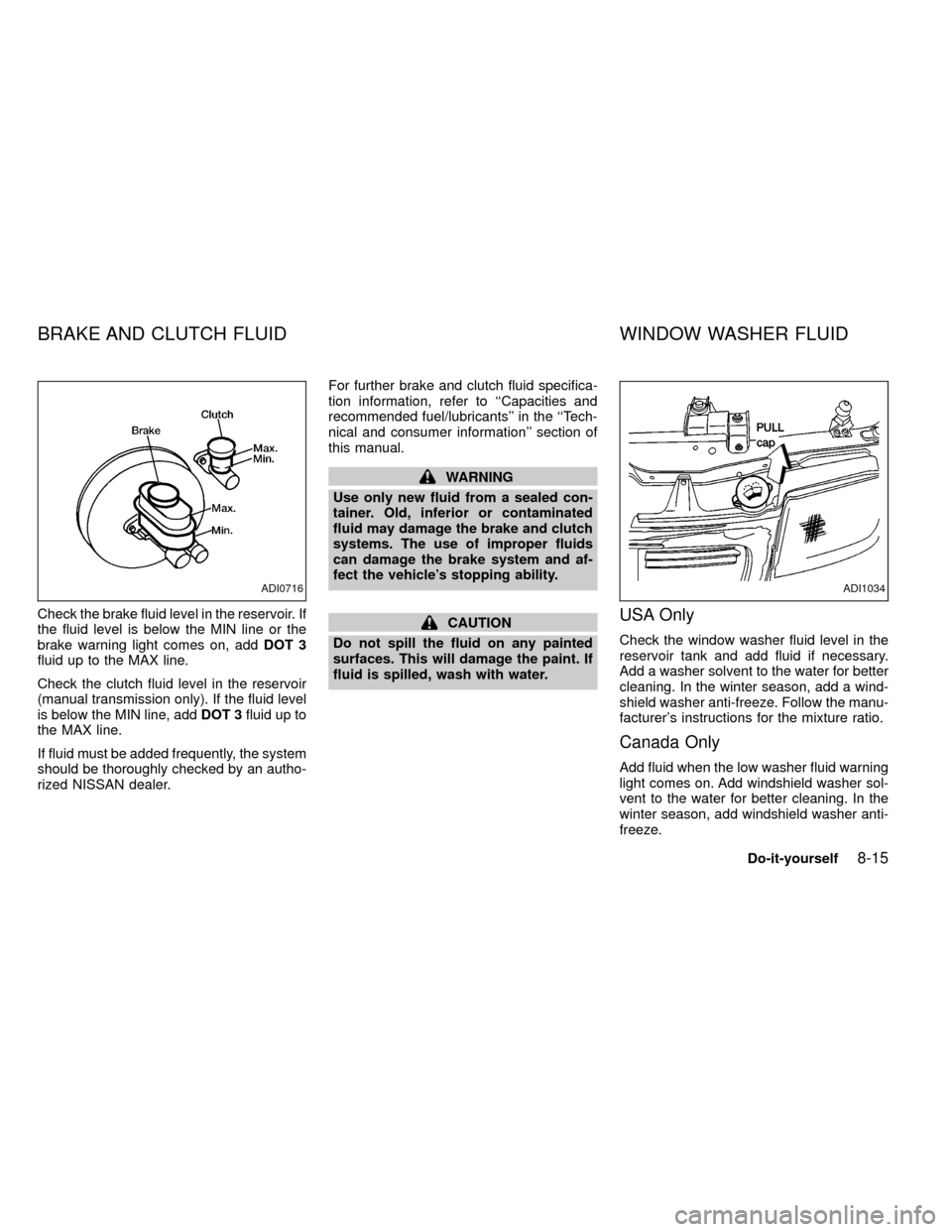
Check the brake fluid level in the reservoir. If
the fluid level is below the MIN line or the
brake warning light comes on, addDOT 3
fluid up to the MAX line.
Check the clutch fluid level in the reservoir
(manual transmission only). If the fluid level
is below the MIN line, addDOT 3fluid up to
the MAX line.
If fluid must be added frequently, the system
should be thoroughly checked by an autho-
rized NISSAN dealer.For further brake and clutch fluid specifica-
tion information, refer to ``Capacities and
recommended fuel/lubricants'' in the ``Tech-
nical and consumer information'' section of
this manual.
WARNING
Use only new fluid from a sealed con-
tainer. Old, inferior or contaminated
fluid may damage the brake and clutch
systems. The use of improper fluids
can damage the brake system and af-
fect the vehicle's stopping ability.
CAUTION
Do not spill the fluid on any painted
surfaces. This will damage the paint. If
fluid is spilled, wash with water.USA Only
Check the window washer fluid level in the
reservoir tank and add fluid if necessary.
Add a washer solvent to the water for better
cleaning. In the winter season, add a wind-
shield washer anti-freeze. Follow the manu-
facturer's instructions for the mixture ratio.
Canada Only
Add fluid when the low washer fluid warning
light comes on. Add windshield washer sol-
vent to the water for better cleaning. In the
winter season, add windshield washer anti-
freeze.
ADI0716ADI1034
BRAKE AND CLUTCH FLUID WINDOW WASHER FLUID
Do-it-yourself8-15
ZX
Page 202 of 247

tion. Be certain to keep the floor mat away
from the pedal.
Parking brake*Check that the lever has
the proper travel and confirm that your
vehicle is held securely on a fairly steep hill
with only the parking brake applied.
Automatic transmission Park position
mechanismCheck that the lock release
button on the selector lever operates prop-
erly and smoothly. On a fairly steep hill
check that your vehicle is held securely with
the selector lever in the P position without
applying any brakes.
UNDER THE HOOD AND
VEHICLE
The maintenance items listed here should
be checked periodically (e.g., each time you
check the engine oil or refuel).
Additional information on the following
items with an ``*'' is found in the ``Do-it-
yourself operations'' section.
Windshield washer fluid*Check that there
is adequate fluid in the reservoir.
Engine coolant level*Check the coolant
level when the engine is cold.Radiator and hosesCheck the front of the
radiator and clean off any dirt, insects,
leaves, etc., that may have accumulated.
Make sure the hoses have no cracks, de-
formation, rot or loose connections.
Brake and clutch fluid levels*Make sure
that the brake and clutch fluid level is be-
tween the MIN and MAX lines on the reser-
voir.
Battery*Check the fluid level in each cell. It
should be between the MAX and MIN lines.
Engine drive belts*Make sure the drive
belts are not frayed, worn, cracked or oily.
Engine oil level*Check the level after
parking the vehicle on a level surface with
the engine off. Wait a few minutes for the oil
to drain back into the oil pan.
Power steering fluid level* and lines
Check the level when the fluid is cold, with
the engine off. Check the lines for proper
attachment, leaks, cracks, etc.
Automatic transmission fluid level*
Check the level after putting the selector
lever in P with the engine idling at operating
temperature.
Exhaust systemMake sure there are noloose supports, cracks or holes. If the sound
of the exhaust seems unusual or there is a
smell of exhaust fumes, immediately have
the exhaust system inspected by an autho-
rized NISSAN dealer. See the carbon mon-
oxide warning in the ``Starting and driving''
section of this manual.
UnderbodyThe underbody is frequently
exposed to corrosive substances such as
those used on icy roads or to control dust. It
is very important to remove these sub-
stances from the underbody, otherwise rust
may form on the floor pan, frame, fuel lines
and exhaust system. At the end of winter,
the underbody should be thoroughly flushed
with plain water, in those areas where mud
and dirt may have accumulated. See the
``Appearance and care'' section of this
manual.
Fluid leaksCheck under the vehicle for
fuel, oil, water or other fluid leaks after the
vehicle has been parked for a while. Water
dripping from the air conditioner after use is
normal. If you should notice any leaks or if
gasoline fumes are evident, check for the
cause and have it corrected immediately.
9-4Maintenance
ZX
Page 241 of 247
11 Index
A
Air bag
Passenger supplemental air bag ON/OFF
switch and light ..................................... 1-14
Air bag (See supplemental restraint
system) ...................................................... 1-12
Air bag warning light .................................. 1-17
Air cleaner housing filter ............................ 8-21
Air conditioner
Air conditioner operation ........................ 4-5
Air conditioner service .......................... 4-10
Air conditioner specification label ....... 10-14
Air conditioner system refrigerant and
lubrication recommendations ................ 10-8
Heater and air conditioner controls ........ 4-3
Air flow charts .............................................. 4-7
Alarm system (See theft warning) ............. 2-13
Anchor point locations ............................... 1-36
Antenna
Power.................................................... 4-23
Anti-lock brake system (ABS).................... 5-29
Anti-lock brake system, rear (R-ABS) ....... 5-29
Ashtray (See cigarette lighter and
ashtray) ...................................................... 2-18
Audio system
AM-FM radio with cassette player ........ 4-11
AM-FM radio with cassette player, compact
disc player and sub-woofer .................. 4-16Auto-lock free-running hubs ...................... 5-20
Automatic
Automatic power window switch .......... 2-23
Automatic transmission fluid (ATF)....... 8-13
Driving with automatic transmission ....... 5-6
Transmission selector lever lock
release .................................................. 5-10
B
Battery........................................................ 8-16
Battery Replacement (See multi-remote control
system) ........................................................ 3-7
Before starting the engine ........................... 5-6
Belts (See drive belts) ............................... 8-18
Brake
Anti-lock brake system (ABS) .............. 5-29
Anti-lock brake system, rear (R-ABS) .. 5-29
Brake booster ....................................... 8-25
Brake fluid ................................... 10-3, 8-15
Brake light (See stop light) ................... 8-29
Brake pedal .......................................... 8-24
Brake system ........................................ 5-28
Brake warning light ................................. 2-8
Brake wear indicators .................. 2-11, 8-25
Parking brake check ............................. 8-24
Parking brake operation ....................... 5-14
Break-in schedule ...................................... 5-18Bulb check/instrument panel ....................... 2-7
Bulb replacement ....................................... 8-29
C
Capacities and recommended fuel/
lubricants.................................................... 10-2
Cargo (See vehicle loading information) . 10-15
Cassette player (See audio system) ......... 4-11
CB radio or car phone ............................... 4-23
Check engine indicator light (See malfunction
indicator light)............................................. 2-11
Child restraint with top tether strap ........... 1-35
Child restraints ........................................... 1-28
Cigarette lighter (accessory) and ashtray . 2-18
Cleaning exterior and interior ...................... 7-2
Clutch
Clutch fluid ............................................ 8-15
Clutch pedal.......................................... 8-26
Cold weather driving .................................. 5-30
Controls
Heater and air conditioner controls ........ 4-3
Coolant
Capacities and recommended fuel/
lubricants .............................................. 10-2
Changing engine coolant........................ 8-6
Checking engine coolant level ............... 8-5
Engine coolant temperature gauge ........ 2-5
ZX
Page 242 of 247

Corrosion protection .................................... 7-4
Cruise control............................................. 5-16
Cup holder ................................................. 2-20
D
Daytime running light system (Canada
only) ........................................................... 2-15
Dimensions and weights .......................... 10-11
Door locks .................................................... 3-2
Drive belts .................................................. 8-18
Driving
Auto-lock free-running hubs ................. 5-20
Cold weather driving............................. 5-30
Driving with automatic transmission ....... 5-6
Driving with manual transmission ......... 5-12
Driving your 4-wheel drive safely ......... 5-24
Manual-lock free-running hubs ............. 5-22
Precautions when starting and driving ... 5-2
E
Economy - fuel........................................... 5-18
Emission control information label........... 10-14
Emission control system warranty ........... 10-27
Engine
Before starting the engine ...................... 5-6
Capacities and recommended fuel/
lubricants .............................................. 10-2
Changing engine coolant........................ 8-6
Changing engine oil.............................. 8-10Changing engine oil filter...................... 8-12
Checking engine coolant level ............... 8-5
Checking engine oil level ....................... 8-9
Engine compartment check locations .... 8-3
Engine coolant temperature gauge ........ 2-5
Engine cooling system ........................... 8-5
Engine oil ................................................ 8-9
Engine oil and oil filter
recommendation ................................... 10-6
Engine oil pressure warning light ........... 2-9
Engine oil viscosity ............................... 10-7
Engine serial number ......................... 10-13
Engine specifications ............................ 10-9
Starting the engine ............................... 5-14
Exhaust gas (Carbon monoxide) ................. 5-2
F
Flashers (See hazard warning flasher
switch) ........................................................ 2-18
Flat tire ......................................................... 6-2
Floor mat positioning aid ............................. 7-4
Fluid
Automatic transmission fluid (ATF)....... 8-13
Brake fluid ................................... 10-3, 8-15
Capacities and recommended fuel/
lubricants .............................................. 10-2
Clutch fluid ............................................ 8-15
Engine coolant ........................................ 8-5
Engine oil ................................................ 8-9
Power steering fluid .............................. 8-14
Window washer fluid ............................ 8-16F.M.V.S.S. certification label .................... 10-13
Front seats
Bench...................................................... 1-6
Separate ................................................. 1-2
Fuel
Capacities and recommended fuel/
lubricants .............................................. 10-2
Fuel economy ....................................... 5-18
Fuel filler cap .......................................... 3-9
Fuel gauge.............................................. 2-6
Fuel octane rating................................. 10-5
Fuel recommendation ........................... 10-4
Fuses ......................................................... 8-27
G
Gauge
Engine coolant temperature gauge ........ 2-5
Fuel gauge.............................................. 2-6
Odometer ................................................ 2-3
Speedometer .......................................... 2-3
Tachometer ............................................. 2-5
General maintenance .................................. 9-2
H
Hazard warning flasher switch .................. 2-18
Headlight and turn signal switch ............... 2-15
Headlights .................................................. 8-28
Heater
Heater and air conditioner controls ........ 4-3
11-2
ZX