load NISSAN FRONTIER 2006 D22 / 1.G Warranty Booklet
[x] Cancel search | Manufacturer: NISSAN, Model Year: 2006, Model line: FRONTIER, Model: NISSAN FRONTIER 2006 D22 / 1.GPages: 55, PDF Size: 1.67 MB
Page 39 of 55
34
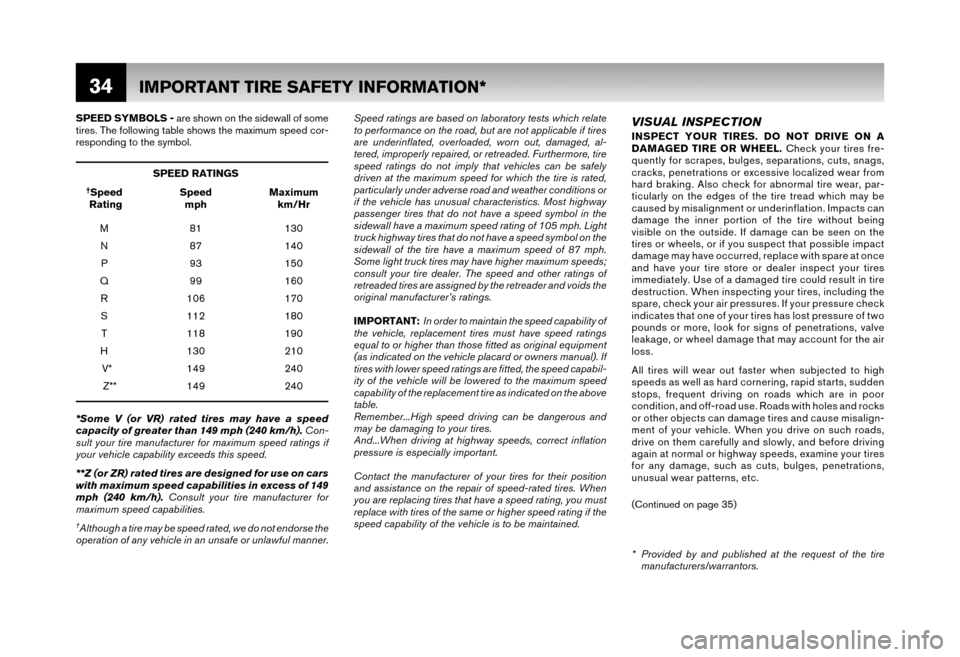
SPEED SYMBOLS - are shown on the sidewall of some
tires. The following table shows the maximum speed cor-
responding to the symbol.
SPEED RATINGS
†Speed Speed Maximum
Rating mph km/Hr
M 81 130 N 87 140 P 93 150
Q 99 160 R 106 170
S 112 180 T 118 190
H 130 210
V* 149 240
Z** 149 240
*Some V (or VR) rated tires may have a speed
capacity of greater than 149 mph (240 km/h). Con-
sult your tire manufacturer for maximum speed ratings if
your vehicle capability exceeds this speed.
**Z (or ZR) rated tires are designed for use on cars
with maximum speed capabilities in excess of 149
mph (240 km/h). Consult your tire manufacturer for
maximum speed capabilities.
†Although a tire may be speed rated, we do not endorse the
operation of any vehicle in an unsafe or unlawful manner. Speed ratings are based on laboratory tests which relate
to performance on the road, but are not applicable if tires
are underinflated, overloaded, worn out, damaged, al-
tered, improperly repaired, or retreaded. Furthermore, tire
speed ratings do not imply that vehicles can be safely
driven at the maximum speed for which the tire is rated,
particularly under adverse road and weather conditions or
if the vehicle has unusual characteristics. Most highway
passenger tires that do not have a speed symbol in the
sidewall have a maximum speed rating of 105 mph. Light
truck highway tires that do not have a speed symbol on the
sidewall of the tire have a maximum speed of 87 mph.
Some light truck tires may have higher maximum speeds;
consult your tire dealer. The speed and other ratings of
retreaded tires are assigned by the retreader and voids the
original manufacturer’s ratings.
IMPORTANT:
In order to maintain the speed capability of
the vehicle, replacement tires must have speed ratings
equal to or higher than those fitted as original equipment
(as indicated on the vehicle placard or owners manual). If
tires with lower speed ratings are fitted, the speed capabil-
ity of the vehicle will be lowered to the maximum speed
capability of the replacement tire as indicated on the above
table.
Remember...High speed driving can be dangerous and
may be damaging to your tires.
And...When driving at highway speeds, correct inflation
pressure is especially important.
Contact the manufacturer of your tires for their position
and assistance on the repair of speed-rated tires. When
you are replacing tires that have a speed rating, you must
replace with tires of the same or higher speed rating if the
speed capability of the vehicle is to be maintained.
VISUAL INSPECTION
INSPECT YOUR TIRES. DO NOT DRIVE ON A
DAMAGED TIRE OR WHEEL. Check your tires fre-
quently for scrapes, bulges, separations, cuts, snags,
cracks, penetrations or excessive localized wear from
hard braking. Also check for abnormal tire wear, par-
ticularly on the edges of the tire tread which may be
caused by misalignment or underinflation. Impacts can
damage the inner portion of the tire without being
visible on the outside. If damage can be seen on the
tires or wheels, or if you suspect that possible impact
damage may have occurred, replace with spare at once
and have your tire store or dealer inspect your tires
immediately. Use of a damaged tire could result in tire
destruction. When inspecting your tires, including the
spare, check your air pressures. If your pressure check
indicates that one of your tires has lost pressure of two
pounds or more, look for signs of penetrations, valve
leakage, or wheel damage that may account for the air
loss.
All tires will wear out faster when subjected to high
speeds as well as hard cornering, rapid starts, sudden
stops, frequent driving on roads which are in poor
condition, and off-road use. Roads with holes and rocks
or other objects can damage tires and cause misalign-
ment of your vehicle. When you drive on such roads,
drive on them carefully and slowly, and before driving
again at normal or highway speeds, examine your tires
for any damage, such as cuts, bulges, penetrations,
unusual wear patterns, etc.
* Provided by and published at the request of the tire
manufacturers/warrantors.
IMPORTANT TIRE SAFETY INFORMATION*
(Continued on page 35)
Page 41 of 55
36
HARD BRAKINGYou must inspect your tires after any hard braking circum-
stances or after tires have slid on the pavement. This can
cause a flat spot in a section of the tire tread.
TIRE SPINNINGNever spin your tires above a speedometer reading of 35
mph (55 km/h) if your vehicle becomes stuck. The centrifu-
gal force generated by the free spinning tire/wheel assem-
bly may cause a sudden tire explosion, resulting in vehicle
damage and/or serious personal injury or death. Never
allow anyone to stand near or behind a tire spinning at high
speed while attempting to push a vehicle that is stuck.
When in mud, sand, snow, ice or other slippery conditions,
do not indulge in excessive wheel spin. In such conditions,
with automatic transmission vehicles, by accelerating the
engine excessively, it is possible to spin one of the drive
tires beyond its speed capability. This is also true when
balancing a drive tire/wheel assembly using the engine of
the vehicle to spin the wheel.
TIRE TREADTires must be replaced when the depth of the tread
reaches 2/32 inch (1.6 mm). Tires are manufactured with
tread wear indicators molded into the tire grooves which
indicate tread wearout. As tires approximate 2/32 inch (1.6
mm) wearout, the tread gauge becomes thinner and more
vulnerable to the effects of road hazards. Also, worn tires
are more subject to hydroplaning, which can cause loss of
control. Therefore, visual tire inspection becomes more
crucial as the tires wear out.
WORN TIRESNever drive on worn tires. Tires should be replaced by
trained personnel when 2/32nds of an inch tread depth
remains, as indicated by the tread wear indicators molded
into the tread grooves. In most states, it is illegal to drive
with less than 2/32nds of an inch of tread remaining.
TIRE MIXINGFor best performance select tires similar in size and load
rating to the original equipment tires. It is recommended
that the same size and type of tire be used on all four wheel
positions. In certain tires, casing ply material and ply
construction may vary as indicated on the sidewall of the
tire. When changing or replacing tires, it is preferred that
all four tires are the same construction type (i.e., High
Performance, All Season, Mud & Snow) and construction
(Radial or Bias Ply). Before mixing tires of different types on
a vehicle in any configuration, be sure to check the vehicle
owner’s manual for its recommendations.
Tires which meet the Rubber Manufacturer's Association
(RMA) definition of mud and snow tires are marked M/S,
M+S, M&S. On such tires, this designation is molded into
the sidewall. Tires without this notation are not recom-
mended for mud and/or snow driving.
If snow tires are needed, it is necessary to select tires
equivalent in size and load rating to the original equipment
tires. Always fit performance snow tires in sets of four (4)
for optimum mud & snow traction and maintenance of
vehicle handling characteristics. If you do not, it may
adversely affect the safety and handling of your vehicle. It
is also important to check the vehicle owner’s manual
before mixing or matching tires on 4-wheel drive vehicles
as this may require special precautions. Please refer to your Owner’s Manual for more information
on tire replacement precautions.
TIRE ROTATION
Tires on your Nissan vehicle should be rotated every
7,500 miles or as irregular wear develops. If irregular
wear becomes apparent or if the wear rate on the tires
is perceptibly uneven, the tires should be rotated in
such a way to alleviate the problem. Check your vehicle
for any mechanical problems and correct if necessary.
Any rotation pattern or procedure may be followed
including those indicated in the Owner’s Manual. Some
tires have arrows on the sidewall showing the direction
in which the tire should turn. When rotating this type of
tire, care must be taken to maintain the proper turning
direction as indicated by the arrows.
Some vehicles
have different tire sizes specified for front and rear
axles. Tires on these vehicles should not be rotated
side to side (unless they are directional). Where a
temporary type spare tire is available, it should not be
included in the tire rotation schedule. Such tires are
intended for temporary use only. Whenever only two
tires are replaced, the new tires should be put on the
rear axle of vehicles equipped with the same size tire
on all four wheel positions .
* Provided by and published at the request of the tire manufacturers/warrantors.
IMPORTANT TIRE SAFETY INFORMATION*
(Continued on page 37)
Page 42 of 55

37
TRAILER TOWINGIf you anticipate towing a trailer, you should see a tire dealer
for advice concerning the correct size of tire and pressure.
Tire size and pressure will depend on the type and size of
the trailer and hitch utilized, but in no case must the
maximum cold inflation pressure or the tire load rating be
exceeded. Check the tire decal and your Owner’s Manual
for further recommendations on trailer towing.
TIRE ALTERATIONSDo not perform any alterations on your tires. Alterations
may prevent proper performance, leading to tire damage,
which can result in an accident. Tires which become
unserviceable due to alterations such as truing, whitewall
inlays, addition of balancing or sealant liquids, may be
excluded from warranty coverage. Consult your tire war-
ranty.
HIGH PRESSURE TEMPORARY SPARE
TIRES
1) The high-pressure spare tire in your Nissan vehicle is designed for temporary use only and must not be
used continually as a regular tire. The standard tire
should be repaired and/or replaced as soon as
possible.
2) Avoid driving over obstacles that may damage the tire through impact or cutting, such as potholes, glass,
metal, etc. 3) Speed must not exceed 50MPH (80km/h) for non-
speed-rated temporary spare tires.
4) Temporary spare tires have a limited treadlife which can vary depending on road conditions and your
driving habits. The spare tire should be returned to the
trunk as soon as the standard tire can be repaired or
replaced.
5) Because the high-pressure spare tire was specifically designed for your car, it should not be used on any
other vehicle.
6) Do not use snow chains on your high-pressure spare. This could cause damage to your vehicle.
7) Check the tire’s cold inflation pressure monthly and
maintain at 60psi (4.2kg/cm
2) even when not in use.
8) The high-pressure spare tire should not be used with any other rim nor should standard tires, wheel covers,
or trim rings be used on the high-pressure spare tire
rim which was originally installed.
9) When the tread wear indicator appears on the tire,
replace it only with the same type spare tire.
10) Do not enter an automatic carwash with a temporary spare tire fitted.
11) Do not make a sharp turn or apply the brakes suddenly when driving on a high-pressure tempo-
rary spare.
Note: When using any temporary type spare tire, be
sure to follow the vehicle Owner’s Manual
instructions.
TIRE STORAGEAll tires should be stored in a cool dry place indoors so that
there is no danger of water collecting inside them.
When tires are stored they should be stored in a cool place
away from sources of heat and ozone such as hot pipes and
electric generators. Be sure that surfaces on which tires
are stored are clean and free from grease, gasoline or other
substances which could deteriorate the rubber. (Tires
exposed to these materials during storage or driving could
be subject to sudden failure.)
To Avoid Damage to your Tires and
Possible Accident:
• Check tire pressure at least once a month when
tires are cold and before long trips.
• Do not underinflate/overinflate.
• Do not overload.
• Drive at moderate speeds, observe legal limits.
• Avoid driving over potholes, obstacles, curbs or
edges of pavement.
• Avoid excessive wheel spinning.
• If you see any damage to a tire, replace with spare
and see the tire manufacturer’s dealer or your
Nissan dealership.
For further information, the Consumer Tire Guide on
passenger tire care, safety and mileage performance is
available in the United States by writing the Tire Industry
Safety Council, Box 1801, Washington, D.C. 20013.
* Provided by and published at the request of the tire manufacturers/warrantors.
IMPORTANT TIRE SAFETY INFORMATION*