roof NISSAN FRONTIER 2009 Owner´s Manual
[x] Cancel search | Manufacturer: NISSAN, Model Year: 2009, Model line: FRONTIER, Model: NISSAN FRONTIER 2009Pages: 366, PDF Size: 6.43 MB
Page 8 of 366
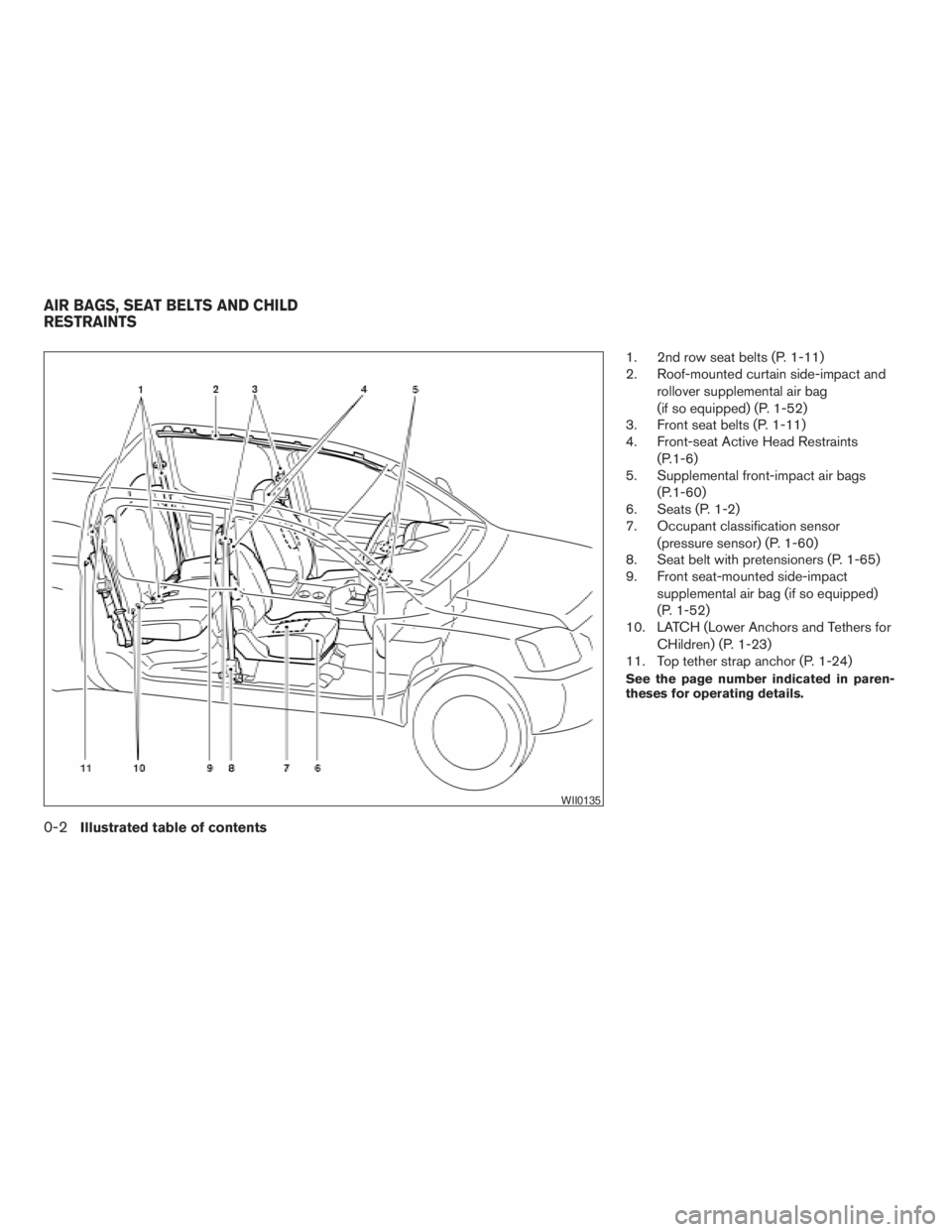
1. 2nd row seat belts (P. 1-11)
2. Roof-mounted curtain side-impact and
rollover supplemental air bag
(if so equipped) (P. 1-52)
3. Front seat belts (P. 1-11)
4. Front-seat Active Head Restraints
(P.1-6)
5. Supplemental front-impact air bags
(P.1-60)
6. Seats (P. 1-2)
7. Occupant classification sensor
(pressure sensor) (P. 1-60)
8. Seat belt with pretensioners (P. 1-65)
9. Front seat-mounted side-impact
supplemental air bag (if so equipped)
(P. 1-52)
10. LATCH (Lower Anchors and Tethers for
CHildren) (P. 1-23)
11. Top tether strap anchor (P. 1-24)
See the page number indicated in paren-
theses for operating details.
WII0135
AIR BAGS, SEAT BELTS AND CHILD
RESTRAINTS
0-2Illustrated table of contents
ZREVIEW COPYÐ2009 08+ Truck/Frontier(fro)
Owners ManualÐUSA_English(nna)
05/24/08Ðdebbie
X
Page 70 of 366
try another seating position or a different
booster seat.
4. Position the lap portion of the seat belt low
and snug on the child’s hips. Be sure to
follow the booster seat manufacturer’s in-
structions for adjusting the belt routing.
5. Pull the shoulder belt portion of the seat belt
toward the retractor to take up extra slack.
Be sure the shoulder belt is positioned
across the top, middle portion of the child’s
shoulder. Be sure to follow the booster seat
manufacturer’s instructions for adjusting the
belt routing.
6. Follow the warnings, cautions and instruc-
tions for properly fastening a seat belt
shown in “Three-point type seat belt with
retractor” earlier in this section.PRECAUTIONS ON
SUPPLEMENTAL RESTRAINT
SYSTEM
This Supplemental Restraint System (SRS) sec-
tion contains important information concerning
the following systems:
cDriver and passenger supplemental front-
impact air bag (NISSAN Advanced Air Bag
System)
cFront seat-mounted side-impact supple-
mental air bag
cRoof-mounted curtain side-impact and roll-
over supplemental air bag
cSeat belt with pretensioner
Supplemental front-impact air bag system:
The NISSAN Advanced Air Bag System can help
cushion the impact force to the head and chest of
the driver and front passenger in certain frontal
collisions.
Front seat-mounted side-impact supple-
mental air bag system (if so equipped):This
system can help cushion the impact force to the
chest area of the driver and front passenger in
certain side impact collisions. The side air bags
are designed to inflate on the side where the
vehicle is impacted.Roof-mounted curtain side-impact and
rollover supplemental air bag system (if so
equipped):This system can help cushion the
impact force to the head of occupants in front
and rear outboard seating positions in certain
side impact or rollover collisions. In a side impact,
the curtain and rollover air bags are designed to
inflate on the side where the vehicle is impacted.
In a rollover, both curtain and rollover air bags are
designed to inflate and remain inflated for a short
time.
These supplemental restraint systems are de-
signed tosupplementthe crash protection pro-
vided by the seat belts and arenot a substitute
for them. Seat belts should always be correctly
worn and the occupant seated a suitable dis-
tance away from the steering wheel, instrument
panel and door finishers. See “Seat belts” earlier
in this section for instructions and precautions on
seat belt usage.
The supplemental air bags operate only
when the ignition switch is in the ON or
START position.
After placing the ignition switch in the ON
position, the supplemental air bag warning
light illuminates. The supplemental air bag
warning light will turn off after about 7
seconds if the system is operational.
SUPPLEMENTAL RESTRAINT
SYSTEM
1-52Safety—Seats, seat belts and supplemental restraint system
ZREVIEW COPYÐ2009 08+ Truck/Frontier(fro)
Owners ManualÐUSA_English(nna)
05/24/08Ðdebbie
X
Page 74 of 366
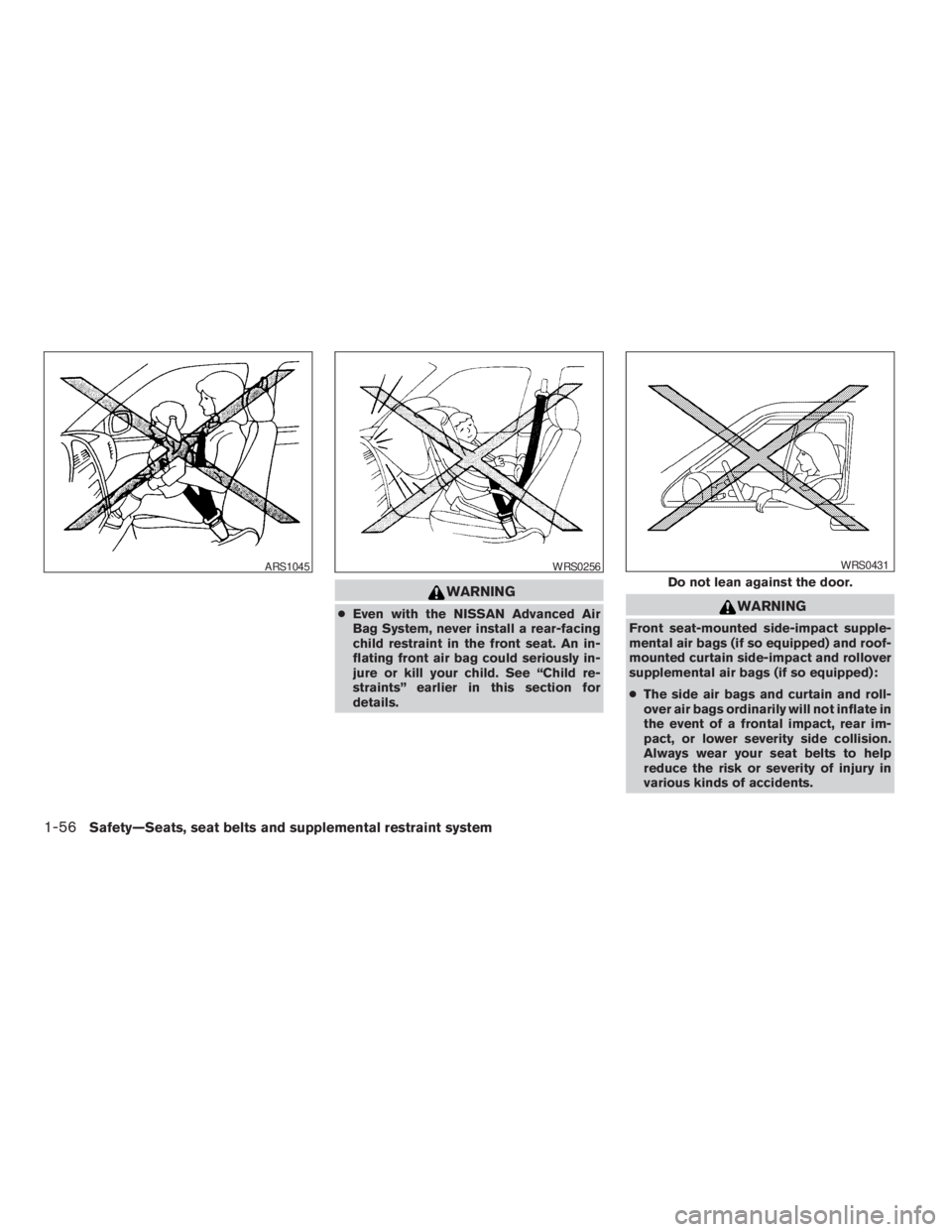
WARNING
cEven with the NISSAN Advanced Air
Bag System, never install a rear-facing
child restraint in the front seat. An in-
flating front air bag could seriously in-
jure or kill your child. See “Child re-
straints” earlier in this section for
details.WARNING
Front seat-mounted side-impact supple-
mental air bags (if so equipped) and roof-
mounted curtain side-impact and rollover
supplemental air bags (if so equipped):
cThe side air bags and curtain and roll-
over air bags ordinarily will not inflate in
the event of a frontal impact, rear im-
pact, or lower severity side collision.
Always wear your seat belts to help
reduce the risk or severity of injury in
various kinds of accidents.
ARS1045WRS0256
Do not lean against the door.
WRS0431
1-56Safety—Seats, seat belts and supplemental restraint system
ZREVIEW COPYÐ2009 08+ Truck/Frontier(fro)
Owners ManualÐUSA_English(nna)
05/24/08Ðdebbie
X
Page 75 of 366
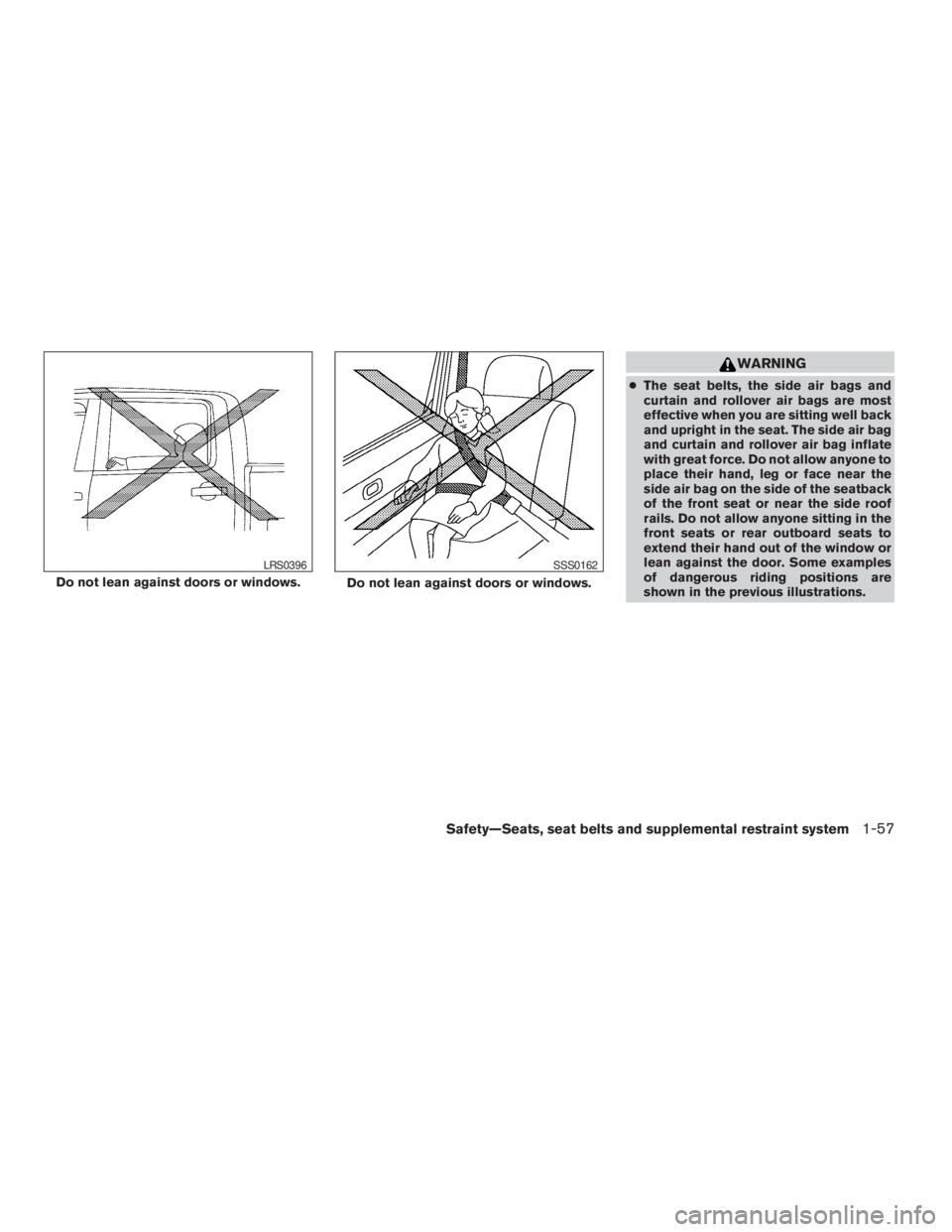
WARNING
cThe seat belts, the side air bags and
curtain and rollover air bags are most
effective when you are sitting well back
and upright in the seat. The side air bag
and curtain and rollover air bag inflate
with great force. Do not allow anyone to
place their hand, leg or face near the
side air bag on the side of the seatback
of the front seat or near the side roof
rails. Do not allow anyone sitting in the
front seats or rear outboard seats to
extend their hand out of the window or
lean against the door. Some examples
of dangerous riding positions are
shown in the previous illustrations.
Do not lean against doors or windows.
LRS0396
Do not lean against doors or windows.
SSS0162
Safety—Seats, seat belts and supplemental restraint system1-57
ZREVIEW COPYÐ2009 08+ Truck/Frontier(fro)
Owners ManualÐUSA_English(nna)
05/24/08Ðdebbie
X
Page 77 of 366
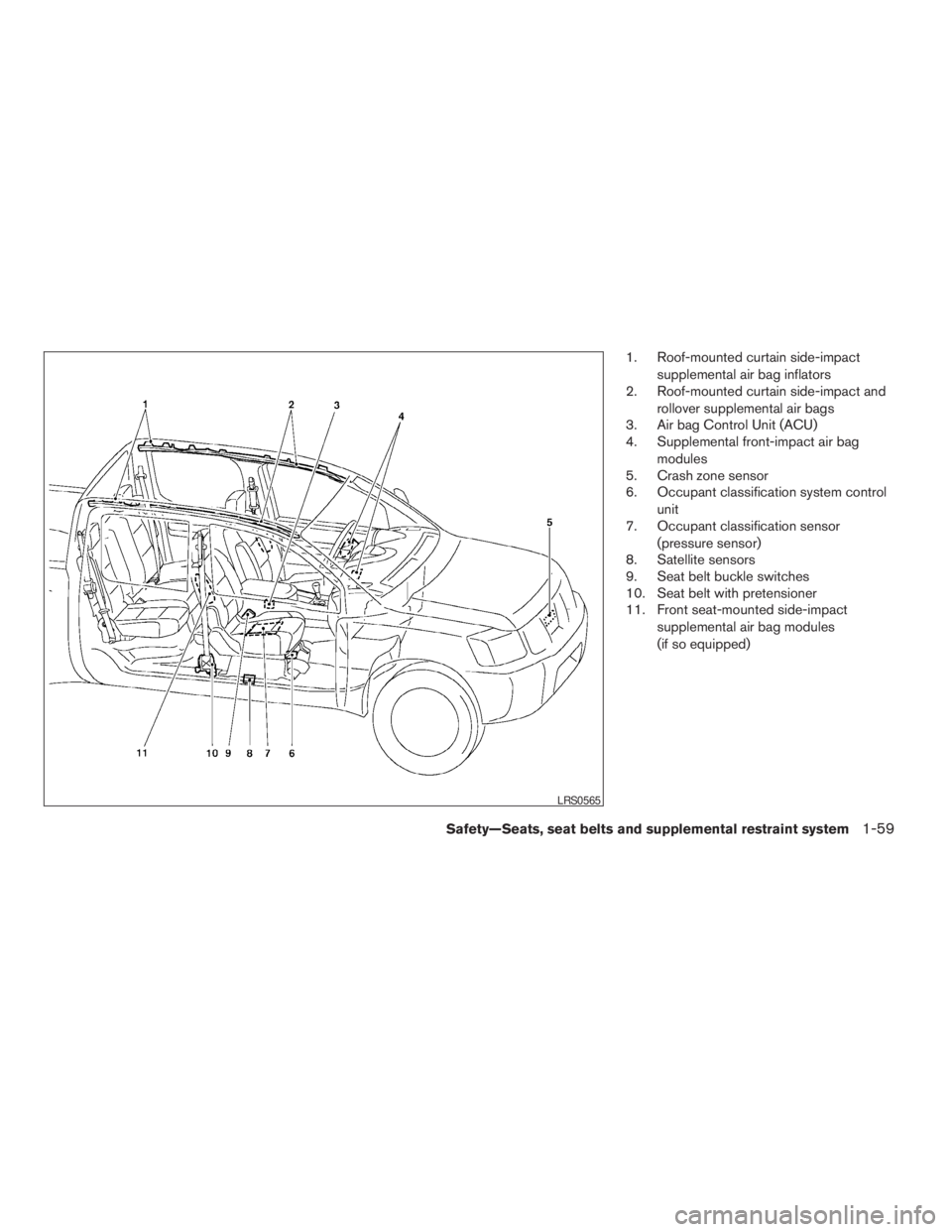
1. Roof-mounted curtain side-impact
supplemental air bag inflators
2. Roof-mounted curtain side-impact and
rollover supplemental air bags
3. Air bag Control Unit (ACU)
4. Supplemental front-impact air bag
modules
5. Crash zone sensor
6. Occupant classification system control
unit
7. Occupant classification sensor
(pressure sensor)
8. Satellite sensors
9. Seat belt buckle switches
10. Seat belt with pretensioner
11. Front seat-mounted side-impact
supplemental air bag modules
(if so equipped)
LRS0565
Safety—Seats, seat belts and supplemental restraint system1-59
ZREVIEW COPYÐ2009 08+ Truck/Frontier(fro)
Owners ManualÐUSA_English(nna)
06/13/08Ðdebbie
X
Page 82 of 366
Front seat-mounted side-impact
supplemental air bag (if so equipped)
and roof-mounted curtain side-impact
and rollover supplemental air bag (if so
equipped) systems
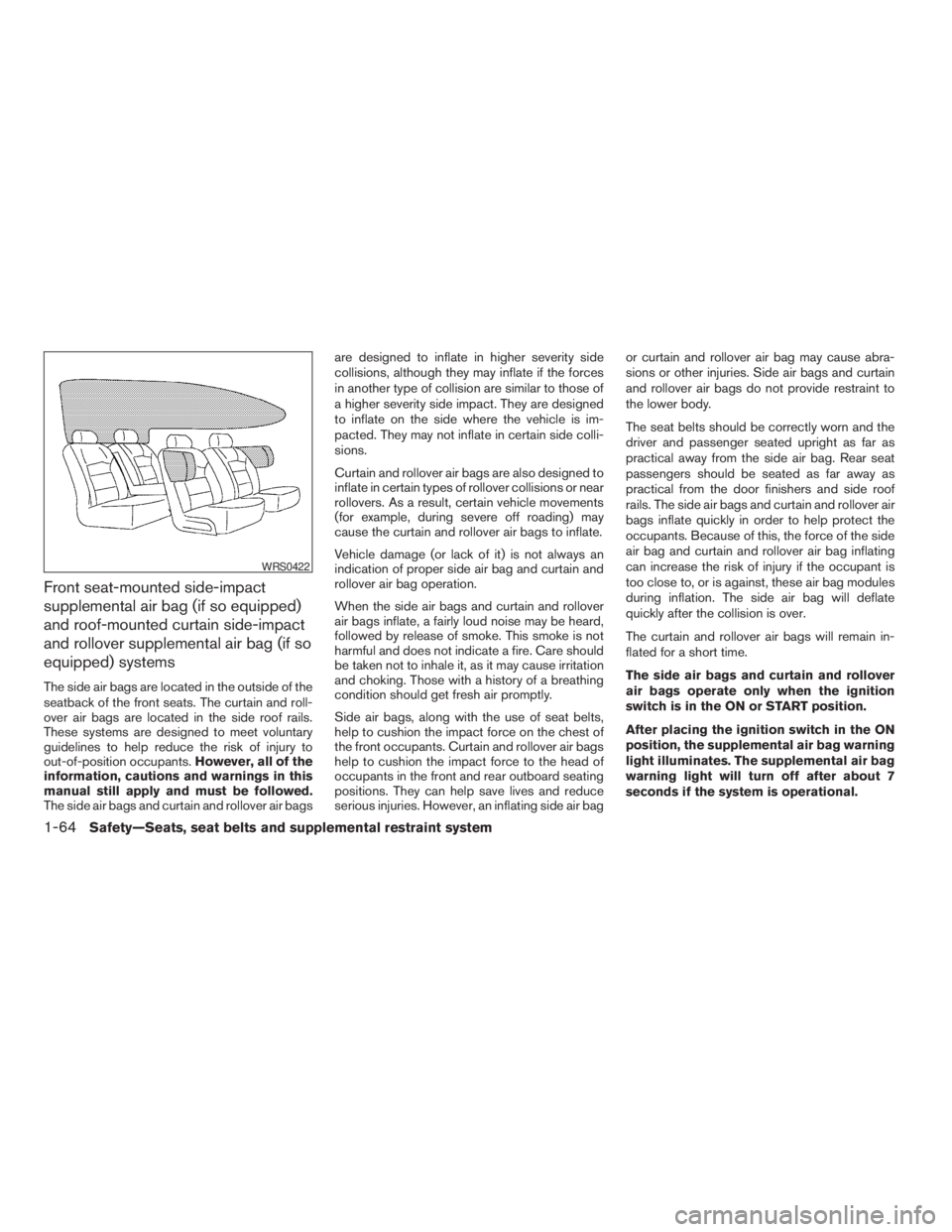
The side air bags are located in the outside of the
seatback of the front seats. The curtain and roll-
over air bags are located in the side roof rails.
These systems are designed to meet voluntary
guidelines to help reduce the risk of injury to
out-of-position occupants.However, all of the
information, cautions and warnings in this
manual still apply and must be followed.
The side air bags and curtain and rollover air bagsare designed to inflate in higher severity side
collisions, although they may inflate if the forces
in another type of collision are similar to those of
a higher severity side impact. They are designed
to inflate on the side where the vehicle is im-
pacted. They may not inflate in certain side colli-
sions.
Curtain and rollover air bags are also designed to
inflate in certain types of rollover collisions or near
rollovers. As a result, certain vehicle movements
(for example, during severe off roading) may
cause the curtain and rollover air bags to inflate.
Vehicle damage (or lack of it) is not always an
indication of proper side air bag and curtain and
rollover air bag operation.
When the side air bags and curtain and rollover
air bags inflate, a fairly loud noise may be heard,
followed by release of smoke. This smoke is not
harmful and does not indicate a fire. Care should
be taken not to inhale it, as it may cause irritation
and choking. Those with a history of a breathing
condition should get fresh air promptly.
Side air bags, along with the use of seat belts,
help to cushion the impact force on the chest of
the front occupants. Curtain and rollover air bags
help to cushion the impact force to the head of
occupants in the front and rear outboard seating
positions. They can help save lives and reduce
serious injuries. However, an inflating side air bagor curtain and rollover air bag may cause abra-
sions or other injuries. Side air bags and curtain
and rollover air bags do not provide restraint to
the lower body.
The seat belts should be correctly worn and the
driver and passenger seated upright as far as
practical away from the side air bag. Rear seat
passengers should be seated as far away as
practical from the door finishers and side roof
rails. The side air bags and curtain and rollover air
bags inflate quickly in order to help protect the
occupants. Because of this, the force of the side
air bag and curtain and rollover air bag inflating
can increase the risk of injury if the occupant is
too close to, or is against, these air bag modules
during inflation. The side air bag will deflate
quickly after the collision is over.
The curtain and rollover air bags will remain in-
flated for a short time.
The side air bags and curtain and rollover
air bags operate only when the ignition
switch is in the ON or START position.
After placing the ignition switch in the ON
position, the supplemental air bag warning
light illuminates. The supplemental air bag
warning light will turn off after about 7
seconds if the system is operational.
WRS0422
1-64Safety—Seats, seat belts and supplemental restraint system
ZREVIEW COPYÐ2009 08+ Truck/Frontier(fro)
Owners ManualÐUSA_English(nna)
05/24/08Ðdebbie
X
Page 85 of 366
SUPPLEMENTAL AIR BAG
WARNING LABELS
Warning labels about the supplemental front-
impact air bag, front seat-mounted side-impact
supplemental air bag and roof-mounted curtain
side-impact and rollover supplemental air bag
systems are placed in the vehicle as shown in the
illustration.
SUPPLEMENTAL AIR BAG
WARNING LIGHT
The supplemental air bag warning light,
displaying
in the instrument panel, moni-
tors the circuits of the supplemental front-impact
air bag, front seat-mounted side-impact supple-
mental air bag, roof-mounted curtain side-impact
and rollover supplemental air bag and seat belt
pretensioner systems. The monitored circuits in-
clude the Air bag Control Unit (ACU) , crash zone
sensor, satellite sensors, rollover sensor, front air
bag modules, side air bag modules, curtain and
rollover air bag modules, pretensioners and all
related wiring.When the ignition switch is placed in the ON or
START position, the supplemental air bag warn-
ing light illuminates for about 7 seconds and then
turns off. This means the system is operational.
If any of the following conditions occur, the front
air bag, side air bag, curtain and rollover air bag
and pretensioner systems need servicing:
cThe supplemental air bag warning light re-
mains on after approximately 7 seconds.
cThe supplemental air bag warning light
flashes intermittently.
cThe supplemental air bag warning light does
not come on at all.
Under these conditions, the front air bag, side air
bag, curtain and rollover air bag or pretensioner
systems may not operate properly. They must be
checked and repaired. Take your vehicle to the
nearest NISSAN dealer.
LRS0100
Safety—Seats, seat belts and supplemental restraint system1-67
ZREVIEW COPYÐ2009 08+ Truck/Frontier(fro)
Owners ManualÐUSA_English(nna)
05/24/08Ðdebbie
X
Page 89 of 366
Under-seat storage bins........................2-39
Console box..................................2-40
Glove box....................................2-40
Sunglasses holder (if so equipped)..............2-40
Map pockets..................................2-41
Seat pockets (if so equipped)...................2-42
Cup holders..................................2-42
Roof rack (if so equipped)......................2-44
Windows........................................2-46
Power windows (if so equipped)................2-46
Manual windows (if so equipped)................2-48
Rear sliding window (if so equipped)............2-48
Moonroof (if so equipped).........................2-48Interior lights.....................................2-50
Map lights (if so equipped)........................2-51
HomeLinkTuniversal transceiver (if so equipped).....2-51
Programming HomeLinkT.......................2-52
Programming HomeLinkTfor Canadian
customers....................................2-53
Operating the HomeLinkTuniversal
transceiver....................................2-53
Programming trouble-diagnosis.................2-53
Clearing the programmed information............2-54
Reprogramming a single HomeLinkTbutton......2-54
If your vehicle is stolen.........................2-54
ZREVIEW COPYÐ2009 08+ Truck/Frontier(fro)
Owners ManualÐUSA_English(nna)
05/24/08Ðdebbie
X
Page 132 of 366
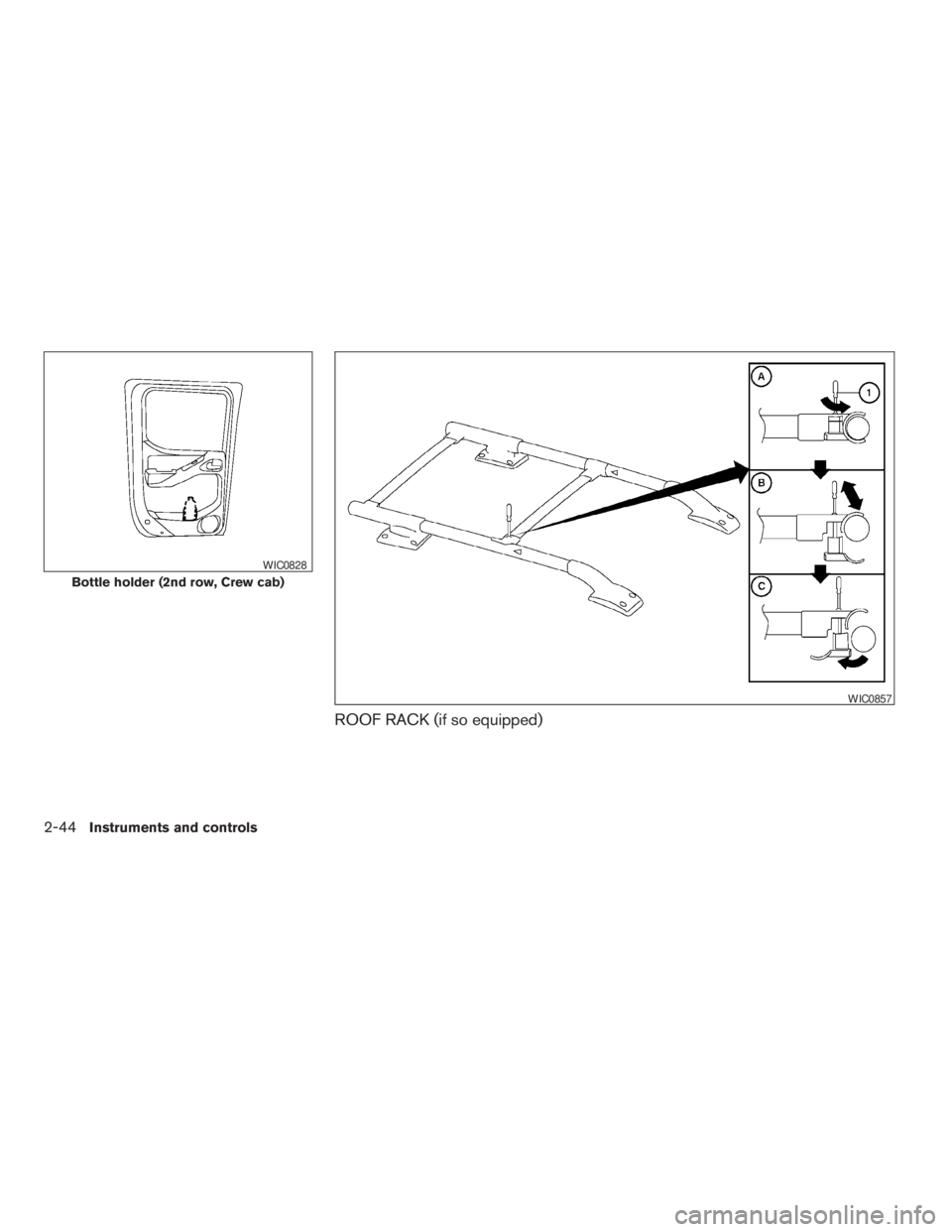
ROOF RACK (if so equipped)
Bottle holder (2nd row, Crew cab)
WIC0828
WIC0857
2-44Instruments and controls
ZREVIEW COPYÐ2009 08+ Truck/Frontier(fro)
Owners ManualÐUSA_English(nna)
05/27/08Ðdebbie
X
Page 133 of 366
WARNING
cDrive extra carefully when the vehicle is
loaded at or near the cargo carrying
capacity, especially if the significant
portion of that load is carried on the
roof rack.
cHeavy loading of the roof rack has the
potential to affect the vehicle stability
and handling during sudden or abnor-
mal handling maneuvers.
cRoof rack load should be evenly
distributed.
cDo not exceed maximum roof rack load
weight capacity.
cProperly secure all cargo with ropes or
straps to help prevent it from sliding or
shifting. In a sudden stop or collision,
unsecured cargo could cause personal
injury.
CAUTION
Use care when placing or removing items
from the roof rack. If you cannot comfort-
ably lift the items onto the roof rack from
the ground, use a ladder or stool.Always evenly distribute the cargo on the tubular
roof rack.The maximum total load is 125 lb
(56 kg) evenly distributed.Be careful that your
vehicle does not exceed the Gross Vehicle
Weight Rating (GVWR) or the Gross Axle
Weight Ratings (GAWR front and rear) . The
GVWR and GAWR are located on the F.M.V.S.S.
label (located on the driver’s side door jamb
pillar) . For more information regarding GVWR
and GAWR, refer to “Vehicle loading information”
in the “Technical and consumer information” sec-
tion later in this manual.
The front crossbar can be adjusted or removed.
Use the Torxdriver provided in the tool kit to
loosen both crossbar adjusting screws.
To adjust:
1. Loosen the adjusting screws with the
Torxdriver
s1by turning counterclockwise
sA.
2. When the clamp is loosened, move the
crossbar so the cargo can be positioned on
the crossbar
sB.
3. Tighten the crossbar adjusting screws with
the Torxdriver by turning clockwise.
4. Secure the cargo with rope.
5. Always check the tightness of the crossbar
adjusting screws.To remove:
1. Loosen the adjusting screws with the
Torxdriver
s1by turning counterclockwise
sA.
2. Rotate the clamps
sC.
3. Remove the crossbar.
4. Reverse to install.
5. Always check the tightness of the crossbar
adjusting screws.
If you hear wind noise coming from the roof rack
while driving, adjust the roof rack crossbar to the
neutral position, rearward ofDon the side rails.
Instruments and controls2-45
ZREVIEW COPYÐ2009 08+ Truck/Frontier(fro)
Owners ManualÐUSA_English(nna)
05/27/08Ðdebbie
X