mirror NISSAN FRONTIER 2010 Owner´s Manual
[x] Cancel search | Manufacturer: NISSAN, Model Year: 2010, Model line: FRONTIER, Model: NISSAN FRONTIER 2010Pages: 373, PDF Size: 6.21 MB
Page 160 of 373
AUTOMATIC ANTI-GLARE
REARVIEW MIRROR (if so equipped)
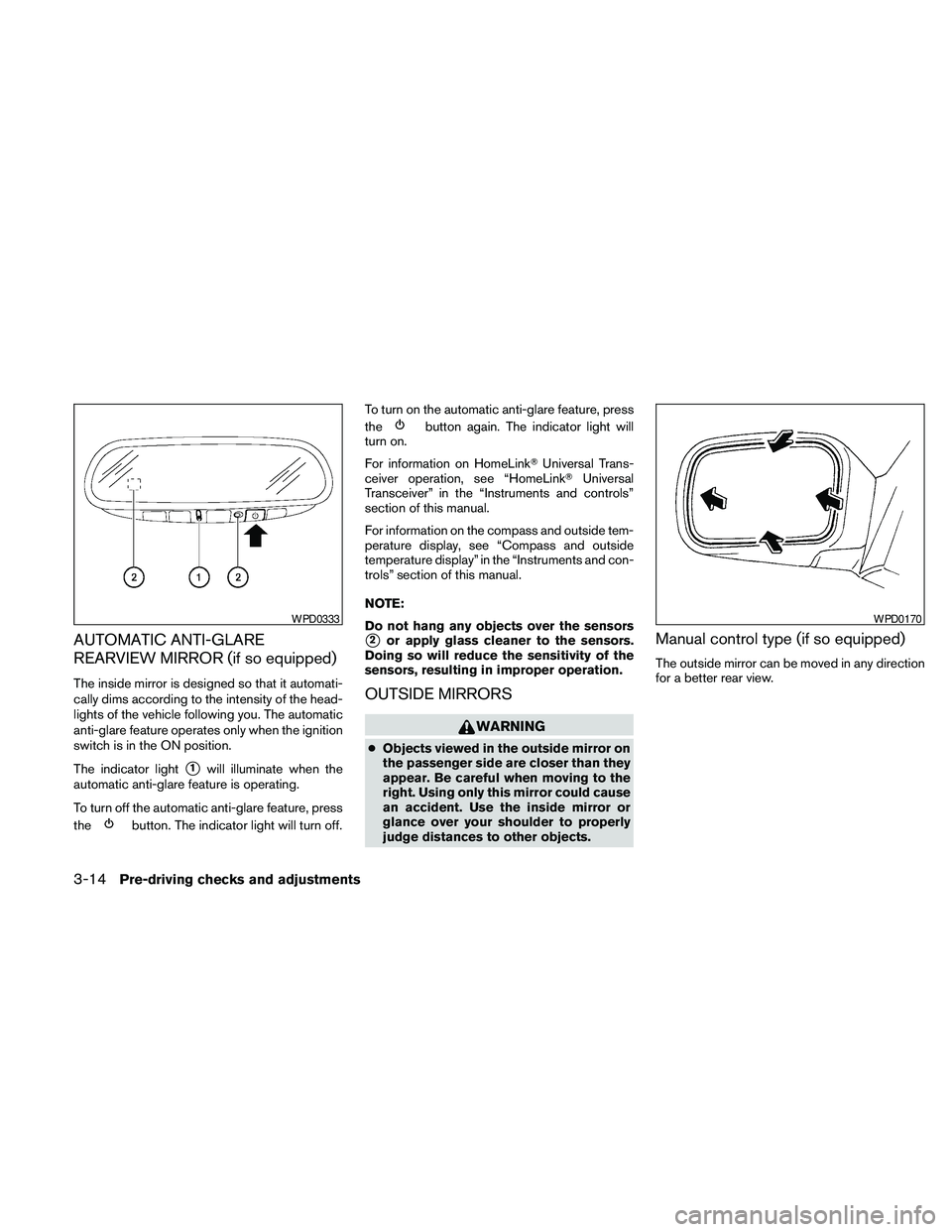
The inside mirror is designed so that it automati-
cally dims according to the intensity of the head-
lights of the vehicle following you. The automatic
anti-glare feature operates only when the ignition
switch is in the ON position.
The indicator light
s1will illuminate when the
automatic anti-glare feature is operating.
To turn off the automatic anti-glare feature, press
the
button. The indicator light will turn off.To turn on the automatic anti-glare feature, press
the
button again. The indicator light will
turn on.
For information on HomeLinkTUniversal Trans-
ceiver operation, see “HomeLinkTUniversal
Transceiver” in the “Instruments and controls”
section of this manual.
For information on the compass and outside tem-
perature display, see “Compass and outside
temperature display” in the “Instruments and con-
trols” section of this manual.
NOTE:
Do not hang any objects over the sensors
s2or apply glass cleaner to the sensors.
Doing so will reduce the sensitivity of the
sensors, resulting in improper operation.
OUTSIDE MIRRORS
WARNING
cObjects viewed in the outside mirror on
the passenger side are closer than they
appear. Be careful when moving to the
right. Using only this mirror could cause
an accident. Use the inside mirror or
glance over your shoulder to properly
judge distances to other objects.
Manual control type (if so equipped)
The outside mirror can be moved in any direction
for a better rear view.
WPD0333WPD0170
3-14Pre-driving checks and adjustments
Page 161 of 373
Electric control type (if so equipped)
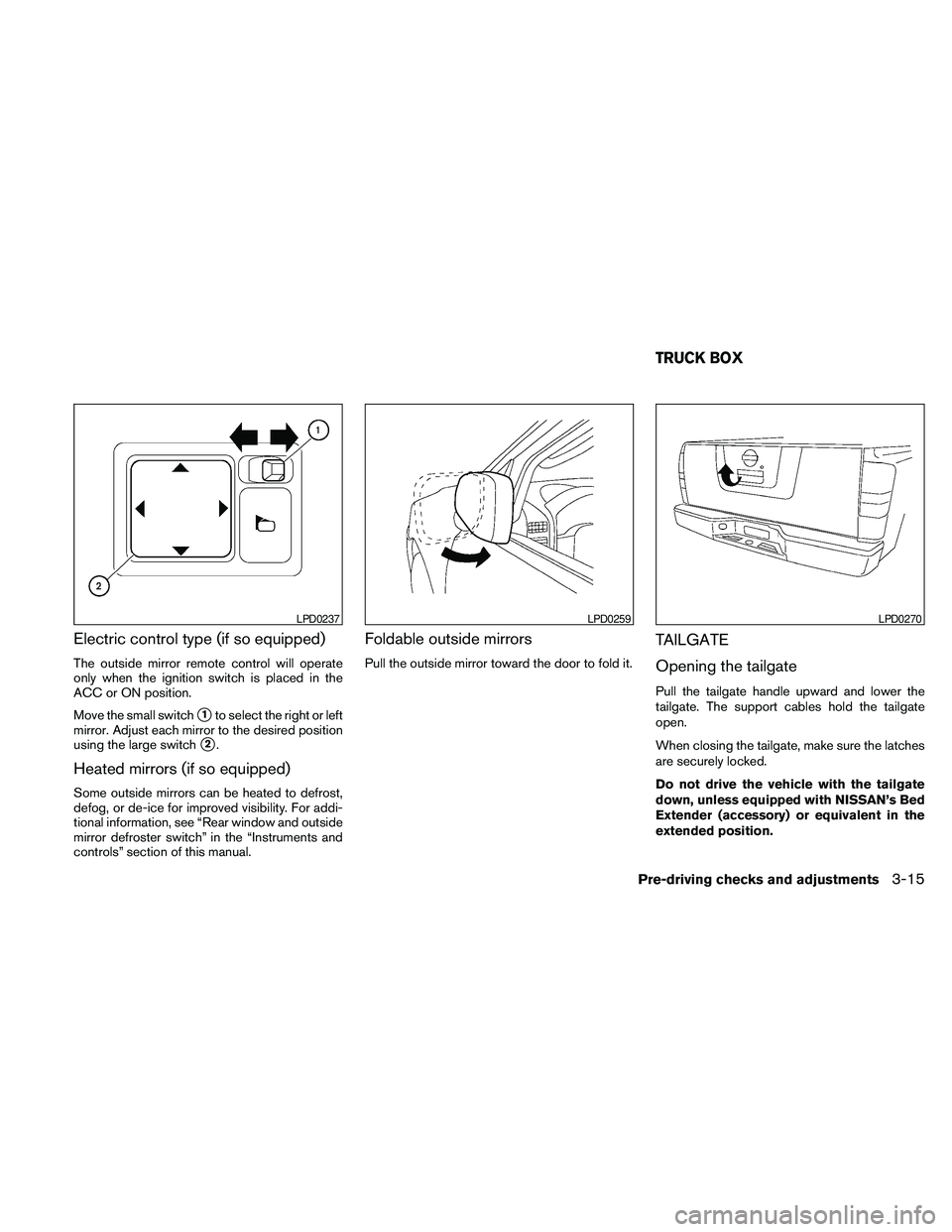
The outside mirror remote control will operate
only when the ignition switch is placed in the
ACC or ON position.
Move the small switch
s1to select the right or left
mirror. Adjust each mirror to the desired position
using the large switch
s2.
Heated mirrors (if so equipped)
Some outside mirrors can be heated to defrost,
defog, or de-ice for improved visibility. For addi-
tional information, see “Rear window and outside
mirror defroster switch” in the “Instruments and
controls” section of this manual.
Foldable outside mirrors
Pull the outside mirror toward the door to fold it.
TAILGATE
Opening the tailgate
Pull the tailgate handle upward and lower the
tailgate. The support cables hold the tailgate
open.
When closing the tailgate, make sure the latches
are securely locked.
Do not drive the vehicle with the tailgate
down, unless equipped with NISSAN’s Bed
Extender (accessory) or equivalent in the
extended position.
LPD0237LPD0259LPD0270
TRUCK BOX
Pre-driving checks and adjustments3-15
Page 177 of 373
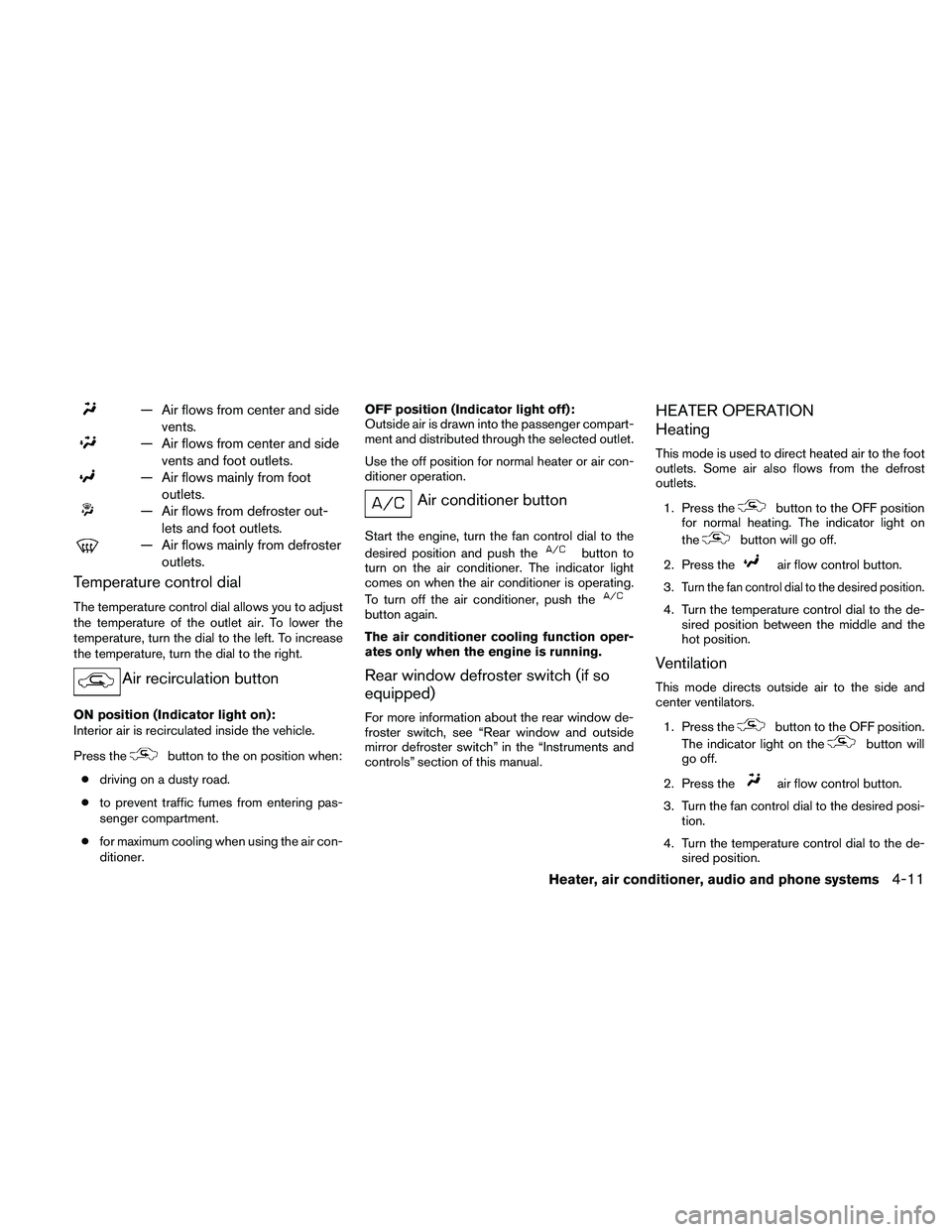
— Air flows from center and side
vents.
— Air flows from center and side
vents and foot outlets.
— Air flows mainly from foot
outlets.
— Air flows from defroster out-
lets and foot outlets.
— Air flows mainly from defroster
outlets.
Temperature control dial
The temperature control dial allows you to adjust
the temperature of the outlet air. To lower the
temperature, turn the dial to the left. To increase
the temperature, turn the dial to the right.
Air recirculation button
ON position (Indicator light on):
Interior air is recirculated inside the vehicle.
Press the
button to the on position when:
cdriving on a dusty road.
cto prevent traffic fumes from entering pas-
senger compartment.
cfor maximum cooling when using the air con-
ditioner.OFF position (Indicator light off):
Outside air is drawn into the passenger compart-
ment and distributed through the selected outlet.
Use the off position for normal heater or air con-
ditioner operation.
Air conditioner button
Start the engine, turn the fan control dial to the
desired position and push the
button to
turn on the air conditioner. The indicator light
comes on when the air conditioner is operating.
To turn off the air conditioner, push the
button again.
The air conditioner cooling function oper-
ates only when the engine is running.
Rear window defroster switch (if so
equipped)
For more information about the rear window de-
froster switch, see “Rear window and outside
mirror defroster switch” in the “Instruments and
controls” section of this manual.
HEATER OPERATION
Heating
This mode is used to direct heated air to the foot
outlets. Some air also flows from the defrost
outlets.
1. Press the
button to the OFF position
for normal heating. The indicator light on
the
button will go off.
2. Press the
air flow control button.
3.
Turn the fan control dial to the desired position.
4. Turn the temperature control dial to the de-
sired position between the middle and the
hot position.
Ventilation
This mode directs outside air to the side and
center ventilators.
1. Press the
button to the OFF position.
The indicator light on the
button will
go off.
2. Press the
air flow control button.
3. Turn the fan control dial to the desired posi-
tion.
4. Turn the temperature control dial to the de-
sired position.
Heater, air conditioner, audio and phone systems4-11
Page 230 of 373
cMake sure the area around the vehicle is
clear.
cCheck fluid levels such as engine oil, cool-
ant, brake fluid, and window washer fluid as
frequently as possible, or at least whenever
you refuel.
cCheck that all windows and lights are clean.
cVisually inspect tires for their appearance
and condition. Also check tires for proper
inflation.
cCheck that all doors are closed.
cPosition seat and adjust head restraint and
headrests (if so equipped) .
cAdjust inside and outside mirrors.
cFasten seat belts and ask all passengers to
do likewise.
cCheck the operation of warning lights when
the ignition switch is placed in the ON
sD
position. See “Warning/indicator lights and
audible reminders” in the “Instruments and
controls” section of this manual.1. Apply the parking brake.
2.Automatic transmission:
Move the shift selector to P (Park) or N
(Neutral) . P (Park) is recommended.
The shift selector cannot be moved out
of the P (Park) position and into any of
the other gear positions if the ignition
switch is placed in the OFF position or
if the key is removed from the ignition
switch.
The starter is designed not to operate if
the shift selector is in any of the driving
positions.
Manual transmission:
Move the shift selector to N (Neutral) . De-
press the clutch pedal to the floor while
cranking the engine.
The starter is designed not to operate
unless the clutch pedal is fully de-
pressed.
3. Crank the enginewith your foot off the
accelerator pedalby placing the ignition
switch in the START position. Release the
key when the engine starts. If the engine
starts, but fails to run, repeat the above
procedure.c
If the engine is very hard to start in extremely
cold weather or when restarting, depress
the accelerator pedal a little (approximately
1/3 to the floor) and hold it and then crank
the engine. Release the key and the accel-
erator pedal when the engine starts.
cIf the engine is very hard to start because
it is flooded, depress the accelerator
pedal all the way to the floor and hold it.
Crank the engine for 5-6 seconds. After
cranking the engine, release the accel-
erator pedal. Crank the enginewith your
foot off the accelerator pedalby plac-
ing the ignition in the START position.
Release the key when the engine starts. If
the engine starts, but fails to run, repeat
the above procedure.
CAUTION
Do not operate the starter for more than
15 seconds at a time. If the engine does
not start, turn the key off and wait 10
seconds before cranking again, otherwise
the starter could be damaged.
4. Allow the engine to idle for at least 30 sec-
onds after starting. Do not race the engine
while warming it up. Drive at moderate
speed for a short distance first, especially in
cold weather.
BEFORE STARTING THE ENGINE STARTING THE ENGINE
5-12Starting and driving
Page 357 of 373
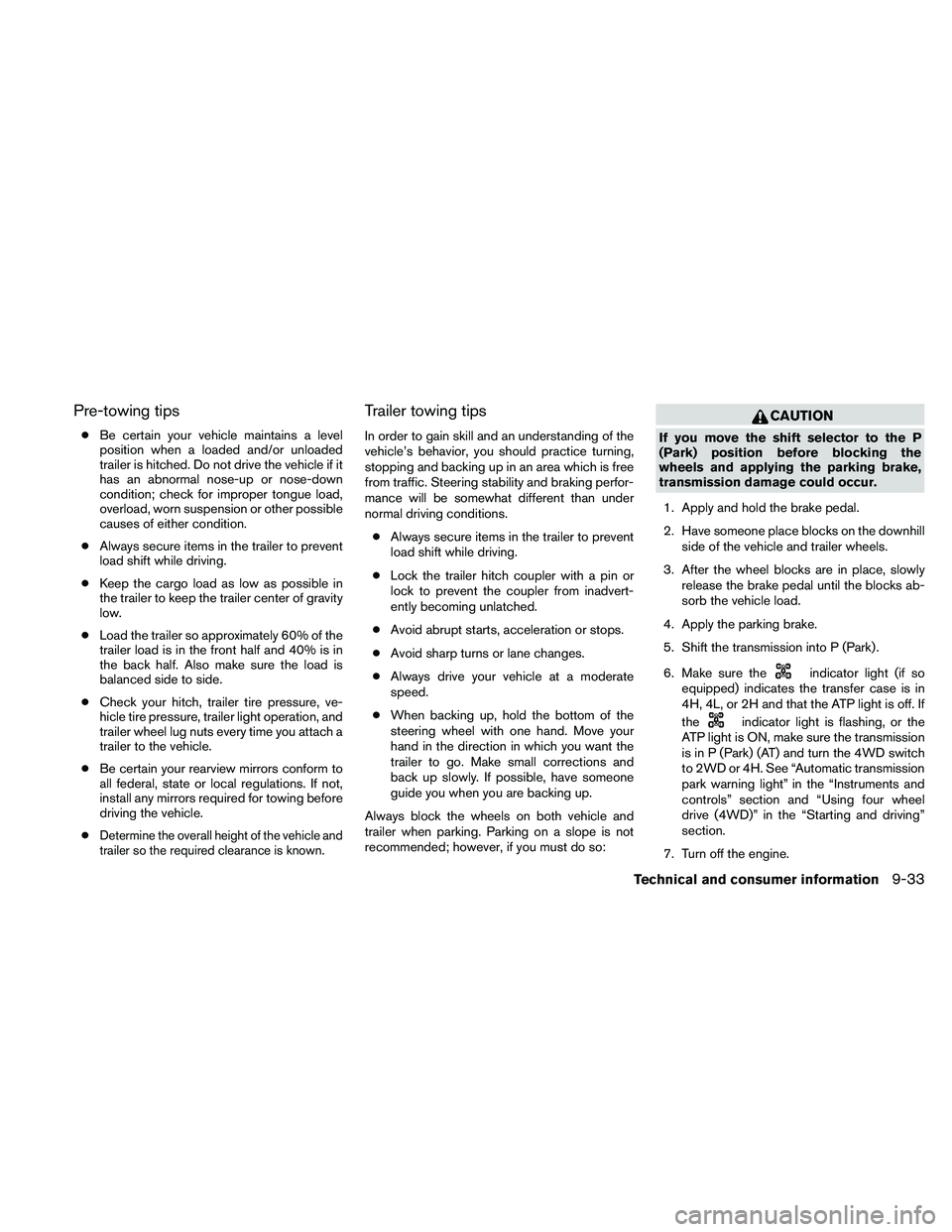
Pre-towing tips
cBe certain your vehicle maintains a level
position when a loaded and/or unloaded
trailer is hitched. Do not drive the vehicle if it
has an abnormal nose-up or nose-down
condition; check for improper tongue load,
overload, worn suspension or other possible
causes of either condition.
cAlways secure items in the trailer to prevent
load shift while driving.
cKeep the cargo load as low as possible in
the trailer to keep the trailer center of gravity
low.
cLoad the trailer so approximately 60% of the
trailer load is in the front half and 40% is in
the back half. Also make sure the load is
balanced side to side.
cCheck your hitch, trailer tire pressure, ve-
hicle tire pressure, trailer light operation, and
trailer wheel lug nuts every time you attach a
trailer to the vehicle.
cBe certain your rearview mirrors conform to
all federal, state or local regulations. If not,
install any mirrors required for towing before
driving the vehicle.
c
Determine the overall height of the vehicle and
trailer so the required clearance is known.
Trailer towing tips
In order to gain skill and an understanding of the
vehicle’s behavior, you should practice turning,
stopping and backing up in an area which is free
from traffic. Steering stability and braking perfor-
mance will be somewhat different than under
normal driving conditions.
cAlways secure items in the trailer to prevent
load shift while driving.
cLock the trailer hitch coupler with a pin or
lock to prevent the coupler from inadvert-
ently becoming unlatched.
cAvoid abrupt starts, acceleration or stops.
cAvoid sharp turns or lane changes.
cAlways drive your vehicle at a moderate
speed.
cWhen backing up, hold the bottom of the
steering wheel with one hand. Move your
hand in the direction in which you want the
trailer to go. Make small corrections and
back up slowly. If possible, have someone
guide you when you are backing up.
Always block the wheels on both vehicle and
trailer when parking. Parking on a slope is not
recommended; however, if you must do so:
CAUTION
If you move the shift selector to the P
(Park) position before blocking the
wheels and applying the parking brake,
transmission damage could occur.
1. Apply and hold the brake pedal.
2. Have someone place blocks on the downhill
side of the vehicle and trailer wheels.
3. After the wheel blocks are in place, slowly
release the brake pedal until the blocks ab-
sorb the vehicle load.
4. Apply the parking brake.
5. Shift the transmission into P (Park) .
6. Make sure the
indicator light (if so
equipped) indicates the transfer case is in
4H, 4L, or 2H and that the ATP light is off. If
the
indicator light is flashing, or the
ATP light is ON, make sure the transmission
is in P (Park) (AT) and turn the 4WD switch
to 2WD or 4H. See “Automatic transmission
park warning light” in the “Instruments and
controls” section and “Using four wheel
drive (4WD)” in the “Starting and driving”
section.
7. Turn off the engine.
Technical and consumer information9-33
Page 365 of 373
10 Index
4WD warning light...............2-16
A
Active brake limited slip (ABLS) system
(if so equipped).................5-34
Air bag (See supplemental restraint system). .1-57
Air bag system
Front (See supplemental front impact
air bag system)...............1-65
Air bag warning labels.............1-71
Air bag warning light...........1-72, 2-18
Air cleaner housing filter............8-20
Air conditioner
Air conditioner operation.......4-6, 4-12
Air conditioner service...........4-17
Air conditioner specification label.....9-12
Air conditioner system refrigerant and
oil recommendations.............9-7
Heater and air conditioner
controls................4-2, 4-10
Servicing air conditioner..........4-17
Air flow charts...............4-7, 4-14
Alarm system (See vehicle security system). .2-23
Anchor point locations.............1-30
Antenna.....................4-36
Anti-lock brake warning light..........2-14
Anti-lock Braking System (ABS)........5-33
Audible reminders...............2-22
Audio system..................4-17
Compact Disc (CD) changer. . . .4-30, 4-33
Compact disc (CD) player.........4-27FM-AM radio with compact disc (CD)
changer...................4-30
FM/AM radio with compact disc (CD)
player....................4-25
Radio....................4-17
Steering wheel audio control switch . . .4-35
Autolight switch.................2-27
Automatic
Automatic power window switch.....2-47
Automatic transmission position indicator
light.....................2-18
Driving with automatic transmission. . . .5-13
Automatic anti-glare inside mirror.......3-14
Automatic door locks..............3-5
AUX jack....................4-34
B
Battery......................8-15
Charge warning light............2-15
Before starting the engine...........5-12
Belt (See drive belt)..............8-18
Block heater
Engine....................5-39
BluetoothThands-free phone system.....4-37
Booster seats..................1-52
Brake
Anti-lock Braking System (ABS)......5-33
Brake fluid..................8-14
Brake light (See stop light).........8-30
Brake system................5-32
Brake warning light.............2-15Brake wear indicators........2-22, 8-23
Parking brake operation..........5-19
Self-adjusting brakes............8-23
Brakes......................8-23
Break-in schedule...............5-21
Brightness control
Instrument panel..............2-29
Bulb check/instrument panel..........2-14
Bulb replacement................8-30
C
Capacities and recommended
fuel/lubricants...................9-2
Car phone or CB radio.............4-36
Cargo light switch...............2-31
Cargo (See vehicle loading information) . . .9-13
CD care and cleaning.............4-35
CD changer (See audio system). . . .4-30, 4-33
CD player (See audio system).........4-27
Child restraint with top tether strap......1-30
Child restraints.......1-24, 1-25, 1-26, 1-28
Precautions on child
restraints........1-26, 1-33, 1-42, 1-52
Top tether strap anchor point locations . .1-30
Child safety rear door lock............3-6
Chimes, audible reminders...........2-22
Cleaning exterior and interior..........7-2
Clock......................4-26
Clutch
Clutch fluid.................8-14
Clutch interlock (clutch start) switch.....2-35
Page 367 of 373
G
Garage door opener, HomeLinkTUniversal
Transceiver....................2-51
Gascap..................3-10, 3-10
Gauge
Engine coolant temperature gauge.....2-6
Engine oil pressure gauge..........2-8
Fuel gauge...................2-7
Odometer...................2-4
Speedometer.................2-4
Tachometer..................2-6
Trip computer.................2-5
Trip odometer.................2-4
Voltmeter....................2-8
General maintenance...............8-2
Glove box.....................2-40
H
Hands-free phone system, BluetoothT.....4-37
Hazard warning flasher switch.........2-30
Headlight and turn signal switch........2-26
Headlight control switch............2-26
Headlights....................8-28
Heated seats...................2-32
Heater
Heater and air conditioner controls . .4-2, 4-10
Heater operation............4-4, 4-11
Hill descent control switch...........2-33
Hill descent control system...........5-36
Hill start assist system..............5-37
HomeLinkTUniversal Transceiver........2-51
Hood release...................3-10Horn.......................2-31
I
Ignition switch...................5-9
Immobilizer system.........2-24, 3-2, 5-11
Important vehicle information label.......9-11
In-cabin microfilter................8-20
Increasing fuel economy.............5-22
Indicator lights and audible reminders
(See warning/indicator lights and audible
reminders)....................2-13
Inside automatic anti-glare mirror........3-14
Inside mirror...................3-13
Instrument brightness control..........2-29
Instrument panel...............0-6, 2-2
Instrument panel dimmer switch........2-29
Interior light....................2-50
ISOFIX child restraints.............1-28
J
Jump seat.....................1-5
Jump starting...................6-9
K
Key.........................3-2
Keyfob battery replacement...........8-26
Keyless entry system (See remote keyless entry
system).......................3-6L
Labels
Air conditioner specification label.....9-12
C.M.V.S.S. certification label........9-11
Emission control information label.....9-12
Engine serial number............9-11
F.M.V.S.S. certification label.........9-11
Tire and Loading Information label.....9-12
Vehicle identification number (VIN) plate . .9-10
Warning labels (for SRS)..........1-71
LATCH (Lower Anchors and Tethers for CHildren)
System......................1-28
License plate
Installing the license plate..........9-13
Light
Air bag warning light.........1-72, 2-18
Brake light (See stop light).........8-30
Bulb check/instrument panel........2-14
Bulb replacement..............8-30
Charge warning light............2-15
Fog light switch...............2-30
Headlight and turn signal switch......2-26
Headlight control switch..........2-26
Headlights..................8-28
Interior light..................2-50
Light bulbs..................8-28
Low tire pressure warning light.......2-16
Low washer fluid warning light.......2-18
Passenger air bag and status light.....1-66
Security indicator light............2-20
Warning/indicator lights and audible
reminders...................2-13
Lights
Map lights..................2-51
10-3
Page 368 of 373
Lock
Child safety rear door lock..........3-6
Door locks...................3-3
Power door locks...............3-4
Low fuel warning light..............2-16
Low tire pressure warning light.........2-16
Low washer fluid warning light.........2-18
Luggage rack (see roof rack)..........2-44
Luggage (See vehicle loading information) . .9-13
M
Maintenance
General maintenance.............8-2
Inside the vehicle...............8-3
Maintenance precautions...........8-5
Outside the vehicle..............8-2
Seat belt maintenance............1-24
Under the hood and vehicle.........8-4
Malfunction indicator light............2-20
Manual front seat adjustment...........1-2
Manual windows.................2-47
Map lights....................2-51
Map pocket....................2-41
Meters and gauges................2-3
Instrument brightness control........2-29
Mirror
Automatic anti-glare inside mirror......3-14
Inside mirror.................3-13
Outside mirrors...............3-14
Vanity mirror.................3-13
Moonroof.....................2-48
Multi-remote control system
(See remote keyless entry system)........3-6N
NISSAN vehicle immobilizer
system................2-24, 3-2, 5-11
O
Octane rating (See fuel octane rating)......9-5
Odometer.....................2-4
Oil
Capacities and recommended
fuel/lubricants.................9-2
Changing engine oil.............8-11
Changing engine oil filter..........8-12
Checking engine oil level...........8-9
Engine oil...................8-9
Engine oil and oil filter recommendation . . .9-6
Engine oil viscosity..............9-6
Outside mirrors.................3-14
Overdrive switch.................5-16
Overheat
If your vehicle overheats...........6-11
Owner’s manual order form...........9-39
Owner’s manual/service manual order
information....................9-39
P
Parking
Parking brake operation...........5-19
Parking/parking on hills...........5-31
Phone, BluetoothThands-free system.....4-37
Power
Front seat adjustment.............1-4Power door locks...............3-4
Power outlet.................2-35
Power steering fluid.............8-13
Power steering system...........5-32
Power windows...............2-45
Rear power windows............2-47
Precautions
Maintenance precautions...........8-5
On-pavement and off-road driving
precautions..................5-5
Precautions on child
restraints.........1-26, 1-33, 1-42, 1-52
Precautions on seat belt usage.......1-16
Precautions on supplemental restraint
system....................1-57
Precautions when starting and driving. . . .5-2
Pre-tensioner seat belt system.........1-70
Push starting...................6-11
R
Radio
Car phone or CB radio...........4-36
Compact Disc (CD) changer. . . .4-30, 4-33
FM-AM radio with compact disc (CD)
changer....................4-30
FM/AM radio with compact disc (CD)
player.....................4-25
Steering wheel audio control switch. . . .4-35
Readiness for inspection maintenance (I/M)
test........................9-37
Rear power windows..............2-47
Rear sliding window...............2-48
Rear window defroster switch.........2-26
10-4
Page 370 of 373
Temperature gauge
Engine coolant temperature gauge.....2-6
Theft (NISSAN vehicle immobilizer system) ,
engine start.............2-24, 3-2, 5-11
Three-way catalyst................5-3
Tie down hooks.................3-18
Tilting steering wheel..............3-12
Tire
Flat tire.....................6-3
Spare tire................6-4, 8-42
Tire and Loading Information label.....9-12
Tire chains..................8-39
Tire placard..................9-12
Tire pressure.................8-32
Tire rotation..................8-39
Tires of 4-wheel drive............8-41
Types of tires.................8-38
Uniform tire quality grading.........9-36
Wheels and tires...............8-32
Wheel/tire size.................9-9
Tire pressure
Low tire pressure warning light.......2-16
Tire Pressure Monitoring System (TPMS). . . .5-3
Top tether strap child restraint.........1-30
Towing
2-wheel drive models............6-13
4-wheel drive models............6-14
Flat towing..................9-35
Tow truck towing...............6-12
Towing load/specification..........9-28
Trailer towing.................9-24
Transceiver
HomeLinkTUniversal Transceiver......2-51
Transmission
Driving with automatic transmission. . . .5-13
Driving with manual transmission......5-17Travel (See registering your vehicle in
another country).................9-10
Trip computer...................2-5
Trip odometer...................2-4
Truck - camper loading.............9-23
Turn signal switch................2-30
U
Uniform tire quality grading...........9-36
V
Vanity mirror...................3-13
Variable voltage control system.........8-17
Vehicle dimensions and weights.........9-9
Vehicle dynamic control (VDC) off switch . . .2-32
Vehicle dynamic control (VDC) system.....5-34
Vehicle identification...............9-10
Vehicle identification number (VIN)
(Chassis number)................9-10
Vehicle identification number (VIN) plate. . . .9-10
Vehicle loading information...........9-13
Vehicle recovery..............6-14, 6-15
Vehicle security system.............2-23
Vehicle security system (NISSAN vehicle immobi-
lizer system) , engine start......2-24, 3-2, 5-11
Ventilators.....................4-2
Visors.......................3-12
Voltmeter......................2-8W
Warning
4WD warning light..............2-16
Air bag warning light.........1-72, 2-18
Anti-lock brake warning light........2-14
Battery charge warning light........2-15
Brake warning light.............2-15
Door open warning light...........2-15
Engine oil pressure warning light......2-15
Hazard warning flasher switch.......2-30
Low fuel warning light............2-16
Low tire pressure warning light.......2-16
Low washer fluid warning light.......2-18
Passenger air bag and status light.....1-66
Seat belt warning light............2-18
Vehicle security system...........2-23
Warning labels (for SRS)..........1-71
Warning/indicator lights and audible
reminders...................2-13
Warning lights..................2-13
Washer switch
Windshield wiper and washer switch . . .2-25
Weights (See dimensions and weights).....9-9
Wheels and tires.................8-32
Wheel/tire size...................9-9
When traveling or registering your vehicle
in another country................9-10
Window washer fluid..............8-15
Windows
Locking passengers’ windows.......2-47
Manual windows...............2-47
Power windows...............2-45
Rear power windows............2-47
Rear sliding window.............2-48
10-6