ECO mode NISSAN FRONTIER 2018 Owner´s Manual
[x] Cancel search | Manufacturer: NISSAN, Model Year: 2018, Model line: FRONTIER, Model: NISSAN FRONTIER 2018Pages: 502, PDF Size: 4.85 MB
Page 468 of 502
CREW CAB MODELS
Crew Cab short wheel base models
should not be used to carry a slide-in
camper.
KING CAB® MODELS
This information is provided for you to
properly install a slide-in camper and is
based on the National Highway Traffic
Safety Administration regulations. It is rec-
ommended that, before installing the
camper, you carefully read the following in-
formation and ensure that the camper
meets the specifications.
This information may not apply to some
Canada model vehicles.
SPECIAL BODY VEHICLES
Some vehicles are equipped with commer-
cial or camper bodies. However, this Own-
er’s Manual does not cover these options.
For additional information, refer to the
body manufacturer’s instruction manual.
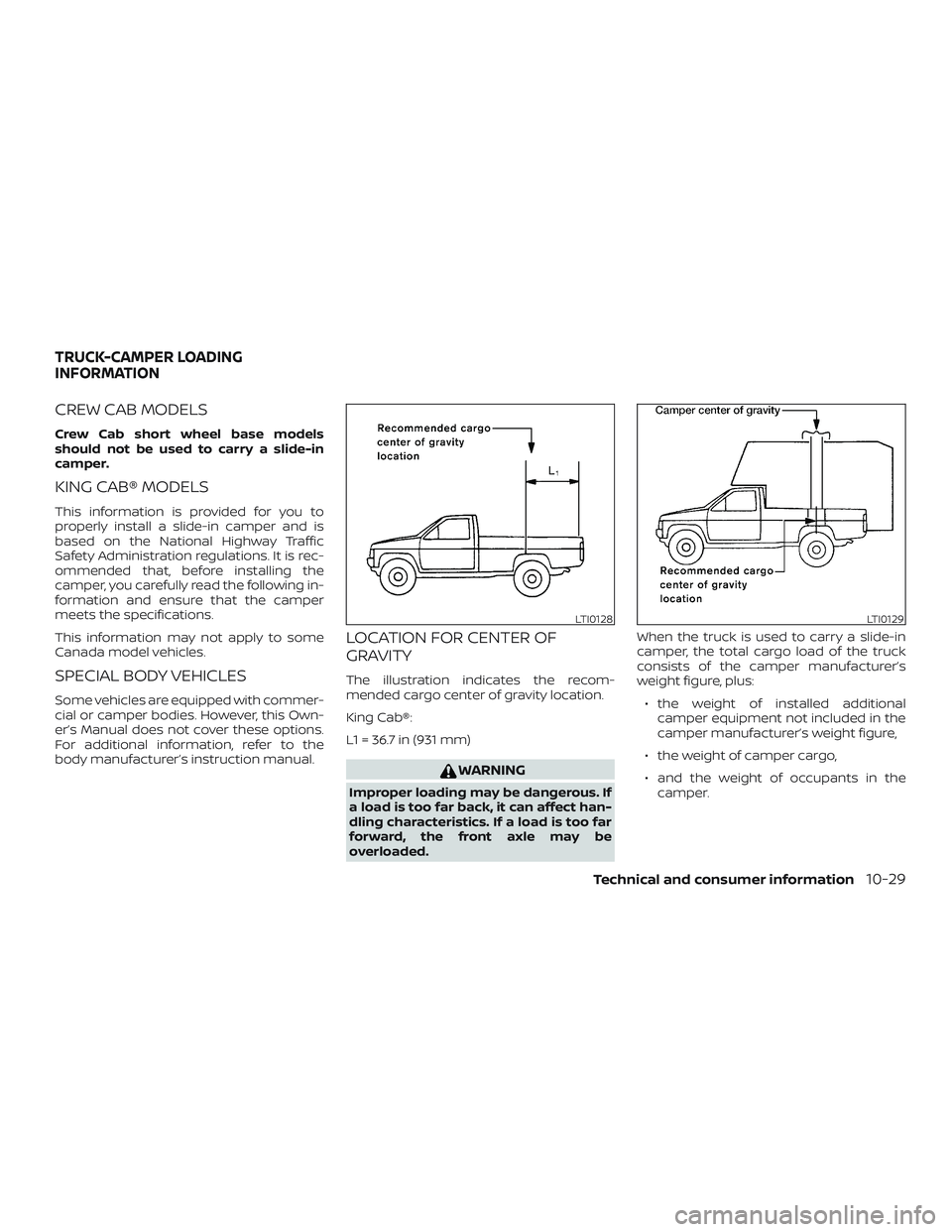
LOCATION FOR CENTER OF
GRAVITY
The illustration indicates the recom-
mended cargo center of gravity location.
King Cab®:
L1 = 36.7 in (931 mm)
WARNING
Improper loading may be dangerous. If
a load is too far back, it can affect han-
dling characteristics. If a load is too far
forward, the front axle may be
overloaded.When the truck is used to carry a slide-in
camper, the total cargo load of the truck
consists of the camper manufacturer’s
weight figure, plus:
∙ the weight of installed additional camper equipment not included in the
camper manufacturer’s weight figure,
∙ the weight of camper cargo,
∙ and the weight of occupants in the camper.
LTI0128LTI0129
TRUCK-CAMPER LOADING
INFORMATION
Technical and consumer information10-29
Page 480 of 502
∙ Always drive your vehicle at a moderatespeed.
∙ When backing up, hold the bottom of the steering wheel with one hand. Move
your hand in the direction in which you
want the trailer to go. Make small cor-
rections and back up slowly. If possible,
have someone guide you when you are
backing up.
Always block the wheels on both vehicle
and trailer when parking. Parking on a
slope is not recommended; however, if you
must do so:
CAUTION
If you move the shif t lever to the P (Park)
position before blocking the wheels
and applying the parking brake, trans-
mission damage could occur.
1. Apply and hold the brake pedal.
2. Have someone place blocks on the downhill side of the vehicle and trailer
wheels.
3. Af ter the wheel blocks are in place, slowly release the brake pedal until the
blocks absorb the vehicle load.
4. Apply the parking brake. 5. Shif t the transmission into P (Park).
6. Make sure the
indicator light (if so
equipped) indicates the transfer case is
in 4H, 4L, or 2H and that the ATP light is
off. If the
indicator light is flashing,
or the ATP light is ON, make sure the
transmission is in P (Park) (A/T) and
turn the 4WD switch to 2WD or 4H. For
additional information, refer to “Auto-
matic transmission park warning light”
in the “Instruments and controls” sec-
tion and “Using 4-wheel drive (4WD)” in
the “Starting and driving” section of this
manual.
7. Turn off the engine.
To drive away:
1. Start the vehicle.
2. Apply and hold the brake pedal.
3. Shif t the transmission into gear.
4. Release the parking brake.
5. Drive slowly until the vehicle and trailer are clear from the blocks.
6. Apply and hold the brake pedal.
7. Have someone retrieve and store the blocks. ∙ While going downhill, the weight of the
trailer pushing on the tow vehicle may
decrease overall stability. Therefore, to
maintain adequate control, reduce your
speed and shif t to a lower gear. Avoid
long or repeated use of the brakes
when descending a hill, as this reduces
their effectiveness and could cause
overheating. Shif ting to a lower gear in-
stead provides “engine braking” and re-
duces the need to brake as frequently.
∙ If the engine coolant temperature rises to a high temperature, refer to “If your
vehicle overheats” in the “In case of
emergency” section of this manual.
∙ Trailer towing requires more fuel than normal circumstances.
∙ Avoid towing a trailer for your vehicle’s first 500 miles (805 km).
∙ For the first 500 miles (805 km) that you do tow, do not drive over 50 mph
(80 km/h).
∙ Have your vehicle serviced more of ten than at intervals specified. For addi-
tional information, refer to “Mainte-
nance Schedules” in the “Maintenance
and schedules” section of this manual.
Technical and consumer information10-41
Page 489 of 502
Brightness/contrast button.........4-9
Brightness control Instrument panel .............2-32
Bulb check/instrument panel ........2-15
Bulb replacement ...............8-29
C
Capacities and recommended fuel/
lubricants....................10-2
Cargolightswitch...............2-34
Cargo
(See vehicle loading information) .....10-20
Car phone or CB radio ............4-79
CDcareandcleaning.............4-71
CD player (See audio system) .4-44, 4-50, 4-57
Childrestraints........1-25, 1-26, 1-28, 1-31 LATCH (Lower Anchors and Tethers for
CHildren)System..............1-31
Precautions on child
restraints.........1-28, 1-41, 1-56, 1-68
Top tether strap anchor point
locations.................. .1-34
Child restraint with top tether strap . . . .1-33
Child safety rear door lock ..........3-6
Chimes, audible reminders .........2-24
Cleaningexteriorandinterior......7-2,7-4
Clock set/adjustment .............4-7
Clock setting (models with Navigation
System)......................4-7
Clock setting (models without Navigation
System) ...........4-41,4-43,4-47,4-49
Clutch Clutchfluid.................8-12
Clutch interlock (clutch start) switch . . .2-38 C.M.V.S.S. certification label
.........10-17
Cold weather driving .............5-43
Compact disc (CD) player . . .4-44, 4-50, 4-57
Compass display ................2-11
Connect phone ................4-74
Console box ..................2-45
Control panel buttons .............4-4
Back button .................4-7
Brightness/contrast button .......4-9
Enterbutton.................4-4
Settingbutton................4-7
Withnavigationsystem .......4-4,4-5
Controls Audio controls (steering wheel) .....4-72
Heater and air conditioner
controls................4-17,4-29
Coolant Capacities and recommended
fuel/lubricants...............10-2
Changing engine coolant .........8-6
Checking engine coolant level ......8-6
Engine coolant temperature gauge . .2-6
Corrosionprotection..............7-7
Cruisecontrol .................5-22
Cupholders ..................2-46
Curtain side-impact and rollover air
bag....................... .1-87
D
Daytime Running Light System .......2-32
Defroster switch Rear window and outside mirror
defrosterswitch..............2-28
Rearwindowdefrosterswitch.....2-28 Dimensions and weights
..........10-15
Dimmer switch for instrument panel . . .2-32
Display controls
(see control panel buttons) ..........4-4
Door locks ....................3-3
Door open warning light ...........2-17
Drivebelt ....................8-16
Driving Coldweatherdriving...........5-43
Driving with automatic transmission .5-14
Driving with manual transmission . . .5-18
Precautions when starting and driving .5-2
Driving the vehicle ...............5-14
E
Economy - fuel .................5-25
Electronic locking rear differential (E-Lock)
system......................5-33
Electronic locking rear differential (E-Lock)
systemswitch.................2-37
Emission control information label . . . .10-18
Emission control system warranty . . . .10-45
Engine Before starting the engine ........5-13
Capacities and recommended
fuel/lubricants...............10-2
Changing engine coolant .........8-6
Changing engine oil ............8-8
Changing engine oil filter .........8-10
Checking engine coolant level ......8-6
Checking engine oil level .........8-7
Engine
compartment check
locations...................8-3
Engine coolant temperature gauge . .2-6
11-2
Page 494 of 502
Power door lock switch..........3-4
Rear sonar system OFF switch .....2-39
Rear window and outside mirror
defrosterswitch..............2-28
Rearwindowdefrosterswitch.....2-28
Turn signal switch .............2-32
T
Tachometer ...................2-6
Tailgate ..................3-18, 3-18
Tailgatelatch...............3-22,3-23
Temperature gauge Engine coolant temperature gauge . .2-6
Thef t (NISSAN Vehicle Immobilizer System),
engine start ...............2-26,5-12
Three-waycatalyst...............5-3
Tie down hooks ................3-23
Tilting steering wheel .............3-14
Tire Flattire..................6-3,6-4
Spare tire ...............6-5,8-42
Tire and Loading Information label . .10-18
Tire chains .................8-38
Tire pressure .............8-31,8-31
Tirerotation ................8-39
Tires of 4-wheel drive ...........8-41
Types of tires ................8-37
Uniform tire quality grading ......10-44
Wheels and tires ..........8-31,10-14
Wheel/tire size ...............10-14
Tire pressure Low tire pressure warning light .....2-18
Tire Pressure Monitoring System (TPMS) . .5-3
Toptetherstrapchildrestraint.......1-33 Towing
2-wheel drive models ...........6-19
4-wheel drive models ........6-17,6-18
Flattowing.................10-43
Towing load/specification .......10-34
Towtrucktowing .............6-15
Trailertowing...............10-30
Towingatrailer................10-30
Transceiver HomeLink® Universal Transceiver . . .2-55,
2-56, 2-57, 2-58, 2-58, 2-59
Transmission Driving with automatic
transmission ................5-14
Driving with manual transmission . . .5-18
Travel (See registering a vehicle in another
country) .....................10-16
Trip computer ..................2-9
Trip odometer ..................2-4
Troubleshooting guide (NISSAN voice
recognition system) .............4-105
Truckbox.................3-18,3-18
Truck - camper loading ...........10-29
Turn signal switch ...............2-32
U
Uniform tire quality grading ........10-44
USB interface Audio file operation ........4-60,4-62
Using four wheel drive (4WD) ........5-26 V
Vanitymirror..................3-15
Variablevoltagecontrolsystem......8-16
Vehicle dimensions and weights .....10-15
Vehicle Dynamic Control (VDC) OFF
switch......................2-35
Vehicle dynamic control (VDC) system . .5-38
Vehicle Dynamic Control (VDC) system . .5-38
Vehicle identification .............10-16
Vehicle identification number (VIN) . . . .10-16
Vehicle identification number (VIN)
plate.......................10-16
Vehicle immobilizer system ......2-26,5-12
Vehicle loading information ........10-20
Vehiclerecovery................6-19
Vehicle security system ...........2-25
Vehicle security system (NISSAN Vehicle
Immobilizer System), engine start . .2-26, 5-12
Ventilators ....................4-17
Visors.......................3-14
Voice Prompt Interrupt ........4-83,4-94
Voice recognition system ..........4-101
Voltmeter.................... .2-8
W
Warning 4WDwarninglight.............2-15
A
irbagwarninglight........1-90, 2-20
Anti-lock brake warning light ......2-15
Battery charge warning light ......2-17
Brakewarninglight............2-16
Door open warning light .........2-17
Engine oil pressure warning light . . . .2-17
11-7
Page 499 of 502
FUEL RECOMMENDATION (for
QR25DE models):
Use unleaded regular gasoline with an oc-
tane rating of at least 87 AKI (Anti-Knock
Index) number (Research octane number
91).
CAUTION
∙ Only vehicles with the E-85 filler doorlabel can operate on E-85. Fuel system
or other damage can occur if E-85 is
used in vehicles that are not designed
to run on E-85.
∙ Using a fuel other than that specified could adversely affect the emission
control system, and may also affect
the warranty coverage.
∙ Under no circumstances should a leaded gasoline be used, because this
will damage the three-way catalyst. ∙ Do not use a fuel containing more
than 15% ethanol in your vehicle. Your
vehicle is not designed to run on a fuel
containing more than 15% ethanol.
Using a fuel containing more than 15%
ethanol in a vehicle not specifically
designed for a fuel containing more
than 15% ethanol can adversely affect
the emission control devices and sys-
tems of the vehicle. Damage caused
by such fuel is not covered by the
NISSAN New Vehicle Limited Warranty.
∙ Do not use fuel that contains the oc- tane booster methylcyclopentadienyl
manganese tricarbonyl (MMT). Using
fuel containing MMT may adversely
affect vehicle performance and ve-
hicle emissions. Not all fuel dispens-
ers are labeled to indicate MMT con-
tent, so you may have to consult your
gasoline retailer for more details.
Note that Federal and California laws
prohibit the use of MMT in reformu-
lated gasoline. ∙ U.S. government regulations require
ethanol dispensing pumps to be iden-
tified by a small, square, orange and
black label with the common abbre-
viation or the appropriate percentage
for that region.
For additional information, refer to “Recom-
mended fluids/lubricants and capacities”
in the “Technical and consumer informa-
tion” section of this manual.
FUEL RECOMMENDATION (for
VQ40DE models):
Use unleaded regular gasoline with an oc-
tane rating of at least 87 AKI (Anti-Knock
Index) number (Research octane number
91).
CAUTION
∙ Only vehicles with the E-85 filler door label can operate on E-85. Fuel system
or other damage can occur if E-85 is
used in vehicles that are not designed
to run on E-85.
∙ Using a fuel other than that specified could adversely affect the emission
control system, and may also affect
the warranty coverage.
GAS STATION INFORMATION
Page 500 of 502
∙ Under no circumstances should aleaded gasoline be used, because this
will damage the three-way catalyst.
∙ Do not use E-15 or E-85 fuel in your vehicle. Your vehicle is not designed to
run on E-15 or E-85 fuel. Using E-15 or
E-85 fuel in a vehicle not specifically
designed for E-15 or E-85 fuel can ad-
versely affect the emission control
devices and systems of the vehicle.
Damage caused by such fuel is not
covered by the NISSAN New Vehicle
Limited Warranty.
∙ Do not use fuel that contains the oc- tane booster methylcyclopentadienyl
manganese tricarbonyl (MMT). Using
fuel containing MMT may adversely
affect vehicle performance and ve-
hicle emissions. Not all fuel dispens-
ers are labeled to indicate MMT con-
tent, so you may have to consult your
gasoline retailer for more details.
Note that Federal and California laws
prohibit the use of MMT in reformu-
lated gasoline. ∙ U.S. government regulations require
ethanol dispensing pumps to be iden-
tified by a small, square, orange and
black label with the common abbre-
viation or the appropriate percentage
for that region.
For additional information, refer to “Recom-
mended fluids/lubricants and capacities”
in the “Technical and consumer informa-
tion” section of this manual.
FLEXIBLE FUEL VEHICLE (FFV)
FUEL RECOMMENDATION (if so
equipped):
If your vehicle is equipped as a Flexible Fuel
Vehicle (FFV) your vehicle is designed to
use (E-85) Fuel Ethanol, “Regular” unleaded
regular gasoline or any percentage of the
two fuels combined.
CAUTION
∙ Using a fuel other than that specified could adversely affect the emission
control system, and may also affect
the warranty coverage.
∙ Under no circumstances should a leaded gasoline be used, because this
will damage the three-way catalyst. For additional information, refer to “Recom-
mended fluids/lubricants and capacities”
in the “Technical and consumer informa-
tion” section of this manual.
ENGINE OIL RECOMMENDATION:
QR25DE engine models:
• Genuine “Nissan Motor Oil 5W-30 SN”
VQ40DE engine models:
• Genuine “Nissan Motor Oil Ester 5W-30 SN”
For additional information, refer to “Engine
oil and oil filter recommendations” in the
“Technical and consumer information” sec-
tion of this manual.
COLD TIRE PRESSURE:
For additional information, refer to “Tire and
Loading Information label” in the “Technical
and consumer information” section of this
manual.
The label is typically located on the driver
side center pillar or on the driver’s door. For
additional information, refer to “Wheels and
tires” in the “Do-it-yourself ” section of this
manual.