transmission NISSAN FRONTIER 2018 Owner´s Manual
[x] Cancel search | Manufacturer: NISSAN, Model Year: 2018, Model line: FRONTIER, Model: NISSAN FRONTIER 2018Pages: 502, PDF Size: 4.85 MB
Page 367 of 502
CAUTION
∙ Do not push start this vehicle. The3-way catalyst may be damaged.
∙ Automatic transmission models can- not be push-started or tow-started.
Attempting to do so may cause trans-
mission damage.
∙ For manual transmission models, never try to start the vehicle by tow-
ing it. When the engine starts, the for-
ward surge could cause the vehicle to
collide with the tow vehicle.
WARNING
∙ Do not continue to drive if your vehicleoverheats. Doing so could cause en-
gine damage or a vehicle fire.
∙ To avoid the danger of being scalded, never remove the radiator cap while
the engine is still hot. When the radia-
tor cap is removed, pressurized hot
water will spurt out, possibly causing
serious injury.
∙ Do not open the hood if steam is com- ing out.
If your vehicle is overheating (indicated by
an extremely high temperature gauge
reading), or if you feel a lack of engine
power, detect abnormal noise, etc. take the
following steps. 1. Move the vehicle safely off the road, ap- ply the parking brake and move the
shif t lever to N (Neutral) (manual trans-
mission) or to P (Park) (automatic trans-
mission).
Do not stop the engine. 2. Turn off the air conditioner. Open all the
windows, move the heater or air condi-
tioner temperature control to maxi-
mum hot and fan control to high
speed.
3. Get out of the vehicle. Look and listen for steam or coolant escaping from the
radiator before opening the hood. If
steam or coolant is escaping, turn off
the engine. Do not open the hood fur-
ther until no steam or coolant can be
seen.
4. Open the engine hood.
WARNING
If steam or water is coming from the
engine, stand clear to prevent getting
burned.
5. Visually check drive belts for damage or looseness. Also check if the cooling
fan is running. The radiator hoses and
radiator should not leak water. If cool-
ant is leaking, the water pump belt is
missing or loose, or the cooling fan
does not run, stop the engine.
PUSH STARTING IF YOUR VEHICLE OVERHEATS
6-14In case of emergency
Page 368 of 502
WARNING
Be careful not to allow your hands, hair,
jewelry or clothing to come into contact
with, or get caught in, engine belts or
the engine cooling fan. The engine cool-
ing fan can start at any time.6. Af ter the engine cools down, check the coolant level in the engine coolant res-
ervoir tank with the engine running.
Add coolant to the engine coolant res-
ervoir tank if necessary. Have your ve-
hicle repaired. It is recommended that
you visit a NISSAN dealer for this ser-
vice. When towing your vehicle, all jurisdictional
and local regulations for towing must be
followed. Incorrect towing equipment
could damage your vehicle. Towing in-
structions are available from a NISSAN
dealer. Local service operators are gener-
ally familiar with the applicable laws and
procedures for towing. To assure proper
towing and to prevent accidental damage
to your vehicle, NISSAN recommends hav-
ing a service operator tow your vehicle. It is
advisable to have the service operator
carefully read the following precautions:
WARNING
∙ Never ride in a vehicle that is being
towed.
∙ Never get under your vehicle af ter it has been lif ted by a tow truck.
CAUTION
∙ When towing, make sure that thetransmission, axles, steering system
and powertrain are in working condi-
tion. If any of these conditions apply,
dollies or a flatbed tow truck must be
used.
∙ Always attach safety chains before towing. For additional information, refer to “Flat
towing — 4WD with automatic transmis-
sion,” “Flat towing — 2WD with automatic
transmission” and “Flat towing — 2WD/4WD
with manual transmission” in the “Technical
and consumer information” section of this
manual.
TOWING RECOMMENDED BY
NISSAN
NISSAN recommends towing your vehicle
based upon the type of drivetrain. For addi-
tional information, refer to the diagrams in
this section to ensure that your vehicle is
properly towed.
TOWING YOUR VEHICLE
In case of emergency6-15
Page 369 of 502
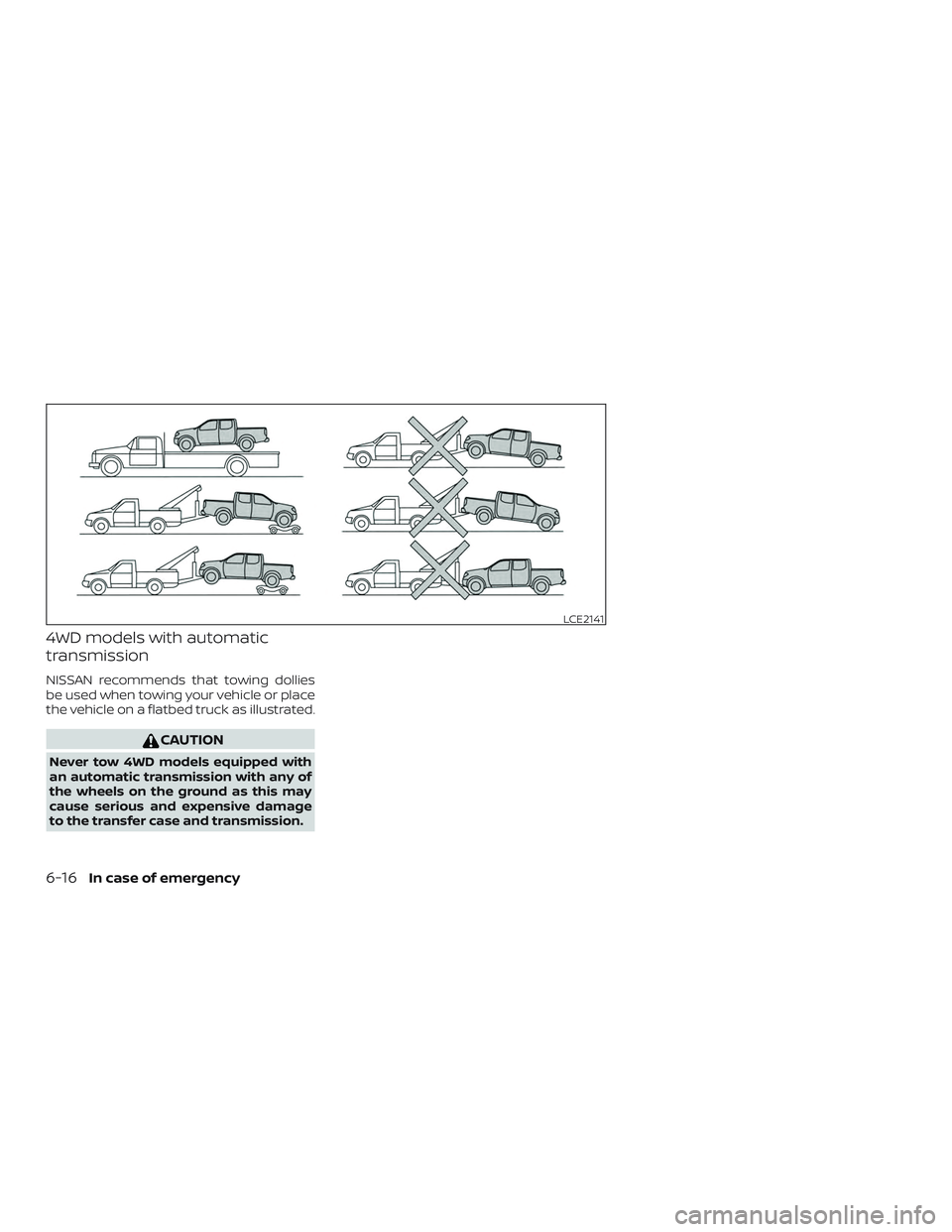
4WD models with automatic
transmission
NISSAN recommends that towing dollies
be used when towing your vehicle or place
the vehicle on a flatbed truck as illustrated.
CAUTION
Never tow 4WD models equipped with
an automatic transmission with any of
the wheels on the ground as this may
cause serious and expensive damage
to the transfer case and transmission.
LCE2141
6-16In case of emergency
Page 370 of 502
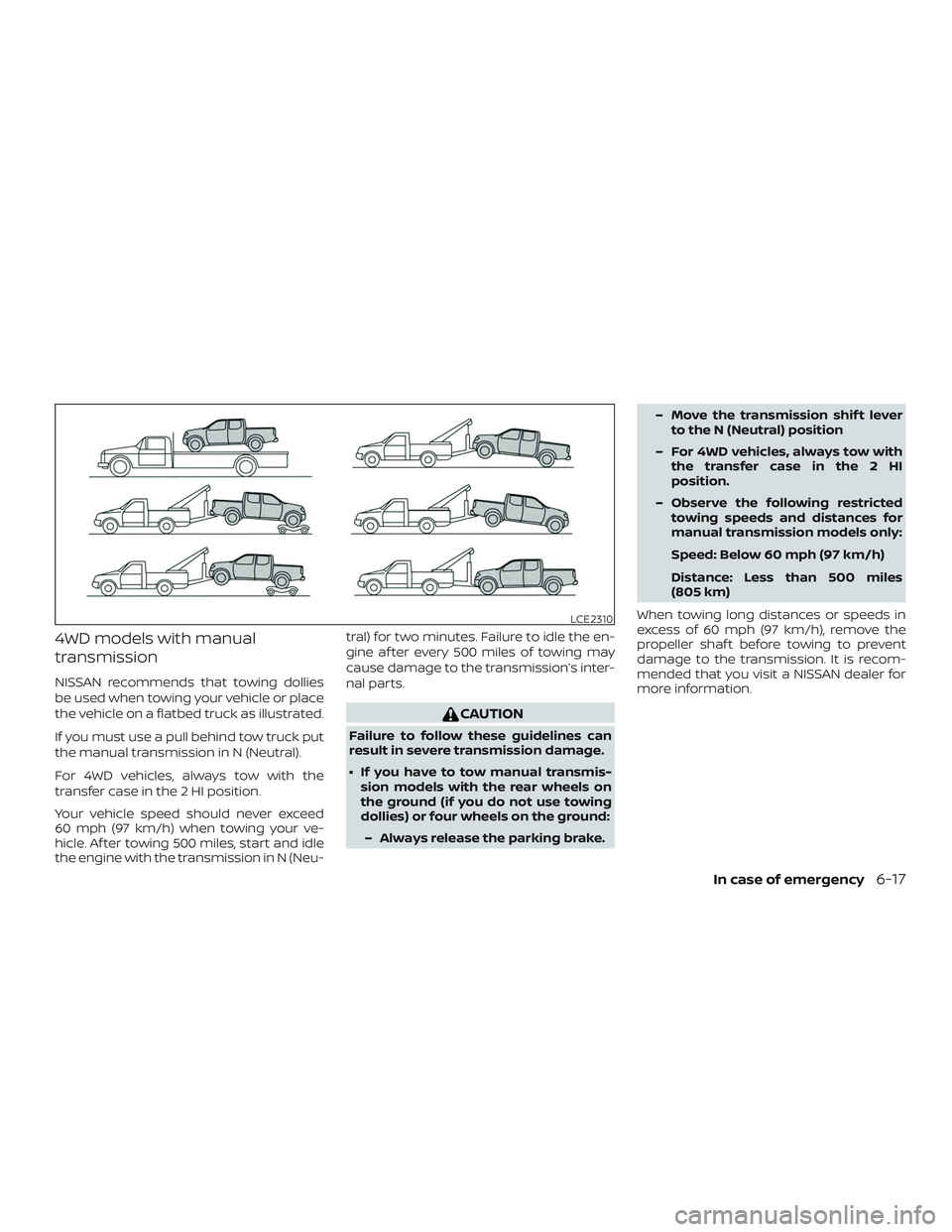
4WD models with manual
transmission
NISSAN recommends that towing dollies
be used when towing your vehicle or place
the vehicle on a flatbed truck as illustrated.
If you must use a pull behind tow truck put
the manual transmission in N (Neutral).
For 4WD vehicles, always tow with the
transfer case in the 2 HI position.
Your vehicle speed should never exceed
60 mph (97 km/h) when towing your ve-
hicle. Af ter towing 500 miles, start and idle
the engine with the transmission in N (Neu-tral) for two minutes. Failure to idle the en-
gine af ter every 500 miles of towing may
cause damage to the transmission’s inter-
nal parts.
CAUTION
Failure to follow these guidelines can
result in severe transmission damage.
∙ If you have to tow manual transmis-
sion models with the rear wheels on
the ground (if you do not use towing
dollies) or four wheels on the ground:
– Always release the parking brake. – Move the transmission shif t lever
to the N (Neutral) position
– For 4WD vehicles, always tow with the transfer case in the 2 HI
position.
– Observe the following restricted towing speeds and distances for
manual transmission models only:
Speed: Below 60 mph (97 km/h)
Distance: Less than 500 miles
(805 km)
When towing long distances or speeds in
excess of 60 mph (97 km/h), remove the
propeller shaf t before towing to prevent
damage to the transmission. It is recom-
mended that you visit a NISSAN dealer for
more information.
LCE2310
In case of emergency6-17
Page 371 of 502
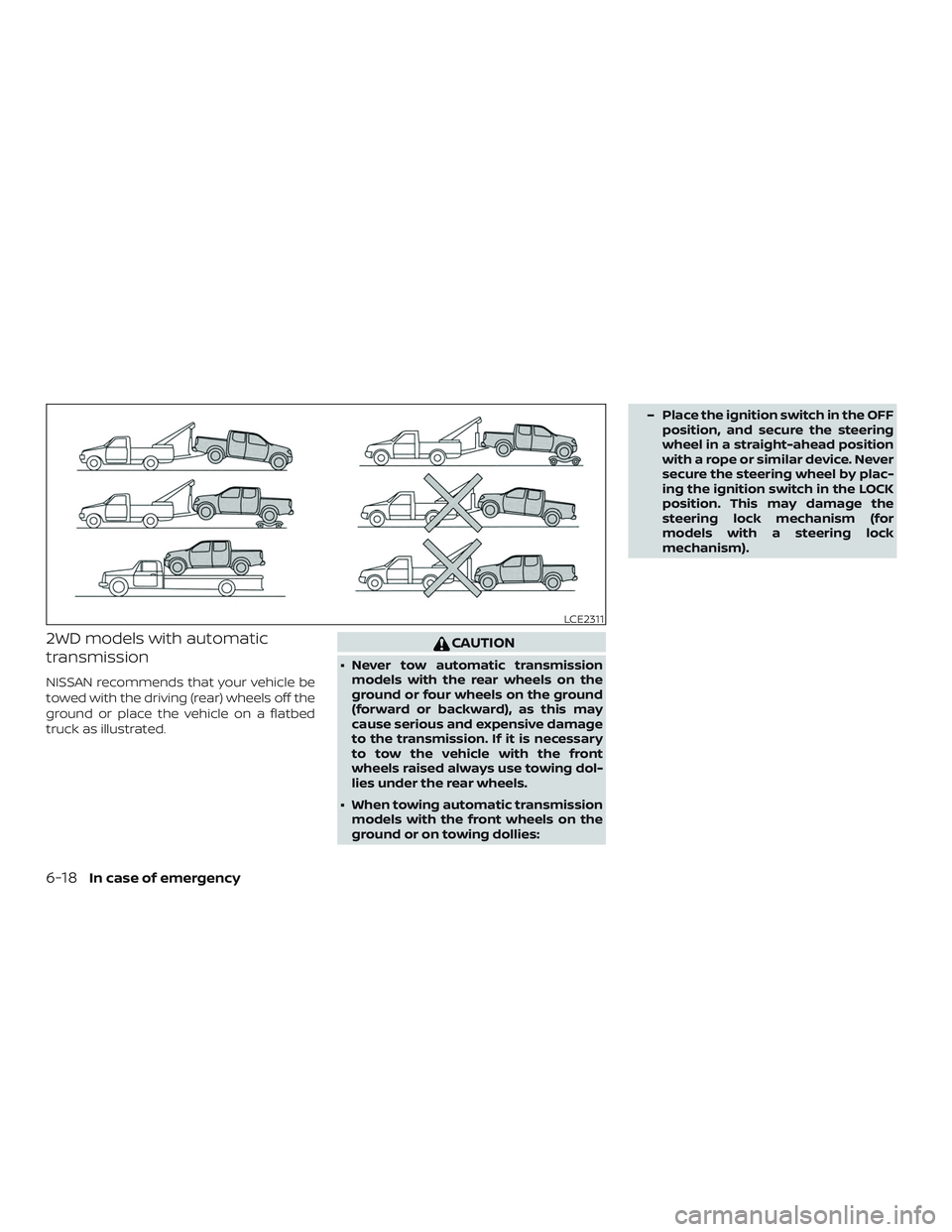
2WD models with automatic
transmission
NISSAN recommends that your vehicle be
towed with the driving (rear) wheels off the
ground or place the vehicle on a flatbed
truck as illustrated.
CAUTION
∙ Never tow automatic transmissionmodels with the rear wheels on the
ground or four wheels on the ground
(forward or backward), as this may
cause serious and expensive damage
to the transmission. If it is necessary
to tow the vehicle with the front
wheels raised always use towing dol-
lies under the rear wheels.
∙ When towing automatic transmission models with the front wheels on the
ground or on towing dollies: – Place the ignition switch in the OFF
position, and secure the steering
wheel in a straight-ahead position
with a rope or similar device. Never
secure the steering wheel by plac-
ing the ignition switch in the LOCK
position. This may damage the
steering lock mechanism (for
models with a steering lock
mechanism).
LCE2311
6-18In case of emergency
Page 372 of 502
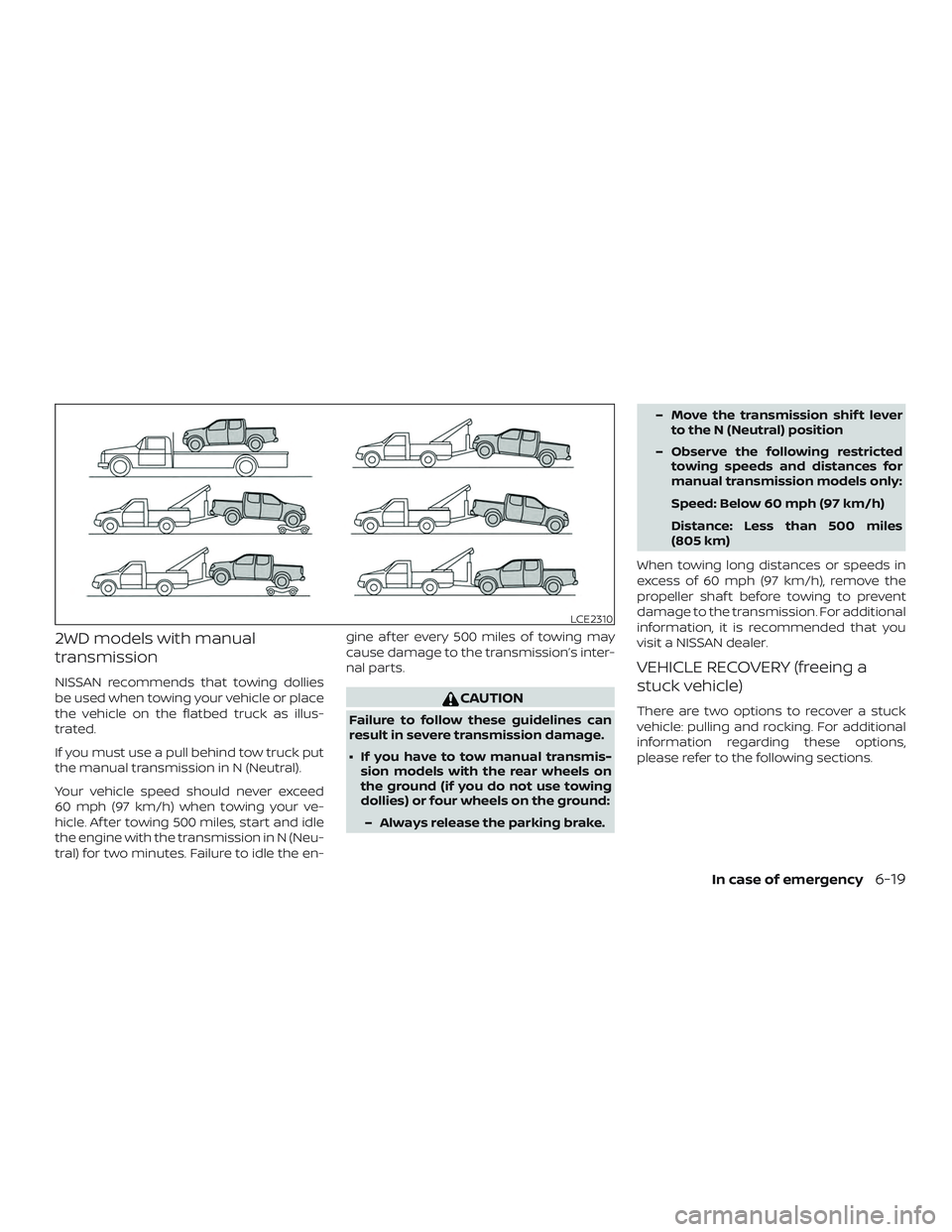
2WD models with manual
transmission
NISSAN recommends that towing dollies
be used when towing your vehicle or place
the vehicle on the flatbed truck as illus-
trated.
If you must use a pull behind tow truck put
the manual transmission in N (Neutral).
Your vehicle speed should never exceed
60 mph (97 km/h) when towing your ve-
hicle. Af ter towing 500 miles, start and idle
the engine with the transmission in N (Neu-
tral) for two minutes. Failure to idle the en-gine af ter every 500 miles of towing may
cause damage to the transmission’s inter-
nal parts.
CAUTION
Failure to follow these guidelines can
result in severe transmission damage.
∙ If you have to tow manual transmis-
sion models with the rear wheels on
the ground (if you do not use towing
dollies) or four wheels on the ground:
– Always release the parking brake. – Move the transmission shif t lever
to the N (Neutral) position
– Observe the following restricted towing speeds and distances for
manual transmission models only:
Speed: Below 60 mph (97 km/h)
Distance: Less than 500 miles
(805 km)
When towing long distances or speeds in
excess of 60 mph (97 km/h), remove the
propeller shaf t before towing to prevent
damage to the transmission. For additional
information, it is recommended that you
visit a NISSAN dealer.
VEHICLE RECOVERY (freeing a
stuck vehicle)
There are two options to recover a stuck
vehicle: pulling and rocking. For additional
information regarding these options,
please refer to the following sections.
LCE2310
In case of emergency6-19
Page 373 of 502
Pulling a stuck vehicle
WARNING
To avoid vehicle damage, serious per-
sonal injury or death when recovering a
stuck vehicle:
∙ Contact a professional towing serviceto recover the vehicle if you have any
questions regarding the recovery
procedure.
∙ Attach recovery devices only to main structural members of the vehicle or
the recovery hooks.
∙ Do not use the vehicle tie-downs to tow or free a stuck vehicle.
∙ Only use devices specifically designed for vehicle recovery and follow the
manufacturer’s instructions.
∙ Always pull the recovery device straight out from the front of the ve-
hicle. Never pull at an angle.
∙ Route recovery devices so they do not touch any part of the vehicle except
the attachment point. If your vehicle is stuck in sand, snow, mud,
etc., use a tow strap or other device de-
signed specifically for vehicle recovery. Al-
ways follow the manufacturer’s instruc-
tions for the recovery device.
Rocking a stuck vehicle
WARNING
∙ Stand clear of a stuck vehicle.
∙ Do not spin your tires at high speed.
This could cause them to explode and
result in serious injury. Parts of your
vehicle could also overheat and be
damaged.
If your vehicle is stuck in sand, snow, mud,
etc., use the following procedure: 1. Turn off the Vehicle Dynamic Control (VDC) system.
2. Make sure the area in front and behind the vehicle is clear of obstructions.
3. Turn the steering wheel right and lef t to clear an area around the front tires. 4. Slowly rock the vehicle forward and
backward.
∙ Shif t back and forth between R (Re- verse) and D (Drive) (automatic trans-
mission models) or 1st (Low) and R
(Reverse) (manual transmission
models).
∙ Apply the accelerator as little as pos- sible to maintain the rocking motion.
∙ Release the accelerator pedal before shif ting between R and D (automatic
transmission models) or 1st and R
(manual transmission models).
∙ Do not spin the tires above 34 mph (55 km/h).
5. If the vehicle cannot be freed af ter a few tries, contact a professional towing
service to remove the vehicle.
6-20In case of emergency
Page 379 of 502
Floor mat installation
Your vehicle is equipped with floor mat po-
sitioning hook(s). The number and shape of
the floor mat positioning hooks for each
seating position varies depending on the
vehicle.
When installing Genuine NISSAN floor mats,
follow the installation instructions provided
with the mat and the following:1. With the ignition in the OFF position, the shif t lever in P (Park) position (auto-
matic transmission models) or the shif t
lever in the N (Neutral) position (manual
transmission models) and with the
parking brake fully applied, position the
floor mat in the floorwell so that the
floor mat grommet holes are aligned
with the hook(s).
2. Secure the grommet holes into the hook(s) and ensure that the floor mat is
properly positioned. 3. Make sure the floor mat does not inter-
fere with pedal operation. With the igni-
tion still in the OFF position, the shif t
lever in the P (Park) position (automatic
transmission models) or the shif t lever
in the N (Neutral) position (manual
transmission models) and with the
parking brake applied, fully apply and
release all pedals. The floor mat must
not interfere with pedal operation or
prevent the pedal from returning to its
normal position.
It is recommended that you visit a NISSAN
dealer for details about installing the floor
mats in your vehicle.
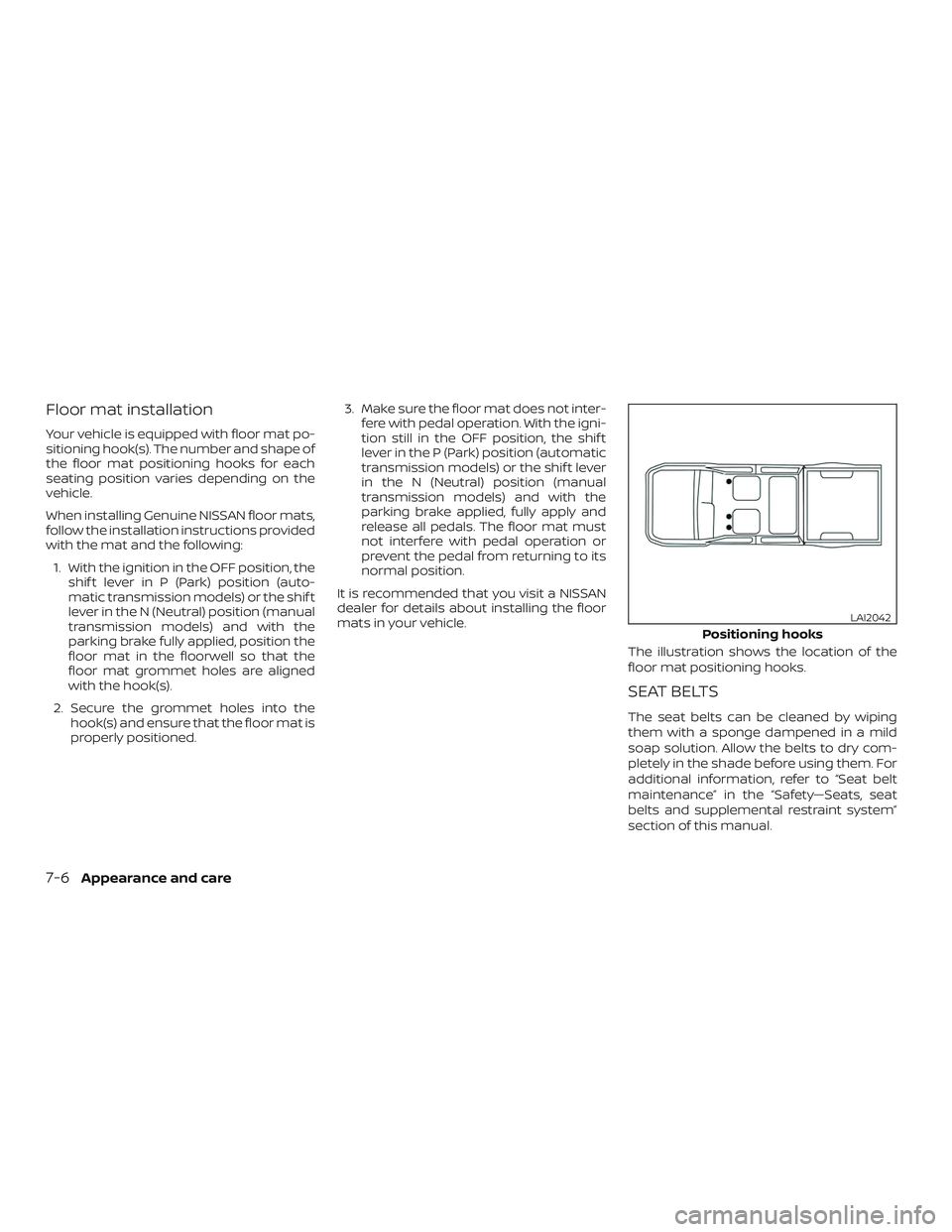
The illustration shows the location of the
floor mat positioning hooks.
SEAT BELTS
The seat belts can be cleaned by wiping
them with a sponge dampened in a mild
soap solution. Allow the belts to dry com-
pletely in the shade before using them. For
additional information, refer to “Seat belt
maintenance” in the “Safety—Seats, seat
belts and supplemental restraint system”
section of this manual.
Positioning hooks
LAI2042
7-6Appearance and care
Page 382 of 502
8 Do-it-yourself
Maintenance precautions.......................8-2
Engine compartment check locations ...........8-3
Engine cooling system ..........................8-5
Checking engine coolant level ................8-6
Changing engine coolant .....................8-6
Engine oil ........................................8-7
Checking engine oil level .....................8-7
Changing engine oil ..........................8-8
Changing engine oil filter ....................8-10
5-speed Automatic Transmission
(if so equipped) Fluid (ATF) .......................8-11
Power Steering Fluid (PSF) .......................8-11
Brake and clutch (if so equipped) fluid ..........8-12
Brake fluid ................................... 8-12
Clutch (if so equipped) fluid ..................8-12
Windshield-washer fluid ........................8-13
Windshield-washer fluid reservoir ............8-13
Battery......................................... 8-14
Jump starting ............................... 8-15
Variable voltage control system ................8-16
Drive belt ....................................... 8-16
Spark plugs .................................... 8-17Replacing spark plugs
....................... 8-17
Air cleaner ...................................... 8-18
In-cabin microfilter .......................... 8-19
Windshield wiper blades ........................8-20
Cleaning .................................... 8-20
Replacing ................................... 8-20
Brakes.......................................... 8-21
Fuses ........................................... 8-22
Engine compartment .......................8-23
Passenger compartment ....................8-24
Battery replacement ........................... 8-25
Key fob (if so equipped) ......................8-26
Lights .......................................... 8-27
Headlights ................................... 8-27
Fog lights (if so equipped) ...................8-28
Exterior and interior lights ...................8-29
Wheels
and tires ................................ 8-31
Tire pressure ................................ 8-31
Tire labeling ................................. 8-34
Types of tires ................................ 8-37
Tire chains .................................. 8-38
Changing wheels and tires ..................8-39
Page 392 of 502
When checking or replacement is required,
it is recommend that you visit a NISSAN
dealer for this service.
CAUTION
∙ Use Genuine NISSAN Matic S ATF. IfGenuine NISSAN Matic S ATF is not
available, Genuine NISSAN Matic J ATF
may also be used.
∙ Using automatic transmission fluid other than Genuine NISSAN Matic S
ATF or Matic J ATF will cause deterio-
ration in driveability and automatic
transmission durability, and may
damage the automatic transmission,
which is not covered by the NISSAN
New Vehicle Limited Warranty.
The specified automatic transmission fluid
is also described on caution labels located
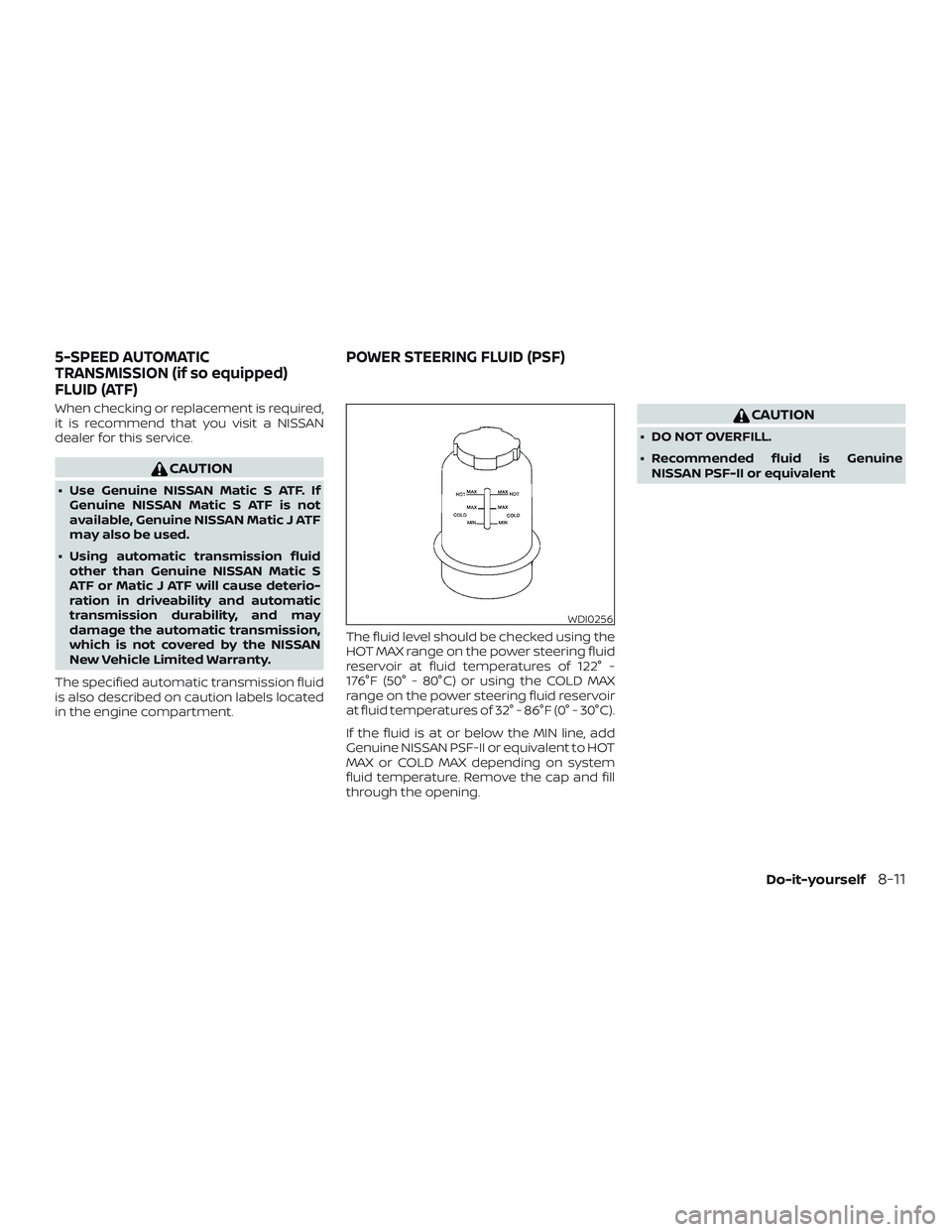
in the engine compartment. The fluid level should be checked using the
HOT MAX range on the power steering fluid
reservoir at fluid temperatures of 122° -
176°F (50° - 80°C) or using the COLD MAX
range on the power steering fluid reservoir
at fluid temperatures of 32° - 86°F (0° - 30°C).
If the fluid is at or below the MIN line, add
Genuine NISSAN PSF-II or equivalent to HOT
MAX or COLD MAX depending on system
fluid temperature. Remove the cap and fill
through the opening.
CAUTION
∙ DO NOT OVERFILL.
∙ Recommended fluid is Genuine
NISSAN PSF-II or equivalent
WDI0256
5-SPEED AUTOMATIC
TRANSMISSION (if so equipped)
FLUID (ATF) POWER STEERING FLUID (PSF)
Do-it-yourself8-11