ECU NISSAN FRONTIER 2018 Owner´s Manual
[x] Cancel search | Manufacturer: NISSAN, Model Year: 2018, Model line: FRONTIER, Model: NISSAN FRONTIER 2018Pages: 502, PDF Size: 4.85 MB
Page 91 of 502
10. Check to make sure that the child re-straint is properly secured prior to each
use. If the seat belt is not locked, repeat
steps 3 through 9.
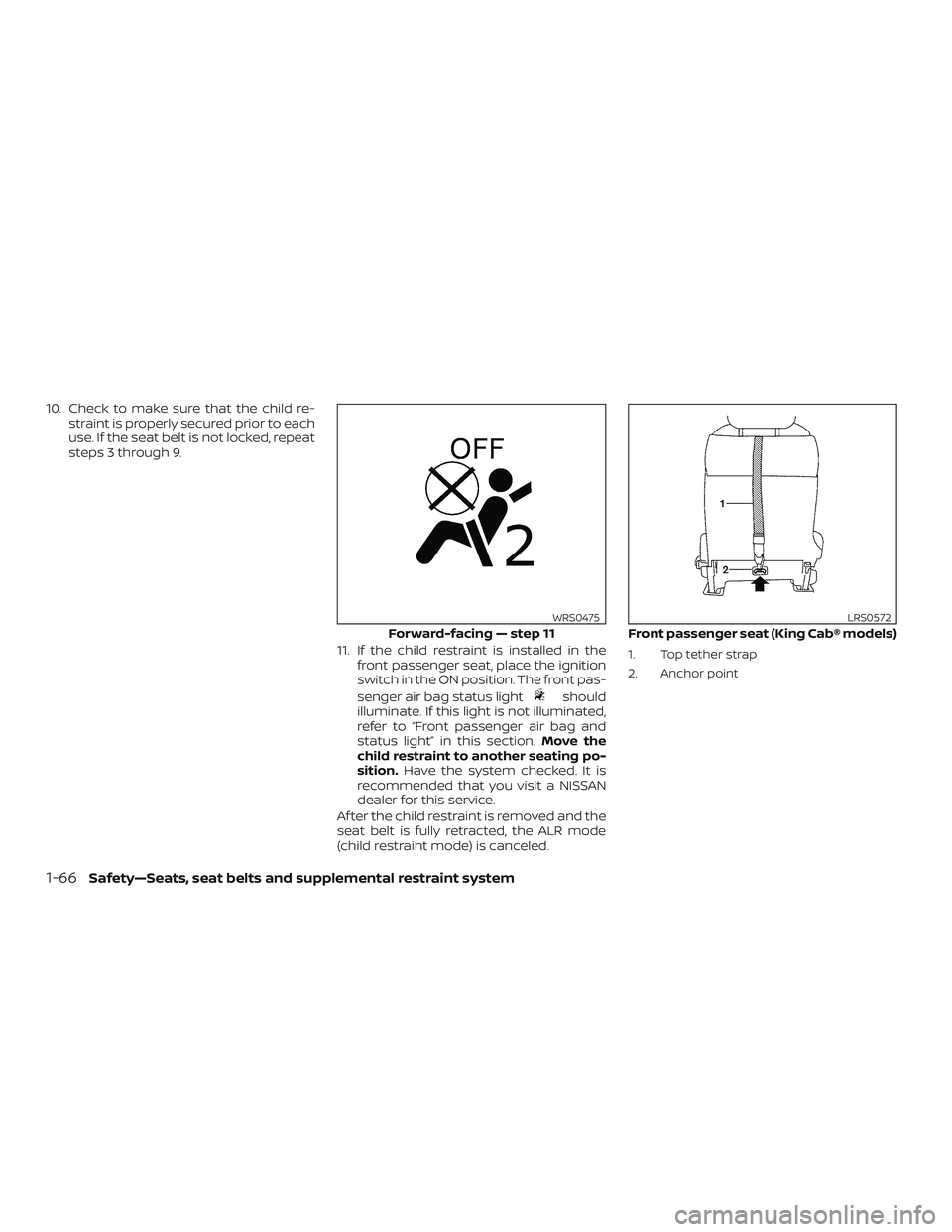
11. If the child restraint is installed in thefront passenger seat, place the ignition
switch in the ON position. The front pas-
senger air bag status light
should
illuminate. If this light is not illuminated,
refer to “Front passenger air bag and
status light” in this section. Move the
child restraint to another seating po-
sition. Have the system checked. It is
recommended that you visit a NISSAN
dealer for this service.
Af ter the child restraint is removed and the
seat belt is fully retracted, the ALR mode
(child restraint mode) is canceled.
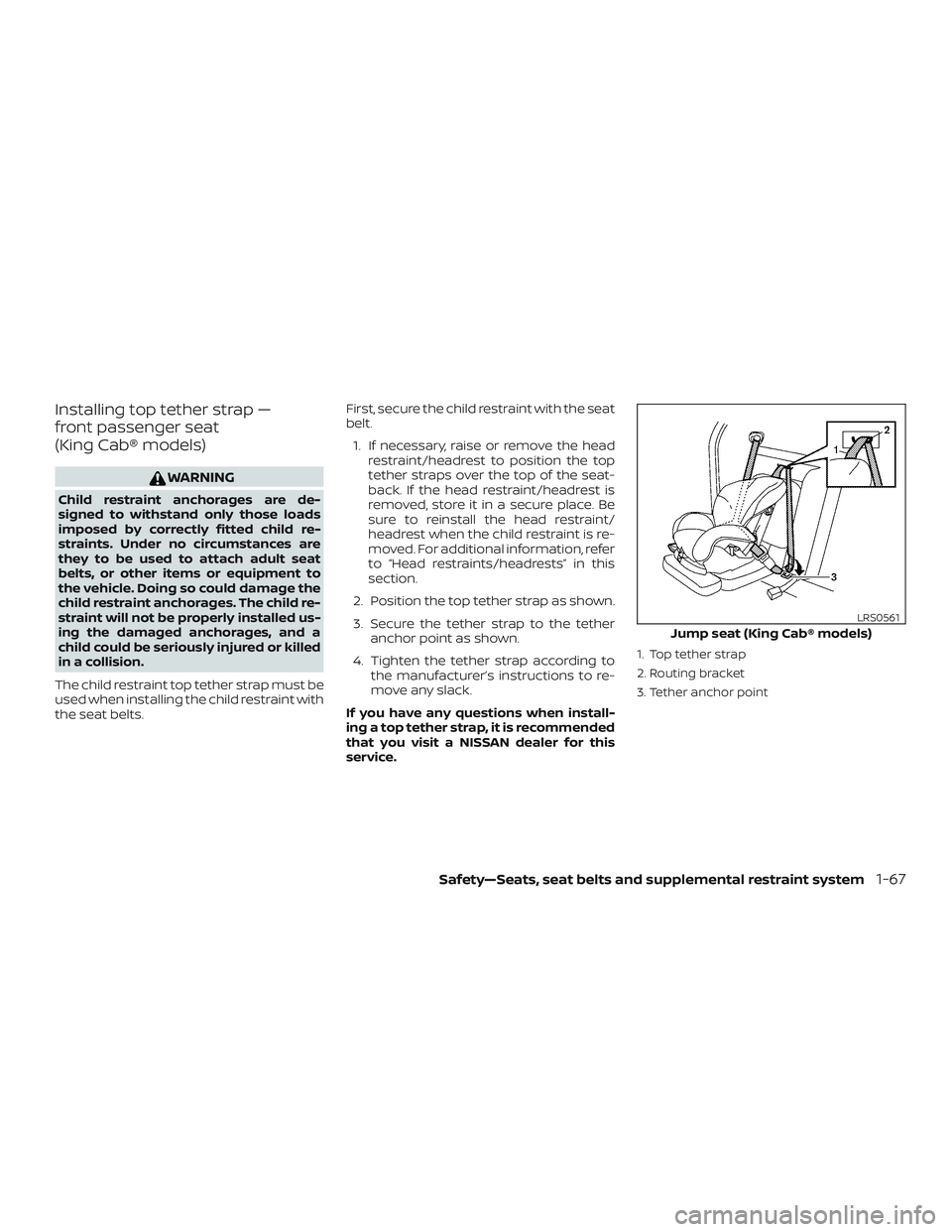
1. Top tether strap
2. Anchor point
Forward-facing — step 11
WRS0475
Front passenger seat (King Cab® models)
LRS0572
1-66Safety—Seats, seat belts and supplemental restraint system
Page 92 of 502
Installing top tether strap —
front passenger seat
(King Cab® models)
WARNING
Child restraint anchorages are de-
signed to withstand only those loads
imposed by correctly fitted child re-
straints. Under no circumstances are
they to be used to attach adult seat
belts, or other items or equipment to
the vehicle. Doing so could damage the
child restraint anchorages. The child re-
straint will not be properly installed us-
ing the damaged anchorages, and a
child could be seriously injured or killed
in a collision.
The child restraint top tether strap must be
used when installing the child restraint with
the seat belts. First, secure the child restraint with the seat
belt.
1. If necessary, raise or remove the head restraint/headrest to position the top
tether straps over the top of the seat-
back. If the head restraint/headrest is
removed, store it in a secure place. Be
sure to reinstall the head restraint/
headrest when the child restraint is re-
moved. For additional information, refer
to “Head restraints/headrests” in this
section.
2. Position the top tether strap as shown.
3. Secure the tether strap to the tether anchor point as shown.
4. Tighten the tether strap according to the manufacturer’s instructions to re-
move any slack.
If you have any questions when install-
ing a top tether strap, it is recommended
that you visit a NISSAN dealer for this
service.
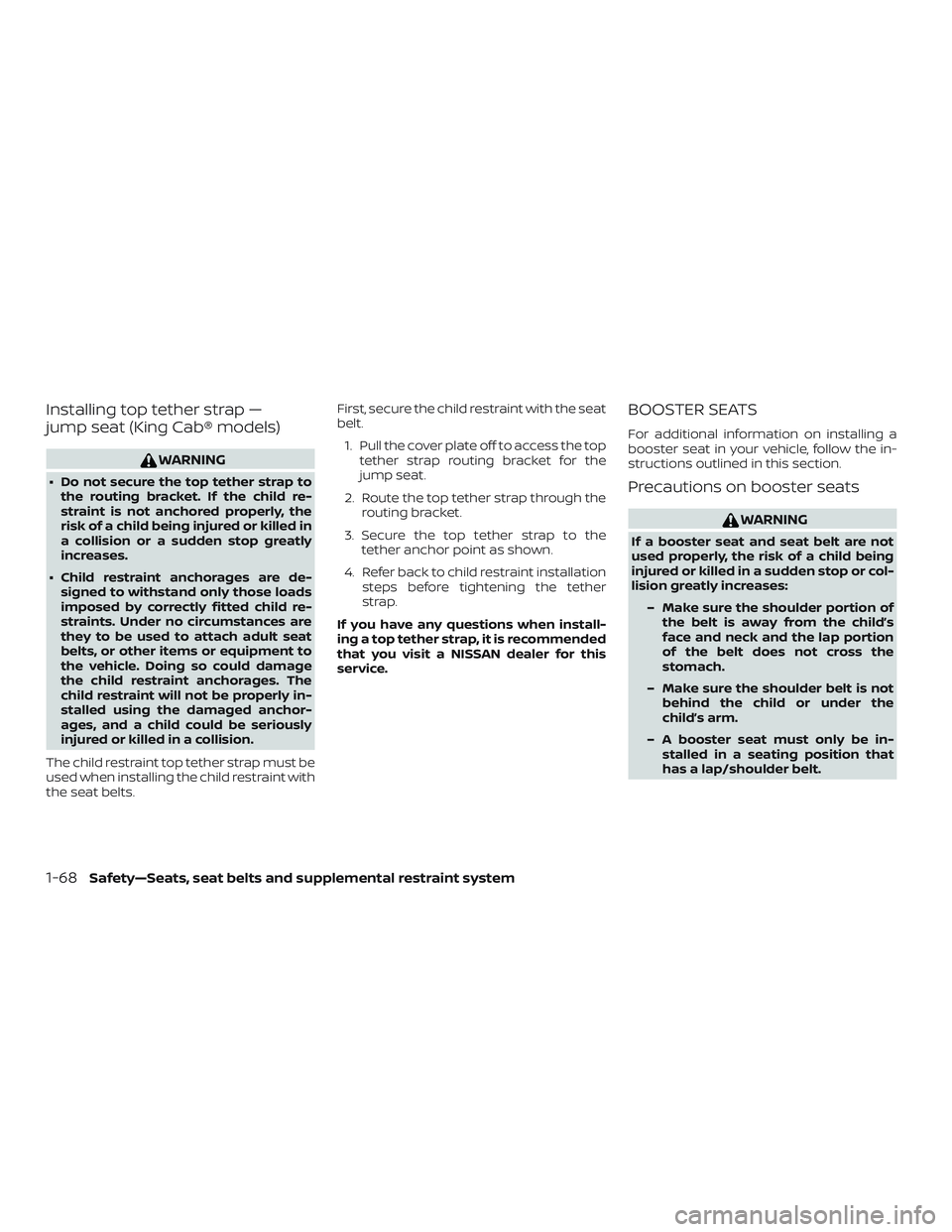
1. Top tether strap
2. Routing bracket
3. Tether anchor point
Jump seat (King Cab® models)
LRS0561
Safety—Seats, seat belts and supplemental restraint system1-67
Page 93 of 502
Installing top tether strap —
jump seat (King Cab® models)
WARNING
∙ Do not secure the top tether strap tothe routing bracket. If the child re-
straint is not anchored properly, the
risk of a child being injured or killed in
a collision or a sudden stop greatly
increases.
∙ Child restraint anchorages are de- signed to withstand only those loads
imposed by correctly fitted child re-
straints. Under no circumstances are
they to be used to attach adult seat
belts, or other items or equipment to
the vehicle. Doing so could damage
the child restraint anchorages. The
child restraint will not be properly in-
stalled using the damaged anchor-
ages, and a child could be seriously
injured or killed in a collision.
The child restraint top tether strap must be
used when installing the child restraint with
the seat belts. First, secure the child restraint with the seat
belt.
1. Pull the cover plate off to access the top tether strap routing bracket for the
jump seat.
2. Route the top tether strap through the routing bracket.
3. Secure the top tether strap to the tether anchor point as shown.
4. Refer back to child restraint installation steps before tightening the tether
strap.
If you have any questions when install-
ing a top tether strap, it is recommended
that you visit a NISSAN dealer for this
service.
BOOSTER SEATS
For additional information on installing a
booster seat in your vehicle, follow the in-
structions outlined in this section.
Precautions on booster seats
WARNING
If a booster seat and seat belt are not
used properly, the risk of a child being
injured or killed in a sudden stop or col-
lision greatly increases: – Make sure the shoulder portion ofthe belt is away from the child’s
face and neck and the lap portion
of the belt does not cross the
stomach.
– Make sure the shoulder belt is not behind the child or under the
child’s arm.
– A booster seat must only be in- stalled in a seating position that
has a lap/shoulder belt.
1-68Safety—Seats, seat belts and supplemental restraint system
Page 96 of 502
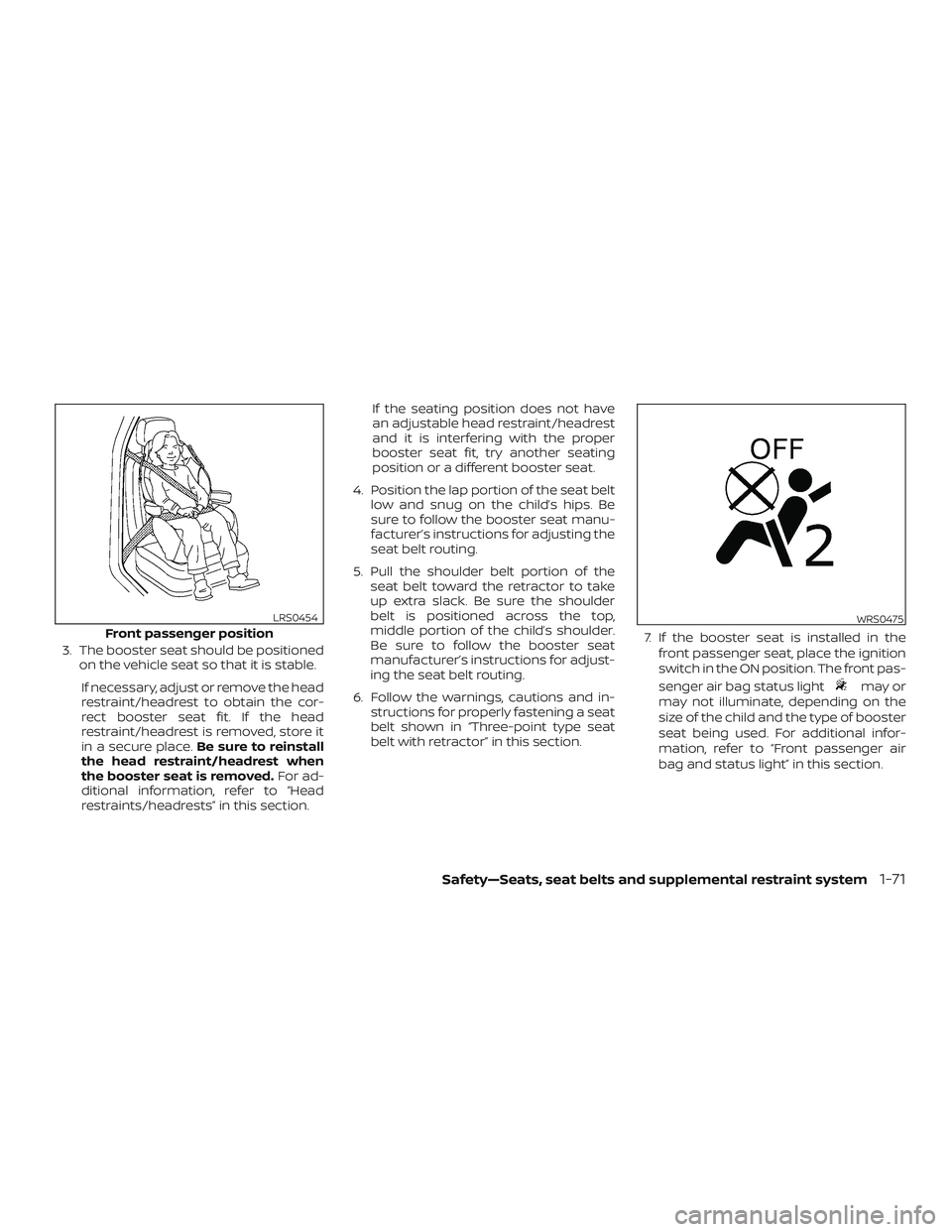
3. The booster seat should be positionedon the vehicle seat so that it is stable.
If necessary, adjust or remove the head
restraint/headrest to obtain the cor-
rect booster seat fit. If the head
restraint/headrest is removed, store it
in a secure place. Be sure to reinstall
the head restraint/headrest when
the booster seat is removed. For ad-
ditional information, refer to “Head
restraints/headrests” in this section. If the seating position does not have
an adjustable head restraint/headrest
and it is interfering with the proper
booster seat fit, try another seating
position or a different booster seat.
4. Position the lap portion of the seat belt low and snug on the child’s hips. Be
sure to follow the booster seat manu-
facturer’s instructions for adjusting the
seat belt routing.
5. Pull the shoulder belt portion of the seat belt toward the retractor to take
up extra slack. Be sure the shoulder
belt is positioned across the top,
middle portion of the child’s shoulder.
Be sure to follow the booster seat
manufacturer’s instructions for adjust-
ing the seat belt routing.
6. Follow the warnings, cautions and in- structions for properly fastening a seat
belt shown in “Three-point type seat
belt with retractor” in this section. 7. If the booster seat is installed in the
front passenger seat, place the ignition
switch in the ON position. The front pas-
senger air bag status light
may or
may not illuminate, depending on the
size of the child and the type of booster
seat being used. For additional infor-
mation, refer to “Front passenger air
bag and status light” in this section.
Front passenger position
LRS0454WRS0475
Safety—Seats, seat belts and supplemental restraint system1-71
Page 98 of 502
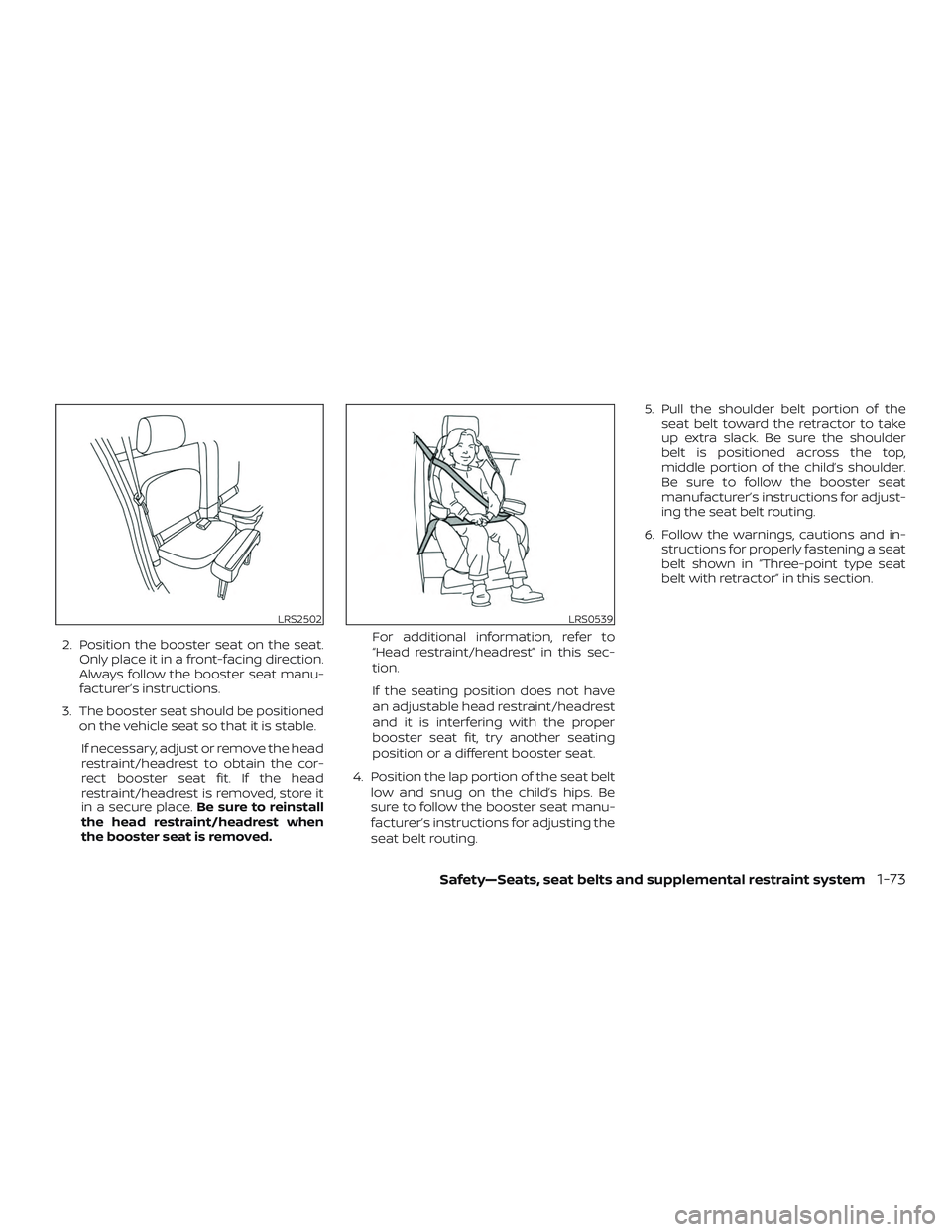
2. Position the booster seat on the seat.Only place it in a front-facing direction.
Always follow the booster seat manu-
facturer’s instructions.
3. The booster seat should be positioned on the vehicle seat so that it is stable.
If necessary, adjust or remove the head
restraint/headrest to obtain the cor-
rect booster seat fit. If the head
restraint/headrest is removed, store it
in a secure place. Be sure to reinstall
the head restraint/headrest when
the booster seat is removed. For additional information, refer to
“Head restraint/headrest” in this sec-
tion.
If the seating position does not have
an adjustable head restraint/headrest
and it is interfering with the proper
booster seat fit, try another seating
position or a different booster seat.
4. Position the lap portion of the seat belt low and snug on the child’s hips. Be
sure to follow the booster seat manu-
facturer’s instructions for adjusting the
seat belt routing. 5. Pull the shoulder belt portion of the
seat belt toward the retractor to take
up extra slack. Be sure the shoulder
belt is positioned across the top,
middle portion of the child’s shoulder.
Be sure to follow the booster seat
manufacturer’s instructions for adjust-
ing the seat belt routing.
6. Follow the warnings, cautions and in- structions for properly fastening a seat
belt shown in “Three-point type seat
belt with retractor” in this section.
LRS2502LRS0539
Safety—Seats, seat belts and supplemental restraint system1-73
Page 109 of 502
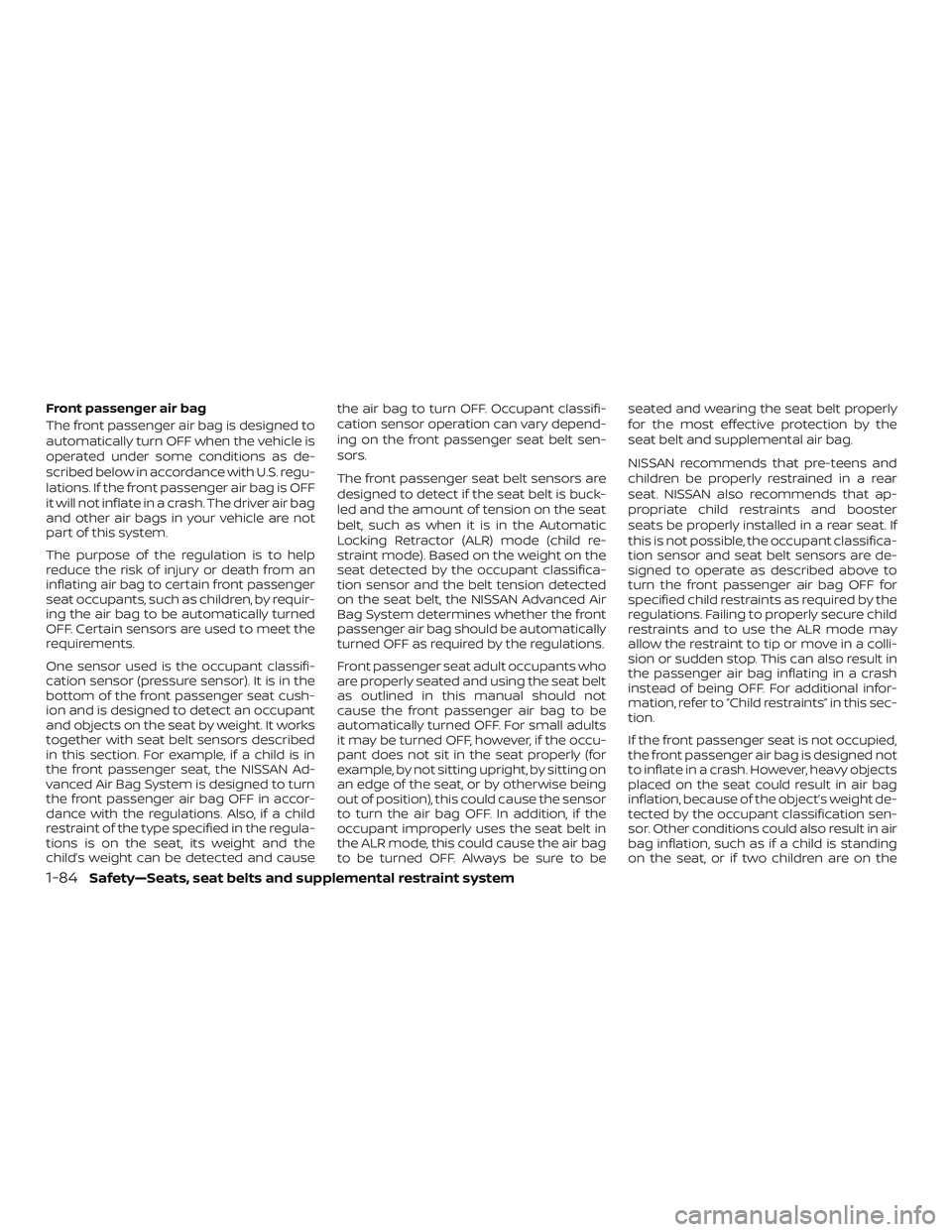
Front passenger air bag
The front passenger air bag is designed to
automatically turn OFF when the vehicle is
operated under some conditions as de-
scribed below in accordance with U.S. regu-
lations. If the front passenger air bag is OFF
it will not inflate in a crash. The driver air bag
and other air bags in your vehicle are not
part of this system.
The purpose of the regulation is to help
reduce the risk of injury or death from an
inflating air bag to certain front passenger
seat occupants, such as children, by requir-
ing the air bag to be automatically turned
OFF. Certain sensors are used to meet the
requirements.
One sensor used is the occupant classifi-
cation sensor (pressure sensor). It is in the
bottom of the front passenger seat cush-
ion and is designed to detect an occupant
and objects on the seat by weight. It works
together with seat belt sensors described
in this section. For example, if a child is in
the front passenger seat, the NISSAN Ad-
vanced Air Bag System is designed to turn
the front passenger air bag OFF in accor-
dance with the regulations. Also, if a child
restraint of the type specified in the regula-
tions is on the seat, its weight and the
child’s weight can be detected and causethe air bag to turn OFF. Occupant classifi-
cation sensor operation can vary depend-
ing on the front passenger seat belt sen-
sors.
The front passenger seat belt sensors are
designed to detect if the seat belt is buck-
led and the amount of tension on the seat
belt, such as when it is in the Automatic
Locking Retractor (ALR) mode (child re-
straint mode). Based on the weight on the
seat detected by the occupant classifica-
tion sensor and the belt tension detected
on the seat belt, the NISSAN Advanced Air
Bag System determines whether the front
passenger air bag should be automatically
turned OFF as required by the regulations.
Front passenger seat adult occupants who
are properly seated and using the seat belt
as outlined in this manual should not
cause the front passenger air bag to be
automatically turned OFF. For small adults
it may be turned OFF, however, if the occu-
pant does not sit in the seat properly (for
example, by not sitting upright, by sitting on
an edge of the seat, or by otherwise being
out of position), this could cause the sensor
to turn the air bag OFF. In addition, if the
occupant improperly uses the seat belt in
the ALR mode, this could cause the air bag
to be turned OFF. Always be sure to beseated and wearing the seat belt properly
for the most effective protection by the
seat belt and supplemental air bag.
NISSAN recommends that pre-teens and
children be properly restrained in a rear
seat. NISSAN also recommends that ap-
propriate child restraints and booster
seats be properly installed in a rear seat. If
this is not possible, the occupant classifica-
tion sensor and seat belt sensors are de-
signed to operate as described above to
turn the front passenger air bag OFF for
specified child restraints as required by the
regulations. Failing to properly secure child
restraints and to use the ALR mode may
allow the restraint to tip or move in a colli-
sion or sudden stop. This can also result in
the passenger air bag inflating in a crash
instead of being OFF. For additional infor-
mation, refer to “Child restraints” in this sec-
tion.
If the front passenger seat is not occupied,
the front passenger air bag is designed not
to inflate in a crash. However, heavy objects
placed on the seat could result in air bag
inflation, because of the object’s weight de-
tected by the occupant classification sen-
sor. Other conditions could also result in air
bag inflation, such as if a child is standing
on the seat, or if two children are on the
1-84Safety—Seats, seat belts and supplemental restraint system
Page 117 of 502
2 Instruments and controls
Instrument panel................................2-2
Meters and gauges ..............................2-3
Speedometer and odometer .................2-4
Tachometer ..................................2-6
Engine coolant temperature gauge ..........2-6
Fuel gauge ................................... 2-7
Engine oil pressure gauge (if so
equipped) ....................................2-8
Voltmeter (if so equipped) ....................2-8
Trip computer (if so equipped) ................2-9
Compass and outside temperature display
(if so equipped) ................................. 2-10
Outside temperature display .................2-11
Compass ..................................... 2-11
Warning lights, indicator lights and audible
reminders ...................................... 2-14
Checking lights .............................. 2-15
Warning lights ............................... 2-15
Indicator lights .............................. 2-20
Audible reminders ........................... 2-24
Security systems (if so equipped) ...............2-25
Vehicle security system (if so equipped) .....2-25
NISSAN Vehicle Immobilizer System
(if so equipped) .............................. 2-26Wiper and washer switch
.......................2-28
Switch operation ............................ 2-28
Rear window or outside mirror defroster
switch (if so equipped) .......................... 2-28
Headlight and turn signal switch ...............2-29
Headlight control switch .....................2-29
Daytime Running Light (DRL) system
(if so equipped) .............................. 2-32
Instrument brightness control ...............2-32
Turn signal switch ........................... 2-32
Fog light switch (if so equipped) .............2-33
Horn ........................................... 2-33
Cargo lamp switch ............................. 2-34
Heated seat switches (if so equipped) ..........2-34
Vehicle Dynamic Control (VDC) OFF switch ......2-35
Hill descent control switch (if so equipped) ......2-36
Electronic locking rear differential (E-Lock)
system switch (if so equipped) ..................2-37
Clutch
interlock (clutch start) switch
(if so equipped) ................................. 2-38
Rear Sonar System (RSS) OFF switch
(if so equipped) ................................. 2-39
Power outlets .................................. 2-39
Storage ........................................ 2-40
Page 131 of 502
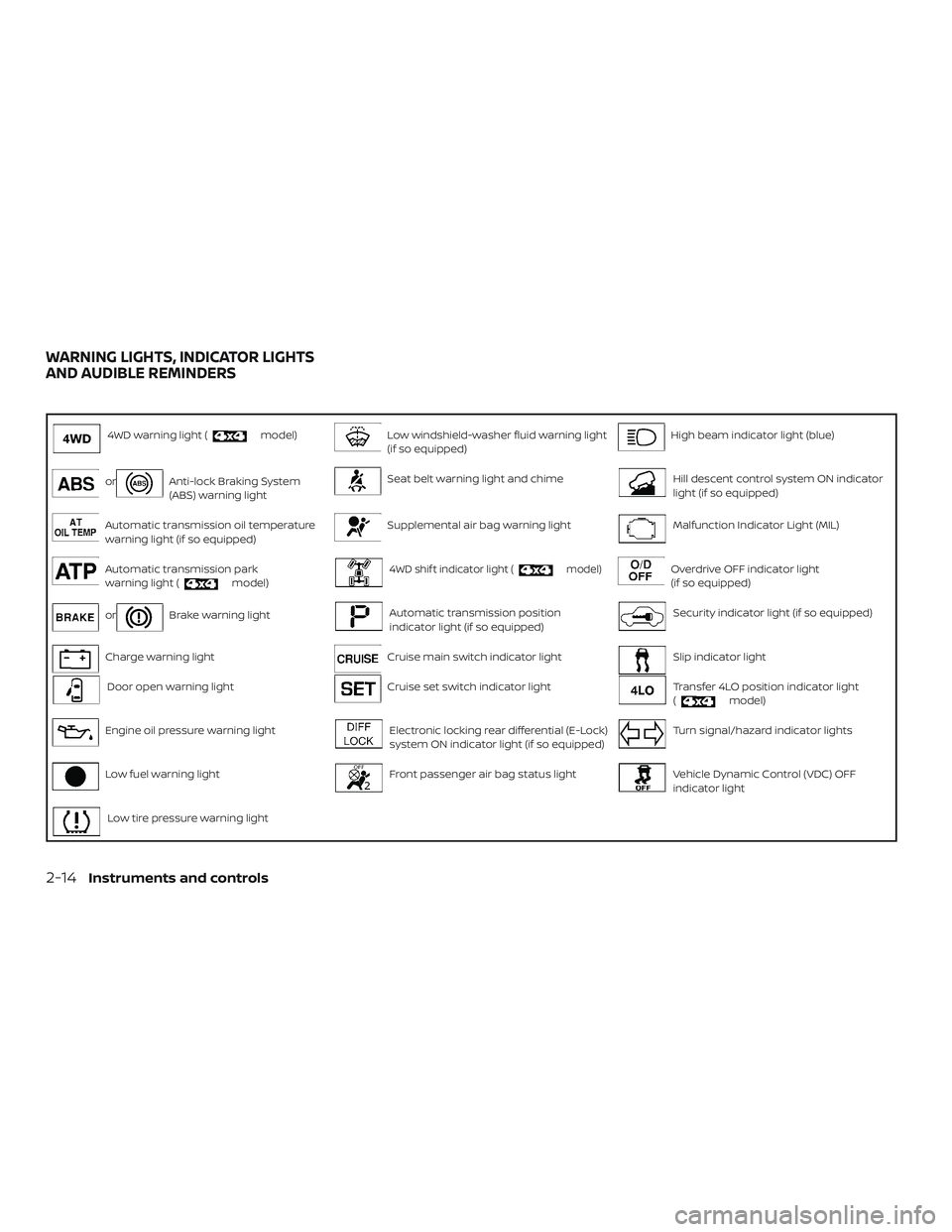
4WD warning light (model)Low windshield-washer fluid warning light
(if so equipped)High beam indicator light (blue)
orAnti-lock Braking System
(ABS) warning lightSeat belt warning light and chimeHill descent control system ON indicator
light (if so equipped)
Automatic transmission oil temperature
warning light (if so equipped)Supplemental air bag warning lightMalfunction Indicator Light (MIL)
Automatic transmission park
warning light (model)4WD shif t indicator light (model)Overdrive OFF indicator light
(if so equipped)
orBrake warning lightAutomatic transmission position
indicator light (if so equipped)Security indicator light (if so equipped)
Charge warning lightCruise main switch indicator lightSlip indicator light
Door open warning lightCruise set switch indicator lightTransfer 4LO position indicator light
(model)
Engine oil pressure warning lightElectronic locking rear differential (E-Lock)
system ON indicator light (if so equipped)Turn signal/hazard indicator lights
Low fuel warning lightFront passenger air bag status lightVehicle Dynamic Control (VDC) OFF
indicator light
Low tire pressure warning light
WARNING LIGHTS, INDICATOR LIGHTS
AND AUDIBLE REMINDERS
2-14Instruments and controls
Page 133 of 502
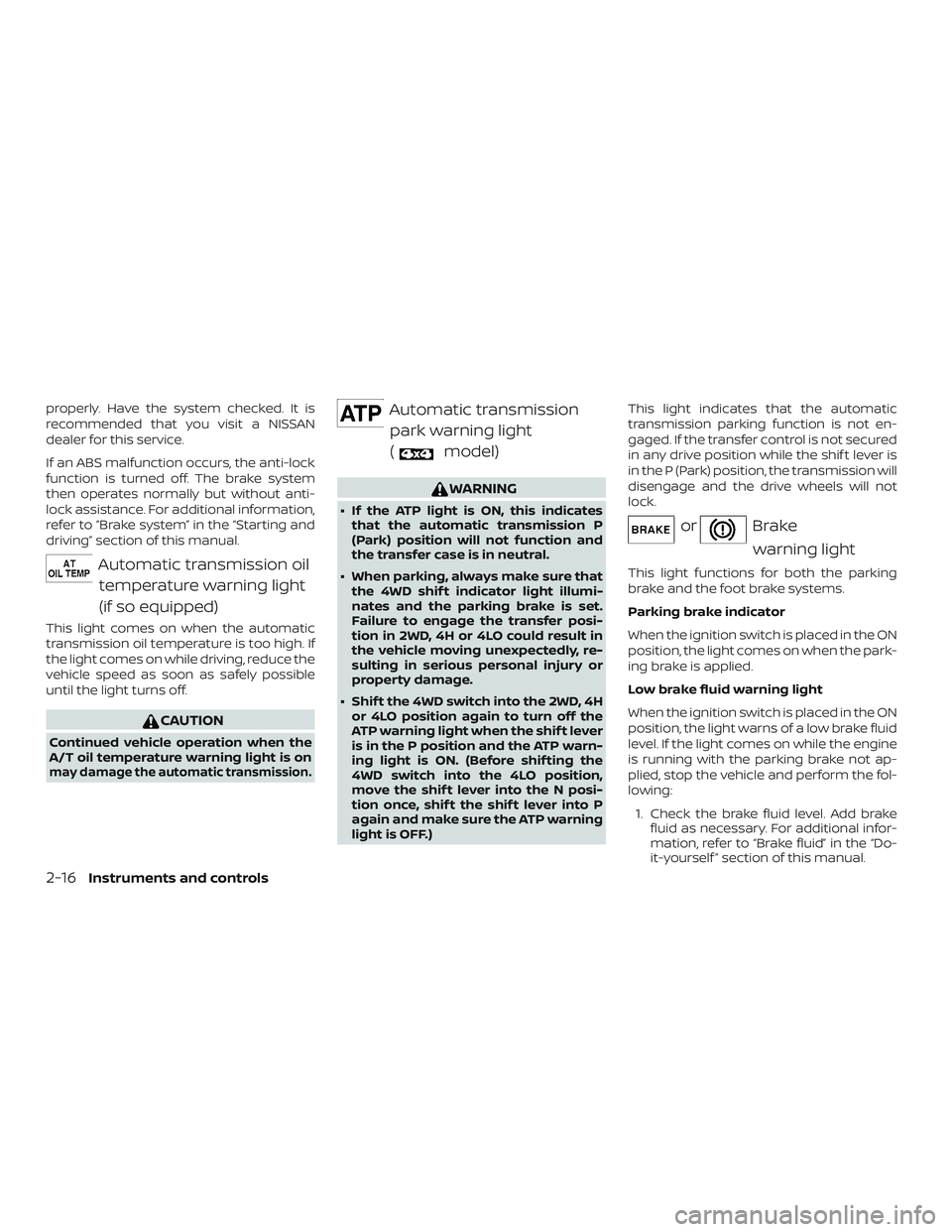
properly. Have the system checked. It is
recommended that you visit a NISSAN
dealer for this service.
If an ABS malfunction occurs, the anti-lock
function is turned off. The brake system
then operates normally but without anti-
lock assistance. For additional information,
refer to “Brake system” in the “Starting and
driving” section of this manual.
Automatic transmission oiltemperature warning light
(if so equipped)
This light comes on when the automatic
transmission oil temperature is too high. If
the light comes on while driving, reduce the
vehicle speed as soon as safely possible
until the light turns off.
CAUTION
Continued vehicle operation when the
A/T oil temperature warning light is on
may damage the automatic transmission.
Automatic transmissionpark warning light
(
model)
WARNING
∙ If the ATP light is ON, this indicates that the automatic transmission P
(Park) position will not function and
the transfer case is in neutral.
∙ When parking, always make sure that the 4WD shif t indicator light illumi-
nates and the parking brake is set.
Failure to engage the transfer posi-
tion in 2WD, 4H or 4LO could result in
the vehicle moving unexpectedly, re-
sulting in serious personal injury or
property damage.
∙ Shif t the 4WD switch into the 2WD, 4H or 4LO position again to turn off the
ATP warning light when the shif t lever
is in the P position and the ATP warn-
ing light is ON. (Before shif ting the
4WD switch into the 4LO position,
move the shif t lever into the N posi-
tion once, shif t the shif t lever into P
again and make sure the ATP warning
light is OFF.) This light indicates that the automatic
transmission parking function is not en-
gaged. If the transfer control is not secured
in any drive position while the shif t lever is
in the P (Park) position, the transmission will
disengage and the drive wheels will not
lock.
orBrake
warning light
This light functions for both the parking
brake and the foot brake systems.
Parking brake indicator
When the ignition switch is placed in the ON
position, the light comes on when the park-
ing brake is applied.
Low brake fluid warning light
When the ignition switch is placed in the ON
position, the light warns of a low brake fluid
level. If the light comes on while the engine
is running with the parking brake not ap-
plied, stop the vehicle and perform the fol-
lowing:
1. Check the brake fluid level. Add brake fluid as necessary. For additional infor-
mation, refer to “Brake fluid” in the “Do-
it-yourself ” section of this manual.
2-16Instruments and controls
Page 134 of 502
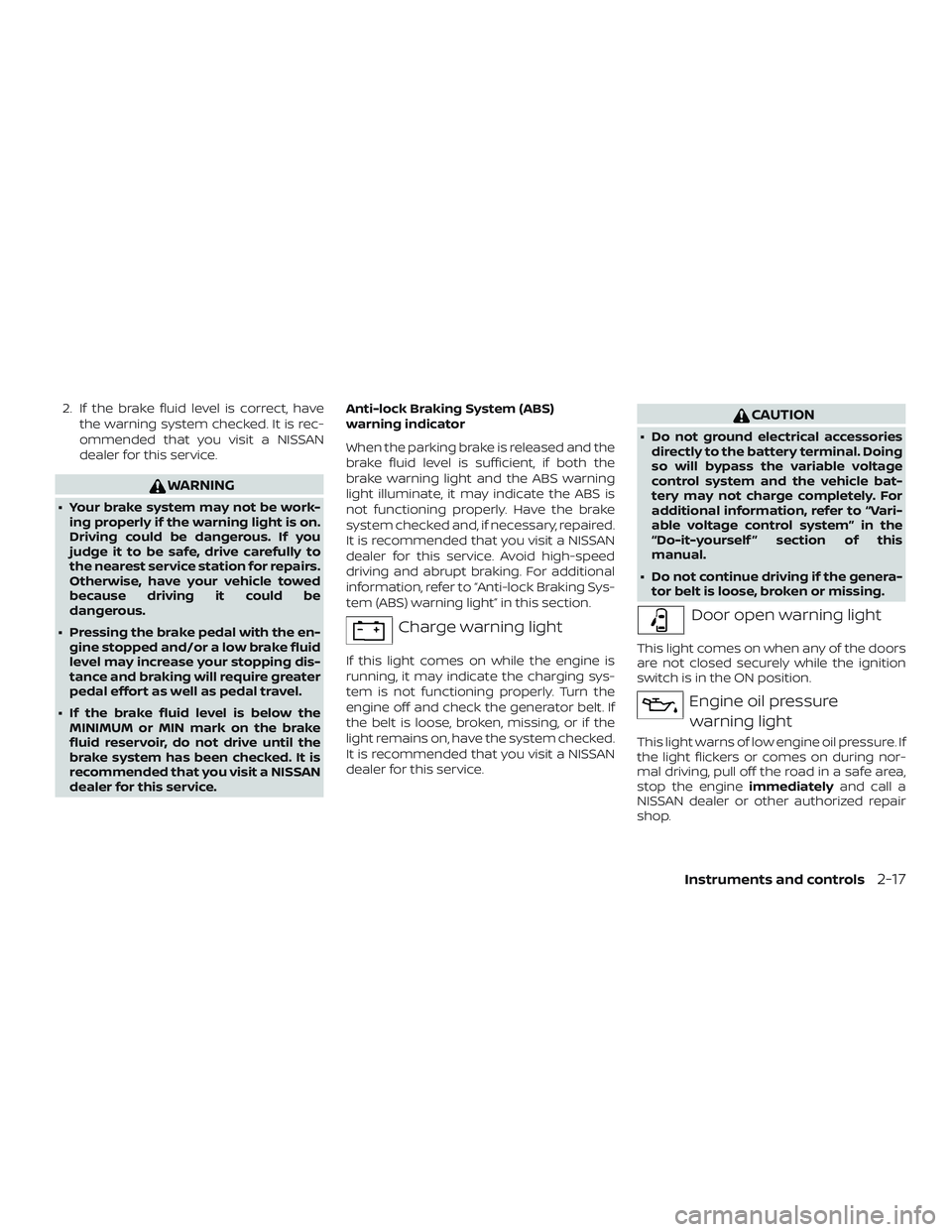
2. If the brake fluid level is correct, havethe warning system checked. It is rec-
ommended that you visit a NISSAN
dealer for this service.
WARNING
∙ Your brake system may not be work-ing properly if the warning light is on.
Driving could be dangerous. If you
judge it to be safe, drive carefully to
the nearest service station for repairs.
Otherwise, have your vehicle towed
because driving it could be
dangerous.
∙ Pressing the brake pedal with the en- gine stopped and/or a low brake fluid
level may increase your stopping dis-
tance and braking will require greater
pedal effort as well as pedal travel.
∙ If the brake fluid level is below the MINIMUM or MIN mark on the brake
fluid reservoir, do not drive until the
brake system has been checked. It is
recommended that you visit a NISSAN
dealer for this service. Anti-lock Braking System (ABS)
warning indicator
When the parking brake is released and the
brake fluid level is sufficient, if both the
brake warning light and the ABS warning
light illuminate, it may indicate the ABS is
not functioning properly. Have the brake
system checked and, if necessary, repaired.
It is recommended that you visit a NISSAN
dealer for this service. Avoid high-speed
driving and abrupt braking. For additional
information, refer to “Anti-lock Braking Sys-
tem (ABS) warning light” in this section.
Charge warning light
If this light comes on while the engine is
running, it may indicate the charging sys-
tem is not functioning properly. Turn the
engine off and check the generator belt. If
the belt is loose, broken, missing, or if the
light remains on, have the system checked.
It is recommended that you visit a NISSAN
dealer for this service.
CAUTION
∙ Do not ground electrical accessories
directly to the battery terminal. Doing
so will bypass the variable voltage
control system and the vehicle bat-
tery may not charge completely. For
additional information, refer to “Vari-
able voltage control system” in the
“Do-it-yourself ” section of this
manual.
∙ Do not continue driving if the genera- tor belt is loose, broken or missing.
Door open warning light
This light comes on when any of the doors
are not closed securely while the ignition
switch is in the ON position.
Engine oil pressure
warning light
This light warns of low engine oil pressure. If
the light flickers or comes on during nor-
mal driving, pull off the road in a safe area,
stop the engine immediatelyand call a
NISSAN dealer or other authorized repair
shop.
Instruments and controls2-17