air condition NISSAN FRONTIER 2018 Owner´s Manual
[x] Cancel search | Manufacturer: NISSAN, Model Year: 2018, Model line: FRONTIER, Model: NISSAN FRONTIER 2018Pages: 502, PDF Size: 4.85 MB
Page 443 of 502
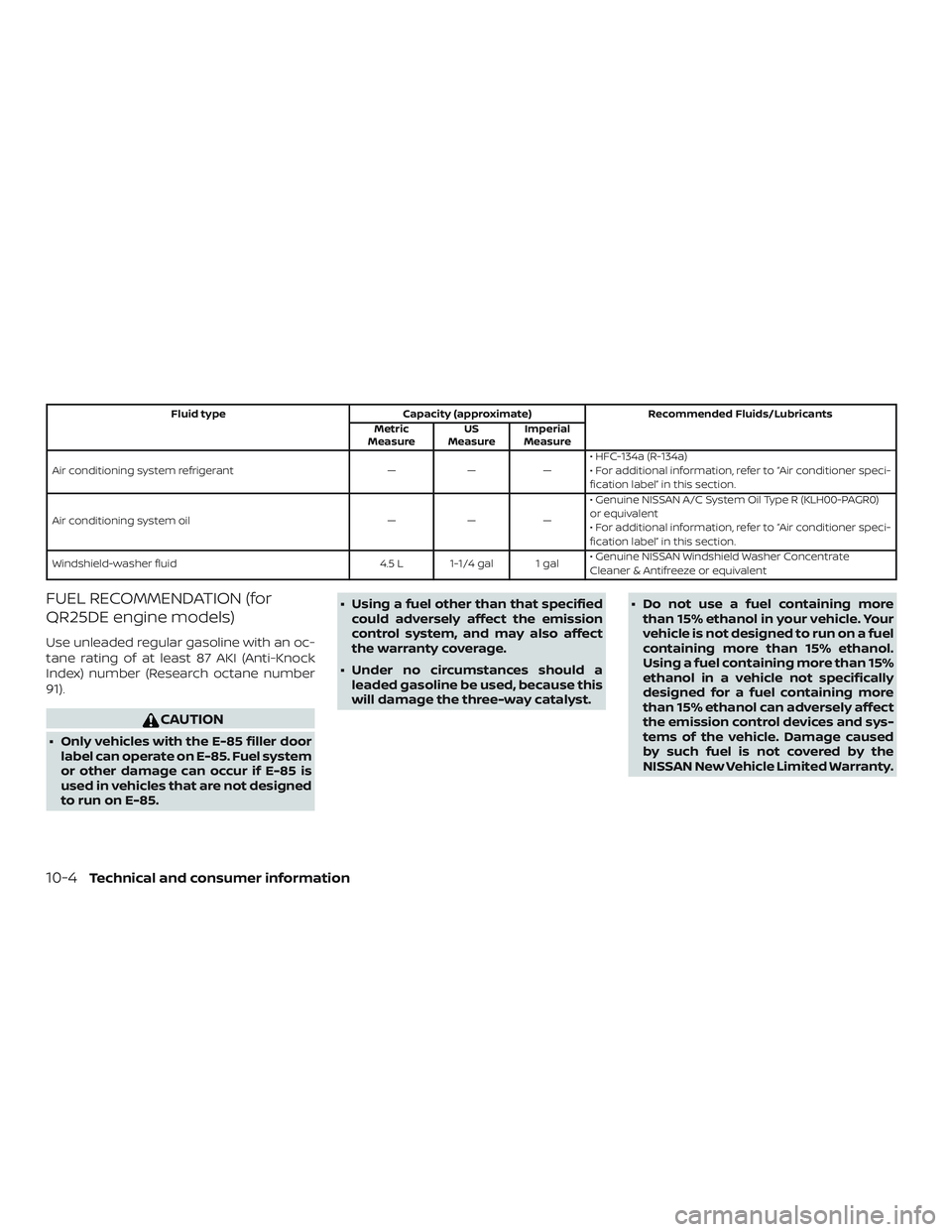
Fluid typeCapacity (approximate) Recommended Fluids/Lubricants
Metric
Measure US
Measure Imperial
Measure
Air conditioning system refrigerant ———• HFC-134a (R-134a)
• For additional information, refer to “Air conditioner speci-
fication label” in this section.
Air conditioning system oil ———• Genuine NISSAN A/C System Oil Type R (KLH00-PAGR0)
or equivalent
• For additional information, refer to “Air conditioner speci-
fication label” in this section.
Windshield-washer fluid 4.5 L 1-1/4 gal 1 gal• Genuine NISSAN Windshield Washer Concentrate
Cleaner & Antifreeze or equivalent
FUEL RECOMMENDATION (for
QR25DE engine models)
Use unleaded regular gasoline with an oc-
tane rating of at least 87 AKI (Anti-Knock
Index) number (Research octane number
91).
CAUTION
∙ Only vehicles with the E-85 filler door
label can operate on E-85. Fuel system
or other damage can occur if E-85 is
used in vehicles that are not designed
to run on E-85. ∙ Using a fuel other than that specified
could adversely affect the emission
control system, and may also affect
the warranty coverage.
∙ Under no circumstances should a leaded gasoline be used, because this
will damage the three-way catalyst. ∙ Do not use a fuel containing more
than 15% ethanol in your vehicle. Your
vehicle is not designed to run on a fuel
containing more than 15% ethanol.
Using a fuel containing more than 15%
ethanol in a vehicle not specifically
designed for a fuel containing more
than 15% ethanol can adversely affect
the emission control devices and sys-
tems of the vehicle. Damage caused
by such fuel is not covered by the
NISSAN New Vehicle Limited Warranty.
10-4Technical and consumer information
Page 451 of 502
Change intervals
The oil and oil filter change intervals for
your engine are based on the use of the
specified quality oils and filters. Using en-
gine oil and filters that are not of the speci-
fied quality, or exceeding recommended oil
and filter change intervals could reduce
engine life. Damage to the engine caused
by improper maintenance or use of incor-
rect oil and filter quality and/or viscosity is
not covered by the NISSAN New Vehicle
Limited Warranty.
Your engine was filled with a high-quality
engine oil when it was built. You do not have
to change the oil before the first recom-
mended change interval. Oil and filter
change intervals depend upon how you
use your vehicle.
Operation under the following conditions
may require more frequent oil and filter
changes:∙ repeated short distance driving at cold outside temperatures
∙ driving in dusty conditions
∙ extensive idling
∙ towing a trailer
∙ stop and go commuting For additional information, refer to the
“Maintenance and schedules” section of
this manual.
AIR CONDITIONER SYSTEM
REFRIGERANT AND OIL
RECOMMENDATIONS
The air conditioner system in your
NISSAN vehicle must be charged with the
refrigerant HFC-134a (R-134a) and
NISSAN A/C system oil Type R (KLH00-
PAGRO) or the exact equivalents.
CAUTION
The use of any other refrigerant or oil
will cause severe damage to the air con-
ditioning system and will require the re-
placement of all air conditioner system
components.
The refrigerant HFC-134a (R-134a) in your
NISSAN vehicle does not harm the earth’s
ozone layer. Although this refrigerant does
not affect the earth’s atmosphere, certain
government regulations require the recov-
ery and recycling of any refrigerant during
automotive air conditioner system service.
A NISSAN dealer has the trained techni-
cians and equipment needed to recover
and recycle your air conditioner system re-
frigerant.
It is recommended that you visit a NISSAN
dealer when servicing your air conditioner
system.
10-12Technical and consumer information
Page 458 of 502
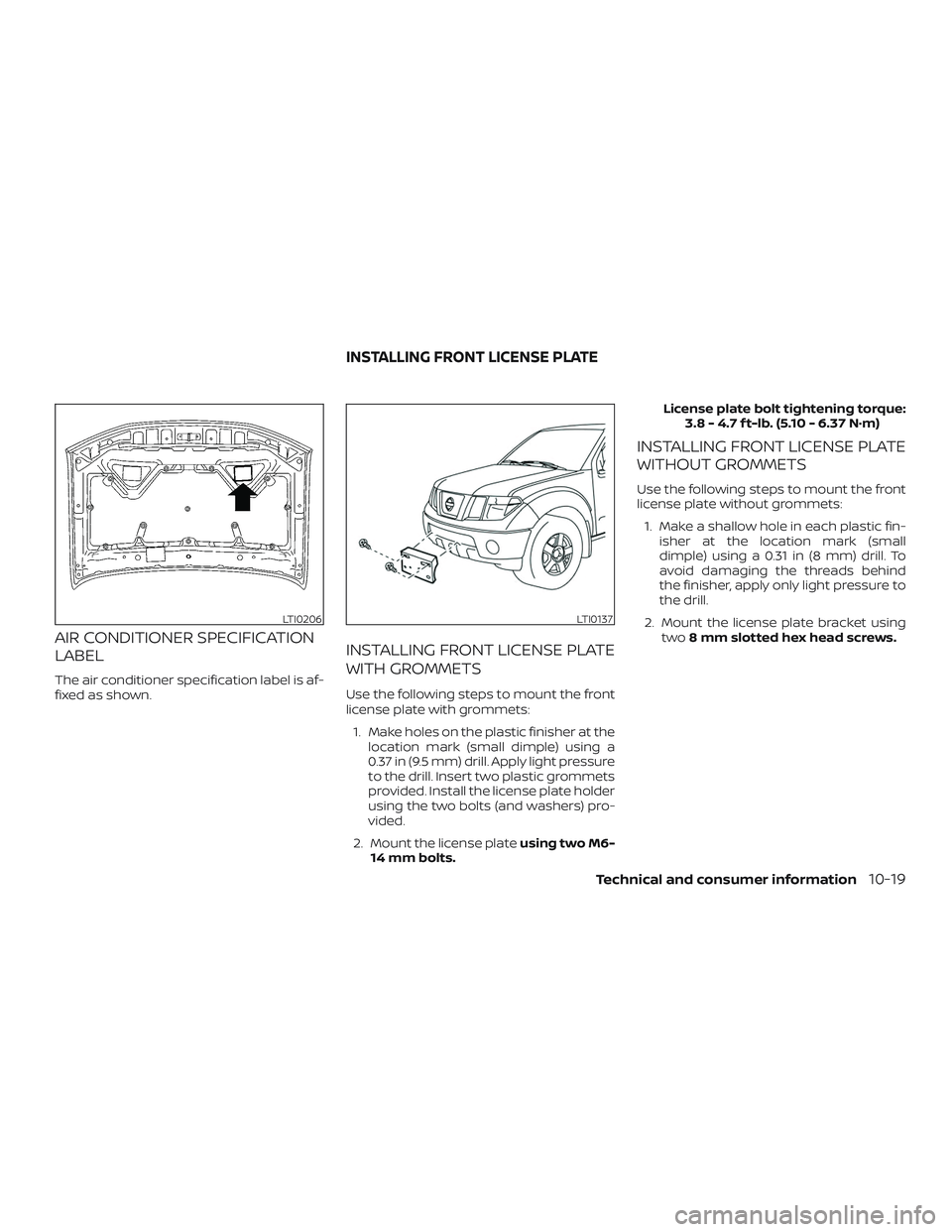
AIR CONDITIONER SPECIFICATION
LABEL
The air conditioner specification label is af-
fixed as shown.
INSTALLING FRONT LICENSE PLATE
WITH GROMMETS
Use the following steps to mount the front
license plate with grommets:1. Make holes on the plastic finisher at the location mark (small dimple) using a
0.37 in (9.5 mm) drill. Apply light pressure
to the drill. Insert two plastic grommets
provided. Install the license plate holder
using the two bolts (and washers) pro-
vided.
2. Mount the license plate using two M6-
14 mm bolts. License plate bolt tightening torque:
3.8 - 4.7 f t-lb. (5.10 - 6.37 N·m)
INSTALLING FRONT LICENSE PLATE
WITHOUT GROMMETS
Use the following steps to mount the front
license plate without grommets:
1. Make a shallow hole in each plastic fin- isher at the location mark (small
dimple) using a 0.31 in (8 mm) drill. To
avoid damaging the threads behind
the finisher, apply only light pressure to
the drill.
2. Mount the license plate bracket using two 8 mm slotted hex head screws.
LTI0206LTI0137
INSTALLING FRONT LICENSE PLATE
Technical and consumer information10-19
Page 469 of 502
The total cargo load should not exceed the
truck’s pay load weight rating and the
camper’s center of gravity should fall within
the truck’s recommended center of gravity
location when installed.
WARNING
Overloading or improper loading can
adversely affect vehicle handling, brak-
ing and performance and may lead to
accidents.
VEHICLE LOAD WEIGHT CAPACITY
The vehicle payload weight capacity
shown on the Tire and Loading Information
label, refer to “Tire and Loading Information
label” in this section, indicates the maxi-
mum total weight of passengers, optional
equipment (air conditioning, trailer hitch,
etc.) and cargo that your vehicle is de-
signed to carry.
Before driving a loaded vehicle, confirm
that you do not exceed the GVWR or the
GAWR for your vehicle. For additional infor-
mation, refer to ’’Vehicle loading informa-
tion’’ in this section.
Also check tires for proper inflation pres-
sures. For additional information, refer to
the Tire and Loading Information label.
MEASUREMENT OF WEIGHTS
Secure loose items to prevent
weight shif ts that could affect the
balance of your vehicle. When the ve-
hicle is loaded, drive to a scale and
weigh the front and the rear wheels
separately to determine axle loads.
Individual axle loads should not ex-
ceed either of the GAWR. The total of
the axle loads should not exceed the
GVWR. These ratings are given on
the vehicle certification label. If
weight ratings are exceeded, move
or remove items to bring all weights
below the ratings.
WARNING
∙ Overloading or improper loading of atrailer and its cargo can adversely af-
fect vehicle handling, braking and
performance and may lead to
accidents.
∙ Do not tow a trailer when the TEMPO- RARY FULL SIZE spare tire is installed.
CAUTION
∙ Do not tow a trailer or haul a heavyload for the first 500 mile (805 km).
Your engine, axle or other parts could
be damaged.
∙ For the first 500 miles (805 km) that you tow a trailer, do not drive over
50 mph (80 km/h) and do not make
starts at full throttle. This helps the
engine and other parts of your vehicle
wear in at the heavier loads.
Your new vehicle was designed to be used
primarily to carry passengers and cargo.
Remember that towing a trailer places ad-
ditional loads on your vehicle’s engine,
drive train, steering, braking and other sys-
tems.
TOWING A TRAILER
10-30Technical and consumer information
Page 485 of 502
You may notif y NISSAN by contact-
ing our Consumer Affairs Depart-
ment, toll-free, at 1-800-NISSAN-1.
For Canada
If you believe that your vehicle has a
defect which could cause a crash or
could cause injury or death, you
should immediately inform Trans-
port Canada in addition to notif ying
NISSAN.
If Transport Canada receives com-
plaints, it may open an investigation,
and if it finds that a safety defect
exists in a group of vehicles, it may
request that NISSAN conduct a recall
campaign. However, Transport
Canada cannot become involved in
individual problems between you,
your dealer, or NISSAN.You may contact Transport Canada’s
Defect Investigations and Recalls Divi-
sion toll free at 1-800-333-0510. You
may also report safety defects online
at: https://wwwapps.tc.gc.ca/Saf-
Sec-Sur/7/PCDB-BDPP/fc-
cp.aspx?lang=eng (English speakers)
or https://wwwapps.tc.gc.ca/Saf-
Sec-Sur/7/PCDB-BDPP/fc-
cp.aspx?lang=fra (French speakers)
Additional information concerning
motor vehicle safety may be ob-
tained from Transport Canada’s
Road Safety Information Centre at
1-800-333-0371 or online at
www.tc.gc.ca/roadsafety (English
speakers) or www.tc.gc.ca/
securiteroutiere (French speakers).
To notif y NISSAN of any safety con-
cerns please contact our Consumer
Information Centre toll free at 1-800-
387-0122.
WARNING
A vehicle equipped with Four-Wheel
Drive (4WD) should never be tested us-
ing a two wheel dynamometer (such as
the dynamometers used by some
states for emissions testing), or similar
equipment. Make sure you inform the
test facility personnel that your vehicle
is equipped with 4WD before it is placed
on a dynamometer. Using the wrong
test equipment may result in transmis-
sion damage or unexpected vehicle
movement which could result in serious
vehicle damage or personal injury.
Due to legal requirements in some states
and Canadian Provinces, your vehicle may
be required to be in what is called the
“ready condition” for an
Inspection/Maintenance (I/M) test of the
emission control system.
The vehicle is set to the “ready condition”
when it is driven through certain driving
patterns. Usually, the ready condition can
be obtained by ordinary usage of the ve-
hicle.
READINESS FOR INSPECTION/
MAINTENANCE (I/M) TEST
10-46Technical and consumer information
Page 486 of 502
If a powertrain system component is re-
paired or the battery is disconnected, the
vehicle may be reset to a “not ready” condi-
tion. Before taking the I/M test, check the
vehicle’s inspection/maintenance test
readiness condition. Place the ignition
switch in the ON position without starting
the engine. If the Malfunction Indicator
Light (MIL) comes on steady for 20 seconds
and then blinks for 10 seconds, the I/M test
condition is “not ready”. If the MIL does not
blink af ter 20 seconds, the I/M test condi-
tion is “ready”. It is recommended that you
visit a NISSAN dealer to set the “ready con-
dition” or to prepare the vehicle for testing.This vehicle is equipped with an Event Data
Recorder (EDR). The main purpose of an
EDR is to record, in certain crash or near
crash-like situations, such as an air bag
deployment or hitting a road obstacle, data
that will assist in understanding how a ve-
hicle’s systems performed. The EDR is de-
signed to record data related to vehicle dy-
namics and safety systems for a short
period of time, typically 30 seconds or less.
The EDR in this vehicle is designed to re-
cord such data as:
∙ How various systems in your vehicle were operating;
∙ Whether or not the driver and passen- ger safety belts were buckled/fastened;
∙ How far (if at all) the driver was depress- ing the accelerator and/or brake pedal;
and,
∙ How fast the vehicle was traveling.
∙ Sounds are not recorded. These data can help provide a better un-
derstanding of the circumstances in which
crashes and injuries occur. NOTE: EDR data
are recorded by your vehicle only if a non-
trivial crash situation occurs; no data are
recorded by the EDR under normal driving
conditions and no personal data (e.g.
name, gender, age and crash location) are
recorded. However, other parties, such as
law enforcement, could combine the EDR
data with the type of personally identif ying
data routinely acquired during a crash in-
vestigation.
To read data recorded by an EDR, special
equipment is required and access to the
vehicle or the EDR is needed. In addition to
the vehicle manufacturer and NISSAN
dealer, other parties, such as law enforce-
ment, that have the special equipment, can
read the information if they have access to
the vehicle or the EDR. EDR data will only be
accessed with the consent of the vehicle
owner or lessee or as otherwise required or
permitted by law.
EVENT DATA RECORDERS (EDR)
Technical and consumer information10-47
Page 488 of 502
11 Index
4WD.......................5-26
4WDwarninglight ..............2-15
4-Wheel Drive.................5-26
5-Speed automatic transmission
fluid(ATF)....................8-11
A
Active Brake Limited Slip (ABLS)
system .....................5-37
Air bag (See supplemental restraint
system) .................... .1-74
Air bag system Front (See supplemental front impact air
bagsystem)............... .1-81
Air bag warning labels ............1-89
Airbagwarninglight .........1-90, 2-20
Air bag warning light,
supplemental ..............1-90, 2-20
Air cleaner housing filter ..........8-18
Air conditioner Air conditioner operation .....4-21,4-29
Air conditioner service ..........4-31
Air conditioner specification label . .10-19
Air conditioner system refrigerant
and oil recommendations .......10-12
Air conditioner system refrigerant
recommendations ...........10-12
Heater and air conditioner
controls................4-17,4-29
Servicing air conditioner ........4-31
Air flow charts .................4-22 Alarm system
(See vehicle security system)
.......2-25
Anchor point locations ...........1-34
Antenna ....................4-73
Antifreeze ...................5-43
Anti-lock brake warning light ........2-15
Anti-lock Braking System (ABS) ......5-36
Apps .......................4-73
Audible reminders ..............2-24
Audiosystem.................4-31 AMradioreception............4-32
Bluetooth® audio .........4-69,4-70
Compact disc (CD)
player.............4-44,4-50,4-57
FM/AM radio with compact disc (CD)
player....................4-40
FM/AM/SAT radio with compact disc (CD)
player ................4-46,4-52
FMradioreception............4-32
iPod®Player.............4-63,4-65
iPod® player operation ......4-63,4-65
Radio ....................4-31
Steering wheel audio control
switch....................4-72
Autolightswitch ...............2-30
Automatic Automatic power window switch . . .2-51
Automatic transmission position
indicatorlight...............2-21
Driving with automatic
transmission ................5-14
Automatic anti-glare inside mirror ....3-16
Automatic door locks .............3-6 AUXjack....................4-58
B
Back button ...................4-7
Battery..................5-43,8-14 Charge warning light ...........2-17
Battery replacement ............8-25
Keyfob................8-25,8-26
Before starting the engine .........5-13
Belt(Seedrivebelt)..............8-16
Bluetooth® audio ...........4-69,4-70
Bluetooth® hands-free phone
system .....................4-92
Bluetooth® Hands-Free Phone System
without Navigation System ........4-80
Bluetooth® streaming audio with
NavigationSystem..............4-70
Booster seats .................1-68
Brake Anti-lock Braking System (ABS) ....5-36
Brakefluid.................8-12
Brakelight(Seestoplight).......8-29
Brakesystem...............5-35
Brakewarninglight............2-16
Brakewearindicators.......2-24, 8-21
Parking brake operation .........5-21
Self-adjustingbrakes ..........8-21
B
rakefluid...................8-12
Brakes......................8-21
Brakesystem.................5-35
Break-in schedule ..............5-24
Page 489 of 502
Brightness/contrast button.........4-9
Brightness control Instrument panel .............2-32
Bulb check/instrument panel ........2-15
Bulb replacement ...............8-29
C
Capacities and recommended fuel/
lubricants....................10-2
Cargolightswitch...............2-34
Cargo
(See vehicle loading information) .....10-20
Car phone or CB radio ............4-79
CDcareandcleaning.............4-71
CD player (See audio system) .4-44, 4-50, 4-57
Childrestraints........1-25, 1-26, 1-28, 1-31 LATCH (Lower Anchors and Tethers for
CHildren)System..............1-31
Precautions on child
restraints.........1-28, 1-41, 1-56, 1-68
Top tether strap anchor point
locations.................. .1-34
Child restraint with top tether strap . . . .1-33
Child safety rear door lock ..........3-6
Chimes, audible reminders .........2-24
Cleaningexteriorandinterior......7-2,7-4
Clock set/adjustment .............4-7
Clock setting (models with Navigation
System)......................4-7
Clock setting (models without Navigation
System) ...........4-41,4-43,4-47,4-49
Clutch Clutchfluid.................8-12
Clutch interlock (clutch start) switch . . .2-38 C.M.V.S.S. certification label
.........10-17
Cold weather driving .............5-43
Compact disc (CD) player . . .4-44, 4-50, 4-57
Compass display ................2-11
Connect phone ................4-74
Console box ..................2-45
Control panel buttons .............4-4
Back button .................4-7
Brightness/contrast button .......4-9
Enterbutton.................4-4
Settingbutton................4-7
Withnavigationsystem .......4-4,4-5
Controls Audio controls (steering wheel) .....4-72
Heater and air conditioner
controls................4-17,4-29
Coolant Capacities and recommended
fuel/lubricants...............10-2
Changing engine coolant .........8-6
Checking engine coolant level ......8-6
Engine coolant temperature gauge . .2-6
Corrosionprotection..............7-7
Cruisecontrol .................5-22
Cupholders ..................2-46
Curtain side-impact and rollover air
bag....................... .1-87
D
Daytime Running Light System .......2-32
Defroster switch Rear window and outside mirror
defrosterswitch..............2-28
Rearwindowdefrosterswitch.....2-28 Dimensions and weights
..........10-15
Dimmer switch for instrument panel . . .2-32
Display controls
(see control panel buttons) ..........4-4
Door locks ....................3-3
Door open warning light ...........2-17
Drivebelt ....................8-16
Driving Coldweatherdriving...........5-43
Driving with automatic transmission .5-14
Driving with manual transmission . . .5-18
Precautions when starting and driving .5-2
Driving the vehicle ...............5-14
E
Economy - fuel .................5-25
Electronic locking rear differential (E-Lock)
system......................5-33
Electronic locking rear differential (E-Lock)
systemswitch.................2-37
Emission control information label . . . .10-18
Emission control system warranty . . . .10-45
Engine Before starting the engine ........5-13
Capacities and recommended
fuel/lubricants...............10-2
Changing engine coolant .........8-6
Changing engine oil ............8-8
Changing engine oil filter .........8-10
Checking engine coolant level ......8-6
Checking engine oil level .........8-7
Engine
compartment check
locations...................8-3
Engine coolant temperature gauge . .2-6
11-2
Page 490 of 502
Engine cooling system..........8-5
Engine oil ...................8-7
Engine oil and oil filter
recommendation .............10-11
Engine oil pressure gauge ........2-8
Engine oil pressure warning light ....2-17
Engine oil viscosity ............10-11
Engine serial number ..........10-16
Engine specifications ..........10-13
Starting the engine ............5-13
Engine Block Heater .............5-45
Engine coolant temperature gauge ....2-6
Engine oil pressure gauge ..........2-8
Enterbutton...................4-4
EventDatarecorders............10-47
Exhaust gas (Carbon monoxide) .......5-2
Explanation of maintenance items .....9-2
Explanation of scheduled maintenance
items .......................9-5
Extended storage switch ..........8-25
Eyeglasscase.................2-45
F
Firstaidkit....................6-2
Flashers
(See hazard warning flasher switch) ....6-2
Flattire....................6-3,6-4
Floormatpositioningaid...........7-6
Fluid Brakefluid..................8-12
Capacities and recommended
fuel/lubricants...............10-2
Clutchfluid.................8-12
Engine coolant ...............8-5 Engine oil
...................8-7
Powersteeringfluid............8-11
Windshield-washer fluid .........8-13
F.M.V.S.S. certification label .........10-17
Foglightswitch................2-33
Four-Wheel Drive ...............5-26
Front air bag system
(See supplemental restraint system) . . . .1-81
Front power seat adjustment ........1-5
Frontseats....................1-2
Fuel Capacities and recommended
fuel/lubricants...............10-2
Fuel economy ...............5-25
Fuel gauge ..................2-7
Fueloctanerating..........10-6,10-8
Fuel recommendation .......10-4,10-6
Loose fuel cap warning .......2-5,3-11
Fuel efficient driving tips ...........5-24
Fuel-filler door ..................3-11
Fuel gauge ....................2-7
Fuses .......................8-22
Fusiblelinks...................8-23
G
Garage door opener, HomeLink® Universal
Transceiver. . .2-55, 2-56, 2-57, 2-58, 2-58, 2-59
Gauge Engine coolant temperature gauge . .2-6
Engine oil pressure gauge ........2-8
Fuel gauge ..................2-7
Odometer ..................2-4
Speedometer ................2-4
Tachometer .................2-6 Trip computer
................2-9
Trip odometer ................2-4
Voltmeter...................2-8
General maintenance .............9-2
Glovebox....................2-45
H
Hands-free phone system, Bluetooth® . .4-92
Hazardwarningflasherswitch........6-2
Headlight and turn signal switch ......2-29
Headlightcontrolswitch...........2-29
Headlights ...................8-27
Headrestraints.................1-10
Heatedseats..................2-34
Heater Heater and air conditioner
controls................4-17,4-29
Heater operation ..........4-20,4-30
Hill descent control switch ..........2-36
Hill descent control system .........5-41
Hill start assist system ............5-42
HomeLink® Universal
Transceiver . .2-55, 2-56, 2-57, 2-58, 2-58, 2-59
Hood release ..................3-10
Horn.......................2-33
I
Ignition switch .................5-10
Immobilizer system ...........2-26,5-12
Important vehicle information label . . .10-17
In-cabinmicrofilter ..............8-19
Increasing fuel economy ...........5-25
11-3
Page 491 of 502
Indicator lights and audible reminders
(See warning/indicator lights and audible
reminders)...................2-20
Inside automatic anti-glare mirror .....3-16
Instrument brightness control .......2-32
Instrument panel .............0-6,2-2
Instrument panel dimmer switch .....2-32
Interiorlight...................2-54
iPod®Player...............4-63,4-65
ISOFIX child restraints .............1-31
J
Jumpseat.....................1-7
Jumpstarting ..............6-12,8-15
K
Key.........................3-2
Key fob battery replacement .....8-25,8-26
Keyless entry Without Intelligent Key system
(See remote keyless entry system) . . .3-7
Keys NISSAN Vehicle Immobilizer System
keys......................3-2
L
Labels Air conditioner specification label . . .10-19
C.M.V.S.S. certification label .......10-17
Emission control information label . .10-18 Engine serial number
..........10-16
F.M.V.S.S. certification label .......10-17
Tire and Loading Information label . .10-18
Vehicle identification number (VIN) . .10-16
Vehicle identification number (VIN)
plate.....................10-16
Warning labels (for SRS) .........1-89
LATCH (Lower Anchors and Tethers for
CHildren)System................1-31
License plate Installing the license plate .......10-19
Light Airbagwarninglight........1-90, 2-20
Brakelight(Seestoplight)........8-29
Bulb check/instrument panel ......2-15
Bulb replacement .............8-29
Charge warning light ...........2-17
ExteriorandInteriorlights........8-29
Foglights..................8-28
Foglightswitch..............2-33
Headlight and turn signal switch ....2-29
Headlightcontrolswitch.........2-29
Headlights .................8-27
Interiorlight.................2-54
Lightbulbs.................8-27
Low tire pressure warning light .....2-18
Low windshield-washer fluid warning
light......................2-20
Passenger air bag and status light. . .1-83
Security indicator light ..........2-23
Warning/indicator lights and audible
reminders ..................2-20
Lights ......................8-27 Maplights..................2-55
Lock Child safety rear door lock ........3-6Door locks
..................3-3
Power door locks ..............3-4
Loose fuel cap warning .........2-5,3-11
Lowfuelwarninglight ........... .2-18
Low tire pressure warning light .......2-18
Low windshield-washer fluid warning
light........................2-20
Luggage rack (see roof rack) ........2-48
Luggage
(See vehicle loading information) .....10-20
M
Maintenance General maintenance ...........9-2
Insidethevehicle..............9-3
Maintenance precautions .........8-2
Outsidethevehicle.............9-2
Seat belt maintenance ..........1-25
Under the hood and vehicle .......9-4
Maintenance log ................9-13
Maintenance requirements ..........9-2
Maintenance schedules ............9-7
Maintenance under severe operation
conditions....................9-12
M
alfunctionindicatorlight..........2-22
Manual front seat adjustment ........1-3
Manual windows ...............2-49
Maplights................... .2-55
Map pocket ................2-40, 2-41
Meters and gauges ...............2-3
Instrument brightness control .....2-32
Mirror Automatic anti-glare inside mirror . . .3-16
Outsidemirrors...............3-17
11-4