headrest NISSAN FRONTIER 2019 Owner´s Manual
[x] Cancel search | Manufacturer: NISSAN, Model Year: 2019, Model line: FRONTIER, Model: NISSAN FRONTIER 2019Pages: 516, PDF Size: 5.04 MB
Page 71 of 516
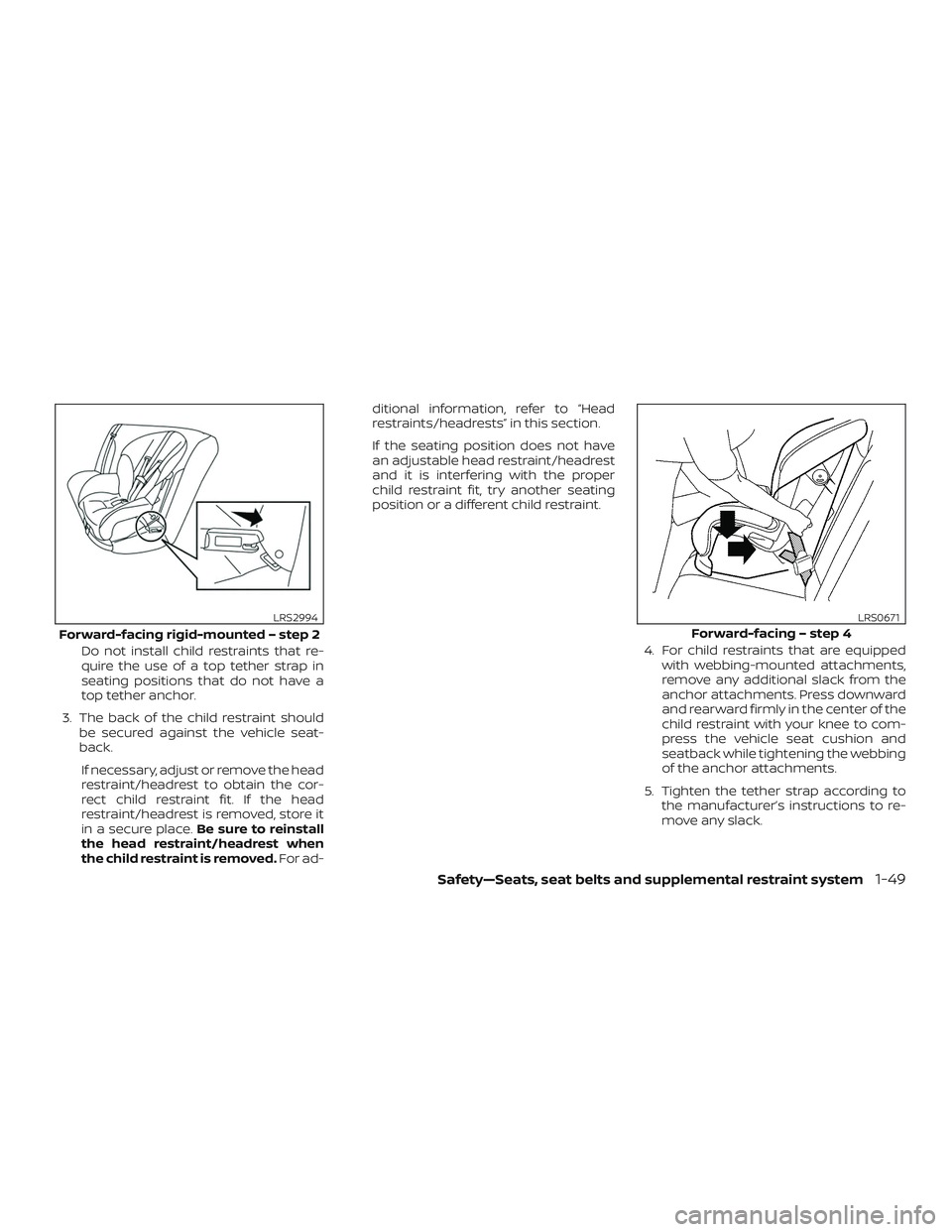
Do not install child restraints that re-
quire the use of a top tether strap in
seating positions that do not have a
top tether anchor.
3. The back of the child restraint should be secured against the vehicle seat-
back.
If necessary, adjust or remove the head
restraint/headrest to obtain the cor-
rect child restraint fit. If the head
restraint/headrest is removed, store it
in a secure place. Be sure to reinstall
the head restraint/headrest when
the child restraint is removed. For ad-ditional information, refer to “Head
restraints/headrests” in this section.
If the seating position does not have
an adjustable head restraint/headrest
and it is interfering with the proper
child restraint fit, try another seating
position or a different child restraint.
4. For child restraints that are equippedwith webbing-mounted attachments,
remove any additional slack from the
anchor attachments. Press downward
and rearward firmly in the center of the
child restraint with your knee to com-
press the vehicle seat cushion and
seatback while tightening the webbing
of the anchor attachments.
5. Tighten the tether strap according to the manufacturer’s instructions to re-
move any slack.
Forward-facing rigid-mounted – step 2
LRS2994
Forward-facing – step 4
LRS0671
Safety—Seats, seat belts and supplemental restraint system1-49
Page 73 of 516
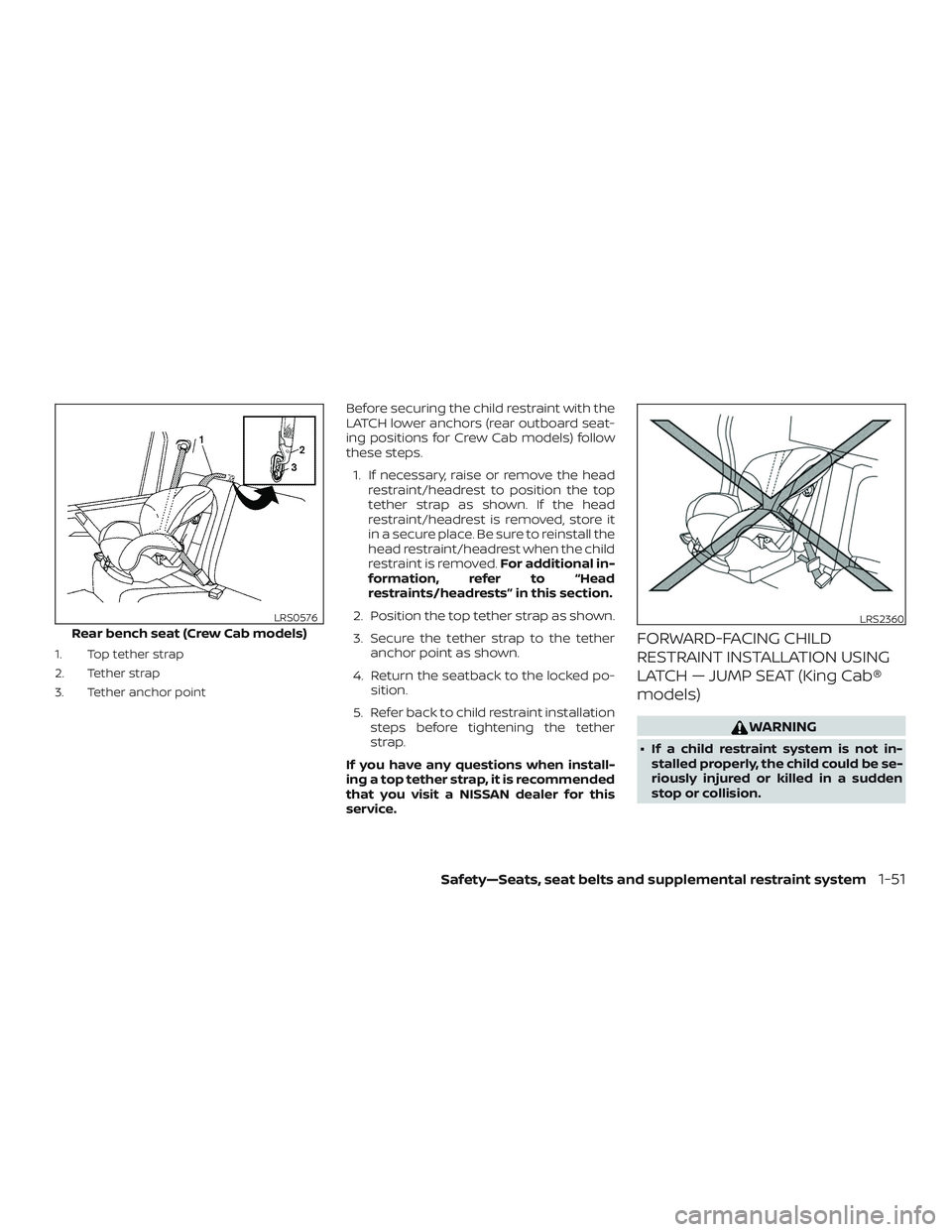
1. Top tether strap
2. Tether strap
3. Tether anchor point
Before securing the child restraint with the
LATCH lower anchors (rear outboard seat-
ing positions for Crew Cab models) follow
these steps.1. If necessary, raise or remove the head restraint/headrest to position the top
tether strap as shown. If the head
restraint/headrest is removed, store it
in a secure place. Be sure to reinstall the
head restraint/headrest when the child
restraint is removed. For additional in-
formation, refer to “Head
restraints/headrests” in this section.
2. Position the top tether strap as shown.
3. Secure the tether strap to the tether anchor point as shown.
4. Return the seatback to the locked po- sition.
5. Refer back to child restraint installation steps before tightening the tether
strap.
If you have any questions when install-
ing a top tether strap, it is recommended
that you visit a NISSAN dealer for this
service.
FORWARD-FACING CHILD
RESTRAINT INSTALLATION USING
LATCH — JUMP SEAT (King Cab®
models)
WARNING
∙ If a child restraint system is not in- stalled properly, the child could be se-
riously injured or killed in a sudden
stop or collision.
Rear bench seat (Crew Cab models)
LRS0576LRS2360
Safety—Seats, seat belts and supplemental restraint system1-51
Page 75 of 516
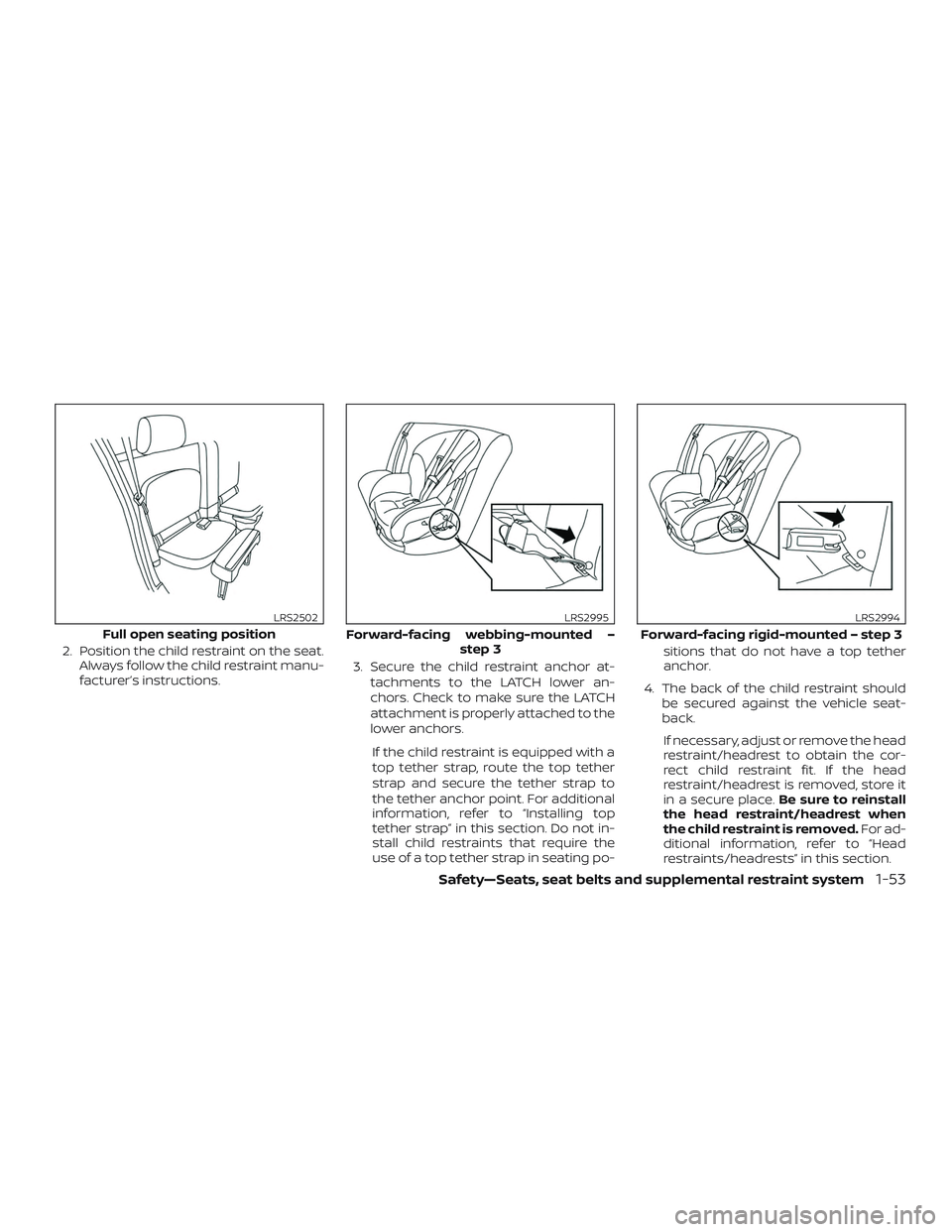
2. Position the child restraint on the seat.Always follow the child restraint manu-
facturer’s instructions. 3. Secure the child restraint anchor at-
tachments to the LATCH lower an-
chors. Check to make sure the LATCH
attachment is properly attached to the
lower anchors.
If the child restraint is equipped with a
top tether strap, route the top tether
strap and secure the tether strap to
the tether anchor point. For additional
information, refer to “Installing top
tether strap” in this section. Do not in-
stall child restraints that require the
use of a top tether strap in seating po- sitions that do not have a top tether
anchor.
4. The back of the child restraint should be secured against the vehicle seat-
back.
If necessary, adjust or remove the head
restraint/headrest to obtain the cor-
rect child restraint fit. If the head
restraint/headrest is removed, store it
in a secure place. Be sure to reinstall
the head restraint/headrest when
the child restraint is removed. For ad-
ditional information, refer to “Head
restraints/headrests” in this section.
Full open seating position
LRS2502
Forward-facing webbing-mounted – step 3
LRS2995
Forward-facing rigid-mounted – step 3
LRS2994
Safety—Seats, seat belts and supplemental restraint system1-53
Page 76 of 516
If the seating position does not have
an adjustable head restraint/headrest
and it is interfering with the proper
child restraint fit, try another seating
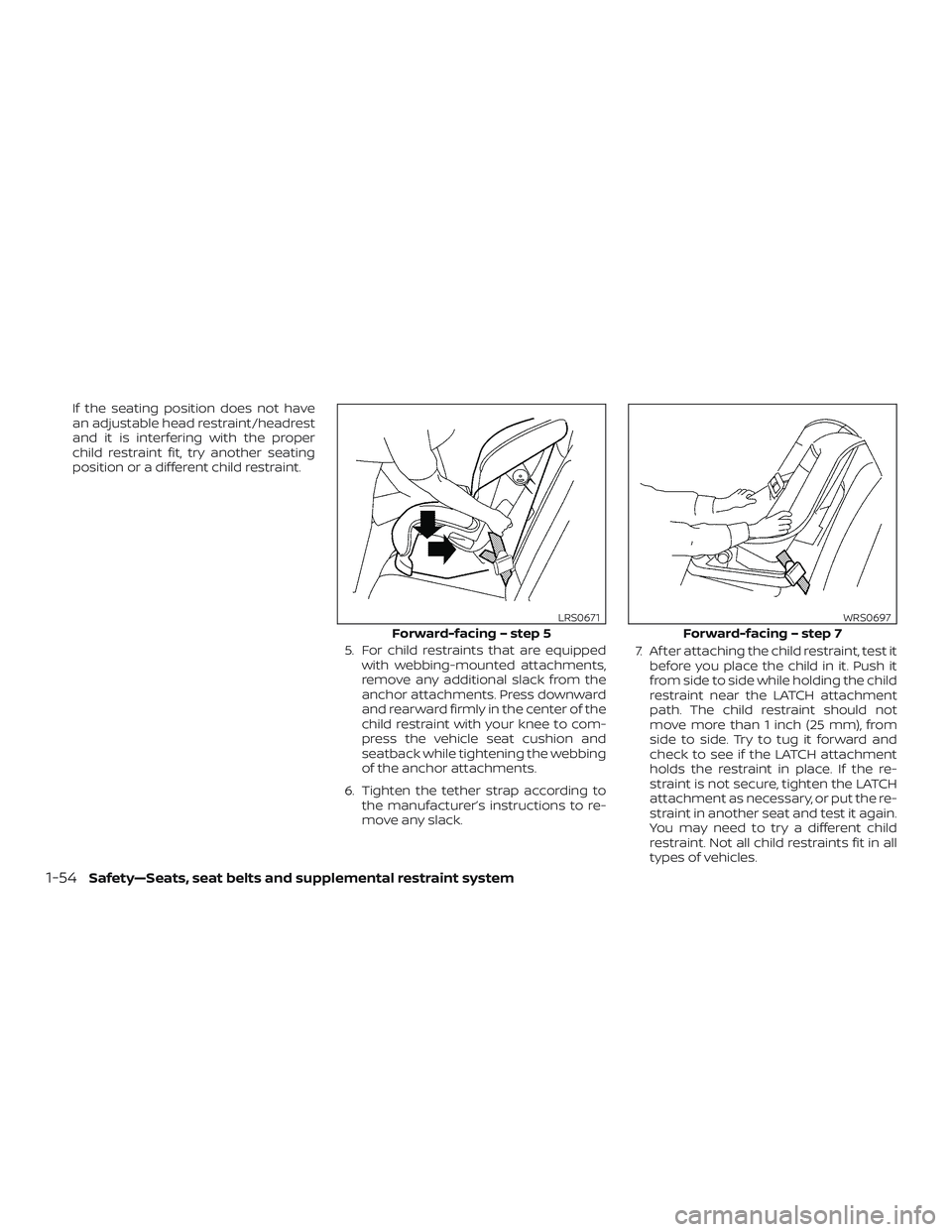
position or a different child restraint.5. For child restraints that are equippedwith webbing-mounted attachments,
remove any additional slack from the
anchor attachments. Press downward
and rearward firmly in the center of the
child restraint with your knee to com-
press the vehicle seat cushion and
seatback while tightening the webbing
of the anchor attachments.
6. Tighten the tether strap according to the manufacturer’s instructions to re-
move any slack. 7. Af ter attaching the child restraint, test it
before you place the child in it. Push it
from side to side while holding the child
restraint near the LATCH attachment
path. The child restraint should not
move more than 1 inch (25 mm), from
side to side. Try to tug it forward and
check to see if the LATCH attachment
holds the restraint in place. If the re-
straint is not secure, tighten the LATCH
attachment as necessary, or put the re-
straint in another seat and test it again.
You may need to try a different child
restraint. Not all child restraints fit in all
types of vehicles.
Forward-facing – step 5
LRS0671
Forward-facing – step 7
WRS0697
1-54Safety—Seats, seat belts and supplemental restraint system
Page 79 of 516
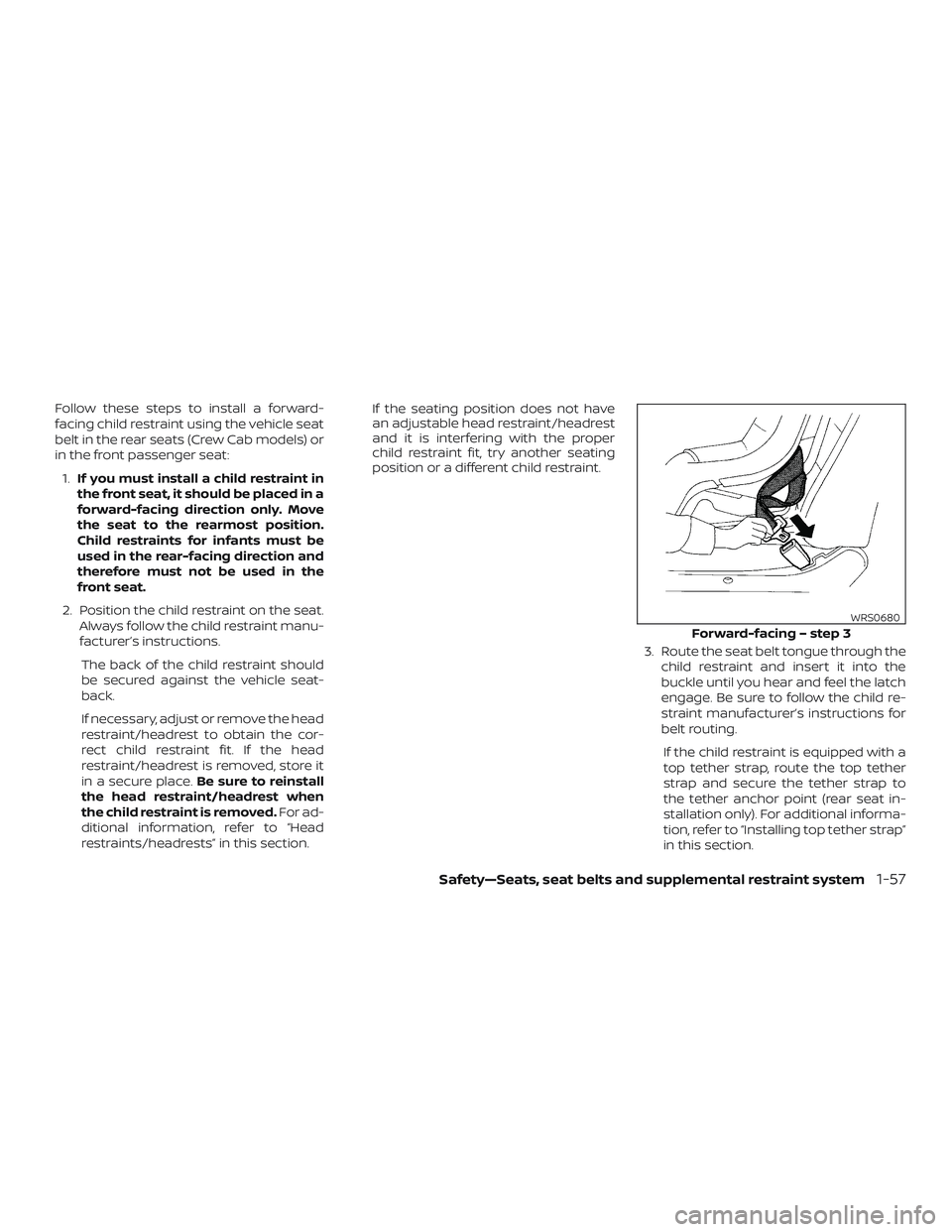
Follow these steps to install a forward-
facing child restraint using the vehicle seat
belt in the rear seats (Crew Cab models) or
in the front passenger seat:1. If you must install a child restraint in
the front seat, it should be placed in a
forward-facing direction only. Move
the seat to the rearmost position.
Child restraints for infants must be
used in the rear-facing direction and
therefore must not be used in the
front seat.
2. Position the child restraint on the seat. Always follow the child restraint manu-
facturer’s instructions.
The back of the child restraint should
be secured against the vehicle seat-
back.
If necessary, adjust or remove the head
restraint/headrest to obtain the cor-
rect child restraint fit. If the head
restraint/headrest is removed, store it
in a secure place. Be sure to reinstall
the head restraint/headrest when
the child restraint is removed. For ad-
ditional information, refer to “Head
restraints/headrests” in this section. If the seating position does not have
an adjustable head restraint/headrest
and it is interfering with the proper
child restraint fit, try another seating
position or a different child restraint.
3. Route the seat belt tongue through thechild restraint and insert it into the
buckle until you hear and feel the latch
engage. Be sure to follow the child re-
straint manufacturer’s instructions for
belt routing.
If the child restraint is equipped with a
top tether strap, route the top tether
strap and secure the tether strap to
the tether anchor point (rear seat in-
stallation only). For additional informa-
tion, refer to “Installing top tether strap”
in this section.
Forward-facing – step 3
WRS0680
Safety—Seats, seat belts and supplemental restraint system1-57
Page 83 of 516
First, secure the child restraint with the seat
belt.1. If necessary, raise or remove the head restraint/headrest to position the top
tether strap as shown. If the head
restraint/headrest is removed, store it
in a secure place. Be sure to reinstall the
head restraint/headrest when the child
restraint is removed. For additional in-
formation, refer to “Head
restraints/headrests” in this section.
2. Position the top tether strap as shown.
3. Secure the tether strap to the tether anchor point as shown.
4. Return the seatback to the locked po- sition.
5. Refer back to child restraint installation steps before tightening the tether
strap.
If you have any questions when install-
ing a top tether strap, it is recommended
that you visit a NISSAN dealer for this
service.
FORWARD-FACING CHILD
RESTRAINT INSTALLATION USING
THE SEAT BELTS — FRONT
PASSENGER AND JUMP SEATS
(King Cab® models)
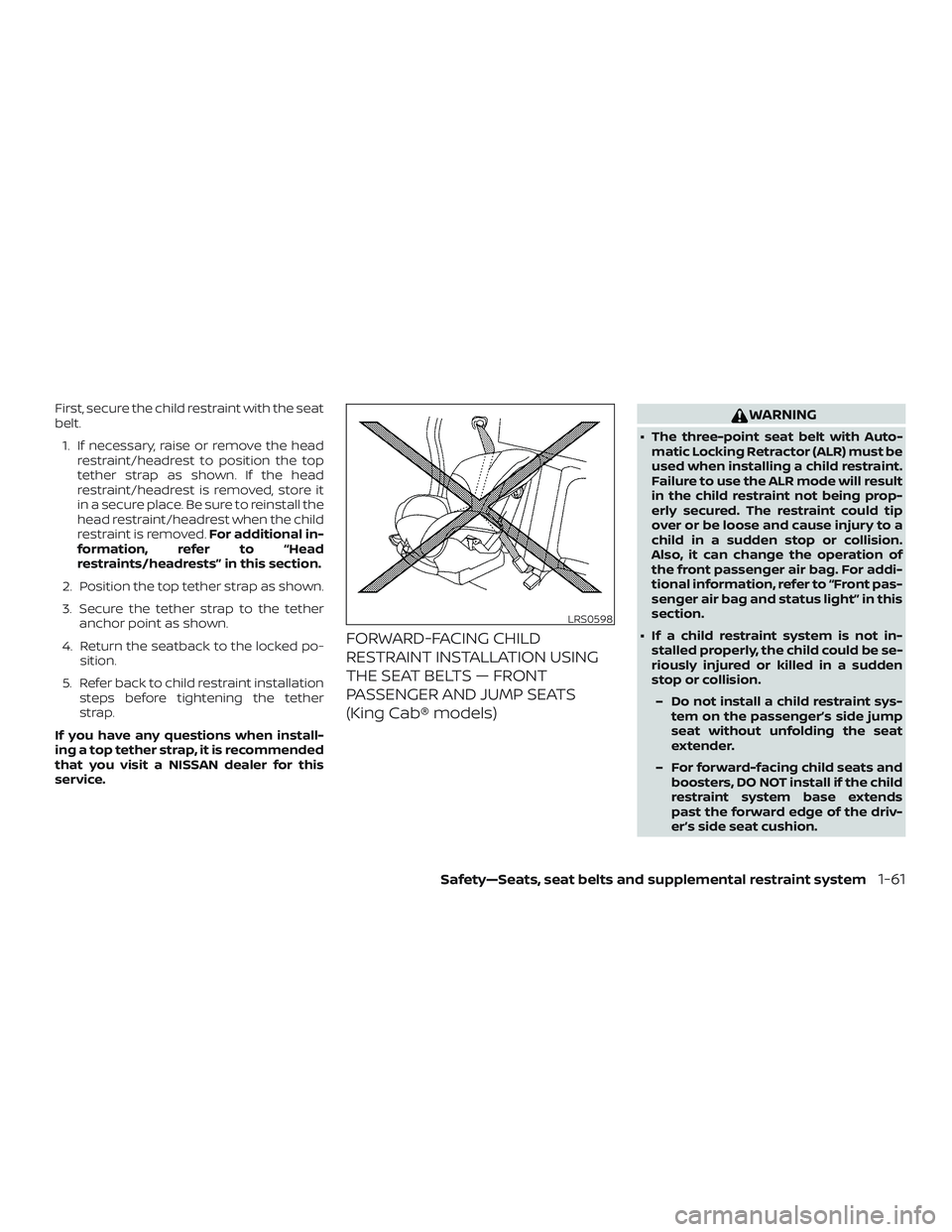
WARNING
∙ The three-point seat belt with Auto- matic Locking Retractor (ALR) must be
used when installing a child restraint.
Failure to use the ALR mode will result
in the child restraint not being prop-
erly secured. The restraint could tip
over or be loose and cause injury to a
child in a sudden stop or collision.
Also, it can change the operation of
the front passenger air bag. For addi-
tional information, refer to “Front pas-
senger air bag and status light” in this
section.
∙ If a child restraint system is not in- stalled properly, the child could be se-
riously injured or killed in a sudden
stop or collision.
– Do not install a child restraint sys- tem on the passenger’s side jump
seat without unfolding the seat
extender.
– For forward-facing child seats and boosters, DO NOT install if the child
restraint system base extends
past the forward edge of the driv-
er’s side seat cushion.
LRS0598
Safety—Seats, seat belts and supplemental restraint system1-61
Page 85 of 516
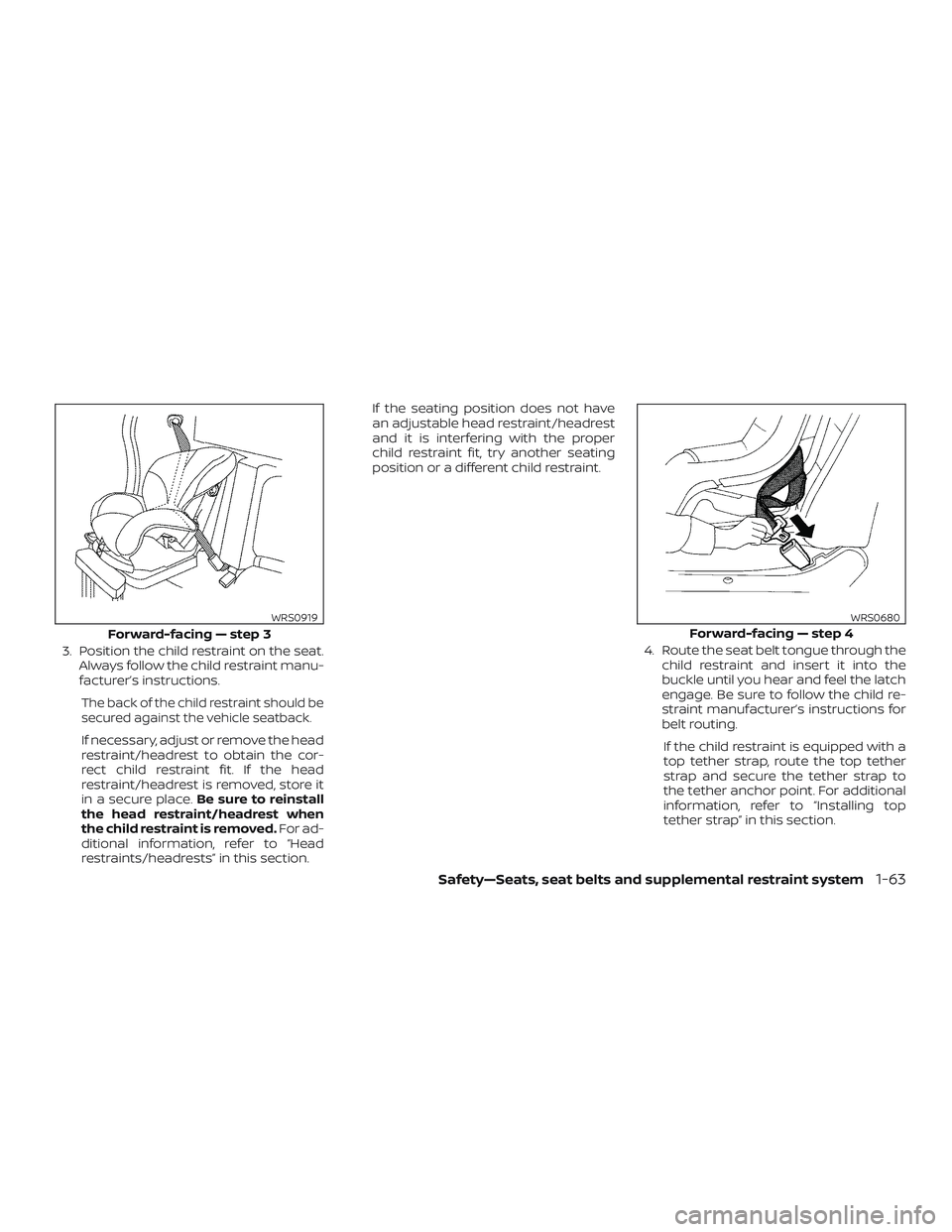
3. Position the child restraint on the seat.Always follow the child restraint manu-
facturer’s instructions.
The back of the child restraint should be
secured against the vehicle seatback.
If necessary, adjust or remove the head
restraint/headrest to obtain the cor-
rect child restraint fit. If the head
restraint/headrest is removed, store it
in a secure place. Be sure to reinstall
the head restraint/headrest when
the child restraint is removed. For ad-
ditional information, refer to “Head
restraints/headrests” in this section. If the seating position does not have
an adjustable head restraint/headrest
and it is interfering with the proper
child restraint fit, try another seating
position or a different child restraint.
4. Route the seat belt tongue through thechild restraint and insert it into the
buckle until you hear and feel the latch
engage. Be sure to follow the child re-
straint manufacturer’s instructions for
belt routing.
If the child restraint is equipped with a
top tether strap, route the top tether
strap and secure the tether strap to
the tether anchor point. For additional
information, refer to “Installing top
tether strap” in this section.
Forward-facing — step 3
WRS0919
Forward-facing — step 4
WRS0680
Safety—Seats, seat belts and supplemental restraint system1-63
Page 88 of 516
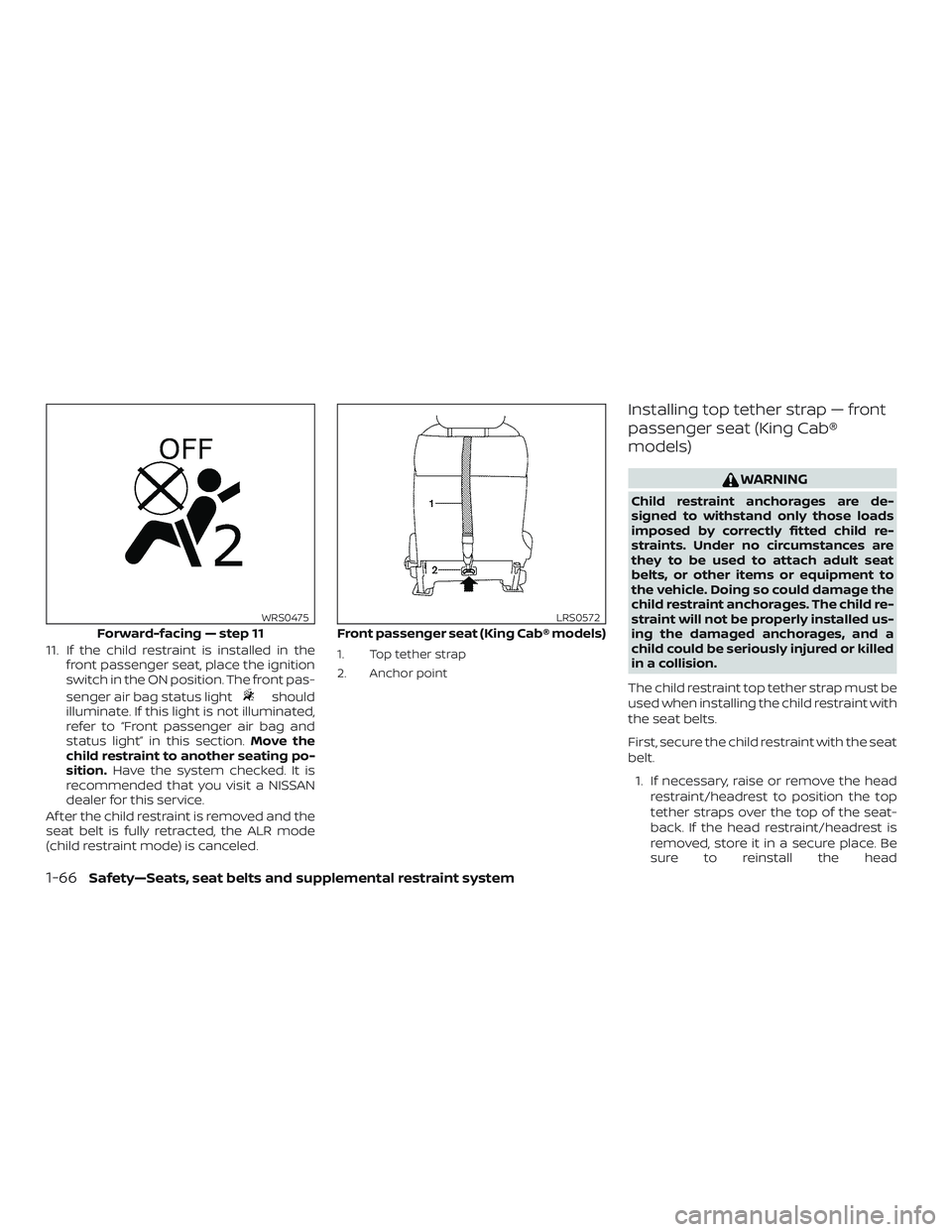
11. If the child restraint is installed in thefront passenger seat, place the ignition
switch in the ON position. The front pas-
senger air bag status light
should
illuminate. If this light is not illuminated,
refer to “Front passenger air bag and
status light” in this section. Move the
child restraint to another seating po-
sition. Have the system checked. It is
recommended that you visit a NISSAN
dealer for this service.
Af ter the child restraint is removed and the
seat belt is fully retracted, the ALR mode
(child restraint mode) is canceled.
1. Top tether strap
2. Anchor point
Installing top tether strap — front
passenger seat (King Cab®
models)
WARNING
Child restraint anchorages are de-
signed to withstand only those loads
imposed by correctly fitted child re-
straints. Under no circumstances are
they to be used to attach adult seat
belts, or other items or equipment to
the vehicle. Doing so could damage the
child restraint anchorages. The child re-
straint will not be properly installed us-
ing the damaged anchorages, and a
child could be seriously injured or killed
in a collision.
The child restraint top tether strap must be
used when installing the child restraint with
the seat belts.
First, secure the child restraint with the seat
belt. 1. If necessary, raise or remove the head restraint/headrest to position the top
tether straps over the top of the seat-
back. If the head restraint/headrest is
removed, store it in a secure place. Be
sure to reinstall the head
Forward-facing — step 11
WRS0475
Front passenger seat (King Cab® models)
LRS0572
1-66Safety—Seats, seat belts and supplemental restraint system
Page 89 of 516
restraint/headrest when the child re-
straint is removed. For additional infor-
mation, refer to “Head
restraints/headrests” in this section.
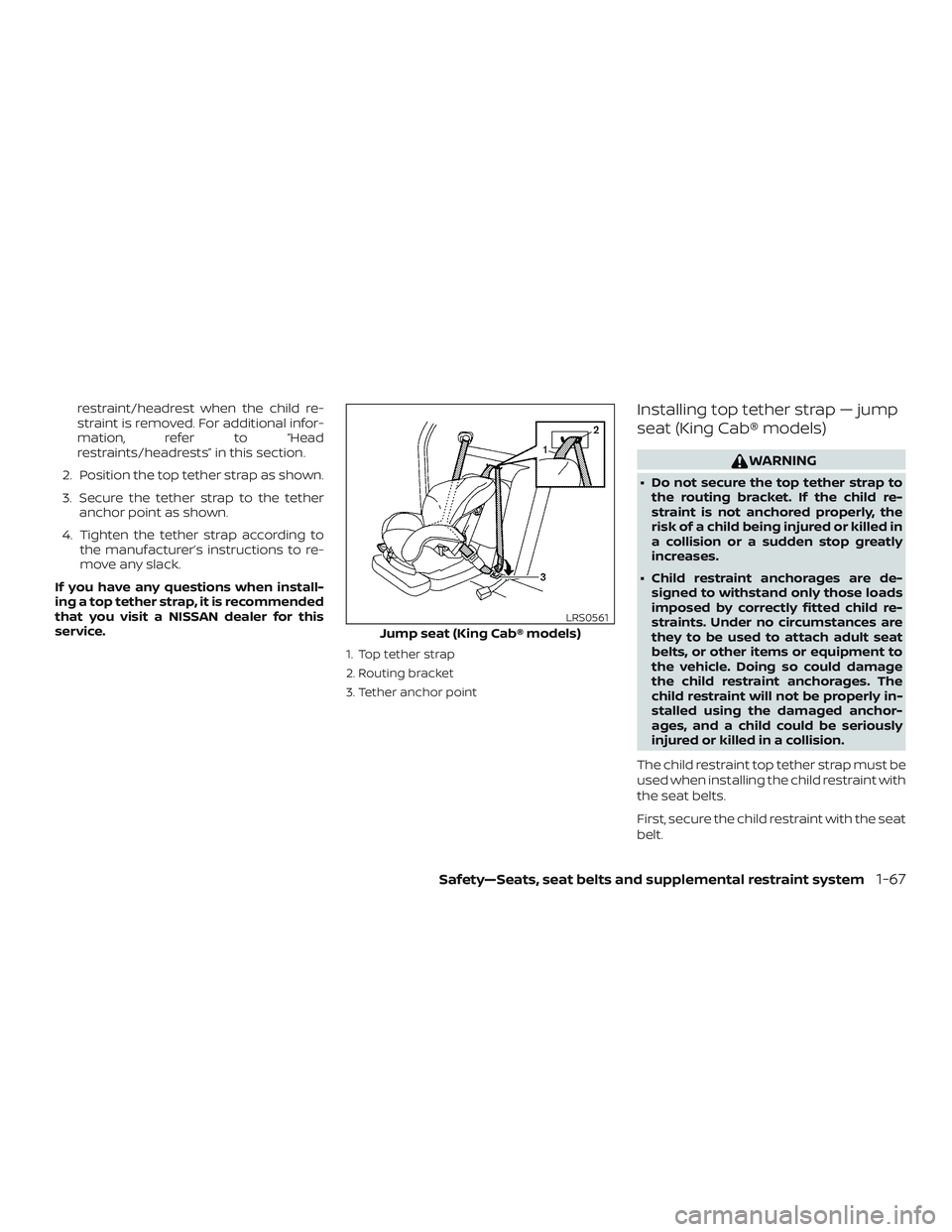
2. Position the top tether strap as shown.
3. Secure the tether strap to the tether anchor point as shown.
4. Tighten the tether strap according to the manufacturer’s instructions to re-
move any slack.
If you have any questions when install-
ing a top tether strap, it is recommended
that you visit a NISSAN dealer for this
service.
1. Top tether strap
2. Routing bracket
3. Tether anchor point
Installing top tether strap — jump
seat (King Cab® models)
WARNING
∙ Do not secure the top tether strap to the routing bracket. If the child re-
straint is not anchored properly, the
risk of a child being injured or killed in
a collision or a sudden stop greatly
increases.
∙ Child restraint anchorages are de- signed to withstand only those loads
imposed by correctly fitted child re-
straints. Under no circumstances are
they to be used to attach adult seat
belts, or other items or equipment to
the vehicle. Doing so could damage
the child restraint anchorages. The
child restraint will not be properly in-
stalled using the damaged anchor-
ages, and a child could be seriously
injured or killed in a collision.
The child restraint top tether strap must be
used when installing the child restraint with
the seat belts.
First, secure the child restraint with the seat
belt.
Jump seat (King Cab® models)
LRS0561
Safety—Seats, seat belts and supplemental restraint system1-67
Page 92 of 516
Follow these steps to install a booster seat
in the rear seat or in the front passenger
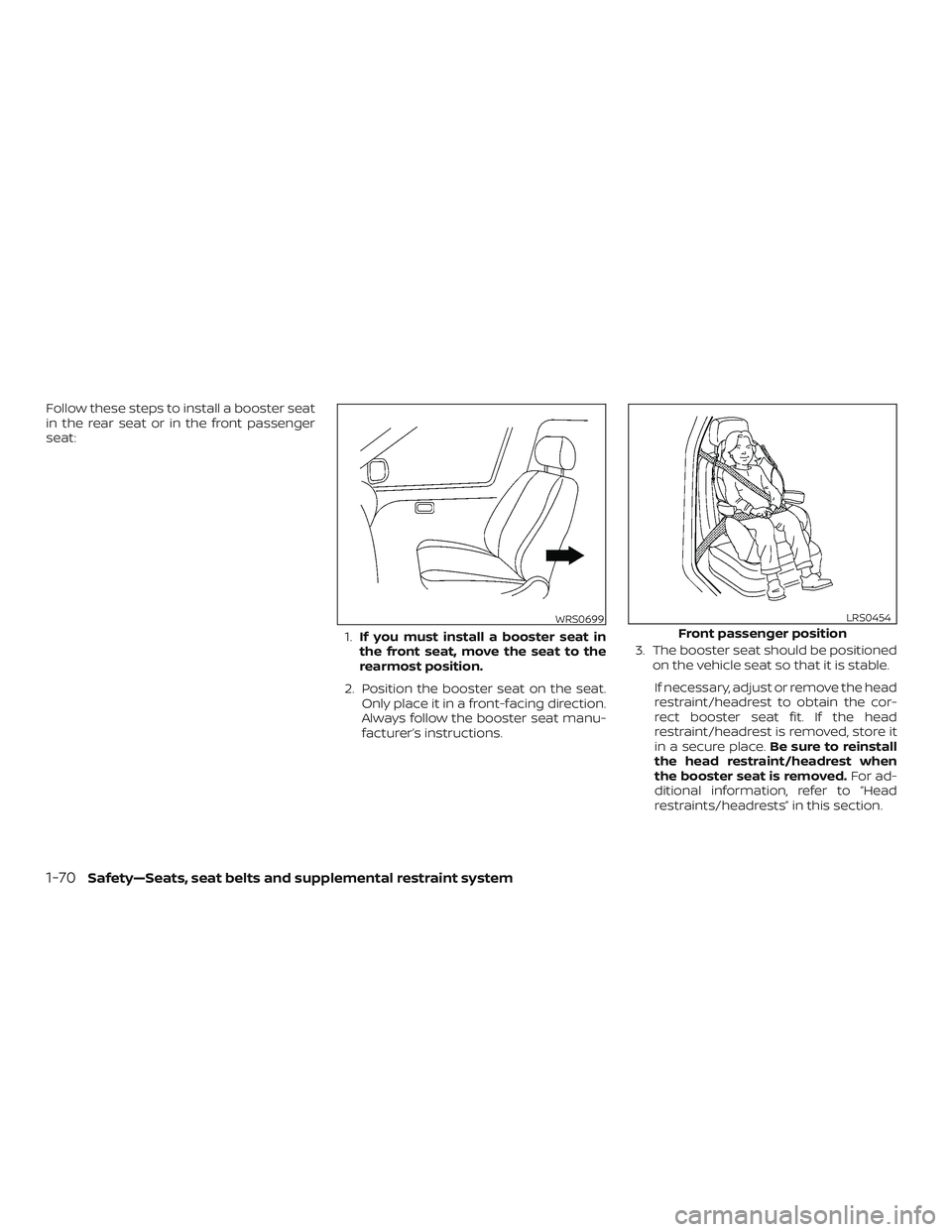
seat:1.If you must install a booster seat in
the front seat, move the seat to the
rearmost position.
2. Position the booster seat on the seat. Only place it in a front-facing direction.
Always follow the booster seat manu-
facturer’s instructions. 3. The booster seat should be positioned
on the vehicle seat so that it is stable.
If necessary, adjust or remove the head
restraint/headrest to obtain the cor-
rect booster seat fit. If the head
restraint/headrest is removed, store it
in a secure place. Be sure to reinstall
the head restraint/headrest when
the booster seat is removed. For ad-
ditional information, refer to “Head
restraints/headrests” in this section.
WRS0699Front passenger position
LRS0454
1-70Safety—Seats, seat belts and supplemental restraint system