headrest NISSAN FRONTIER 2019 Owner´s Manual
[x] Cancel search | Manufacturer: NISSAN, Model Year: 2019, Model line: FRONTIER, Model: NISSAN FRONTIER 2019Pages: 516, PDF Size: 5.04 MB
Page 93 of 516
If the seating position does not have
an adjustable head restraint/headrest
and it is interfering with the proper
booster seat fit, try another seating
position or a different booster seat.
4. Position the lap portion of the seat belt low and snug on the child’s hips. Be
sure to follow the booster seat manu-
facturer’s instructions for adjusting the
seat belt routing.
5. Pull the shoulder belt portion of the seat belt toward the retractor to take
up extra slack. Be sure the shoulder
belt is positioned across the top,
middle portion of the child’s shoulder.
Be sure to follow the booster seat
manufacturer’s instructions for adjust-
ing the seat belt routing.
6. Follow the warnings, cautions and in- structions for properly fastening a seat
belt shown in “Three-point type seat
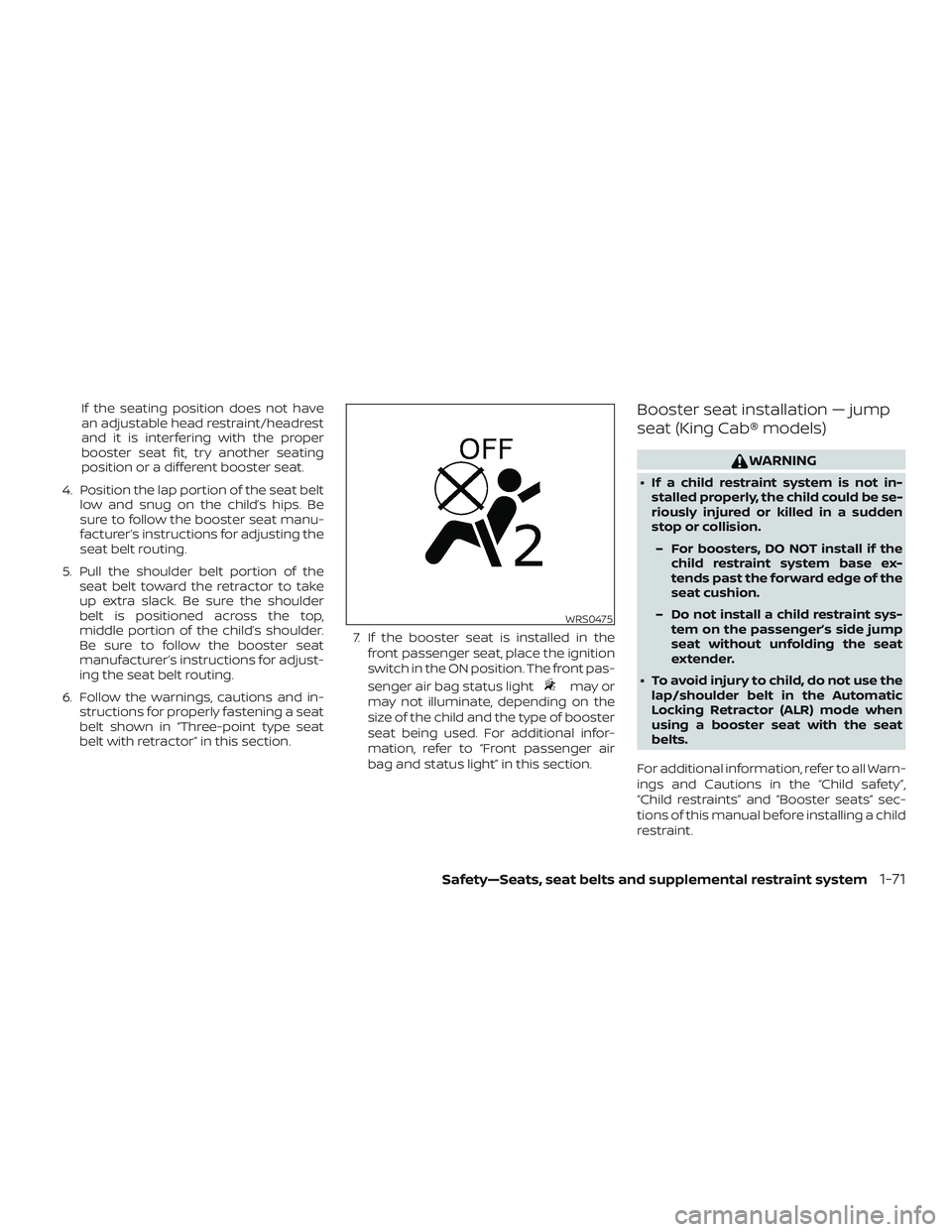
belt with retractor” in this section. 7. If the booster seat is installed in the
front passenger seat, place the ignition
switch in the ON position. The front pas-
senger air bag status light
may or
may not illuminate, depending on the
size of the child and the type of booster
seat being used. For additional infor-
mation, refer to “Front passenger air
bag and status light” in this section.
Booster seat installation — jump
seat (King Cab® models)
WARNING
∙ If a child restraint system is not in- stalled properly, the child could be se-
riously injured or killed in a sudden
stop or collision.
– For boosters, DO NOT install if the child restraint system base ex-
tends past the forward edge of the
seat cushion.
– Do not install a child restraint sys- tem on the passenger’s side jump
seat without unfolding the seat
extender.
∙ To avoid injury to child, do not use the lap/shoulder belt in the Automatic
Locking Retractor (ALR) mode when
using a booster seat with the seat
belts.
For additional information, refer to all Warn-
ings and Cautions in the “Child safety”,
“Child restraints” and “Booster seats” sec-
tions of this manual before installing a child
restraint.
WRS0475
Safety—Seats, seat belts and supplemental restraint system1-71
Page 95 of 516
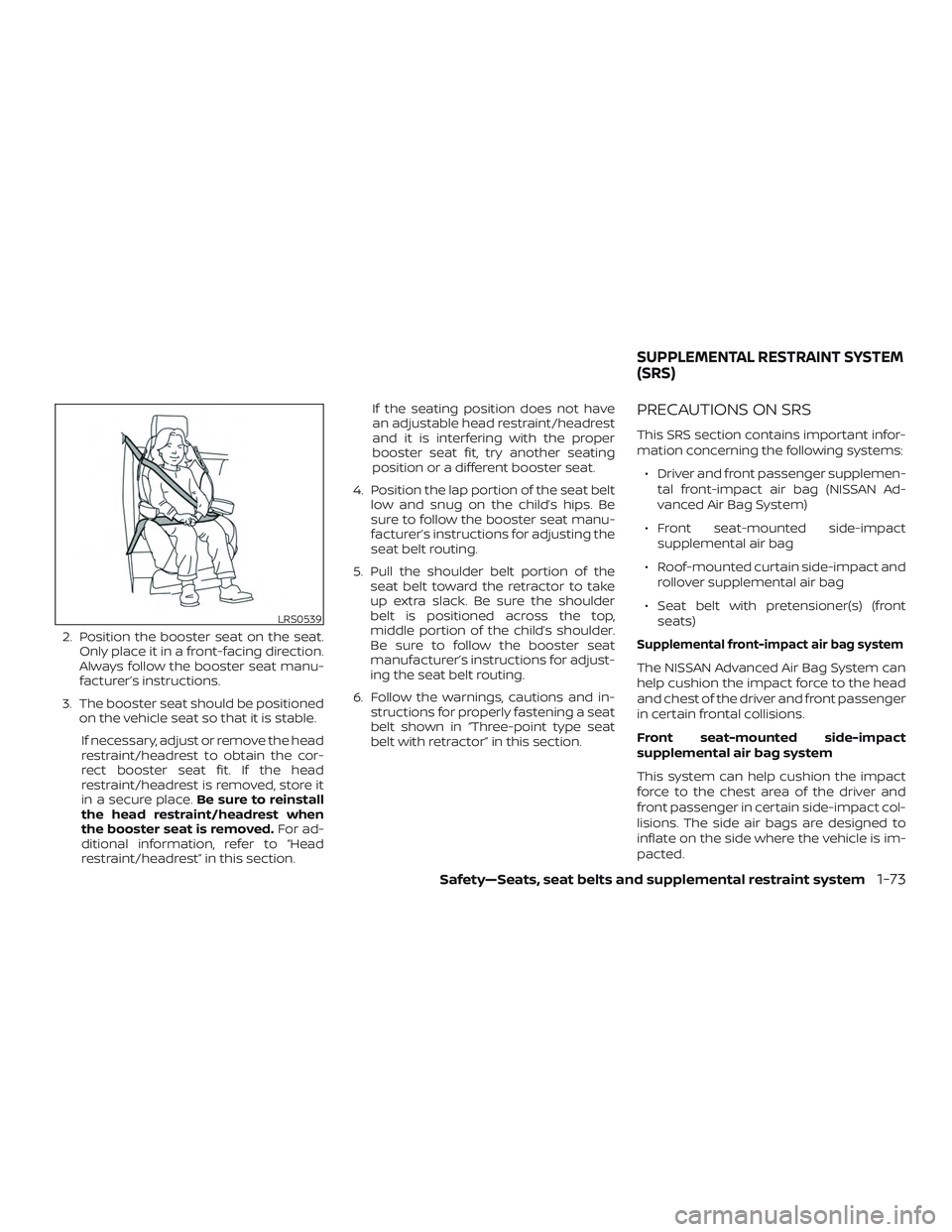
2. Position the booster seat on the seat.Only place it in a front-facing direction.
Always follow the booster seat manu-
facturer’s instructions.
3. The booster seat should be positioned on the vehicle seat so that it is stable.
If necessary, adjust or remove the head
restraint/headrest to obtain the cor-
rect booster seat fit. If the head
restraint/headrest is removed, store it
in a secure place. Be sure to reinstall
the head restraint/headrest when
the booster seat is removed. For ad-
ditional information, refer to “Head
restraint/headrest” in this section. If the seating position does not have
an adjustable head restraint/headrest
and it is interfering with the proper
booster seat fit, try another seating
position or a different booster seat.
4. Position the lap portion of the seat belt low and snug on the child’s hips. Be
sure to follow the booster seat manu-
facturer’s instructions for adjusting the
seat belt routing.
5. Pull the shoulder belt portion of the seat belt toward the retractor to take
up extra slack. Be sure the shoulder
belt is positioned across the top,
middle portion of the child’s shoulder.
Be sure to follow the booster seat
manufacturer’s instructions for adjust-
ing the seat belt routing.
6. Follow the warnings, cautions and in- structions for properly fastening a seat
belt shown in “Three-point type seat
belt with retractor” in this section.
PRECAUTIONS ON SRS
This SRS section contains important infor-
mation concerning the following systems:
∙ Driver and front passenger supplemen- tal front-impact air bag (NISSAN Ad-
vanced Air Bag System)
∙ Front seat-mounted side-impact supplemental air bag
∙ Roof-mounted curtain side-impact and rollover supplemental air bag
∙ Seat belt with pretensioner(s) (front seats)
Supplemental front-impact air bag system
The NISSAN Advanced Air Bag System can
help cushion the impact force to the head
and chest of the driver and front passenger
in certain frontal collisions.
Front seat-mounted side-impact
supplemental air bag system
This system can help cushion the impact
force to the chest area of the driver and
front passenger in certain side-impact col-
lisions. The side air bags are designed to
inflate on the side where the vehicle is im-
pacted.
LRS0539
SUPPLEMENTAL RESTRAINT SYSTEM
(SRS)
Safety—Seats, seat belts and supplemental restraint system1-73
Page 329 of 516
If the engine fails to start using a registered
key (for example, when interference is
caused by another registered key, an auto-
mated toll road device or automatic pay-
ment device on the key ring), restart the
engine using the following procedures:1. Leave the ignition switch in the ON po- sition for approximately 5 seconds.
2. Place the ignition switch in the OFF or LOCK position, and wait approximately
10 seconds.
3. Repeat steps 1 and 2.
4. Restart the engine while holding the device (which may have caused the in-
terference) separate from the regis-
tered key.
If the no start condition re-occurs, NISSAN
recommends placing the registered key on
a separate key ring to avoid interference
from other devices. ∙ Make sure the area around the vehicle is
clear.
∙ Check fluid levels such as engine oil, coolant, brake and clutch fluid (if so
equipped), and windshield-washer fluid
as frequently as possible, or at least
whenever you refuel.
∙ Check that all windows and lights are clean.
∙ Visually inspect tires for their appear- ance and condition. Also check tires for
proper inflation.
∙ Check that all doors are closed.
∙ Position seat and adjust head restraints/headrests.
∙ Adjust inside and outside mirrors.
∙ Fasten the seat belt and ask all passen- gers to do likewise.
∙ Check the operation of warning lights when the key is placed in the ON posi-
tion. For additional information, refer to
“Warning lights, indicator lights and au-
dible reminders” in the “Instruments
and controls” section of this manual. 1. Apply the parking brake.
2.
Automatic transmission:
Move the shif t lever to P (Park) or N
(Neutral). P (Park) is recommended.
The shif t lever cannot be moved out
of the P (Park) position and into any
of the other gear positions if the ig-
nition switch is placed in the OFF po-
sition or if the key is removed from
the ignition switch.
The starter is designed not to oper-
ate if the shif t lever is in any of the
driving positions.
Manual transmission:
Move the shif t lever to N (Neutral). De-
press the clutch pedal to the floor
while cranking the engine.
The starter is designed not to oper-
ate unless the clutch pedal is fully
depressed.
3. Crank the engine with your foot off
the accelerator pedal by placing the
ignition switch in the START position.
Release the key when the engine
starts. If the engine starts, but fails to
run, repeat the above procedure.
BEFORE STARTING THE ENGINE STARTING THE ENGINE
Starting and driving5-13
Page 368 of 516
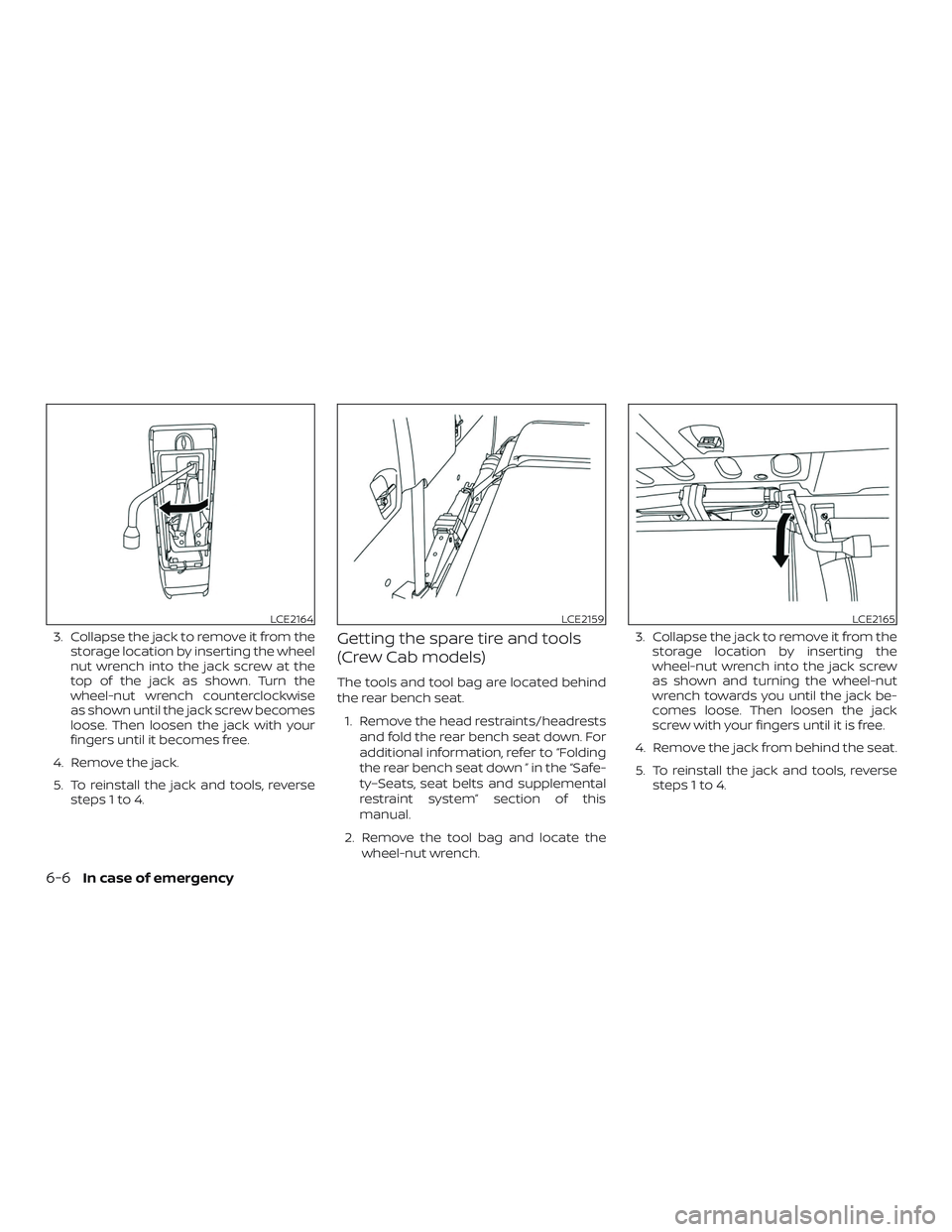
3. Collapse the jack to remove it from thestorage location by inserting the wheel
nut wrench into the jack screw at the
top of the jack as shown. Turn the
wheel-nut wrench counterclockwise
as shown until the jack screw becomes
loose. Then loosen the jack with your
fingers until it becomes free.
4. Remove the jack.
5. To reinstall the jack and tools, reverse steps 1 to 4.Getting the spare tire and tools
(Crew Cab models)
The tools and tool bag are located behind
the rear bench seat.
1. Remove the head restraints/headrests and fold the rear bench seat down. For
additional information, refer to “Folding
the rear bench seat down ” in the “Safe-
ty–Seats, seat belts and supplemental
restraint system” section of this
manual.
2. Remove the tool bag and locate the wheel-nut wrench. 3. Collapse the jack to remove it from the
storage location by inserting the
wheel-nut wrench into the jack screw
as shown and turning the wheel-nut
wrench towards you until the jack be-
comes loose. Then loosen the jack
screw with your fingers until it is free.
4. Remove the jack from behind the seat.
5. To reinstall the jack and tools, reverse steps 1 to 4.
LCE2164LCE2159LCE2165
6-6In case of emergency
Page 440 of 516
Seats:Check seat position controls such
as seat adjusters, seatback recliner, etc., to
ensure they operate smoothly and all
latches lock securely in every position.
Check that the head restraints/headrests
move up and down smoothly and the locks
(if so equipped) hold securely in all latched
positions.
Seat belts: Check that all parts of the seat
belt system (for example, buckles, anchors,
adjusters and retractors) operate properly
and smoothly, and are installed securely.
Check the belt webbing for cuts, fraying,
wear or damage.
Steering wheel: Check for changes in the
steering system, such as excessive free
play, hard steering or strange noises.
Warning lights and chimes: Make sure all
warning lights and chimes are operating
properly.
Windshield defroster: Check that the air
comes out of the defroster outlets properly
and in sufficient quantity when operating
the heater or air conditioner.
Windshield wiper and washer*: Check
that the wipers and washer operate prop-
erly and that the wipers do not streak.Under the hood and vehicle
The maintenance items listed here should
be checked periodically (for example, each
time you check the engine oil or refuel).
Battery (for maintenance free batter-
ies)*: This vehicle is equipped with a sealed
maintenance free battery. It is recom-
mended that you visit a NISSAN dealer for
service.
NOTE:
Care should be taken to avoid situations
that can lead to potential battery dis-
charge and potential no-start conditions
such as:
1. Installation or extended use of elec-
tronic accessories that consume bat-
tery power when the engine is not
running (Phone chargers, GPS, DVD
players, etc.).
2. Vehicle is not driven regularly and/or
only driven short distances.
In these cases, the battery may need to
be charged to maintain battery health. Brake and clutch (if so equipped) fluid
level*:
Make sure that the fluid level is be-
tween the MAX and MIN lines on the reser-
voir.
Engine coolant level*: Check the coolant
level when the engine is cold.
Engine drive belts*: Make sure the drive
belts are not frayed, worn, cracked or oily.
Engine oil level*: Check the level af ter
parking the vehicle on a level spot and
turning off the engine. Wait more than
15 minutes for the oil to drain back into the
oil pan.
Exhaust system: Make sure there are no
loose supports, cracks or holes. If the
sound of the exhaust seems unusual or
there is a smell of exhaust fumes, immedi-
ately have the exhaust system inspected. It
is recommended that you visit a NISSAN
dealer for this service. For additional infor-
mation, refer to “Exhaust gas (carbon mon-
oxide)” in the “Starting and driving” section
of this manual.
Fluid leaks: Check under the vehicle for
fuel, oil, water or other fluid leaks af ter the
vehicle has been parked for a while. Water
dripping from the air conditioner af ter use
is normal. If you should notice any leaks or if
9-4Maintenance and schedules
Page 503 of 516
Changing engine oil filter.........8-8
Checking engine coolant level ......8-6
Checking engine oil level .........8-7
Engine compartment check
locations...................8-3
Engine coolant temperature gauge . .2-6
Engine cooling system ..........8-5
Engine oil ...................8-7
Engine oil and oil filter
recommendation .............10-11
Engine oil pressure gauge ........2-8
Engine oil pressure warning light ....2-17
Engine oil viscosity ............10-11
Engine serial number ..........10-15
Engine specifications ..........10-13
Starting the engine ............5-13
Engine Block Heater .............5-45
Engine coolant temperature gauge ....2-6
Engine oil pressure gauge ..........2-8
Enterbutton................4-4,4-10
EventDatarecorders............10-46
Exhaust gas (Carbon monoxide) .......5-2
Explanation of maintenance items .....9-2
Explanation of scheduled maintenance
items .......................9-5
Extended storage switch ..........8-26
Eyeglasscase.................2-45
F
Firstaidkit....................6-2
Flashers
(See hazard warning flasher switch) ....6-2
Flattire....................6-3,6-4
Floormatpositioningaid...........7-6 Fluid
Brakefluid..................8-13
Capacities and recommended
fuel/lubricants...............10-2
Clutchfluid.................8-14
Engine coolant ...............8-5
Engine oil ...................8-7
Powersteeringfluid............8-12
Windshield-washer fluid .........8-14
F.M.V.S.S. certification label .........10-16
Foglightswitch................2-32
Front air bag system
(See supplemental restraint system) . . . .1-81
Front-door pocket ..............2-40
Front power seat adjustment ........1-5
Frontseats....................1-2
Fuel Capacities and recommended
fuel/lubricants...............10-2
Fuel economy ...............5-25
Fuel gauge ..................2-7
Fueloctanerating..........10-6,10-9
Fuel recommendation .......10-4,10-7
Loose fuel cap warning .......2-5,3-11
Fuel efficient driving tips ...........5-24
Fuel-filler door ..................3-11
Fuel gauge ....................2-7
Fuses .......................8-23
Fusiblelinks...................8-24
G
Garage door opener, HomeLink® Universal
Transceiver . .2-55, 2-56, 2-57, 2-58, 2-58, 2-59 Gauge
Engine coolant temperature gauge . .2-6
Engine oil pressure gauge ........2-8
Fuel gauge ..................2-7
Odometer ..................2-4
Speedometer ................2-4
Tachometer .................2-6
Trip computer ................2-9
Trip odometer ................2-4
Voltmeter...................2-9
General maintenance .............9-2
Glovebox....................2-44
H
Hands-fr ee
phone system,
Bluetooth®...................4-102
Hazardwarningflasherswitch........6-2
Headlight and turn signal switch ......2-29
Headlightcontrolswitch...........2-29
Headlights...................8-28
Headrestraints.................1-10
Heated seat switches ............2-34
Heater Heater and air conditioner
controls................4-23,4-35
Heater operation ..........4-26,4-36
Hill descent control switch ..........2-35
Hill descent control system .........5-41
Hill start assist system ............5-42
HomeLink® Universal
Transceiver . .2-55, 2-56, 2-57, 2-58, 2-58, 2-59
Hood release ..................3-10
Horn.......................2-33
11-3