maint sch NISSAN FRONTIER 2019 Owner´s Manual
[x] Cancel search | Manufacturer: NISSAN, Model Year: 2019, Model line: FRONTIER, Model: NISSAN FRONTIER 2019Pages: 516, PDF Size: 5.04 MB
Page 464 of 516
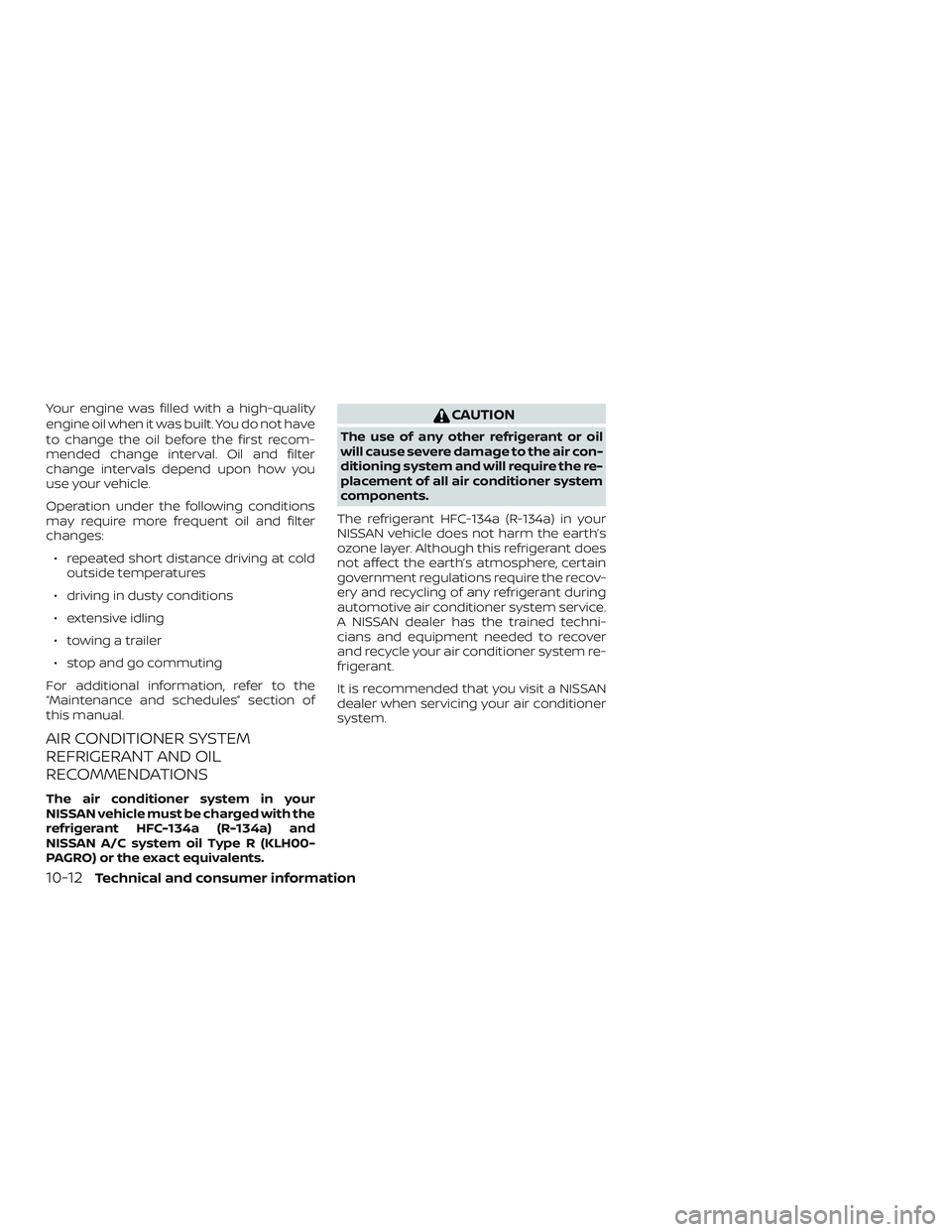
Your engine was filled with a high-quality
engine oil when it was built. You do not have
to change the oil before the first recom-
mended change interval. Oil and filter
change intervals depend upon how you
use your vehicle.
Operation under the following conditions
may require more frequent oil and filter
changes:∙ repeated short distance driving at cold outside temperatures
∙ driving in dusty conditions
∙ extensive idling
∙ towing a trailer
∙ stop and go commuting
For additional information, refer to the
“Maintenance and schedules” section of
this manual.
AIR CONDITIONER SYSTEM
REFRIGERANT AND OIL
RECOMMENDATIONS
The air conditioner system in your
NISSAN vehicle must be charged with the
refrigerant HFC-134a (R-134a) and
NISSAN A/C system oil Type R (KLH00-
PAGRO) or the exact equivalents.
CAUTION
The use of any other refrigerant or oil
will cause severe damage to the air con-
ditioning system and will require the re-
placement of all air conditioner system
components.
The refrigerant HFC-134a (R-134a) in your
NISSAN vehicle does not harm the earth’s
ozone layer. Although this refrigerant does
not affect the earth’s atmosphere, certain
government regulations require the recov-
ery and recycling of any refrigerant during
automotive air conditioner system service.
A NISSAN dealer has the trained techni-
cians and equipment needed to recover
and recycle your air conditioner system re-
frigerant.
It is recommended that you visit a NISSAN
dealer when servicing your air conditioner
system.
10-12Technical and consumer information
Page 492 of 516
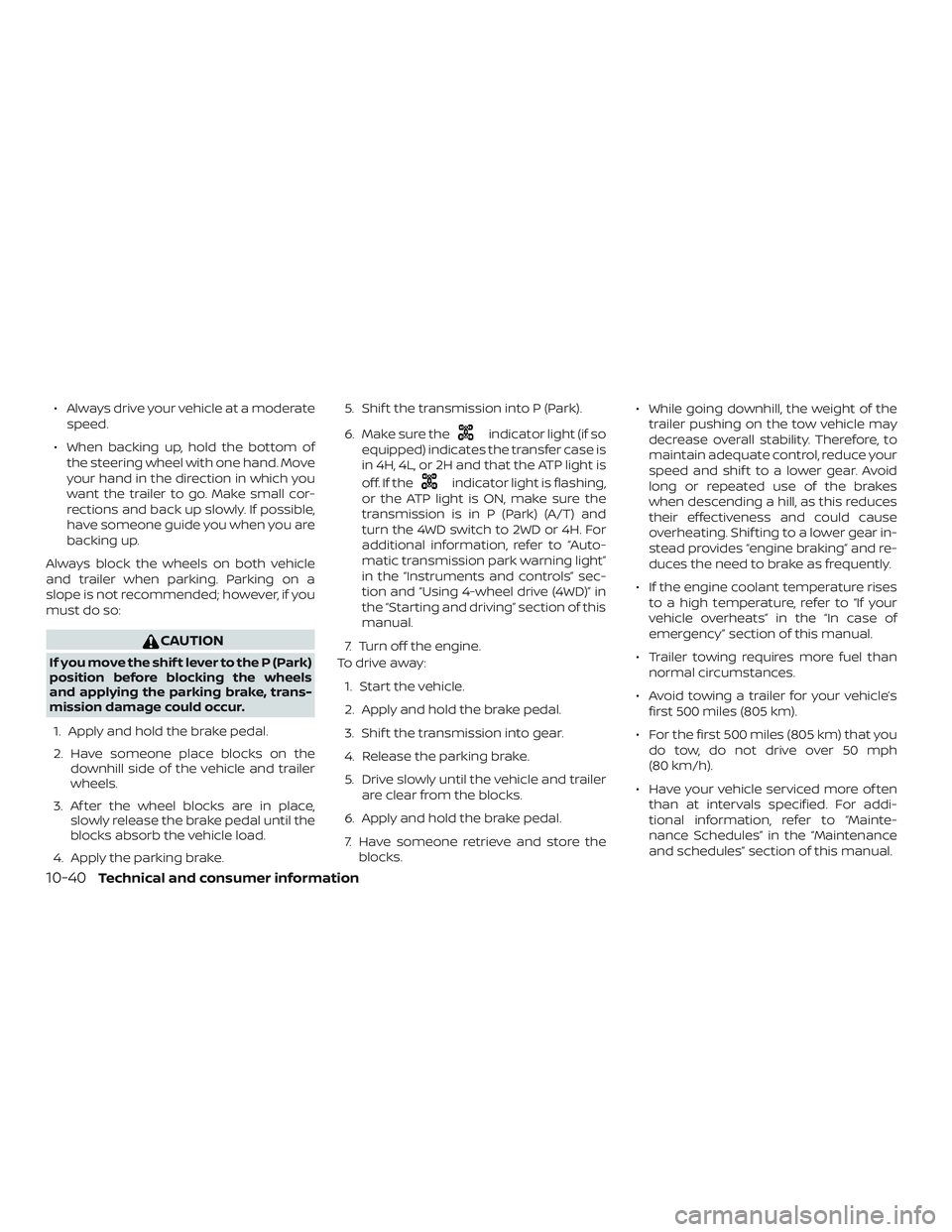
∙ Always drive your vehicle at a moderatespeed.
∙ When backing up, hold the bottom of the steering wheel with one hand. Move
your hand in the direction in which you
want the trailer to go. Make small cor-
rections and back up slowly. If possible,
have someone guide you when you are
backing up.
Always block the wheels on both vehicle
and trailer when parking. Parking on a
slope is not recommended; however, if you
must do so:
CAUTION
If you move the shif t lever to the P (Park)
position before blocking the wheels
and applying the parking brake, trans-
mission damage could occur.
1. Apply and hold the brake pedal.
2. Have someone place blocks on the downhill side of the vehicle and trailer
wheels.
3. Af ter the wheel blocks are in place, slowly release the brake pedal until the
blocks absorb the vehicle load.
4. Apply the parking brake. 5. Shif t the transmission into P (Park).
6. Make sure the
indicator light (if so
equipped) indicates the transfer case is
in 4H, 4L, or 2H and that the ATP light is
off. If the
indicator light is flashing,
or the ATP light is ON, make sure the
transmission is in P (Park) (A/T) and
turn the 4WD switch to 2WD or 4H. For
additional information, refer to “Auto-
matic transmission park warning light”
in the “Instruments and controls” sec-
tion and “Using 4-wheel drive (4WD)” in
the “Starting and driving” section of this
manual.
7. Turn off the engine.
To drive away:
1. Start the vehicle.
2. Apply and hold the brake pedal.
3. Shif t the transmission into gear.
4. Release the parking brake.
5. Drive slowly until the vehicle and trailer are clear from the blocks.
6. Apply and hold the brake pedal.
7. Have someone retrieve and store the blocks. ∙ While going downhill, the weight of the
trailer pushing on the tow vehicle may
decrease overall stability. Therefore, to
maintain adequate control, reduce your
speed and shif t to a lower gear. Avoid
long or repeated use of the brakes
when descending a hill, as this reduces
their effectiveness and could cause
overheating. Shif ting to a lower gear in-
stead provides “engine braking” and re-
duces the need to brake as frequently.
∙ If the engine coolant temperature rises to a high temperature, refer to “If your
vehicle overheats” in the “In case of
emergency” section of this manual.
∙ Trailer towing requires more fuel than normal circumstances.
∙ Avoid towing a trailer for your vehicle’s first 500 miles (805 km).
∙ For the first 500 miles (805 km) that you do tow, do not drive over 50 mph
(80 km/h).
∙ Have your vehicle serviced more of ten than at intervals specified. For addi-
tional information, refer to “Mainte-
nance Schedules” in the “Maintenance
and schedules” section of this manual.
10-40Technical and consumer information
Page 503 of 516
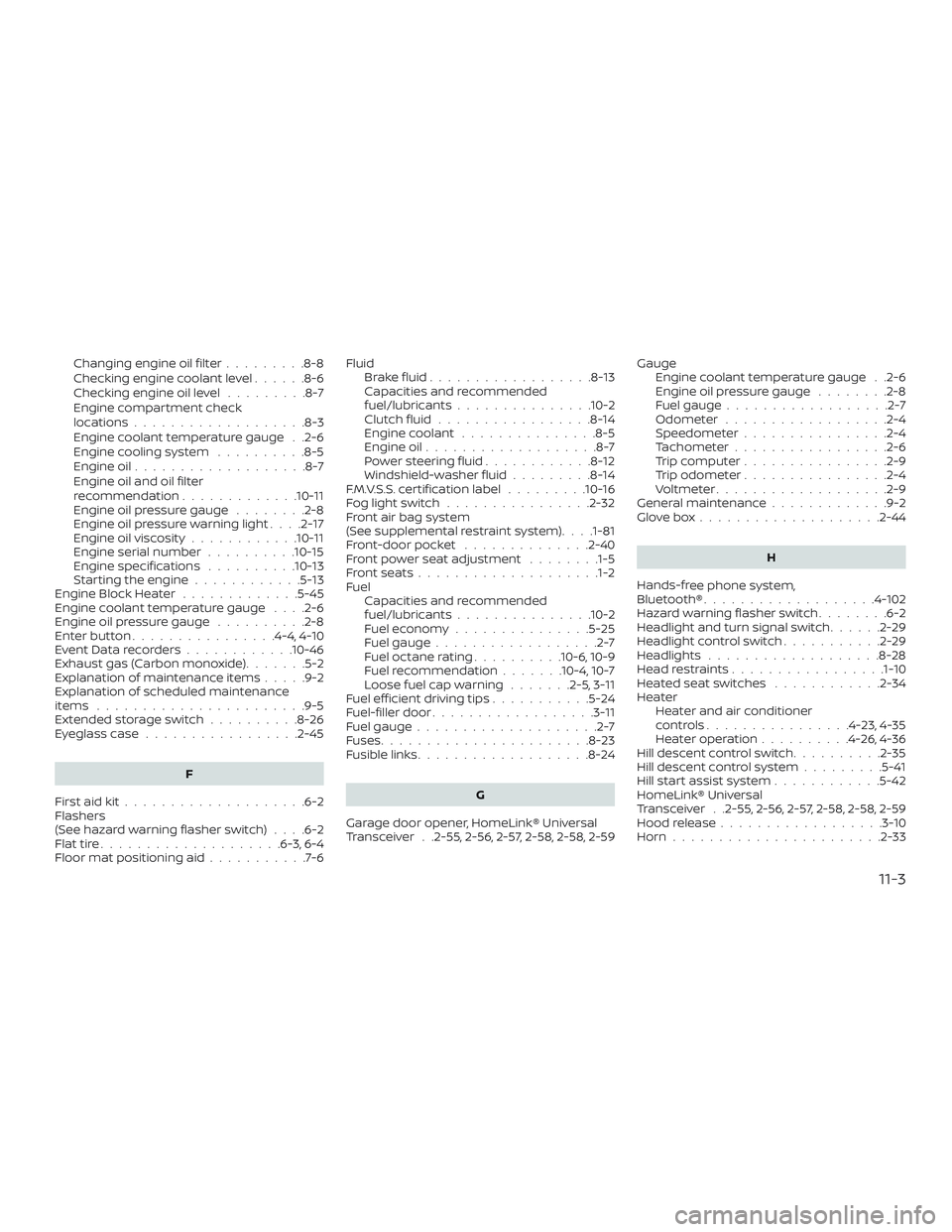
Changing engine oil filter.........8-8
Checking engine coolant level ......8-6
Checking engine oil level .........8-7
Engine compartment check
locations...................8-3
Engine coolant temperature gauge . .2-6
Engine cooling system ..........8-5
Engine oil ...................8-7
Engine oil and oil filter
recommendation .............10-11
Engine oil pressure gauge ........2-8
Engine oil pressure warning light ....2-17
Engine oil viscosity ............10-11
Engine serial number ..........10-15
Engine specifications ..........10-13
Starting the engine ............5-13
Engine Block Heater .............5-45
Engine coolant temperature gauge ....2-6
Engine oil pressure gauge ..........2-8
Enterbutton................4-4,4-10
EventDatarecorders............10-46
Exhaust gas (Carbon monoxide) .......5-2
Explanation of maintenance items .....9-2
Explanation of scheduled maintenance
items .......................9-5
Extended storage switch ..........8-26
Eyeglasscase.................2-45
F
Firstaidkit....................6-2
Flashers
(See hazard warning flasher switch) ....6-2
Flattire....................6-3,6-4
Floormatpositioningaid...........7-6 Fluid
Brakefluid..................8-13
Capacities and recommended
fuel/lubricants...............10-2
Clutchfluid.................8-14
Engine coolant ...............8-5
Engine oil ...................8-7
Powersteeringfluid............8-12
Windshield-washer fluid .........8-14
F.M.V.S.S. certification label .........10-16
Foglightswitch................2-32
Front air bag system
(See supplemental restraint system) . . . .1-81
Front-door pocket ..............2-40
Front power seat adjustment ........1-5
Frontseats....................1-2
Fuel Capacities and recommended
fuel/lubricants...............10-2
Fuel economy ...............5-25
Fuel gauge ..................2-7
Fueloctanerating..........10-6,10-9
Fuel recommendation .......10-4,10-7
Loose fuel cap warning .......2-5,3-11
Fuel efficient driving tips ...........5-24
Fuel-filler door ..................3-11
Fuel gauge ....................2-7
Fuses .......................8-23
Fusiblelinks...................8-24
G
Garage door opener, HomeLink® Universal
Transceiver . .2-55, 2-56, 2-57, 2-58, 2-58, 2-59 Gauge
Engine coolant temperature gauge . .2-6
Engine oil pressure gauge ........2-8
Fuel gauge ..................2-7
Odometer ..................2-4
Speedometer ................2-4
Tachometer .................2-6
Trip computer ................2-9
Trip odometer ................2-4
Voltmeter...................2-9
General maintenance .............9-2
Glovebox....................2-44
H
Hands-fr ee
phone system,
Bluetooth®...................4-102
Hazardwarningflasherswitch........6-2
Headlight and turn signal switch ......2-29
Headlightcontrolswitch...........2-29
Headlights...................8-28
Headrestraints.................1-10
Heated seat switches ............2-34
Heater Heater and air conditioner
controls................4-23,4-35
Heater operation ..........4-26,4-36
Hill descent control switch ..........2-35
Hill descent control system .........5-41
Hill start assist system ............5-42
HomeLink® Universal
Transceiver . .2-55, 2-56, 2-57, 2-58, 2-58, 2-59
Hood release ..................3-10
Horn.......................2-33
11-3
Page 504 of 516
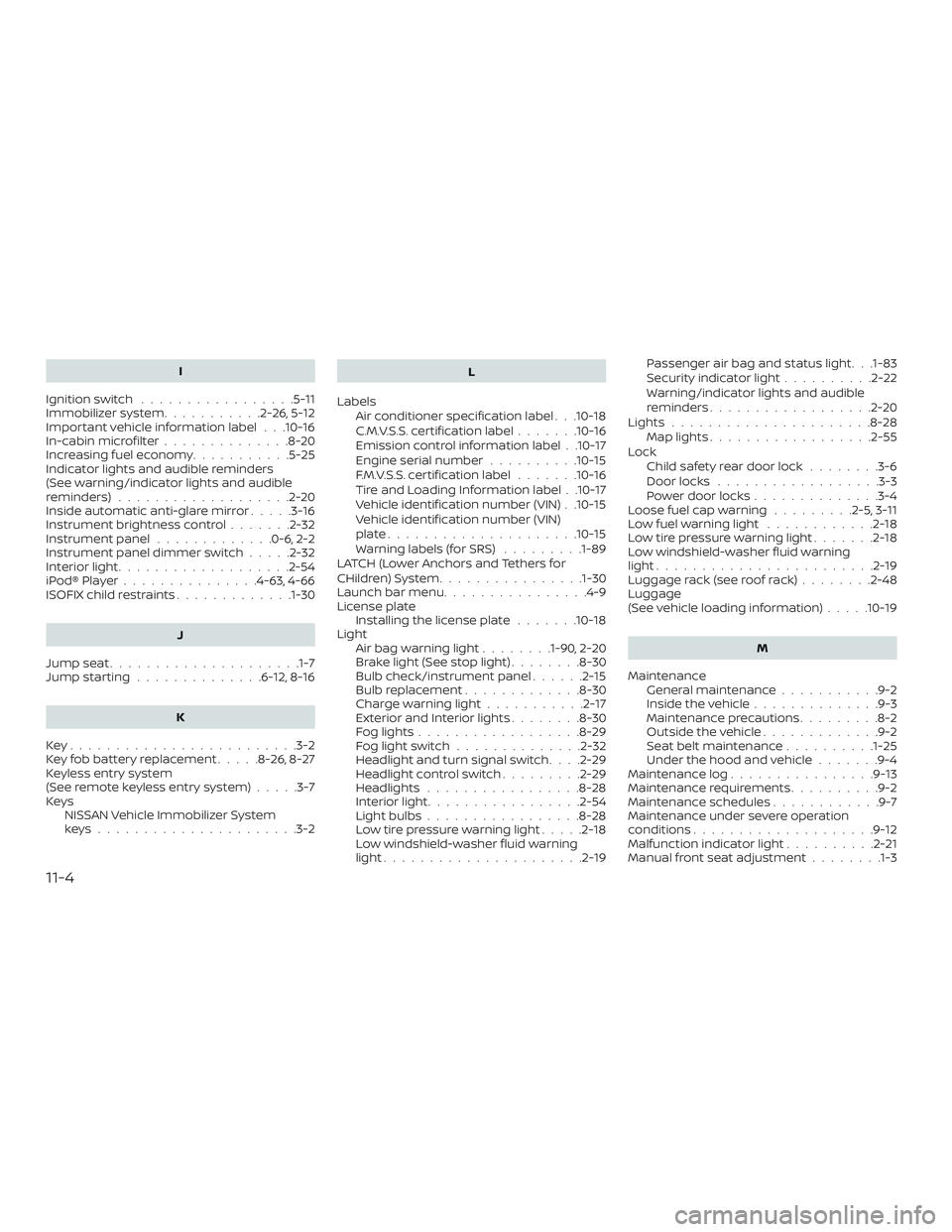
I
Ignition switch .................5-11
Immobilizer system ...........2-26,5-12
Important vehicle information label . . .10-16
In-cabinmicrofilter..............8-20
Increasing fuel economy ...........5-25
Indicator lights and audible reminders
(See warning/indicator lights and audible
reminders) ...................2-20
Inside automatic anti-glare mirror .....3-16
Instrument brightness control .......2-32
Instrument panel .............0-6,2-2
Instrument panel dimmer switch .....2-32
Interiorlight...................2-54
iPod®Player...............4-63,4-66
ISOFIX child restraints .............1-30
J
Jumpseat.....................1-7
Jumpstarting..............6-12,8-16
K
Key.........................3-2
Key fob battery replacement .....8-26,8-27
Keyless entry system
(See remote keyless entry system) .....3-7
Keys NISSAN Vehicle Immobilizer System
keys......................3-2 L
Labels Air conditioner specification label . . .10-18
C.M.V.S.S. certification label .......10-16
Emission control information label . .10-17
Engine serial number ..........10-15
F.M.V.S.S. certification label .......10-16
Tire and Loading Information label . .10-17
Vehicle identification number (VIN) . .10-15
Vehicle identification number (VIN)
plate.....................10-15
Warning labels (for SRS) .........1-89
LATCH (Lower Anchors and Tethers for
CHildren)System................1-30
Launch bar menu ................4-9
License plate Installing the license plate .......10-18
Light Airbagwarninglight........1-90, 2-20
Brakelight(Seestoplight)........8-30
Bulb check/instrument panel ......2-15
Bulb replacement .............8-30
Charge warning light ...........2-17
ExteriorandInteriorlights........8-30
Foglights..................8-29
Foglightswitch..............2-32
Headlight and turn signal switch ....2-29
Headlightcontrolswitch.........2-29
Headlights.................8-28
Interiorlight.................2-54
Lightbulbs.................8-28
Low tire pressure warning light .....2-18
Low windshield-washer fluid warning
light......................2-19 Passenger air bag and status light. . .1-83
Security indicator light
..........2-22
Warning/indicator lights and audible
reminders ..................2-20
Lights......................8-28 Maplights..................2-55
Lock Child safety rear door lock ........3-6
Door locks ..................3-3
Power door locks ..............3-4
Loose fuel cap warning .........2-5,3-11
Lowfuelwarninglight ........... .2-18
Low tire pressure warning light .......2-18
Low windshield-washer fluid warning
light........................2-19
Luggage rack (see roof rack) ........2-48
Luggage
(See vehicle loading information) .....10-19
M
Maintenance General maintenance ...........9-2
Insidethevehicle..............9-3
Maintenance precautions .........8-2
Outsidethevehicle.............9-2
Seat belt maintenance ..........1-25
Under the
hood and vehicle .......9-4
Maintenance log ................9-13
Maintenance requirements ..........9-2
Maintenance schedules ............9-7
Maintenance under severe operation
conditions....................9-12
Malfunctionindicatorlight..........2-21
Manual front seat adjustment ........1-3
11-4