transmission NISSAN FRONTIER 2019 Owner´s Manual
[x] Cancel search | Manufacturer: NISSAN, Model Year: 2019, Model line: FRONTIER, Model: NISSAN FRONTIER 2019Pages: 516, PDF Size: 5.04 MB
Page 377 of 516
WARNING
Be careful not to allow your hands, hair,
jewelry or clothing to come into contact
with, or get caught in, engine belts or
the engine cooling fan. The engine cool-
ing fan can start at any time.6. Af ter the engine cools down, check the coolant level in the engine coolant res-
ervoir tank with the engine running.
Add coolant to the engine coolant res-
ervoir tank if necessary. Have your ve-
hicle repaired. It is recommended that
you visit a NISSAN dealer for this ser-
vice. When towing your vehicle, all jurisdictional
and local regulations for towing must be
followed. Incorrect towing equipment
could damage your vehicle. Towing in-
structions are available from a NISSAN
dealer. Local service operators are gener-
ally familiar with the applicable laws and
procedures for towing. To assure proper
towing and to prevent accidental damage
to your vehicle, NISSAN recommends hav-
ing a service operator tow your vehicle. It is
advisable to have the service operator
carefully read the following precautions:
WARNING
∙ Never ride in a vehicle that is being
towed.
∙ Never get under your vehicle af ter it has been lif ted by a tow truck.
CAUTION
∙ When towing, make sure that thetransmission, axles, steering system
and powertrain are in working condi-
tion. If any of these conditions apply,
dollies or a flatbed tow truck must be
used.
∙ Always attach safety chains before towing. For additional information, refer to “Flat
towing — 4WD with automatic transmis-
sion,” “Flat towing — 2WD with automatic
transmission” and “Flat towing — 2WD/4WD
with manual transmission” in the “Technical
and consumer information” section of this
manual.
TOWING RECOMMENDED BY
NISSAN
NISSAN recommends towing your vehicle
based upon the type of drivetrain. For addi-
tional information, refer to the diagrams in
this section to ensure that your vehicle is
properly towed.
TOWING YOUR VEHICLE
In case of emergency6-15
Page 378 of 516
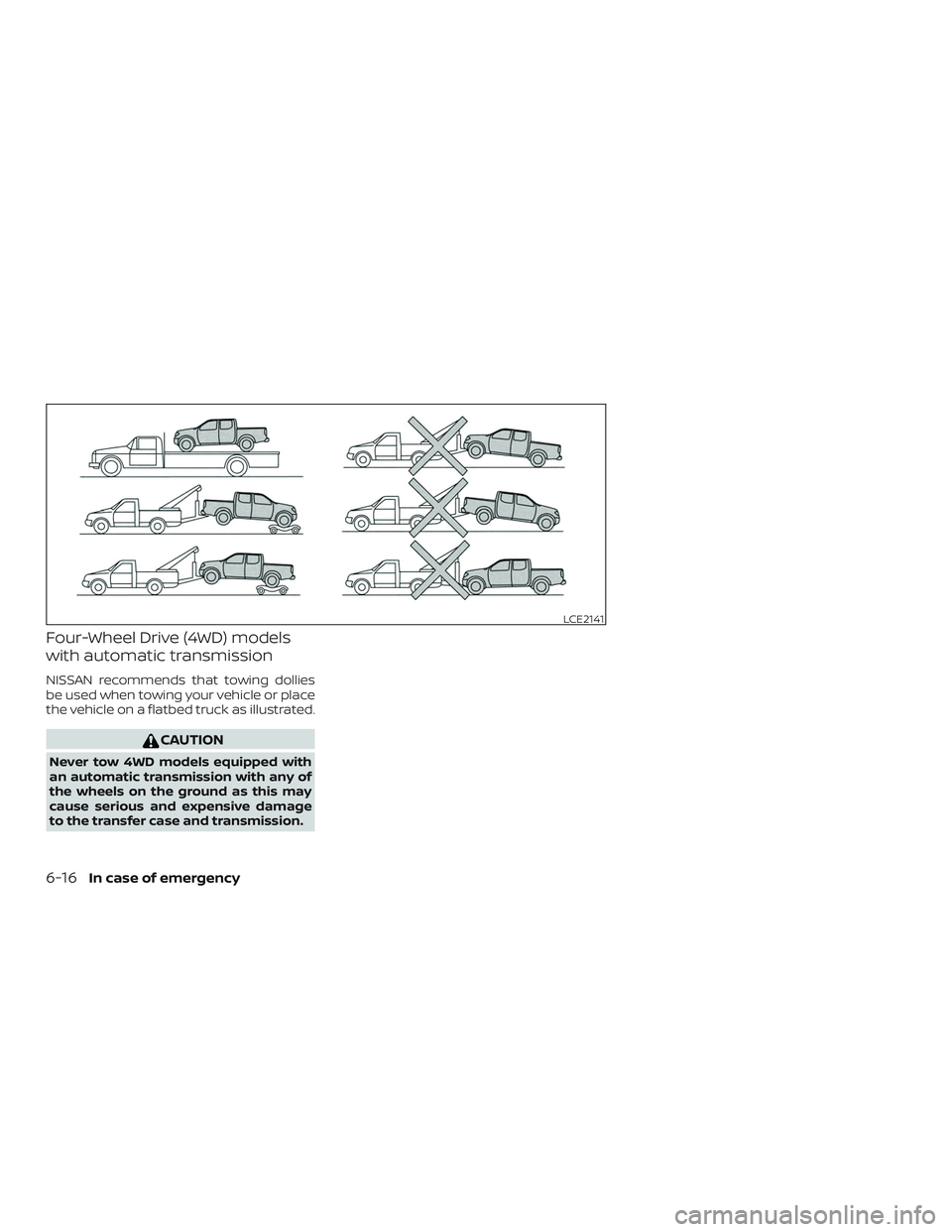
Four-Wheel Drive (4WD) models
with automatic transmission
NISSAN recommends that towing dollies
be used when towing your vehicle or place
the vehicle on a flatbed truck as illustrated.
CAUTION
Never tow 4WD models equipped with
an automatic transmission with any of
the wheels on the ground as this may
cause serious and expensive damage
to the transfer case and transmission.
LCE2141
6-16In case of emergency
Page 379 of 516
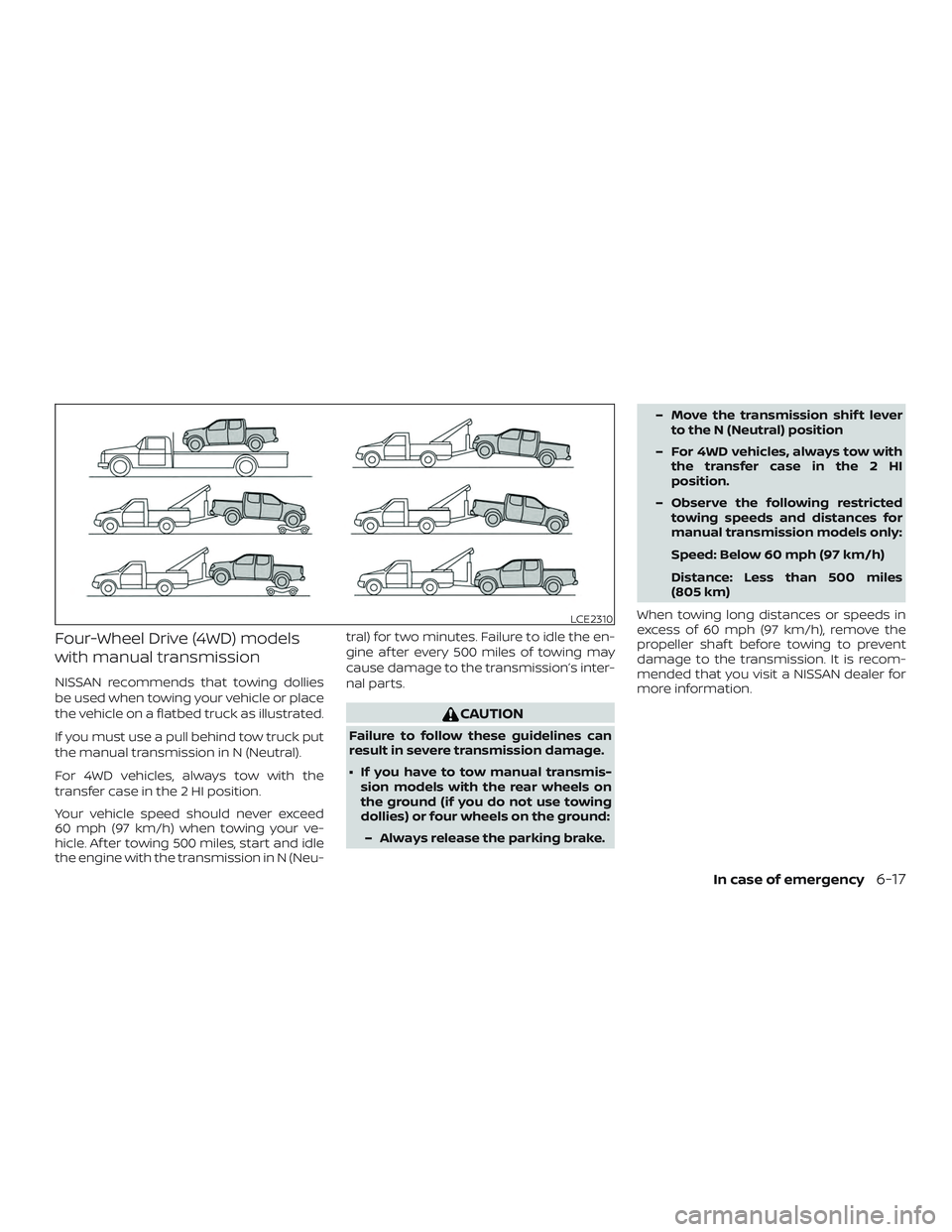
Four-Wheel Drive (4WD) models
with manual transmission
NISSAN recommends that towing dollies
be used when towing your vehicle or place
the vehicle on a flatbed truck as illustrated.
If you must use a pull behind tow truck put
the manual transmission in N (Neutral).
For 4WD vehicles, always tow with the
transfer case in the 2 HI position.
Your vehicle speed should never exceed
60 mph (97 km/h) when towing your ve-
hicle. Af ter towing 500 miles, start and idle
the engine with the transmission in N (Neu-tral) for two minutes. Failure to idle the en-
gine af ter every 500 miles of towing may
cause damage to the transmission’s inter-
nal parts.
CAUTION
Failure to follow these guidelines can
result in severe transmission damage.
∙ If you have to tow manual transmis-
sion models with the rear wheels on
the ground (if you do not use towing
dollies) or four wheels on the ground:
– Always release the parking brake. – Move the transmission shif t lever
to the N (Neutral) position
– For 4WD vehicles, always tow with the transfer case in the 2 HI
position.
– Observe the following restricted towing speeds and distances for
manual transmission models only:
Speed: Below 60 mph (97 km/h)
Distance: Less than 500 miles
(805 km)
When towing long distances or speeds in
excess of 60 mph (97 km/h), remove the
propeller shaf t before towing to prevent
damage to the transmission. It is recom-
mended that you visit a NISSAN dealer for
more information.
LCE2310
In case of emergency6-17
Page 380 of 516
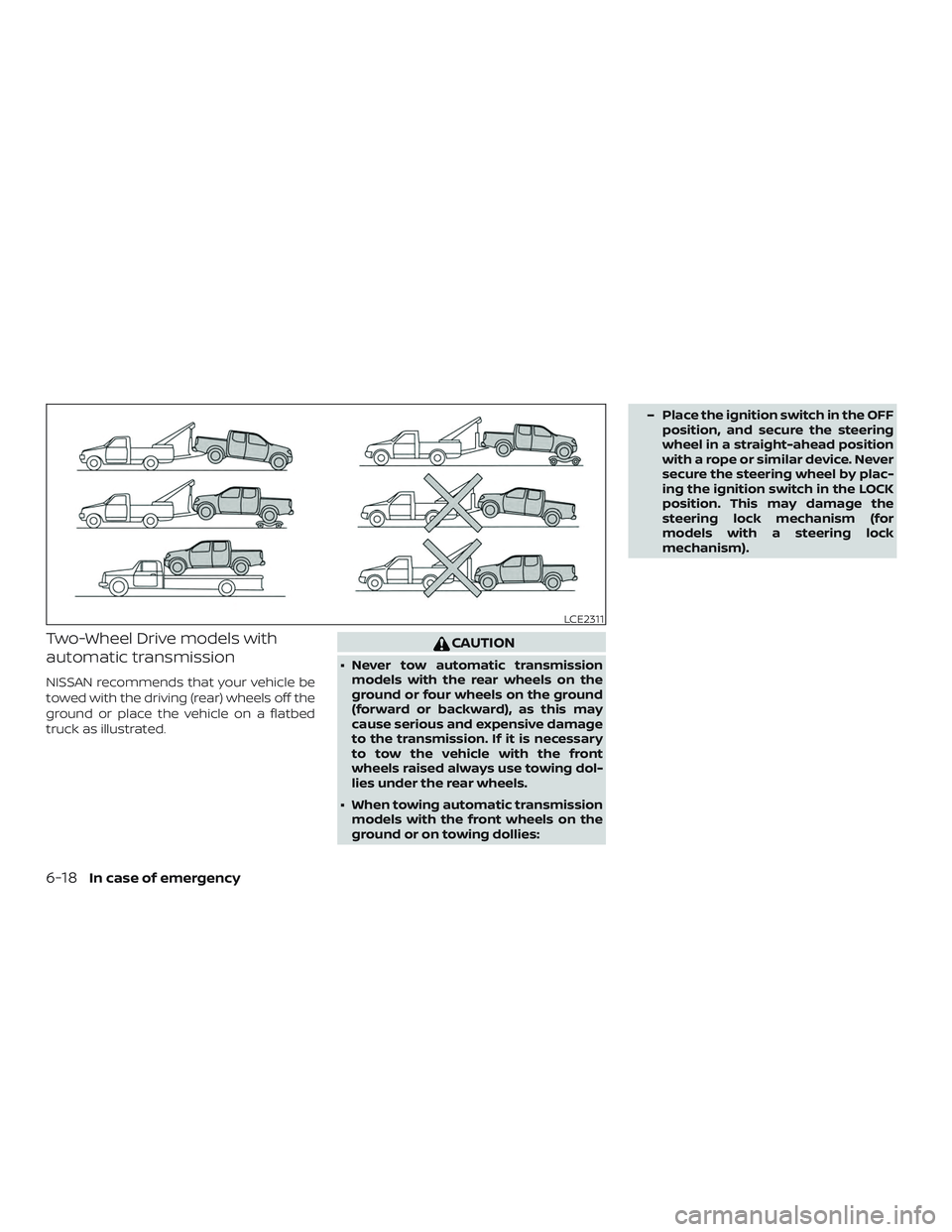
Two-Wheel Drive models with
automatic transmission
NISSAN recommends that your vehicle be
towed with the driving (rear) wheels off the
ground or place the vehicle on a flatbed
truck as illustrated.
CAUTION
∙ Never tow automatic transmissionmodels with the rear wheels on the
ground or four wheels on the ground
(forward or backward), as this may
cause serious and expensive damage
to the transmission. If it is necessary
to tow the vehicle with the front
wheels raised always use towing dol-
lies under the rear wheels.
∙ When towing automatic transmission models with the front wheels on the
ground or on towing dollies: – Place the ignition switch in the OFF
position, and secure the steering
wheel in a straight-ahead position
with a rope or similar device. Never
secure the steering wheel by plac-
ing the ignition switch in the LOCK
position. This may damage the
steering lock mechanism (for
models with a steering lock
mechanism).
LCE2311
6-18In case of emergency
Page 381 of 516
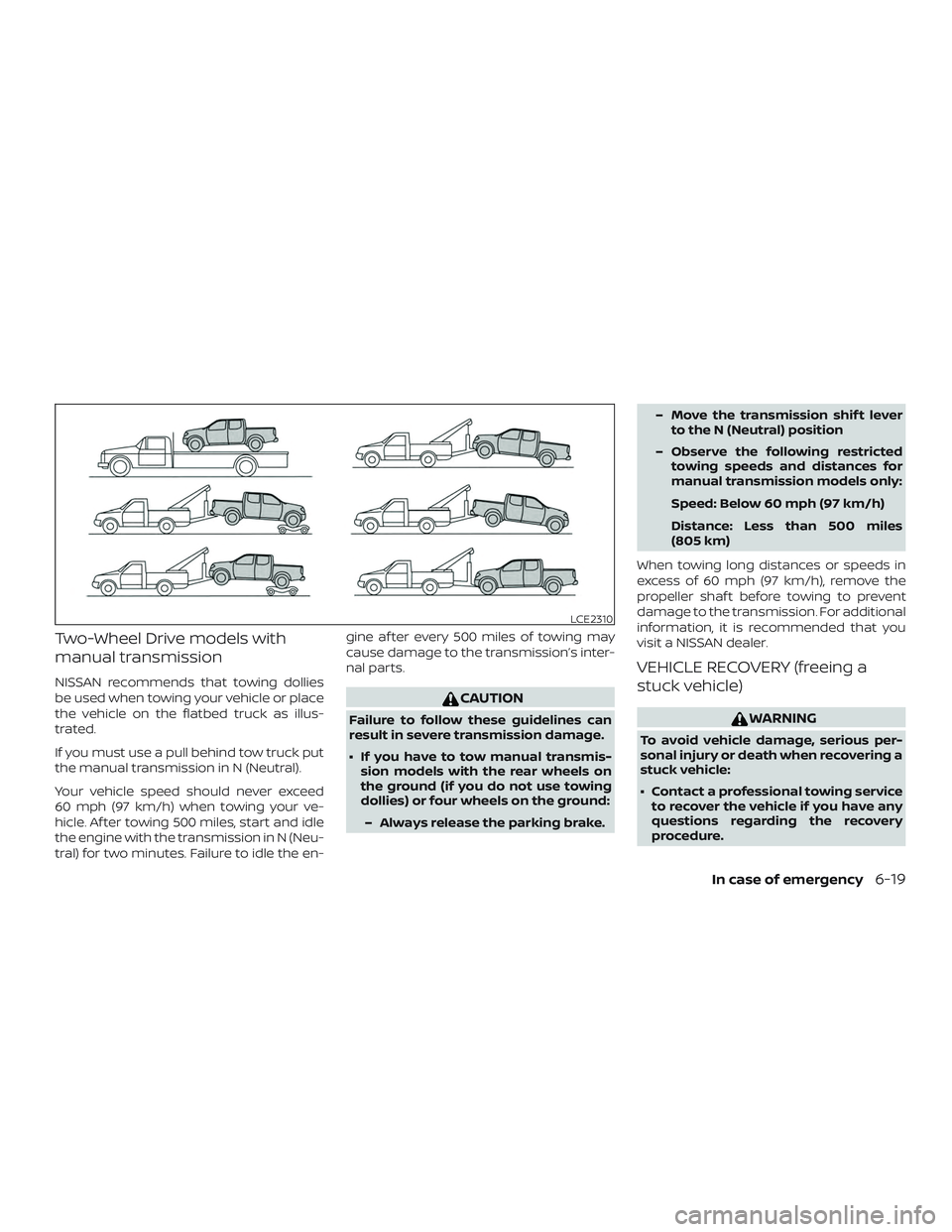
Two-Wheel Drive models with
manual transmission
NISSAN recommends that towing dollies
be used when towing your vehicle or place
the vehicle on the flatbed truck as illus-
trated.
If you must use a pull behind tow truck put
the manual transmission in N (Neutral).
Your vehicle speed should never exceed
60 mph (97 km/h) when towing your ve-
hicle. Af ter towing 500 miles, start and idle
the engine with the transmission in N (Neu-
tral) for two minutes. Failure to idle the en-gine af ter every 500 miles of towing may
cause damage to the transmission’s inter-
nal parts.
CAUTION
Failure to follow these guidelines can
result in severe transmission damage.
∙ If you have to tow manual transmis-
sion models with the rear wheels on
the ground (if you do not use towing
dollies) or four wheels on the ground:
– Always release the parking brake. – Move the transmission shif t lever
to the N (Neutral) position
– Observe the following restricted towing speeds and distances for
manual transmission models only:
Speed: Below 60 mph (97 km/h)
Distance: Less than 500 miles
(805 km)
When towing long distances or speeds in
excess of 60 mph (97 km/h), remove the
propeller shaf t before towing to prevent
damage to the transmission. For additional
information, it is recommended that you
visit a NISSAN dealer.
VEHICLE RECOVERY (freeing a
stuck vehicle)
WARNING
To avoid vehicle damage, serious per-
sonal injury or death when recovering a
stuck vehicle:
∙ Contact a professional towing service to recover the vehicle if you have any
questions regarding the recovery
procedure.
LCE2310
In case of emergency6-19
Page 382 of 516
∙ Tow chains or cables must be at-tached only to main structural mem-
bers of the vehicle.
∙ Do not use the vehicle tie-downs to tow or free a stuck vehicle.
∙ Only use devices specifically designed for vehicle recovery and follow the
manufacturer’s instructions.
∙ Always pull the recovery device straight out from the front of the ve-
hicle. Never pull at an angle.
∙ Route recovery devices so they do not touch any part of the vehicle except
the attachment point.
If your vehicle is stuck in sand, snow, mud,
etc., use a tow strap or other device de-
signed specifically for vehicle recovery. Al-
ways follow the manufacturer’s instruc-
tions for the recovery device.Rocking a stuck vehicle
WARNING
∙ Stand clear of a stuck vehicle.
∙ Do not spin your tires at high speed. This could cause them to explode and
result in serious injury. Parts of your
vehicle could also overheat and be
damaged.
If your vehicle is stuck in sand, snow, mud,
etc., use the following procedure: 1. Turn off the Vehicle Dynamic Control (VDC) system.
2. Make sure the area in front and behind the vehicle is clear of obstructions.
3. Turn the steering wheel right and lef t to clear an area around the front tires.
4. Slowly rock the vehicle forward and backward.
∙ Shif t back and forth between R (Re- verse) and D (Drive) (automatic trans-
mission models) or 1st (Low) and R
(Reverse) (manual transmission
models). ∙ Apply the accelerator as little as pos-
sible to maintain the rocking motion.
∙ Release the accelerator pedal before shif ting between R and D (automatic
transmission models) or 1st and R
(manual transmission models).
∙ Do not spin the tires above 34 mph (55 km/h).
5. If the vehicle cannot be freed af ter a few tries, contact a professional towing
service to remove the vehicle.
6-20In case of emergency
Page 388 of 516
FLOOR MATS (if so equipped)
WARNING
To avoid potential pedal interference
that may result in a collision, injury or
death:
∙ NEVER place a floor mat on top of an-other floor mat in the driver front po-
sition or install them upside down or
backwards.
∙ Use only Genuine NISSAN floor mats, or equivalent floor mats, that are spe-
cifically designed for use in your ve-
hicle model and model year. ∙ Properly position the mats in the
floorwell using the floor mat position-
ing hook. For additional information,
refer to "Floor mat installation" in this
section.
∙ Make sure the floor mat does not in- terfere with pedal operation.
∙ Periodically check the floor mats to make sure they are properly installed.
∙ Af ter cleaning the vehicle interior, check the floor mats to make sure
they are properly installed.
The use of Genuine NISSAN floor mats can
extend the life of your vehicle carpet and
make it easier to clean the interior. Mats
should be maintained with regular clean-
ing and replaced if they become exces-
sively worn.
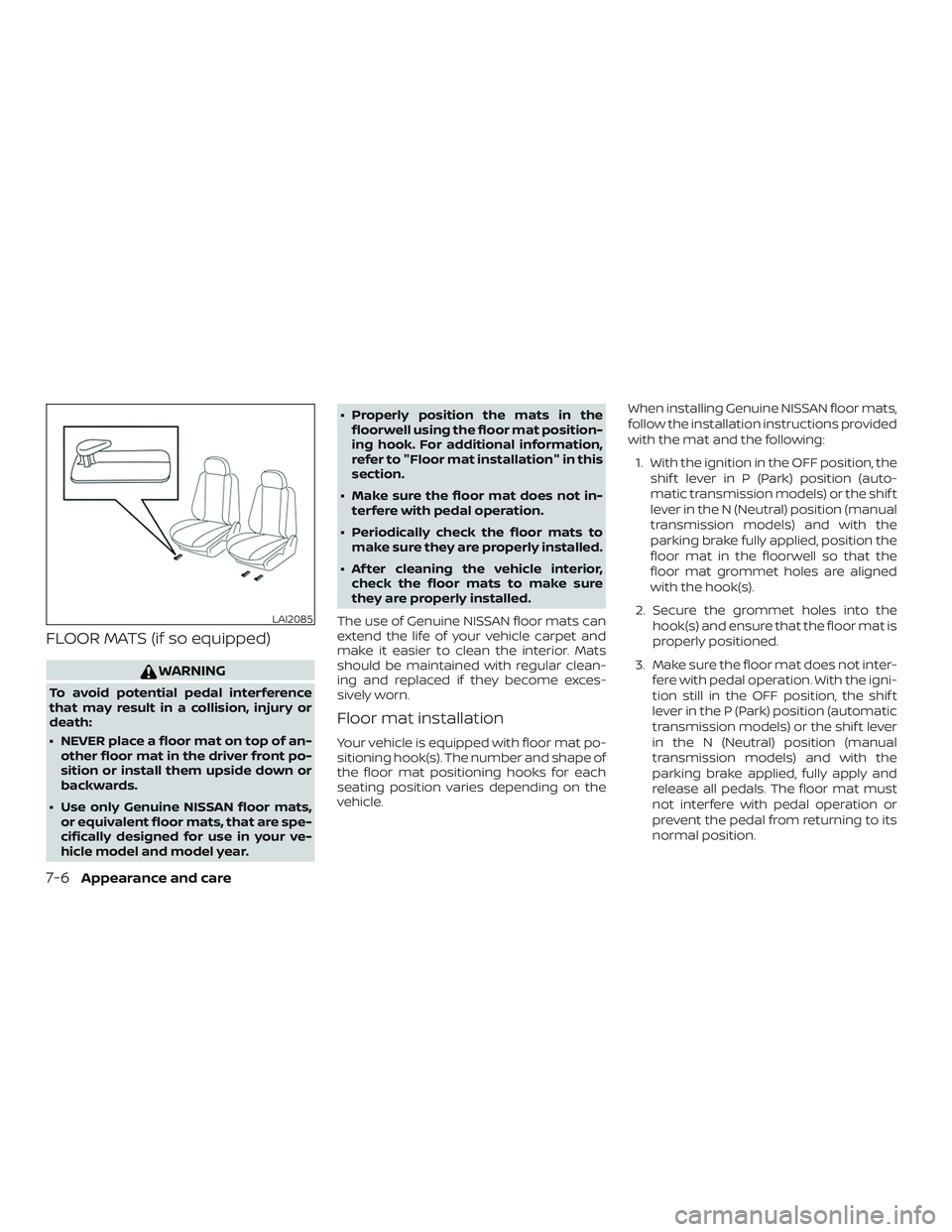
Floor mat installation
Your vehicle is equipped with floor mat po-
sitioning hook(s). The number and shape of
the floor mat positioning hooks for each
seating position varies depending on the
vehicle. When installing Genuine NISSAN floor mats,
follow the installation instructions provided
with the mat and the following:
1. With the ignition in the OFF position, the shif t lever in P (Park) position (auto-
matic transmission models) or the shif t
lever in the N (Neutral) position (manual
transmission models) and with the
parking brake fully applied, position the
floor mat in the floorwell so that the
floor mat grommet holes are aligned
with the hook(s).
2. Secure the grommet holes into the hook(s) and ensure that the floor mat is
properly positioned.
3. Make sure the floor mat does not inter- fere with pedal operation. With the igni-
tion still in the OFF position, the shif t
lever in the P (Park) position (automatic
transmission models) or the shif t lever
in the N (Neutral) position (manual
transmission models) and with the
parking brake applied, fully apply and
release all pedals. The floor mat must
not interfere with pedal operation or
prevent the pedal from returning to its
normal position.
LAI2085
7-6Appearance and care
Page 391 of 516
8 Do-it-yourself
Maintenance precautions.......................8-2
Engine compartment check locations ...........8-3
Engine cooling system ..........................8-5
Checking engine coolant level ................8-6
Changing engine coolant .....................8-6
Engine oil ........................................8-7
Checking engine oil level .....................8-7
Changing engine oil and oil filter ..............8-8
5-speed Automatic Transmission
(if so equipped) Fluid (ATF) ......................8-12
Power Steering Fluid (PSF) ......................8-12
Brake and clutch (if so equipped) fluid ..........8-13
Brake fluid ................................... 8-13
Clutch (if so equipped) fluid ..................8-14
Windshield-washer fluid ........................8-14
Windshield-washer fluid reservoir ............8-14
Battery......................................... 8-15
Jump starting ............................... 8-16
Variable voltage control system ................8-17
Drive belt ....................................... 8-17
Spark plugs .................................... 8-18
Replacing spark plugs .......................8-18Air cleaner
...................................... 8-19
In-cabin microfilter .......................... 8-20
Windshield wiper blades ........................8-21
Cleaning .................................... 8-21
Replacing ................................... 8-21
Brakes.......................................... 8-22
Fuses ........................................... 8-23
Engine compartment .......................8-24
Passenger compartment ....................8-25
Battery replacement ........................... 8-26
Key fob (if so equipped) ......................8-27
Lights .......................................... 8-28
Headlights ................................... 8-28
Fog lights (if so equipped) ...................8-29
Exterior and interior lights ...................8-30
Wheels and tires ................................ 8-33
Tir e
pressure ................................ 8-33
Tire labeling ................................. 8-36
Types of tires ................................ 8-39
Tire chains .................................. 8-40
Changing wheels and tires ..................8-41
Page 392 of 516
When performing any inspection or main-
tenance work on your vehicle, always take
care to prevent serious accidental injury to
yourself or damage to the vehicle. The fol-
lowing are general precautions which
should be closely observed.
WARNING
∙Park the vehicle on a level surface, ap-
ply the parking brake securely and
block the wheels to prevent the vehicle
from moving. For manual transmission
models, move the shif t lever to N (Neu-
tral). For Automatic Transmission (A/T)
move the shif t lever to P (Park)
∙ Be sure the ignition key is in the OFF orLOCK position when performing any
parts replacement or repairs.
∙ If you must work with the engine run- ning, keep your hands, clothing, hair
and tools away from moving fans,
belts and any other moving parts.
∙ It is advisable to secure or remove any loose clothing and remove any jew-
elry, such as rings, watches, etc. be-
fore working on your vehicle.
∙ Always wear eye protection whenever you work on your vehicle. ∙ If you must run the engine in an en-
closed space such as a garage, be sure
there is proper ventilation for exhaust
gases to escape.
∙ Never get under the vehicle while it is supported only by a jack. If it is neces-
sary to work under the vehicle, sup-
port it with safety stands.
∙ Keep smoking materials, flame and sparks away from the fuel tank and
battery.
∙ On gasoline engine models, the fuel filter or fuel lines should be serviced
because the fuel lines are under high
pressure even when the engine is off.
It is recommended that you visit a
NISSAN dealer for this service.
CAUTION
∙ Do not work under the hood while theengine is hot. Turn the engine off and
wait until it cools down.
∙
Avoid contact with used engine oil and
coolant. Improperly disposed engine
oil, engine coolant and/or other vehicle
fluids can damage the environment. Al-
ways conform to local regulations for
disposal of vehicle fluid.
∙ Never leave the engine or the trans- mission related component harness
connector disconnected while the ig-
nition switch is in the ON position.
∙ Never connect or disconnect the bat- tery or any transistorized component
while the ignition switch is in the ON
position.
This “Do-it-yourself ” section gives instruc-
tions regarding only those items which are
relatively easy for an owner to perform.
A Genuine NISSAN service manual is also
available. For additional information, refer
to “Owner’s Manual/Service Manual order
information” in the “Technical and con-
sumer information” section of this manual.
You should be aware that incomplete or
improper servicing may result in operating
difficulties or excessive emissions, and
could affect warranty coverage. If in doubt
about any servicing, it is recommended
that you have it done by a NISSAN dealer.
MAINTENANCE PRECAUTIONS
8-2Do-it-yourself
Page 402 of 516
Af ter the operation
1. Reinstall plate in reverse order of re-moval.
2. Lower the vehicle carefully to the ground.
∙ Dispose of waste oil and filter properly.
∙ Check your local regulations. When checking or replacement is required,
it is recommend that you visit a NISSAN
dealer for this service.
CAUTION
∙ Use Genuine NISSAN Matic S ATF. If
Genuine NISSAN Matic S ATF is not
available, Genuine NISSAN Matic J ATF
may also be used.
∙ Using automatic transmission fluid other than Genuine NISSAN Matic S
ATF or Matic J ATF (or their equiva-
lents) will cause deterioration in
driveability and automatic transmis-
sion durability, and may damage the
automatic transmission, which is not
covered by the NISSAN New Vehicle
Limited Warranty.
The specified automatic transmission fluid
is also described on caution labels located
in the engine compartment. The fluid level should be checked using the
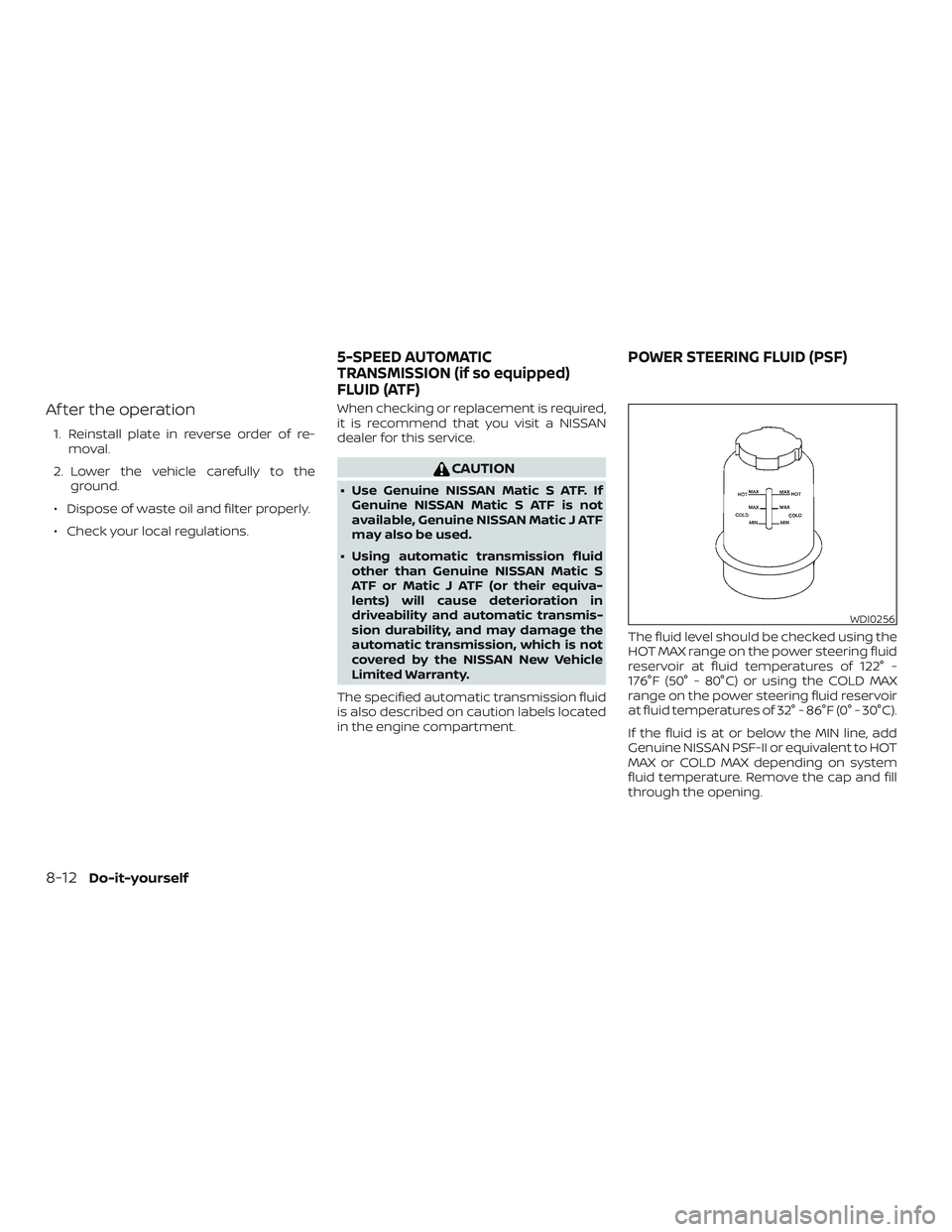
HOT MAX range on the power steering fluid
reservoir at fluid temperatures of 122° -
176°F (50° - 80°C) or using the COLD MAX
range on the power steering fluid reservoir
at fluid temperatures of 32° - 86°F (0° - 30°C).
If the fluid is at or below the MIN line, add
Genuine NISSAN PSF-II or equivalent to HOT
MAX or COLD MAX depending on system
fluid temperature. Remove the cap and fill
through the opening.
WDI0256
5-SPEED AUTOMATIC
TRANSMISSION (if so equipped)
FLUID (ATF)
POWER STEERING FLUID (PSF)
8-12Do-it-yourself