belt NISSAN FRONTIER 2022 Owner´s Manual
[x] Cancel search | Manufacturer: NISSAN, Model Year: 2022, Model line: FRONTIER, Model: NISSAN FRONTIER 2022Pages: 556, PDF Size: 6.11 MB
Page 489 of 556
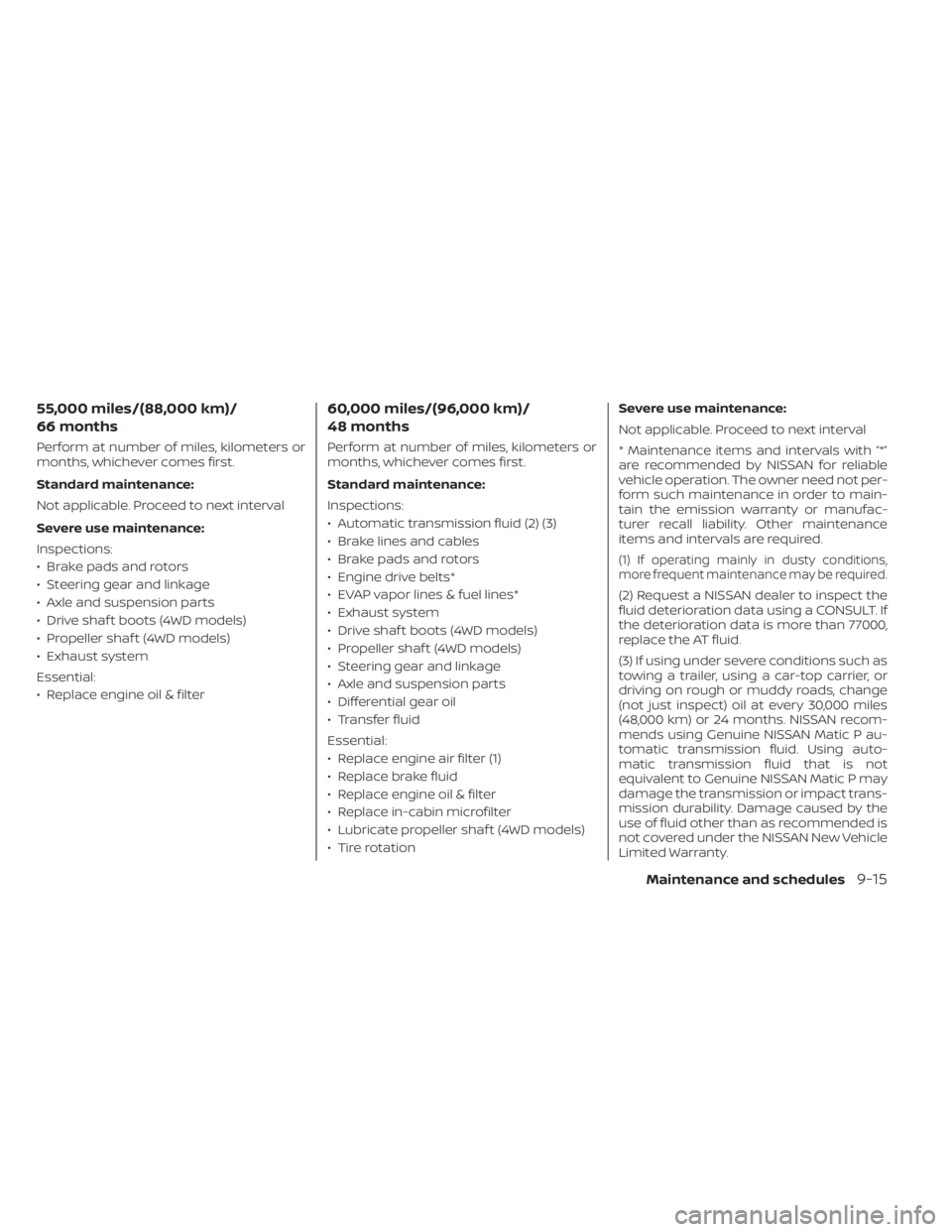
55,000 miles/(88,000 km)/
66 months
Perform at number of miles, kilometers or
months, whichever comes first.
Standard maintenance:
Not applicable. Proceed to next interval
Severe use maintenance:
Inspections:
• Brake pads and rotors
• Steering gear and linkage
• Axle and suspension parts
• Drive shaf t boots (4WD models)
• Propeller shaf t (4WD models)
• Exhaust system
Essential:
• Replace engine oil & filter
60,000 miles/(96,000 km)/
48 months
Perform at number of miles, kilometers or
months, whichever comes first.
Standard maintenance:
Inspections:
• Automatic transmission fluid (2) (3)
• Brake lines and cables
• Brake pads and rotors
• Engine drive belts*
• EVAP vapor lines & fuel lines*
• Exhaust system
• Drive shaf t boots (4WD models)
• Propeller shaf t (4WD models)
• Steering gear and linkage
• Axle and suspension parts
• Differential gear oil
• Transfer fluid
Essential:
• Replace engine air filter (1)
• Replace brake fluid
• Replace engine oil & filter
• Replace in-cabin microfilter
• Lubricate propeller shaf t (4WD models)
• Tire rotationSevere use maintenance:
Not applicable. Proceed to next interval
* Maintenance items and intervals with “*”
are recommended by NISSAN for reliable
vehicle operation. The owner need not per-
form such maintenance in order to main-
tain the emission warranty or manufac-
turer recall liability. Other maintenance
items and intervals are required.
(1) If operating mainly in dusty conditions,
more frequent maintenance may be required.
(2) Request a NISSAN dealer to inspect the
fluid deterioration data using a CONSULT. If
the deterioration data is more than 77000,
replace the AT fluid.
(3) If using under severe conditions such as
towing a trailer, using a car-top carrier, or
driving on rough or muddy roads, change
(not just inspect) oil at every 30,000 miles
(48,000 km) or 24 months. NISSAN recom-
mends using Genuine NISSAN Matic P au-
tomatic transmission fluid. Using auto-
matic transmission fluid that is not
equivalent to Genuine NISSAN Matic P may
damage the transmission or impact trans-
mission durability. Damage caused by the
use of fluid other than as recommended is
not covered under the NISSAN New Vehicle
Limited Warranty.
Maintenance and schedules9-15
Page 491 of 556
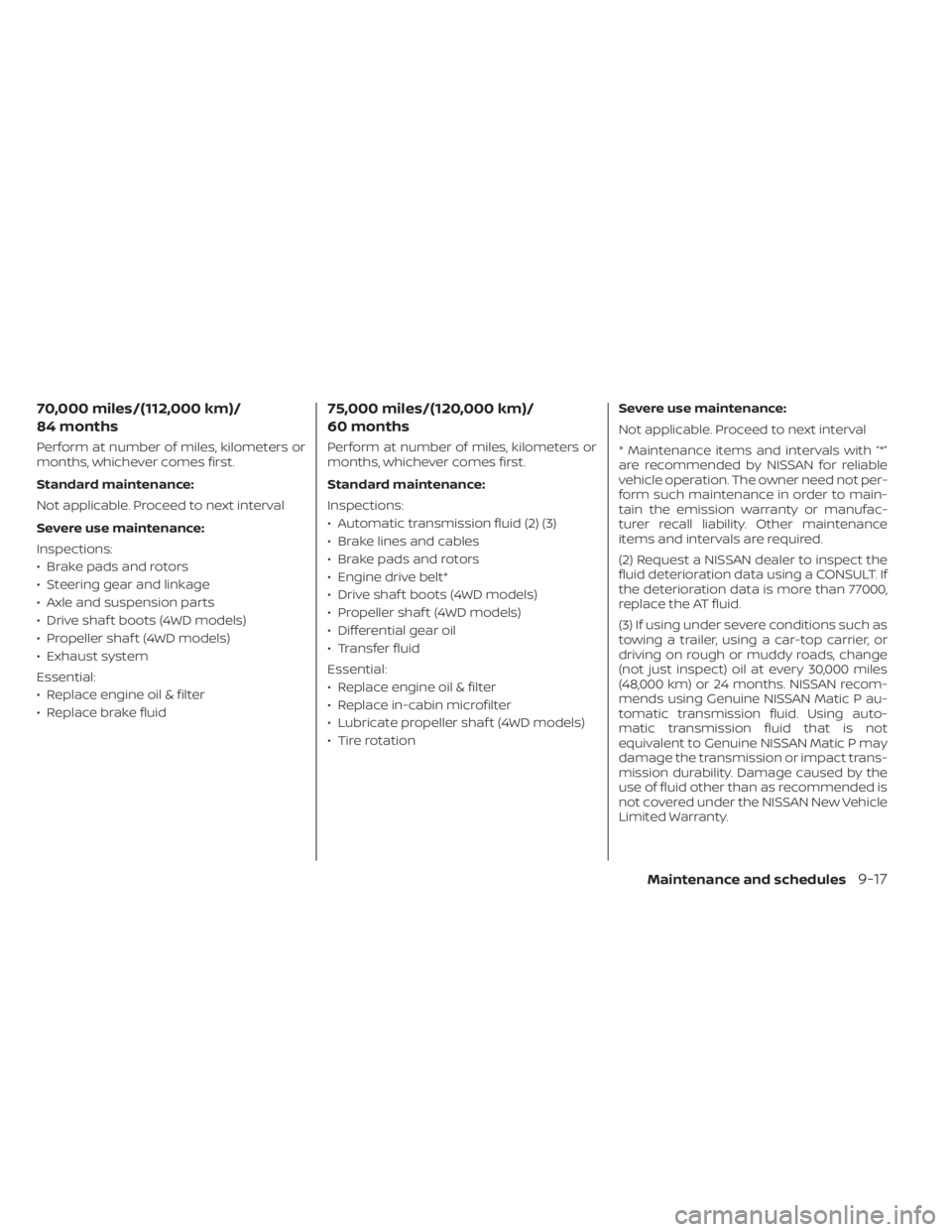
70,000 miles/(112,000 km)/
84 months
Perform at number of miles, kilometers or
months, whichever comes first.
Standard maintenance:
Not applicable. Proceed to next interval
Severe use maintenance:
Inspections:
• Brake pads and rotors
• Steering gear and linkage
• Axle and suspension parts
• Drive shaf t boots (4WD models)
• Propeller shaf t (4WD models)
• Exhaust system
Essential:
• Replace engine oil & filter
• Replace brake fluid
75,000 miles/(120,000 km)/
60 months
Perform at number of miles, kilometers or
months, whichever comes first.
Standard maintenance:
Inspections:
• Automatic transmission fluid (2) (3)
• Brake lines and cables
• Brake pads and rotors
• Engine drive belt*
• Drive shaf t boots (4WD models)
• Propeller shaf t (4WD models)
• Differential gear oil
• Transfer fluid
Essential:
• Replace engine oil & filter
• Replace in-cabin microfilter
• Lubricate propeller shaf t (4WD models)
• Tire rotationSevere use maintenance:
Not applicable. Proceed to next interval
* Maintenance items and intervals with “*”
are recommended by NISSAN for reliable
vehicle operation. The owner need not per-
form such maintenance in order to main-
tain the emission warranty or manufac-
turer recall liability. Other maintenance
items and intervals are required.
(2) Request a NISSAN dealer to inspect the
fluid deterioration data using a CONSULT. If
the deterioration data is more than 77000,
replace the AT fluid.
(3) If using under severe conditions such as
towing a trailer, using a car-top carrier, or
driving on rough or muddy roads, change
(not just inspect) oil at every 30,000 miles
(48,000 km) or 24 months. NISSAN recom-
mends using Genuine NISSAN Matic P au-
tomatic transmission fluid. Using auto-
matic transmission fluid that is not
equivalent to Genuine NISSAN Matic P may
damage the transmission or impact trans-
mission durability. Damage caused by the
use of fluid other than as recommended is
not covered under the NISSAN New Vehicle
Limited Warranty.
Maintenance and schedules9-17
Page 493 of 556
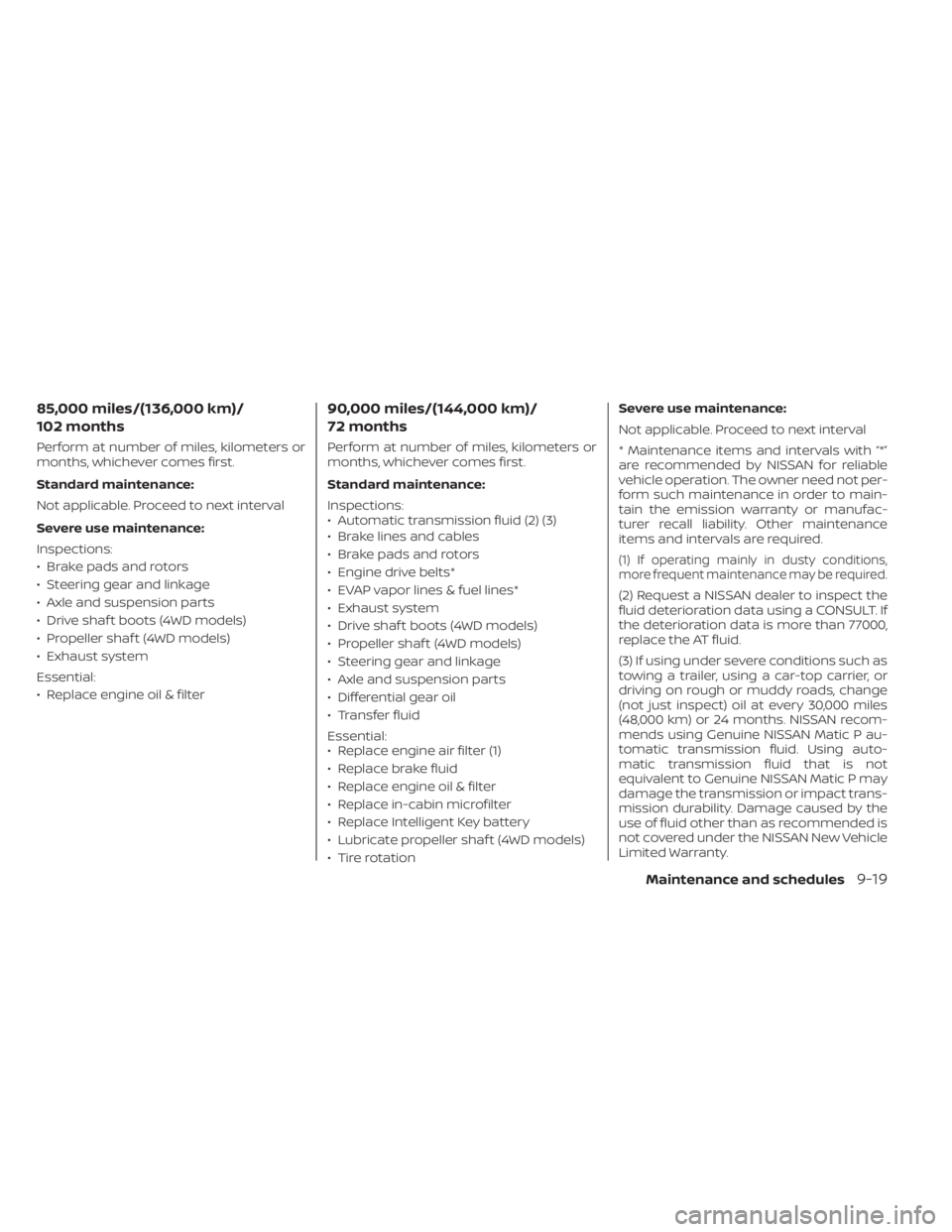
85,000 miles/(136,000 km)/
102 months
Perform at number of miles, kilometers or
months, whichever comes first.
Standard maintenance:
Not applicable. Proceed to next interval
Severe use maintenance:
Inspections:
• Brake pads and rotors
• Steering gear and linkage
• Axle and suspension parts
• Drive shaf t boots (4WD models)
• Propeller shaf t (4WD models)
• Exhaust system
Essential:
• Replace engine oil & filter
90,000 miles/(144,000 km)/
72 months
Perform at number of miles, kilometers or
months, whichever comes first.
Standard maintenance:
Inspections:
• Automatic transmission fluid (2) (3)
• Brake lines and cables
• Brake pads and rotors
• Engine drive belts*
• EVAP vapor lines & fuel lines*
• Exhaust system
• Drive shaf t boots (4WD models)
• Propeller shaf t (4WD models)
• Steering gear and linkage
• Axle and suspension parts
• Differential gear oil
• Transfer fluid
Essential:
• Replace engine air filter (1)
• Replace brake fluid
• Replace engine oil & filter
• Replace in-cabin microfilter
• Replace Intelligent Key battery
• Lubricate propeller shaf t (4WD models)
• Tire rotationSevere use maintenance:
Not applicable. Proceed to next interval
* Maintenance items and intervals with “*”
are recommended by NISSAN for reliable
vehicle operation. The owner need not per-
form such maintenance in order to main-
tain the emission warranty or manufac-
turer recall liability. Other maintenance
items and intervals are required.
(1) If operating mainly in dusty conditions,
more frequent maintenance may be required.
(2) Request a NISSAN dealer to inspect the
fluid deterioration data using a CONSULT. If
the deterioration data is more than 77000,
replace the AT fluid.
(3) If using under severe conditions such as
towing a trailer, using a car-top carrier, or
driving on rough or muddy roads, change
(not just inspect) oil at every 30,000 miles
(48,000 km) or 24 months. NISSAN recom-
mends using Genuine NISSAN Matic P au-
tomatic transmission fluid. Using auto-
matic transmission fluid that is not
equivalent to Genuine NISSAN Matic P may
damage the transmission or impact trans-
mission durability. Damage caused by the
use of fluid other than as recommended is
not covered under the NISSAN New Vehicle
Limited Warranty.
Maintenance and schedules9-19
Page 495 of 556
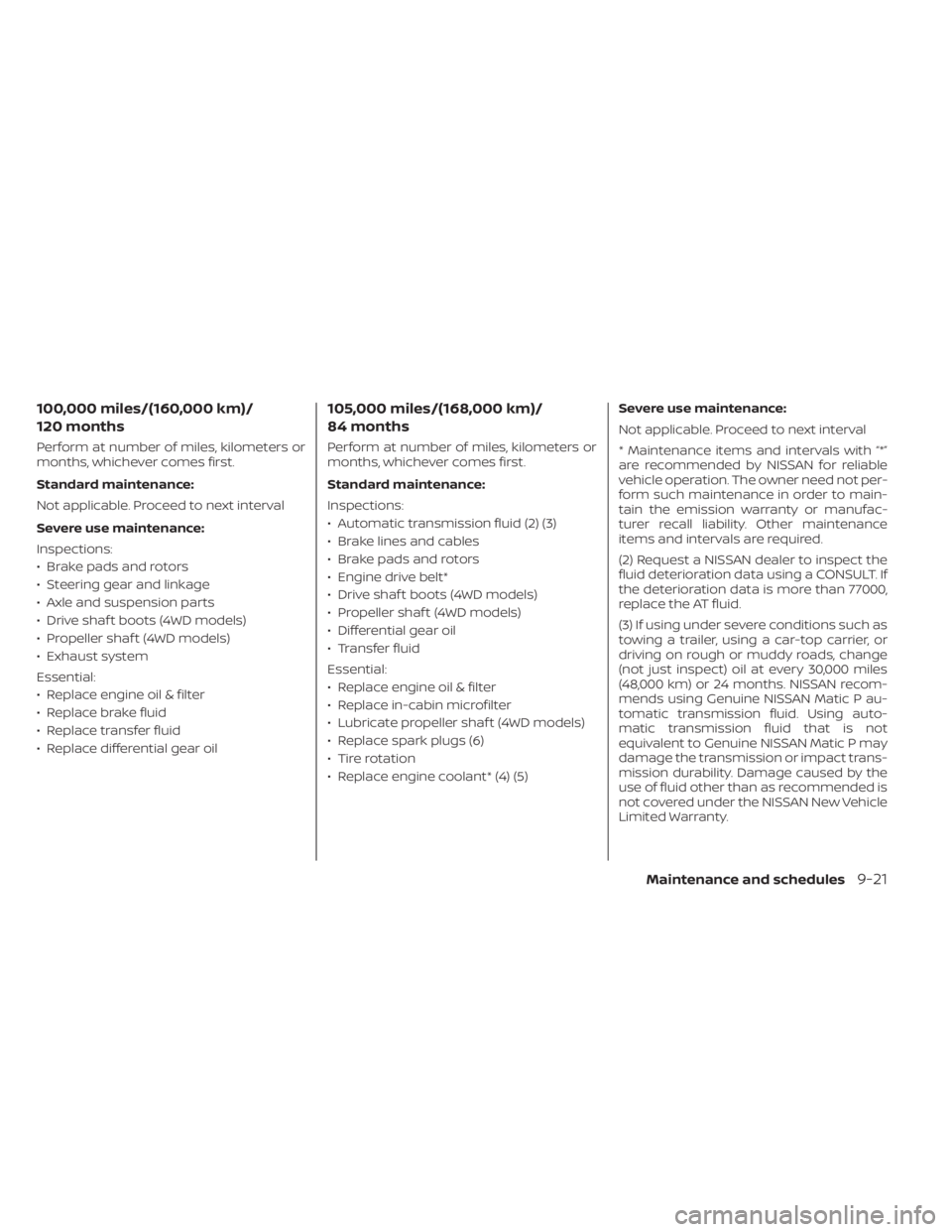
100,000 miles/(160,000 km)/
120 months
Perform at number of miles, kilometers or
months, whichever comes first.
Standard maintenance:
Not applicable. Proceed to next interval
Severe use maintenance:
Inspections:
• Brake pads and rotors
• Steering gear and linkage
• Axle and suspension parts
• Drive shaf t boots (4WD models)
• Propeller shaf t (4WD models)
• Exhaust system
Essential:
• Replace engine oil & filter
• Replace brake fluid
• Replace transfer fluid
• Replace differential gear oil
105,000 miles/(168,000 km)/
84 months
Perform at number of miles, kilometers or
months, whichever comes first.
Standard maintenance:
Inspections:
• Automatic transmission fluid (2) (3)
• Brake lines and cables
• Brake pads and rotors
• Engine drive belt*
• Drive shaf t boots (4WD models)
• Propeller shaf t (4WD models)
• Differential gear oil
• Transfer fluid
Essential:
• Replace engine oil & filter
• Replace in-cabin microfilter
• Lubricate propeller shaf t (4WD models)
• Replace spark plugs (6)
• Tire rotation
• Replace engine coolant* (4) (5)Severe use maintenance:
Not applicable. Proceed to next interval
* Maintenance items and intervals with “*”
are recommended by NISSAN for reliable
vehicle operation. The owner need not per-
form such maintenance in order to main-
tain the emission warranty or manufac-
turer recall liability. Other maintenance
items and intervals are required.
(2) Request a NISSAN dealer to inspect the
fluid deterioration data using a CONSULT. If
the deterioration data is more than 77000,
replace the AT fluid.
(3) If using under severe conditions such as
towing a trailer, using a car-top carrier, or
driving on rough or muddy roads, change
(not just inspect) oil at every 30,000 miles
(48,000 km) or 24 months. NISSAN recom-
mends using Genuine NISSAN Matic P au-
tomatic transmission fluid. Using auto-
matic transmission fluid that is not
equivalent to Genuine NISSAN Matic P may
damage the transmission or impact trans-
mission durability. Damage caused by the
use of fluid other than as recommended is
not covered under the NISSAN New Vehicle
Limited Warranty.
Maintenance and schedules9-21
Page 497 of 556
112,500 miles/(180,000 km)/
90 months
Perform at number of miles, kilometers or
months, whichever comes first.
Standard maintenance:
Essential:
• Replace engine oil & filter
• Replace Intelligent Key battery
• Tire rotation
Severe use maintenance:
Not applicable. Proceed to next interval
115,000 miles/(184,000 km)/
138 months
Perform at number of miles, kilometers or
months, whichever comes first.
Standard maintenance:
Not applicable. Proceed to next interval
Severe use maintenance:
Inspections:
• Brake pads and rotors
• Steering gear and linkage
• Axle and suspension parts
• Drive shaf t boots (4WD models)
• Propeller shaf t (4WD models)
• Exhaust system
Essential:
• Replace engine oil & filter
120,000 miles/(192,000 km)/
96 months
Perform at number of miles, kilometers or
months, whichever comes first.
Standard maintenance:
Inspections:
• Automatic transmission fluid (2) (3)
• Brake lines and cables
• Brake pads and rotors
• Engine drive belts*
• EVAP vapor lines & fuel lines*
• Exhaust system
• Drive shaf t boots (4WD models)
• Propeller shaf t (4WD models)
• Steering gear and linkage
• Axle and suspension parts
• Differential gear oil
• Transfer fluid
Essential:
• Replace engine air filter (1)
• Replace brake fluid
• Replace engine oil & filter
• Replace in-cabin microfilter
• Lubricate propeller shaf t (4WD models)
• Tire rotation
Maintenance and schedules9-23
Page 511 of 556
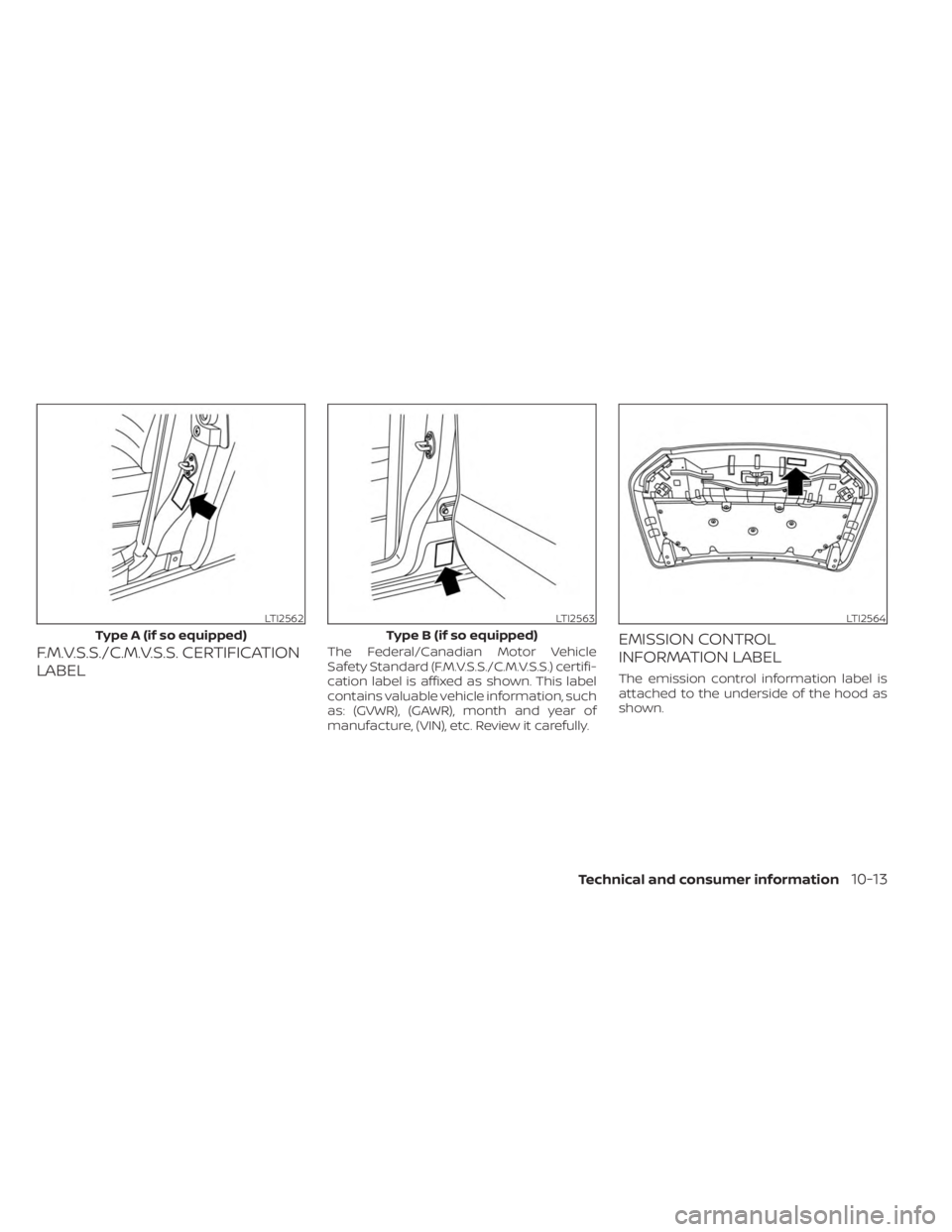
F.M.V.S.S./C.M.V.S.S. CERTIFICATION
LABELThe Federal/Canadian Motor Vehicle
Safety Standard (F.M.V.S.S./C.M.V.S.S.) certifi-
cation label is affixed as shown. This label
contains valuable vehicle information, such
as: (GVWR), (GAWR), month and year of
manufacture, (VIN), etc. Review it carefully.EMISSION CONTROL
INFORMATION LABEL
The emission control information label is
attached to the underside of the hood as
shown.
LTI2562
Type A (if so equipped)
LTI2563
Type B (if so equipped)
LTI2564
Technical and consumer information10-13
Page 512 of 556
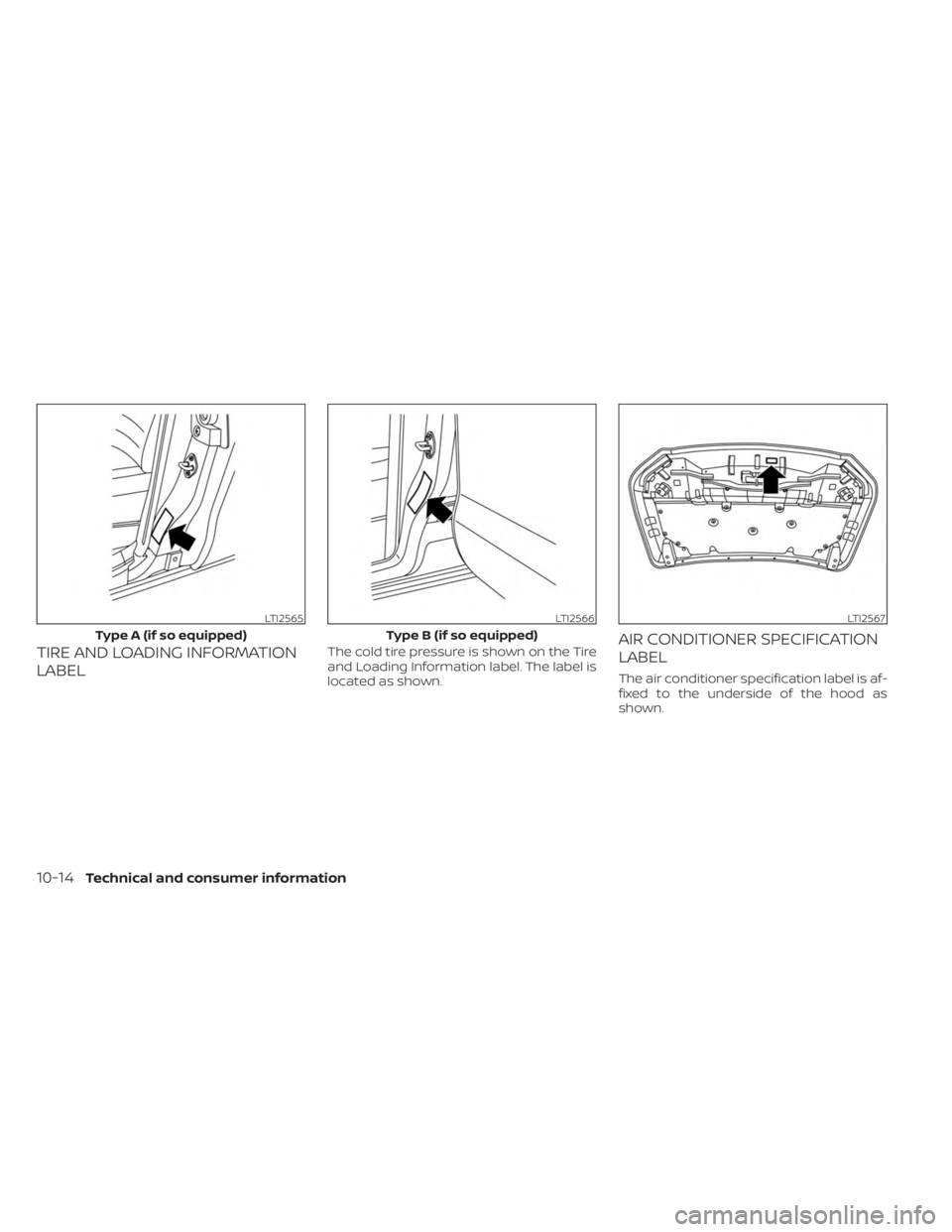
TIRE AND LOADING INFORMATION
LABELThe cold tire pressure is shown on the Tire
and Loading Information label. The label is
located as shown.AIR CONDITIONER SPECIFICATION
LABEL
The air conditioner specification label is af-
fixed to the underside of the hood as
shown.
LTI2565
Type A (if so equipped)
LTI2566
Type B (if so equipped)
LTI2567
10-14Technical and consumer information
Page 514 of 556
WARNING
• It is extremely dangerous to
ride in a cargo area inside a ve-
hicle. In a collision, people rid-
ing in these areas are more
likely to be seriously injured or
killed.
• Do not allow people to ride in
any area of your vehicle that is
not equipped with seats and
seat belts.
• Be sure everyone in your ve-
hicle is in a seat and using a
seat belt properly.
TERMS
It is important to familiarize yourself
with the following terms before
loading your vehicle: • Curb Weight (actual weight of your
vehicle) - vehicle weight including:
standard and optional equipment,
fluids, emergency tools, and spare
tire assembly. This weight does
not include passengers and cargo.
• GVW (Gross Vehicle Weight) - curb weight plus the combined weight
of passengers and cargo.
• GVWR (Gross Vehicle Weight Rat- ing) - maximum total combined
weight of the unloaded vehicle,
passengers, cargo, hitch, trailer
tongue load and any other op-
tional equipment. This information
is located on the F.M.V.S.S./
C.M.V.S.S. certification label.
• GAWR (Gross Axle Weight Rating) - maximum weight (load) limit
specified for the front or rear axle.
This information is located on the
F.M.V.S.S./C.M.V.S.S. certification
label. • GCWR (Gross Combined Weight
Rating) - The maximum total
weight rating of the vehicle, pas-
sengers, cargo, and trailer.
• Vehicle Capacity Weight, Load limit, Total load capacity - maximum to-
tal weight limit specified of the load
(passengers and cargo) for the ve-
hicle. This is the maximum com-
bined weight of occupants and
cargo that can be loaded into the
vehicle. If the vehicle is used to tow
a trailer, the trailer tongue weight
must be included as part of the
cargo load. This information is lo-
cated on the Tire and Loading In-
formation label.
• Cargo capacity - permissible weight of cargo, the subtracted
weight of occupants from the load
limit.
VEHICLE LOADING INFORMATION
10-16Technical and consumer information
Page 541 of 556
If a powertrain system component is re-
paired or the battery is disconnected, the
vehicle may be reset to a “not ready” condi-
tion. Before taking the I/M test, check the
vehicle's inspection/maintenance test
readiness condition. Place the ignition
switch in the ON position without starting
the engine. If the Malfunction Indicator
Light (MIL) comes on steady for 20 seconds
and then blinks for 10 seconds, the I/M test
condition is “not ready”. If the MIL does not
blink af ter 20 seconds, the I/M test condi-
tion is “ready”. It is recommended that you
visit a NISSAN dealer to set the “ready con-
dition” or to prepare the vehicle for testing.This vehicle is equipped with an Event Data
Recorder (EDR). The main purpose of an
EDR is to record, in certain crash or near
crash-like situations, such as an air bag
deployment or hitting a road obstacle, data
that will assist in understanding how a ve-
hicle's systems performed. The EDR is de-
signed to record data related to vehicle dy-
namics and safety systems for a short
period of time, typically 30 seconds or less.
The EDR in this vehicle is designed to re-
cord such data as:
• How various systems in your vehicle were
operating;
• Whether or not the driver and passenger safety belts were buckled/fastened;
• How far (if at all) the driver was depress- ing the accelerator and/or brake pedal;
and,
• How fast the vehicle was traveling.
• Sounds are not recorded. These data can help provide a better un-
derstanding of the circumstances in which
crashes and injuries occur. NOTE: EDR data
are recorded by your vehicle only if a non-
trivial crash situation occurs; no data are
recorded by the EDR under normal driving
conditions and no personal data (e.g.,
name, gender, age, and crash location) are
recorded. However, other parties, such as
law enforcement, could combine the EDR
data with the type of personally identif ying
data routinely acquired during a crash
investigation.
To read data recorded by an EDR, special
equipment is required, and access to the
vehicle or the EDR is needed. In addition to
the vehicle manufacturer and NISSAN
dealer, other parties, such as law enforce-
ment, that have the special equipment, can
read the information if they have access to
the vehicle or the EDR.
EDR data will only be accessed with the
consent of the vehicle owner or lessee or
as otherwise required or permitted by law.
EVENT DATA RECORDERS (EDR)
Technical and consumer information10-43
Page 543 of 556
11 Index
4
4-Wheel Drive................5-1094WD......................5-109
A
Active Brake Limited Slip (ABLS)
system....................5-120Air bag (See supplemental restraint
system).....................1-71Air bag systemFront (See supplemental front impact air
bag system)
................1-78Air bag warning labels...........1-88Air bag warning light.........1-88, 2-14Air bag warning light,
supplemental.............1-88, 2-14Air cleaner housing filter..........8-18Air conditionerAir conditioner operation. . . .4-30, 4-36Air conditioner service..........4-40Air conditioner specification label. .10-14Air conditioner system refrigerant
recommendations............10-8Air conditioner system refrigerant and oil
recommendations............10-8Heater and air conditioner (automatic)
(if so equipped)..............4-35
Heater and air conditioner
controls.................. .4-36Servicing air conditioner........4-40Air flow charts.................4-31Alarm system (See vehicle security
system)................... .2-34Anchor point locations...........1-33Antenna....................4-40Anti-lock brake warning light........2-11Anti-lock Braking System (ABS)......5-119Antifreeze...................5-129Autolight switch...............2-39Automatic
Automatic power window switch. . .2-71Driving with automatic
transmission................5-18Automatic anti-glare inside mirror. . . .3-25Automatic door locks.............3-7Automatic Emergency Braking (AEB) with
Pedestrian Detection............5-81Automatic transmission fluid temperature
gauge..................... .2-8
B
Battery.................5-129, 8-14Charge warning light...........2-13Battery replacement............8-23Key fob...................8-23NISSAN Intelligent Key®.........8-24
Before starting the engine.........5-17Belt (See drive belt)..............8-16Blind Spot Warning (BSW)..........5-32Booster seats.................1-66Brake
Anti-lock Braking System (ABS). . . .5-119Brake fluid.................8-12Brake light (See stop light).......8-27Brake system...............5-118Brake warning light............2-12Brake wear indicators.......2-19,8-20Parking brake operation.........5-23Self-adjusting brakes..........8-20Brake fluid...................8-12Brake system................5-118Brakes.....................8-20Break-in schedule..............5-107Brightness controlInstrument panel.............2-44Bulb check/instrument panel.......2-11Bulb replacement..............8-27
C
C.M.V.S.S. certification label........10-13Capacities and recommended
fuel/lubricants................10-2Car phone or CB radio............4-41Cargo (See vehicle loading
information)................ .10-16