oil level NISSAN FRONTIER 2022 Owner´s Manual
[x] Cancel search | Manufacturer: NISSAN, Model Year: 2022, Model line: FRONTIER, Model: NISSAN FRONTIER 2022Pages: 556, PDF Size: 6.11 MB
Page 500 of 556
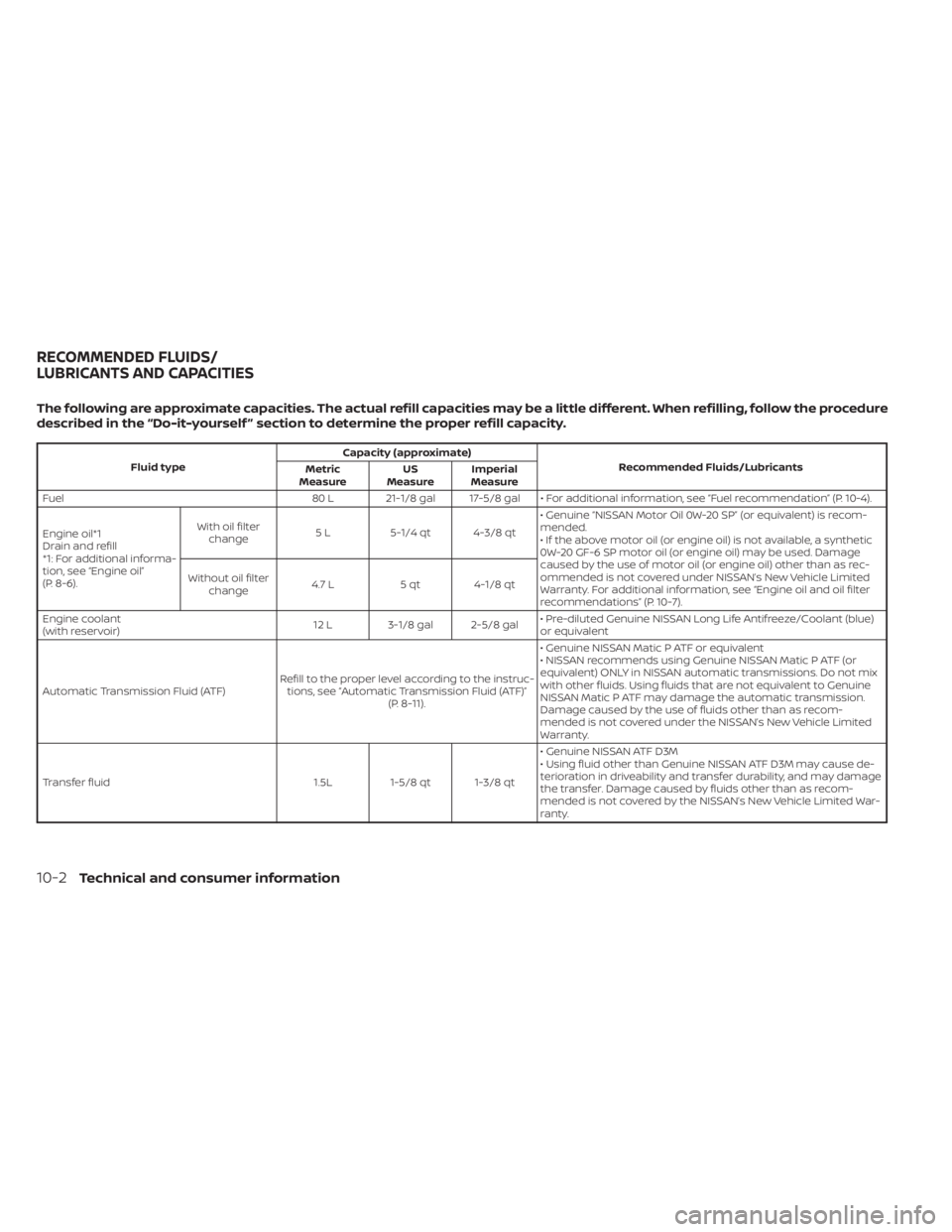
The following are approximate capacities. The actual refill capacities may be a little different. When refilling, follow the procedure
described in the “Do-it-yourself ” section to determine the proper refill capacity.
Fluid typeCapacity (approximate)
Recommended Fluids/Lubricants
Metric
Measure US
Measure Imperial
Measure
Fuel 80 L 21-1/8 gal 17-5/8 gal • For additional information, see “Fuel recommendation” (P. 10-4).
Engine oil*1
Drain and refill
*1: For additional informa-
tion, see “Engine oil”
(P. 8-6). With oil filter
change 5 L
5-1/4 qt 4-3/8 qt • Genuine “NISSAN Motor Oil 0W-20 SP” (or equivalent) is recom-
mended.
• If the above motor oil (or engine oil) is not available, a synthetic
0W-20 GF-6 SP motor oil (or engine oil) may be used. Damage
caused by the use of motor oil (or engine oil) other than as rec-
ommended is not covered under NISSAN’s New Vehicle Limited
Warranty. For additional information, see “Engine oil and oil filter
recommendations” (P. 10-7).
Without oil filter
change 4.7 L
5 qt 4-1/8 qt
Engine coolant
(with reservoir) 12 L
3-1/8 gal 2-5/8 gal • Pre-diluted Genuine NISSAN Long Life Antifreeze/Coolant (blue)
or equivalent
Automatic Transmission Fluid (ATF) Refill to the proper level according to the instruc-
tions, see “Automatic Transmission Fluid (ATF)” (P. 8-11). • Genuine NISSAN Matic P ATF or equivalent
• NISSAN recommends using Genuine NISSAN Matic P ATF (or
equivalent) ONLY in NISSAN automatic transmissions. Do not mix
with other fluids. Using fluids that are not equivalent to Genuine
NISSAN Matic P ATF may damage the automatic transmission.
Damage caused by the use of fluids other than as recom-
mended is not covered under the NISSAN’s New Vehicle Limited
Warranty.
Transfer fluid 1.5L1-5/8 qt 1-3/8 qt • Genuine NISSAN ATF D3M
• Using fluid other than Genuine NISSAN ATF D3M may cause de-
terioration in driveability and transfer durability, and may damage
the transfer. Damage caused by fluids other than as recom-
mended is not covered by the NISSAN’s New Vehicle Limited War-
ranty.
RECOMMENDED FLUIDS/
LUBRICANTS AND CAPACITIES
10-2Technical and consumer information
Page 501 of 556
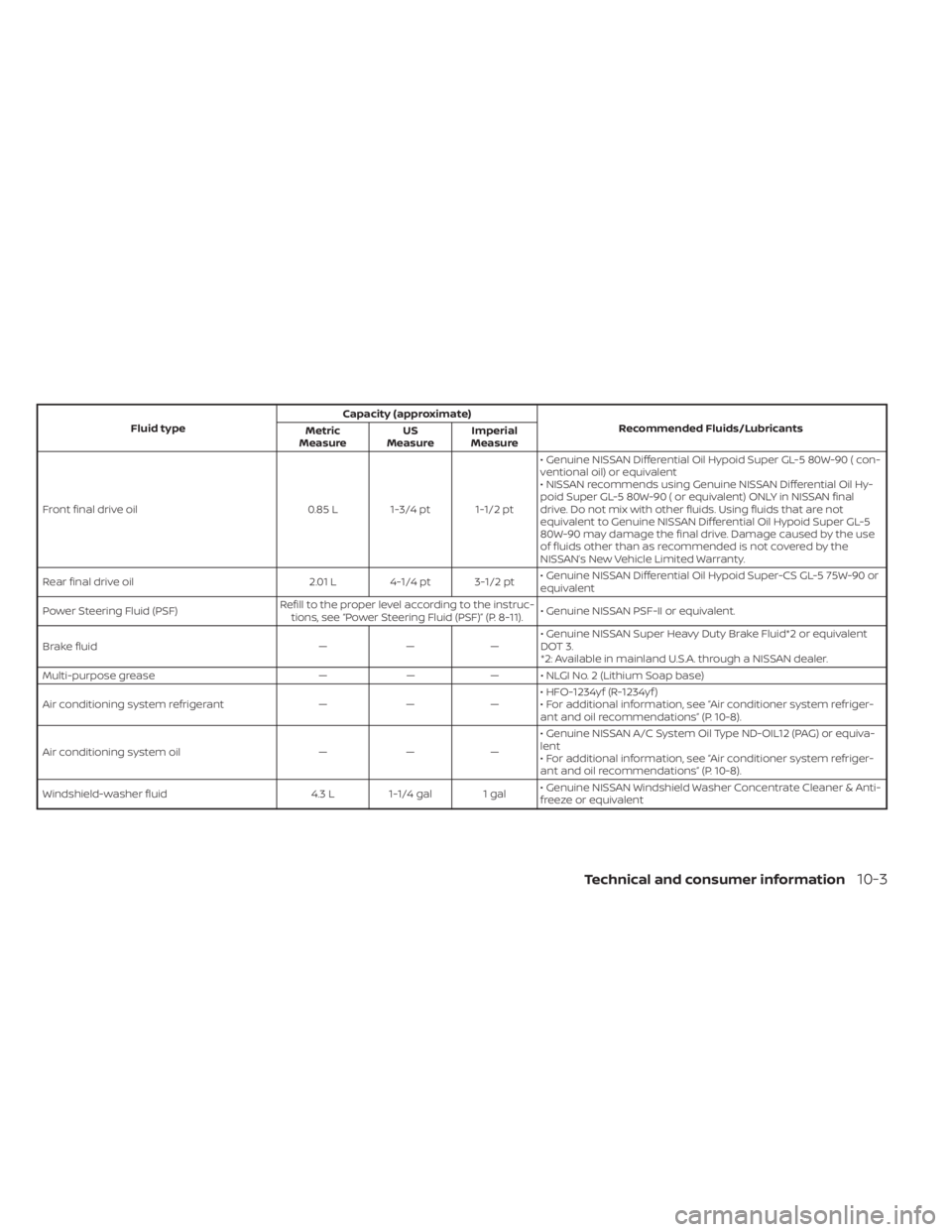
Fluid typeCapacity (approximate)
Recommended Fluids/Lubricants
Metric
Measure US
Measure Imperial
Measure
Front final drive oil 0.85 L 1-3/4 pt 1-1/2 pt• Genuine NISSAN Differential Oil Hypoid Super GL-5 80W-90 ( con-
ventional oil) or equivalent
• NISSAN recommends using Genuine NISSAN Differential Oil Hy-
poid Super GL-5 80W-90 ( or equivalent) ONLY in NISSAN final
drive. Do not mix with other fluids. Using fluids that are not
equivalent to Genuine NISSAN Differential Oil Hypoid Super GL-5
80W-90 may damage the final drive. Damage caused by the use
of fluids other than as recommended is not covered by the
NISSAN’s New Vehicle Limited Warranty.
Rear final drive oil 2.01 L 4-1/4 pt 3-1/2 pt• Genuine NISSAN Differential Oil Hypoid Super-CS GL-5 75W-90 or
equivalent
Power Steering Fluid (PSF) Refill to the proper level according to the instruc-
tions, see “Power Steering Fluid (PSF)” (P. 8-11). • Genuine NISSAN PSF-II or equivalent.
Brake fluid ———• Genuine NISSAN Super Heavy Duty Brake Fluid*2 or equivalent
DOT 3.
*2: Available in mainland U.S.A. through a NISSAN dealer.
Multi-purpose grease ——— • NLGI No. 2 (Lithium Soap base)
Air conditioning system refrigerant ———• HFO-1234yf (R-1234yf )
• For additional information, see “Air conditioner system refriger-
ant and oil recommendations” (P. 10-8).
Air conditioning system oil ———• Genuine NISSAN A/C System Oil Type ND-OIL12 (PAG) or equiva-
lent
• For additional information, see “Air conditioner system refriger-
ant and oil recommendations” (P. 10-8).
Windshield-washer fluid 4.3 L1-1/4 gal 1 gal • Genuine NISSAN Windshield Washer Concentrate Cleaner & Anti-
freeze or equivalent
Technical and consumer information10-3
Page 536 of 556
• Have your vehicle serviced more of tenthan at intervals specified. For additional
information, see the “Maintenance and
schedules” section of this manual.
• When making a turn, your trailer wheels will be closer to the inside of the turn than
your vehicle wheels. To compensate for
this, make a larger than normal turning
radius during the turn.
• Crosswinds and rough roads will ad- versely affect vehicle/trailer handling,
possibly causing vehicle sway. When be-
ing passed by larger vehicles, be pre-
pared for possible changes in crosswinds
that could affect vehicle handling.
Do the following if the trailer begins to
sway:
1. Take your foot off the accelerator pedal to allow the vehicle to coast and steer as
straight ahead as the road conditions
allow. This combination will help stabilize
the vehicle
– Do not correct trailer sway by steering or applying the brakes.
2. When the trailer sway stops, gently apply the brakes and pull to the side of the
road in a safe area. 3. Try to rearrange the trailer load so it is
balanced as described in this section.
• Be careful when passing other vehicles. Passing while towing a trailer requires
considerably more distance than normal
passing. Remember, the length of the
trailer must also pass the other vehicle
before you can safely change lanes.
• Downshif t the transmission to a lower gear for engine braking when driving
down steep or long hills. This will help
slow the vehicle without applying the
brakes.
• Avoid holding the brake pedal down too long or too frequently. This could cause
the brakes to overheat, resulting in re-
duced braking efficiency.
• Increase your following distance to allow for greater stopping distances while tow-
ing a trailer. Anticipate stops and brake
gradually.
• NISSAN recommends that the cruise control not be used while towing a trailer.
• Some states or provinces have specific regulations and speed limits for vehicles
that are towing trailers. Obey the local
speed limits. • Check your hitch, trailer wiring harness
connections, and trailer wheel lug nuts
af ter 50 miles (80 km) of travel and at
every break.
• When launching a boat, don't allow the water level to go over the exhaust tail
pipe or rear bumper.
• Make sure you disconnect the trailer lights before backing the trailer into the
water or the trailer lights may burn out.
When towing a trailer, final drive gear oil
should be replaced and transmission oil/
fluid should be changed more fre-
quently. For additional information, refer
to the “Do-it-yourself ” section in this
manual.
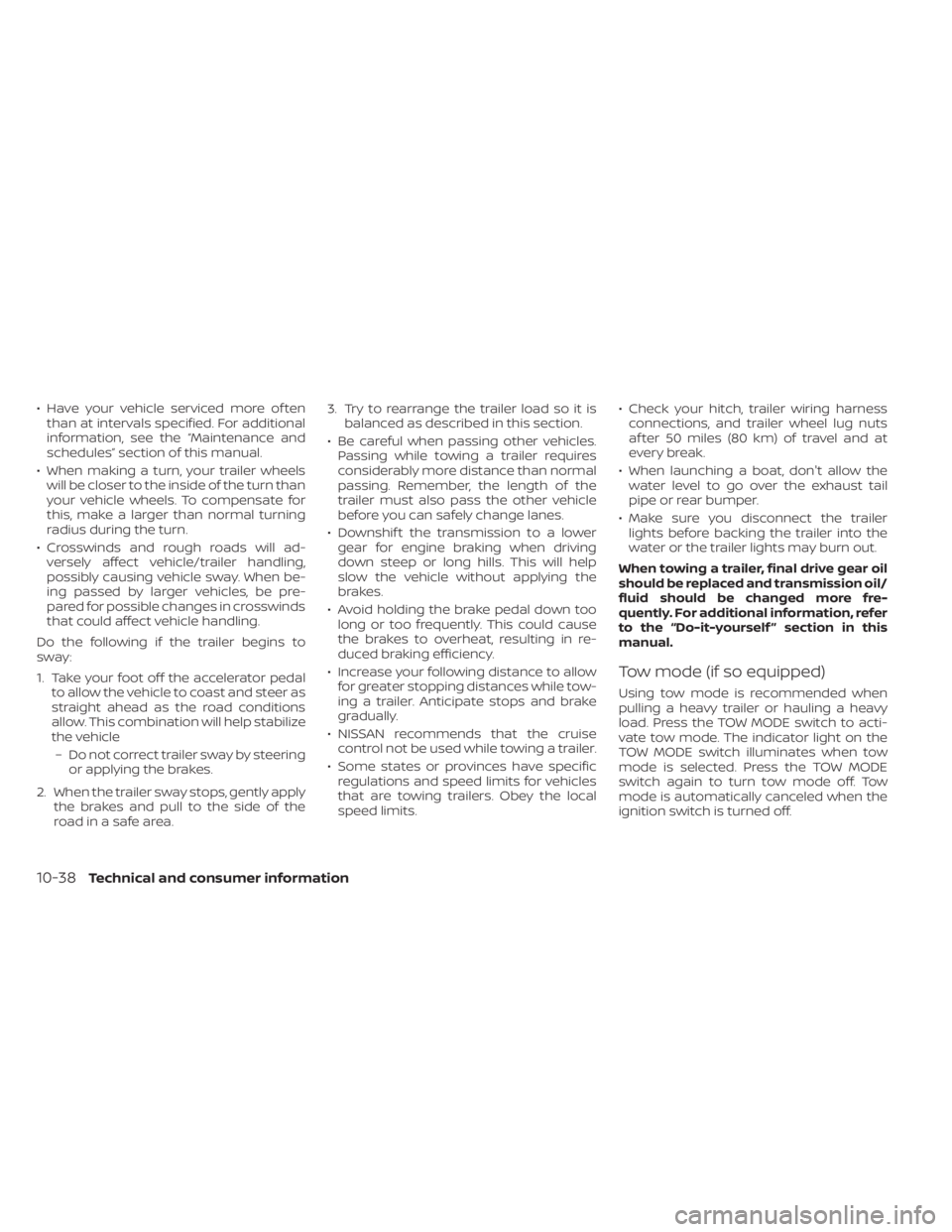
Tow mode (if so equipped)
Using tow mode is recommended when
pulling a heavy trailer or hauling a heavy
load. Press the TOW MODE switch to acti-
vate tow mode. The indicator light on the
TOW MODE switch illuminates when tow
mode is selected. Press the TOW MODE
switch again to turn tow mode off. Tow
mode is automatically canceled when the
ignition switch is turned off.
10-38Technical and consumer information
Page 544 of 556
Cargo lamp switch..............2-46Cargo light...................2-75Check tire pressure..........2-29,2-31Child restraint with top tether strap. . . .1-33Child restraints.......1-25,1-26,1-28, 1-30Precautions on child
restraints.........1-40, 1-43, 1-55, 1-66Top tether strap anchor point
locations.................. .1-33Child safety rear door lock..........3-7Cleaning exterior and interior......7-2,7-4Cold weather driving............5-129Console box..................2-66Controls
Heater and air conditioner controls. .4-36Heater and air conditioner controls
(manual)...................4-26CoolantCapacities and recommended
fuel/lubricants
...............10-2Changing engine coolant.........8-5Checking engine coolant level......8-5Engine coolant temperature gauge. . .2-6Corrosion protection..............7-7Cruise control................ .5-51Cup holders................. .2-67Curtain side-impact and rollover air
bag....................... .1-83
D
Daytime Running Light System......2-43Daytime Running Lights (DRL) system. .2-43
Dimensions and weights..........10-11Dimmer switch for instrument panel. . .2-44Door locks....................3-4Drive belt....................8-16Driving
Cold weather driving...........5-129Driving with automatic
transmission................5-18Precautions when starting and
driving................. .5-4, 5-11Driving the vehicle...............5-18
E
Economy - fuel................5-109Electronic locking rear differential (E-Lock)
system.....................5-116Electronic locking rear differential (E-Lock)
system switch.................2-50Emergency call (SOS) button........2-53Emergency engine shutoff.......5-15,6-2Emission control information label. . . .10-13Emission control system warranty. . . .10-41Engine
Before starting the engine........5-17Capacities and recommended
fuel/lubricants...............10-2Changing engine coolant.........8-5Changing engine oil............8-6Changing engine oil filter.........8-6Checking engine coolant level......8-5Checking engine oil level.........8-6Engine coolant temperature gauge. . .2-6
Engine cooling system...........8-4Engine oil.................. .8-6Engine oil and oil filter
recommendation.............10-7Engine oil pressure gauge.........2-8Engine oil pressure warning light. . . .2-13Engine oil viscosity.............10-7Engine serial number..........10-12Engine specifications...........10-9Engine Block Heater.............5-130Engine coolant temperature gauge. . . .2-6Engine oil pressure gauge..........2-8Event Data recorders............10-43Exhaust gas (Carbon monoxide)......5-4Explanation of maintenance items.....9-2Explanation of scheduled maintenance
items...................... .9-5Extended storage switch..........2-61Eyeglass case.................2-67
F
Flashers (See hazard warning flasher
switch)......................6-2Flat tire..................... .6-3Floor mat positioning aid...........7-6Fluid
Brake fluid..................8-12Capacities and recommended
fuel/lubricants...............10-2Engine coolant................8-4Engine oil.................. .8-6Power steering fluid............8-11
11-2
Page 547 of 556
O
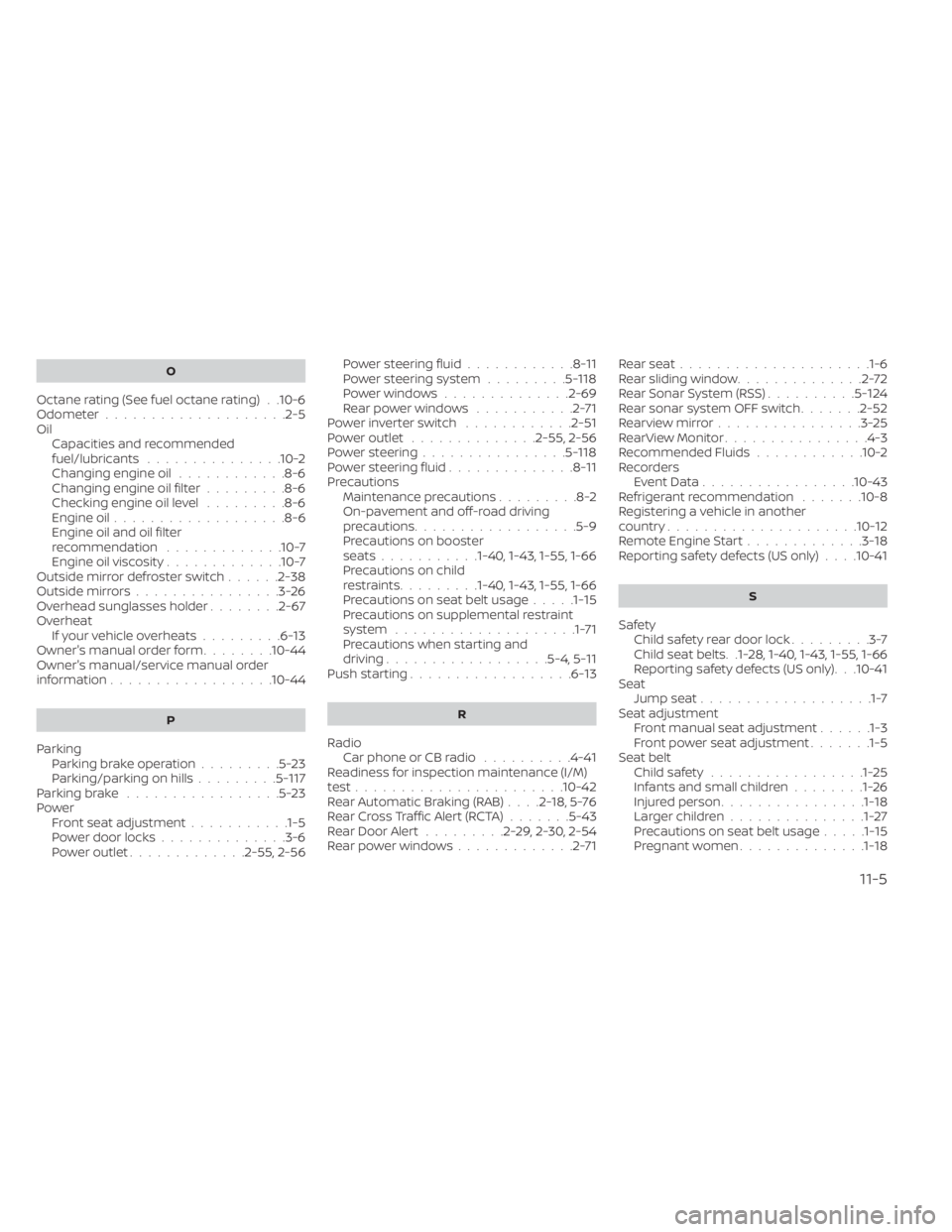
Octane rating (See fuel octane rating). .10-6Odometer....................2-5Oil
Capacities and recommended
fuel/lubricants
...............10-2Changing engine oil............8-6Changing engine oil filter.........8-6Checking engine oil level.........8-6Engine oil.................. .8-6Engine oil and oil filter
recommendation.............10-7Engine oil viscosity.............10-7Outside mirror defroster switch......2-38Outside mirrors................3-26Overhead sunglasses holder........2-67Overheat
If your vehicle overheats.........6-13Owner's manual order form........10-44Owner's manual/service manual order
information................. .10-44
P
Parking
Parking brake operation.........5-23Parking/parking on hills.........5-117Parking brake.................5-23PowerFront seat adjustment...........1-5Power door locks..............3-6Power outlet.............2-55, 2-56
Power steering fluid............8-11Power steering system.........5-118Power windows..............2-69Rear power windows...........2-71Power inverter switch............2-51Power outlet..............2-55, 2-56Power steering................5-118Power steering fluid..............8-11PrecautionsMaintenance precautions.........8-2On-pavement and off-road driving
precautions................. .5-9Precautions on booster
seats...........1-40, 1-43, 1-55, 1-66Precautions on child
restraints.........1-40, 1-43, 1-55, 1-66Precautions on seat belt usage.....1-15Precautions on supplemental restraint
system....................1-71Precautions when starting and
driving..................5-4, 5-11Push starting..................6-13
R
Radio
Car phone or CB radio..........4-41Readiness for inspection maintenance (I/M)
test...................... .10-42Rear Automatic Braking (RAB). . . .2-18, 5-76Rear Cross Traffic Alert (RCTA).......5-43Rear Door Alert.........2-29,2-30, 2-54Rear power windows.............2-71
Rear seat.................... .1-6Rear sliding window..............2-72Rear Sonar System (RSS)..........5-124Rear sonar system OFF switch.......2-52Rearview mirror................3-25RearView Monitor................4-3Recommended Fluids............10-2Recorders
Event Data................ .10-43Refrigerant recommendation.......10-8Registering a vehicle in another
country.................... .10-12Remote Engine Start.............3-18Reporting safety defects (US only). . . .10-41
S
Safety
Child safety rear door lock.........3-7Child seat belts. .1-28, 1-40, 1-43, 1-55, 1-66Reporting safety defects (US only). . .10-41SeatJump seat...................1-7Seat adjustmentFront manual seat adjustment......1-3Front power seat adjustment.......1-5Seat beltChild safety.................1-25Infants and small children........1-26Injured person................1-18Larger children...............1-27Precautions on seat belt usage.....1-15Pregnant women..............1-18
11-5