Mirrors NISSAN FRONTIER 2022 Owner´s Manual
[x] Cancel search | Manufacturer: NISSAN, Model Year: 2022, Model line: FRONTIER, Model: NISSAN FRONTIER 2022Pages: 556, PDF Size: 6.11 MB
Page 348 of 556
• When the parking brake is applied
• When the VDC operates (including thetraction control system)
• When a wheel slips
When the system is not operating properly,
the chime sounds and the color of the
cruise indicator will change to orange.
Action to take
If the color of the cruise indicator changes
to orange, stop the vehicle in a safe place
and place the shif t lever in the P (Park) po-
sition. Turn the engine off, restart the en-
gine, resume driving, and then perform the
setting again.
If it is not possible to set or the indicator
stays on, it may indicate that the system
is malfunctioning. Although the vehicle
is still drivable under normal conditions,
have the vehicle checked. It is recom-
mended that you visit a NISSAN dealer
for this service.WARNING
Failure to follow the warnings and in-
structions for proper use of the RAB
system could result in serious injury or
death.
• The RAB system is a supplemental
aid to the driver. It is not a replace-
ment for proper driving procedures.
Always use the side and rear mirrors
and turn and look in the direction you
will move before and while backing
up. Never rely solely on the RAB sys-
tem. It is the driver’s responsibility to
stay alert, drive safely, and be in con-
trol of the vehicle at all times.
• There is a limitation to the RAB sys-
tem capability. The RAB system is not
effective in all situations.
• Inclement weather or ultrasonic
sources such as an automatic car
wash, a truck’s compressed-air
brakes or a pneumatic drill may af-
fect the function of the system; this
may include reduced performance or
a false activation.
The RAB system can assist the driver when
the vehicle is backing up and approaching
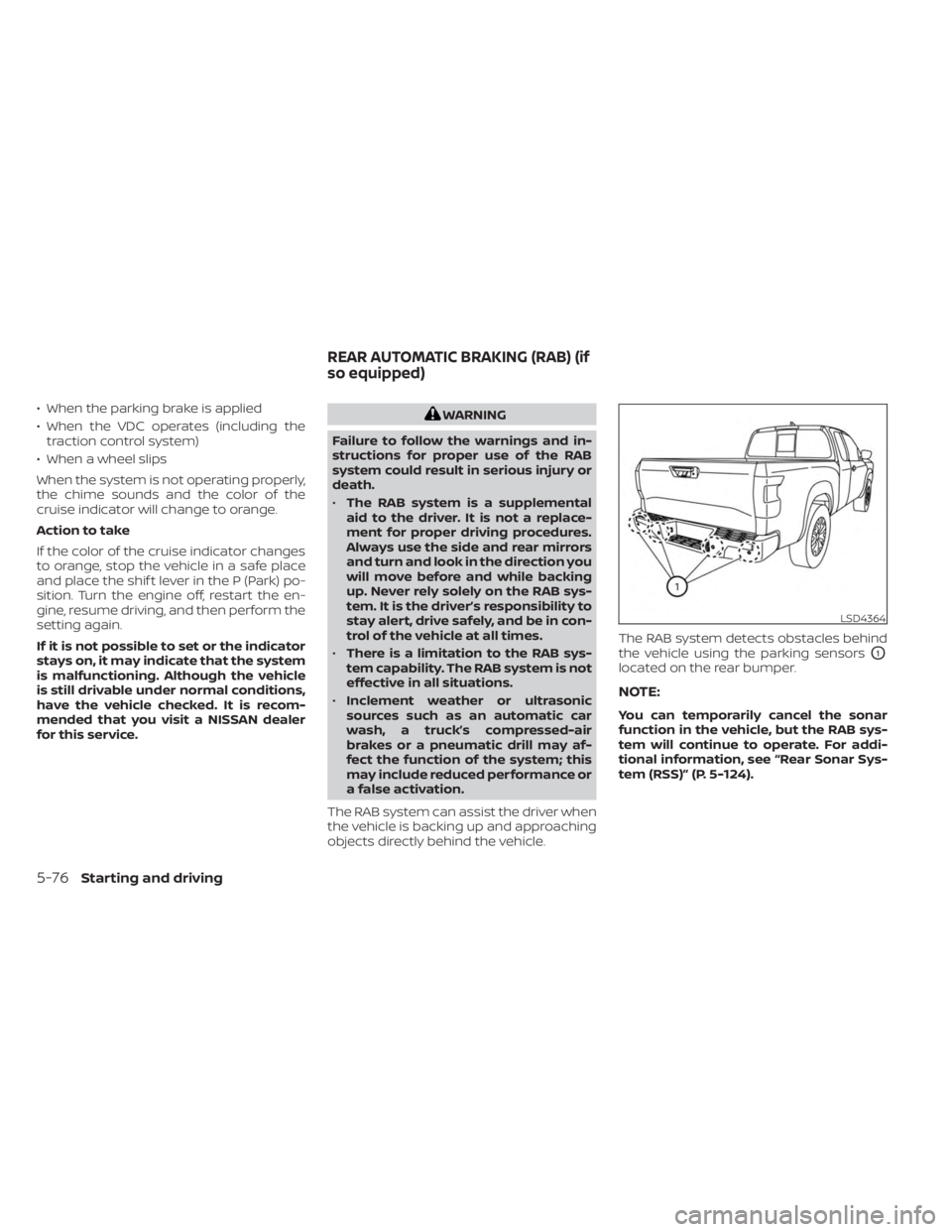
objects directly behind the vehicle. The RAB system detects obstacles behind
the vehicle using the parking sensors
O1
located on the rear bumper.
NOTE:
You can temporarily cancel the sonar
function in the vehicle, but the RAB sys-
tem will continue to operate. For addi-
tional information, see “Rear Sonar Sys-
tem (RSS)” (P. 5-124).
LSD4364
REAR AUTOMATIC BRAKING (RAB) (if
so equipped)
5-76Starting and driving
Page 509 of 556
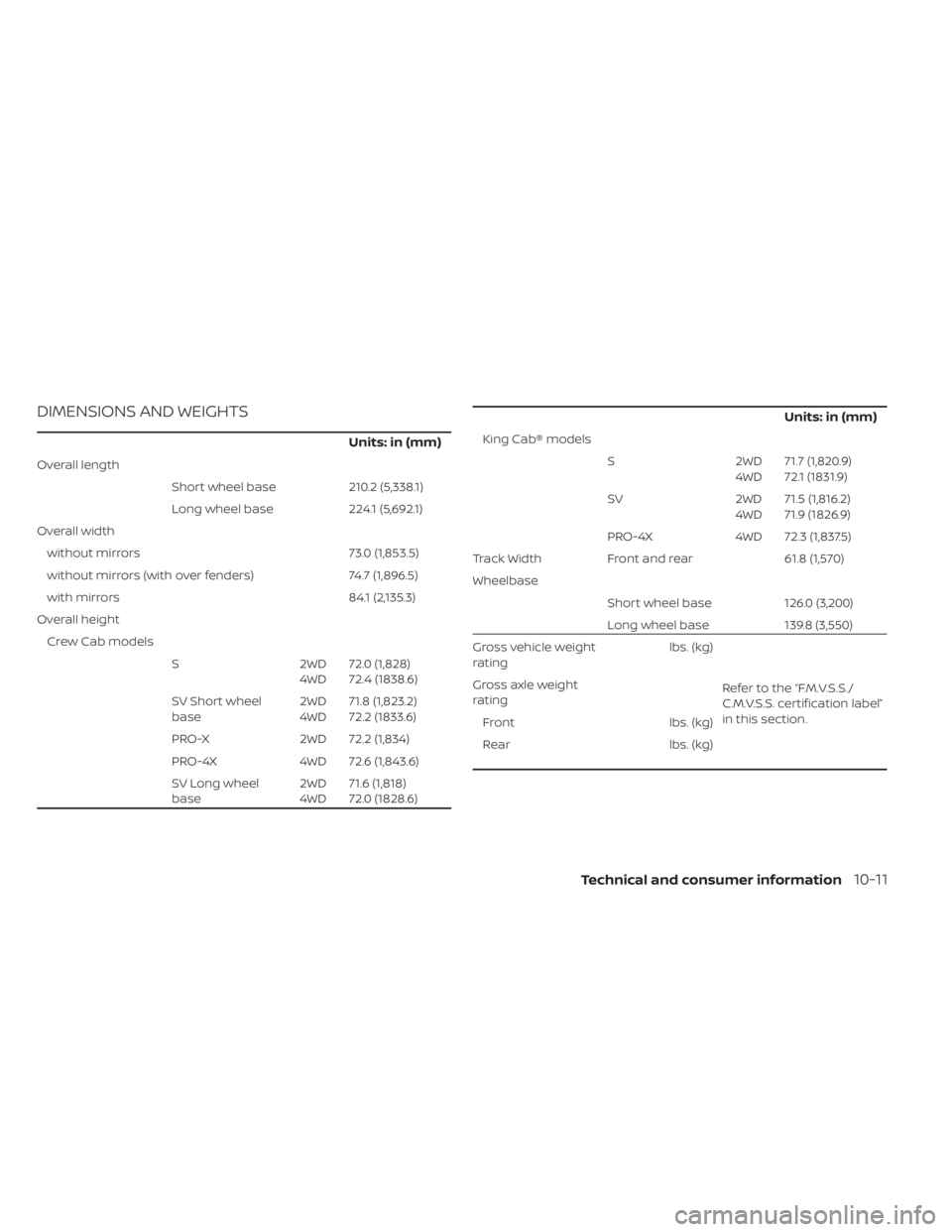
DIMENSIONS AND WEIGHTS
Units: in (mm)
Overall lengthShort wheel base 210.2 (5,338.1)
Long wheel base 224.1 (5,692.1)
Overall width without mirrors 73.0 (1,853.5)
without mirrors (with over fenders) 74.7 (1,896.5)
with mirrors 84.1 (2,135.3)
Overall height Crew Cab models S 2WD
4WD 72.0 (1,828)
72.4 (1838.6)
SV Short wheel
base 2WD
4WD 71.8 (1,823.2)
72.2 (1833.6)
PRO-X 2WD 72.2 (1,834)
PRO-4X 4WD 72.6 (1,843.6)
SV Long wheel
base 2WD
4WD 71.6 (1,818)
72.0 (1828.6)
Units: in (mm)
King Cab® models
S 2WD 4WD71.7 (1,820.9)
72.1 (1831.9)
SV 2WD 4WD71.5 (1,816.2)
71.9 (1826.9)
PRO-4X 4WD 72.3 (1,837.5)
Track Width Front and rear 61.8 (1,570)
Wheelbase Short wheel base 126.0 (3,200)
Long wheel base 139.8 (3,550)
Gross vehicle weight
rating lbs. (kg)
Refer to the “F.M.V.S.S./
C.M.V.S.S. certification label”
in this section.
Gross axle weight
rating
Front lbs. (kg)
Rear lbs. (kg)
Technical and consumer information10-11
Page 534 of 556
When towing a trailer load of 3,500 lbs.
(1587 kg) or more, trailers with a brake
system MUST be used.However, most
states require a separate braking system
on trailers with a loaded weight above a
specific amount. Make sure the trailer
meets the local regulations and the regu-
lations where you plan to tow.
Several types of braking systems are
available.
Surge Brakes -The surge brake actuator is
mounted on the trailer tongue with a hy-
draulic line running to each trailer wheel.
Surge brakes are activated by the trailer
pushing against the hitch ball when the
tow vehicle is braking. Hydraulic surge
brakes are common on rental trailers and
some boat trailers. In this type of system,
there is no hydraulic or electric connection
for brake operation between the tow ve-
hicle and the trailer.
Electric Trailer Brakes -Electric braking
systems are activated by an electronic sig-
nal sent from a trailer brake controller (spe-
cial brake-sensing module). If electric trailer
brakes are used, see “Electric trailer brake
controller" (P. 10-36).. Have a professional supplier of towing
equipment make sure the trailer brakes are
properly installed and demonstrate proper
brake function testing.
Electric trailer brake controller
Trailers equipped with electric brakes may
require the installation of an af termarket
trailer brake controller.
A Genuine NISSAN jumper harness is avail-
able that is specifically designed to be used
when installing an af termarket brake
controller.
Install the af termarket electric trailer brake
controller according to the manufacturer's
instructions.
Pre-towing tips
• Be certain your vehicle maintains a level
position when a loaded and/or unloaded
trailer is hitched. Do not drive the vehicle if
it has an abnormal nose-up or nose-
down condition; check for improper
tongue load, overload, worn suspension
or other possible causes of either
condition.
• Always secure items in the trailer to pre- vent load shif t while driving. • Keep the cargo load as low as possible in
the trailer to keep the trailer center of
gravity low.
• Load the trailer so approximately 60% of the trailer load is in the front half and 40%
is in the back half. Also make sure the load
is balanced side to side.
• Check your hitch, trailer tire pressure, ve- hicle tire pressure, trailer light operation,
and trailer wheel lug nuts every time you
attach a trailer to the vehicle.
• Be certain your rearview mirrors conform to all federal, state or local regulations. If
not, install any mirrors required for towing
before driving the vehicle.
• Determine the overall height of the ve- hicle and trailer so the required clearance
is known.Trailer towing tips
In order to gain skill and an understanding
of the vehicle's behavior, you should prac-
tice turning, stopping and backing up in an
area which is free from traffic. Steering sta-
bility and braking performance will be
somewhat different than under normal
driving conditions.
• Always secure items in the trailer to pre-vent load shif t while driving.
10-36Technical and consumer information
Page 546 of 556
J
Jump seat.....................1-7Jump starting..............6-11,8-15
K
Key.........................3-2Key fob battery replacement........8-23Keyless entryWith Intelligent Key system
(See Intelligent Key system)
.......3-13KeysNISSAN Intelligent Key®........3-2,3-8NISSAN Vehicle Immobilizer System
keys..................... .3-4
L
Labels
Air conditioner specification label. . .10-14C.M.V.S.S. certification label.......10-13Emission control information label. .10-13Engine serial number..........10-12Tire and Loading Information label. .10-14Vehicle identification number (VIN). .10-12Vehicle identification number (VIN)
plate.................... .10-12Warning labels (for SRS)..........1-88Ladder rack..................2-69Lane Departure Warning (LDW).......5-27
Light
Air bag warning light........1-88, 2-14Brake light (See stop light)........8-27Bulb check/instrument panel......2-11Bulb replacement.............8-27Charge warning light...........2-13Exterior and Interior lights........8-27Fog light switch..............2-45Fog lights..................8-26Headlight and turn signal switch. . . .2-38Headlight control switch.........2-38Headlights..................8-25Interior light.................2-74Light bulbs.................8-25Low tire pressure warning light.....2-15Low windshield-washer fluid warning
light......................2-29Passenger air bag and status light. . .1-80Security indicator light..........2-14Warning/indicator lights and audible
reminders..................2-11Lights......................8-25Map lights..................2-75LockChild safety rear door lock.........3-7Door locks................. .3-4Power door locks..............3-6Loose fuel cap warning...........2-28Low fuel warning light......2-13,2-18,2-29Low tire pressure warning light.......2-15Low windshield-washer fluid warning
light.......................2-29Luggage (See vehicle loading
information)..................10-16
M
Maintenance
General maintenance...........9-2Inside the vehicle..............9-3Maintenance precautions.........8-2Outside the vehicle.............9-2Seat belt maintenance..........1-25Under the hood and vehicle.......9-4Maintenance requirements..........9-2Maintenance schedules............9-7Malfunction indicator light..........2-17Manual front seat adjustment........1-3Manual windows...............2-69Map lights....................2-75Map pocket.................. .2-62Meters and gauges............2-4, 2-8Instrument brightness control.....2-44Mirror
Automatic anti-glare inside mirror. . .3-25Outside mirrors..............3-26Rearview...................3-25Vanity mirror................3-24Mirrors......................3-25Moonroof.................2-72,7-5Moving Object Detection (MOD)......4-22
N
NISSAN Intelligent Key®..........3-2,3-8NISSAN Vehicle Immobilizer
System................. .2-36, 5-16NissanConnect® Owner's Manual......4-2
11-4
Page 547 of 556
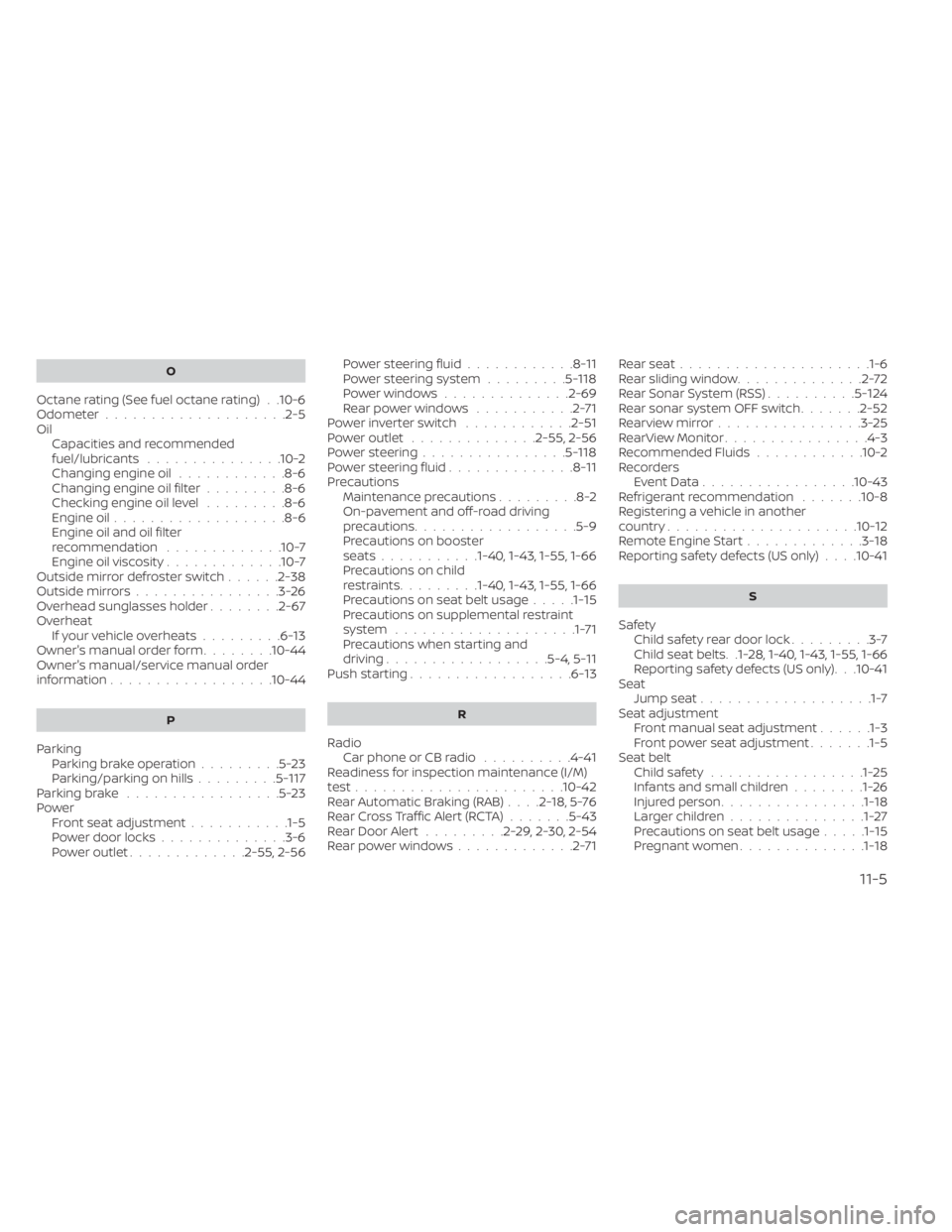
O
Octane rating (See fuel octane rating). .10-6Odometer....................2-5Oil
Capacities and recommended
fuel/lubricants
...............10-2Changing engine oil............8-6Changing engine oil filter.........8-6Checking engine oil level.........8-6Engine oil.................. .8-6Engine oil and oil filter
recommendation.............10-7Engine oil viscosity.............10-7Outside mirror defroster switch......2-38Outside mirrors................3-26Overhead sunglasses holder........2-67Overheat
If your vehicle overheats.........6-13Owner's manual order form........10-44Owner's manual/service manual order
information................. .10-44
P
Parking
Parking brake operation.........5-23Parking/parking on hills.........5-117Parking brake.................5-23PowerFront seat adjustment...........1-5Power door locks..............3-6Power outlet.............2-55, 2-56
Power steering fluid............8-11Power steering system.........5-118Power windows..............2-69Rear power windows...........2-71Power inverter switch............2-51Power outlet..............2-55, 2-56Power steering................5-118Power steering fluid..............8-11PrecautionsMaintenance precautions.........8-2On-pavement and off-road driving
precautions................. .5-9Precautions on booster
seats...........1-40, 1-43, 1-55, 1-66Precautions on child
restraints.........1-40, 1-43, 1-55, 1-66Precautions on seat belt usage.....1-15Precautions on supplemental restraint
system....................1-71Precautions when starting and
driving..................5-4, 5-11Push starting..................6-13
R
Radio
Car phone or CB radio..........4-41Readiness for inspection maintenance (I/M)
test...................... .10-42Rear Automatic Braking (RAB). . . .2-18, 5-76Rear Cross Traffic Alert (RCTA).......5-43Rear Door Alert.........2-29,2-30, 2-54Rear power windows.............2-71
Rear seat.................... .1-6Rear sliding window..............2-72Rear Sonar System (RSS)..........5-124Rear sonar system OFF switch.......2-52Rearview mirror................3-25RearView Monitor................4-3Recommended Fluids............10-2Recorders
Event Data................ .10-43Refrigerant recommendation.......10-8Registering a vehicle in another
country.................... .10-12Remote Engine Start.............3-18Reporting safety defects (US only). . . .10-41
S
Safety
Child safety rear door lock.........3-7Child seat belts. .1-28, 1-40, 1-43, 1-55, 1-66Reporting safety defects (US only). . .10-41SeatJump seat...................1-7Seat adjustmentFront manual seat adjustment......1-3Front power seat adjustment.......1-5Seat beltChild safety.................1-25Infants and small children........1-26Injured person................1-18Larger children...............1-27Precautions on seat belt usage.....1-15Pregnant women..............1-18
11-5