air condition NISSAN FRONTIER 2022 Owner´s Manual
[x] Cancel search | Manufacturer: NISSAN, Model Year: 2022, Model line: FRONTIER, Model: NISSAN FRONTIER 2022Pages: 556, PDF Size: 6.11 MB
Page 485 of 556
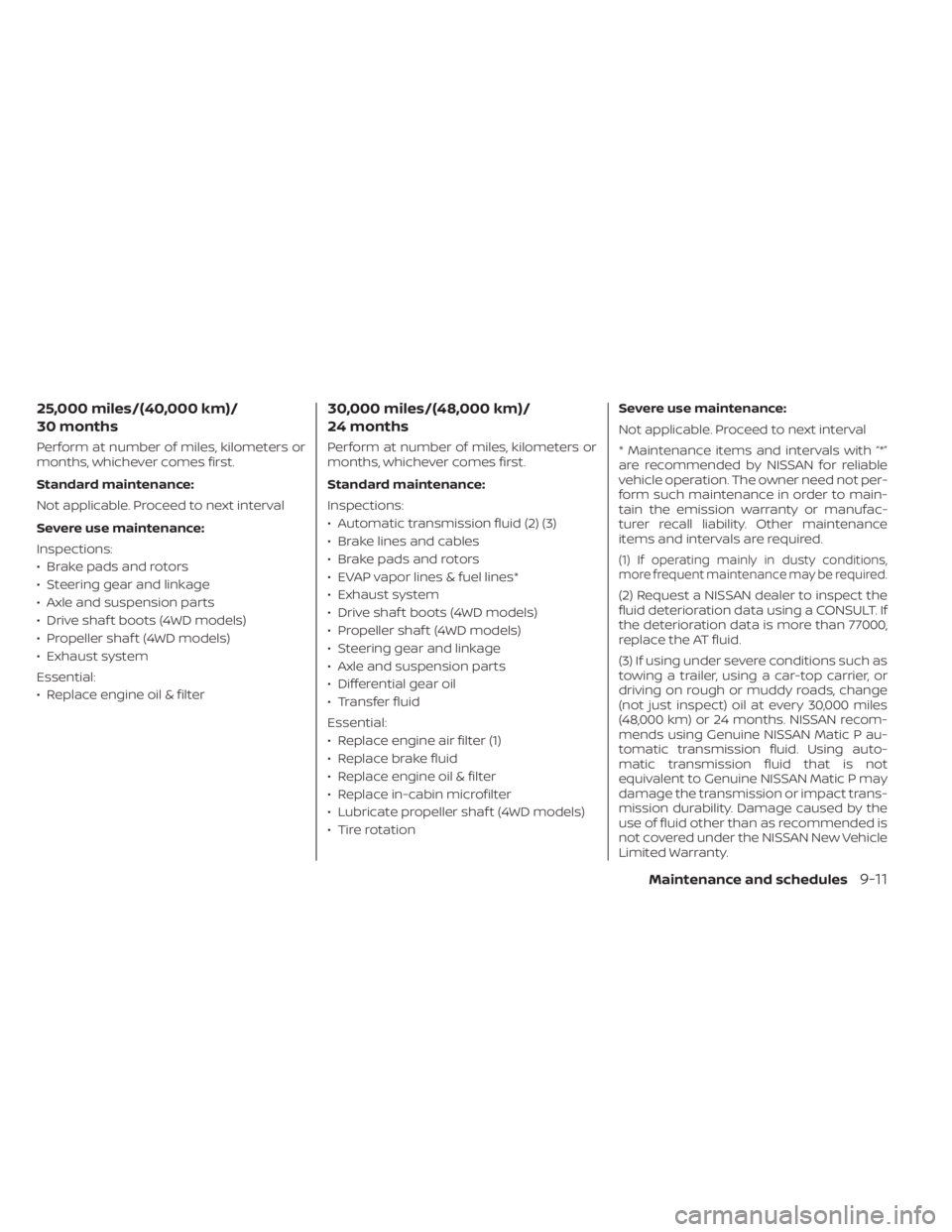
25,000 miles/(40,000 km)/
30 months
Perform at number of miles, kilometers or
months, whichever comes first.
Standard maintenance:
Not applicable. Proceed to next interval
Severe use maintenance:
Inspections:
• Brake pads and rotors
• Steering gear and linkage
• Axle and suspension parts
• Drive shaf t boots (4WD models)
• Propeller shaf t (4WD models)
• Exhaust system
Essential:
• Replace engine oil & filter
30,000 miles/(48,000 km)/
24 months
Perform at number of miles, kilometers or
months, whichever comes first.
Standard maintenance:
Inspections:
• Automatic transmission fluid (2) (3)
• Brake lines and cables
• Brake pads and rotors
• EVAP vapor lines & fuel lines*
• Exhaust system
• Drive shaf t boots (4WD models)
• Propeller shaf t (4WD models)
• Steering gear and linkage
• Axle and suspension parts
• Differential gear oil
• Transfer fluid
Essential:
• Replace engine air filter (1)
• Replace brake fluid
• Replace engine oil & filter
• Replace in-cabin microfilter
• Lubricate propeller shaf t (4WD models)
• Tire rotationSevere use maintenance:
Not applicable. Proceed to next interval
* Maintenance items and intervals with “*”
are recommended by NISSAN for reliable
vehicle operation. The owner need not per-
form such maintenance in order to main-
tain the emission warranty or manufac-
turer recall liability. Other maintenance
items and intervals are required.
(1) If operating mainly in dusty conditions,
more frequent maintenance may be required.
(2) Request a NISSAN dealer to inspect the
fluid deterioration data using a CONSULT. If
the deterioration data is more than 77000,
replace the AT fluid.
(3) If using under severe conditions such as
towing a trailer, using a car-top carrier, or
driving on rough or muddy roads, change
(not just inspect) oil at every 30,000 miles
(48,000 km) or 24 months. NISSAN recom-
mends using Genuine NISSAN Matic P au-
tomatic transmission fluid. Using auto-
matic transmission fluid that is not
equivalent to Genuine NISSAN Matic P may
damage the transmission or impact trans-
mission durability. Damage caused by the
use of fluid other than as recommended is
not covered under the NISSAN New Vehicle
Limited Warranty.
Maintenance and schedules9-11
Page 489 of 556
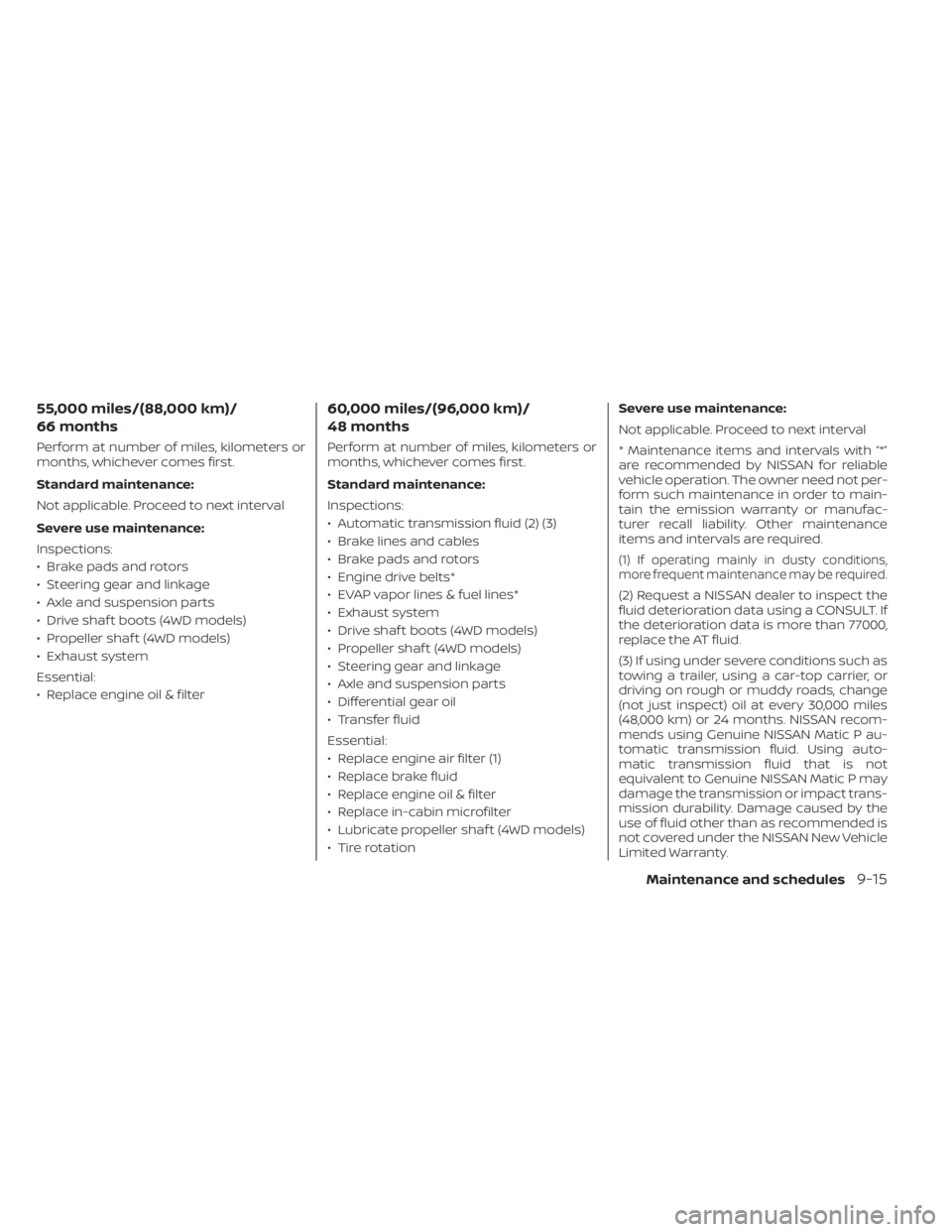
55,000 miles/(88,000 km)/
66 months
Perform at number of miles, kilometers or
months, whichever comes first.
Standard maintenance:
Not applicable. Proceed to next interval
Severe use maintenance:
Inspections:
• Brake pads and rotors
• Steering gear and linkage
• Axle and suspension parts
• Drive shaf t boots (4WD models)
• Propeller shaf t (4WD models)
• Exhaust system
Essential:
• Replace engine oil & filter
60,000 miles/(96,000 km)/
48 months
Perform at number of miles, kilometers or
months, whichever comes first.
Standard maintenance:
Inspections:
• Automatic transmission fluid (2) (3)
• Brake lines and cables
• Brake pads and rotors
• Engine drive belts*
• EVAP vapor lines & fuel lines*
• Exhaust system
• Drive shaf t boots (4WD models)
• Propeller shaf t (4WD models)
• Steering gear and linkage
• Axle and suspension parts
• Differential gear oil
• Transfer fluid
Essential:
• Replace engine air filter (1)
• Replace brake fluid
• Replace engine oil & filter
• Replace in-cabin microfilter
• Lubricate propeller shaf t (4WD models)
• Tire rotationSevere use maintenance:
Not applicable. Proceed to next interval
* Maintenance items and intervals with “*”
are recommended by NISSAN for reliable
vehicle operation. The owner need not per-
form such maintenance in order to main-
tain the emission warranty or manufac-
turer recall liability. Other maintenance
items and intervals are required.
(1) If operating mainly in dusty conditions,
more frequent maintenance may be required.
(2) Request a NISSAN dealer to inspect the
fluid deterioration data using a CONSULT. If
the deterioration data is more than 77000,
replace the AT fluid.
(3) If using under severe conditions such as
towing a trailer, using a car-top carrier, or
driving on rough or muddy roads, change
(not just inspect) oil at every 30,000 miles
(48,000 km) or 24 months. NISSAN recom-
mends using Genuine NISSAN Matic P au-
tomatic transmission fluid. Using auto-
matic transmission fluid that is not
equivalent to Genuine NISSAN Matic P may
damage the transmission or impact trans-
mission durability. Damage caused by the
use of fluid other than as recommended is
not covered under the NISSAN New Vehicle
Limited Warranty.
Maintenance and schedules9-15
Page 493 of 556
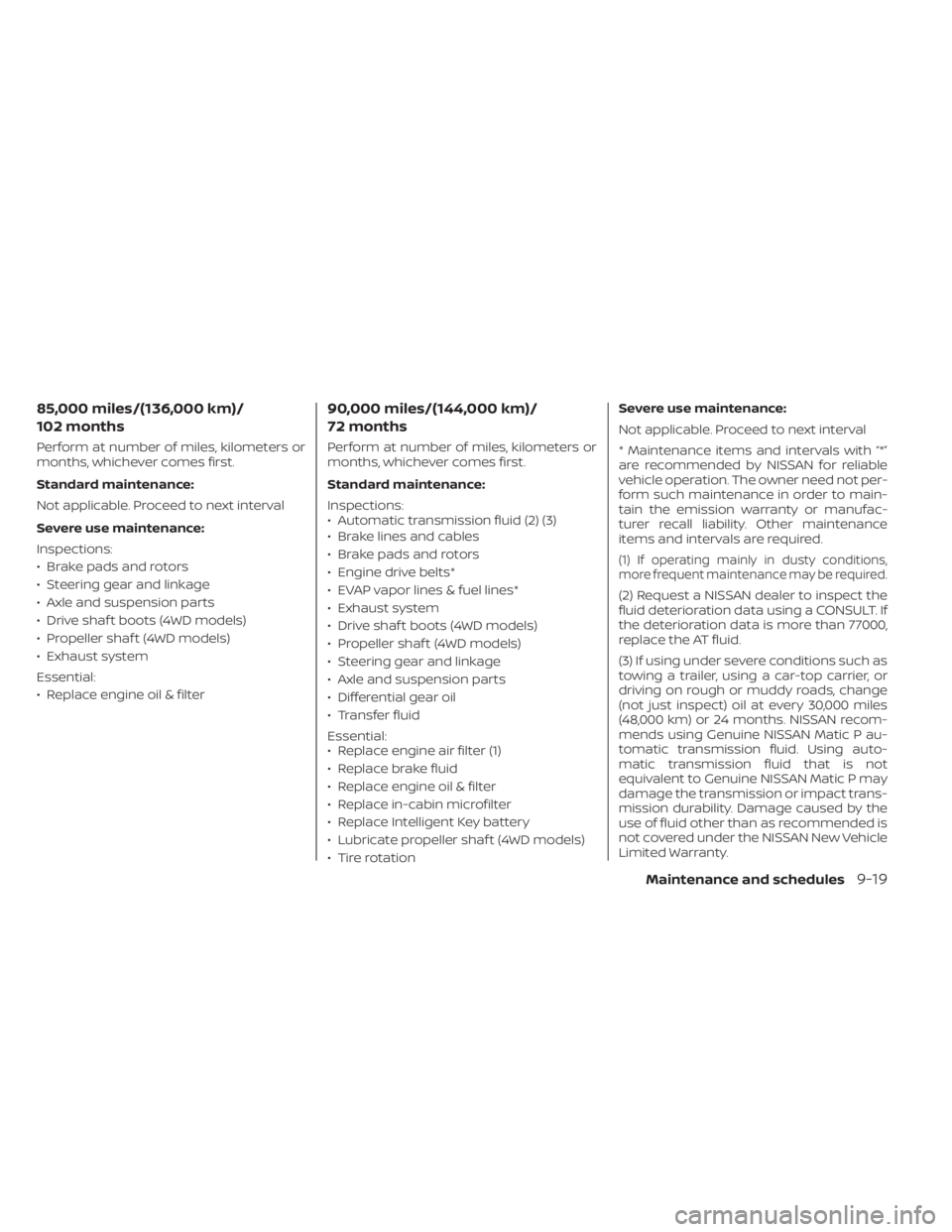
85,000 miles/(136,000 km)/
102 months
Perform at number of miles, kilometers or
months, whichever comes first.
Standard maintenance:
Not applicable. Proceed to next interval
Severe use maintenance:
Inspections:
• Brake pads and rotors
• Steering gear and linkage
• Axle and suspension parts
• Drive shaf t boots (4WD models)
• Propeller shaf t (4WD models)
• Exhaust system
Essential:
• Replace engine oil & filter
90,000 miles/(144,000 km)/
72 months
Perform at number of miles, kilometers or
months, whichever comes first.
Standard maintenance:
Inspections:
• Automatic transmission fluid (2) (3)
• Brake lines and cables
• Brake pads and rotors
• Engine drive belts*
• EVAP vapor lines & fuel lines*
• Exhaust system
• Drive shaf t boots (4WD models)
• Propeller shaf t (4WD models)
• Steering gear and linkage
• Axle and suspension parts
• Differential gear oil
• Transfer fluid
Essential:
• Replace engine air filter (1)
• Replace brake fluid
• Replace engine oil & filter
• Replace in-cabin microfilter
• Replace Intelligent Key battery
• Lubricate propeller shaf t (4WD models)
• Tire rotationSevere use maintenance:
Not applicable. Proceed to next interval
* Maintenance items and intervals with “*”
are recommended by NISSAN for reliable
vehicle operation. The owner need not per-
form such maintenance in order to main-
tain the emission warranty or manufac-
turer recall liability. Other maintenance
items and intervals are required.
(1) If operating mainly in dusty conditions,
more frequent maintenance may be required.
(2) Request a NISSAN dealer to inspect the
fluid deterioration data using a CONSULT. If
the deterioration data is more than 77000,
replace the AT fluid.
(3) If using under severe conditions such as
towing a trailer, using a car-top carrier, or
driving on rough or muddy roads, change
(not just inspect) oil at every 30,000 miles
(48,000 km) or 24 months. NISSAN recom-
mends using Genuine NISSAN Matic P au-
tomatic transmission fluid. Using auto-
matic transmission fluid that is not
equivalent to Genuine NISSAN Matic P may
damage the transmission or impact trans-
mission durability. Damage caused by the
use of fluid other than as recommended is
not covered under the NISSAN New Vehicle
Limited Warranty.
Maintenance and schedules9-19
Page 499 of 556
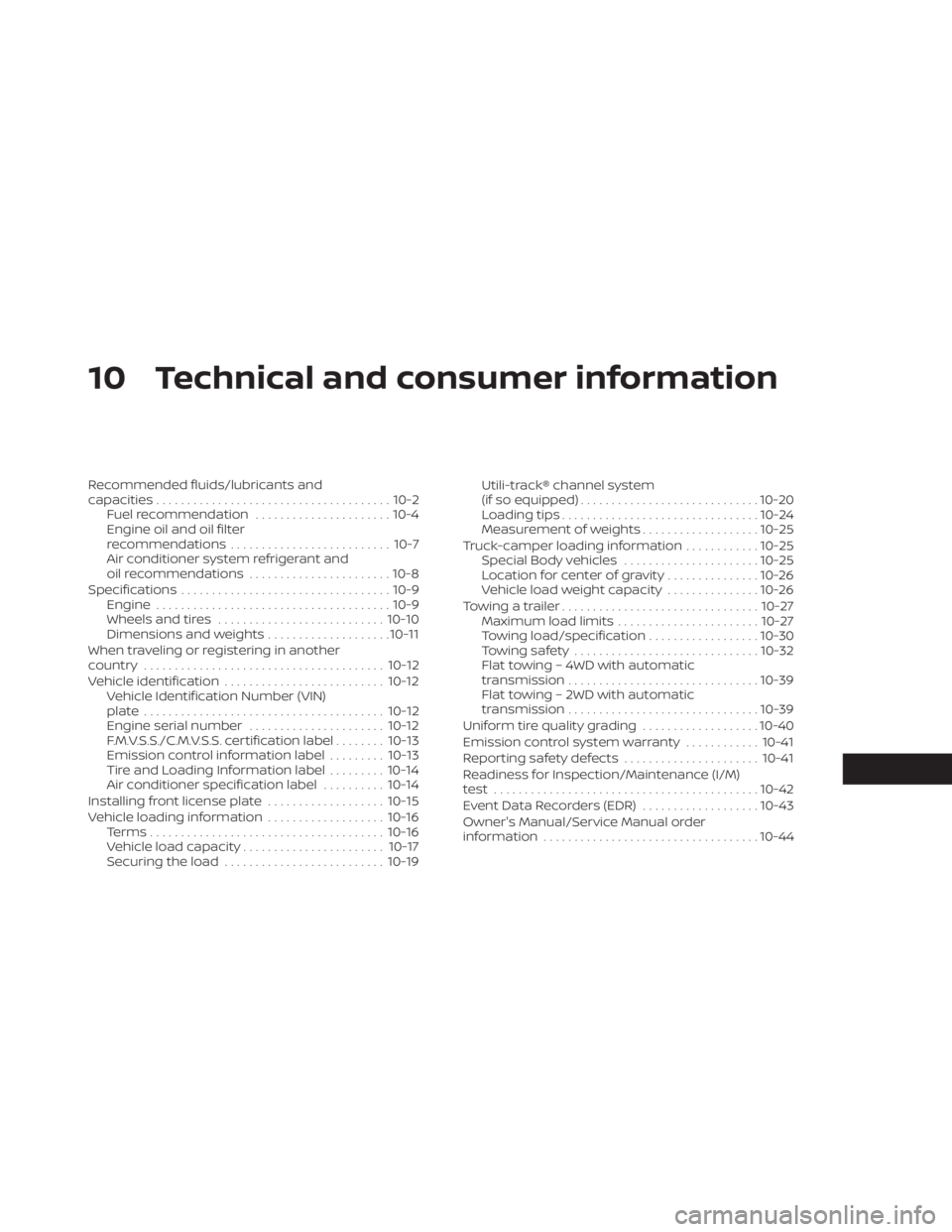
10 Technical and consumer information
Recommended fluids/lubricants and
capacities...................................... 10-2
Fuel recommendation ......................10-4
Engine oil and oil filter
recommendations .......................... 10-7
Air conditioner system refrigerant and
oil recommendations .......................10-8
Specifications .................................. 10-9
Engine ...................................... 10-9
Wheels and tires ........................... 10-10
Dimensions and weights ....................10-11
When traveling or registering in another
country ....................................... 10-12
Vehicle identification .......................... 10-12
Vehicle Identification Number (VIN)
plate ....................................... 10-12
Engine serial number ......................10-12
F.M.V.S.S./C.M.V.S.S. certification label ........10-13
Emission control information label .........10-13
Tire and Loading Information label .........10-14
Air conditioner specification label ..........10-14
Installing front license plate ...................10-15
Vehicle loading information ...................10-16
Terms ...................................... 10-16
Vehicle load capacity ....................... 10-17
Securing the load .......................... 10-19Utili-track® channel system
(if so equipped)
............................. 10-20
Loading tips ................................ 10-24
Measurement of weights ...................10-25
Truck-camper loading information ............10-25
Special Body vehicles ......................10-25
Location for center of gravity ...............10-26
Vehicle load weight capacity ...............10-26
Towing a trailer ................................ 10-27
Maximum load limits ....................... 10-27
Towing load/specification ..................10-30
Towing safety .............................. 10-32
Flat towing – 4WD with automatic
transmission ...............................
10-39
Flat
towing – 2WD with automatic
transmission ............................... 10-39
Uniform tire quality grading ...................10-40
Emission control system warranty ............10-41
Reporting safety defects ......................10-41
Readiness for Inspection/Maintenance (I/M)
test ........................................... 10-42
Event Data Recorders (EDR) ...................10-43
Owner's Manual/Service Manual order
information ................................... 10-44
Page 501 of 556
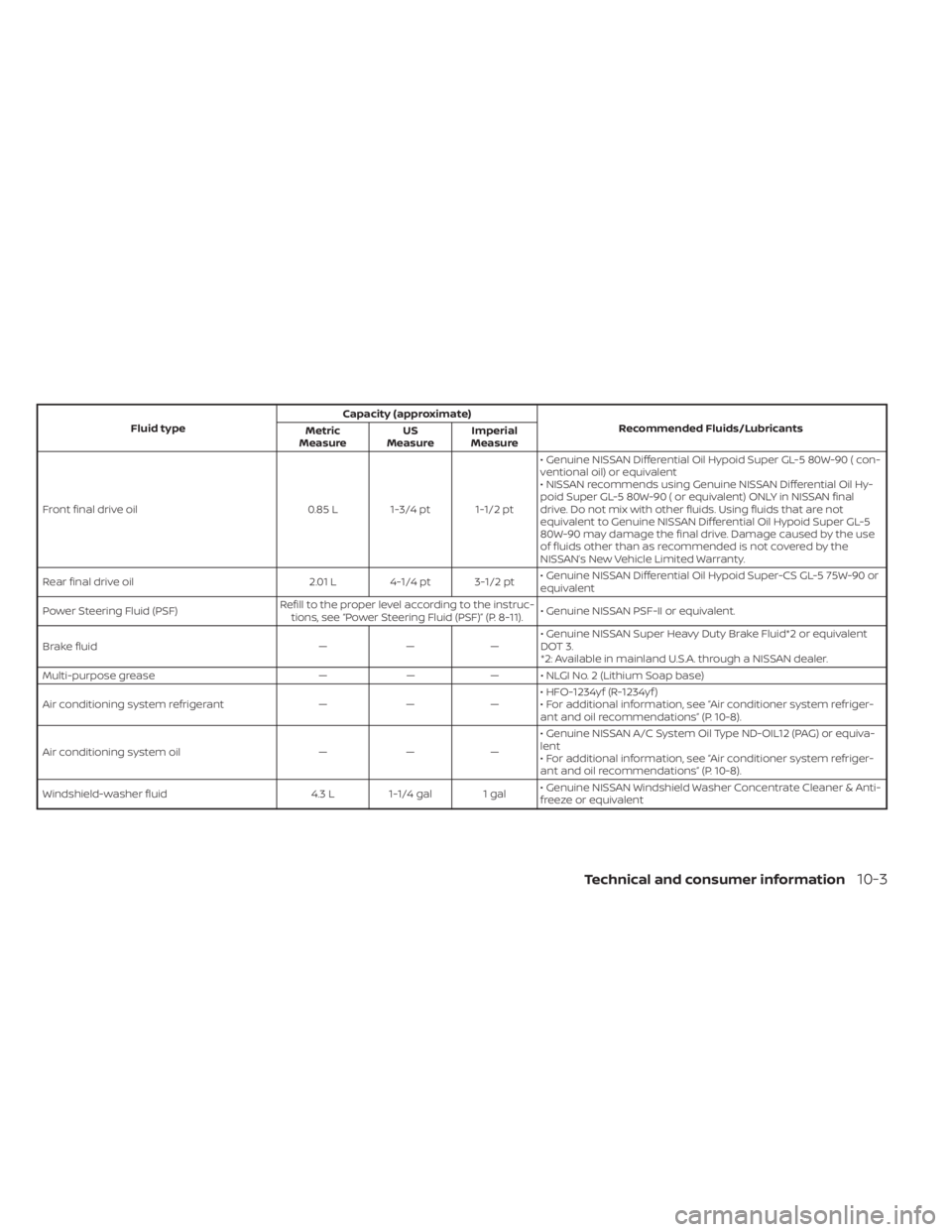
Fluid typeCapacity (approximate)
Recommended Fluids/Lubricants
Metric
Measure US
Measure Imperial
Measure
Front final drive oil 0.85 L 1-3/4 pt 1-1/2 pt• Genuine NISSAN Differential Oil Hypoid Super GL-5 80W-90 ( con-
ventional oil) or equivalent
• NISSAN recommends using Genuine NISSAN Differential Oil Hy-
poid Super GL-5 80W-90 ( or equivalent) ONLY in NISSAN final
drive. Do not mix with other fluids. Using fluids that are not
equivalent to Genuine NISSAN Differential Oil Hypoid Super GL-5
80W-90 may damage the final drive. Damage caused by the use
of fluids other than as recommended is not covered by the
NISSAN’s New Vehicle Limited Warranty.
Rear final drive oil 2.01 L 4-1/4 pt 3-1/2 pt• Genuine NISSAN Differential Oil Hypoid Super-CS GL-5 75W-90 or
equivalent
Power Steering Fluid (PSF) Refill to the proper level according to the instruc-
tions, see “Power Steering Fluid (PSF)” (P. 8-11). • Genuine NISSAN PSF-II or equivalent.
Brake fluid ———• Genuine NISSAN Super Heavy Duty Brake Fluid*2 or equivalent
DOT 3.
*2: Available in mainland U.S.A. through a NISSAN dealer.
Multi-purpose grease ——— • NLGI No. 2 (Lithium Soap base)
Air conditioning system refrigerant ———• HFO-1234yf (R-1234yf )
• For additional information, see “Air conditioner system refriger-
ant and oil recommendations” (P. 10-8).
Air conditioning system oil ———• Genuine NISSAN A/C System Oil Type ND-OIL12 (PAG) or equiva-
lent
• For additional information, see “Air conditioner system refriger-
ant and oil recommendations” (P. 10-8).
Windshield-washer fluid 4.3 L1-1/4 gal 1 gal • Genuine NISSAN Windshield Washer Concentrate Cleaner & Anti-
freeze or equivalent
Technical and consumer information10-3
Page 506 of 556
Change intervals
The oil and oil filter change intervals for
your engine are based on the use of the
specified quality oils and filters. Using en-
gine oil and filters that are not of the speci-
fied quality, or exceeding recommended oil
and filter change intervals could reduce
engine life or cause severe damage to the
engine. Damage to the engine caused by
improper maintenance or use of incorrect
oil and filter quality and/or viscosity is not
covered by the NISSAN New Vehicle Limited
Warranty.
Your engine was filled with a high-quality
engine oil when it was built. You do not have
to change the oil before the first recom-
mended change interval. Oil and filter
change intervals depend upon how you
use your vehicle.
NISSAN recommends the use of Genuine
NISSAN parts or equivalent. The use of
parts that do not meet or exceed NISSAN
specifications, can cause damage to your
vehicle, and have an effect on your war-
ranty coverage. It is recommended that
you visit a NISSAN dealer parts department
who can provide information on the proper
parts for your vehicle.Operation under the following conditions
may require more frequent oil and filter
changes:
• repeated short distance driving at cold
outside temperatures
• driving in dusty conditions
• extensive idling
• towing a trailer
• stop and go commuting
For additional information, see the “Mainte-
nance and schedules” section of this
manual.
AIR CONDITIONER SYSTEM
REFRIGERANT AND OIL
RECOMMENDATIONS
The air conditioner system in your
NISSAN vehicle must be charged with the
refrigerant HFO-1234yf (R-1234yf ) and
NISSAN A/C system oil Type ND-OIL12
(PAG) or the exact equivalents.
CAUTION
The use of any other refrigerant or oil
will cause severe damage to the air
conditioning system and will require
the replacement of all air conditioner
system components. The refrigerant HFO-1234yf (R-1234yf ) in
your NISSAN vehicle does not harm the
earth's ozone layer. Although this refriger-
ant does not affect the earth's atmo-
sphere, certain government regulations re-
quire the recovery and recycling of any
refrigerant during automotive air condi-
tioner system service. Air conditioner sys-
tem should only be serviced by trained and
certified technicians to ensure proper and
safe operation (SAE J2845). A NISSAN dealer
has the trained technicians and equip-
ment needed to recover and recycle your
air conditioner system refrigerant. Only
new and SAEJ2842 certified evaporator(s)
shall be used as replacement parts.
A damaged or leaking air conditioning
evaporator shall never be repaired or re-
placed with one removed from a used or
salvaged vehicle. To replace a damaged or
leaking evaporator, use only new and SAE
J2842 certified evaporator(s). It is recom-
mended that you visit a NISSAN dealer
when servicing your air conditioner
system.
10-8Technical and consumer information
Page 512 of 556
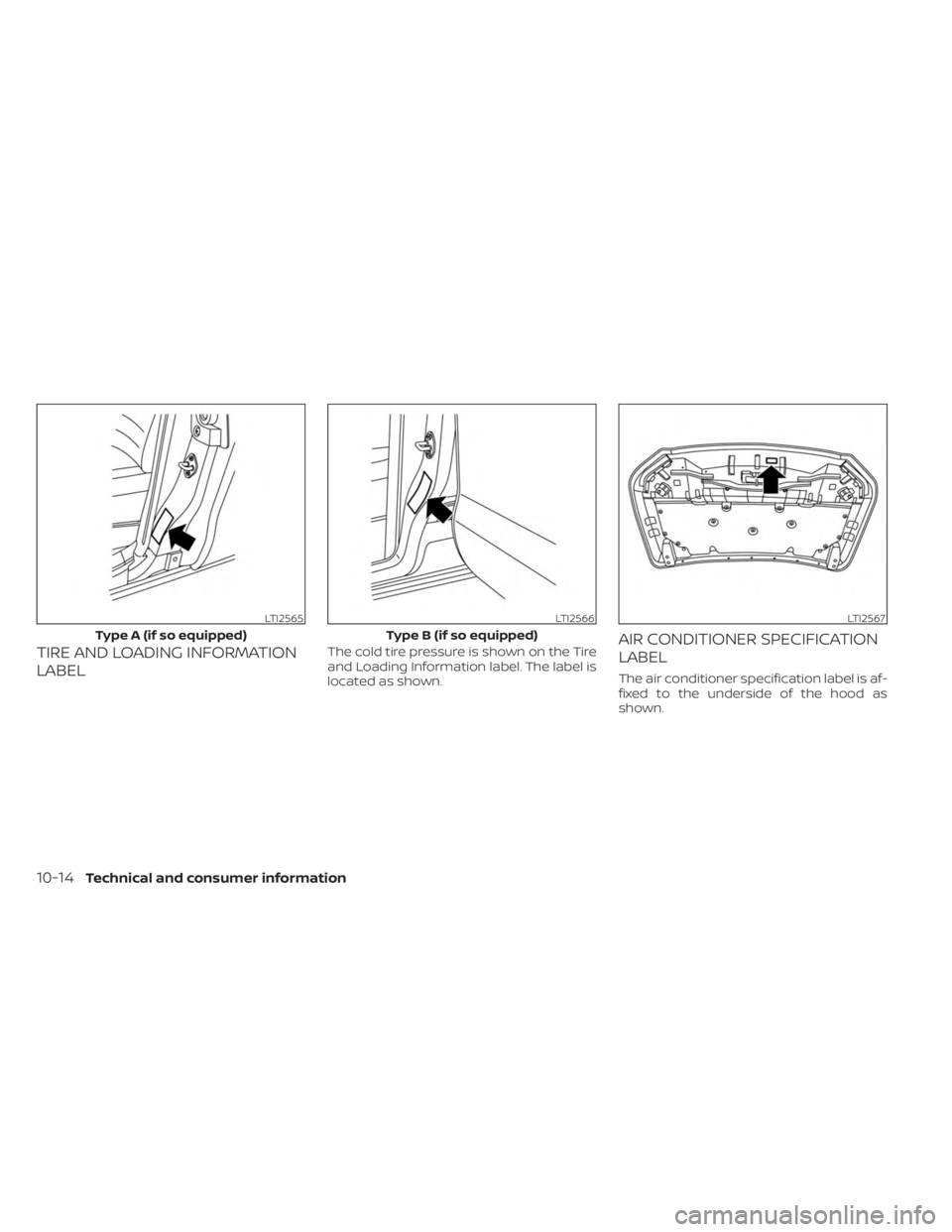
TIRE AND LOADING INFORMATION
LABELThe cold tire pressure is shown on the Tire
and Loading Information label. The label is
located as shown.AIR CONDITIONER SPECIFICATION
LABEL
The air conditioner specification label is af-
fixed to the underside of the hood as
shown.
LTI2565
Type A (if so equipped)
LTI2566
Type B (if so equipped)
LTI2567
10-14Technical and consumer information
Page 513 of 556
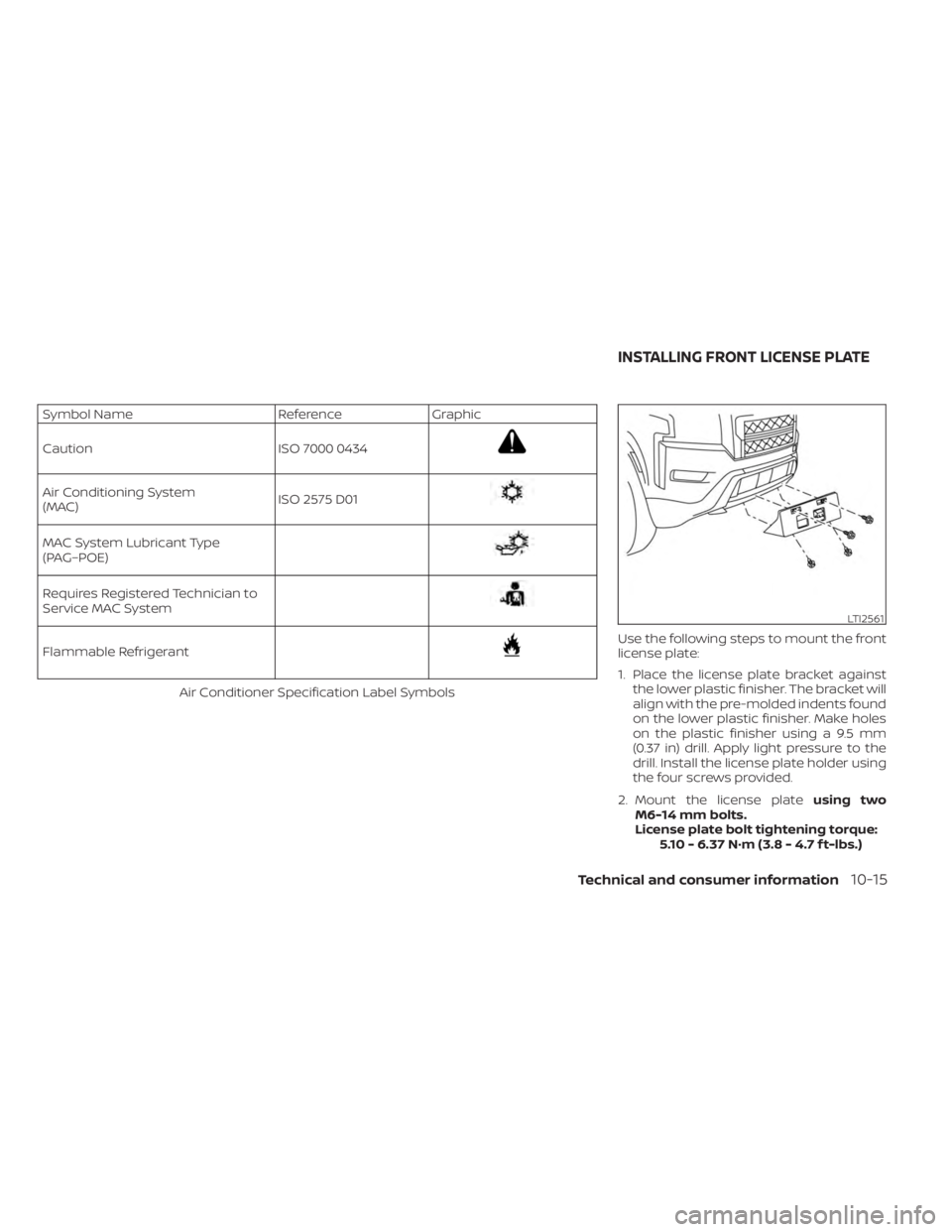
Symbol NameReferenceGraphic
Caution ISO 7000 0434
Air Conditioning System
(MAC)ISO 2575 D01
MAC System Lubricant Type
(PAG–POE)
Requires Registered Technician to
Service MAC System
Flammable Refrigerant
Air Conditioner Specification Label Symbols Use the following steps to mount the front
license plate:
1. Place the license plate bracket against
the lower plastic finisher. The bracket will
align with the pre-molded indents found
on the lower plastic finisher. Make holes
on the plastic finisher using a 9.5 mm
(0.37 in) drill. Apply light pressure to the
drill. Install the license plate holder using
the four screws provided.
2. Mount the license plate using two
M6-14 mm bolts.
License plate bolt tightening torque: 5.10 - 6.37 N·m (3.8 - 4.7 f t-lbs.)
LTI2561
INSTALLING FRONT LICENSE PLATE
Technical and consumer information10-15
Page 524 of 556
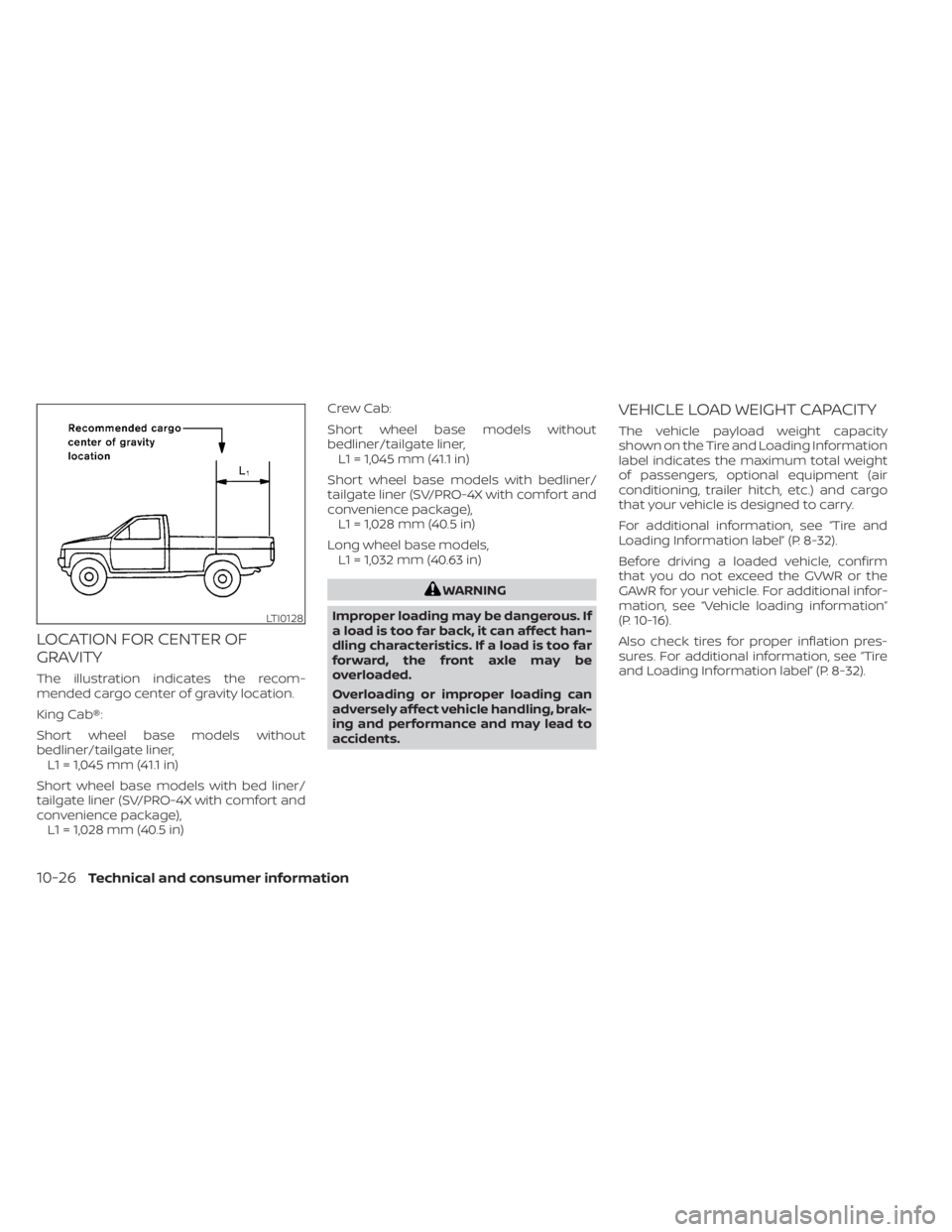
LOCATION FOR CENTER OF
GRAVITY
The illustration indicates the recom-
mended cargo center of gravity location.
King Cab®:
Short wheel base models without
bedliner/tailgate liner,L1 = 1,045 mm (41.1 in)
Short wheel base models with bed liner/
tailgate liner (SV/PRO-4X with comfort and
convenience package), L1 = 1,028 mm (40.5 in) Crew Cab:
Short wheel base models without
bedliner/tailgate liner,
L1 = 1,045 mm (41.1 in)
Short wheel base models with bedliner/
tailgate liner (SV/PRO-4X with comfort and
convenience package), L1 = 1,028 mm (40.5 in)
Long wheel base models, L1 = 1,032 mm (40.63 in)
WARNING
Improper loading may be dangerous. If
a load is too far back, it can affect han-
dling characteristics. If a load is too far
forward, the front axle may be
overloaded.
Overloading or improper loading can
adversely affect vehicle handling, brak-
ing and performance and may lead to
accidents.
VEHICLE LOAD WEIGHT CAPACITY
The vehicle payload weight capacity
shown on the Tire and Loading Information
label indicates the maximum total weight
of passengers, optional equipment (air
conditioning, trailer hitch, etc.) and cargo
that your vehicle is designed to carry.
For additional information, see “Tire and
Loading Information label” (P. 8-32).
Before driving a loaded vehicle, confirm
that you do not exceed the GVWR or the
GAWR for your vehicle. For additional infor-
mation, see “Vehicle loading information”
(P. 10-16).
Also check tires for proper inflation pres-
sures. For additional information, see “Tire
and Loading Information label” (P. 8-32).
LTI0128
10-26Technical and consumer information
Page 541 of 556
If a powertrain system component is re-
paired or the battery is disconnected, the
vehicle may be reset to a “not ready” condi-
tion. Before taking the I/M test, check the
vehicle's inspection/maintenance test
readiness condition. Place the ignition
switch in the ON position without starting
the engine. If the Malfunction Indicator
Light (MIL) comes on steady for 20 seconds
and then blinks for 10 seconds, the I/M test
condition is “not ready”. If the MIL does not
blink af ter 20 seconds, the I/M test condi-
tion is “ready”. It is recommended that you
visit a NISSAN dealer to set the “ready con-
dition” or to prepare the vehicle for testing.This vehicle is equipped with an Event Data
Recorder (EDR). The main purpose of an
EDR is to record, in certain crash or near
crash-like situations, such as an air bag
deployment or hitting a road obstacle, data
that will assist in understanding how a ve-
hicle's systems performed. The EDR is de-
signed to record data related to vehicle dy-
namics and safety systems for a short
period of time, typically 30 seconds or less.
The EDR in this vehicle is designed to re-
cord such data as:
• How various systems in your vehicle were
operating;
• Whether or not the driver and passenger safety belts were buckled/fastened;
• How far (if at all) the driver was depress- ing the accelerator and/or brake pedal;
and,
• How fast the vehicle was traveling.
• Sounds are not recorded. These data can help provide a better un-
derstanding of the circumstances in which
crashes and injuries occur. NOTE: EDR data
are recorded by your vehicle only if a non-
trivial crash situation occurs; no data are
recorded by the EDR under normal driving
conditions and no personal data (e.g.,
name, gender, age, and crash location) are
recorded. However, other parties, such as
law enforcement, could combine the EDR
data with the type of personally identif ying
data routinely acquired during a crash
investigation.
To read data recorded by an EDR, special
equipment is required, and access to the
vehicle or the EDR is needed. In addition to
the vehicle manufacturer and NISSAN
dealer, other parties, such as law enforce-
ment, that have the special equipment, can
read the information if they have access to
the vehicle or the EDR.
EDR data will only be accessed with the
consent of the vehicle owner or lessee or
as otherwise required or permitted by law.
EVENT DATA RECORDERS (EDR)
Technical and consumer information10-43