seats NISSAN FRONTIER 2023 Owners Manual
[x] Cancel search | Manufacturer: NISSAN, Model Year: 2023, Model line: FRONTIER, Model: NISSAN FRONTIER 2023Pages: 572, PDF Size: 6.58 MB
Page 229 of 572
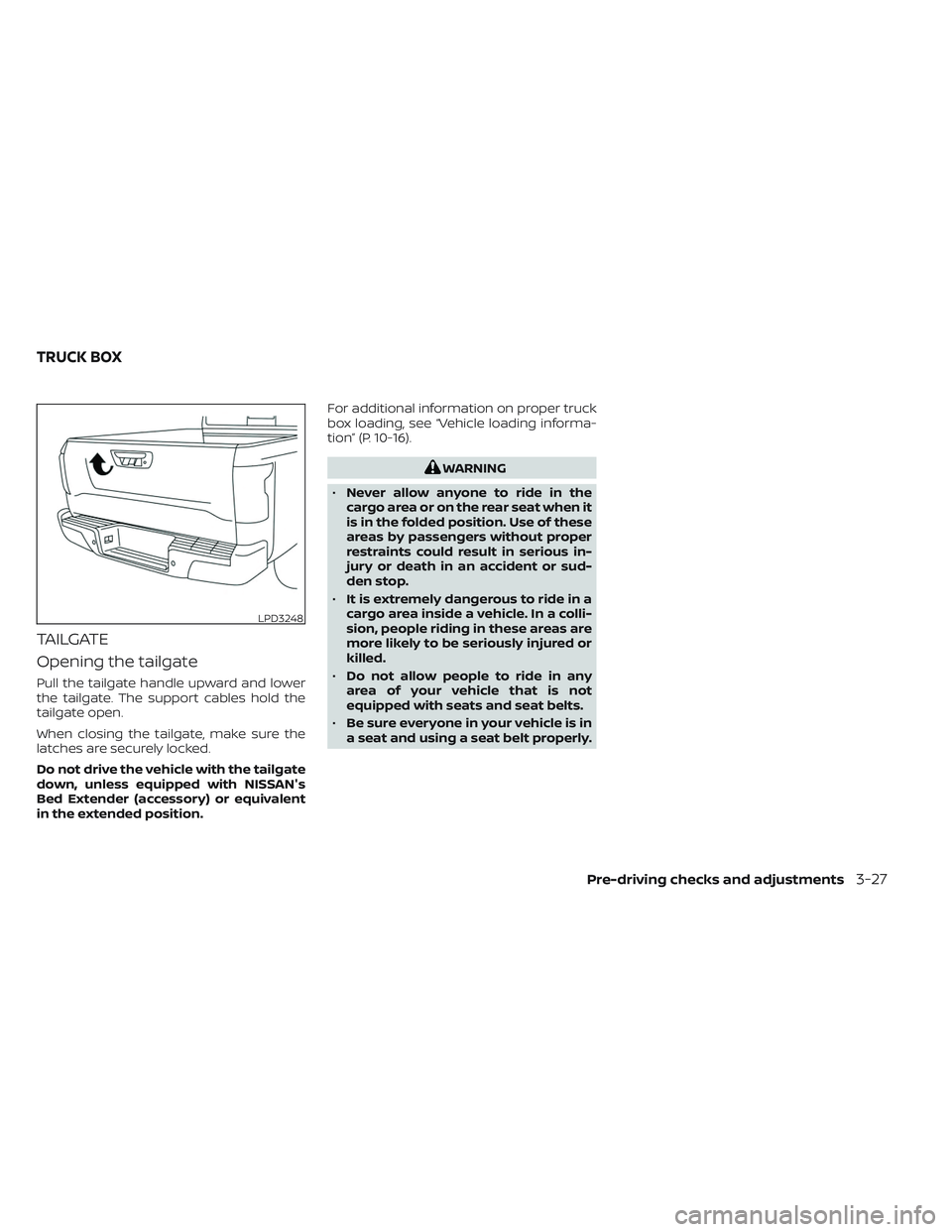
TAILGATE
Opening the tailgate
Pull the tailgate handle upward and lower
the tailgate. The support cables hold the
tailgate open.
When closing the tailgate, make sure the
latches are securely locked.
Do not drive the vehicle with the tailgate
down, unless equipped with NISSAN's
Bed Extender (accessory) or equivalent
in the extended position.For additional information on proper truck
box loading, see “Vehicle loading informa-
tion” (P. 10-16).
WARNING
• Never allow anyone to ride in the
cargo area or on the rear seat when it
is in the folded position. Use of these
areas by passengers without proper
restraints could result in serious in-
jury or death in an accident or sud-
den stop.
• It is extremely dangerous to ride in a
cargo area inside a vehicle. In a colli-
sion, people riding in these areas are
more likely to be seriously injured or
killed.
• Do not allow people to ride in any
area of your vehicle that is not
equipped with seats and seat belts.
• Be sure everyone in your vehicle is in
a seat and using a seat belt properly.
LPD3248
TRUCK BOX
Pre-driving checks and adjustments3-27
Page 289 of 572
– The battery of the tire pressure sen-sor is low.
• If the Easy-Fill Tire Alert does not oper- ate due to TPMS interference, move
the vehicle about 3 f t (1 m) backward
or forward and try again.
If the Easy-Fill Tire Alert is not working, use a
tire pressure gauge.
ON-PAVEMENT AND OFF-ROAD
DRIVING PRECAUTIONS
Utility vehicles have a significantly
higher rollover rate than other types of
vehicles.
They have higher ground clearance than
passenger cars to make them capable of
performing in a variety of on-pavement
and off-road applications. This gives them
a higher center of gravity than ordinary ve-
hicles. An advantage of higher ground
clearance is a better view of the road, allow-
ing you to anticipate problems. However,
they are not designed for cornering at the
same speeds as conventional 2-Wheel
Drive vehicles any more than low-slung
sports cars are designed to perform satis-
factorily under off-road conditions. If at all
possible, avoid sharp turns at high speeds.
As with other vehicles of this type, failure to operate this vehicle correctly may result in
loss of control or vehicle rollover.
In a rollover crash, an unbelted person is
significantly more likely to die than a per-
son wearing a seat belt.
For additional information, see “Driving
safety precautions” (P. 5-11).
AVOIDING COLLISION AND
ROLLOVER
WARNING
Failure to operate this vehicle in a safe
and prudent manner may result in loss
of control or an accident.
Be alert and drive defensively at all times.
Obey all traffic regulations. Avoid excessive
speed, high speed cornering, or sudden
steering maneuvers, because these driving
practices could cause you to lose control of
your vehicle.
As with any vehicle, loss of control could
result in a collision with other vehicles or
objects or cause the vehicle to roll over,
particularly if the loss of control causes
the vehicle to slide sideways.
Be attentive at all times, and avoid driving
when tired. Never drive when under the in- fluence of alcohol or drugs (including pre-
scription or over-the-counter drugs which
may cause drowsiness). Always wear your
seat belt as outlined in the “Safety – Seats,
seat belts and supplemental restraint sys-
tem” section of this manual, and also in-
struct your passengers to do so.
Seat belts help reduce the risk of injury in
collisions and rollovers.
In a rollover crash, an unbelted person is
significantly more likely to die than a
person wearing a seat belt.
OFF-ROAD RECOVERY
While driving, the right side or lef t side
wheels may unintentionally leave the road
surface. If this occurs, maintain control of
the vehicle by following the procedure be-
low. Please note that this procedure is only
a general guide. The vehicle must be driven
as appropriate based on the conditions of
the vehicle, road and traffic.
1. Remain calm and do not overreact.
2. Do not apply the brakes.
3. Maintain a firm grip on the steering
wheel with both hands and try to hold a
straight course.
Starting and driving5-9
Page 420 of 572
3. Park on a level surface and apply theparking brake. Move the shif t lever to P
(Park).
4. Turn off the engine.
5. Raise the hood to warn other traffic and to signal professional road assistance
personnel that you need assistance.
6. Have all passengers get out of the ve- hicle and stand in a safe place, away
from traffic and clear of the vehicle.
WARNING
• Make sure the parking brake is se-
curely applied and the shif t lever is
shif ted into P (Park).
• Never change tires when the vehicle
is on a slope, ice or slippery areas.
This is hazardous.
• Never change tires if oncoming traf-
fic is close to your vehicle. Wait for
professional road assistance.
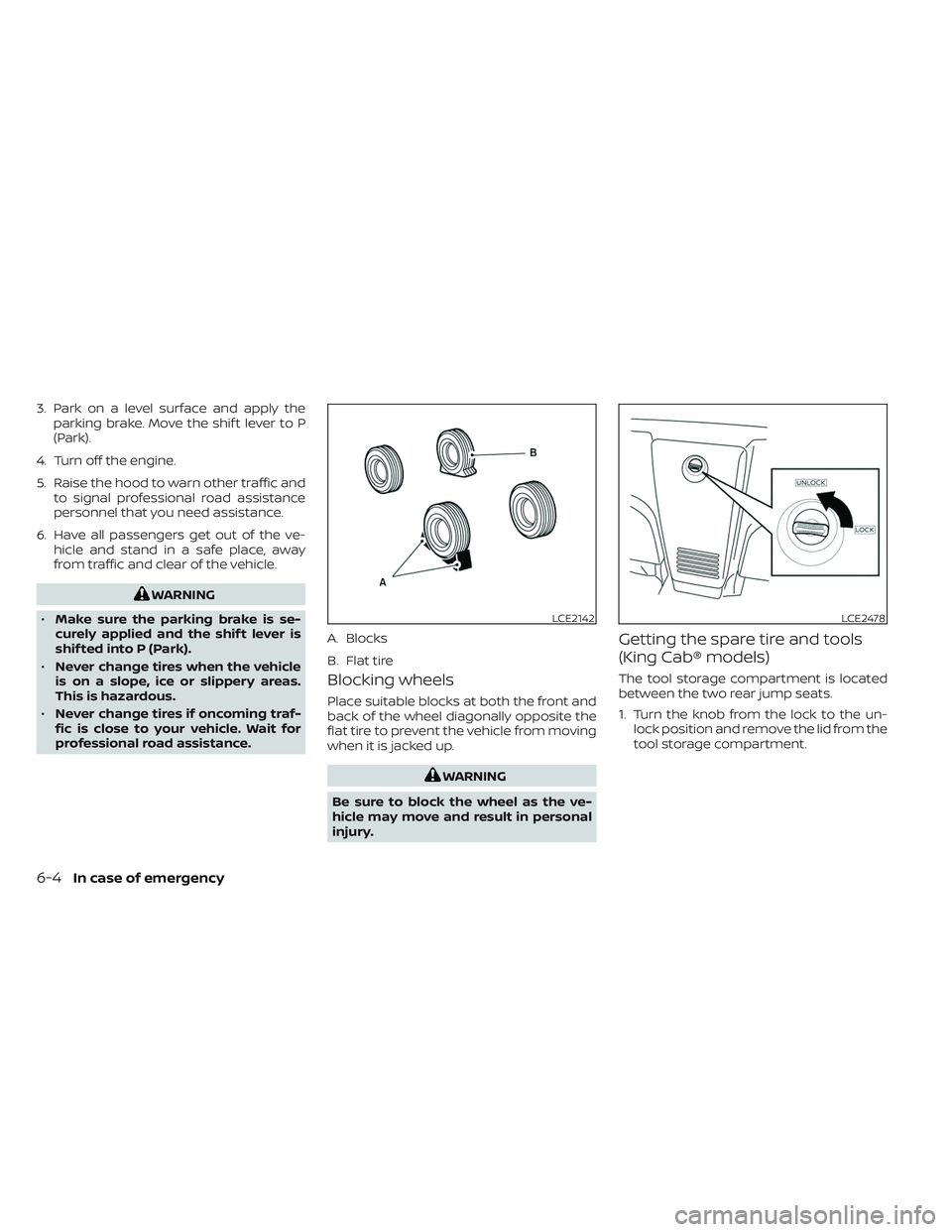
Blocking wheels
Place suitable blocks at both the front and
back of the wheel diagonally opposite the
flat tire to prevent the vehicle from moving
when it is jacked up.
WARNING
Be sure to block the wheel as the ve-
hicle may move and result in personal
injury.
Getting the spare tire and tools
(King Cab® models)
The tool storage compartment is located
between the two rear jump seats.
1. Turn the knob from the lock to the un- lock position and remove the lid from the
tool storage compartment.
LCE2142
A. Blocks
B. Flat tire
LCE2478
6-4In case of emergency
Page 438 of 572
TIRE DRESSINGS
NISSAN does not recommend the use of
tire dressings. Tire manufacturers apply a
coating to the tires to help reduce discolor-
ation of the rubber. If a tire dressing is ap-
plied to the tires, it may react with the coat-
ing and form a compound. This compound
may come off the tire while driving and
stain the vehicle paint.
If you choose to use a tire dressing, take the
following precautions:
• Use a water-based tire dressing. Thecoating on the tire dissolves more easily
than with an oil-based tire dressing.
• Apply a light coat of tire dressing to help prevent it from entering the tire tread/
grooves (where it would be difficult to
remove).
• Wipe off excess tire dressing using a dry towel. Make sure the tire dressing is com-
pletely removed from the tire tread/
grooves.
•
Allow the tire dressing to dry as recom-
mended by the tire dressing manufacturer.
Occasionally remove loose dust from the
interior trim, plastic parts and seats using a
vacuum cleaner or sof t bristled brush. Wipe
the vinyl and leather (if so equipped) sur-
faces with a clean, sof t cloth dampened in
mild soap solution, then wipe clean with a
dry, sof t cloth.
Regular care and cleaning is required in
order to maintain the appearance of the
leather (if so equipped).
Before using any fabric protector, read the
manufacturer's recommendations. Some
fabric protectors contain chemicals that
may stain or bleach the seat material.
Use a cloth dampened only with water to
clean the meter and gauge lens.
WARNING
Do not use water or acidic cleaners (hot
steam cleaners) on the seat. This can
damage the seat or occupant classifi-
cation sensor. This can also affect the
operation of the air bag system and re-
sult in serious personal injury.
CAUTION
• Never use benzine, thinner or any
similar material.
• Small dirt particles can be abrasive
and damaging to leather surfaces
and should be removed promptly. Do
not use saddle soap, car waxes, pol-
ishes, oils, cleaning fluids, solvents,
detergents or ammonia-based
cleaners as they may damage the
leather's natural finish.
• Never use fabric protectors unless
recommended by the manufacturer.
• Do not use glass or plastic cleaner on
meter or gauge lens covers. It may
damage the lens cover.
• Never use chloride solutions for
cleaning aluminum decoratives (if so
equipped), damage may occur.
CLEANING INTERIOR
7-4Appearance and care
Page 492 of 572
Brake pedal:Check the pedal for smooth
operation. If the brake pedal suddenly goes
down further than normal, the pedal feels
spongy or the vehicle seems to take longer
to stop, have your vehicle checked imme-
diately. It is recommended that you visit a
NISSAN dealer for this service. Keep the
floor mat away from the pedal.
Brakes: Check that the brakes do not pull
the vehicle to one side when applied.
Parking brake: Check the parking brake
operation regularly. The vehicle should be
securely held on a fairly steep hill with only
the parking brake applied. If the parking
brake needs adjustment, it is recom-
mended that you visit a NISSAN dealer for
this service.
Seats: Check seat position controls such
as seat adjusters, seatback recliner, etc., to
ensure they operate smoothly and all
latches lock securely in every position.
Check that the head restraints/headrests
move up and down smoothly and the locks
(if so equipped) hold securely in all latched
positions.
Seat belts: Check that all parts of the seat
belt system (for example, buckles, anchors,
adjusters and retractors) operate properly
and smoothly, and are installed securely. Check the belt webbing for cuts, fraying,
wear or damage.
Steering wheel:
Check for changes in the
steering system, such as excessive free
play, hard steering or strange noises.
Warning lights and chimes: Make sure all
warning lights and chimes are operating
properly.
Windshield defroster: Check that the air
comes out of the defroster outlets properly
and in sufficient quantity when operating
the heater or air conditioner.
Windshield wiper and washer*: Check
that the wipers and washer operate prop-
erly and that the wipers do not streak.
Under the hood and vehicle
The maintenance items listed here should
be checked periodically (for example, each
time you check the engine oil or refuel).
Battery (for maintenance free batter-
ies)*: This vehicle is equipped with a sealed
maintenance free battery. It is recom-
mended that you visit a NISSAN dealer for
service.
NOTE:
Care should be taken to avoid situations
that can lead to potential battery dis-
charge and potential no-start conditions
such as:
1. Installation or extended use of elec- tronic accessories that consume bat-
tery power when the engine is not
running (Phone chargers, GPS, DVD
players, etc.).
2. Vehicle is not driven regularly and/or only driven short distances.
In these cases, the battery may need to
be charged to maintain battery health.
Brake fluid level*: Make sure that the fluid
level is between the MAX and MIN lines on
the reservoir.
Engine coolant level*: Check the coolant
level when the engine is cold.
Engine drive belts*: Check engine drive
belts for wear, fraying or cracking and for
proper tension. Replace any damaged
drive belts.
9-4Maintenance and schedules
Page 530 of 572
WARNING
• It is extremely dangerous to
ride in a cargo area inside a ve-
hicle. In a collision, people rid-
ing in these areas are more
likely to be seriously injured or
killed.
• Do not allow people to ride in
any area of your vehicle that is
not equipped with seats and
seat belts.
• Be sure everyone in your ve-
hicle is in a seat and using a
seat belt properly.TERMS
It is important to familiarize yourself
with the following terms before
loading your vehicle:
• Curb Weight (actual weight of your vehicle) - vehicle weight including:
standard and optional equipment,
fluids, emergency tools, and spare
tire assembly. This weight does
not include passengers and cargo.
• GVW (Gross Vehicle Weight) - curb weight plus the combined weight
of passengers and cargo.
• GVWR (Gross Vehicle Weight Rat- ing) - maximum total combined
weight of the unloaded vehicle,
passengers, cargo, hitch, trailer
tongue load and any other op-
tional equipment. This information
is located on the F.M.V.S.S./
C.M.V.S.S. certification label. •
GAWR (Gross Axle Weight Rating) -
maximum weight (load) limit speci-
fied for the front or rear axle. This
information is located on the
F.M.V.S.S./C.M.V.S.S. certification label.
• GCWR (Gross Combined Weight Rating) - The maximum total
weight rating of the vehicle, pas-
sengers, cargo, and trailer.
• Vehicle Capacity Weight, Load limit, Total load capacity - maximum to-
tal weight limit specified of the load
(passengers and cargo) for the ve-
hicle. This is the maximum com-
bined weight of occupants and
cargo that can be loaded into the
vehicle. If the vehicle is used to tow
a trailer, the trailer tongue weight
must be included as part of the
cargo load. This information is lo-
cated on the Tire and Loading In-
formation label.
VEHICLE LOADING INFORMATION
10-16Technical and consumer information
Page 559 of 572
11 Index
4
4-Wheel Drive................5-1094WD......................5-109
A
Active Brake Limited Slip (ABLS)
system....................5-120Air bag (See supplemental restraint
system).....................1-70Air bag systemFront (See supplemental front impact air
bag system)
................1-77Air bag warning labels............1-90Air bag warning light.........1-90, 2-15Air bag warning light,
supplemental..............1-90, 2-15Air cleaner housing filter..........8-20Air conditionerAir conditioner operation. . . .4-33, 4-39Air conditioner service..........4-43Air conditioner specification label. .10-14Air conditioner system refrigerant and oil
recommendations............10-8Air conditioner system refrigerant
recommendations............10-8Heater and air conditioner (automatic)
(if so equipped)..............4-38
Heater and air conditioner controls.4-39Servicing air conditioner........4-43Air flow charts................4-34Alarm system (See vehicle security
system)................... .2-39Anchor point locations............1-31Antenna....................4-44Anti-lock brake warning light.......2-13Anti-lock Braking System (ABS)......5-118Antifreeze...................5-134Autolight switch...............2-44Automatic
Automatic power window switch. . .2-76Driving with automatic transmission.5-19Automatic anti-glare inside mirror. . . .3-25Automatic door locks.............3-7Automatic Emergency Braking (AEB) with
Pedestrian Detection............5-81Automatic transmission fluid temperature
gauge..................... .2-8
B
Battery.................5-134, 8-16Charge warning light...........2-14Battery replacement............8-26Key fob...................8-26NISSAN Intelligent Key®.........8-26Before starting the engine.........5-17Belt (See drive belt)..............8-19
Blind Spot Warning (BSW)..........5-32Booster seats.................1-64Brake
Anti-lock Braking System (ABS). . . .5-118Brake fluid.................8-14Brake light (See stop light).......8-29Brake system...............5-118Brake warning light............2-13Brake wear indicators.......2-21,8-22Parking brake operation.........5-24Self-adjusting brakes..........8-22Brake fluid...................8-14Brake system................5-118Brakes.....................8-22Break-in schedule..............5-107Brightness controlInstrument panel.............2-49Bulb check/instrument panel.......2-13Bulb replacement..............8-29
C
C.M.V.S.S. certification label........10-13Capacities and recommended
fuel/lubricants................10-2Car phone or CB radio...........4-44Cargo (See vehicle loading
information)................ .10-16Cargo lamp switch.............2-50Cargo light................. .2-80
Page 561 of 572
Forward Driving AidsSystem Temporarily
Unavailable
......2-38, 5-67, 5-88, 5-101Four-Wheel Drive...............5-109Front air bag system (See supplemental re-
straint system).................1-77Front power seat adjustment........1-4Front seats....................1-2Front-door pocket..............2-67FuelCapacities and recommended
fuel/lubricants
...............10-2Fuel economy...............5-109Fuel gauge..................2-7Fuel octane rating.............10-6Fuel recommendation..........10-4Fuel-filler cap................3-21Fuel-filler lid.................3-21Loose fuel cap warning..........2-33Fuel efficient driving tips..........5-108Fuel gauge....................2-7Fuel-filler door.................3-21Fuses......................8-23Fusible links..................8-25
G
Garage door opener, HomeLink® Universal
Transceiver........2-80, 2-81, 2-83, 2-84Gas cap.....................3-21GaugeAutomatic transmission fluid temperature
gauge
.................... .2-8
Engine coolant temperature gauge. . .2-6Engine oil pressure gauge.........2-8Fuel gauge..................2-7Odometer...................2-5Speedometer................2-5Tachometer.................2-6Trip odometer................2-5Voltmeter.................. .2-8General maintenance.............9-2Glove box....................2-71
H
Hazard warning flasher switch........6-2Head restraints.................1-9Headlight and turn signal switch.....2-43Headlight control switch...........2-43Headlights...................8-28Heated mirrors................3-26Heated seat switches............2-51Heated steering wheel switch.......2-52Heater
Heater and air conditioner (automatic) (if
so equipped)
................4-38Heater and air conditioner controls. .4-39Heater operation..........4-31, 4-41Heater and air conditioner (automatic).4-38Hill descent control switch.........2-54Hill descent control system........5-123Hill start assist system...........5-124HomeLink® Universal
Transceiver........2-80, 2-81, 2-83, 2-84
Hood release..................3-20Horn...................... .2-50
I
Idling Stop System..............5-129Ignition switch
Push-button ignition switch.......5-13Immobilizer system..........2-41, 5-16In-cabin microfilter..............8-20Increasing fuel economy..........5-109Indicator lights and audible reminders (See
warning/indicator lights and audible
reminders)
...................2-13Inside automatic anti-glare mirror. . . .3-25Instrument brightness control.......2-49Instrument panel.............0-6, 2-2Instrument panel dimmer switch.....2-49Intelligent Around View® Monitor......4-11Intelligent Cruise Control..........5-52Intelligent Driver Alertness (I-DA).....5-104Intelligent Forward Collision Warning
(I-FCW)..................... .5-92Intelligent Key system
Key operating range............3-9Key operation................3-10Mechanical key................3-3Remote keyless entry operation. . . .3-13Troubleshooting guide..........3-16Warning signals...............3-16Interior light..................2-78
11-3
Page 563 of 572
O
Octane rating (See fuel octane rating). .10-6Odometer....................2-5Oil
Capacities and recommended
fuel/lubricants
...............10-2Changing engine oil............8-8Changing engine oil filter.........8-8Checking engine oil level.........8-8Engine oil.................. .8-8Engine oil and oil filter
recommendation.............10-7Engine oil viscosity.............10-7Outside mirror defroster switch......2-43Outside mirrors................3-25Overhead sunglasses holder........2-72Overheat
If your vehicle overheats.........6-13Owner's manual order form........10-44Owner's manual/service manual order
information................. .10-44
P
Parking
Parking brake operation.........5-24Parking/parking on hills.........5-116Parking brake.................5-24PowerPower door locks..............3-6Power outlet.............2-60, 2-61Power steering fluid............8-14
Power steering system.........5-117Power windows...............2-74Rear power windows...........2-75Power inverter switch............2-56Power outlet...............2-60, 2-61Power steering................5-117Power steering fluid..............8-14PrecautionsMaintenance precautions.........8-2On-pavement and off-road driving
precautions................. .5-9Precautions on booster
seats...........1-38, 1-41, 1-54, 1-64Precautions on child
restraints.........1-38, 1-41, 1-54, 1-64Precautions on seat belt usage.....1-14Precautions on supplemental restraint
system....................1-70Precautions when starting and
driving..................5-4, 5-11Push starting..................6-13
R
Radio
Car phone or CB radio..........4-44Readiness for inspection maintenance
(I/M) test................... .10-43Rear Automatic Braking (RAB). . . .2-20, 5-76Rear Cross Traffic Alert (RCTA).......5-42Rear Door Alert.........2-34, 2-35, 2-59Rear power windows.............2-75Rear seat.................... .1-6
Rear sliding window.............2-76Rear Sonar System (RSS)..........5-124Rear sonar system OFF switch.......2-56Rearview mirror................3-25RearView Monitor................4-3Recommended Fluids............10-2Recorders
Event Data................ .10-44Refrigerant recommendation.......10-8Registering a vehicle in another
country.................... .10-12Remote Engine Start.............3-18Reporting safety defects (US only). . . .10-42
S
Safety
Child safety rear door lock.........3-7Child seat belts. .1-26, 1-38, 1-41, 1-54, 1-64Reporting safety defects (US only). .10-42SeatJump seat.................. .1-6Seat adjustment
Front manual seat adjustment......1-3Front power seat adjustment.......1-4Seat beltChild safety.................1-23Infants and small children........1-24Injured person................1-17Larger children...............1-25Precautions on seat belt usage.....1-14Pregnant women..............1-17Seat belt extenders............1-22
11-5
Page 564 of 572
Seat belt maintenance..........1-23Seat belts................1-14,7-6Shoulder belt height adjustment. . . .1-22Three-point type with retractor.....1-18Seat belt extenders..............1-22Seat belt warning light.........1-17,2-15Seatback pockets...............2-68SeatsAdjustment..................1-2Front seats..................1-2Manual front seat adjustment......1-3Rear seat.................. .1-6Security indicator light............2-15Security system (NISSAN Vehicle Immobilizer
System), engine start.........2-41, 5-16Security systems
Vehicle security system.........2-39Self-adjusting brakes.............8-22Service manual order form........10-44Servicing air conditioner...........4-43Shif tingAutomatic transmission.........5-20Shoulder belt height adjustment......1-22Side air bag system (See supplemental side
air bag, curtain and rollover air bag
systems)
................... .1-86Sonar
Rear system................5-124Spark plug replacement...........8-19Spark plugs...................8-19Specifications................ .10-9Speedometer................. .2-5Speedometer and odometer........2-4SRS warning label...............1-90
Stability control................5-121Standard maintenance............9-8Starting
Before starting the engine........5-17Jump starting............6-11,8-18Precautions when starting and
driving................. .5-4, 5-11Push starting................6-13Starting the engine (gasoline engine
only).......................5-17Steering
Power steering fluid............8-14Power steering system.........5-117Tilting steering wheel...........3-23Steering wheel.................3-23Stop light....................8-29Storage.................... .2-67Storage tray...................2-71Sun visors....................3-24Sunglasses case................2-72Sunglasses holder..............2-72Sunroof...................2-77,7-5Supplemental air bag warning labels. . .1-90Supplemental air bag warning
light....................1-90, 2-15Supplemental front impact air bag
system......................1-77Supplemental restraint system
Information and warning labels.....1-90Precautions on supplemental restraint
system....................1-70Supplemental restraint system (Supplemen-
tal air bag system)...............1-70Switch Autolight switch
..............2-44Automatic power window switch. . .2-76Electronic locking rear differential (E-Lock)
system switch...............2-55Fog light switch..............2-49Hazard warning flasher switch......6-2Headlight and turn signal switch. . . .2-43Headlight control switch.........2-43Hill descent control switch........2-54Instrument brightness control.....2-49Power door lock switch..........3-6Power inverter switch...........2-56Rear sonar system OFF switch.....2-56Tow mode switch.............2-57Turn signal switch.............2-49
T
Tachometer..................
.2-6Tailgate.....................3-27Temperature gauge
Engine coolant temperature gauge. . .2-6Thef t (NISSAN Vehicle Immobilizer System),
engine start...............2-41, 5-16Three-way catalyst...............5-5Tie down hooks................3-31Tilting steering wheel.............3-23TireFlat tire................... .6-3Spare tire..........6-4, 6-5, 6-6, 8-44Tire and Loading Information label. .10-14Tire chains.................8-40Tire pressure................8-32
11-6