weight NISSAN FRONTIER 2023 Owner's Manual
[x] Cancel search | Manufacturer: NISSAN, Model Year: 2023, Model line: FRONTIER, Model: NISSAN FRONTIER 2023Pages: 572, PDF Size: 6.58 MB
Page 123 of 572
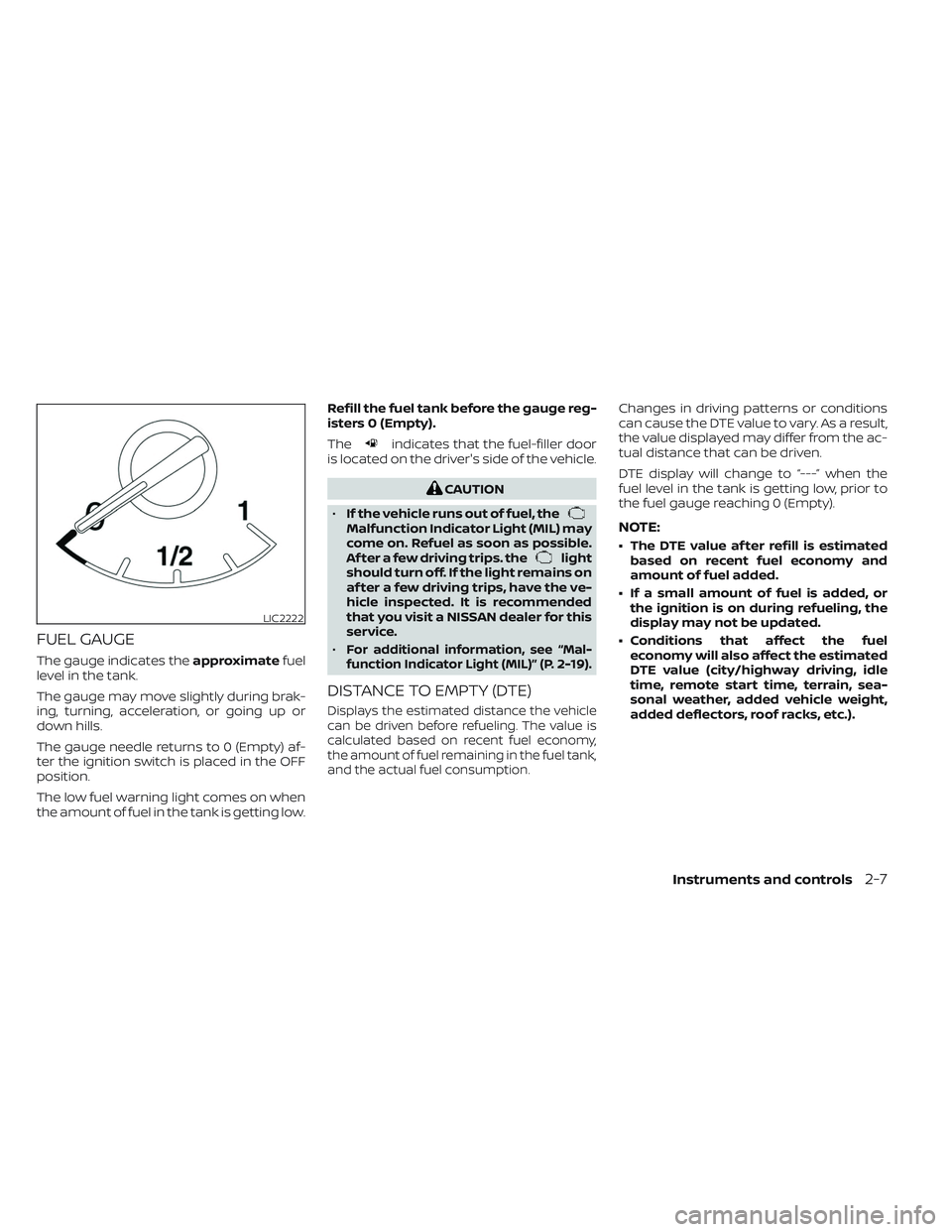
FUEL GAUGE
The gauge indicates theapproximatefuel
level in the tank.
The gauge may move slightly during brak-
ing, turning, acceleration, or going up or
down hills.
The gauge needle returns to 0 (Empty) af-
ter the ignition switch is placed in the OFF
position.
The low fuel warning light comes on when
the amount of fuel in the tank is getting low. Refill the fuel tank before the gauge reg-
isters 0 (Empty).
The
indicates that the fuel-filler door
is located on the driver's side of the vehicle.
CAUTION
• If the vehicle runs out of fuel, the
Malfunction Indicator Light (MIL) may
come on. Refuel as soon as possible.
Af ter a few driving trips. the
light
should turn off. If the light remains on
af ter a few driving trips, have the ve-
hicle inspected. It is recommended
that you visit a NISSAN dealer for this
service.
•
For additional information, see “Mal-
function Indicator Light (MIL)” (P. 2-19).
DISTANCE TO EMPTY (DTE)
Displays the estimated distance the vehicle
can be driven before refueling. The value is
calculated based on recent fuel economy,
the amount of fuel remaining in the fuel tank,
and the actual fuel consumption.
Changes in driving patterns or conditions
can cause the DTE value to vary. As a result,
the value displayed may differ from the ac-
tual distance that can be driven.
DTE display will change to “---” when the
fuel level in the tank is getting low, prior to
the fuel gauge reaching 0 (Empty).
NOTE:
• The DTE value af ter refill is estimated based on recent fuel economy and
amount of fuel added.
• If a small amount of fuel is added, or the ignition is on during refueling, the
display may not be updated.
• Conditions that affect the fuel economy will also affect the estimated
DTE value (city/highway driving, idle
time, remote start time, terrain, sea-
sonal weather, added vehicle weight,
added deflectors, roof racks, etc.).
LIC2222
Instruments and controls2-7
Page 186 of 572
WARNING
• Properly secure all cargo with ropes
or straps to help prevent it from slid-
ing or shif ting. In a sudden stop or
collision, unsecured cargo could
cause personal injury.
• The cargo restrained in the under-
seat storage bins must not exceed
the weight limits listed below or the
bins may not stay secured. In a sud-
den stop or collision, the unsecured
bins could cause personal injury.
King Cab® model: 16 lbs. (7.25 kg)
Crew Cab model Driver’s side: 16 lbs. (7.25 kg)
Passenger’s side: 25 lbs. (11.33 kg)
• If the under-seat storage bins are re-
moved for any reason, they should be
securely stored to prevent them from
causing injury to passengers or dam-
age to the vehicle in case of sudden
braking or an accident.
• Do not place sharp objects in the
under-seat storage bins. Such ob-
jects may become dangerous projec-
tiles and cause injury when the ve-
hicle is moving or if the vehicle is
involved in a collision. To access the under-seat storage bins:
For King Cab® models, lif t up the jump seat.
For additional information, see “Jump seat”
(P. 1-6).
For Crew Cab models, lif t up the rear bench
seat. For additional information, see “Fold-
ing the rear bench seat down” (P. 1-7).
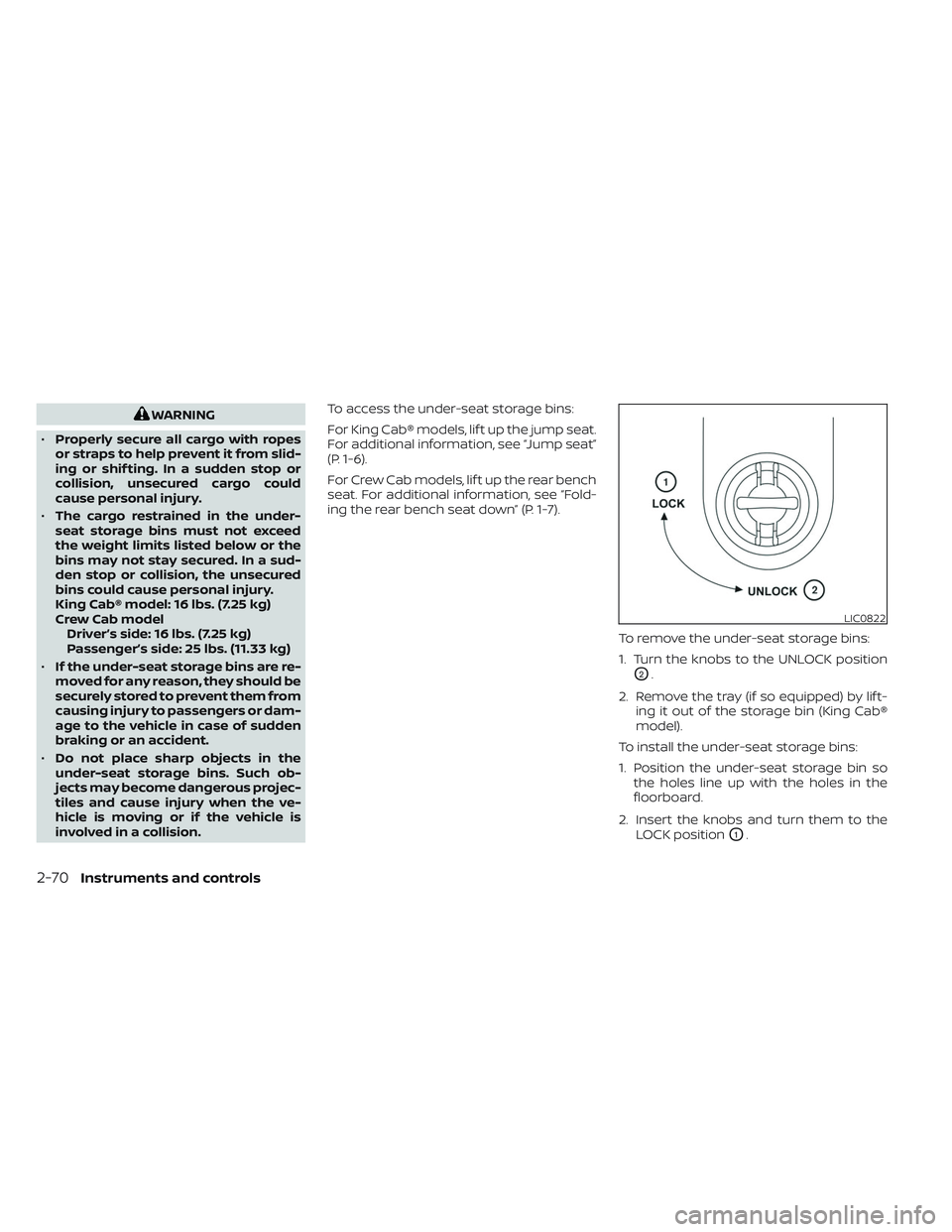
To remove the under-seat storage bins:
1. Turn the knobs to the UNLOCK position
O2.
2. Remove the tray (if so equipped) by lif t- ing it out of the storage bin (King Cab®
model).
To install the under-seat storage bins:
1. Position the under-seat storage bin so the holes line up with the holes in the
floorboard.
2. Insert the knobs and turn them to the LOCK position
O1.
LIC0822
2-70Instruments and controls
Page 233 of 572
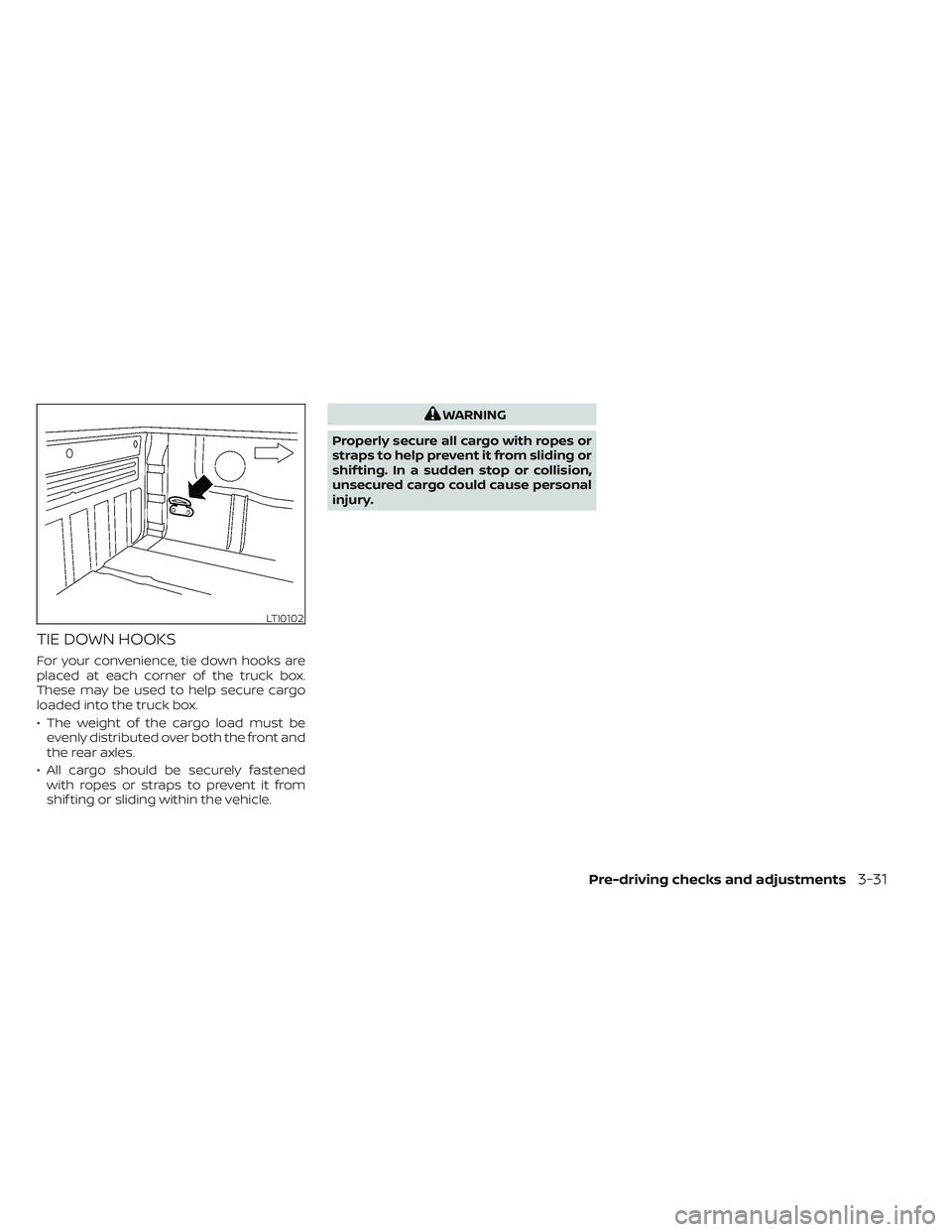
TIE DOWN HOOKS
For your convenience, tie down hooks are
placed at each corner of the truck box.
These may be used to help secure cargo
loaded into the truck box.
• The weight of the cargo load must beevenly distributed over both the front and
the rear axles.
• All cargo should be securely fastened with ropes or straps to prevent it from
shif ting or sliding within the vehicle.
WARNING
Properly secure all cargo with ropes or
straps to help prevent it from sliding or
shif ting. In a sudden stop or collision,
unsecured cargo could cause personal
injury.
LTI0102
Pre-driving checks and adjustments3-31
Page 475 of 572
WARNING
• Improperly inflated tires can
fail suddenly and cause an
accident.
• The Gross Vehicle Weight Rat-
ing (GVWR) is located on the
F.M.V.S.S./C.M.V.S.S. certifica-
tion label. The vehicle weight
capacity is indicated on the Tire
and Loading Information label.
Do not load your vehicle be-
yond this capacity. Overload-
ing your vehicle may result in
reduced tire life, unsafe operat-
ing conditions due to prema-
ture tire failure, or unfavorable
handling characteristics and
could also lead to a serious ac-
cident. Loading beyond the
specified capacity may also re-
sult in failure of other vehicle
components. •
Before taking a long trip, or
whenever you heavily load
your vehicle, use a tire pressure
gauge to ensure that the tire
pressures are at the specified
level.
• For additional information re-
garding tires, refer to “Impor-
tant Tire Safety Information”
(US) or “Tire Safety Informa-
tion” (Canada) in the Warranty
Information Booklet.
Do-it-yourself8-33
Page 479 of 572
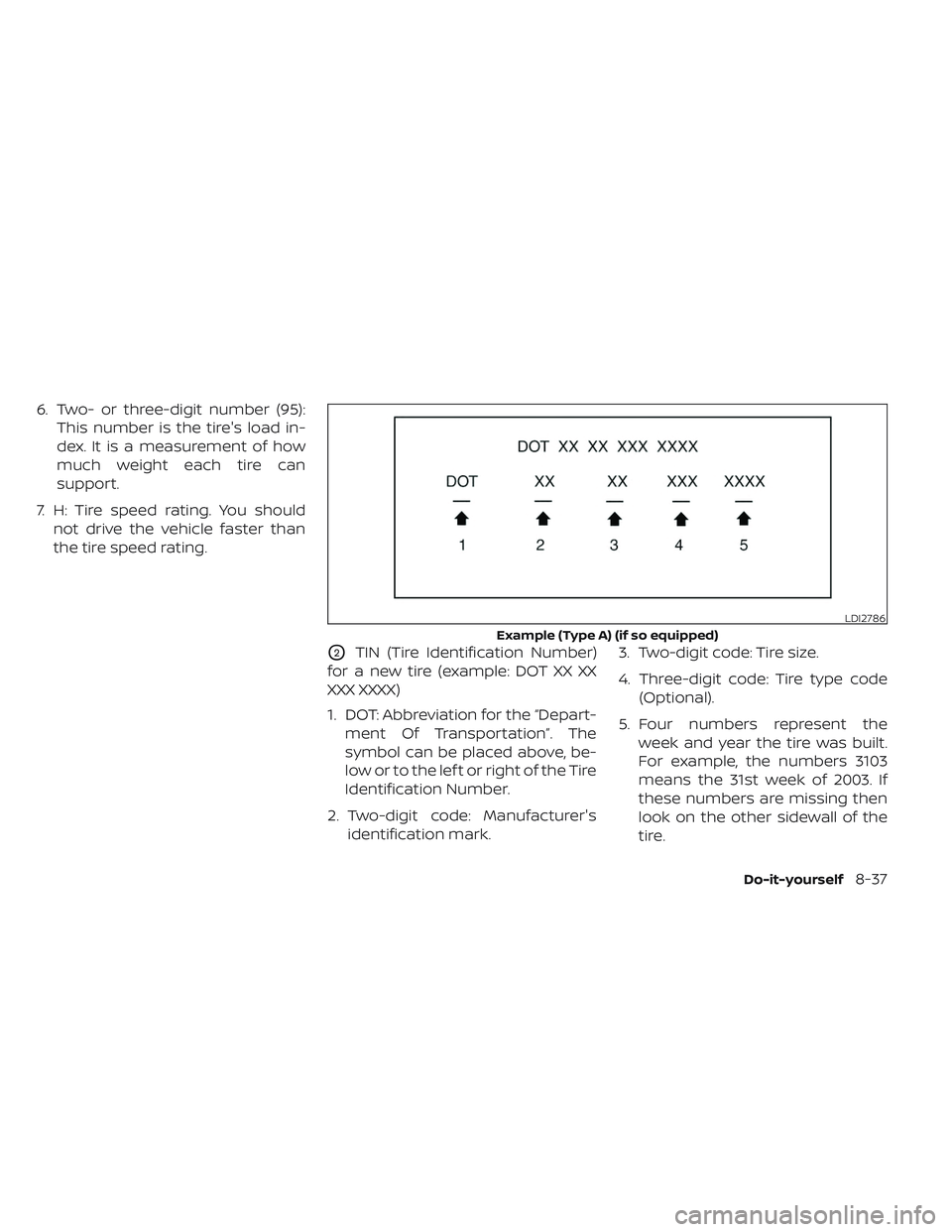
6. Two- or three-digit number (95):This number is the tire's load in-
dex. It is a measurement of how
much weight each tire can
support.
7. H: Tire speed rating. You should not drive the vehicle faster than
the tire speed rating.
O2TIN (Tire Identification Number)
for a new tire (example: DOT XX XX
XXX XXXX)
1. DOT: Abbreviation for the “Depart- ment Of Transportation”. The
symbol can be placed above, be-
low or to the lef t or right of the Tire
Identification Number.
2. Two-digit code: Manufacturer's identification mark. 3. Two-digit code: Tire size.
4. Three-digit code: Tire type code
(Optional).
5. Four numbers represent the week and year the tire was built.
For example, the numbers 3103
means the 31st week of 2003. If
these numbers are missing then
look on the other sidewall of the
tire.
LDI2786
Example (Type A) (if so equipped)
Do-it-yourself8-37
Page 515 of 572
10 Technical and consumer information
Recommended fluids/lubricants and
capacities...................................... 10-2
Fuel recommendation ......................10-4
Engine oil and oil filter
recommendations .......................... 10-7
Air conditioner system refrigerant and
oil recommendations .......................10-8
Specifications .................................. 10-9
Engine ...................................... 10-9
Wheels and tires ........................... 10-10
Dimensions and weights ....................10-11
When traveling or registering in another
country ....................................... 10-12
Vehicle identification .......................... 10-12
Vehicle Identification Number (VIN)
plate ....................................... 10-12
Engine serial number ......................10-12
F.M.V.S.S./C.M.V.S.S. certification label ........10-13
Emission control information label .........10-13
Tire and Loading Information label .........10-14
Air conditioner specification label ..........10-14
Installing front license plate ...................10-15
Vehicle loading information ...................10-16
Terms ...................................... 10-16
Vehicle load capacity ....................... 10-17Securing the load
.......................... 10-19
Utili-track® channel system
(if so equipped) ............................. 10-20
Loading tips ................................ 10-24
Measurement of weights ...................10-25
Truck-camper loading information ............10-25
Special Body vehicles ......................10-25
Location for center of gravity ...............10-26
Vehicle load weight capacity ...............10-26
Towing a trailer ................................ 10-27
Maximum load limits ....................... 10-27
Towing load/specification ..................10-30
Towing safety .............................. 10-33
Flat towing – 4WD with automatic
transmission ............................... 10-40
Flat towing – 2WD with automatic
tr
ansmission ............................... 10-40
Uniform tire quality grading ...................10-41
Emission control system warranty ............10-42
Reporting safety defects ......................10-42
Readiness for Inspection/Maintenance (I/M)
test ........................................... 10-43
Event Data Recorders (EDR) ...................10-44
Owner's Manual/Service Manual order
information ................................... 10-44
Page 525 of 572
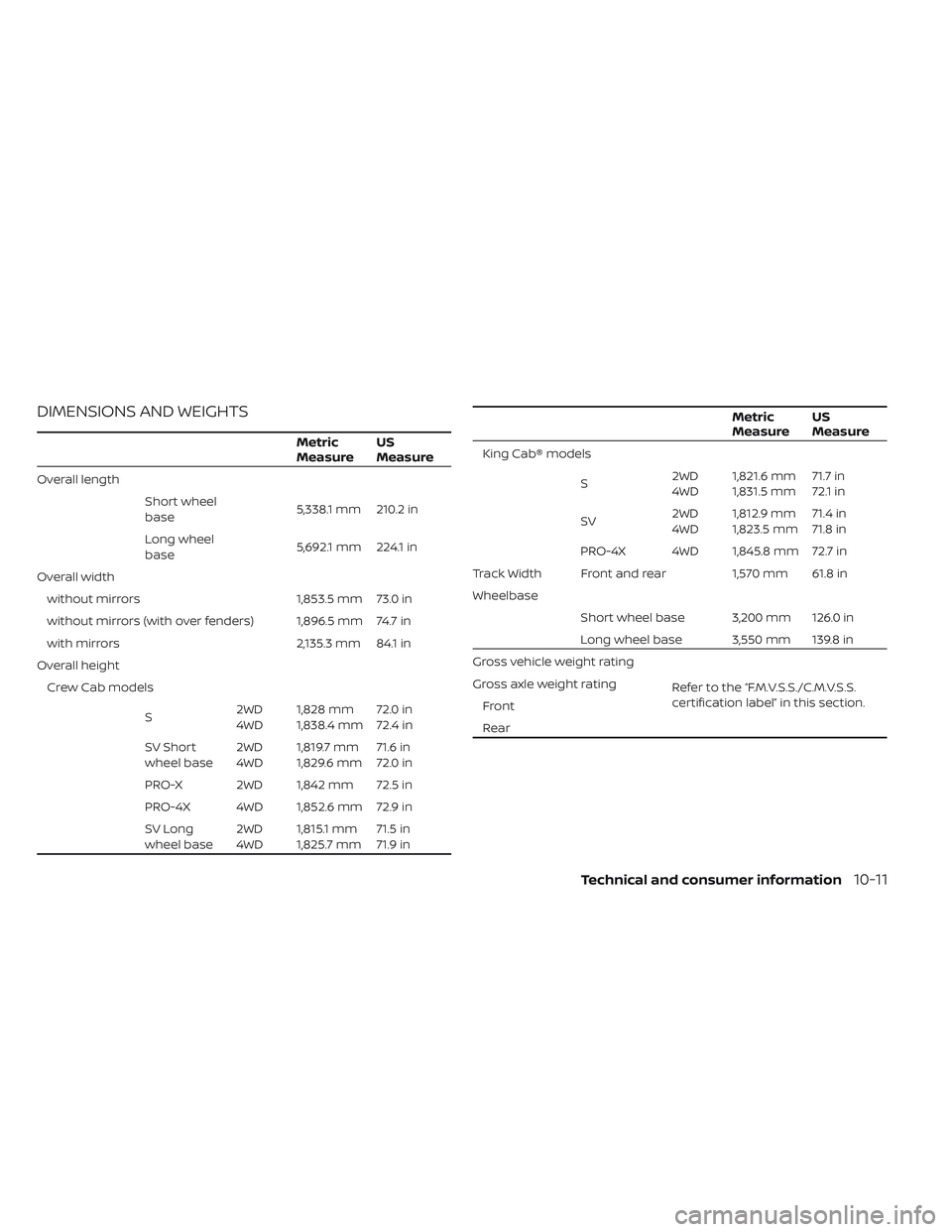
DIMENSIONS AND WEIGHTS
Metric
MeasureUS
Measure
Overall length
Short wheel
base 5,338.1 mm 210.2 in
Long wheel
base 5,692.1 mm 224.1 in
Overall width without mirrors 1,853.5 mm 73.0 in
without mirrors (with over fenders) 1,896.5 mm 74.7 in
with mirrors 2,135.3 mm 84.1 in
Overall height Crew Cab models
S2WD
4WD1,828 mm
1,838.4 mm 72.0 in
72.4 in
SV Short
wheel base 2WD
4WD1,819.7 mm
1,829.6 mm 71.6 in
72.0 in
PRO-X 2WD 1,842 mm 72.5 in
PRO-4X 4WD 1,852.6 mm 72.9 in
SV Long
wheel base 2WD
4WD1,815.1 mm
1,825.7 mm 71.5 in
71.9 in
Metric
Measure
US
Measure
King Cab® models
S2WD
4WD1,821.6 mm
1,831.5 mm 71.7 in
72.1 in
SV 2WD
4WD1,812.9 mm
1,823.5 mm 71.4 in
71.8 in
PRO-4X 4WD 1,845.8 mm 72.7 in
Track Width Front and rear 1,570 mm 61.8 in
Wheelbase Short wheel base 3,200 mm 126.0 in
Long wheel base 3,550 mm 139.8 in
Gross vehicle weight rating
Refer to the “F.M.V.S.S./C.M.V.S.S.
certification label” in this section.
Gross axle weight rating
Front
Rear
Technical and consumer information10-11
Page 530 of 572
WARNING
• It is extremely dangerous to
ride in a cargo area inside a ve-
hicle. In a collision, people rid-
ing in these areas are more
likely to be seriously injured or
killed.
• Do not allow people to ride in
any area of your vehicle that is
not equipped with seats and
seat belts.
• Be sure everyone in your ve-
hicle is in a seat and using a
seat belt properly.TERMS
It is important to familiarize yourself
with the following terms before
loading your vehicle:
• Curb Weight (actual weight of your vehicle) - vehicle weight including:
standard and optional equipment,
fluids, emergency tools, and spare
tire assembly. This weight does
not include passengers and cargo.
• GVW (Gross Vehicle Weight) - curb weight plus the combined weight
of passengers and cargo.
• GVWR (Gross Vehicle Weight Rat- ing) - maximum total combined
weight of the unloaded vehicle,
passengers, cargo, hitch, trailer
tongue load and any other op-
tional equipment. This information
is located on the F.M.V.S.S./
C.M.V.S.S. certification label. •
GAWR (Gross Axle Weight Rating) -
maximum weight (load) limit speci-
fied for the front or rear axle. This
information is located on the
F.M.V.S.S./C.M.V.S.S. certification label.
• GCWR (Gross Combined Weight Rating) - The maximum total
weight rating of the vehicle, pas-
sengers, cargo, and trailer.
• Vehicle Capacity Weight, Load limit, Total load capacity - maximum to-
tal weight limit specified of the load
(passengers and cargo) for the ve-
hicle. This is the maximum com-
bined weight of occupants and
cargo that can be loaded into the
vehicle. If the vehicle is used to tow
a trailer, the trailer tongue weight
must be included as part of the
cargo load. This information is lo-
cated on the Tire and Loading In-
formation label.
VEHICLE LOADING INFORMATION
10-16Technical and consumer information
Page 531 of 572
• Cargo capacity - permissibleweight of cargo, the subtracted
weight of occupants from the load
limit.
VEHICLE LOAD CAPACITY
Before driving a loaded vehicle, con-
firm that you do not exceed the
Gross Vehicle Weight Rating (GVWR)
or the Gross Axle Weight Rating
(GAWR) for your vehicle. Both the
GVWR and GAWR are located on the
F.M.V.S.S./C.M.V.S.S. certification label.
For additional information, see “Mea-
surement of weights” (P. 10-25).
Do not exceed the load limit of your
vehicle shown as “The combined
weight of occupants and cargo” on
the Tire and Loading Information la-
bel. Do not exceed the number of
occupants shown as “Seating Ca-
pacity” on the Tire and Loading Infor-
mation label. To get “the combined weight of oc-
cupants and cargo”, add the weight
of all occupants, then add the total
cargo weight. Examples are shown
in the following illustration.
Technical and consumer information10-17
Page 532 of 572
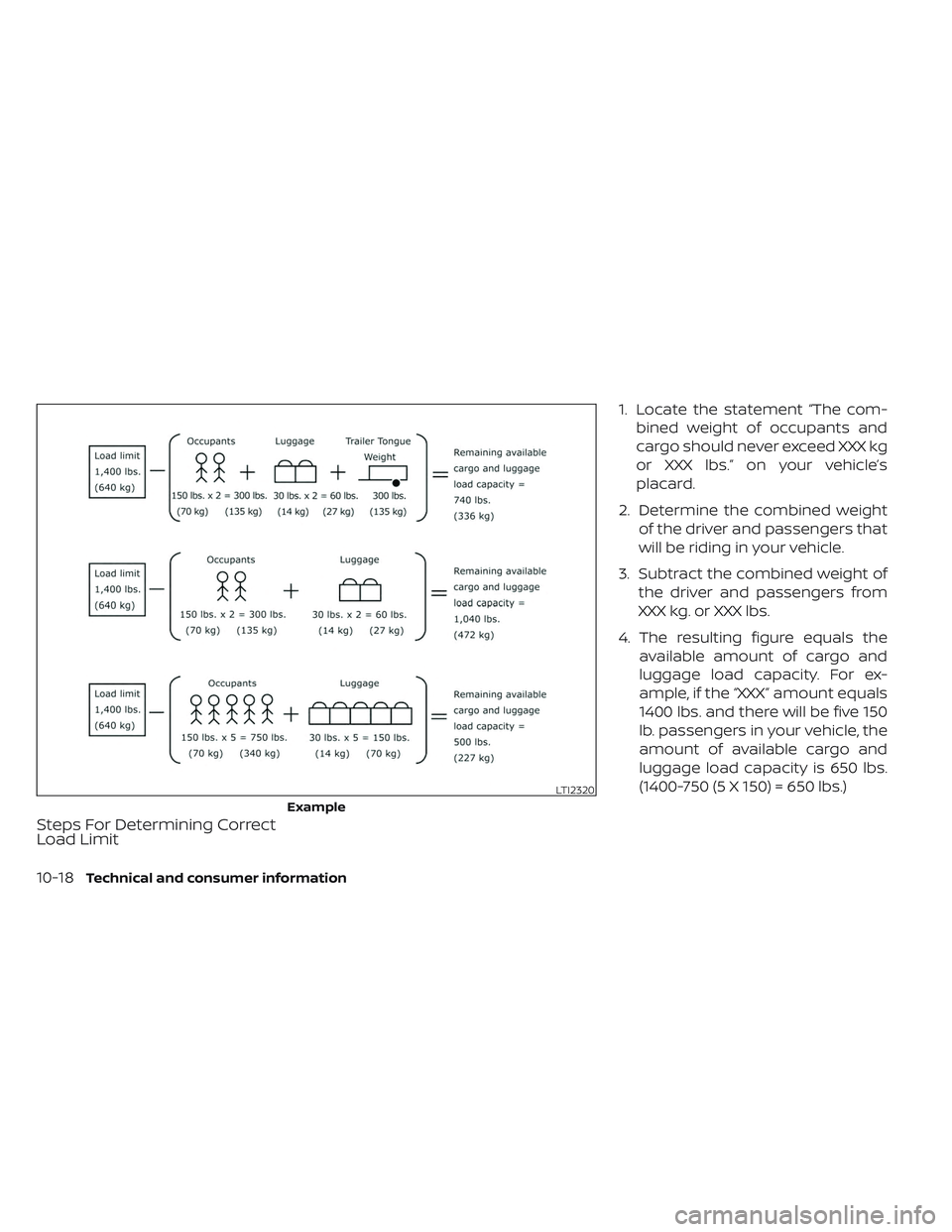
Steps For Determining Correct
Load Limit
1. Locate the statement “The com-bined weight of occupants and
cargo should never exceed XXX kg
or XXX lbs.” on your vehicle’s
placard.
2. Determine the combined weight of the driver and passengers that
will be riding in your vehicle.
3. Subtract the combined weight of the driver and passengers from
XXX kg. or XXX lbs.
4. The resulting figure equals the available amount of cargo and
luggage load capacity. For ex-
ample, if the “XXX ” amount equals
1400 lbs. and there will be five 150
lb. passengers in your vehicle, the
amount of available cargo and
luggage load capacity is 650 lbs.
(1400-750 (5 X 150) = 650 lbs.)
LTI2320
Example
10-18Technical and consumer information