4WD NISSAN FRONTIER 2023 Service Manual
[x] Cancel search | Manufacturer: NISSAN, Model Year: 2023, Model line: FRONTIER, Model: NISSAN FRONTIER 2023Pages: 572, PDF Size: 6.58 MB
Page 510 of 572
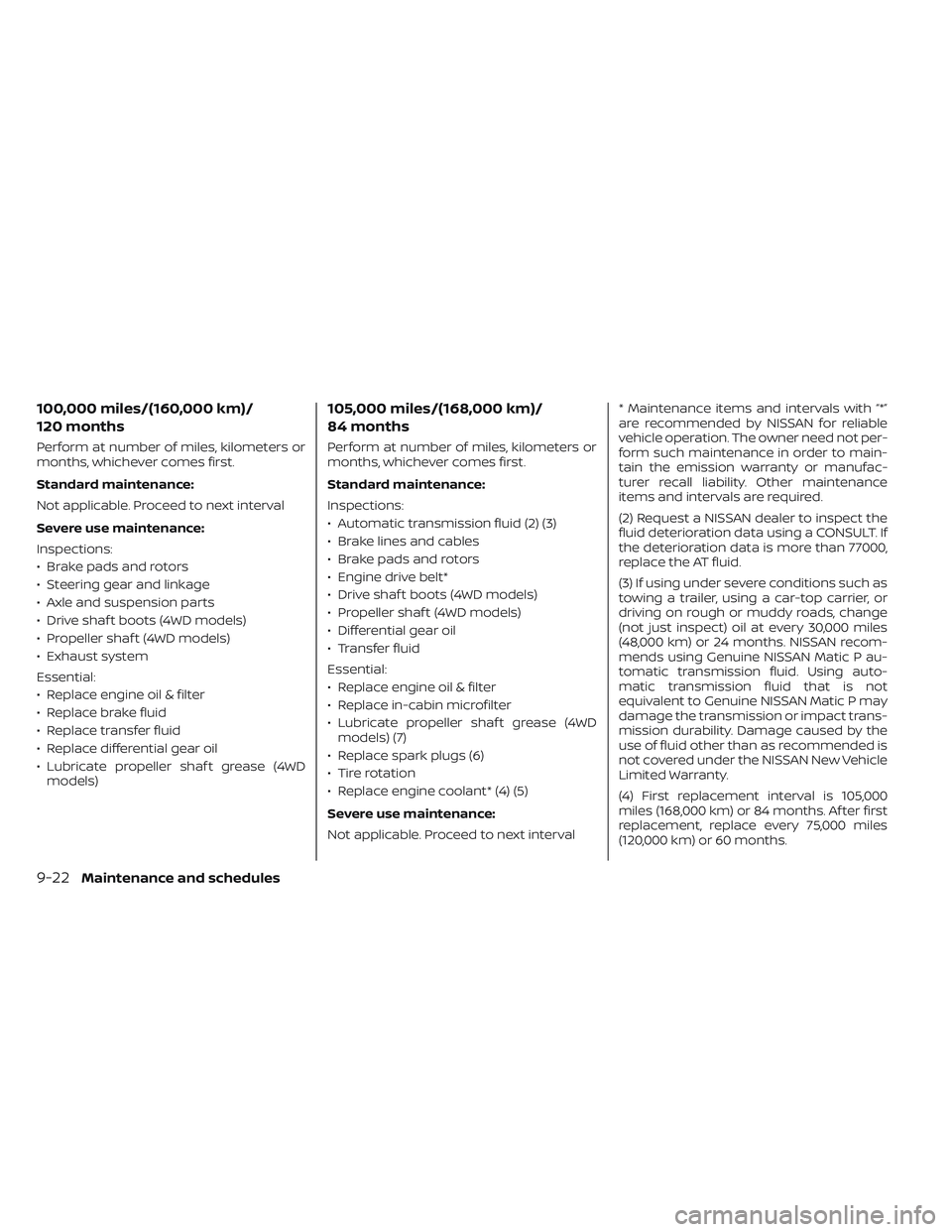
100,000 miles/(160,000 km)/
120 months
Perform at number of miles, kilometers or
months, whichever comes first.
Standard maintenance:
Not applicable. Proceed to next interval
Severe use maintenance:
Inspections:
• Brake pads and rotors
• Steering gear and linkage
• Axle and suspension parts
• Drive shaf t boots (4WD models)
• Propeller shaf t (4WD models)
• Exhaust system
Essential:
• Replace engine oil & filter
• Replace brake fluid
• Replace transfer fluid
• Replace differential gear oil
• Lubricate propeller shaf t grease (4WDmodels)
105,000 miles/(168,000 km)/
84 months
Perform at number of miles, kilometers or
months, whichever comes first.
Standard maintenance:
Inspections:
• Automatic transmission fluid (2) (3)
• Brake lines and cables
• Brake pads and rotors
• Engine drive belt*
• Drive shaf t boots (4WD models)
• Propeller shaf t (4WD models)
• Differential gear oil
• Transfer fluid
Essential:
• Replace engine oil & filter
• Replace in-cabin microfilter
• Lubricate propeller shaf t grease (4WDmodels) (7)
• Replace spark plugs (6)
• Tire rotation
• Replace engine coolant* (4) (5)
Severe use maintenance:
Not applicable. Proceed to next interval * Maintenance items and intervals with “*”
are recommended by NISSAN for reliable
vehicle operation. The owner need not per-
form such maintenance in order to main-
tain the emission warranty or manufac-
turer recall liability. Other maintenance
items and intervals are required.
(2) Request a NISSAN dealer to inspect the
fluid deterioration data using a CONSULT. If
the deterioration data is more than 77000,
replace the AT fluid.
(3) If using under severe conditions such as
towing a trailer, using a car-top carrier, or
driving on rough or muddy roads, change
(not just inspect) oil at every 30,000 miles
(48,000 km) or 24 months. NISSAN recom-
mends using Genuine NISSAN Matic P au-
tomatic transmission fluid. Using auto-
matic transmission fluid that is not
equivalent to Genuine NISSAN Matic P may
damage the transmission or impact trans-
mission durability. Damage caused by the
use of fluid other than as recommended is
not covered under the NISSAN New Vehicle
Limited Warranty.
(4) First replacement interval is 105,000
miles (168,000 km) or 84 months. Af ter first
replacement, replace every 75,000 miles
(120,000 km) or 60 months.
9-22Maintenance and schedules
Page 511 of 572
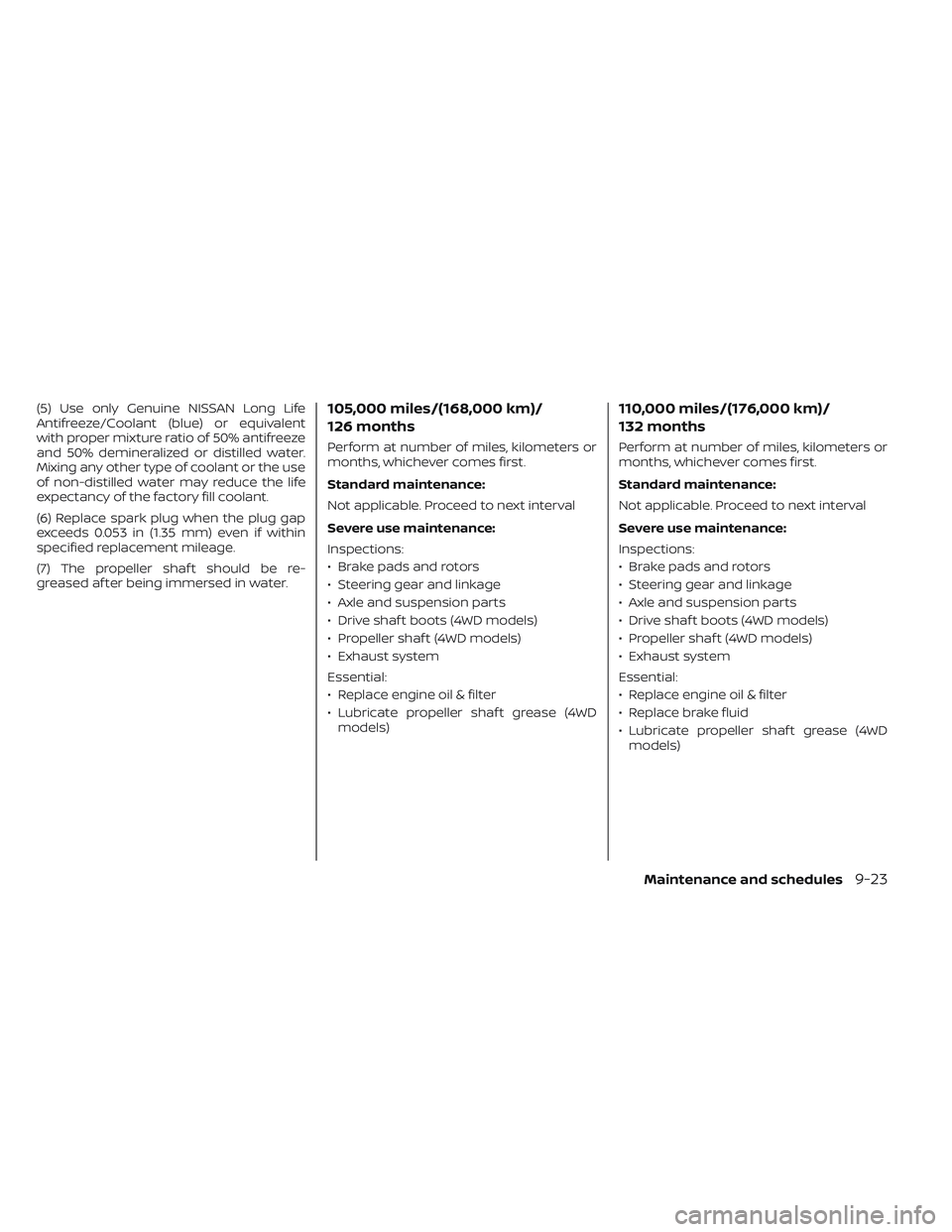
(5) Use only Genuine NISSAN Long Life
Antifreeze/Coolant (blue) or equivalent
with proper mixture ratio of 50% antifreeze
and 50% demineralized or distilled water.
Mixing any other type of coolant or the use
of non-distilled water may reduce the life
expectancy of the factory fill coolant.
(6) Replace spark plug when the plug gap
exceeds 0.053 in (1.35 mm) even if within
specified replacement mileage.
(7) The propeller shaf t should be re-
greased af ter being immersed in water.105,000 miles/(168,000 km)/
126 months
Perform at number of miles, kilometers or
months, whichever comes first.
Standard maintenance:
Not applicable. Proceed to next interval
Severe use maintenance:
Inspections:
• Brake pads and rotors
• Steering gear and linkage
• Axle and suspension parts
• Drive shaf t boots (4WD models)
• Propeller shaf t (4WD models)
• Exhaust system
Essential:
• Replace engine oil & filter
• Lubricate propeller shaf t grease (4WDmodels)
110,000 miles/(176,000 km)/
132 months
Perform at number of miles, kilometers or
months, whichever comes first.
Standard maintenance:
Not applicable. Proceed to next interval
Severe use maintenance:
Inspections:
• Brake pads and rotors
• Steering gear and linkage
• Axle and suspension parts
• Drive shaf t boots (4WD models)
• Propeller shaf t (4WD models)
• Exhaust system
Essential:
• Replace engine oil & filter
• Replace brake fluid
• Lubricate propeller shaf t grease (4WDmodels)
Maintenance and schedules9-23
Page 512 of 572
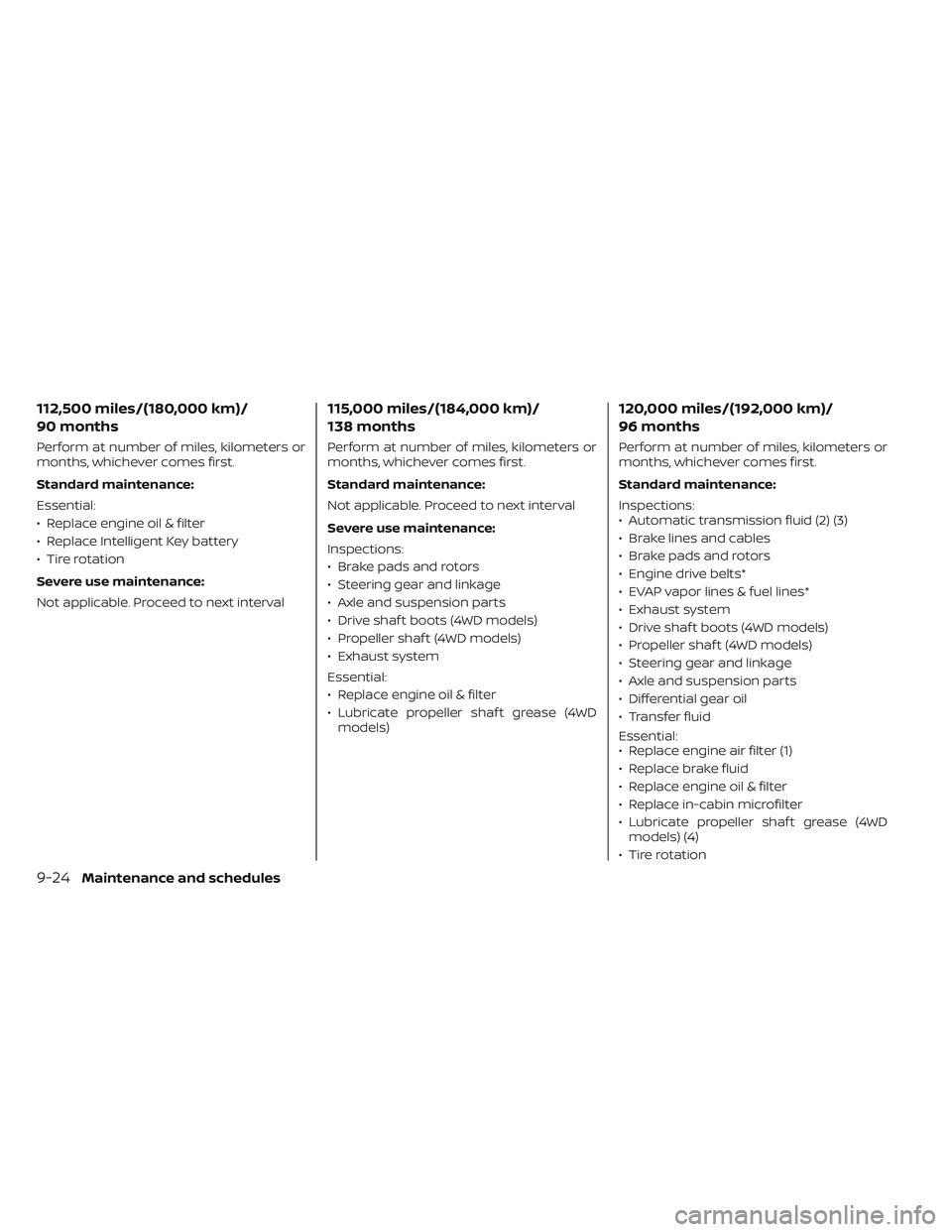
112,500 miles/(180,000 km)/
90 months
Perform at number of miles, kilometers or
months, whichever comes first.
Standard maintenance:
Essential:
• Replace engine oil & filter
• Replace Intelligent Key battery
• Tire rotation
Severe use maintenance:
Not applicable. Proceed to next interval
115,000 miles/(184,000 km)/
138 months
Perform at number of miles, kilometers or
months, whichever comes first.
Standard maintenance:
Not applicable. Proceed to next interval
Severe use maintenance:
Inspections:
• Brake pads and rotors
• Steering gear and linkage
• Axle and suspension parts
• Drive shaf t boots (4WD models)
• Propeller shaf t (4WD models)
• Exhaust system
Essential:
• Replace engine oil & filter
• Lubricate propeller shaf t grease (4WDmodels)
120,000 miles/(192,000 km)/
96 months
Perform at number of miles, kilometers or
months, whichever comes first.
Standard maintenance:
Inspections:
• Automatic transmission fluid (2) (3)
• Brake lines and cables
• Brake pads and rotors
• Engine drive belts*
• EVAP vapor lines & fuel lines*
• Exhaust system
• Drive shaf t boots (4WD models)
• Propeller shaf t (4WD models)
• Steering gear and linkage
• Axle and suspension parts
• Differential gear oil
• Transfer fluid
Essential:
• Replace engine air filter (1)
• Replace brake fluid
• Replace engine oil & filter
• Replace in-cabin microfilter
• Lubricate propeller shaf t grease (4WDmodels) (4)
• Tire rotation
9-24Maintenance and schedules
Page 515 of 572
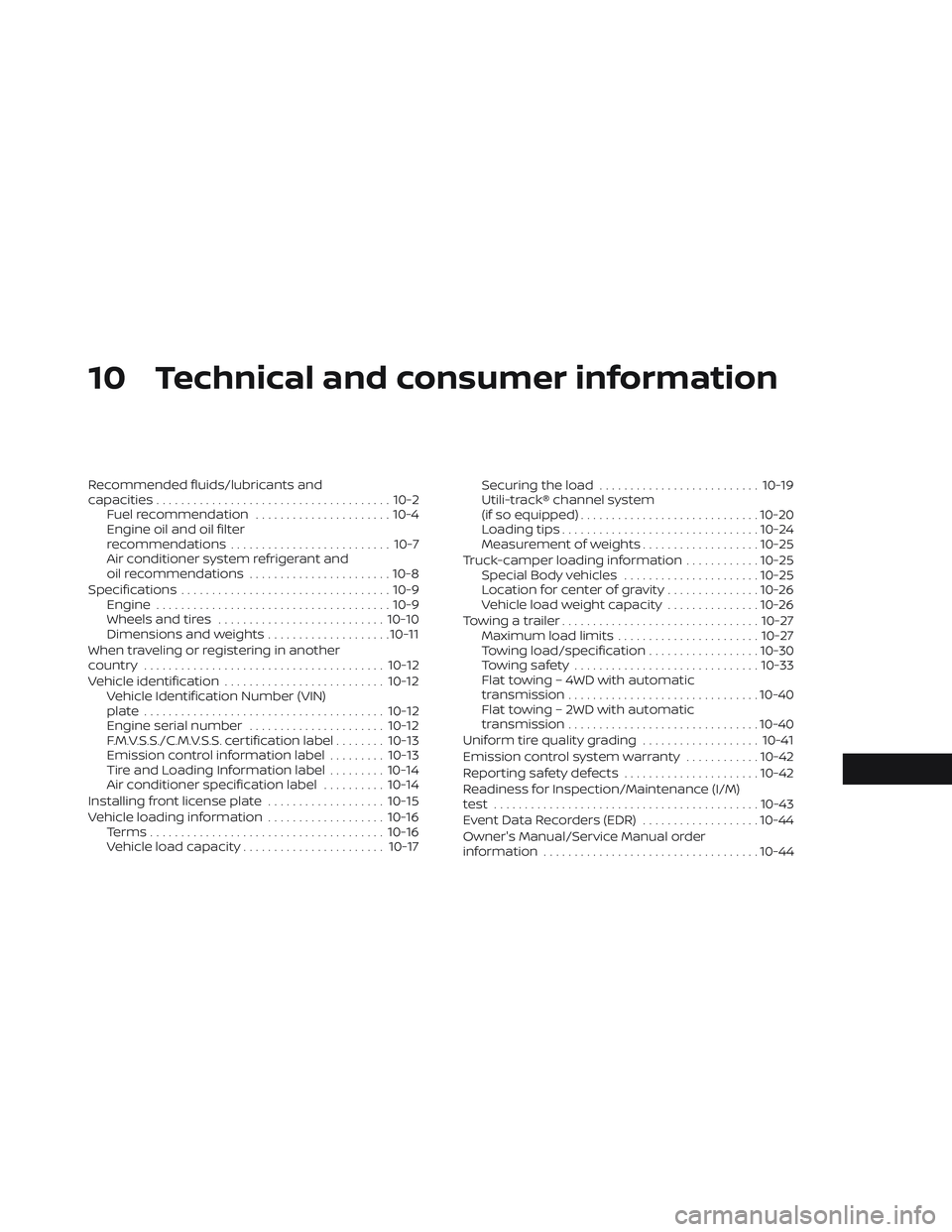
10 Technical and consumer information
Recommended fluids/lubricants and
capacities...................................... 10-2
Fuel recommendation ......................10-4
Engine oil and oil filter
recommendations .......................... 10-7
Air conditioner system refrigerant and
oil recommendations .......................10-8
Specifications .................................. 10-9
Engine ...................................... 10-9
Wheels and tires ........................... 10-10
Dimensions and weights ....................10-11
When traveling or registering in another
country ....................................... 10-12
Vehicle identification .......................... 10-12
Vehicle Identification Number (VIN)
plate ....................................... 10-12
Engine serial number ......................10-12
F.M.V.S.S./C.M.V.S.S. certification label ........10-13
Emission control information label .........10-13
Tire and Loading Information label .........10-14
Air conditioner specification label ..........10-14
Installing front license plate ...................10-15
Vehicle loading information ...................10-16
Terms ...................................... 10-16
Vehicle load capacity ....................... 10-17Securing the load
.......................... 10-19
Utili-track® channel system
(if so equipped) ............................. 10-20
Loading tips ................................ 10-24
Measurement of weights ...................10-25
Truck-camper loading information ............10-25
Special Body vehicles ......................10-25
Location for center of gravity ...............10-26
Vehicle load weight capacity ...............10-26
Towing a trailer ................................ 10-27
Maximum load limits ....................... 10-27
Towing load/specification ..................10-30
Towing safety .............................. 10-33
Flat towing – 4WD with automatic
transmission ............................... 10-40
Flat towing – 2WD with automatic
tr
ansmission ............................... 10-40
Uniform tire quality grading ...................10-41
Emission control system warranty ............10-42
Reporting safety defects ......................10-42
Readiness for Inspection/Maintenance (I/M)
test ........................................... 10-43
Event Data Recorders (EDR) ...................10-44
Owner's Manual/Service Manual order
information ................................... 10-44
Page 525 of 572
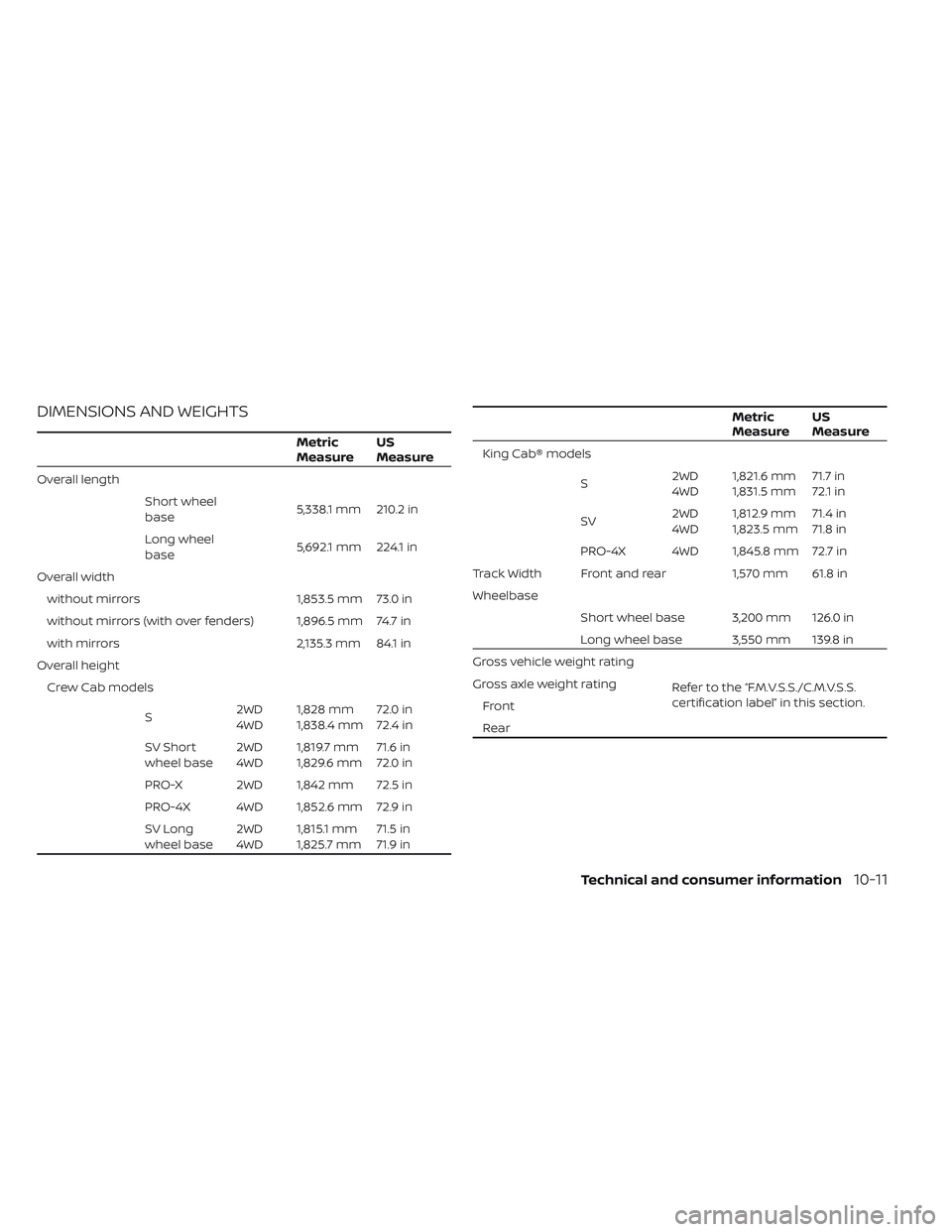
DIMENSIONS AND WEIGHTS
Metric
MeasureUS
Measure
Overall length
Short wheel
base 5,338.1 mm 210.2 in
Long wheel
base 5,692.1 mm 224.1 in
Overall width without mirrors 1,853.5 mm 73.0 in
without mirrors (with over fenders) 1,896.5 mm 74.7 in
with mirrors 2,135.3 mm 84.1 in
Overall height Crew Cab models
S2WD
4WD1,828 mm
1,838.4 mm 72.0 in
72.4 in
SV Short
wheel base 2WD
4WD1,819.7 mm
1,829.6 mm 71.6 in
72.0 in
PRO-X 2WD 1,842 mm 72.5 in
PRO-4X 4WD 1,852.6 mm 72.9 in
SV Long
wheel base 2WD
4WD1,815.1 mm
1,825.7 mm 71.5 in
71.9 in
Metric
Measure
US
Measure
King Cab® models
S2WD
4WD1,821.6 mm
1,831.5 mm 71.7 in
72.1 in
SV 2WD
4WD1,812.9 mm
1,823.5 mm 71.4 in
71.8 in
PRO-4X 4WD 1,845.8 mm 72.7 in
Track Width Front and rear 1,570 mm 61.8 in
Wheelbase Short wheel base 3,200 mm 126.0 in
Long wheel base 3,550 mm 139.8 in
Gross vehicle weight rating
Refer to the “F.M.V.S.S./C.M.V.S.S.
certification label” in this section.
Gross axle weight rating
Front
Rear
Technical and consumer information10-11
Page 545 of 572
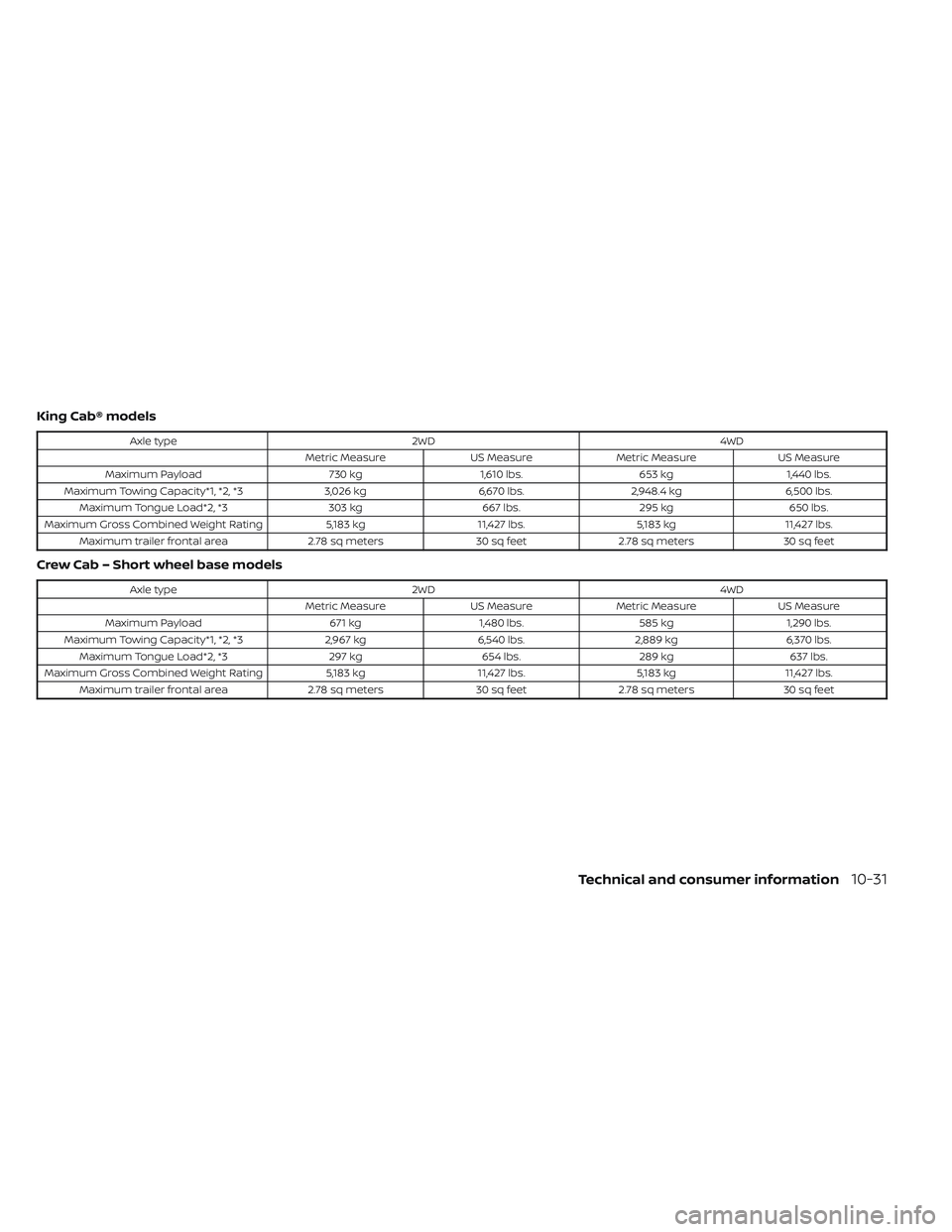
King Cab® models
Axle type2WD 4WD
Metric Measure US MeasureMetric Measure US Measure
Maximum Payload 730 kg1,610 lbs. 653 kg1,440 lbs.
Maximum Towing Capacity*1, *2, *3 3,026 kg6,670 lbs.2,948.4 kg 6,500 lbs.
Maximum Tongue Load*2, *3 303 kg667 lbs. 295 kg650 lbs.
Maximum Gross Combined Weight Rating 5,183 kg11,427 lbs. 5,183 kg11,427 lbs.
Maximum trailer frontal area 2.78 sq meters30 sq feet2.78 sq meters 30 sq feet
Crew Cab – Short wheel base models
Axle type 2WD 4WD
Metric Measure US MeasureMetric Measure US Measure
Maximum Payload 671 kg1,480 lbs. 585 kg1,290 lbs.
Maximum Towing Capacity*1, *2, *3 2,967 kg6,540 lbs. 2,889 kg6,370 lbs.
Maximum Tongue Load*2, *3 297 kg654 lbs. 289 kg637 lbs.
Maximum Gross Combined Weight Rating 5,183 kg11,427 lbs. 5,183 kg11,427 lbs.
Maximum trailer frontal area 2.78 sq meters30 sq feet2.78 sq meters 30 sq feet
Technical and consumer information10-31
Page 546 of 572
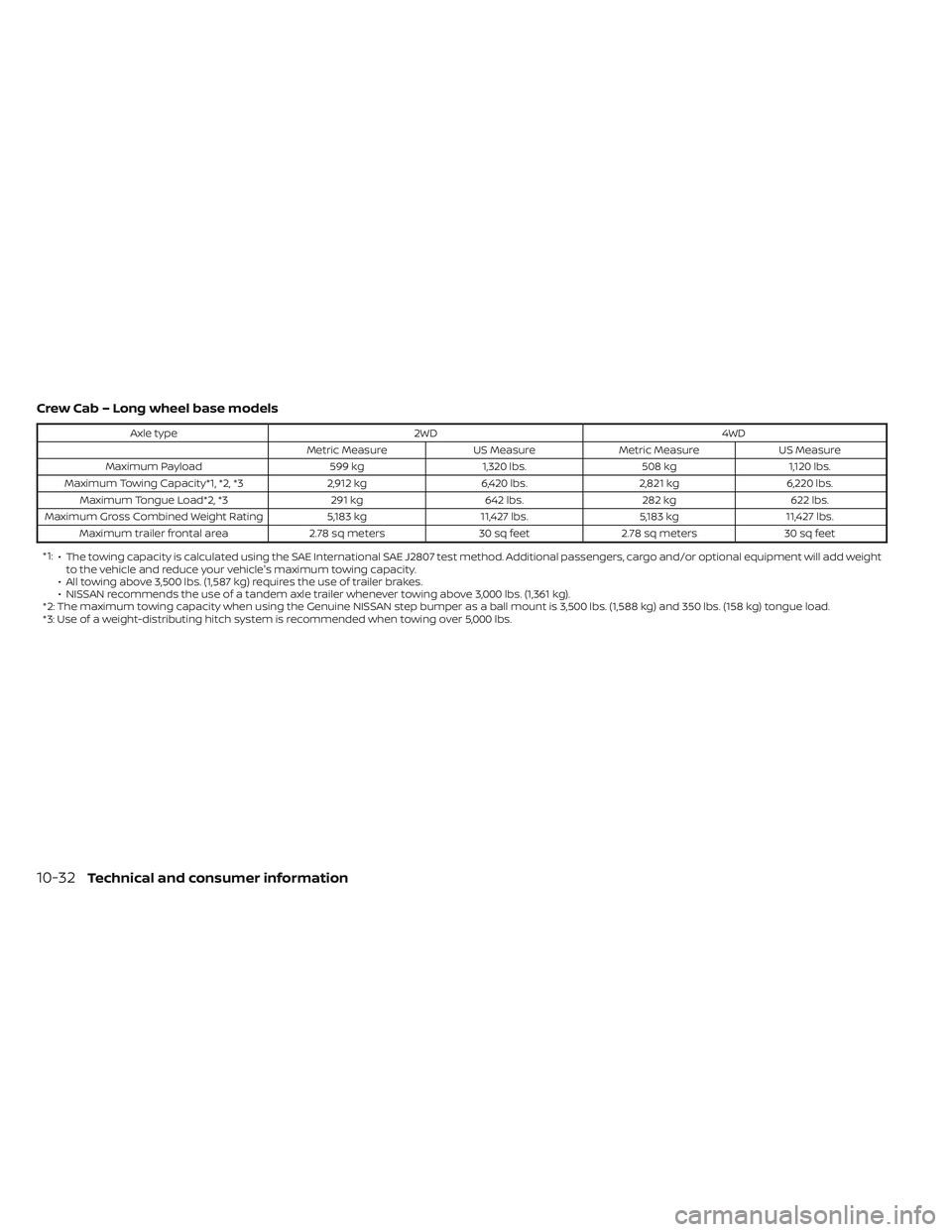
Crew Cab – Long wheel base models
Axle type2WD 4WD
Metric Measure US MeasureMetric Measure US Measure
Maximum Payload 599 kg1,320 lbs. 508 kg1,120 lbs.
Maximum Towing Capacity*1, *2, *3 2,912 kg6,420 lbs. 2,821 kg6,220 lbs.
Maximum Tongue Load*2, *3 291 kg642 lbs. 282 kg622 lbs.
Maximum Gross Combined Weight Rating 5,183 kg11,427 lbs. 5,183 kg11,427 lbs.
Maximum trailer frontal area 2.78 sq meters30 sq feet2.78 sq meters 30 sq feet
*1: • The towing capacity is calculated using the SAE International SAE J2807 test method. Additional passengers, cargo and/or optional equipment will a dd weight
to the vehicle and reduce your vehicle's maximum towing capacity.
• All towing above 3,500 lbs. (1,587 kg) requires the use of trailer brakes.
• NISSAN recommends the use of a tandem axle trailer whenever towing above 3,000 lbs. (1,361 kg).
*2: The maximum towing capacity when using the Genuine NISSAN step bumper as a ball mount is 3,500 lbs. (1,588 kg) and 350 lbs. (158 kg) tongue load.
*3: Use of a weight-distributing hitch system is recommended when towing over 5,000 lbs.
10-32Technical and consumer information
Page 552 of 572
• Avoid abrupt starts, acceleration or stops.
• Avoid sharp turns or lane changes.
• Always drive your vehicle at a moderatespeed.
• When backing up, hold the bottom of the steering wheel with one hand. Move your
hand in the direction in which you want
the trailer to go. Make small corrections
and back up slowly. If possible, have
someone guide you when you are back-
ing up.
Always block the wheels on both vehicle
and trailer when parking. Parking on a
slope is not recommended; however, if you
must do so:
CAUTION
If you move the shif t lever to the P
(Park) position before blocking the
wheels and applying the parking brake,
transmission damage could occur.
1. Apply and hold the brake pedal.
2. Have someone place blocks on the downhill side of the vehicle and trailer
wheels.
3. Af ter the wheel blocks are in place, slowly release the brake pedal until the
blocks absorb the vehicle load. 4. Apply the parking brake.
5. Shif t the transmission into P (Park).
6. Make sure the 4WD shif t indicator light (if
so equipped) indicates the transfer case
is in 4H, 4LO, or 2WD and that the ATP
light is off. If the 4WD shif t indicator light
is flashing, or the ATP light is ON, make
sure the transmission is in P (Park) and
turn the 4WD switch to 2WD or 4H. For
additional information, see “Automatic
transmission park warning light” (P. 2-13)
and “Using 4-wheel drive (4WD)” (P. 5-109).
7. Turn off the engine.
To drive away:
1. Start the vehicle.
2. Apply and hold the brake pedal.
3. Shif t the transmission into gear.
4. Release the parking brake.
5. Drive slowly until the vehicle and trailer are clear from the blocks.
6. Apply and hold the brake pedal.
7. Have someone retrieve and store the blocks. • While going downhill, the weight of the
trailer pushing on the tow vehicle may
decrease overall stability. Therefore, to
maintain adequate control, reduce your
speed and shif t to a lower gear. Avoid
long or repeated use of the brakes when
descending a hill, as this reduces their
effectiveness and could cause overheat-
ing. Shif ting to a lower gear instead pro-
vides “engine braking” and reduces the
need to brake as frequently.
• If the engine coolant temperature rises to a high temperature, see “If your vehicle
overheats” (P. 6-13).
• Trailer towing requires more fuel than normal circumstances.
• Avoid towing a trailer for your vehicle's first 500 miles (805 km).
• For the first 500 miles (805 km) that you do tow, do not drive over 50 mph (80
km/h).
• Have your vehicle serviced more of ten than at intervals specified. For additional
information, see the “Maintenance and
schedules” section of this manual.
• When making a turn, your trailer wheels will be closer to the inside of the turn than
your vehicle wheels. To compensate for
this, make a larger than normal turning
radius during the turn.
10-38Technical and consumer information
Page 554 of 572
Driving the vehicle in the tow mode with no
trailer/load or light trailer/light load will not
cause any damage. However, fuel
economy may be reduced and the
transmission/engine driving characteris-
tics may feel unusual.
When towing a trailer, final drive gear oil
should be replaced and transmission oil/
fluid should be changed more frequently.
For additional information, see the “Do-it-
yourself ” section of this manual.
FLAT TOWING – 4WD WITH
AUTOMATIC TRANSMISSION
Towing a vehicle behind a recreational ve-
hicle, such as a motor home, is sometimes
called flat towing.
CAUTION
• DO NOT flat tow a 4WD vehicle
equipped with an automatic trans-
mission. Flat towing or using a ve-
hicle dolly WILL DAMAGE internal
transmission parts due to lack of
lubrication.
• For emergency towing procedures,
see “Towing recommended by
NISSAN” (P. 6-15).
FLAT TOWING – 2WD WITH
AUTOMATIC TRANSMISSION
Towing a vehicle behind a recreational ve-
hicle, such as a motor home, is sometimes
called flat towing.
CAUTION
• Failure to follow these guidelines
can result in severe transmission
damage.
• Whenever flat towing your vehicle,
always tow forward, never backward.
• DO NOT tow any automatic transmis-
sion vehicle with all four wheels on
the ground. Doing so WILL DAMAGE
internal transmission parts due to
lack of transmission lubrication.
• For emergency towing procedures,
see “Towing recommended by
NISSAN” (P. 6-15).
To tow a vehicle equipped with an auto-
matic transmission, an appropriate vehicle
dolly MUST be placed under the towed ve-
hicle’s drive wheels. Alwaysfollow the dolly
manufacturer’s recommendations when
using their product.
Automatic Transmission
To tow a vehicle equipped with an auto-
matic transmission, an appropriate vehicle
dolly MUST be placed under the towed ve-
hicle's drive wheels. Alwaysfollow the dolly
manufacturer's recommendations when
using their product.
NOTE:
If the battery is completely drained the
transmission will not manually shif t to
other positions.
10-40Technical and consumer information
Page 557 of 572
You may also report safety defects
online at: http://www.tc.gc.ca/eng/
motorvehiclesafety/menu.htm
(English speakers) or
http://www.tc.gc.ca/fra/
securiteautomobile/menu.htm
(French speakers)
Or contact Transport Canada by
mail at:
Transport Canada Motor Vehicle
Safety Investigations Laboratory
80 Noel Street Gatineau, QC J8Z0A1
Additional information concerning
motor vehicle safety may be obtained
from Transport Canada's Road Safety
Information Centre at 1-800-333-0371
or online at www.tc.gc.ca/roadsafety
(English speakers) or www.tc.gc.ca/
securiteroutiere (French speakers).
To notif y NISSAN of any safety con-
cerns please contact our Consumer
Information Centre toll free at
1-800-387-0122.
WARNING
A vehicle equipped with Four-Wheel
Drive (4WD) should never be tested
using a two wheel dynamometer (such
as the dynamometers used by some
states for emissions testing), or similar
equipment. Make sure you inform the
test facility personnel that your vehicle
is equipped with 4WD before it is placed
on a dynamometer. Using the wrong
test equipment may result in transmis-
sion damage or unexpected vehicle
movement which could result in seri-
ous vehicle damage or personal injury.
Due to legal requirements in some states
and Canadian Provinces, your vehicle may
be required to be in what is called the
“ready condition” for an Inspection/
Maintenance (I/M) test of the emission
control system.
The vehicle is set to the “ready condition”
when it is driven through certain driving
patterns. Usually, the ready condition can
be obtained by ordinary usage of the
vehicle. If a powertrain system component is re-
paired or the battery is disconnected, the
vehicle may be reset to a “not ready” condi-
tion. Before taking the I/M test, check
the vehicle's inspection/maintenance test
readiness condition. Place the ignition
switch in the ON position without starting
the engine. If the Malfunction Indicator
Light (MIL) comes on steady for 20 seconds
and then blinks for 10 seconds, the I/M test
condition is “not ready”. If the MIL does not
blink af ter 20 seconds, the I/M test condi-
tion is “ready”. It is recommended that you
visit a NISSAN dealer to set the “ready con-
dition” or to prepare the vehicle for testing.
READINESS FOR INSPECTION/
MAINTENANCE (I/M) TEST
Technical and consumer information10-43