tires NISSAN GT-R 2013 R35 User Guide
[x] Cancel search | Manufacturer: NISSAN, Model Year: 2013, Model line: GT-R, Model: NISSAN GT-R 2013 R35Pages: 346, PDF Size: 4.19 MB
Page 24 of 346
.Adjust the tire pressure to the specification
shown in the table, in order to make the
balance of rigidity between the front and rear
tires more uniform when the temperature of
the tires increases due to driving at high
speed or engaging in high performance
driving.Condition Pressure PSI (kPa)
Starting to drive (Tires are cold) Front: 30.5 (210) - 31.9 (220), Rear: 29 (200)
Increasing tire pressure (Tires are hot) Front: Not exceeding 39.2 (270) ,
Rear: Not exceeding 37.7 (260)
The tire pressure changes depending on the
outside temperature or altitude. Check the tire
pressure regularly and when the climate condi-
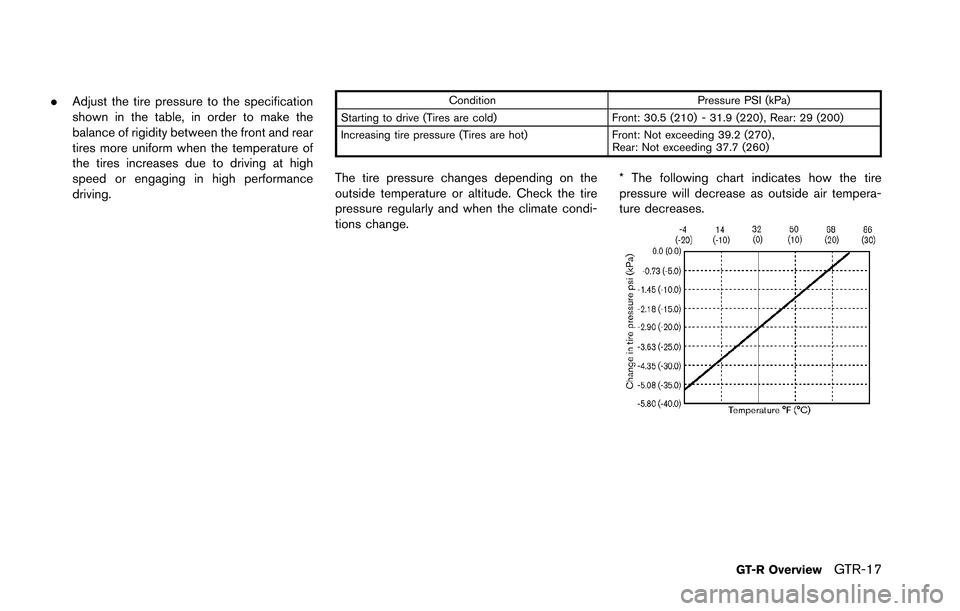
tions change. * The following chart indicates how the tire
pressure will decrease as outside air tempera-
ture decreases.
GT-R OverviewGTR-17
Page 25 of 346
GTR-18GT-R Overview
WARNING
Keep your tires inflated to the correct
tire pressure. Driving with low tire
pressure can damage some powertrain
systems and affect the operation of the
ABS and VDC systems. Low Tire pres-
sure may also cause tire failure and
result in serious personal injury or
death.
. Make sure the tire valve stem cap is installed
and that the valve stem is tight. When
installing the cap, make sure to tighten the
cap by hand. If a tool is used to tighten the
cap, the cap may be damaged.
. Make sure the wheel nuts are tight.
(
“Wheels and tires” page 8-31)
. Make sure the drive shaft nuts are tight.
. Make sure to replace the grommet seal, the
valve core and the valve cap of the Tire
Pressure Monitoring System (TPMS) sensor
attached to the wheel every 3 years for
performance driving use. Replace them
every 5 years even when not engaging in
performance driving. A dirty grommet seal
will cause the air leak from the tire. .
Make sure that the nuts and valves that are
attached to the TPMS sensor are tight and
there is no nitrogen leak.
. Use only a NISSAN genuine valve cap or
equivalent.
. Check wheel hub run out and that the wheel
rotates smoothly without any friction. Check
these with the tires removed whenever an
inspection is performed with the vehicle
jacked up.
. Secure road wheel balance weights with
aluminum tape.
. Check that the wheel nuts are not stripped.
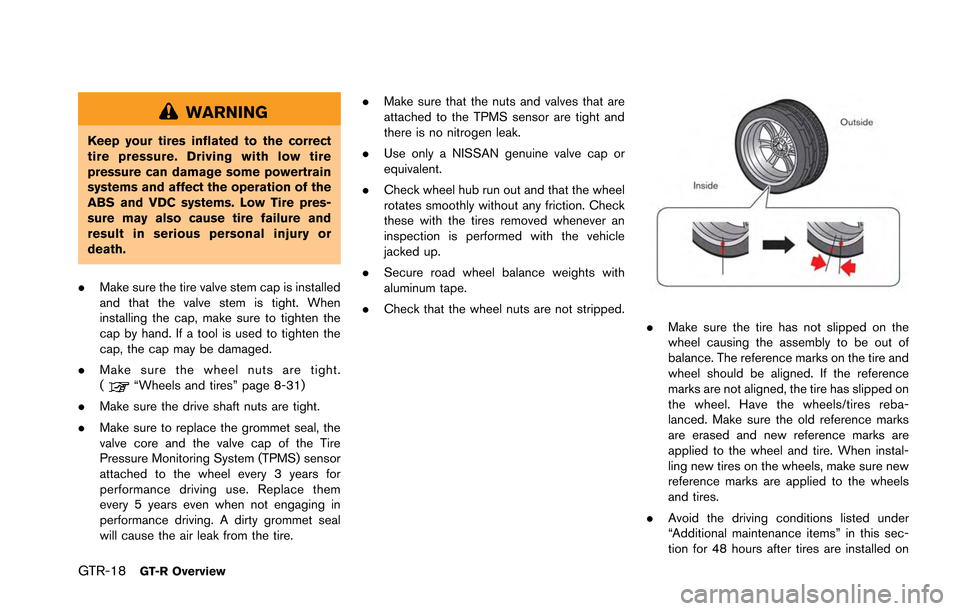
.Make sure the tire has not slipped on the
wheel causing the assembly to be out of
balance. The reference marks on the tire and
wheel should be aligned. If the reference
marks are not aligned, the tire has slipped on
the wheel. Have the wheels/tires reba-
lanced. Make sure the old reference marks
are erased and new reference marks are
applied to the wheel and tire. When instal-
ling new tires on the wheels, make sure new
reference marks are applied to the wheels
and tires.
. Avoid the driving conditions listed under
“Additional maintenance items” in this sec-
tion for 48 hours after tires are installed on
Page 30 of 346
Suspension and wheel alignment
.Check the steering and suspension system
and other links for loose and/or damaged
parts.
. Measure and adjust the wheel alignment.
Contact a GT-R certified NISSAN dealer to
adjust the wheel alignment to the recom-
mended setting for normal driving.
Wheels and tires
.Check tire wear and cracking.
. Inspect the tire side wall for damage.
. Check the tire pressure and adjust the
pressure as necessary when the tires are
cold. (
“Wheels and tires” page GTR-
16) If you do not drive under the conditions
listed in this section, see (
“Wheels and
tires” page 8-31)
. Check that the wheel nuts are not stripped.
Check if there is no deformation on the
contact surface of the wheel nuts.
. Make sure the wheel nuts are tight.
(
“Wheels and tires” page 8-31)
. Make sure the drive shaft nuts are tight.
. Check wheel hub run out and that the wheel
rotates smoothly without any friction. Check
these with the tires removed whenever an inspection is performed with the vehicle
jacked up.
. Make sure the tire has not slipped on the
wheel causing the assembly to be out of
balance. The reference marks on the tire and
wheel should be aligned. If the reference
marks are not aligned, the tire has slipped on
the wheel. Have the wheels/tires reba-
lanced. Make sure the old reference marks
are erased and new reference marks are
applied to the wheel and tire. When instal-
ling new tires on the wheels, make sure new
reference marks are applied to the wheels
and tires. (
“Wheels and tires” page
GTR-16)
. Make sure that the TPMS sensor installation
nuts and the sensor valve are tight and there
is no nitrogen leak.
Brakes
.Check for the heat deterioration of the
brakes and parts around the brakes.
. Check the condition of the brake pads and
disc rotors and replace them as necessary.
Engine and powertrain
.Check the engine, transmission, differential
and under the vehicle for oil and coolant leaks.
. Inspect the area surrounding the catalytic
converter for heat deterioration.
. Inspect and confirm the clearance between
the exhaust finisher and rear bumper is more
than 0.24 in (6 mm) (up/down) and more
than 0.20 in (5 mm) (left/right) .
. The clutch clearance and shift fork position
may need to be adjusted.
. Inspect the dust boot of the drive shaft
universal joint for cracks or damage.
. Check that there is no abnormal noise,
vibrations or warning lights illuminated when
making tight turns at slow speed (for tight
corner braking phenomenon) .
GT-R OverviewGTR-23
Page 32 of 346
1588F (708C) , drive the vehicle until it reaches
normal operating temperature. If the temperature
is higher than 2308F (1108C), perform cool-
down driving procedure. (
“Cool down”
page GTR-13) When the temperature of the
engine coolant is between 1588F (708C) and
2308F (1108C) , the engine output returns to
normal.
DISTORTION OF REAR SPOILER
When the vehicle is parked in direct sunlight on
a hot day, the center of the rear spoiler may
become distorted. This is normal. When the
surface temperature of the rear spoiler is
reduced, the shape of the spoiler should return
to normal.
UNEVEN WEAR OF TIRES
The GT-R is equipped with high performance,
low profile, run-flat tires that are optimized for
performance and handling. The life of these tires
will be less than those of tires installed on a
typical vehicle, and you are likely to experience
uneven tire wear and tire noise regardless of the
type of tire used.
NOISES ARE HEARD WHILE DRIV-
ING
. The GT-R brake pads use material that
provides a high amount of braking power
even in high temperatures. This material can
cause an intermittent screeching noise just
before the vehicle comes to a stop when the
brakes are gently applied. The noise de-
creases as the brake pads wear. However,
the additional brake pad break-in or repla-
cing the cross spring may decrease the
noise. Contact a GT-R certified NISSAN
dealer.
. A screeching noise may be heard when the
brake pedal is depressed:
— When driving the vehicle for the first time
in the morning,
— After leaving the vehicle parked for extended periods of time, or
— When the vehicle is damp following rain showers or washing the vehicle.
These sounds are normal. The noise is
caused when the brake pads absorb moist-
ure, and the noise stops after the brake is
applied several times.
. A screeching noise may also be heard when
the brake pedal is depressed: — When repeatedly applying gentle brak-
ing, especially on a curve at a low speed,
or
— When the brake rotors have circular scores with the brake temperature high.
WARNING
Follow the instructions below when
parking the vehicle to help prevent the
brake rotor and brake pads from rust-
ing together. Failure to follow the
instructions could cause the rotor and
pads to rust together. If the rotor and
pads rust together, there may be a
popping noise and some vibration
when the vehicle is driven, a wheel
may not roll correctly, or the brake pads
could be damaged. If the pads are
damaged, this may reduce the effec-
tiveness of the brake system which
could cause a collision, serious perso-
nal injury or death.
. The GT-R uses brake pad materials that
have high metallic content. The brake pad
material helps maintain braking performance
in a wide range of weather and driving
conditions.
GT-R OverviewGTR-25
Page 33 of 346
GTR-26GT-R Overview
For the first 3,000-6,000 miles (5,000-
10,000 km) of the vehicle’s service life,
and for the first 3,000-6,000 miles (5,000-
10,000 km) after a brake replacement, the
brake pad to brake rotor clearance is very
small. When parking, apply the parking
brake and move the shift lever to the
&Pposition. Idle the engine for more than 20
seconds without depressing the brake
pedal. This allows the brake pads to move
away from the rotor so the pad does not
contact the rotor.
Additionally, the brakes must be dry before
parking the vehicle after driving on wet roads
or after washing the vehicle. If the roads are
wet, lightly apply the brakes for a short
distance before parking the vehicle to dry
the brakes. After washing the vehicle, dry the
brakes by driving on a dry road for a few
miles and apply the brakes normally based
on traffic and road conditions.
The metallic brake pads and brake disc rotor
may rust together when the brakes are not
applied:
— If the vehicle is not idled for 20 secondswithout the brakes applied, or if the
brakes are applied when the vehicle is
shut off, the rotor and pads can rust
together, even when the brake pads are dry.
— If the brakes are wet when the vehicle is parked and the parking brake is applied
for a long time.
— The hill start assist system can apply the brakes even if the brake pedal is not
depressed. The brake pads and rotors
can rust together if the parking proce-
dure previously described is not fol-
lowed.
Contact a GT-R certified NISSAN dealer if
the brake pads and brake rotor have rusted
together.
NOTICE
To help reduce the possibility of the
rotors and brake pads rusting:
Have the brake pads and/or rotors
quenched when the brake pads are
replaced. For detailed information
about quenching, contact a GT-R certi-
fied NISSAN dealer.
After quenching the brake pads and/or
rotors, apply a brake of 0.5G to stop the
vehicle 6-7 times at least once a week
in a safe location. G-force can be
checked on the multi function display. Refer to the separate Multi Function
Display Owner’s Manual.
. To maintain steady braking performance in
both extremely high and low temperatures,
the gap between the brake pad and caliper
is larger than normal and large-size brake
pads are used. When driving over a bump, a
light rattling sound may be heard from the
brake pad. This does not indicate that there
is a malfunction.
. When the brake disc rotor undergoes
thermal expansion, a ticking noise may be
heard from the engaging portion of the
wheel and the brake disc rotor. This does
not indicate that there is a malfunction. The
noise will reduce when the temperature
decreases.
. In addition to noise resulting from uneven
tire wear discussed in the previous section,
the GT-R tires are more rigid than a typical
passenger car tire and are made from a
specially formulated rubber to maximize the
vehicle’s performance capabilities. These
characteristics cause the GT-R tires to have
more road noise than a typical passenger
car tire. This road noise is normal.
. Due to the performance capabilities and
Page 41 of 346
0-4Illustrated table of contents
FRONT
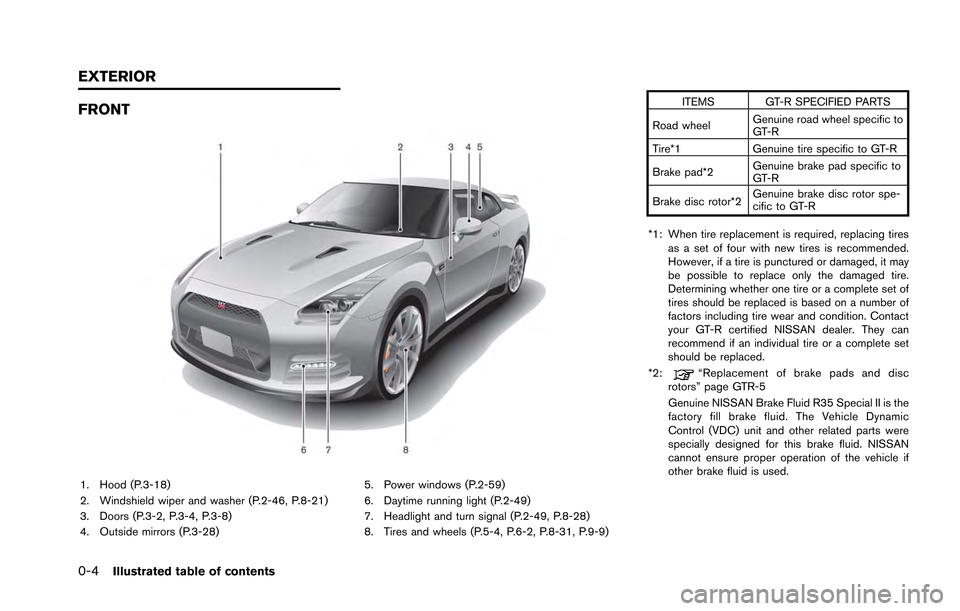
1. Hood (P.3-18)
2. Windshield wiper and washer (P.2-46, P.8-21)
3. Doors (P.3-2, P.3-4, P.3-8)
4. Outside mirrors (P.3-28)5. Power windows (P.2-59)
6. Daytime running light (P.2-49)
7. Headlight and turn signal (P.2-49, P.8-28)
8. Tires and wheels (P.5-4, P.6-2, P.8-31, P.9-9) ITEMS GT-R SPECIFIED PARTS
Road wheel Genuine road wheel specific to
GT-R
Tire*1 Genuine tire specific to GT-R
Brake pad*2 Genuine brake pad specific to
GT-R
Brake disc rotor*2 Genuine brake disc rotor spe-
cific to GT-R
*1: When tire replacement is required, replacing tires as a set of four with new tires is recommended.
However, if a tire is punctured or damaged, it may
be possible to replace only the damaged tire.
Determining whether one tire or a complete set of
tires should be replaced is based on a number of
factors including tire wear and condition. Contact
your GT-R certified NISSAN dealer. They can
recommend if an individual tire or a complete set
should be replaced.
*2:
“Replacement of brake pads and disc
rotors” page GTR-5
Genuine NISSAN Brake Fluid R35 Special II is the
factory fill brake fluid. The Vehicle Dynamic
Control (VDC) unit and other related parts were
specially designed for this brake fluid. NISSAN
cannot ensure proper operation of the vehicle if
other brake fluid is used.
EXTERIOR
Page 117 of 346
2-22Instruments and controls
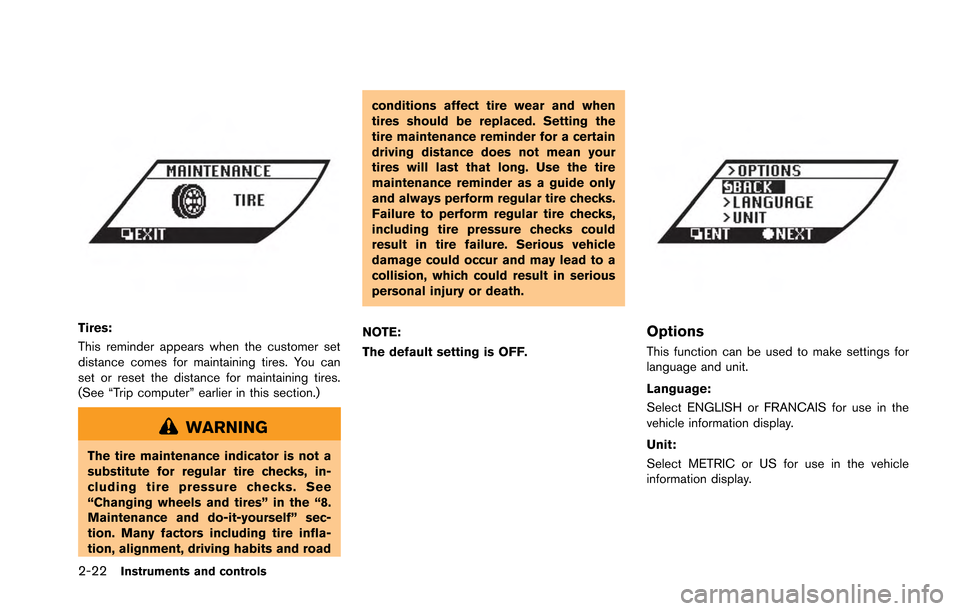
Tires:
This reminder appears when the customer set
distance comes for maintaining tires. You can
set or reset the distance for maintaining tires.
(See “Trip computer” earlier in this section.)
WARNING
The tire maintenance indicator is not a
substitute for regular tire checks, in-
cluding tire pressure checks. See
“Changing wheels and tires” in the “8.
Maintenance and do-it-yourself” sec-
tion. Many factors including tire infla-
tion, alignment, driving habits and roadconditions affect tire wear and when
tires should be replaced. Setting the
tire maintenance reminder for a certain
driving distance does not mean your
tires will last that long. Use the tire
maintenance reminder as a guide only
and always perform regular tire checks.
Failure to perform regular tire checks,
including tire pressure checks could
result in tire failure. Serious vehicle
damage could occur and may lead to a
collision, which could result in serious
personal injury or death.
NOTE:
The default setting is OFF.
Options
This function can be used to make settings for
language and unit.
Language:
Select ENGLISH or FRANCAIS for use in the
vehicle information display.
Unit:
Select METRIC or US for use in the vehicle
information display.
Page 120 of 346
Pull off the road in a safe area,
and idle the engine. The driving
mode will change to RWD to
prevent the AWD system from
malfunctioning. If the warning
light turns off, you can drive
again. This does not indicate
that there is a malfunction.
— blinks slowly (about once every 2 seconds):
Pull off the road in a safe area,
and idle the engine. Check that
all tire sizes are the same as
that specified on the Tire and
Loading Information label lo-
cated in the driver’s door open-
ing, tire pressure is correct and
tires are not worn. (
“Tire
and loading information label”
page 9-13)
If the tire pressure is insuffi-
cient, fill with nitrogen gas.
Contact a GT-R certified NISSAN
dealer about filling with nitro-
gen gas. If nitrogen gas is not
available, compressed air may
be safely used under normal
driving conditions. However,
NISSAN recommends refilling with nitrogen gas for maximum
tire performance.
. If the warning light is still on after
the above operations, have your
vehicle checked by a GT-R certified
NISSAN dealer as soon as possible.
orAnti-lock Braking
System (ABS) warning light
When the ignition switch is in the ON position,
the Anti-lock Braking System (ABS) warning
light illuminates and then turns off. This indicates
the ABS is operational.
If the ABS warning light illuminates while the
engine is running, or while driving, it may
indicate the ABS is not functioning properly.
Have the system checked by a GT-R certified
NISSAN dealer.
If an ABS malfunction occurs, the anti-lock
function is turned off. The brake system then
operates normally, but without anti-lock assis-
tance. (
“Brake system” page 5-47)
orBrake warning light
This light functions for both the parking brake
and the foot brake systems. Parking brake indicator:
When the ignition switch is in the ON position,
the light comes on when the parking brake is
applied.
Low brake fluid warning light:
When the ignition switch is in the ON position,
the light warns of a low brake fluid level. If the
light comes on while the engine is running with
the parking brake not applied, stop the vehicle
and perform the following:
1. Check the brake fluid level. Add brake fluid
as necessary. (
“Brake fluid” page 8-
15)
2. If the brake fluid level is correct, have the warning system checked by a GT-R certified
NISSAN dealer.
Anti-lock Braking System (ABS) warning
indicator:
When the parking brake is released and the
brake fluid level is sufficient, if both the brake
warning light and the Anti-lock Braking System
(ABS) warning light illuminate, it may indicate
the ABS is not functioning properly. Have the
brake system checked, and if necessary re-
paired, by a GT-R certified NISSAN dealer
promptly. (
“Anti-lock Braking System
(ABS) warning light” page 2-25)
Instruments and controls2-25
Page 121 of 346
2-26Instruments and controls
WARNING
.Your brake system may not be
working properly if the warning light
is on. Driving could be dangerous. If
you judge it to be safe, drive care-
fully to the nearest service station
for repairs. Otherwise, have your
vehicle towed because driving it
could be dangerous.
. Pressing the brake pedal with the
engine stopped and/or low brake
fluid level may increase your stop-
ping distance and braking will re-
quire greater pedal effort as well as
pedal travel.
. If the brake fluid level is below the
minimum or MIN mark on the brake
fluid reservoir, do not drive until the
brake system has been checked at a
GT-R certified NISSAN dealer.
Charge warning light
If the light comes on while the engine is running,
it may indicate the charging system is not
functioning properly. Turn the engine off and
check the alternator belt. If the belt is loose, broken, missing or if the light remains on, see a
GT-R certified NISSAN dealer immediately.
NOTICE
Do not continue driving if the alternator
belt is loose, broken or missing.
Engine oil pressure warning
light
This light warns of low engine oil pressure. If the
light flickers or comes on during normal driving,
pull off the road in a safe area, stop the engine
immediately and call a GT-R certified NISSAN
dealer.
The engine oil pressure warning light is
not designed to indicate a low oil level.
Check the vehicle information display or
use the dipstick to check the oil level.
(
“Engine oil level display” page 2-12)
(“Checking engine oil level” page 8-12)
NOTICE
Running the engine with the engine oil
pressure warning light on could cause
serious damage to the engine almost
immediately. Turn off the engine as soon as it is safe to do so.
Intelligent Key warning light
After the ignition switch is pushed to the ON
position, this light comes on for about 2 seconds
and then turns off.
This light warns of a malfunction with the
electrical steering lock system or the Intelligent
Key system.
If the light comes on while the engine is
stopped, it may be impossible to free the
steering lock or to start the engine. If the light
comes on while the engine is running, you can
drive the vehicle. However in these cases,
contact a GT-R certified NISSAN dealer for
repair as soon as possible.
Low tire pressure warning light
Your vehicle is equipped with a Tire Pressure
Monitoring System (TPMS) that monitors the tire
pressure of all tires.
The low tire pressure warning light warns of low
tire pressure and flat tire, or indicates that the
TPMS is not functioning properly.
After the ignition switch is pushed ON, this light
illuminates for about 1 second and turns off.
Page 122 of 346
Low tire pressure warning:
If the vehicle is being driven with low tire
pressure, the warning light will illuminate.
When the low tire pressure warning light
illuminates, you should stop and adjust the
tire pressure of all 4 wheels to the
recommended COLD tire pressure shown
on the Tire and Loading Information label
located in the driver’s door opening. The
low tire pressure warning light does not
automatically turn off when the tire pres-
sure is adjusted. After the tire is inflated to
the recommended pressure, the vehicle
must be driven at speeds above 16 MPH
(25 km/h) to activate the TPMS and turn off
the low tire pressure warning light. Use a
tire pressure gauge to check the tire
pressure. (
“Tire Pressure Monitoring
System (TPMS)” page 5-4) (“Tire
Pressure Monitoring System (TPMS)” page
6-2)
Run-flat tire warning:
The run-flat tire warning light warns of a flat tire.
If the vehicle is being driven with one or more flat
tires, the warning light will illuminate continu-
ously and a chime will sound for 10 seconds.
The chime will only sound at the first indication
of a flat tire and the warning light will illuminate continuously. When the Flat tire warning is
activated, have the system reset and the tire
checked and replaced if necessary by a GT-R
certified NISSAN dealer. Even if the tire is
inflated to the specified COLD tire pressure, the
warning light will continue to illuminate until the
system is reset by a GT-R certified NISSAN
dealer.
If you select the tire pressure information in the
multi function display, the LOW PRESSURE
warning message will be displayed. The tire
pressure for each tire will also be displayed.
Refer to the separate Multi Function Display
Owner’s Manual.
Your vehicle can be driven for a limited time on a
flat tire. (
“Tire Pressure Monitoring System
(TPMS)” page 5-4) (“Tire Pressure Mon-
itoring System (TPMS)” page 6-2)
TPMS malfunction:
If the TPMS is not functioning properly, the low
tire pressure warning light will flash for approxi-
mately 1 minute when the ignition switch is
pushed ON. The light will remain on after the 1
minute. Have the system checked by a GT-R
certified NISSAN dealer. (
“Tire Pressure
Monitoring System (TPMS)” page 5-4)
(
“Tire pressure” page 8-31)
WARNING
. If the light does not illuminate with
the ignition switch pushed ON, have
the vehicle checked by a GT-R
certified NISSAN dealer as soon as
possible.
. If the light illuminates while driving,
avoid sudden steering maneuvers or
abrupt braking, reduce vehicle
speed, pull off the road to a safe
location and stop the vehicle as
soon as possible. Driving with un-
der-inflated tires may permanently
damage the tires and increase the
likelihood of tire failure. Serious
vehicle damage could occur and
may lead to an accident and could
result in serious personal injury.
Check the tire pressure for all four
tires. Adjust the tire pressure to the
recommended COLD tire pressure
shown on the Tire and Loading
Information label located in the
driver’s door opening to turn the
low tire pressure warning light off. If
the light still illuminates while driv-
ing after adjusting the tire pressure,
a tire may be flat.
Instruments and controls2-27