check engine NISSAN GT-R 2013 R35 Workshop Manual
[x] Cancel search | Manufacturer: NISSAN, Model Year: 2013, Model line: GT-R, Model: NISSAN GT-R 2013 R35Pages: 346, PDF Size: 4.19 MB
Page 278 of 346
CHECKING ENGINE COOLANT LE-
VEL
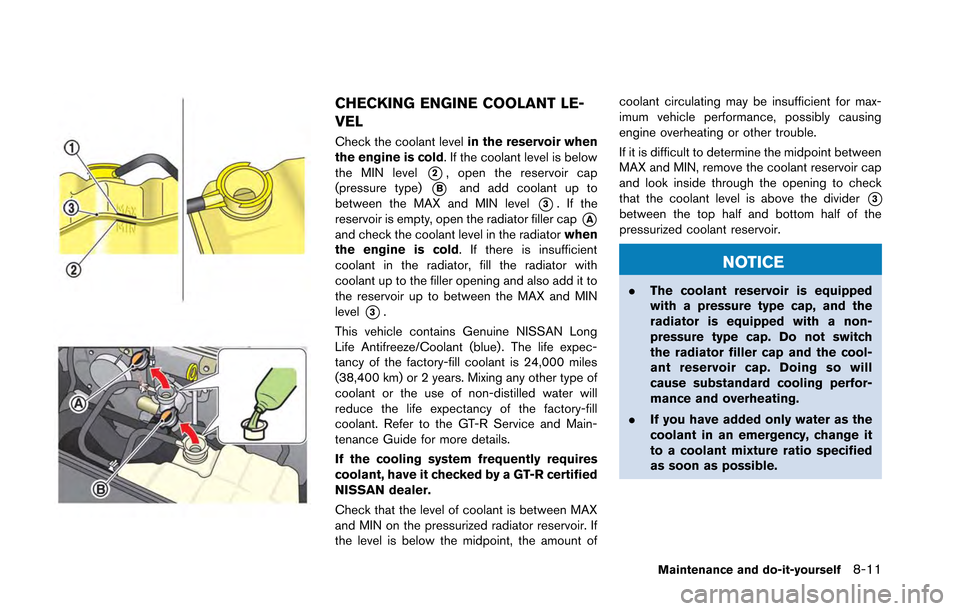
Check the coolant levelin the reservoir when
the engine is cold. If the coolant level is below
the MIN level
*2, open the reservoir cap
(pressure type)
*Band add coolant up to
between the MAX and MIN level
*3. If the
reservoir is empty, open the radiator filler cap
*Aand check the coolant level in the radiator when
the engine is cold. If there is insufficient
coolant in the radiator, fill the radiator with
coolant up to the filler opening and also add it to
the reservoir up to between the MAX and MIN
level
*3.
This vehicle contains Genuine NISSAN Long
Life Antifreeze/Coolant (blue). The life expec-
tancy of the factory-fill coolant is 24,000 miles
(38,400 km) or 2 years. Mixing any other type of
coolant or the use of non-distilled water will
reduce the life expectancy of the factory-fill
coolant. Refer to the GT-R Service and Main-
tenance Guide for more details.
If the cooling system frequently requires
coolant, have it checked by a GT-R certified
NISSAN dealer.
Check that the level of coolant is between MAX
and MIN on the pressurized radiator reservoir. If
the level is below the midpoint, the amount of coolant circulating may be insufficient for max-
imum vehicle performance, possibly causing
engine overheating or other trouble.
If it is difficult to determine the midpoint between
MAX and MIN, remove the coolant reservoir cap
and look inside through the opening to check
that the coolant level is above the divider
*3between the top half and bottom half of the
pressurized coolant reservoir.
NOTICE
.
The coolant reservoir is equipped
with a pressure type cap, and the
radiator is equipped with a non-
pressure type cap. Do not switch
the radiator filler cap and the cool-
ant reservoir cap. Doing so will
cause substandard cooling perfor-
mance and overheating.
. If you have added only water as the
coolant in an emergency, change it
to a coolant mixture ratio specified
as soon as possible.
Maintenance and do-it-yourself8-11
Page 279 of 346
8-12Maintenance and do-it-yourself
CHANGING ENGINE COOLANT
If major cooling system repairs are required,
contact a GT-R certified NISSAN dealer. The
service procedures can be found in the appro-
priate NISSAN Service Manual.
Improper servicing can result in reduced
heater performance and engine overheat-
ing.
WARNING
.To avoid the danger of being
scalded, never change the coolant
when the engine is hot.
. Never remove the radiator filler cap
and the coolant reservoir cap when
the engine is hot. Serious burns
could be caused by high pressure
fluid escaping from the radiator and
reservoir.
. Avoid direct skin contact with used
coolant. If skin contact is made,
wash thoroughly with soap or hand
cleaner as soon as possible.
. Keep coolant out of reach of chil-
dren and pets. Engine coolant must be disposed of properly.
Check your local regulations.
CHECKING ENGINE OIL LEVEL
1. Park the vehicle on a level surface and apply
the parking brake.
2. Run the engine until it reaches operating temperature.
3. Turn off the engine. Wait at least 5
minutes for the oil to drain back into
the oil pan before checking the oil.
4. Remove the dipstick and wipe it clean. Reinsert it all the way.
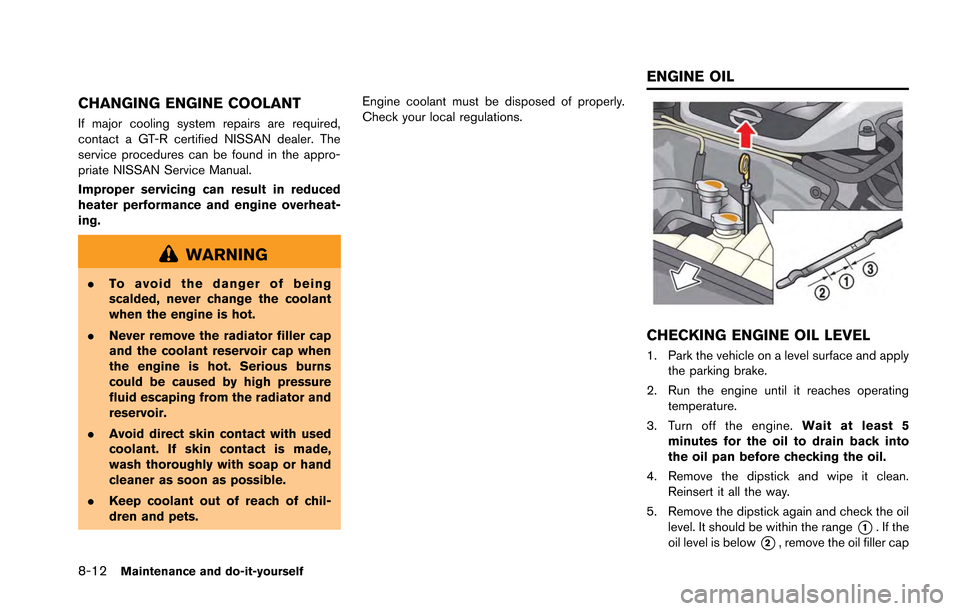
5. Remove the dipstick again and check the oil level. It should be within the range
*1. If the
oil level is below
*2, remove the oil filler cap
ENGINE OIL
Page 280 of 346
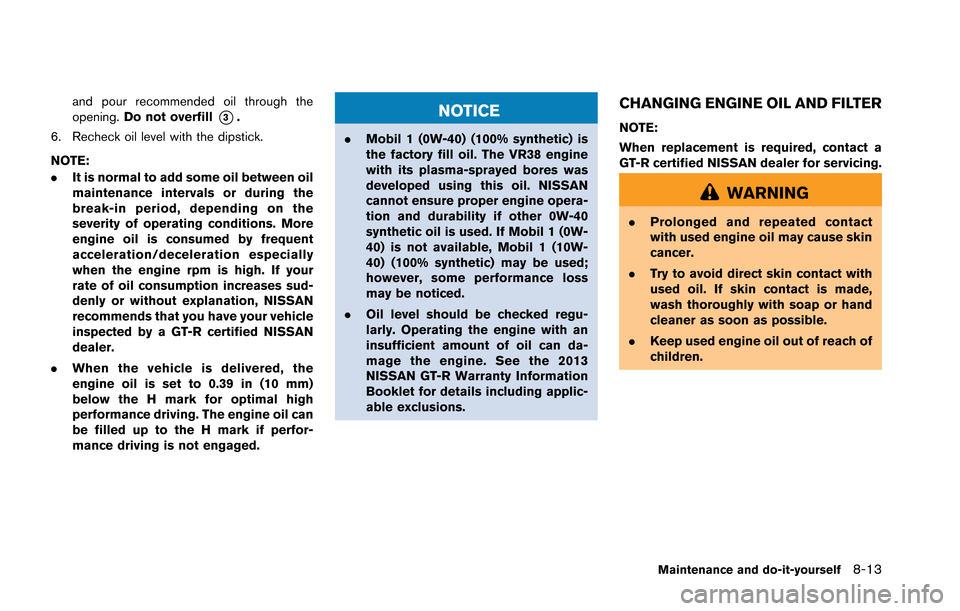
and pour recommended oil through the
opening.Do not overfill
*3.
6. Recheck oil level with the dipstick.
NOTE:
. It is normal to add some oil between oil
maintenance intervals or during the
break-in period, depending on the
severity of operating conditions. More
engine oil is consumed by frequent
acceleration/deceleration especially
when the engine rpm is high. If your
rate of oil consumption increases sud-
denly or without explanation, NISSAN
recommends that you have your vehicle
inspected by a GT-R certified NISSAN
dealer.
. When the vehicle is delivered, the
engine oil is set to 0.39 in (10 mm)
below the H mark for optimal high
performance driving. The engine oil can
be filled up to the H mark if perfor-
mance driving is not engaged.NOTICE
.Mobil 1 (0W-40) (100% synthetic) is
the factory fill oil. The VR38 engine
with its plasma-sprayed bores was
developed using this oil. NISSAN
cannot ensure proper engine opera-
tion and durability if other 0W-40
synthetic oil is used. If Mobil 1 (0W-
40) is not available, Mobil 1 (10W-
40) (100% synthetic) may be used;
however, some performance loss
may be noticed.
. Oil level should be checked regu-
larly. Operating the engine with an
insufficient amount of oil can da-
mage the engine. See the 2013
NISSAN GT-R Warranty Information
Booklet for details including applic-
able exclusions.
CHANGING ENGINE OIL AND FILTER
NOTE:
When replacement is required, contact a
GT-R certified NISSAN dealer for servicing.
WARNING
.Prolonged and repeated contact
with used engine oil may cause skin
cancer.
. Try to avoid direct skin contact with
used oil. If skin contact is made,
wash thoroughly with soap or hand
cleaner as soon as possible.
. Keep used engine oil out of reach of
children.
Maintenance and do-it-yourself8-13
Page 285 of 346
8-18Maintenance and do-it-yourself
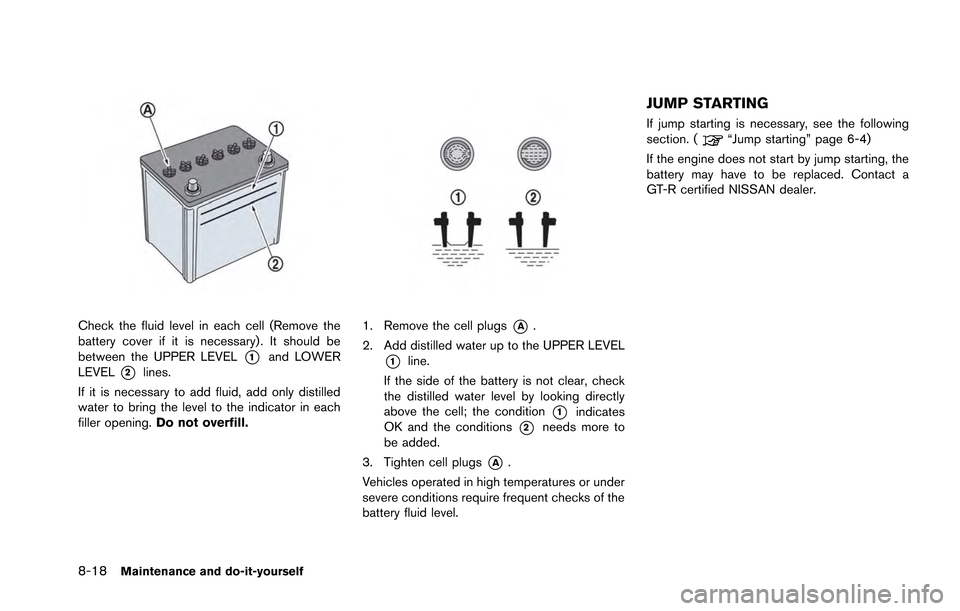
Check the fluid level in each cell (Remove the
battery cover if it is necessary) . It should be
between the UPPER LEVEL
*1and LOWER
LEVEL
*2lines.
If it is necessary to add fluid, add only distilled
water to bring the level to the indicator in each
filler opening. Do not overfill.
1. Remove the cell plugs*A.
2. Add distilled water up to the UPPER LEVEL
*1line.
If the side of the battery is not clear, check
the distilled water level by looking directly
above the cell; the condition
*1indicates
OK and the conditions
*2needs more to
be added.
3. Tighten cell plugs
*A.
Vehicles operated in high temperatures or under
severe conditions require frequent checks of the
battery fluid level.
JUMP STARTING
If jump starting is necessary, see the following
section. (“Jump starting” page 6-4)
If the engine does not start by jump starting, the
battery may have to be replaced. Contact a
GT-R certified NISSAN dealer.
Page 286 of 346
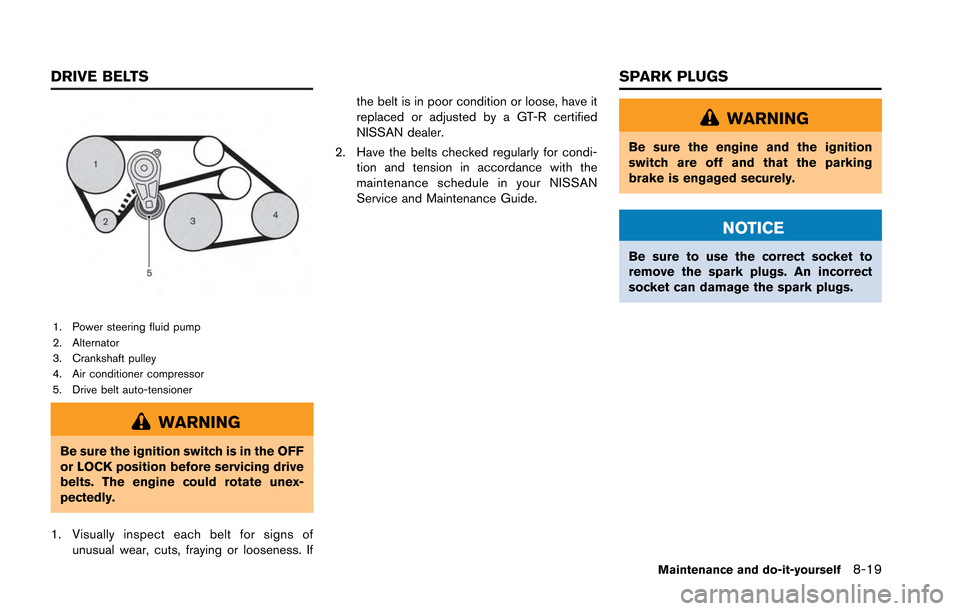
1. Power steering fluid pump
2. Alternator
3. Crankshaft pulley
4. Air conditioner compressor
5. Drive belt auto-tensioner
WARNING
Be sure the ignition switch is in the OFF
or LOCK position before servicing drive
belts. The engine could rotate unex-
pectedly.
1. Visually inspect each belt for signs of unusual wear, cuts, fraying or looseness. If the belt is in poor condition or loose, have it
replaced or adjusted by a GT-R certified
NISSAN dealer.
2. Have the belts checked regularly for condi- tion and tension in accordance with the
maintenance schedule in your NISSAN
Service and Maintenance Guide.
WARNING
Be sure the engine and the ignition
switch are off and that the parking
brake is engaged securely.
NOTICE
Be sure to use the correct socket to
remove the spark plugs. An incorrect
socket can damage the spark plugs.
Maintenance and do-it-yourself8-19
DRIVE BELTS SPARK PLUGS
Page 290 of 346
dry road, especially after washing the vehicle or
driving in rain. Contact a GT-R certified NISSAN
dealer if the noise and vibration continue.
Frequent hard braking may cause scorching of
the brake pads. This will require the brake pads
to be replaced, even if the wear limit has not
been reached. Have the brake pads and disc
rotors inspected at the regular vehicle inspec-
tions.
For more details, contact a GT-R certified
NISSAN dealer.
REPLACING THE BRAKE PADS
NISSAN generally recommends to replace all
four sets of brake pads and disc rotors at the
same time to maintain maximum brake perfor-
mance.
However, replacing only the brake pads may be
allowed in some cases (four wheels or only front
wheels depending on the conditions). A GT-R
certified technician must inspect the vehicle and
determine that only the brake pads need to be
replaced. In this case, replacing all brake pads
and disc rotors as a set is not necessary.
Note that the replacement of brake pads and the
disc rotors as a set on all four wheels should be
performed when a GT-R certified technician
determines that this is the correct repair.If the inside of the disc rotors are cold during the
winter and the surface becomes hot due to a
heavy force being applied repeatedly to the
brakes, cracks may occur near the coolant hole
on the surface of the disc rotor. Cracks may also
occur due to a heavy force being repeatedly
applied to the brakes during high performance
driving. In these cases it may be necessary to
replace the disc rotors or brake pads depending
on the condition of the crack. Contact a GT-R
certified NISSAN dealer for replacement.
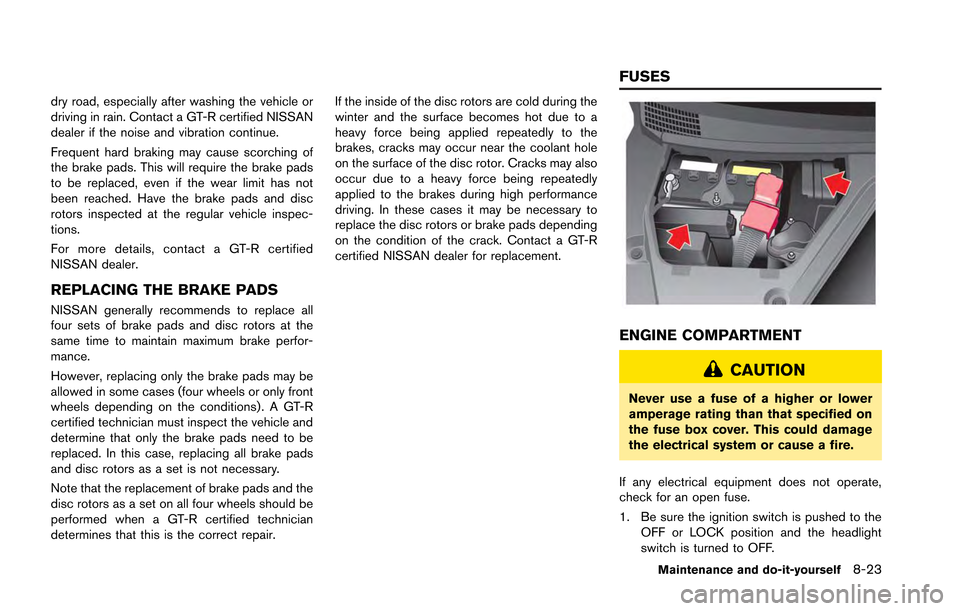
ENGINE COMPARTMENT
CAUTION
Never use a fuse of a higher or lower
amperage rating than that specified on
the fuse box cover. This could damage
the electrical system or cause a fire.
If any electrical equipment does not operate,
check for an open fuse.
1. Be sure the ignition switch is pushed to the OFF or LOCK position and the headlight
switch is turned to OFF.
Maintenance and do-it-yourself8-23
FUSES
Page 291 of 346
8-24Maintenance and do-it-yourself
2. Open the engine hood and remove thecover on the battery and the fuse/fusible link
holder.
3. Remove the fuse/fusible link holder cover.
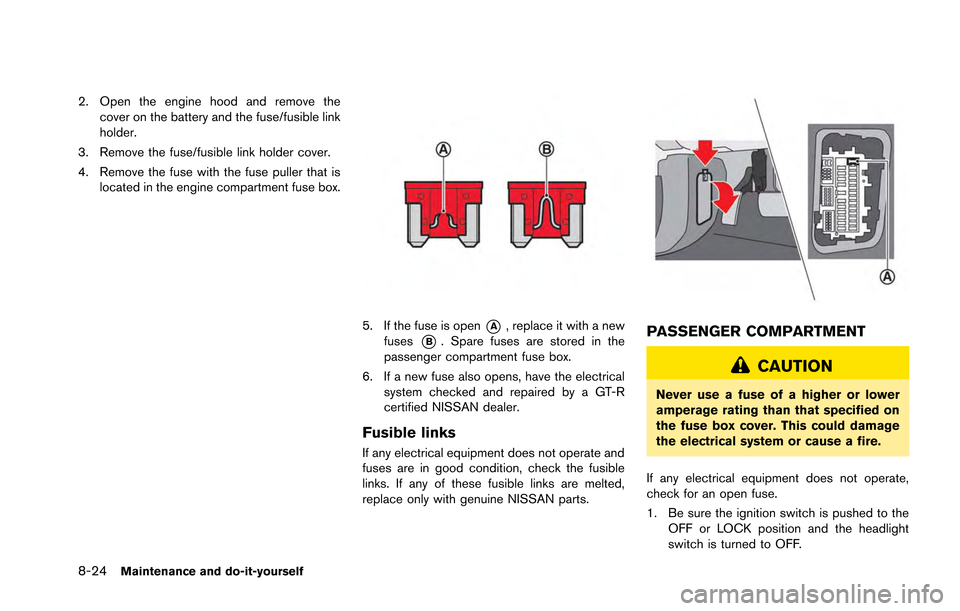
4. Remove the fuse with the fuse puller that is located in the engine compartment fuse box.
5. If the fuse is open*A, replace it with a new
fuses
*B. Spare fuses are stored in the
passenger compartment fuse box.
6. If a new fuse also opens, have the electrical system checked and repaired by a GT-R
certified NISSAN dealer.
Fusible links
If any electrical equipment does not operate and
fuses are in good condition, check the fusible
links. If any of these fusible links are melted,
replace only with genuine NISSAN parts.
PASSENGER COMPARTMENT
CAUTION
Never use a fuse of a higher or lower
amperage rating than that specified on
the fuse box cover. This could damage
the electrical system or cause a fire.
If any electrical equipment does not operate,
check for an open fuse.
1. Be sure the ignition switch is pushed to the OFF or LOCK position and the headlight
switch is turned to OFF.
Page 319 of 346
9-6Technical and consumer information
Octane rating tips
Using unleaded gasoline with an octane
rating lower than recommended above can
cause persistent, heavy spark knock.
(Spark knock is a metallic rapping noise.)
If severe, this can lead to engine damage.
If you detect a persistent heavy spark
knock even when using gasoline of the
stated octane rating, or if you hear steady
spark knock while holding a steady speed
on level roads, have a GT-R certified
NISSAN dealer correct the condition. Fail-
ure to correct the condition is misuse of
the vehicle, for which NISSAN is not
responsible.
Incorrect ignition timing will result in knocking,
after-run or overheating. This in turn may cause
excessive fuel consumption or damage to the
engine. If any of the above symptoms are
encountered, have your vehicle checked at a
GT-R certified NISSAN dealer or other compe-
tent service facility.
However, now and then you may notice
light spark knock for a short time while
accelerating or driving up hills. This is no
cause for concern, because you get the
greatest fuel benefit when there is light
spark knock for a short time under heavy
engine load.
ENGINE OIL AND OIL FILTER RE-
COMMENDATION
Selecting the correct oil
It is essential to choose the correct grade,
quality, and viscosity engine oil to ensure
satisfactory engine life and performance.
(
“Capacities and recommended fuel/lubri-
cants” page 9-2)
Mobil 1 (0W-40) (100% synthetic) is the factory
fill oil. The VR38 engine with its plasma-sprayed
bores was developed using this oil. NISSAN
cannot ensure proper engine operation and
durability if other 0W-40 synthetic oil is used.
If Mobil 1 (0W-40) is not available, Mobil 1
(10W-40) (100% synthetic) may be used;
however, some performance loss may be
noticed.
NOTICE
Using an engine oil other than that
specified could adversely affect the
engine. See the 2013 NISSAN GT-R
Warranty Information Booklet for de-
tails and exclusions.
Oil additives
NISSAN does not recommend the use of oil
additives. The use of an oil additive is not
necessary when the proper oil type is used and
maintenance intervals are followed.
Oil which may contain foreign matter or has
been previously used should not be used.
Oil viscosity
The engine oil viscosity or thickness changes
with temperature. Because of this, it is important
that the engine oil viscosity be selected based
on the temperatures at which the vehicle will be
operated before the next oil change. Choosing
an oil viscosity other than that recommended
could cause serious engine damage.
Selecting the correct oil filter
Your new vehicle is equipped with a high-quality
genuine NISSAN oil filter. NISSAN recommends
to use the genuine NISSAN oil filter for the
reason described in change intervals.
Change intervals
The oil and oil filter change intervals for your
engine are based on the use of the specified
quality oils and filters. Oil and filter other than the
specified quality, or oil and filter change intervals
longer than recommended could reduce engine
Page 333 of 346
9-20Technical and consumer information
www.tc.gc.ca/roadsafety (English speak-
ers) or www.tc.gc.ca/securiteroutiere
(French speakers).
To notify NISSAN of any safety concerns
please contact our Consumer Information
Centre toll free at 1-800-387-0122.A vehicle equipped with All-Wheel Drive (AWD)
should never be tested using a two wheel
dynamometer (such as the dynamometers used
by some states for emissions testing), or similar
equipment. Make sure you inform test facility
personnel that your vehicle is equipped with
AWD before it is placed on a dynamometer.
Using the wrong test equipment may result in
transmission damage or unexpected vehicle
movement which could result in serious vehicle
damage or personal injury.
Due to legal requirements in some states/ areas,
your vehicle may be required to be in what is
called the “ready condition” for an Inspection/
Maintenance (I/M) test of the emission control
system.
The vehicle is set to the “ready condition” when
it is driven through certain driving patterns.
Usually, the “ready condition” can be obtained
by ordinary usage of the vehicle.
If a powertrain system component is repaired or
the battery is disconnected, the vehicle may be
reset to a “not ready condition”. Before taking
the I/M test, check the vehicle’s inspection/
maintenance test readiness condition. Push the
ignition switch to the ON position without
starting the engine. If the Malfunction Indicator
Light (MIL) comes on steady for 20 seconds and
then blinks for 10 seconds, the I/M testcondition is “not ready”. If the MIL does not
blink after 20 seconds, the I/M test condition is
“ready”.
Contact a GT-R certified NISSAN dealer to set
“ready condition” or to prepare the vehicle for
testing.
READINESS FOR INSPECTION/
MAINTENANCE (I/M) TEST (US only)
Page 336 of 346
10 Index
A
Additional maintenance items............................ GTR-12
Air cleaner..................................................................... 8-20
Air conditionerAir conditioner specification label.................... 9-13
Air conditioning system refrigerant and
lubricant recommendations......................................... 9-7
Air fresheners................................................................. 7-5
All-season tires...................................................... GTR-11
All-Wheel Drive............................................................ 5-41
All-Wheel Drive driving safety precautions ............ 5-9
Anti-freeze..................................................................... 5-51
Anti-lock Braking System.......................................... 5-48
Anti-lock Braking System warning.......................... 2-36
Audible reminders....................................................... 2-31
Automatic Automatic door lock system................................. 3-5
Average fuel consumption and speed................... 2-16
Avoiding body damage........................................ GTR-11
Avoiding collision and rollover ................................... 5-7
AWD clutch high temperature warning................. 2-36
AWD system characteristics.................................... 5-43
AWD system warning ................................................ 2-37
AWD warning light ..................................................... 5-41
B
Battery................................................................ 5-51, 8-17 Intelligent Key battery discharge...................... 5-11
Intelligent Key battery discharge indicator..... 2-43
Intelligent Key battery replacement ................. 8-26 Before starting the engine........................................ 5-13
Body repair ............................................................. GTR-12
Booster seats............................................................... 1-28
Brake
Brake assist........................................................... 5-48
Brake fluid............................................... GTR-4, 8-15
Brake pad wear warning.................................... 8-22
Brake system......................................................... 5-47
Brakes..................................................................... 8-22
High performance brake system ...................... 8-22
Low brake fluid warning ..................................... 2-35
Parking brake ........................................................ 5-33
Parking brake break-in........................................ 5-47
Parking brake release warning ......................... 2-35
Replacing the brake pads.................................. 8-23
Self-adjusting brakes .......................................... 8-22
Brake dust............................................................... GTR-27
Brake pad................................................................ GTR-15
Brake pad and disc rotor...................................... GTR-5
Brake pad break-in procedure........................... GTR-15
Brake system information.................................... GTR-27
Brakes.................................................... GTR-19, GTR-23
Braking precautions.................................................... 5-47
Break-in schedule ........................................ GTR-9, 5-39
C
Capacities and recommended fuel/lubricants ....... 9-2
Changing Changing engine coolant................................... 8-12
Changing engine oil and filter........................... 8-13 Changing wheels and tires................................ 8-39
Checking Checking bulbs..................................................... 2-24
Checking engine coolant level.......................... 8-11
Checking engine oil level................................... 8-12
Checking the tire pressure................................ 8-34
Checking the exhaust finisher and rear
bumper clearance ................................................... GTR-9
Child restraints............................................................. 1-14
Child safety................................................................... 1-12
Chrome parts ................................................................. 7-4
Cleaning ........................................................................ 8-21
Cleaning exterior ........................................................... 7-2
Cleaning interior ............................................................ 7-5
Clearing the programmed information................... 2-66
Closing the fuel-filler door ........................................ 3-25
Closing the hood......................................................... 3-19
Coat hooks ................................................................... 2-58
Cockpit ............................................................................ 2-3
Cold weather driving.................................................. 5-51
Console box ................................................................. 2-58
Cool down .............................................................. GTR-13
Coolant Changing engine coolant................................... 8-12
Checking engine coolant level.......................... 8-11
Draining of coolant water................................... 5-51
Engine coolant temperature gauge .................... 2-7
Coolant level and mixture ratio.......................... GTR-15
Corrosion protection .................................................... 7-8
Cracks on brake pad ........................................... GTR-27
Cracks on the disc rotors................................... GTR-27