MAINT NISSAN KICKS 2020 Owner´s Manual
[x] Cancel search | Manufacturer: NISSAN, Model Year: 2020, Model line: KICKS, Model: NISSAN KICKS 2020Pages: 500, PDF Size: 3.43 MB
Page 458 of 500
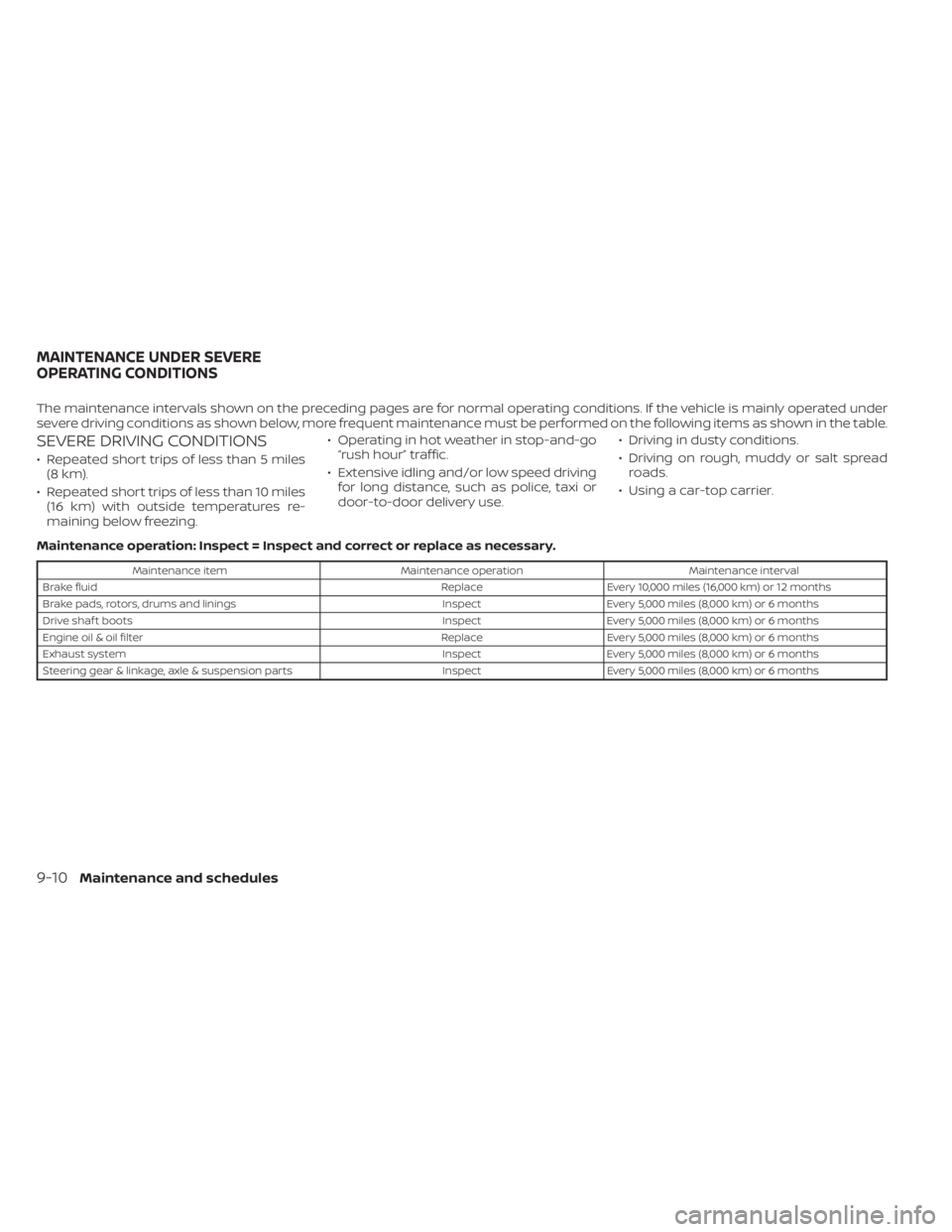
The maintenance intervals shown on the preceding pages are for normal operating conditions. If the vehicle is mainly operated under
severe driving conditions as shown below, more frequent maintenance must be performed on the following items as shown in the table.
SEVERE DRIVING CONDITIONS
• Repeated short trips of less than 5 miles(8 km).
• Repeated short trips of less than 10 miles (16 km) with outside temperatures re-
maining below freezing. • Operating in hot weather in stop-and-go
“rush hour” traffic.
• Extensive idling and/or low speed driving for long distance, such as police, taxi or
door-to-door delivery use. • Driving in dusty conditions.
• Driving on rough, muddy or salt spread
roads.
• Using a car-top carrier.
Maintenance operation: Inspect = Inspect and correct or replace as necessary.
Maintenance item Maintenance operation Maintenance interval
Brake fluid ReplaceEvery 10,000 miles (16,000 km) or 12 months
Brake pads, rotors, drums and linings InspectEvery 5,000 miles (8,000 km) or 6 months
Drive shaf t boots InspectEvery 5,000 miles (8,000 km) or 6 months
Engine oil & oil filter ReplaceEvery 5,000 miles (8,000 km) or 6 months
Exhaust system InspectEvery 5,000 miles (8,000 km) or 6 months
Steering gear & linkage, axle & suspension parts InspectEvery 5,000 miles (8,000 km) or 6 months
MAINTENANCE UNDER SEVERE
OPERATING CONDITIONS
9-10Maintenance and schedules
Page 459 of 500
7,500 Miles (12,000 km) or 6 Months
Dealer Name:
Date:
Mileage:
Dealer
Stamp:15,000 Miles (24,000 km) or 12 Months
Dealer Name:
Date:
Mileage:
Dealer
Stamp:22,500 Miles (36,000 km) or 18 Months
Dealer Name:
Date:
Mileage:
Dealer
Stamp:
30,000 Miles (48,000 km) or 24 Months
Dealer Name:
Date:
Mileage:
Dealer
Stamp: 37,500 Miles (60,000 km) or 30 Months
Dealer Name:
Date:
Mileage:
Dealer
Stamp:45,000 Miles (72,000 km) or 36 Months
Dealer Name:
Date:
Mileage:
Dealer
Stamp:
52,500 Miles (84,000 km) or 42 Months
Dealer Name:
Date:
Mileage:
Dealer
Stamp: 60,000 Miles (96,000 km) or 48 Months
Dealer Name:
Date:
Mileage:
Dealer
Stamp:67,500 Miles (108,000 km) or 54 Months
Dealer Name:
Date:
Mileage:
Dealer
Stamp:
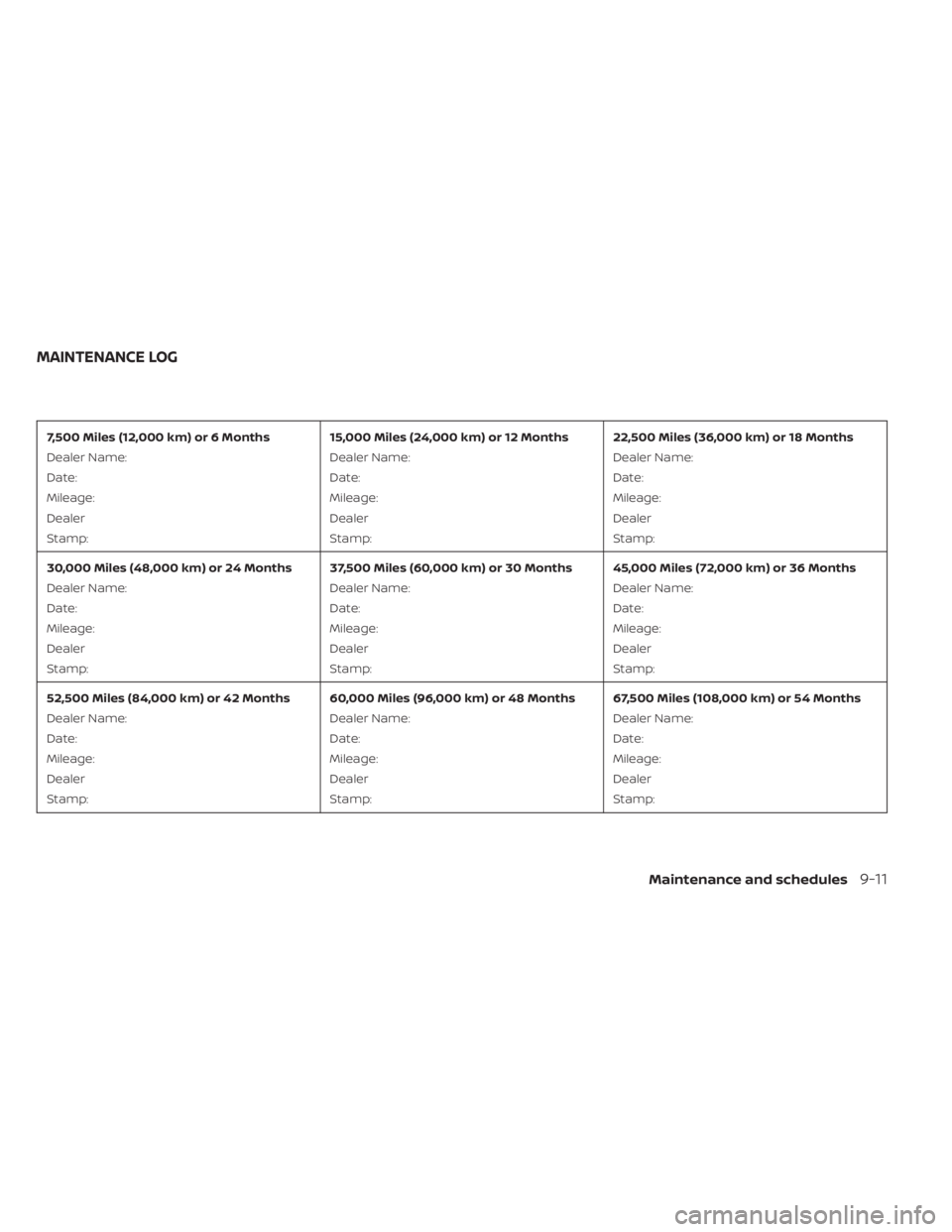
MAINTENANCE LOG
Maintenance and schedules9-11
Page 460 of 500
75,000 Miles (120,000 km) or 60 Months
Dealer Name:
Date:
Mileage:
Dealer
Stamp:82,500 Miles (132,000 km) or 66 Months
Dealer Name:
Date:
Mileage:
Dealer
Stamp:90,000 Miles (144,000 km) or 72 Months
Dealer Name:
Date:
Mileage:
Dealer
Stamp:
97,500 Miles (156,000 km) or 78 Months
Dealer Name:
Date:
Mileage:
Dealer
Stamp: 105,000 Miles (168,000 km) or 84 Months
Dealer Name:
Date:
Mileage:
Dealer
Stamp:112,500 Miles (180,000 km) or 90 Months
Dealer Name:
Date:
Mileage:
Dealer
Stamp:
120,000 Miles (192,000 km) or 96 Months
Dealer Name:
Date:
Mileage:
Dealer
Stamp:
Miles (km) or
Months
Dealer Name:
Date:
Mileage:
Dealer
Stamp:
Miles (km) or
Months
Dealer Name:
Date:
Mileage:
Dealer
Stamp:
9-12Maintenance and schedules
Page 461 of 500
Miles (km) or
Months
Dealer Name:
Date:
Mileage:
Dealer
Stamp:
Miles (km) or
Months
Dealer Name:
Date:
Mileage:
Dealer
Stamp:
Miles (km) or
Months
Dealer Name:
Date:
Mileage:
Dealer
Stamp:
Miles (km) or
Months
Dealer Name:
Date:
Mileage:
Dealer
Stamp:
Miles (km) or
Months
Dealer Name:
Date:
Mileage:
Dealer
Stamp:
Miles (km) or
Months
Dealer Name:
Date:
Mileage:
Dealer
Stamp:
Miles (km) or
Months
Dealer Name:
Date:
Mileage:
Dealer
Stamp:
Miles (km) or
Months
Dealer Name:
Date:
Mileage:
Dealer
Stamp:
Miles (km) or
Months
Dealer Name:
Date:
Mileage:
Dealer
Stamp:
Maintenance and schedules9-13
Page 462 of 500
Miles (km) or
Months
Dealer Name:
Date:
Mileage:
Dealer
Stamp:
Miles (km) or
Months
Dealer Name:
Date:
Mileage:
Dealer
Stamp:
Miles (km) or
Months
Dealer Name:
Date:
Mileage:
Dealer
Stamp:
9-14Maintenance and schedules
Page 463 of 500
10 Technical and consumer information
Recommended fluids/lubricants and
capacities...................................... 10-2
Fuel recommendation ......................10-3
Engine oil and oil filter
recommendations .......................... 10-6
Air conditioner system refrigerant and
oil recommendations ....................... 10-7
Specifications .................................. 10-8
Engine ...................................... 10-8
Wheels and tires ............................ 10-8
Dimensions and weights ....................10-9
When traveling or registering in another
country ....................................... 10-10
Vehicle identification .......................... 10-10
Vehicle Identification Number (VIN)
plate ....................................... 10-10
Vehicle identification number
(chassis number) ........................... 10-10
Engine serial number .......................10-11
F.M.V.S.S./C.M.V.S.S. certification label .........10-11
Emission control information label ..........10-11 Tire and Loading Information label
.........10-12
Air conditioner specification label ..........10-12
Installing front license plate ...................10-12
Vehicle loading information ...................10-13
Terms ...................................... 10-13
Vehicle load capacity ....................... 10-14
Securing the load .......................... 10-15
Loading tips ................................ 10-16
Measurement of weights ...................10-16
Towing a trailer ................................ 10-17
Flat towing ................................. 10-17
Uniform tire quality grading ...................10-18
Emission control system warranty ............10-19
Reporting safety defects ......................10-19
Readiness for Inspection/Maintenance (I/M)
test ........................................... 10-20
Event Data Recorders (EDR) ...................10-20
Owner's Manual/Service Manual order
information ................................... 10-21
Page 468 of 500
ENGINE OIL AND OIL FILTER
RECOMMENDATIONS
Selecting the correct oil
It is essential to choose the correct grade,
quality and viscosity engine oil to ensure
satisfactory engine life and performance.
For additional information, refer to “Recom-
mended fluids/lubricants and capacities”
in this section. NISSAN recommends the
use of an energy conserving oil in order to
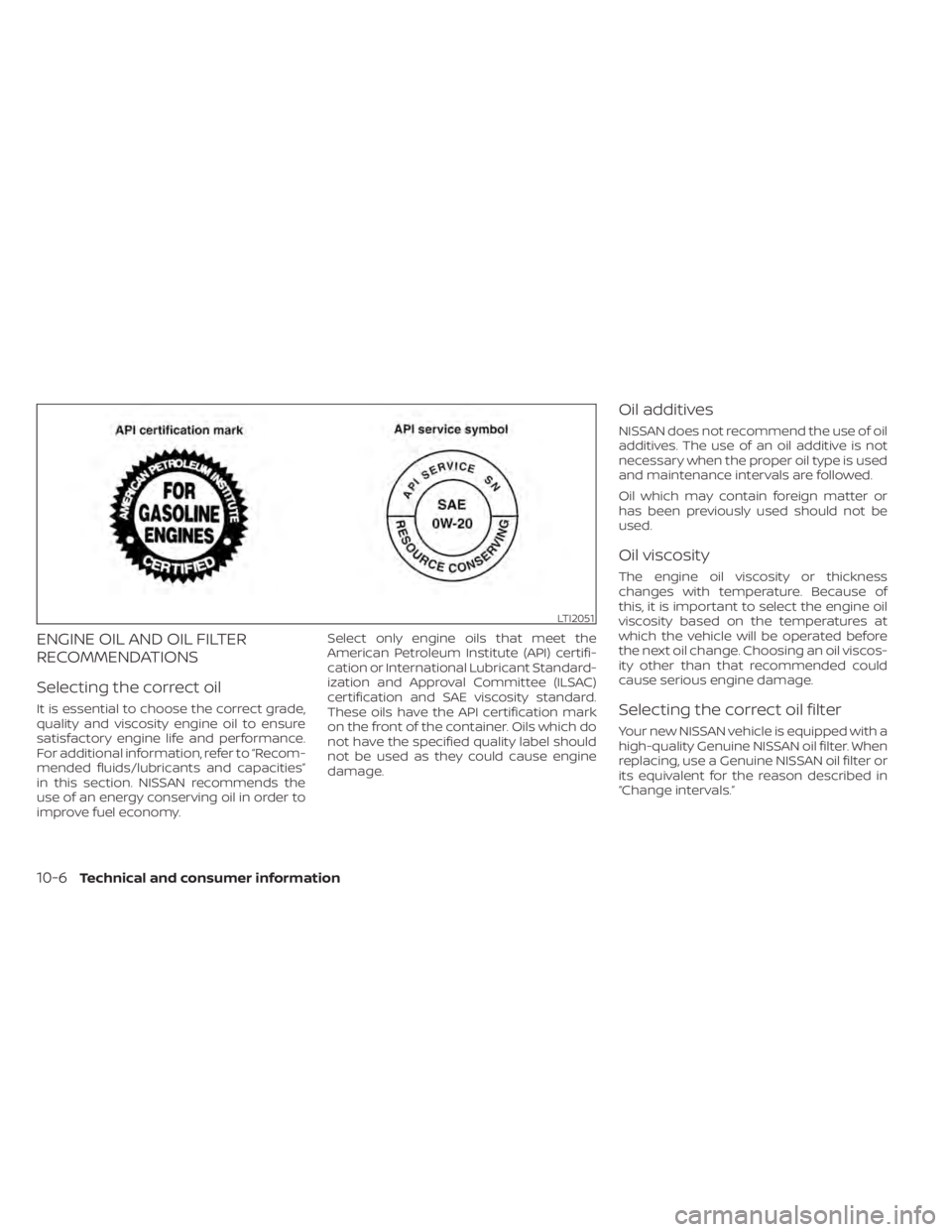
improve fuel economy.Select only engine oils that meet the
American Petroleum Institute (API) certifi-
cation or International Lubricant Standard-
ization and Approval Committee (ILSAC)
certification and SAE viscosity standard.
These oils have the API certification mark
on the front of the container. Oils which do
not have the specified quality label should
not be used as they could cause engine
damage.
Oil additives
NISSAN does not recommend the use of oil
additives. The use of an oil additive is not
necessary when the proper oil type is used
and maintenance intervals are followed.
Oil which may contain foreign matter or
has been previously used should not be
used.
Oil viscosity
The engine oil viscosity or thickness
changes with temperature. Because of
this, it is important to select the engine oil
viscosity based on the temperatures at
which the vehicle will be operated before
the next oil change. Choosing an oil viscos-
ity other than that recommended could
cause serious engine damage.
Selecting the correct oil filter
Your new NISSAN vehicle is equipped with a
high-quality Genuine NISSAN oil filter. When
replacing, use a Genuine NISSAN oil filter or
its equivalent for the reason described in
“Change intervals.”
LTI2051
10-6Technical and consumer information
Page 469 of 500
Change intervals
The oil and oil filter change intervals for
your engine are based on the use of the
specified quality oils and filters. Using en-
gine oil and filters that are not of the speci-
fied quality, or exceeding recommended oil
and filter change intervals could reduce
engine life. Damage to the engine caused
by improper maintenance or use of incor-
rect oil and filter quality and/or viscosity is
not covered by the NISSAN New Vehicle
Limited Warranty.
Your engine was filled with a high-quality
engine oil when it was built. You do not have
to change the oil before the first recom-
mended change interval. Oil and filter
change intervals depend upon how you
use your vehicle.
Operation under the following conditions
may require more frequent oil and filter
changes:
• repeated short distance driving at coldoutside temperatures
• driving in dusty conditions
• extensive idling
• stop and go commuting For additional information, refer to the
“Maintenance and schedules” section of
this manual.
AIR CONDITIONER SYSTEM
REFRIGERANT AND OIL
RECOMMENDATIONS
The air conditioner system in your
NISSAN vehicle must be charged with the
refrigerant HFO-1234yf (R-1234yf ) and
NISSAN A/C system oil Type PAG or the
exact equivalents.
CAUTION
The use of any other refrigerant or oil
will cause severe damage to the air
conditioning system and will require
the replacement of all air conditioner
system components. The refrigerant HFO-1234yf (R-1234yf ) in
your NISSAN vehicle does not harm the
earth's ozone layer. Although this refriger-
ant does not affect the earth's atmo-
sphere, certain government regulations re-
quire the recovery and recycling of any
refrigerant during automotive air condi-
tioner system service. A NISSAN dealer has
the trained technicians and equipment
needed to recover and recycle your air con-
ditioner system refrigerant.
It is recommended that you visit a NISSAN
dealer when servicing your air conditioner
system.
Technical and consumer information10-7
Page 482 of 500
You may contact Transport Cana-
da's Defect Investigations and Re-
calls Division toll free at 1-800-333-
0510. You may also report safety
defects online at: https://
wwwapps.tc.gc.ca/Saf-Sec-Sur/7/
PCDB-BDPP/fc-cp.aspx?lang=eng
(English speakers) or https://
wwwapps.tc.gc.ca/Saf-Sec-Sur/7/
PCDB-BDPP/fc-cp.aspx?lang=fra
(French speakers)
Additional information concerning
motor vehicle safety may be ob-
tained from Transport Canada's
Road Safety Information Centre at
1-800-333-0371 or online at
www.tc.gc.ca/roadsafety (English
speakers) or www.tc.gc.ca/
securiteroutiere (French speakers).
To notif y NISSAN of any safety con-
cerns please contact our Consumer
Information Centre toll free at 1-800-
387-0122.Due to legal requirements in some states
and Canadian Provinces, your vehicle may
be required to be in what is called the
“ready condition” for an Inspection/
Maintenance (I/M) test of the emission
control system.
The vehicle is set to the “ready condition”
when it is driven through certain driving
patterns. Usually, the ready condition can
be obtained by ordinary usage of the ve-
hicle.
If a powertrain system component is re-
paired or the battery is disconnected, the
vehicle may be reset to a “not ready ” condi-
tion. Before taking the I/M test, check the
vehicle's inspection/maintenance test
readiness condition. Place the ignition
switch in the ON position without starting
the engine. If the Malfunction Indicator
Light (MIL) comes on steady for 20 seconds
and then blinks for 10 seconds , the I/M test
condition is “not ready”. If the MIL does not
blink af ter 20 seconds, the I/M test condi-
tion is “ready ”. It is recommended that you
visit a NISSAN dealer to set the “ready con-
dition” or to prepare the vehicle for testing.This vehicle is equipped with an Event Data
Recorder (EDR). The main purpose of an
EDR is to record, in certain crash or near
crash-like situations, such as an air bag
deployment or hitting a road obstacle, data
that will assist in understanding how a ve-
hicle's systems performed. The EDR is de-
signed to record data related to vehicle dy-
namics and safety systems for a short
period of time, typically 30 seconds or less.
The EDR in this vehicle is designed to re-
cord such data as:
• How various systems in your vehicle were
operating;
• Whether or not the driver and passenger safety belts were buckled/fastened;
• How far (if at all) the driver was depress- ing the accelerator and/or brake pedal;
and,
• How fast the vehicle was traveling.
• Sounds are not recorded.
These data can help provide a better un-
derstanding of the circumstances in which
crashes and injuries occur. NOTE: EDR data
are recorded by your vehicle only if a non-
trivial crash situation occurs; no data are
recorded by the EDR under normal driving
conditions and no personal data (e.g.
name, gender, age and crash location) are
recorded. However, other parties, such as
READINESS FOR INSPECTION/
MAINTENANCE (I/M) TEST EVENT DATA RECORDERS (EDR)
10-20Technical and consumer information
Page 487 of 500
Event Data recorders............10-20Exhaust gas (Carbon monoxide)......5-4Explanation of maintenance items.....9-2Explanation of scheduled maintenance
items.......................9-5Extended storage switch..........2-58
F
Flashers (See hazard warning flasher
switch)......................6-2Flat tire...................6-3, 6-4Floor mat positioning aid...........7-5Fluid
Brake fluid................. .8-9Capacities and recommended
fuel/lubricants...............10-2Continuously Variable Transmission (CVT)
fluid..................... .8-9Engine coolant................8-4Engine oil...................8-5Windshield-washer fluid.........8-10F.M.V.S.S. certification label.........10-11Fog light switch................2-51Front air bag system (See supplemental
restraint system)...............1-48Front-door pocket..............2-59Front seats....................1-2Fuel
Capacities and recommended
fuel/lubricants
...............10-2Fuel economy...............5-96Fuel-filler door lock opener lever. . . .3-25
Fuel gauge................. .2-8Fuel octane rating.............10-5Fuel recommendation..........10-3Fuel efficient driving tips...........5-95Fuel-filler door.................3-25Fuel gauge................... .2-8Fuses.......................8-19Fusible links..................8-20
G
Gauge
Fuel gauge................. .2-8Speedometer..............2-5, 2-6Tachometer..................2-7Trip odometer.............2-5, 2-6General maintenance.............9-2Glove box................... .2-61Grocery hooks.................2-63
H
Hands-free phone system, Bluetooth®. .4-67Hazard warning flasher switch........6-2Headlight and turn signal switch.....2-44Headlight control switch..........2-44Headlights...................8-24Head restraints.................1-5Heated seat switches............2-52Heater
Heater and air conditioner........4-41Heater and air conditioner controls. .4-42Heater operation..........4-35, 4-42
Hill start assist system...........5-104Hood.......................3-21HookLuggage hook...............2-63Horn...................... .2-52
I
Ignition switch
Push-button ignition switch.......5-11Immobilizer system..........2-40, 5-14Important vehicle information label. . .10-11In-cabin microfilter..............8-16Increasing fuel economy..........5-96IndicatorNISSAN Intelligent Key® battery discharge
indicator
...................5-13Instrument brightness control.......2-50Instrument panel.............0-6, 2-2Instrument panel dimmer switch.....2-50Integrated Dynamics-control Module. .5-103Intelligent Around View Monitor......4-17Intelligent Driver Alertness (I-DA)......5-92Intelligent Engine Brake (I-EB).......5-103Intelligent Forward Collision Warning
(I-FCW)..................... .5-80Intelligent Key system
Key operating range............3-8Mechanical key................3-3Remote keyless entry operation. . . .3-12Troubleshooting guide..........3-16Warning signals...............3-16Intelligent Trace Control (I-TC).......5-103
Index11-3