brake NISSAN LATIO 2009 Service User Guide
[x] Cancel search | Manufacturer: NISSAN, Model Year: 2009, Model line: LATIO, Model: NISSAN LATIO 2009Pages: 4331, PDF Size: 58.04 MB
Page 56 of 4331
AT
N
O P
Inspections Before Trouble Diagnosis
INFOID:0000000004305319
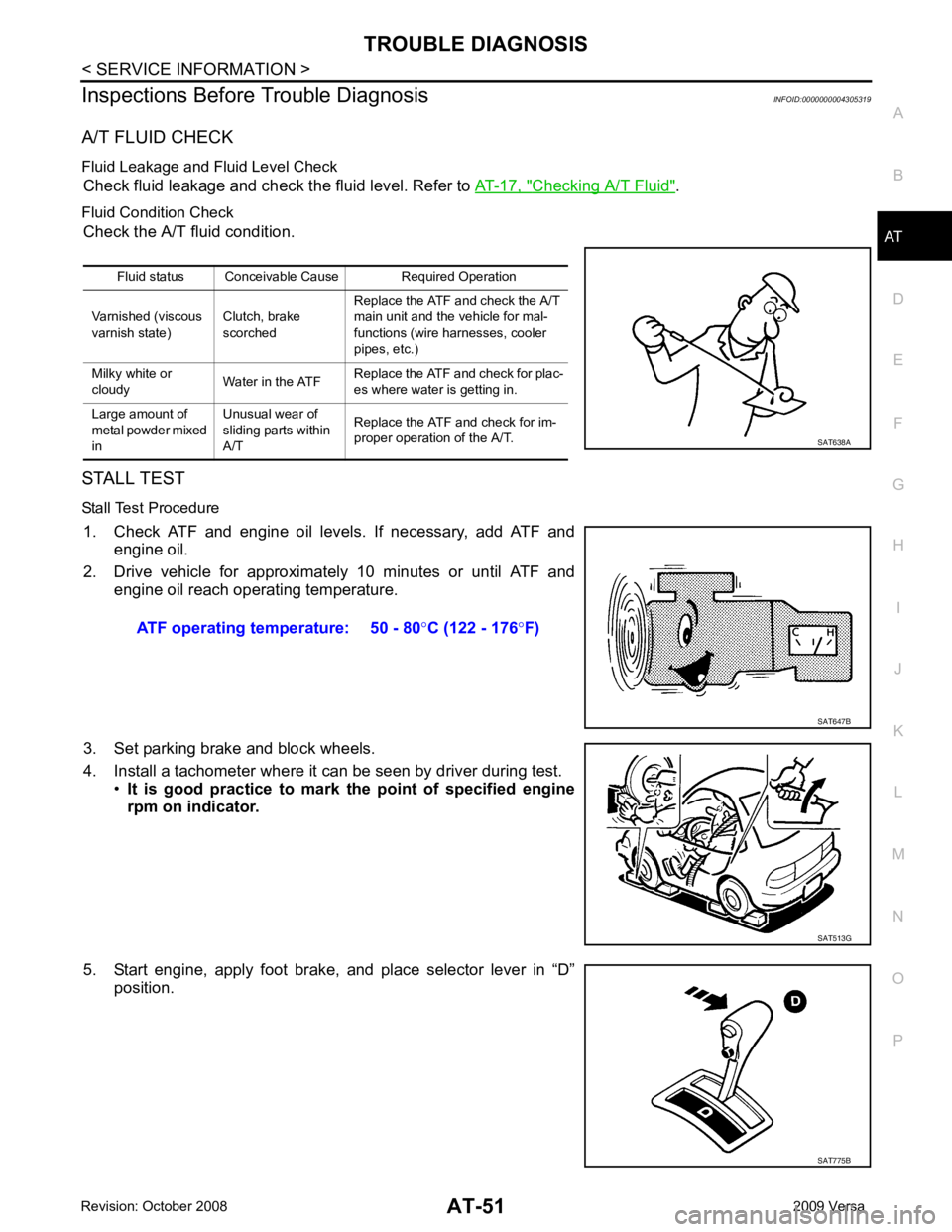
A/T FLUID CHECK
Fluid Leakage and Fluid Level Check Check fluid leakage and check the fluid level. Refer to AT-17, " Checking A/T Fluid " .
Fluid Condition Check Check the A/T fluid condition.
STALL TEST
Stall Test Procedure 1. Check ATF and engine oil levels. If necessary, add ATF and engine oil.
2. Drive vehicle for approximately 10 minutes or until ATF and engine oil reach operating temperature.
3. Set parking brake and block wheels.
4. Install a tachometer where it can be seen by driver during test. •It is good practice to mark the point of specified engine
rpm on indicator.
5. Start engine, apply foot brake, and place selector lever in “D” position.Fluid status Conceivable Cause Required Operation
Varnished (viscous
varnish state) Clutch, brake
scorched Replace the ATF and check the A/T
main unit and the vehicle for mal-
functions (wire harnesses, cooler
pipes, etc.)
Milky white or
cloudy Water in the ATFReplace the ATF and check for plac-
es where water is getting in.
Large amount of
metal powder mixed
in Unusual wear of
sliding parts within
A/T Replace the ATF and check for im-
proper operation of the A/T. SAT775B
Page 57 of 4331
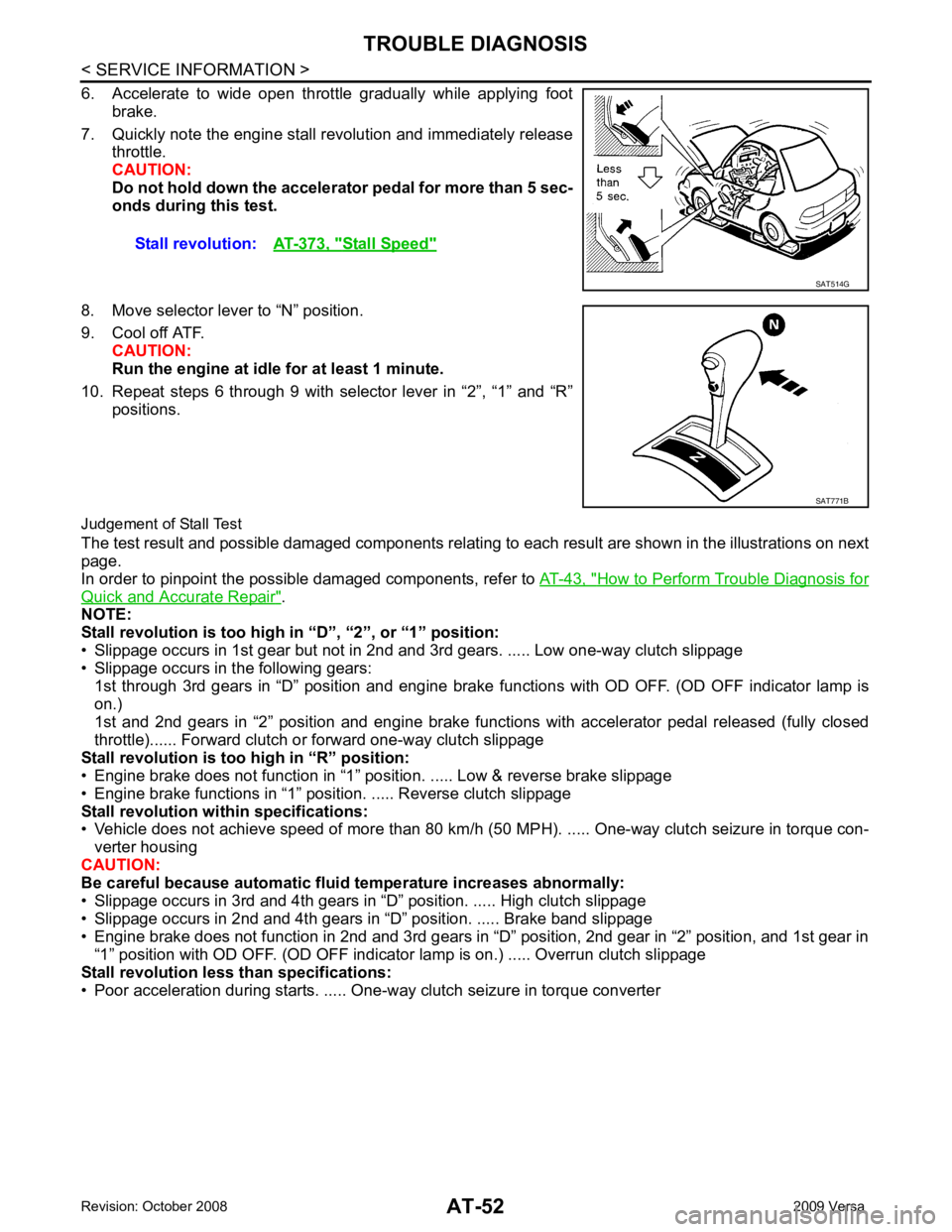
How to Perform Trouble Diagnosis for
Quick and Accurate Repair " .
NOTE:
Stall revolution is too high in “D”, “2”, or “1” position:
• Slippage occurs in 1st gear but not in 2nd and 3rd gears. ..... Low one-way clutch slippage
• Slippage occurs in the following gears:
1st through 3rd gears in “D” position and engine brake f unctions with OD OFF. (OD OFF indicator lamp is
on.)
1st and 2nd gears in “2” position and engine brake functions with accelerator pedal released (fully closed
throttle)...... Forwar d clutch or forward one-way clutch slippage
Stall revolution is too high in “R” position:
• Engine brake does not function in “1” posit ion. ..... Low & reverse brake slippage
• Engine brake functions in “1” position. ..... Reverse clutch slippage
Stall revolution with in specifications:
• Vehicle does not achieve speed of more than 80 km/h ( 50 MPH). ..... One-way clutch seizure in torque con-
verter housing
CAUTION:
Be careful because automatic flui d temperature increases abnormally:
• Slippage occurs in 3rd and 4th gears in “D” position. ..... High clutch slippage
• Slippage occurs in 2nd and 4th gears in “D” position. ..... Brake band slippage
• Engine brake does not function in 2nd and 3rd gears in “D” position, 2nd gear in “2” position, and 1st gear in “1” position with OD OFF. (OD OFF indicator lamp is on.) ..... Overrun clutch slippage
Stall revolution less than specifications:
• Poor acceleration during starts. ..... One-way clutch seizure in torque converter Stall revolution:
AT-373, " Stall Speed "
SAT771B
Page 59 of 4331
AT-54< SERVICE INFORMATION >
TROUBLE DIAGNOSIS
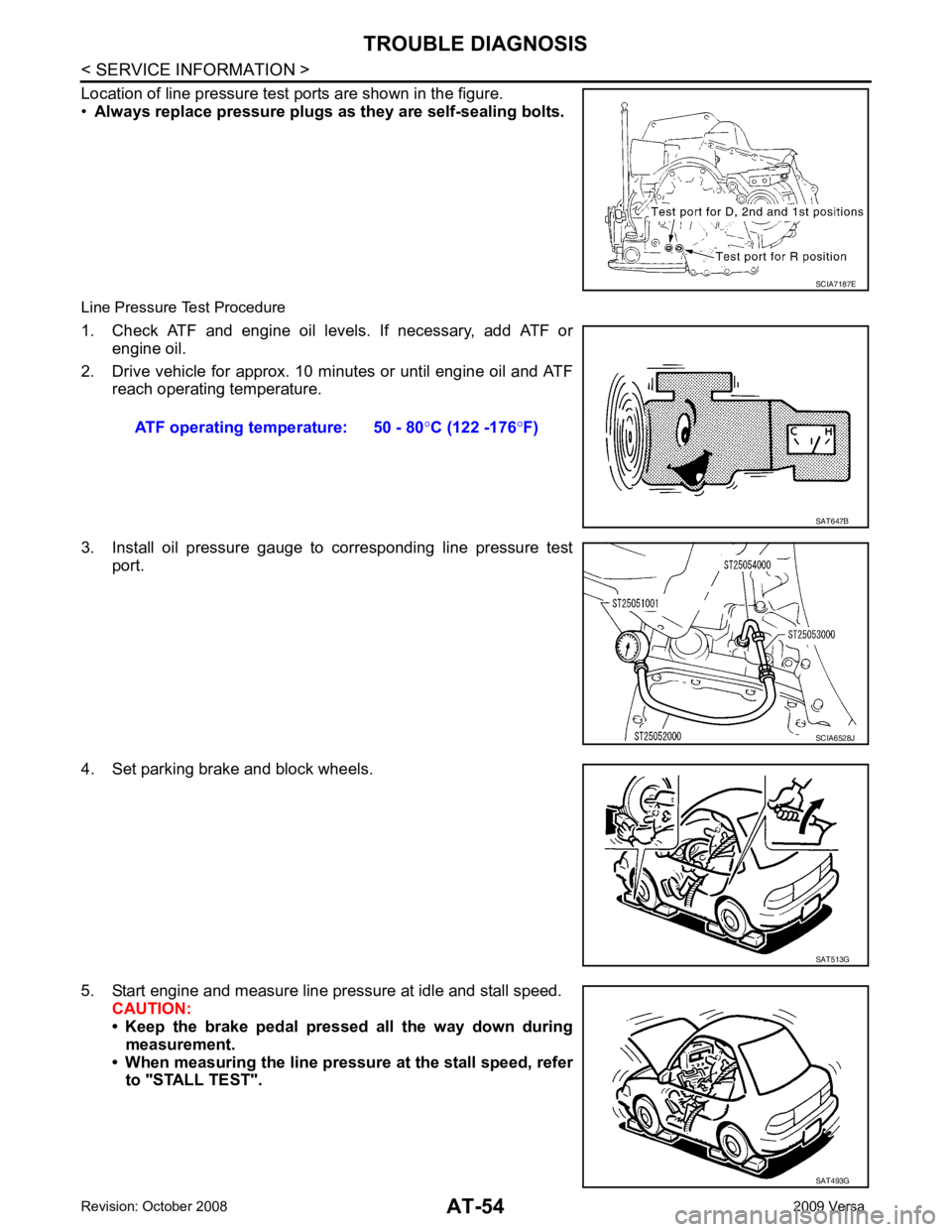
Location of line pressure test ports are shown in the figure.
• Always replace pressure plugs as they are self-sealing bolts.
Line Pressure Test Procedure
1. Check ATF and engine oil levels. If necessary, add ATF or engine oil.
2. Drive vehicle for approx. 10 minutes or until engine oil and ATF reach operating temperature.
3. Install oil pressure gauge to corresponding line pressure test port.
4. Set parking brake and block wheels.
5. Start engine and measure line pressure at idle and stall speed. CAUTION:
• Keep the brake pedal pressed all the way down during
measurement.
• When measuring the line pressure at the stall speed, refer to "STALL TEST". SCIA7187E
ATF operating temperature: 50 - 80
°C (122 -176 °F) SAT647B
SCIA6528J
SAT513G
SAT493G
Page 60 of 4331
AT
N
O P
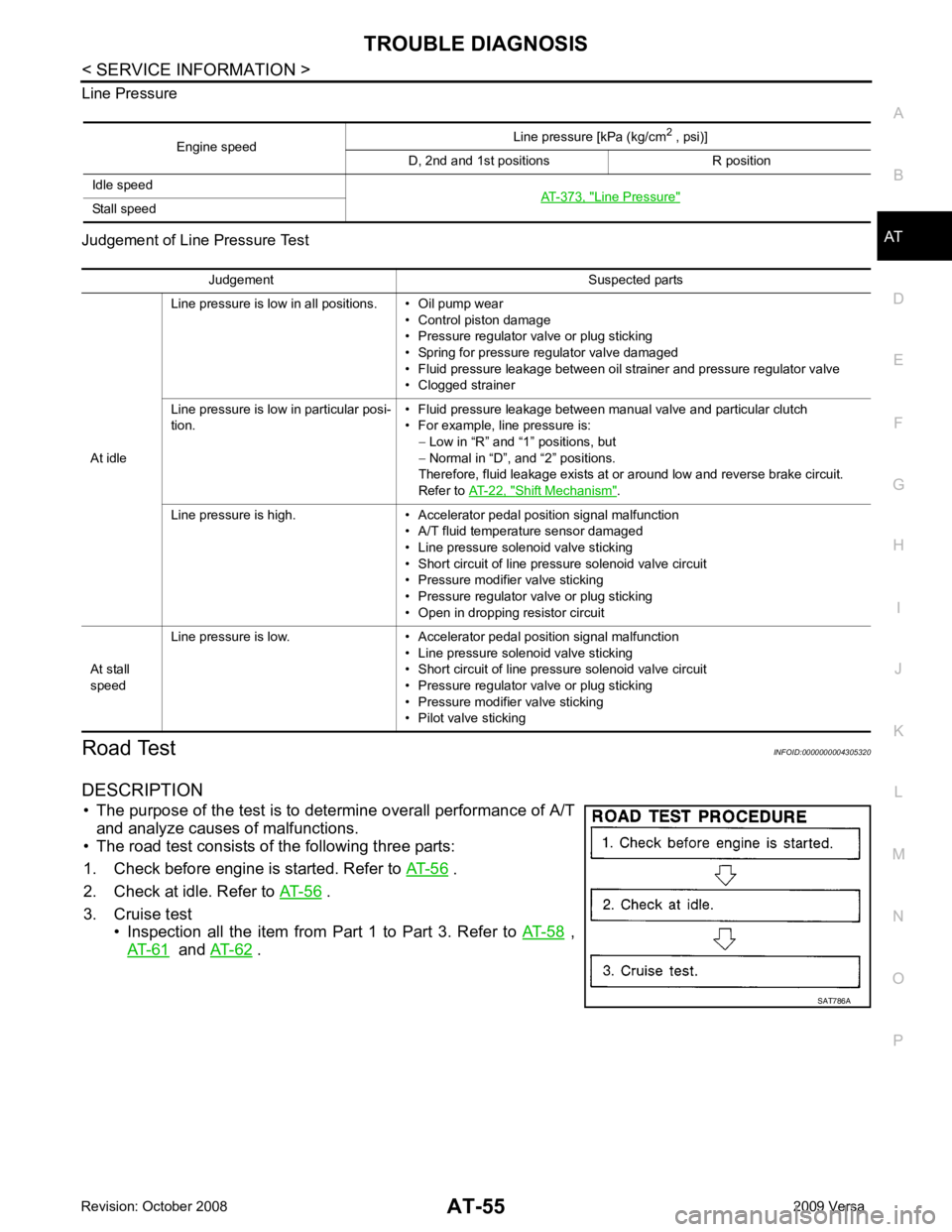
Line Pressure
Judgement of Line Pressure Test
Road Test INFOID:0000000004305320
DESCRIPTION • The purpose of the test is to det ermine overall performance of A/T
and analyze causes of malfunctions.
• The road test consists of the following three parts:
1. Check before engine is started. Refer to AT-56 .
2. Check at idle. Refer to AT-56 .
3. Cruise test • Inspection all the item from Part 1 to Part 3. Refer to AT-58 ,
AT-61 and
AT-62 .
Engine speed
Line pressure [kPa (kg/cm
2
, psi)]
D, 2nd and 1st positions R position
Idle speed AT-373, " Line Pressure "
Stall speed
Judgement Suspected parts
At idle Line pressure is low in all positions. • Oil pump wear
• Control piston damage
• Pressure regulator valve or plug sticking
• Spring for pressure regulator valve damaged
• Fluid pressure leakage between oil strainer and pressure regulator valve
• Clogged strainer
Line pressure is low in particular posi-
tion. • Fluid pressure leakage between manual valve and particular clutch
• For example, line pressure is: − Low in “R” and “1 ” positions, but
− Normal in “D”, and “2” positions.
Therefore, fluid leakage exists at or around low and reverse brake circuit.
Refer to AT-22, " Shift Mechanism " .
Line pressure is high. • Accelerator pedal position signal malfunction • A/T fluid temperature sensor damaged
• Line pressure solenoid valve sticking
• Short circuit of line pressure solenoid valve circuit
• Pressure modifier valve sticking
• Pressure regulator valve or plug sticking
• Open in dropping resistor circuit
At stall
speed Line pressure is low. • Accelerator pedal position signal malfunction
• Line pressure solenoid valve sticking
• Short circuit of line pressure solenoid valve circuit
• Pressure regulator valve or plug sticking
• Pressure modifier valve sticking
• Pilot valve sticking
Page 66 of 4331
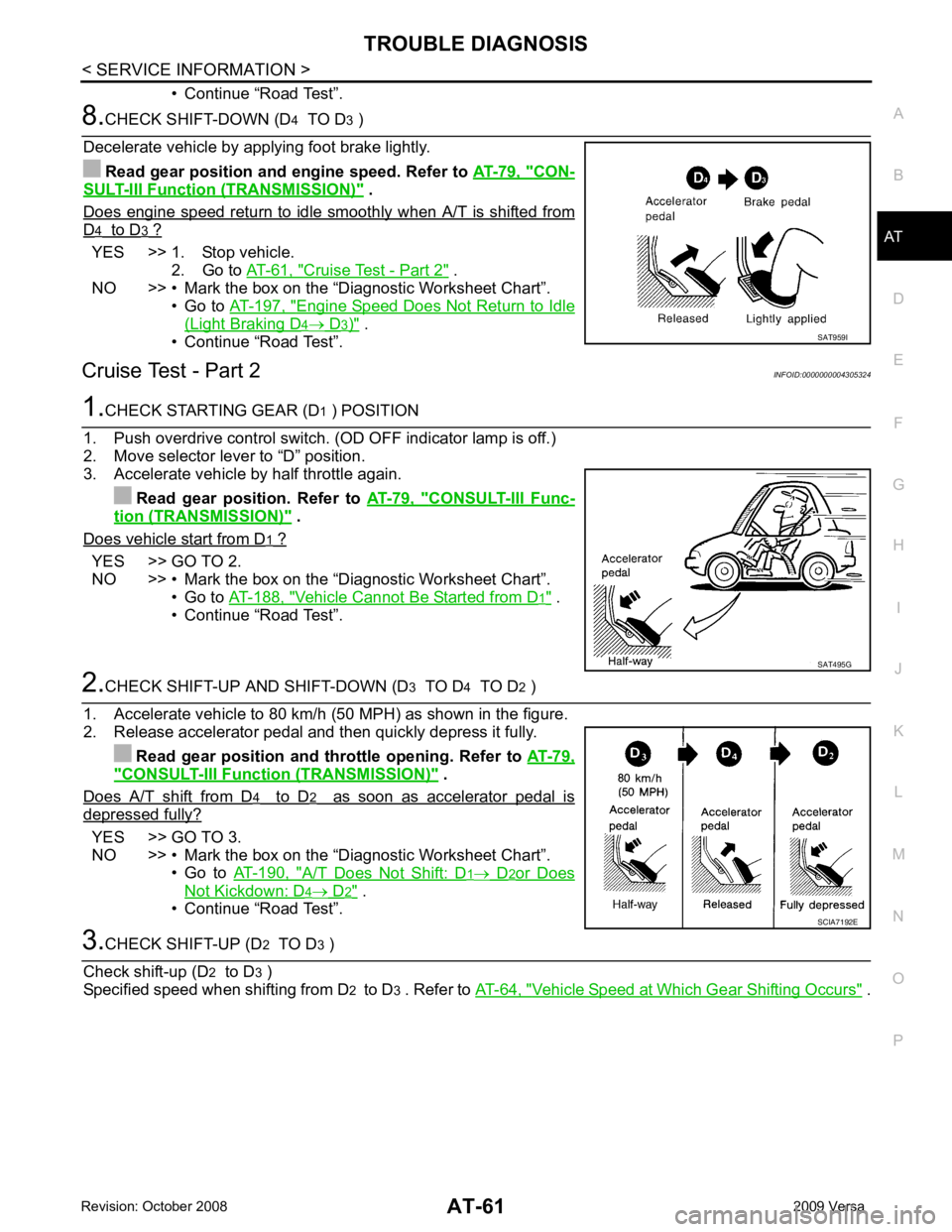
TROUBLE DIAGNOSIS
AT-61
< SERVICE INFORMATION >
D
E
F
G H
I
J
K L
M A
B AT
N
O P
• Continue “Road Test”. 8.
CHECK SHIFT-DOWN (D 4 TO D 3 )
Decelerate vehicle by applying foot brake lightly. Read gear position and engine speed. Refer to AT-79, " CON-
SULT-III Functi
on (TRANSMISSION) " .
Does engine speed return to idle smoothly when A/T is shifted from D 4 to D 3 ?
YES >> 1. Stop vehicle.
2. Go to AT-61, " Cruise Test - Part 2 " .
NO >> • Mark the box on the “D iagnostic Worksheet Chart”.
• Go to AT-197, " Engine Speed Does Not Return to Idle
(Light Braking D 4 → D 3 ) " .
• Continue “Road Test”.
Cruise Test - Part 2 INFOID:00000000043053241.
CHECK STARTING GEAR (D 1 ) POSITION
1. Push overdrive control switch. (OD OFF indicator lamp is off.)
2. Move selector lever to “D” position.
3. Accelerate vehicle by half throttle again.
Read gear position. Refer to AT-79, " CONSULT-III Func-
tion (TRANSMISSION) " .
Does vehicle start from D 1 ?
YES >> GO TO 2.
NO >> • Mark the box on the “D iagnostic Worksheet Chart”.
• Go to AT-188, " Vehicle Cannot Be Started from D 1 " .
• Continue “Road Test”. 2.
CHECK SHIFT-UP AND SHIFT-DOWN (D 3 TO D 4 TO D 2 )
1. Accelerate vehicle to 80 km/h (50 MPH) as shown in the figure.
2. Release accelerator pedal and then quickly depress it fully.
Read gear position and th rottle opening. Refer to AT-79," CONSULT-III Function (TRANSMISSION) " .
Does A/T shift from D 4 to D 2 as soon as accelerator pedal is
depressed fully?
YES >> GO TO 3.
NO >> • Mark the box on the “D iagnostic Worksheet Chart”.
• Go to AT-190, " A/T Does Not Shift: D 1 → D 2 or Does
Not Kickdown: D 4 → D 2 " .
• Continue “Road Test”. 3.
CHECK SHIFT-UP (D 2 TO D 3 )
Check shift-up (D 2 to D 3 )
Specified speed when shifting from D 2 to D 3 . Refer to AT-64, " Vehicle Speed at Which Gear Shifting Occurs " .SAT959I
SAT495G
SCIA7192E
Page 67 of 4331
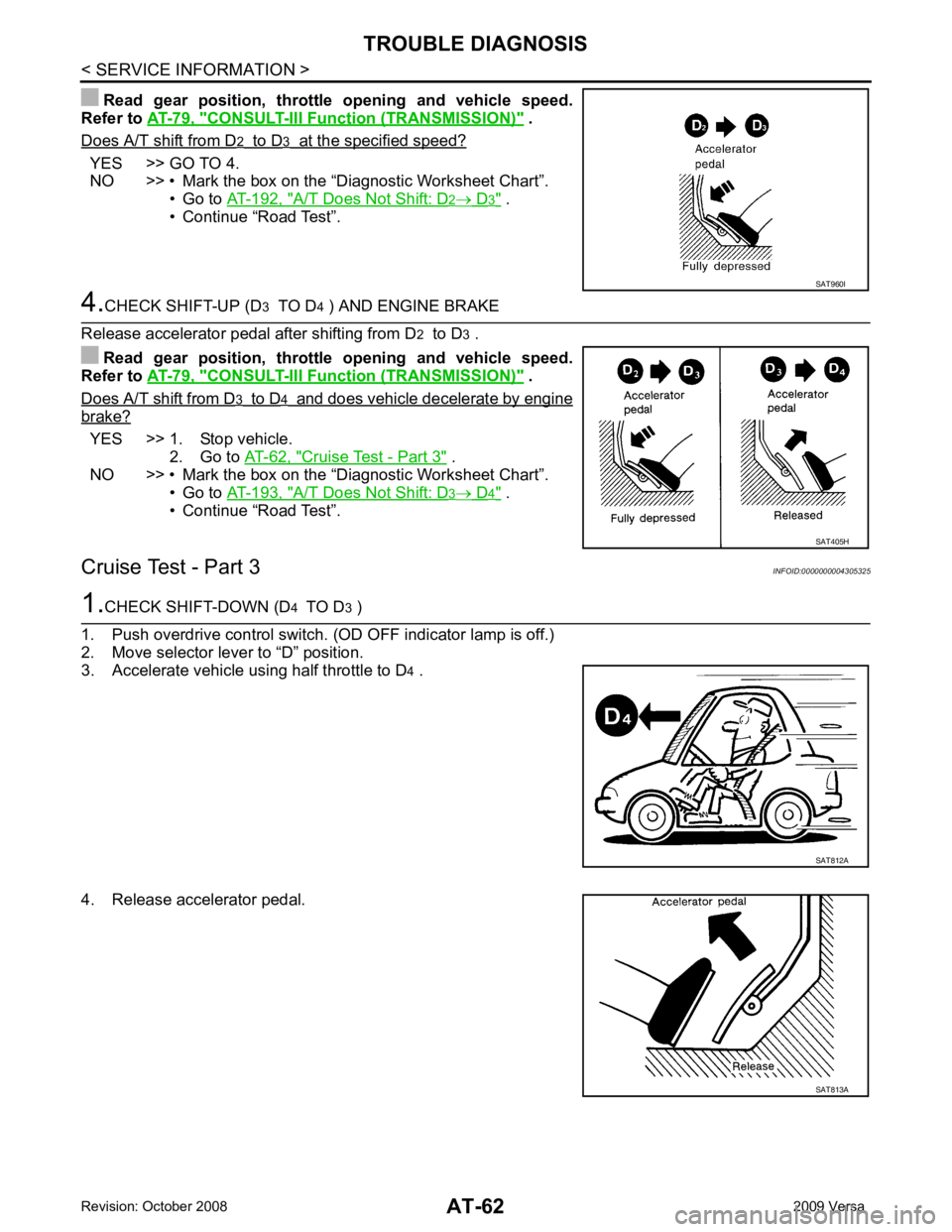
CONSULT-III Funct
ion (TRANSMISSION) " .
Does A/T shift from D YES >> GO TO 4.
NO >> • Mark the box on the “Diagnostic Worksheet Chart”.
• Go to AT-192, " A/T Does Not Shift: D .
• Continue “Road Test”. CONSULT-III Funct
ion (TRANSMISSION) " .
Does A/T shift from D brake?
YES >> 1. Stop vehicle.
2. Go to AT-62, " Cruise Test - Part 3 " .
NO >> • Mark the box on the “Diagnostic Worksheet Chart”.
• Go to AT-193, " A/T Does Not Shift: D .
• Continue “Road Test”.
Cruise Test - Part 3 INFOID:0000000004305325 SAT405H
SAT813A
Page 68 of 4331
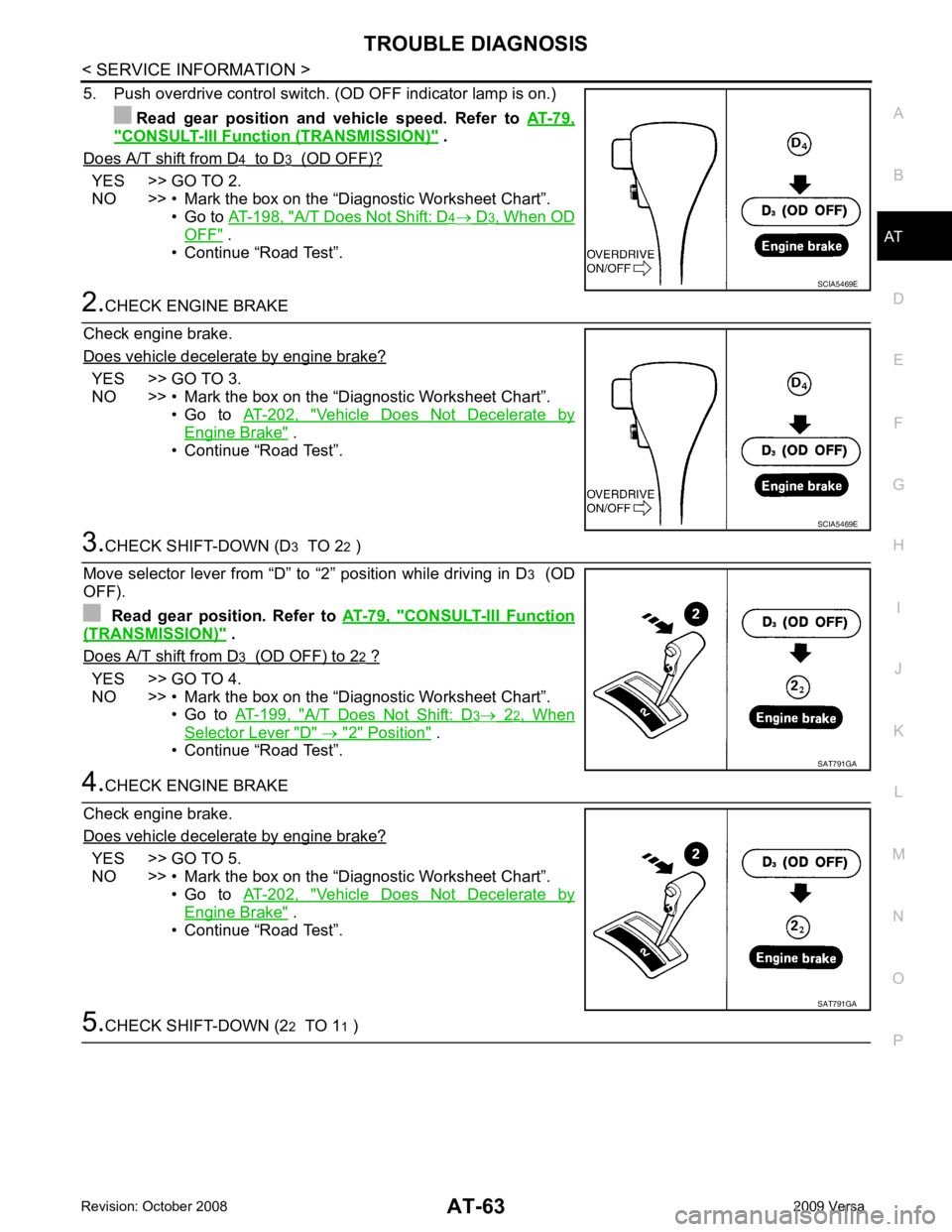
AT
N
O P
5. Push overdrive control switch. (OD OFF indicator lamp is on.)
Read gear position and vehicle speed. Refer to AT-79," CONSULT-III Function (TRANSMISSION) " .
Does A/T shift from D YES >> GO TO 2.
NO >> • Mark the box on the “D iagnostic Worksheet Chart”.
• Go to AT-198, " A/T Does Not Shift: D
OFF " .
• Continue “Road Test”. YES >> GO TO 3.
NO >> • Mark the box on the “D iagnostic Worksheet Chart”.
• Go to AT-202, " Vehicle Does Not Decelerate by
Engine Brake " .
• Continue “Road Test”. CONSULT-III Function
(TRANSMISSION) " .
Does A/T shift from D YES >> GO TO 4.
NO >> • Mark the box on the “D iagnostic Worksheet Chart”.
• Go to AT-199, " A/T Does Not Shift: D
Selector Lever "D" " .
• Continue “Road Test”. YES >> GO TO 5.
NO >> • Mark the box on the “D iagnostic Worksheet Chart”.
• Go to AT-202, " Vehicle Does Not Decelerate by
Engine Brake " .
• Continue “Road Test”. SAT791GA
Page 69 of 4331
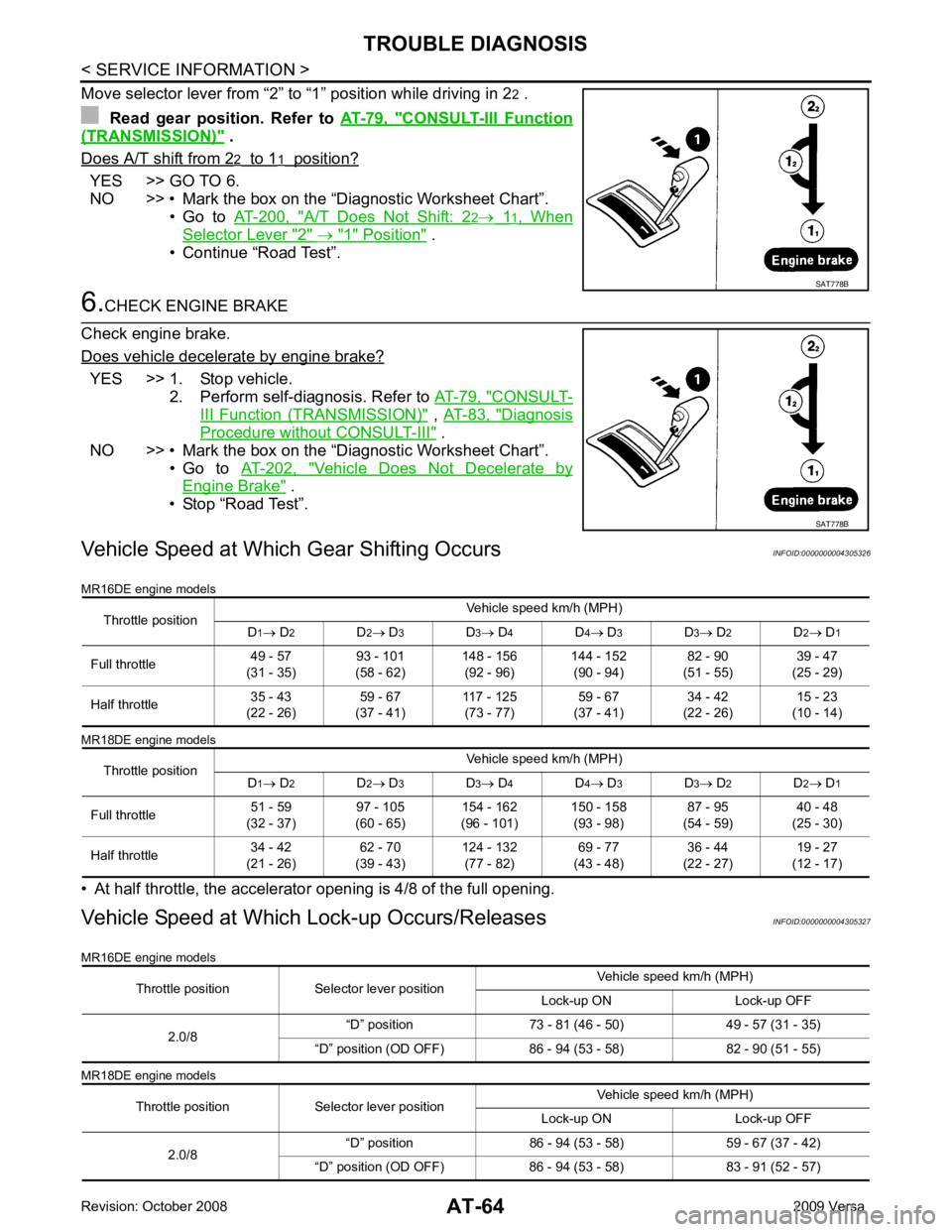
CONSULT-III Function
(TRANSMISSION) " .
Does A/T shift from 2 YES >> GO TO 6.
NO >> • Mark the box on the “Diagnostic Worksheet Chart”.
• Go to AT-200, " A/T Does Not Shift: 2
Selector Lever "2" " .
• Continue “Road Test”. YES >> 1. Stop vehicle.
2. Perform self-diagnosis. Refer to AT-79, " CONSULT-
III Function (TRANSMISSION) " ,
AT-83, " Diagnosis
Procedure without CONSULT-III " .
NO >> • Mark the box on the “Diagnostic Worksheet Chart”. • Go to AT-202, " Vehicle Does Not Decelerate by
Engine Brake " .
• Stop “Road Test”.
Vehicle Speed at Which Gear Shifting Occurs INFOID:0000000004305326
MR16DE engine models
MR18DE engine models
• At half throttle, the accelerator opening is 4/8 of the full opening.
Vehicle Speed at Which Lock-up Occurs/Releases INFOID:0000000004305327
MR16DE engine models
MR18DE engine models SAT778B
Throttle position Selector lever position
Vehicle speed km/h (MPH)
Lock-up ON Lock-up OFF
2.0/8 “D” position 73 - 81 (46
- 50) 49 - 57 (31 - 35)
“D” position (OD OFF) 86 - 94 (53 - 58) 82 - 90 (51 - 55)
Throttle position Selector lever position Vehicle speed km/h (MPH)
Lock-up ON Lock-up OFF
2.0/8 “D” position 86 - 94 (53
- 58) 59 - 67 (37 - 42)
“D” position (OD OFF) 86 - 94 (53 - 58) 83 - 91 (52 - 57)
Page 71 of 4331

(HR16DE), EC- 570 (MR Type 1)
or EC-1082 (MR
Type 2)
2. Accelerator pedal position sensor EC-412 (MR Type
1) or EC-1481
(MR Type 2)
3. Line pressure test AT-51 4. A/T fluid temperature sensor
AT-96 5. Engine speed signal
AT-106 6. Line pressure solenoid valve
AT-134 7. Control valve assembly
AT-221 8. Accumulator N-D
AT-221 OFF vehicle 9. Forward clutch
AT-306Too sharp a shock in
changing from D 1 to
D 2 . ON vehicle1. Accelerator pedal position sensor
EC-412
(HR16DE), EC- 959 (MR Type 1)
or EC-1481 (MR
Type 2)
2. Line pressure test AT-51 3. Accumulator servo release
AT-221 4. Control valve assembly
AT-221 5. A/T fluid temperature sensor
AT-96 OFF vehicle 6. Brake band
AT-330Items Symptom Condition Diagnostic item Reference page
Page 72 of 4331
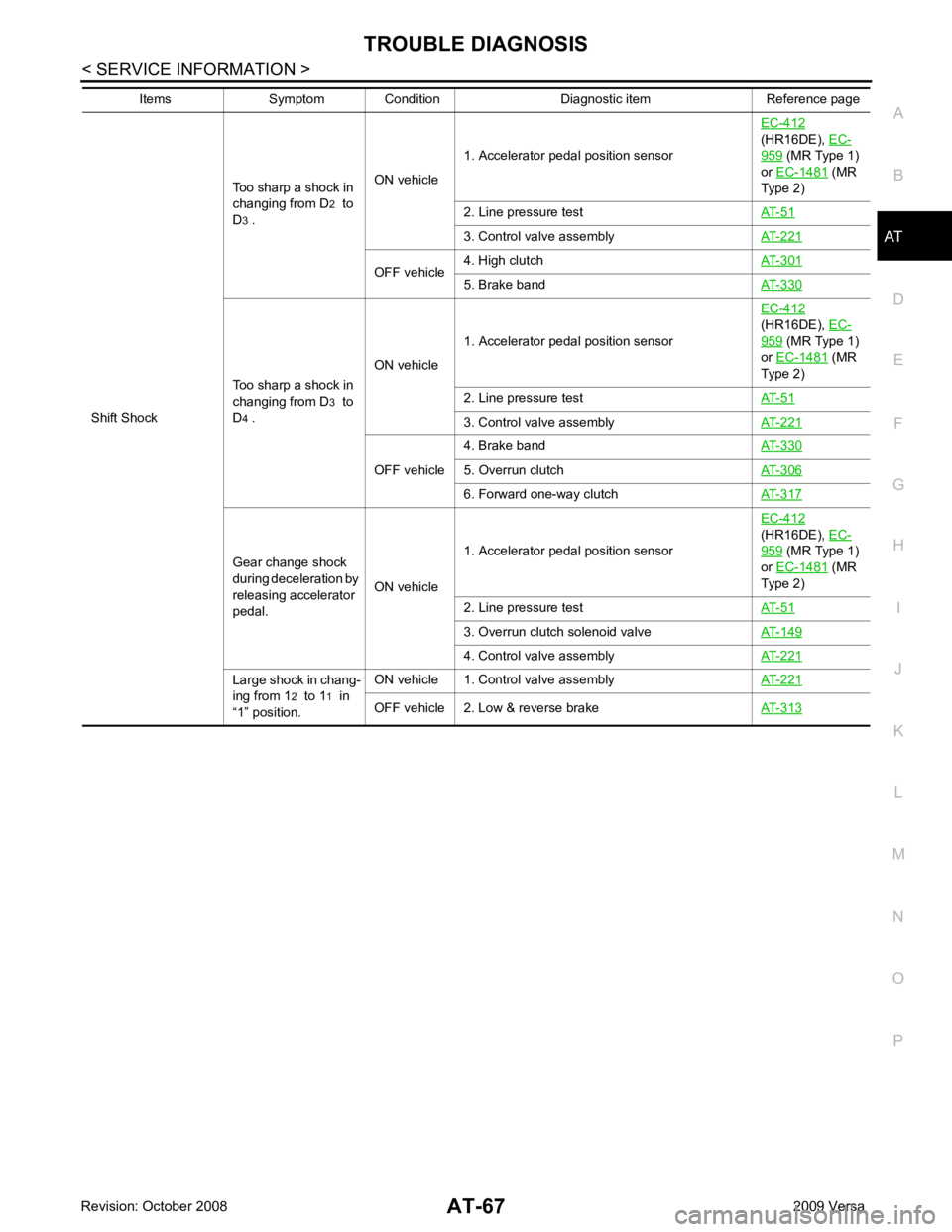
AT
N
O P
Shift Shock
Too sharp a shock in
changing from D 2
to
D 3 . ON vehicle
1. Accelerator pedal position sensor EC-412
(HR16DE), EC- 959 (MR Type 1)
or EC-1481 (MR
Type 2)
2. Line pressure test AT-51 3. Control valve assembly
AT-221 OFF vehicle
4. High clutch
AT-301 5. Brake band
AT-330Too sharp a shock in
changing from D 3 to
D 4 . ON vehicle
1. Accelerator pedal position sensor EC-412
(HR16DE), EC- 959 (MR Type 1)
or EC-1481 (MR
Type 2)
2. Line pressure test AT-51 3. Control valve assembly
AT-221 OFF vehicle
4. Brake band
AT-330 5. Overrun clutch
AT-306 6. Forward one-way clutch
AT-317Gear change shock
during deceleration by
releasing accelerator
pedal. ON vehicle1. Accelerator pedal position sensor
EC-412
(HR16DE), EC- 959 (MR Type 1)
or EC-1481 (MR
Type 2)
2. Line pressure test AT-51 3. Overrun clutch solenoid valve
AT-149 4. Control valve assembly
AT-221Large shock in chang-
ing from 1 2 to 1 1 in
“1” position. ON vehicle 1. Control valve assembly
AT-221OFF vehicle 2. Low & reverse brake
AT-313Items Symptom Condition Diagnostic item Reference page