tow NISSAN LEAF 2011 User Guide
[x] Cancel search | Manufacturer: NISSAN, Model Year: 2011, Model line: LEAF, Model: NISSAN LEAF 2011Pages: 1062, PDF Size: 3.35 MB
Page 122 of 1062

Parking brake mechanically release ....................... 6-16
PowerElectric power steering system ........................ 5-21
Power door lock...................................................... 3-4
Power windows .................................................... 2-54
Power economy........................................................... 5-19
Power meter ................................................................... 2-7
Power outlet ................................................................. 2-49
Power switch......................................................... 5-7, 5-8
Precautions Braking precautions............................................. 5-21
Charging................................................................ CH-2
Child restraints...................................................... 1-19
Cruise control........................................................ 5-17
High voltage precautions ................................... EV-7
Maintenance ............................................................. 8-4
Road accident precautions................................ EV-8
Seat belt usage .................................................... 1-10
Supplemental restraint system.......................... 1-36
When starting and driving .................................... 5-2
Push starting ................................................................ 6-12
Q
Quick charge............................................................ CH-15
R
Rapid air pressure loss................................................ 5-5
Rear center seat belt ................................................. 1-16
Rear door lock, Child safety rear door lock........... 3-6
Rear hatch..................................................................... 3-17
Rear seats....................................................................... 1-4
Rear window and outside mirror
defroster switch........................................................... 2-40
Rear window wiper and washer switch ............... 2-39
Reduction gear fluid..................................................... 8-9 Remote charge ........................................................ CH-24
Remote climate control.............................................. 4-11
Remote keyless entry function, For Intelligent
Key system.................................................................... 3-13
Repairing flat tire........................................................... 6-3
Repairing tire.................................................................. 6-5
Reporting safety defects........................................... 9-15
Road accident precautions....................................... EV-8
Roadside assistance program ................................... 6-2
Rollover............................................................................ 5-5
S
Safety Child seat belts .................................................... 1-17
Reporting safety defects.................................... 9-15
Scene guide At home after driving......................................... EV-21
Before driving your vehicle .............................. EV-13
Charging the Li-ion battery.............................. EV-10
Driving the vehicle.............................................. EV-17
Parking the vehicle............................................. EV-20
Starting your vehicle.......................................... EV-16
Seat adjustment Front manual seat adjustment.............................. 1-3
Front seats................................................................ 1-3
Seat belt(s) Child safety............................................................ 1-17
Infants...................................................................... 1-17
Injured persons..................................................... 1-12
Larger children...................................................... 1-18
Precautions on seat belt usage........................ 1-10
Pregnant women .................................................. 1-12
Rear center seat belt .......................................... 1-16
Seat belt cleaning................................................... 7-6
Seat belt extenders.............................................. 1-16
Seat belt hooks .................................................... 1-15 Seat belt maintenance........................................ 1-16
Seat belt warning light........................................ 2-18
Seat belts............................................................... 1-10
Seat belts with pretensioners........................... 1-49
Shoulder belt height adjustment...................... 1-15
Small children........................................................ 1-18
Three-point type................................................... 1-12
Seat(s) , Seats................................................................ 1-2 Heated seats......................................................... 2-47
Security system (NISSAN Vehicle Immobilizer
System) , EV system start.......................................... 2-36
Servicing climate control........................................... 4-14
Shifting Electric shift control system .............................. 5-11
Shoulder belt height adjustment, For
front seats..................................................................... 1-15
Soft bottle holders...................................................... 2-50
Solar cell module .......................................................... 7-3
Speedometer.................................................................. 2-6
Starting .......................................................................... 5-11 Before starting system........................................ 5-10
Jump starting............................................................ 6-9
Precautions when starting and driving .............. 5-2
Push starting ......................................................... 6-12
Status light, Front passenger air bag .................... 1-44
Steering Electric power steering system ........................ 5-21
Heated steering wheel........................................ 2-45
Tilting steering column........................................ 3-19
Stopping the vehicle .................................................... 6-4
Storage .......................................................................... 2-49
Stowing golf bags....................................................... 2-53
Sun visors ..................................................................... 3-20
Supplemental air bag warning labels..................... 1-50
Supplemental air bag warning light............ 1-50, 2-18
Supplemental restraint system................................. 1-36
Page 123 of 1062
Precautions on supplemental
restraint system..................................................... 1-36
Switch Approaching Vehicle Sound for Pedestrians
(VSP) OFF switch................................................ 2-62
Autolight switch.................................................... 2-42
Fog light switch.................................................... 2-44
Hazard warning flasher switch.......................... 2-45
Headlight Aiming Control ................................. 2-44
Headlight switch................................................... 2-41
Power door lock switch......................................... 3-5
Rear window and outside mirror
defroster switch.................................................... 2-40
Turn signal switch ................................................ 2-44
Vehicle dynamic control (VDC) off switch..... 2-48
T
Telematics overview.................................................... 9-16
Temperature Li-ion battery temperature gauge........................ 2-7
Theft (NISSAN Vehicle Immobilizer System) ,
traction motor start ..................................................... 2-36
Tilt steering column .................................................... 3-19
Tire Low tire pressure warning light........................ 2-16
Tires Flat tire....................................................................... 6-2
Low tire pressure warning system...................... 5-2
Tire and Loading information label ......... 8-27, 9-8
Tire chains.............................................................. 8-31
Tire dressing............................................................. 7-4
Tire pressure ......................................................... 8-28
Tire pressure monitoring
system (TPMS) ............................................... 5-2, 6-2
Tire rotation............................................................ 8-32
Types of tires......................................................... 8-30 Uniform tire quality grading ............................... 9-14
Wheel/tire size......................................................... 9-5
Wheels and tires.................................................. 8-25
Tools............................................................................... 6-12
To p Tether strap child restraints............................... 1-22
Towing Flat towing ............................................................. 9-14
Tow truck towing.................................................. 6-13
Towing a trailer ..................................................... 9-13
TPMS, Tire pressure monitoring system................. 5-2
TPMS, Tire pressure warning system...................... 6-2
Traction motor Traction motor serial number ............................... 9-7
Trailer towing................................................................ 9-13
Transceiver, HomeLink
®Universal
Transceiver............................................................. 2-58
Transmitter, With Intelligent Key system
(See Intelligent Key system)..................................... 3-13
Trickle charge........................................................... CH-11
Trip computer............................................................... 2-27
Turn signal switch ....................................................... 2-44
Type of charge and how to charge the
Li-ion battery................................................................ CH-5
U
Underbody cleaning ..................................................... 7-3
Uniform tire quality grading ...................................... 9-14
Unplugged status.................................................... CH-24
V
Vanity mirror.................................................................. 3-22
vehicle Dimensions and weights....................................... 9-5
Identification number (VIN)................................... 9-6 Loading information ............................................. 9-10
Recovery (freeing stuck vehicle) ...................... 6-15
Security system .................................................... 2-35
Vehicle dynamic control (VDC) off switch..... 2-48
Vehicle dynamic control (VDC) system.......... 5-24
Vehicle Dynamic Control (VDC)
warning light.......................................................... 2-18
Vehicle Dynamic Control (VDC) warning light .... 2-18
Vehicle security system ............................................. 2-35
Ventilators........................................................................ 4-2
VSP OFF switch.......................................................... 2-62
W
Warning Hazard warning flasher switch.......................... 2-45
Indicators for operation....................................... 2-23
Tire pressure monitoring
system (TPMS) ............................................... 5-2, 6-2
Warning information displays............................ 2-31
Warning lights....................................................... 2-13
Warning/indicator lights and
audible reminders................................................. 2-12
Warning and indicator lights.................................... 0-10
Warning information displays................................... 2-31
Warning labels, Air bag warning labels................. 1-50
Warning light Air bag warning light................................ 1-50, 2-18
Anti-lock braking system (ABS)
warning light.......................................................... 2-14
BRAKE system warning light (yellow) ............ 2-14
BRAKE warning light (red) ................................ 2-14
Low tire pressure warning light........................ 2-16
Seat belt warning light........................................ 2-18
Vehicle Dynamic Control (VDC)
warning light.......................................................... 2-18
Index10-5
Page 139 of 1062

9 Technical and consumer information
Capacities and recommended lubricants .......................... 9-2Air conditioning system refrigerant and
lubricant recommendations .............................................. 9-3
Specifications ............................................................................ 9-4 Charging system ................................................................ 9-4
Motor ..................................................................................... 9-5
Wheels and tires ................................................................ 9-5
Dimensions and weights .................................................. 9-5
When traveling or registering your vehicle in
another country ......................................................................... 9-6
Vehicle identification ................................................................ 9-6 Vehicle Identification Number (VIN) plate .................... 9-6
Vehicle identification number (chassis number) ........ 9-6
Traction motor serial number .......................................... 9-7
F.M.V.S.S./C.M.V.S.S certification label ....................... 9-7
Emission control information label ................................. 9-7
Tire and Loading Information label ................................ 9-8
Air conditioner specification label .................................. 9-8 Installing front license plate .................................................. 9-9
Vehicle loading information ................................................ 9-10 Terms ................................................................................ 9-10
Vehicle load capacity ................................................... 9-11
Securing the load ......................................................... 9-12
Loading tips .................................................................... 9-13
Measurement of weights ............................................. 9-13
Towing a trailer ...................................................................... 9-13
Flat towing .............................................................................. 9-14
Uniform tire quality grading ................................................ 9-14
Treadwear ....................................................................... 9-14
Traction AA, A, B and C ............................................. 9-14
Temperature A, B and C ............................................. 9-14
Reporting safety defects .................................................... 9-15
Telematics overview ............................................................. 9-16
Event Data Recorder (EDR) .............................................. 9-18
Owner’s Manual/Service Manual order information .... 9-19
Page 197 of 1062

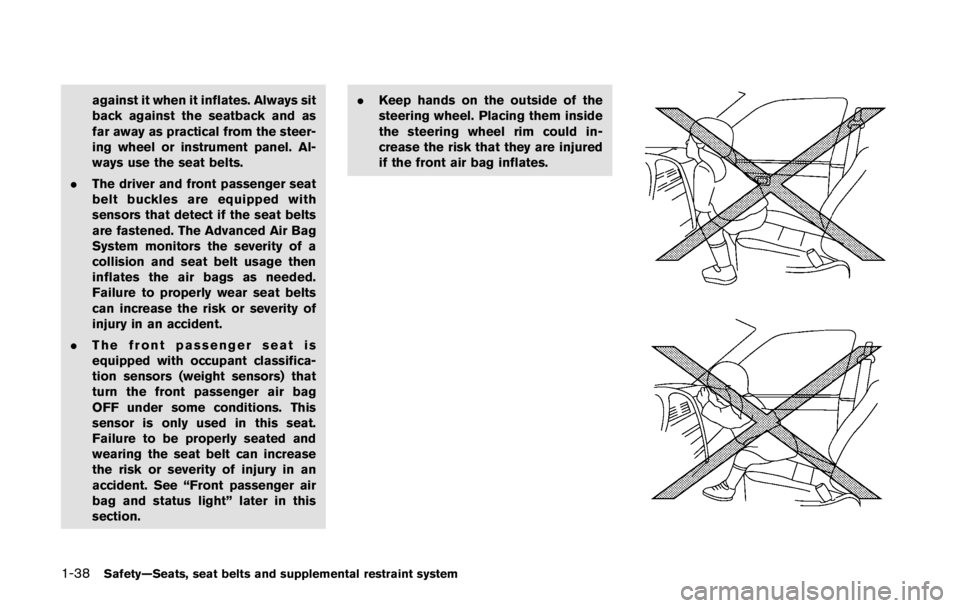
.Removing or modifying the front
passenger seat may affect the func-
tion of the air bag system and result
in serious personal injury.
. Modifying or tampering with the
front passenger seat may result in
serious personal injury. For exam-
ple, do not change the front seats by
placing material on the seat cushion
or by installing additional trim ma-
terial, such as seat covers, on the
seat that is not specifically designed
to assure proper air bag operation.
Additionally, do not stow any ob-
jects under the front passenger seat
or the seat cushion and seatback.
Such objects may interfere with the
proper operation of the occupant
classification sensors.
. No unauthorized changes should be
made to any components or wiring
of the seat belt system. This may
affect the front air bag system.
Tampering with the seat belt system
may result in serious personal in-
jury.
. Work on and around the front air
bag system should be done by a NISSAN certified LEAF dealer. In-
stallation of electrical equipment
should also be done by a NISSAN
certified LEAF dealer. The Supple-
mental Restraint System (SRS) wir-
ing harnesses* should not be
modified or disconnected. Un-
authorized electrical test equipment
and probing devices should not be
used on the air bag system.
. A cracked windshield should be
replaced immediately by a qualified
repair facility. A cracked windshield
could affect the function of the
supplemental air bag system.
*The SRS wiring harness connectors are
yellow and orange for easy identification.
When selling your vehicle, we request that you
inform the buyer about the front air bag system
and guide the buyer to the appropriate sections
in this Owner’s Manual.
Page 237 of 1062
WARNING
In case of a collision:
.If your vehicle is drivable, pull your
vehicle off the road, push the P
(Park) position switch on the selec-
tor lever, apply the parking brake
and turn the EV (Electric Vehicle)
system off.
. Check your vehicle to see if there
are exposed high-voltage parts or
cables. For their locations, see
“High-voltage components” earlier
in this section. To avoid personal
injury, never touch high-voltage wir-
ing, connectors, and other high-
voltage parts, such as inverter unit
and Li-ion battery. An electric shock
may occur if exposed electric wires
are visible when viewed from inside
or outside of your vehicle. There-
fore, never touch exposed electric
wires.
. If the vehicle receives a strong
impact to the floor while driving,
stop the vehicle in a safe location
and check the floor. .
Leaks or damage to the Li-ion
battery may result in a fire. If you
discover them, contact emergency
services immediately. Since the
fluid leak may be lithium manga-
nate from the Li-ion battery, never
touch the fluid leak inside or out-
side the vehicle. If the fluid contacts
your skin or eyes, wash it off
immediately with a large amount of
water and receive immediate medi-
cal attention to help avoid serious
injury.
. If a fire occurs in the EV (Electric
Vehicle) , leave the vehicle as soon
as possible. Only use a type ABC,
BC or C fire extinguisher that is
meant for use on electrical fires.
Using a small amount of water or
the incorrect fire extinguisher can
result in serious injury or death from
electrical shock.
. If your vehicle needs to be towed,
do it with the front wheels raised. If
the front wheels are on the ground
when towing, the traction motor
may generate electricity. This may
damage the components of the EV
(Electric Vehicle) system and cause a fire.
. If you are not able to safely assess
the vehicle due to vehicle damage,
do not touch the vehicle. Leave the
vehicle and contact emergency ser-
vices. Advise 1st responders that
this is an electric vehicle.
. In the event of an accident that
requires body repair and painting,
the vehicle should be delivered to a
NISSAN certified LEAF dealer to
have the Li-ion battery pack and
high voltage parts such as the
inverter, including the wiring har-
ness, removed prior to painting. Li-
ion battery packs exposed to heat in
the paint booth will experience
capacity loss. Damaged Li-ion bat-
tery packs may also pose safety
risks to untrained mechanics and
repair personnel.
ROAD ACCIDENT PRECAUTIONS
Page 292 of 1062

CAUTION
.Be sure to carry the Intelligent Key
with you when operating the vehi-
cle.
. Never leave the Intelligent Key in
the vehicle when you leave the
vehicle.
The Intelligent Key is always communicating with
the vehicle because it receives radio waves. The
Intelligent Key system transmits weak radio
waves. Environmental conditions may interfere
with the operation of the Intelligent Key system
under the following operating conditions.
. When operating near a location where
strong radio waves are transmitted, such
as a TV tower, power station or broad-
casting station.
. When in possession of wireless equipment,
such as a cellular phone, transceiver or CB
radio.
. When the Intelligent Key is in contact with or
covered by metallic materials.
. When any type of radio wave remote control
is used nearby. .
When the Intelligent Key is placed near an
electric appliance such as a personal
computer.
. When the vehicle is parked near a parking
meter.
In such cases, correct the operating conditions
before using the Intelligent Key function or use
the mechanical key.
Although the life of the battery varies depending
on the operating conditions, the battery’s life is
approximately 2 years. If the battery is dis-
charged, replace it with a new one.
When the Intelligent Key battery is almost
discharged, firmly apply the foot brake and
touch the power switch with the Intelligent Key.
Then push the power switch while depressing
the brake pedal within 10 seconds after the
chime sound.
Since the Intelligent Key is continuously receiv-
ing radio waves, if the key is left near equipment
that transmits strong radio waves, such as
signals from a TV or personal computer, the
battery life may become shorter.
For information regarding replacement of a
battery, see “Intelligent Key battery replacement”
in the “8. Maintenance and do-it-yourself”
section. Pay special attention that the vehicle battery is
not completely discharged.
As many as 4 Intelligent Keys can be registered
and used with one vehicle. For information about
the purchase and use of additional Intelligent
Keys, contact a NISSAN certified LEAF dealer.
Page 312 of 1062

The windshield wiper and washer operates
when the power switch is in the ON position.
Push the lever down to operate the wiper at the
following speed:
*1Intermittent — intermittent operation can be
adjusted by turning the knob toward*A(Slower)
or*B(Faster) .
*2Low — continuous low speed operation
*3High — continuous high speed operation
*4MIST — one sweep operation of the wiper
WASHER OPERATION
To operate the washer, pull the lever toward the
back of the vehicle
*5until the desired amount
of washer fluid is spread on the windshield. The wiper will automatically operate several times.
Page 402 of 1062

CAUTION
.Be sure to carry the Intelligent Key
with you when operating the vehi-
cle.
. Never leave the Intelligent Key in
the vehicle when you leave the
vehicle.
The Intelligent Key is always communicating with
the vehicle because it receives radio waves. The
Intelligent Key system transmits weak radio
waves. Environmental conditions may interfere
with the operation of the Intelligent Key system
under the following operating conditions.
. When operating near a location where
strong radio waves are transmitted, such
as a TV tower, power station or broad-
casting station.
. When in possession of wireless equipment,
such as a cellular phone, transceiver or CB
radio.
. When the Intelligent Key is in contact with or
covered by metallic materials.
. When any type of radio wave remote control
is used nearby. .
When the Intelligent Key is placed near an
electric appliance such as a personal
computer.
. When the vehicle is parked near a parking
meter.
In such cases, correct the operating conditions
before using the Intelligent Key function or use
the mechanical key.
Although the life of the battery varies depending
on the operating conditions, the battery’s life is
approximately 2 years. If the battery is dis-
charged, replace it with a new one.
When the Intelligent Key battery is almost
discharged, firmly apply the foot brake and
touch the power switch with the Intelligent Key.
Then push the power switch while depressing
the brake pedal within 10 seconds after the
chime sound.
Since the Intelligent Key is continuously receiv-
ing radio waves, if the key is left near equipment
that transmits strong radio waves, such as
signals from a TV or personal computer, the
battery life may become shorter.
For information regarding replacement of a
battery, see “Intelligent Key battery replacement”
in the “8. Maintenance and do-it-yourself”
section. Pay special attention that the vehicle battery is
not completely discharged.
As many as 4 Intelligent Keys can be registered
and used with one vehicle. For information about
the purchase and use of additional Intelligent
Keys, contact a NISSAN certified LEAF dealer.
Page 460 of 1062

6 In case of emergency
Roadside assistance program .............................................. 6-2
Emergency EV (Electric Vehicle) shut off .......................... 6-2 Flat tire ........................................................................................ 6-2
Tire Pressure Monitoring System (TPMS) ................... 6-2
Repairing flat tire ................................................................ 6-3
Jump starting ............................................................................. 6-9
If the Li-ion battery becomes completely discharged ... 6-11 Push starting .......................................................................... 6-12
Tools ........................................................................................ 6-12
Towing your vehicle ............................................................. 6-13
Towing recommended by NISSAN .......................... 6-14
Vehicle recovery (freeing stuck vehicle) ................. 6-15
Parking brake mechanical release ................................... 6-16
Page 467 of 1062

If the tire pressure does not increase to26
psi (180 kPa) within 10 minutes, the tire
may be seriously damaged and the tire
cannot be repaired with this tire repair
kit. Contact a NISSAN certified LEAF
dealer.
7. When the tire pressure is at the specified amount, turn the air compressor off. If the
tire cannot be inflated to the specified
amount, the air compressor can be turned
off at the minimum of 26 psi (180 kPa) .
Remove the power plug from the power
outlet and quickly remove the hose from the
tire valve. Attach the protective cap and
valve cap. Properly stow the emergency tire
puncture repair kit in the cargo area.