brake NISSAN LEAF 2011 Owner's Guide
[x] Cancel search | Manufacturer: NISSAN, Model Year: 2011, Model line: LEAF, Model: NISSAN LEAF 2011Pages: 1062, PDF Size: 3.35 MB
Page 239 of 1062

ion battery is fully charged. Regenera-
tive brake is automatically reduced
when the Li-ion battery is fully charged
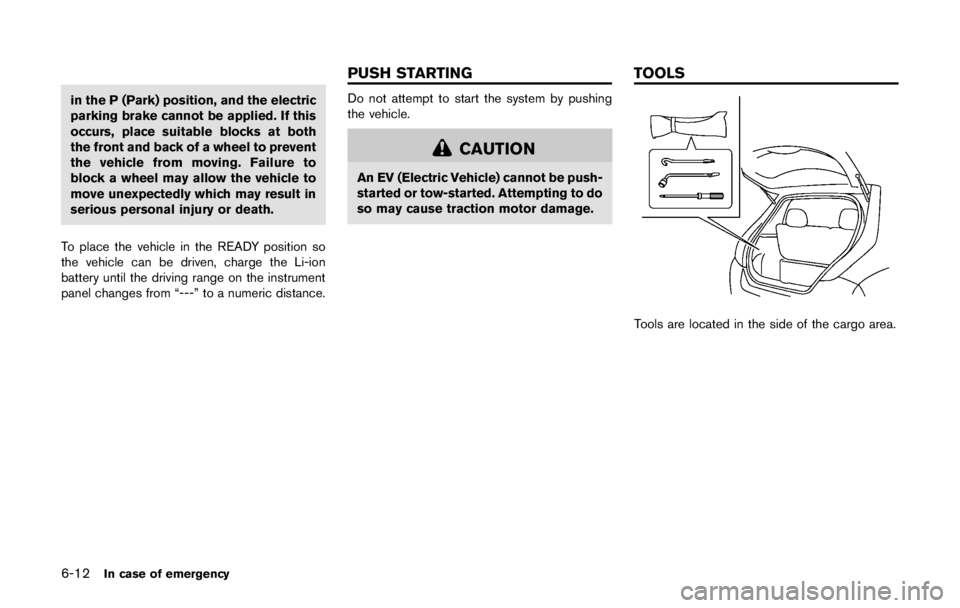
to prevent the Li-ion battery from
becoming overcharged. Regenerating
brake is also automatically reduced
when the battery temperature is high/
low (indicated by the red/blue zones
on the Li-ion battery temperature
gauge) to prevent Li-ion battery da-
mage.
. The brake pedal should be used to
slow or stop the vehicle depending on
traffic or road conditions. The vehicle
brakes are not affected by regenerative
brake system operation.
NOISE AND VIBRATION
You might experience the following noise or
vibration as a normal characteristic of this
vehicle.
.Traction motor noise from motor compart-
ment.
. Noise and vibration when releasing and
applying the electric parking brake.
. Water pump and radiator fan noise while
charging. .
Compressor and radiator fan noise when the
A/C-Heater Timer (Climate Ctrl. Timer) or
remote climate control is used.
. Relay operation noise and vibration at start-
up and shut-down of the EV (Electric
Vehicle) system (power switch placed in
the ON and OFF position) .
. Approaching Vehicle Sound for Pedestrians
(VSP) .
WARNING
The EV (Electric Vehicle) system uses a
high voltage current. Failure to follow
the proper handling instructions may
cause serious injury or death. Be sure
to read the “CH. Charging” section and
follow the procedures and guidelines
described.
LIFE WITH AN EV (scene guide)
Page 275 of 1062
Driving range button
— Audio control
— Bluetooth
®Hands-Free Phone System control
6. Steering wheel
— Electric power steering system (P.5-21) — Horn (P.2-46)
— Driver’s supplemental air bag (P.1-36)
7. Wiper and washer switch (P.2-38)
8. Steering-wheel-mounted controls (right side)
— Cruise control switches (P.5-17)
9. Fuse box cover (P.8-16)
10. Vehicle Dynamic Control (VDC) OFF switch (P.2-48)
11. Headlight aiming control (P.2-44)
12. Approaching Vehicle Sound for Pedestrians (VSP) OFF switch (P.EV-27)
13. Immediate charge switch (P.CH-24)
14. Heated steering wheel switch* (P.2-45)
15. Tilting steering wheel lever (P.3-19)
16. Heated seat switch* (P.2-47)
17. Selector lever (P.5-12)
18. Electric parking brake (P.5-15)
*: if so equipped
COCKPIT
Page 278 of 1062
EMERGENCY SHUT-OFF SYSTEM
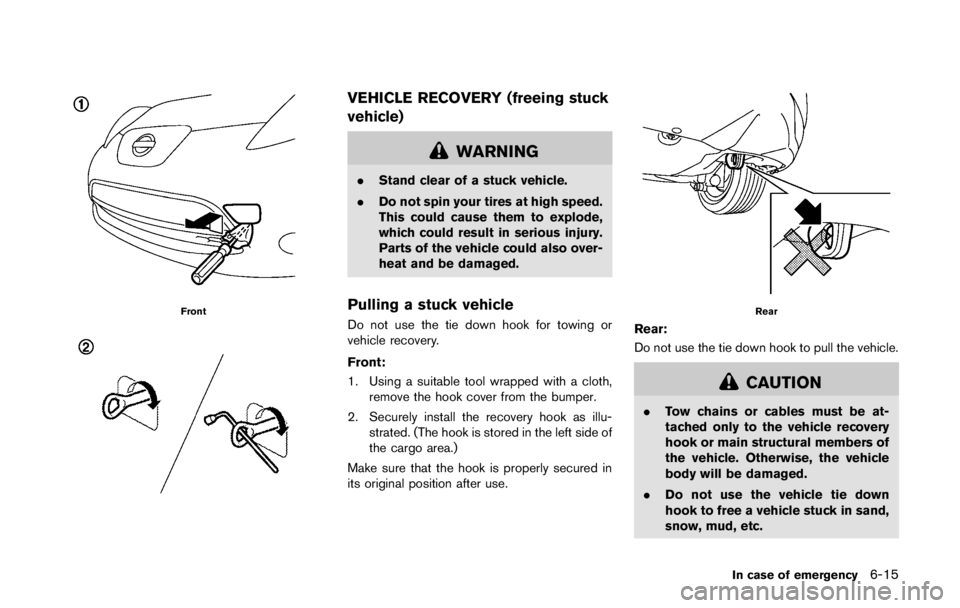
The emergency shut-off system is activated and
the high-voltage system automatically turns off in
the following conditions:
- Front and side collisions in which the air bags
are deployed.
- Certain rear collisions.
- Certain EV (Electric Vehicle) system malfunc-
tions
For the above collisions and certain other EV
(Electric Vehicle) system malfunctions, the
READY to drive indicator light will turn off. See
“Warning/indicator lights and audible remin-
ders” in the “2. Instruments and controls”
section.
The emergency shut-off activates for the above
collisions to minimize risk of an event that could
cause injury or an accident. If the emergency
shut-off system activates, the EV system may
not be switched to READY to drive position,
contact a NISSAN certified LEAF dealer. Even if
the power switch is switched to READY to drive
position, the system may shut-off suddenly.
Therefore, drive cautiously to the nearest
NISSAN certified LEAF dealer or contact a
NISSAN certified LEAF dealer as soon as
possible.WARNING
.Pay special attention to pedes-
trians. Because there is no engine
noise, pedestrians may not know
the vehicle is approaching, moving
or about to move, and may step into
the path of vehicle travel.
. When leaving the vehicle, be sure to
turn off the EV (Electric Vehicle)
system.
. Be sure to push the P (Park) posi-
tion switch on the selector lever and
apply the parking brake when park-
ing because the vehicle can move
when the READY to drive indicator
light is ON. When the READY to
drive indicator light is ON, do not
leave your vehicle in a shift position
other than the P (Park) position.
. Keep the brake pedal depressed
until you are ready to drive. When
the vehicle is in the D (drive) posi-
tion or ECO or R (reverse) position,
if you release the brake pedal and
do not depress accelerator, the
vehicle will creep and may start
abruptly. This may cause serious injury or death.
NOTE:
. The vehicle cannot run with a dis-
charged Li-ion battery. Repeated accel-
eration consumes more power from the
Li-ion battery than driving at a steady
speed.
. This vehicle is equipped with a regen-
erative brake system. The primary pur-
pose of regenerative brake system is to
provide some power to recharge the Li-
ion battery and extend driving range. A
secondary benefit is “engine braking”
that operates based on Li-ion battery
conditions.
. In the D (Drive) position, when the
accelerator pedal is released, the re-
generative brake system provides
some deceleration.
. When you put the shift selector in the
ECO position and take your foot off the
accelerator pedal, more regenerative
brake is applied than in the D (Drive)
position.
. Less deceleration is provided by the
regenerative brake system when the Li-
EV OverviewEV-9
EV (Electric Vehicle)
CHARACTERISTICS
Page 279 of 1062
ion battery is fully charged. Regenera-
tive brake is automatically reduced
when the Li-ion battery is fully charged
to prevent the Li-ion battery from
becoming overcharged. Regenerating
brake is also automatically reduced
when the battery temperature is high/
low (indicated by the red/blue zones
on the Li-ion battery temperature
gauge) to prevent Li-ion battery da-
mage.
. The brake pedal should be used to
slow or stop the vehicle depending on
traffic or road conditions. The vehicle
brakes are not affected by regenerative
brake system operation.
NOISE AND VIBRATION
You might experience the following noise or
vibration as a normal characteristic of this
vehicle.
.Traction motor noise from motor compart-
ment.
. Noise and vibration when releasing and
applying the electric parking brake.
. Water pump and radiator fan noise while
charging. .
Compressor and radiator fan noise when the
A/C-Heater Timer (Climate Ctrl. Timer) or
remote climate control is used.
. Relay operation noise and vibration at start-
up and shut-down of the EV (Electric
Vehicle) system (power switch placed in
the ON and OFF position) .
. Approaching Vehicle Sound for Pedestrians
(VSP) .
WARNING
The EV (Electric Vehicle) system uses a
high voltage current. Failure to follow
the proper handling instructions may
cause serious injury or death. Be sure
to read the “CH. Charging” section and
follow the procedures and guidelines
described.
LIFE WITH AN EV (scene guide)
Page 292 of 1062

CAUTION
.Be sure to carry the Intelligent Key
with you when operating the vehi-
cle.
. Never leave the Intelligent Key in
the vehicle when you leave the
vehicle.
The Intelligent Key is always communicating with
the vehicle because it receives radio waves. The
Intelligent Key system transmits weak radio
waves. Environmental conditions may interfere
with the operation of the Intelligent Key system
under the following operating conditions.
. When operating near a location where
strong radio waves are transmitted, such
as a TV tower, power station or broad-
casting station.
. When in possession of wireless equipment,
such as a cellular phone, transceiver or CB
radio.
. When the Intelligent Key is in contact with or
covered by metallic materials.
. When any type of radio wave remote control
is used nearby. .
When the Intelligent Key is placed near an
electric appliance such as a personal
computer.
. When the vehicle is parked near a parking
meter.
In such cases, correct the operating conditions
before using the Intelligent Key function or use
the mechanical key.
Although the life of the battery varies depending
on the operating conditions, the battery’s life is
approximately 2 years. If the battery is dis-
charged, replace it with a new one.
When the Intelligent Key battery is almost
discharged, firmly apply the foot brake and
touch the power switch with the Intelligent Key.
Then push the power switch while depressing
the brake pedal within 10 seconds after the
chime sound.
Since the Intelligent Key is continuously receiv-
ing radio waves, if the key is left near equipment
that transmits strong radio waves, such as
signals from a TV or personal computer, the
battery life may become shorter.
For information regarding replacement of a
battery, see “Intelligent Key battery replacement”
in the “8. Maintenance and do-it-yourself”
section. Pay special attention that the vehicle battery is
not completely discharged.
As many as 4 Intelligent Keys can be registered
and used with one vehicle. For information about
the purchase and use of additional Intelligent
Keys, contact a NISSAN certified LEAF dealer.
Page 306 of 1062
CHECKING BULBS
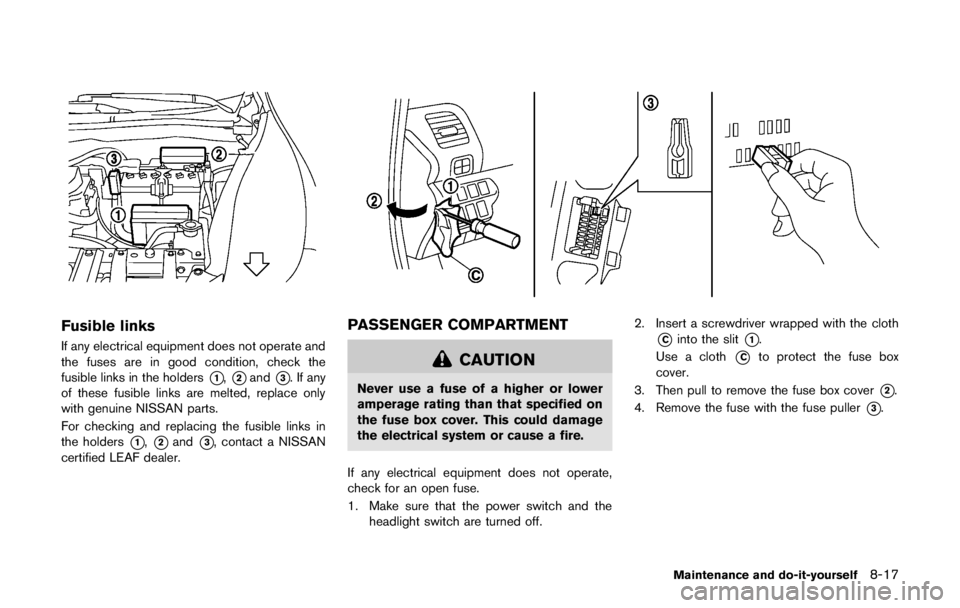
With all doors closed, apply the parking brake,
and push the power switch in the ON position.
The following lights will illuminate (if so
equipped):
Page 402 of 1062

CAUTION
.Be sure to carry the Intelligent Key
with you when operating the vehi-
cle.
. Never leave the Intelligent Key in
the vehicle when you leave the
vehicle.
The Intelligent Key is always communicating with
the vehicle because it receives radio waves. The
Intelligent Key system transmits weak radio
waves. Environmental conditions may interfere
with the operation of the Intelligent Key system
under the following operating conditions.
. When operating near a location where
strong radio waves are transmitted, such
as a TV tower, power station or broad-
casting station.
. When in possession of wireless equipment,
such as a cellular phone, transceiver or CB
radio.
. When the Intelligent Key is in contact with or
covered by metallic materials.
. When any type of radio wave remote control
is used nearby. .
When the Intelligent Key is placed near an
electric appliance such as a personal
computer.
. When the vehicle is parked near a parking
meter.
In such cases, correct the operating conditions
before using the Intelligent Key function or use
the mechanical key.
Although the life of the battery varies depending
on the operating conditions, the battery’s life is
approximately 2 years. If the battery is dis-
charged, replace it with a new one.
When the Intelligent Key battery is almost
discharged, firmly apply the foot brake and
touch the power switch with the Intelligent Key.
Then push the power switch while depressing
the brake pedal within 10 seconds after the
chime sound.
Since the Intelligent Key is continuously receiv-
ing radio waves, if the key is left near equipment
that transmits strong radio waves, such as
signals from a TV or personal computer, the
battery life may become shorter.
For information regarding replacement of a
battery, see “Intelligent Key battery replacement”
in the “8. Maintenance and do-it-yourself”
section. Pay special attention that the vehicle battery is
not completely discharged.
As many as 4 Intelligent Keys can be registered
and used with one vehicle. For information about
the purchase and use of additional Intelligent
Keys, contact a NISSAN certified LEAF dealer.
Page 432 of 1062

5 Starting and driving
Precautions when starting and driving ............................... 5-2Tire Pressure Monitoring System (TPMS) ................... 5-2
Avoiding collision and rollover ........................................ 5-5
Off-road recovery ............................................................... 5-5
Rapid air pressure loss ..................................................... 5-5
Drinking alcohol/drugs and driving ................................ 5-6
Push-button power switch .................................................... 5-7 Intelligent Key system ....................................................... 5-7
Operating range for EV (Electric Vehicle)
start function ........................................................................ 5-8
Power switch operation .................................................... 5-8
Power switch positions ..................................................... 5-9
Emergency EV (Electric Vehicle) shut off .................... 5-9
Intelligent Key battery discharge ................................. 5-10
Before starting the EV (Electric Vehicle) system .......... 5-10
Starting the EV (Electric Vehicle) system ....................... 5-11
Driving vehicle ........................................................................ 5-11 Electric shift control system ......................................... 5-11
Electric parking brake .......................................................... 5-15 Cruise control ........................................................................ 5-17
Precautions on cruise control .................................... 5-17Cruise control operation ............................................. 5-17
Increasing power economy ................................................ 5-19 Parking/parking on hills ....................................................... 5-20
Electric power steering system ........................................ 5-21
Brake system ......................................................................... 5-21 Braking precautions ..................................................... 5-21
Electric parking brake break-in .................................. 5-23
Anti-lock Braking System (ABS) .............................. 5-23
Vehicle Dynamic Control (VDC) system ........................ 5-24
Cold weather driving ........................................................... 5-26 Freeing a frozen door lock .......................................... 5-26
Antifreeze ........................................................................ 5-26
12-volt battery ................................................................ 5-26
Draining of coolant water ............................................ 5-26
Tire equipment ............................................................... 5-27
Special winter equipment ........................................... 5-27
Driving on snow or ice ................................................ 5-27
Freeing a frozen charge port lid ................................ 5-27
Page 435 of 1062

.Do not place metalized film or any
metal parts (antenna, etc.) on the
windows. This may cause poor re-
ception of the signals from the tire
pressure sensors, and the TPMS will
not function properly.
Some devices and transmitters may temporarily
interfere with the operation of the TPMS and
cause the low tire pressure warning light to
illuminate. Some examples are:
. Facilities or electric devices using similar
radio frequencies that are near the vehicle.
. If a transmitter set to similar frequencies is
being used in or near the vehicle.
. If a computer (or similar equipment) or a DC/
AC converter is being used in or near the
vehicle.
FCC Notice:
For USA:
This device complies with Part 15 of the
FCC Rules. Operation is subject to the
following two conditions: (1) This device
may not cause harmful interference, and
(2) this device must accept any interfer-
ence received, including interference that
may cause undesired operation. NOTE:
Changes or modifications not expressly
approved by the party responsible for
compliance could void the user’s authority
to operate the equipment.
For Canada:
This device complies with RSS-210 of
Industry Canada. Operation is subject to
the following two conditions: (1) this
device may not cause interference, and
(2) this device must accept any interfer-
ence, including interference that may
cause undesired operation of the device.
TPMS with Easy Fill Tire Alert
When tire pressure is low, the low tire pressure
warning light illuminates.
This vehicle provides visual and audible signals
to help you inflate the tires to the recommended
COLD tire pressure.
Vehicle set-up:
1. Park the vehicle in a safe and level place.
2. Apply the parking brake and push the P
position switch on the selector lever.
3. Place the power switch in the ON position. Do not place in the READY to drive mode. Operation:
1. Add air to the tire.
2. After a few seconds, the hazard indicators
will start flashing.
3. When the designated pressure is reached, the horn beeps once and the hazard
indicators stop flashing.
4. Perform the above steps for each tire.
. If the tire is over-inflated more than approxi-
mately 4 psi (30 kPa), the horn beeps and
the hazard indicators flash 3 times. To
correct the pressure, push the core of the
valve stem on the tire briefly to release
pressure. When the pressure reaches the
designated pressure, the horn beeps once.
. If the hazard indicator does not flash within
approximately 15 seconds after starting to
inflate the tire, it indicates that the Easy Fill
Tire Alert is not operating.
. The TPMS will not activate the Easy Fill Tire
Alert under the following conditions:
— If there is interference from an external
device or transmitter.
— The air pressure from the inflation device is not sufficient to inflate the tire such as
those using a power socket.
Page 440 of 1062

or ON position.
The power lock is designed so that the power
switch position cannot be switched to LOCK
until the vehicle is into the P (Park) position.
When the power switch cannot be switched to
the LOCK position, proceed as follows.
1. Push the P position switch on the selectorlever to place the vehicle in the P (Park)
position.
2. Push the power switch to the OFF position. The power switch position indicator
*Awill
not illuminate.
3. Open the door. The power switch will change to the LOCK position.
The vehicle can be moved from the P
(Park) position if the power switch is in
the ON position and the brake pedal is
depressed.
POWER SWITCH POSITIONS
LOCK (Normal parking position)
The power switch can only be locked in this
position.
The power switch will be unlocked when it is
pushed to the ACC position while the driver is
carrying the Intelligent Key.
ACC (Accessories)
This position activates electrical accessories,
such as the radio, when EV system is OFF.
ON
This position turns on the EV (Electric Vehicle)
system and electrical accessories.
READY (Normal operating position)
This position turns on the EV (Electric Vehicle)
system, electrical accessories and the vehicle
can be driven.
OFF
The EV (Electric Vehicle) system can be turned
off.
The power switch cannot be placed in the
LOCK position until the vehicle is in the P (Park)
position.