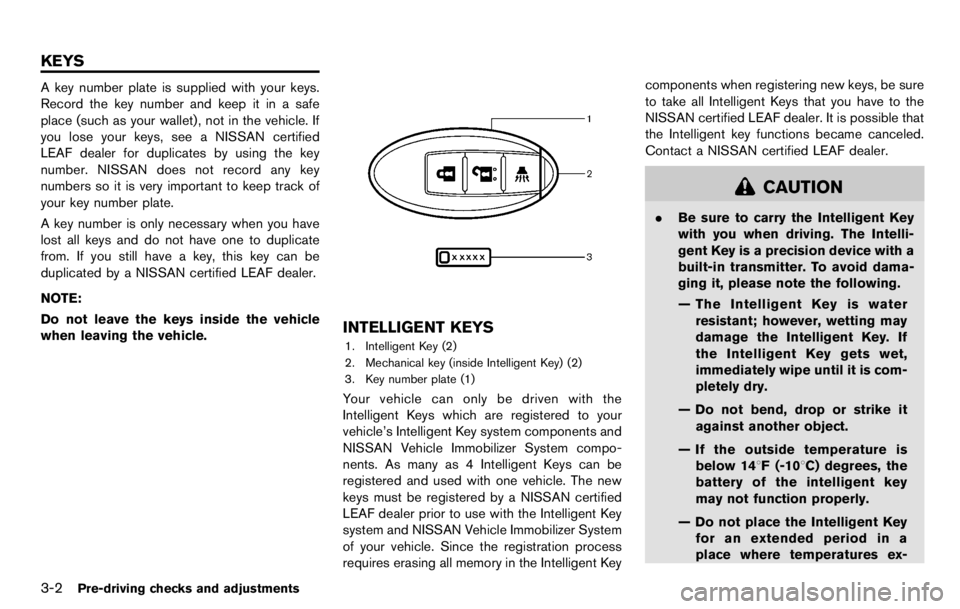
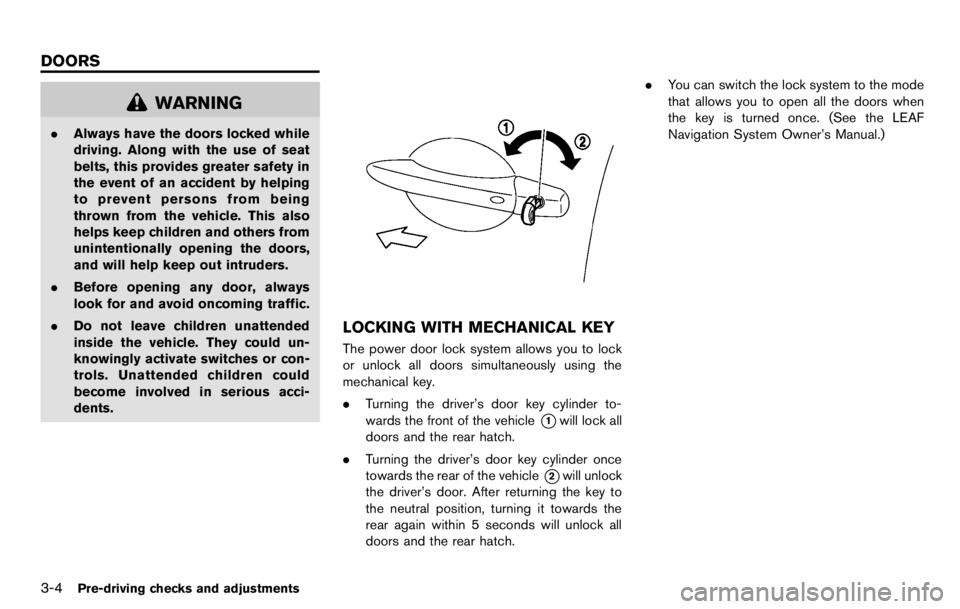
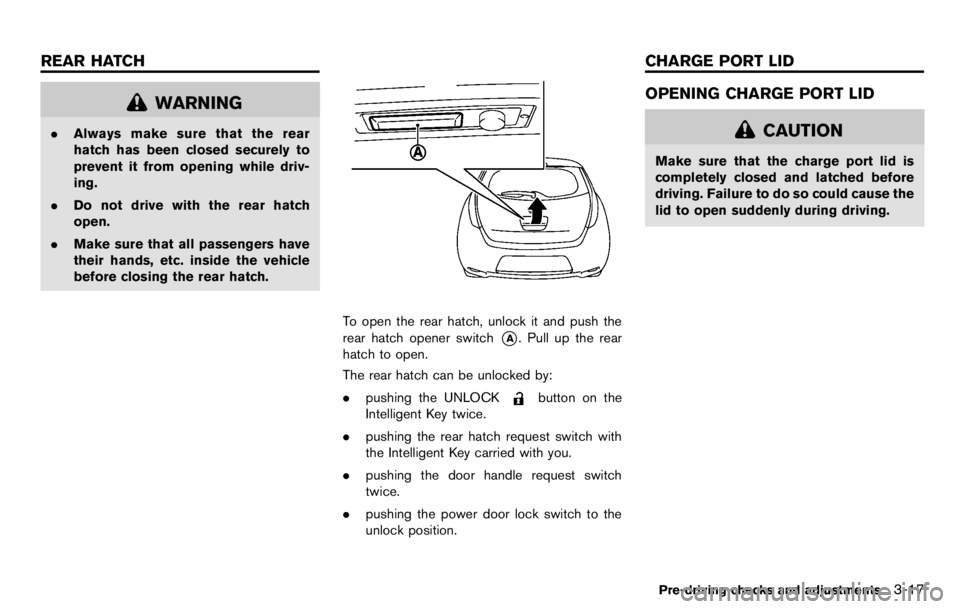
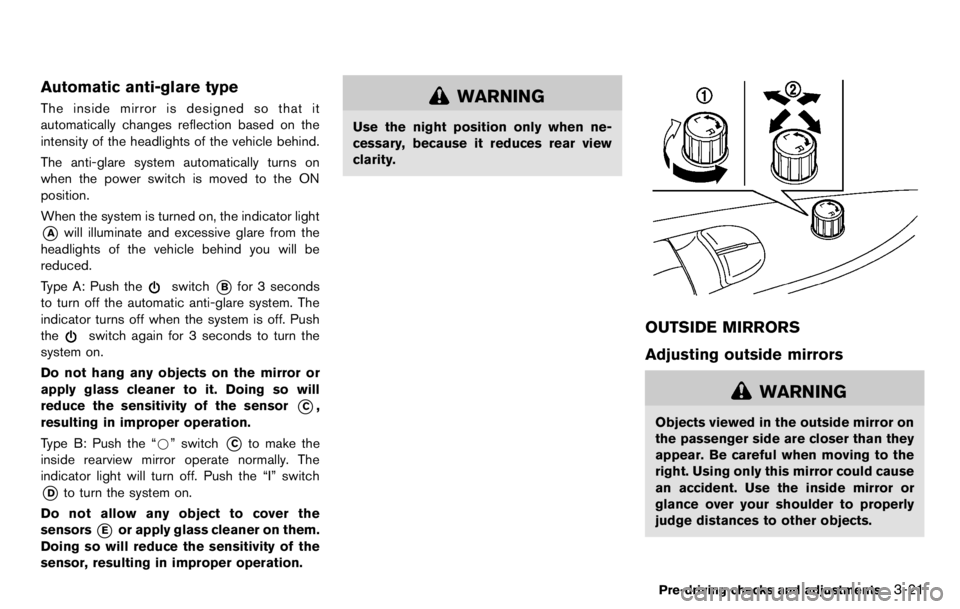
light NISSAN LEAF 2012 Owner's Manual
[x] Cancel search | Manufacturer: NISSAN, Model Year: 2012, Model line: LEAF, Model: NISSAN LEAF 2012Pages: 1062, PDF Size: 3.63 MB
Page 148 of 1062

webbing for cuts, fraying, wear or damage.
Steering wheel:Check for changes in the
steering conditions, such as excessive free play,
hard steering or strange noises.
Warning lights and chimes: Make sure that
all warning lights and chimes are operating
properly.
Windshield defroster: Check that the air
emits from the defroster outlets properly and in
sufficient quantity when operating the heater or
air conditioner.
Windshield wiper and washer*: Check that
the wipers and washers operate properly and
that the wipers do not streak.
Under hood and vehicle
The maintenance items listed here should be
checked periodically.
12-volt battery*: Check the fluid level in each
cell.
It should be between the MAX and MIN lines.
Vehicles operated in high temperatures or under
severe conditions require frequent checks of the
12-volt battery fluid level.
Brake fluid level*: Make sure that the brake
fluid level is between the MAX and MIN lines on
the reservoir. Coolant level*:
Check the coolant level when
the motor compartment is cold.
Fluid leaks: Check under the vehicle for water
or other fluid leaks after the vehicle has been
parked for a short period of time. Water dripping
from the air conditioner after use is normal. If you
notice any leaks, check for the cause and have it
corrected immediately.
Radiator and hoses: Check the front of the
radiator and clean off any dirt, insects, leaves,
etc., that may have accumulated. Make sure that
the hoses have no cracks, deformation, rot or
loose connections.
Underbody: The underbody is frequently ex-
posed to corrosive substances such as those
used on icy roads or to control dust. It is very
important to remove these substances, other-
wise rust will form on the floor pan and frame. At
the end of winter, the underbody should be
thoroughly flushed with plain water, being care-
ful to clean those areas where mud and dirt may
accumulate. For additional information, see
“Cleaning exterior” in the “7. Appearance and
care” section.
Windshield washer fluid*: Check that there is
an adequate amount of fluid in the reservoir.
Page 191 of 1062

WARNING
.Every person who drives or rides in
this vehicle should use a seat belt at
all times. Children should be prop-
erly restrained in the rear seat and,
if appropriate, in a child restraint.
. The seat belt should be properly
adjusted to a snug fit. Failure to do
so may reduce the effectiveness of
the entire restraint system and in-
crease the chance or severity of
injury in an accident. Serious injury
or death can occur if the seat belt is
not worn properly.
. Always route the shoulder belt over
your shoulder and across your
chest. Never put the belt behind
your back, under your arm or across
your neck. The belt should be away
from your face and neck, but not
falling off your shoulder.
. Position the lap belt as low and
snug as possible AROUND THE
HIPS, NOT THE WAIST. A lap belt
worn too high could increase the
risk of internal injuries in an acci-
dent. .
Be sure the seat belt tongue is
securely fastened to the proper
buckle.
. Do not wear the seat belt inside out
or twisted. Doing so may reduce its
effectiveness.
. Do not allow more than one person
to use the same seat belt.
. Never carry more people in the
vehicle than there are seat belts.
. If the seat belt warning light glows
continuously while the power switch
is turned ON with all doors closed
and all seat belts fastened, it may
indicate a malfunction in the sys-
tem. Have the system checked by a
NISSAN certified LEAF dealer.
. No changes should be made to the
seat belt system. For example, do
not modify the seat belt, add mate-
rial, or install devices that may
change the seat belt routing or
tension. Doing so may affect the
operation of the seat belt system.
Modifying or tampering with the
seat belt system may result in
serious personal injury.
Safety—Seats, seat belts and supplemental restraint system1-11
Page 198 of 1062

designed to inflate in higher severity side
collisions, although they may inflate if the forces
in another type of collision are similar to those of
a higher severity side impact. They are designed
to inflate on the side where the vehicle is
impacted. They may not inflate in certain side
collisions on the side where the vehicle is
impacted.
Vehicle damage (or lack of it) is not always an
indication of proper side air bag and curtain air
bag operation.
When the side air bags and curtain air bags
inflate, a fairly loud noise may be heard, followed
by release of smoke. This smoke is not harmful
and does not indicate a fire. Care should be
taken not to inhale it, as it may cause irritation
and choking. Those with a history of a breathing
condition should get fresh air promptly.
Side air bags, along with the use of seat belts,
help to cushion the impact force on the chest
and pelvic area of the front occupants. Curtain
air bags help to cushion the impact force to the
head of occupants in the front and rear outboard
seating positions. They can help save lives and
reduce serious injuries. However, side air bags
and curtain air bags may cause abrasions or
other injuries. Side air bags and curtain air bags
do not provide restraint to the lower body.The seat belts should be correctly worn and the
driver and passenger seated upright as far as
practical away from the side air bags. Rear seat
passengers should be seated as far away as
practical from the door finishers and side roof
rails. The side air bags and curtain air bags
inflate quickly in order to help protect the
occupants in the outboard seating positions.
Because of this, the force of the side air bags
and curtain air bags inflating can increase the
risk of injury if the occupant is too close to, or is
against, these air bag modules during inflation.
The side air bags and curtain air bags will deflate
quickly after the collision is over.
The side air bags and curtain air bags
operate only when the power switch is in
the ON position.
After turning the power switch to the ON
position, the supplemental air bag warning
light illuminates. The supplemental air bag
warning light will turn off after about 7
seconds if the systems are operational.
Page 201 of 1062
When the power switch is in the ON position,
the supplemental air bag warning light illumi-
nates for about 7 seconds and then turns off.
This means the system is operational.
If any of the following conditions occur, the front
air bag, side air bag, curtain air bag and
pretensioner systems need servicing:
.The supplemental air bag warning light
remains on after approximately 7 seconds.
. The supplemental air bag warning light
flashes intermittently.
. The supplemental air bag warning light does
not come on at all.
Under these conditions, the front air bag, side air
bag, curtain air bag and pretensioner systems
may not operate properly. They must be checked
and repaired. Take your vehicle to the nearest
NISSAN certified LEAF dealer.
Page 203 of 1062
2 Instruments and controls
Cockpit ....................................................................................... 2-3
Instrument panel ....................................................................... 2-4
Meters and gauges .................................................................. 2-5Speedometer and odometer ........................................... 2-6
Li-ion battery temperature gauge ................................... 2-7
Power meter ........................................................................ 2-7
Driving range ....................................................................... 2-8
Li-ion battery available charge gauge ........................... 2-9
Li-ion battery capacity level gauge ............................. 2-10
Outside air temperature ................................................ 2-10
ECO indicator .................................................................. 2-10
Clock .................................................................................. 2-11
Warning/indicator lights and audible reminders ........... 2-12
Checking bulbs ................................................................ 2-13
Warning lights .................................................................. 2-13
Indicator lights .................................................................. 2-19
Audible reminders ........................................................... 2-21
Dot matrix liquid crystal display ......................................... 2-22 Indicators for operation .................................................. 2-23
Trip computer ................................................................... 2-27
Warning information displays ....................................... 2-31
Indicators for maintenance ........................................... 2-33
Indicator for timer ............................................................ 2-34
Security systems ................................................................... 2-35 Vehicle security system ................................................. 2-35 NISSAN Vehicle Immobilizer System ....................... 2-36
Windshield wiper and washer switch ............................. 2-38 Washer operation ......................................................... 2-39
Rear window wiper and washer switch ........................ 2-39
Rear window and outside mirror defroster switch ...... 2-40
Instrument brightness control ............................................ 2-41
Headlight and turn signal switch ...................................... 2-41 Headlight switch ........................................................... 2-41
Turn signal switch ......................................................... 2-44
Fog light switch (if so equipped) ..................................... 2-44
Hazard warning flasher switch .......................................... 2-45
Heated steering wheel ........................................................ 2-45
Horn ......................................................................................... 2-46
Heated seats ......................................................................... 2-46
Vehicle Dynamic Control (VDC) OFF switch ................ 2-48
Power outlet ........................................................................... 2-48
Storage ................................................................................... 2-49 Cup holders .................................................................... 2-49
Sunglasses holder ........................................................ 2-50
Glove box ........................................................................ 2-51
Console box ................................................................... 2-51
Cargo cover (if so equipped) .................................... 2-51
Stowing golf bags ........................................................ 2-53
Luggage side hook ....................................................... 2-53
Page 207 of 1062

illuminates, the Li-ion battery charge is too low
for travel. See “Low battery charge warning
light” in the “2. Instruments and controls”
section. Charge the Li-ion battery as soon as
possible.
EV OverviewEV-19
Page 216 of 1062
The sound stops when the vehicle stops.
The sound does not stop with the vehicle in the
R (Reverse) position even if the vehicle stops.
WARNING
.If the sound cannot be heard, pe-
destrians may not notice the on-
coming vehicle, which may cause an
accident resulting in serious injury
or death. Immediately contact a
NISSAN certified LEAF for VSP
system inspection.
. If the VSP system warning light
illuminates while the power switch
is in the ON position, or in the
READY to drive position, it may
indicate the VSP system is not
functioning properly. Have the sys-
tem checked by a NISSAN certified
LEAF dealer. See “Approaching Ve-
hicle Sound for Pedestrians (VSP)
system warning light” in the “2.
Instruments and controls” section.
Page 220 of 1062
for more than 5 seconds.
4. When activated, the hazard warning lights will flash twice. When deactivated, the
hazard warning lights will flash once.
5. The power switch must be placed in the OFF and ON position again between each
setting change.
When the automatic door unlock system is
deactivated, the doors do not unlock when the
power is placed in the OFF position. To unlock
the door manually, use the inside lock knob or
the power door lock switch (driver’s or front
passenger’s side).
Page 228 of 1062

12-volt battery charge
warning light2-13
Page 229 of 1062
EV Overview
The EV (Electric Vehicle) system ...................................... EV-2
Li-ion battery .......................................................................... EV-2 Driving with a discharged Li-ion battery ................... EV-3
Charging the 12-volt battery ........................................ EV-5
Li-ion battery heater ....................................................... EV-5
High voltage precautions .................................................... EV-7
High-voltage components ............................................. EV-7
Road accident precautions ................................................ EV-8 Emergency shut-off system .......................................... EV-9
EV (Electric Vehicle) characteristics ................................ EV-9
Noise and vibration ...................................................... EV-10
Life with an EV (scene guide) ........................................ EV-10 Charging the Li-ion battery ........................................ EV-10
Before driving your vehicle ........................................ EV-13
Starting your vehicle .................................................... EV-16
Driving the vehicle ........................................................ EV-17 At home after driving ................................................. EV-21
Efficient use of your vehicle ............................................ EV-22 Range ............................................................................ EV-22
Improve driving range ............................................... EV-22
Li-ion battery life ......................................................... EV-23
Li-ion battery maintenance ...................................... EV-24
EV unique information ...................................................... EV-24 Meters and indicators ............................................... EV-24
Approaching Vehicle Sound for Pedestrians
(VSP) system .............................................................. EV-27
Electric shift control system .................................... EV-28
Electric parking brake ............................................... EV-28
LED headlight (low beam) ....................................... EV-29
Solar cell module (if so equipped) ........................ EV-29
Driving range button ................................................ EV-29