wheel NISSAN LEAF 2013 1.G Roadside Assistance Guide
[x] Cancel search | Manufacturer: NISSAN, Model Year: 2013, Model line: LEAF, Model: NISSAN LEAF 2013 1.GPages: 37, PDF Size: 1.27 MB
Page 12 of 37
3. Roadside Assistance Response Steps
• NEVER assume the LEAF is shut OFF simply because it is quiet.
• If the vehicle is damaged and you are not sure about the condition of the electric
vehicle system, contact first responders immediately. If the vehicle is damaged, the high
voltage system should be shut down by first responders while following the procedures in
the First Responders Guide and while wearing appropriate Personal Protective
Equipment (PPE) .
• If the READY indicator or charging indicator are ON, the high voltage system is
active.
• If possible, be sure to verify that the READY indicator on the instrument cluster
is
OFF and the high voltage system is stopped.
• Some of the under hood parts get hot and may cause serious burns. Use caution when working on or around these parts.
3-1 Indications the High Voltage System is ON 1. If the READY indicator is ON, the high voltage system is active.
2.
The high voltage system is active if any charge indicator
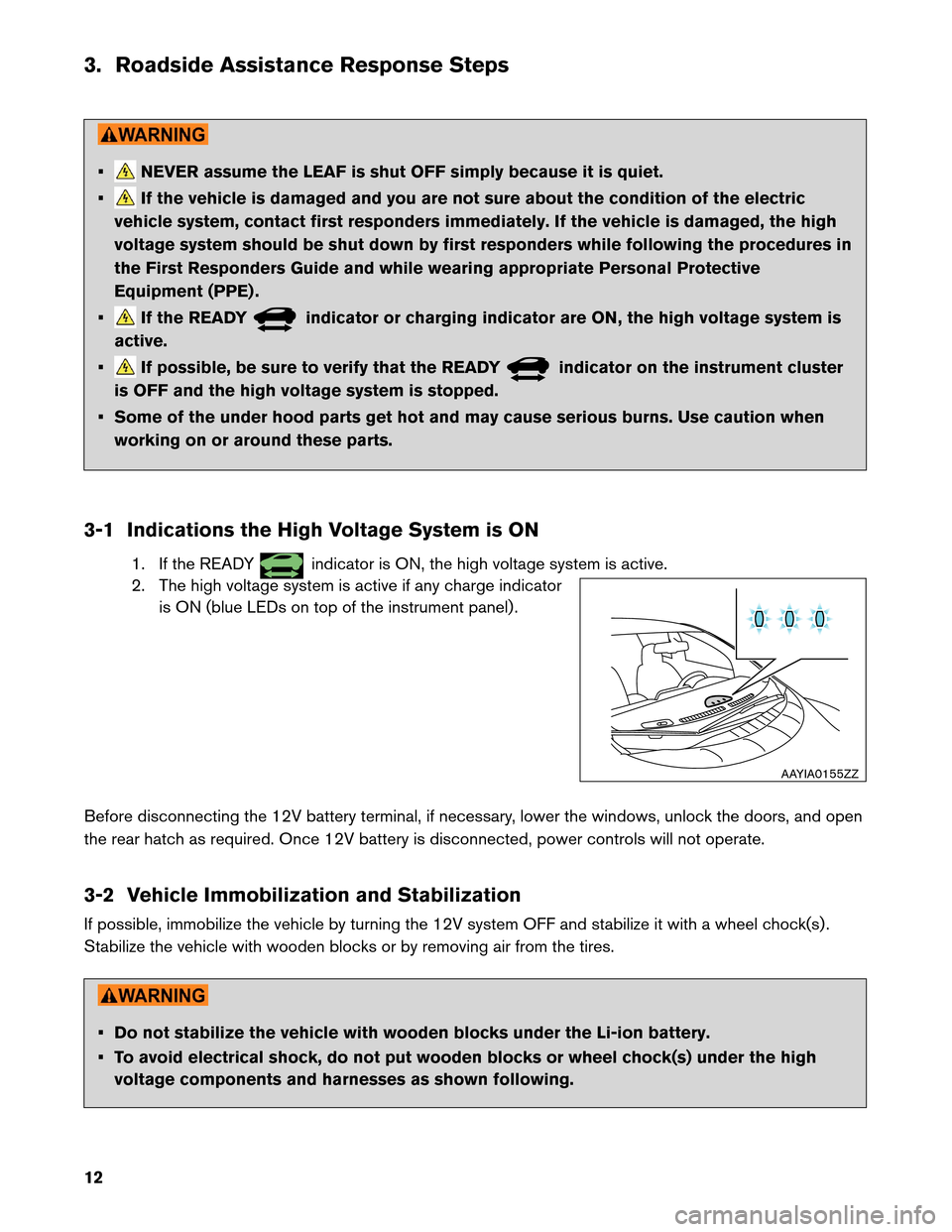
is ON (blue LEDs on top of the instrument panel) .
Before disconnecting the 12V battery terminal, if necessary, lower the windows, unlock the doors, and open
the rear hatch as required. Once 12V battery is disconnected, power controls will not operate.
3-2 Vehicle Immobilization and Stabilization
If possible, immobilize the vehicle by turning the 12V system OFF and stabilize it with a wheel chock(s) .
Stabilize the vehicle with wooden blocks or by removing air from the tires. • Do not stabilize the vehicle with wooden blocks under the Li-ion battery.
•
To avoid electrical shock, do not put wooden blocks or wheel chock(s) under the high
voltage components and harnesses as shown following. AAYIA0155ZZ
12
Page 20 of 37
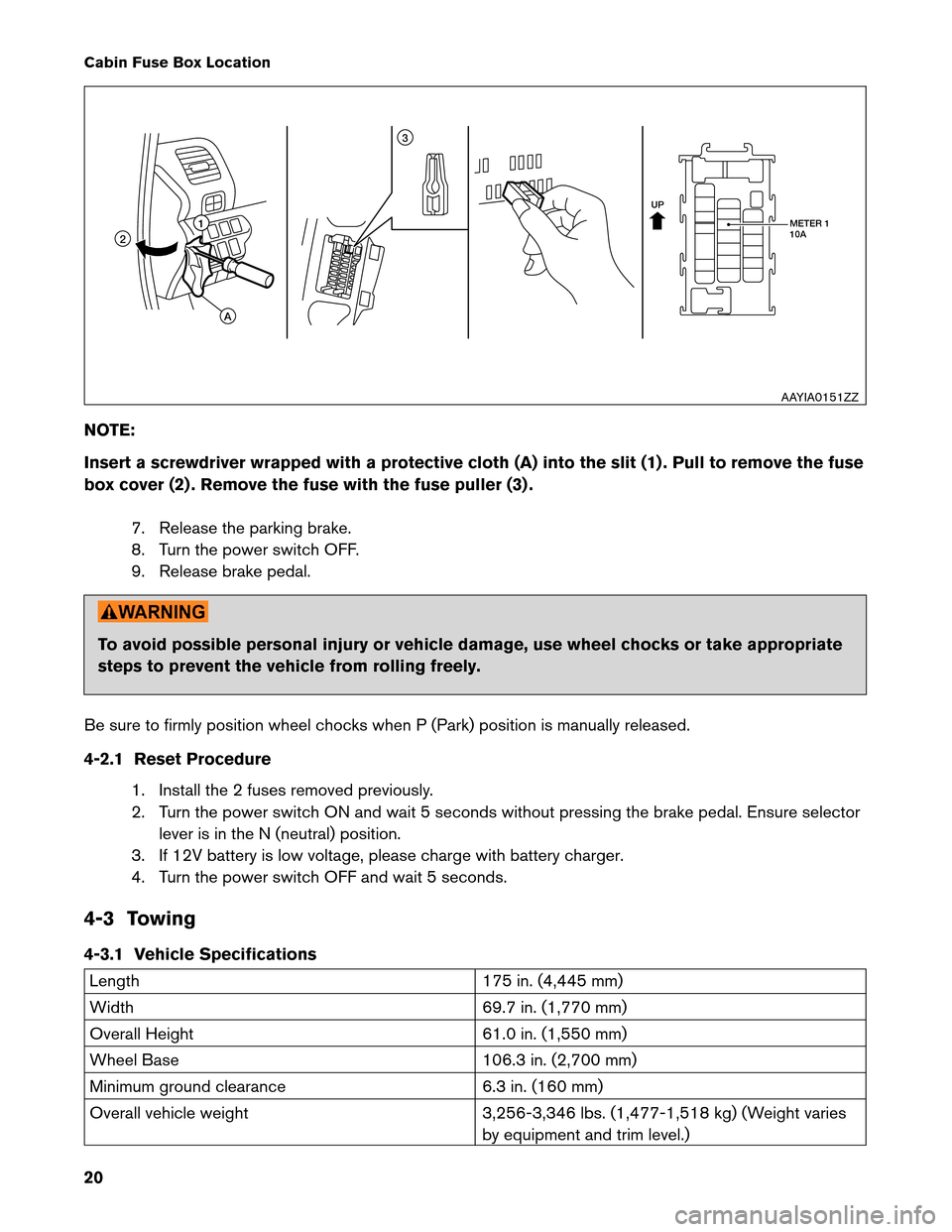
Cabin Fuse Box Location
NO
TE:
Insert a screwdriver wrapped with a protective cloth (A) into the slit (1) . Pull to remove the fuse
box cover (2) . Remove the fuse with the fuse puller (3) .
7. Release the parking brake.
8. Turn the power switch OFF.
9. Release brake pedal. To avoid possible personal injury or vehicle damage, use wheel chocks or take appropriate
steps
to prevent the vehicle from rolling freely.
Be sure to firmly position wheel chocks when P (Park) position is manually released.
4-2.1 Reset Procedure 1. Install the 2 fuses removed previously.
2. Turn the power switch ON and wait 5 seconds without pressing the brake pedal. Ensure selectorlever is in the N (neutral) position.
3. If 12V battery is low voltage, please charge with battery charger.
4. Turn the power switch OFF and wait 5 seconds.
4-3 Towing
4-3.1 Vehicle Specifications Length
175
in. (4,445 mm)
Width 69.7 in. (1,770 mm)
Overall Height 61.0 in. (1,550 mm)
Wheel Base 106.3 in. (2,700 mm)
Minimum ground clearance 6.3 in. (160 mm)
Overall vehicle weight 3,256-3,346 lbs. (1,477-1,518 kg) (Weight varies
by equipment and trim level.) UP
METER 1
10A
11 3
2
A
AAYIA0151ZZ
20
Page 21 of 37
Front approach angle
17°
Rear departure angle 26°
4-3.2 Towing Guidelines
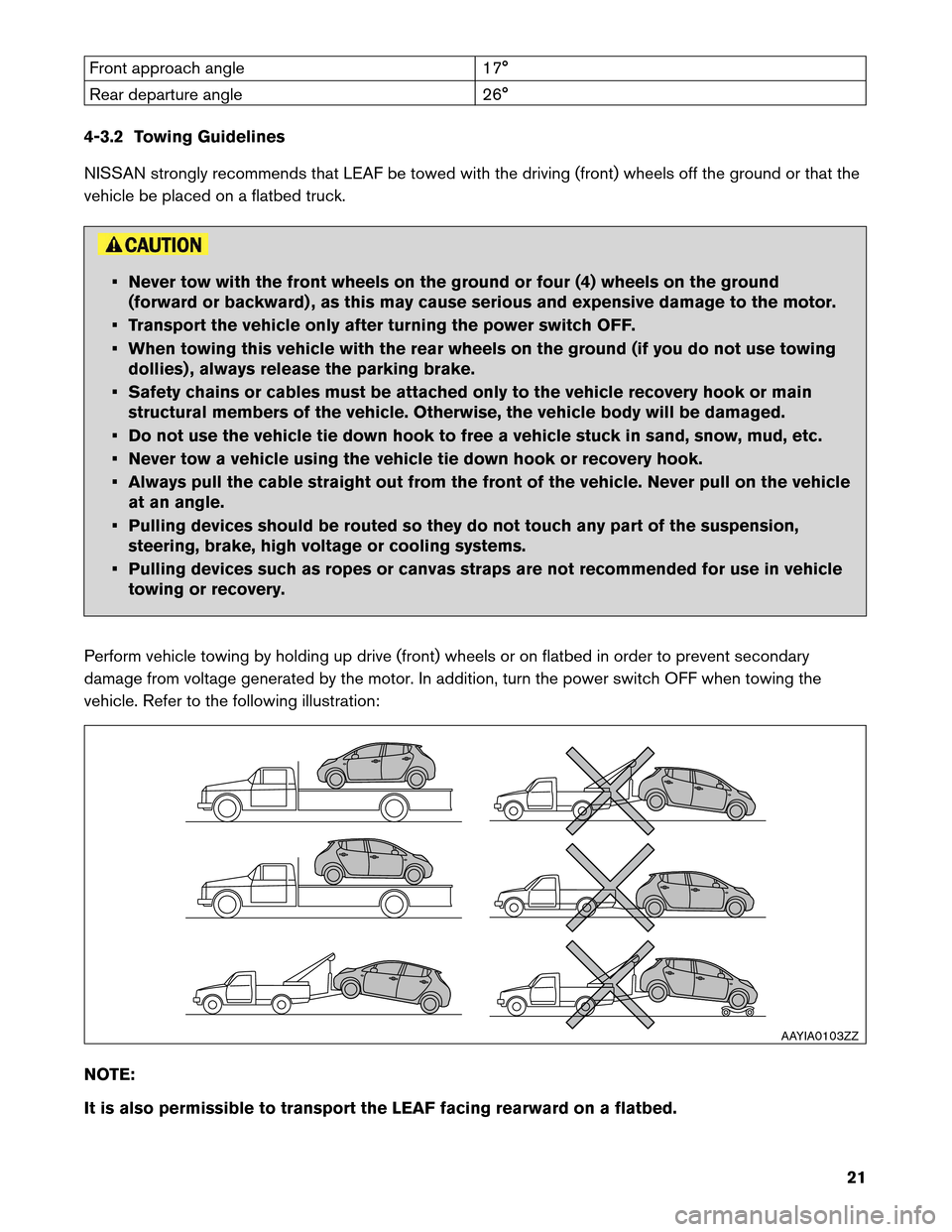
NISSAN strongly recommends that LEAF be towed with the driving (front) wheels off the ground or that the
vehicle be placed on a flatbed truck. • Never tow with the front wheels on the ground or four (4) wheels on the ground
(forward
or backward) , as this may cause serious and expensive damage to the motor.
• Transport the vehicle only after turning the power switch OFF.
• When towing this vehicle with the rear wheels on the ground (if you do not use towing dollies) , always release the parking brake.
• Safety chains or cables must be attached only to the vehicle recovery hook or main structural members of the vehicle. Otherwise, the vehicle body will be damaged.
• Do not use the vehicle tie down hook to free a vehicle stuck in sand, snow, mud, etc.
• Never tow a vehicle using the vehicle tie down hook or recovery hook.
• Always pull the cable straight out from the front of the vehicle. Never pull on the vehicle at an angle.
• Pulling devices should be routed so they do not touch any part of the suspension, steering, brake, high voltage or cooling systems.
• Pulling devices such as ropes or canvas straps are not recommended for use in vehicle towing or recovery.
Perform vehicle towing by holding up drive (front) wheels or on flatbed in order to prevent secondary
damage from voltage generated by the motor. In addition, turn the power switch OFF when towing the
vehicle. Refer to the following illustration:
NOTE:
It is also permissible to transport the LEAF facing rearward on a flatbed. AAYIA0103ZZ
21
Page 23 of 37
6. Place the selector lever in the N (Neutral) position.
NO TE:
If the vehicle cannot be placed in Neutral, a P (Park) release procedure may be
required. Refer to 4–2 P (Park) Position Release Procedure.
7.
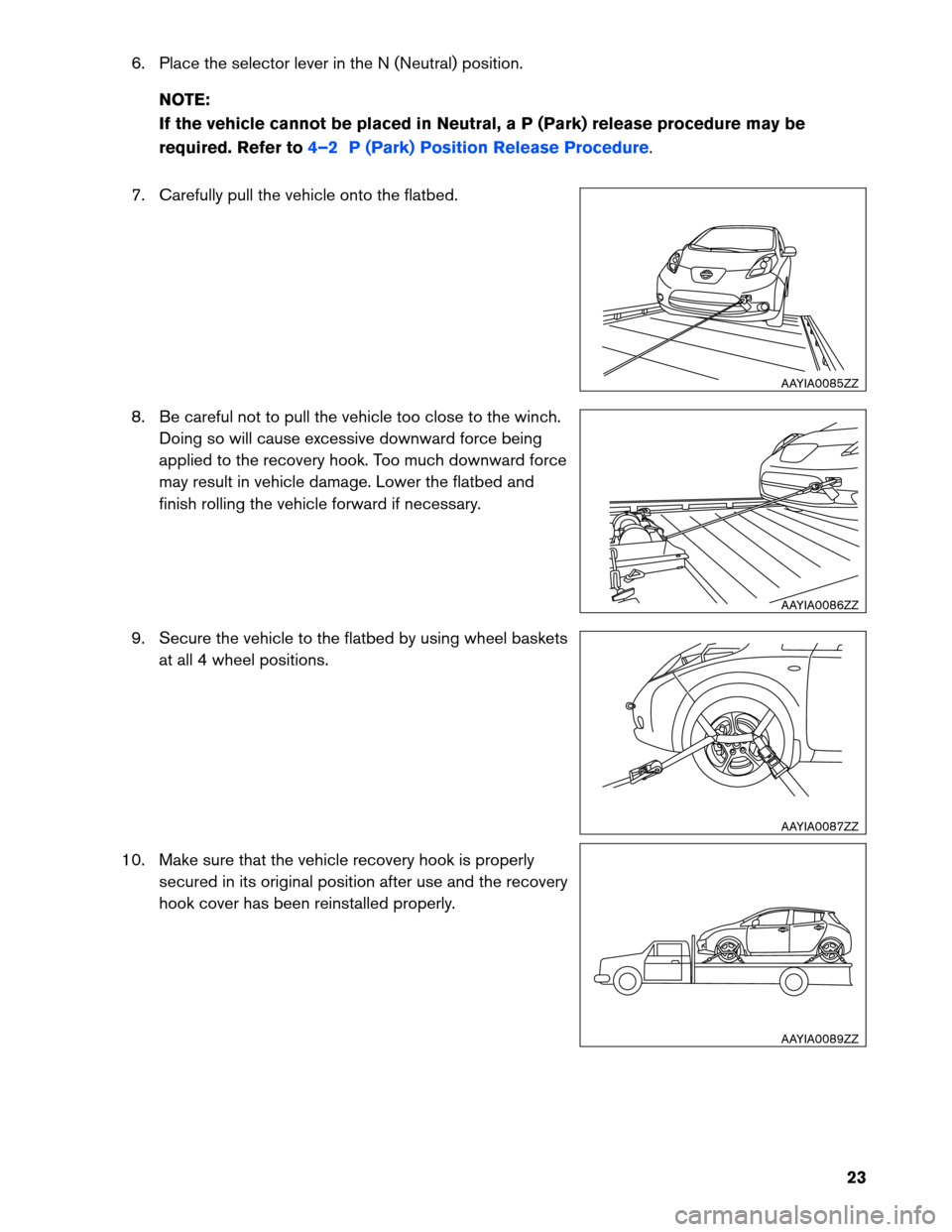
Carefully pull the vehicle onto the flatbed.
8. Be careful not to pull the vehicle too close to the winch. Doing so will cause excessive downward force being
applied to the recovery hook. Too much downward force
may result in vehicle damage. Lower the flatbed and
finish rolling the vehicle forward if necessary.
9. Secure the vehicle to the flatbed by using wheel baskets at all 4 wheel positions.
10. Make sure that the vehicle recovery hook is properly secured in its original position after use and the recovery
hook cover has been reinstalled properly. AAYIA0085ZZ
AAYIA0086ZZ
AAYIA0087ZZ
AAYIA0089ZZ
23
Page 24 of 37
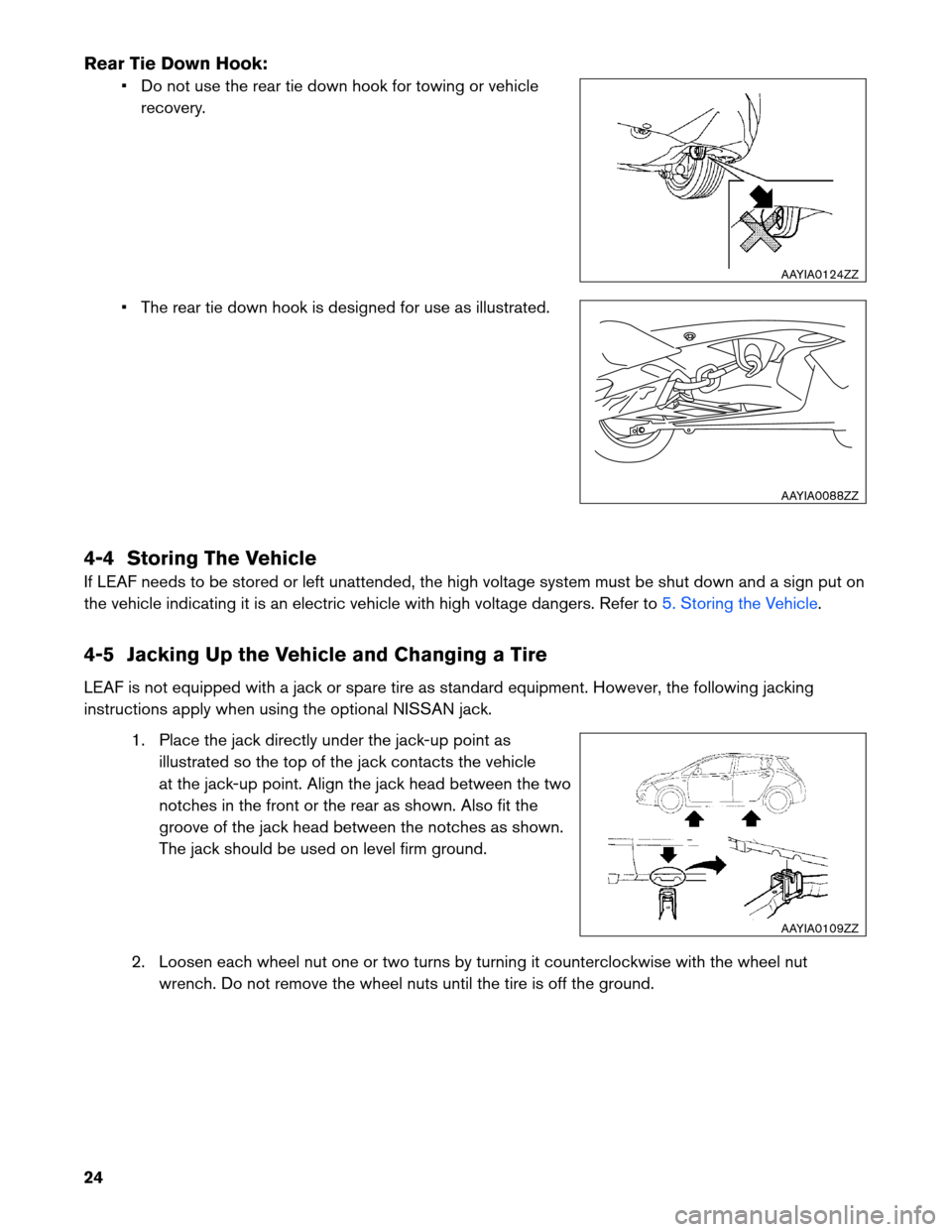
Rear Tie Down Hook:
• Do not use the rear tie down hook for towing or vehicle
recovery.
• The rear tie down hook is designed for use as illustrated.
4-4 Storing The Vehicle
If LEAF needs to be stored or left unattended, the high voltage system must be shut down and a sign put on
the vehicle indicating it is an electric vehicle with high voltage dangers. Refer to 5. Storing the Vehicle.
4-5
Jacking Up the Vehicle and Changing a Tire
LEAF is not equipped with a jack or spare tire as standard equipment. However, the following jacking
instructions apply when using the optional NISSAN jack. 1. Place the jack directly under the jack-up point asillustrated so the top of the jack contacts the vehicle
at the jack-up point. Align the jack head between the two
notches in the front or the rear as shown. Also fit the
groove of the jack head between the notches as shown.
The jack should be used on level firm ground.
2. Loosen each wheel nut one or two turns by turning it counterclockwise with the wheel nut wrench. Do not remove the wheel nuts until the tire is off the ground. AAYIA0124ZZ
AAYIA0088ZZ
AAYIA0109ZZ
24
Page 25 of 37
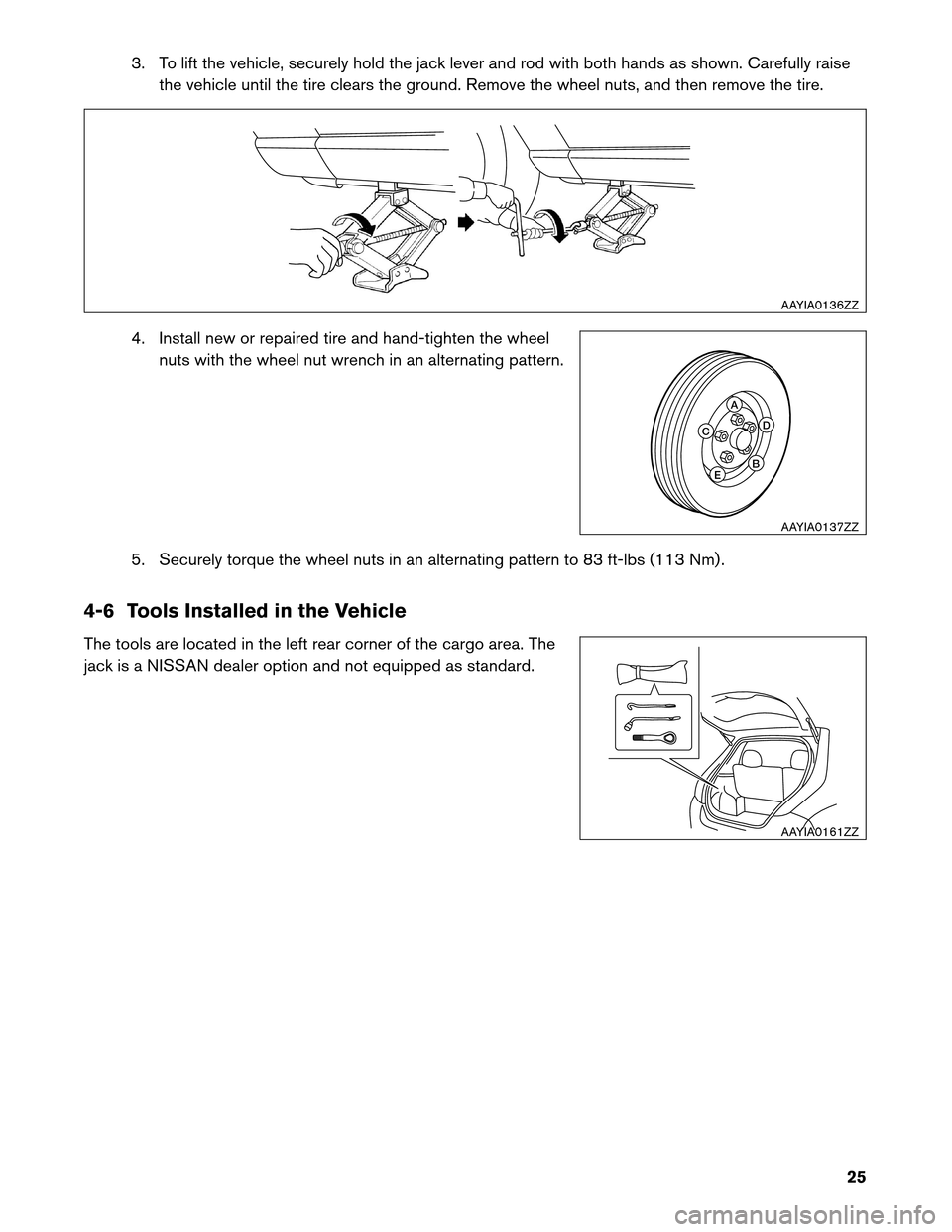
3. To lift the vehicle, securely hold the jack lever and rod with both hands as shown. Carefully raise
the vehicle until the tire clears the ground. Remove the wheel nuts, and then remove the tire.
4. Install new or repaired tire and hand-tighten the wheel nuts with the wheel nut wrench in an alternating pattern.
5. Securely torque the wheel nuts in an alternating pattern to 83 ft-lbs (113 Nm) .
4-6 Tools Installed in the Vehicle
The tools are located in the left rear corner of the cargo area. The
jack is a NISSAN dealer option and not equipped as standard. AAYIA0136ZZ
B
EC DA
AAYIA0137ZZ AAYIA0161ZZ
25
Page 27 of 37
• To avoid the Emergency Tire Puncture Repair Kit from being damaged during storage or
use:
–
Only use the Emergency Tire Puncture Repair Kit on the LEAF vehicle. Do not use it
on other vehicles.
– Only use the kit to inflate the tires of the LEAF and to check the vehicle’s tire pressure.
– Only plug the compressor into a 12V DC car power point.
– Keep the kit free of dirt and water.
– Do not disassemble or modify the kit.
– Do not drop the kit or allow hard impacts to the kit.
• Do not use the Emergency Tire Puncture Repair Kit under the following conditions. Contact a NISSAN certified LEAF dealer or professional road assistance:
– when the sealant has passed its expiration date (shown on the label attached to the bottle) .
– when the cut or the puncture in the tire is approximately 0.25 in (6 mm) or longer.
– when the tire sidewall is damaged.
– when the vehicle has been driven with extremely low tire pressure.
– when the tire has come off the inside or the outside of the wheel.
– when the wheel is damaged.
– when two (2) or more tires are flat.
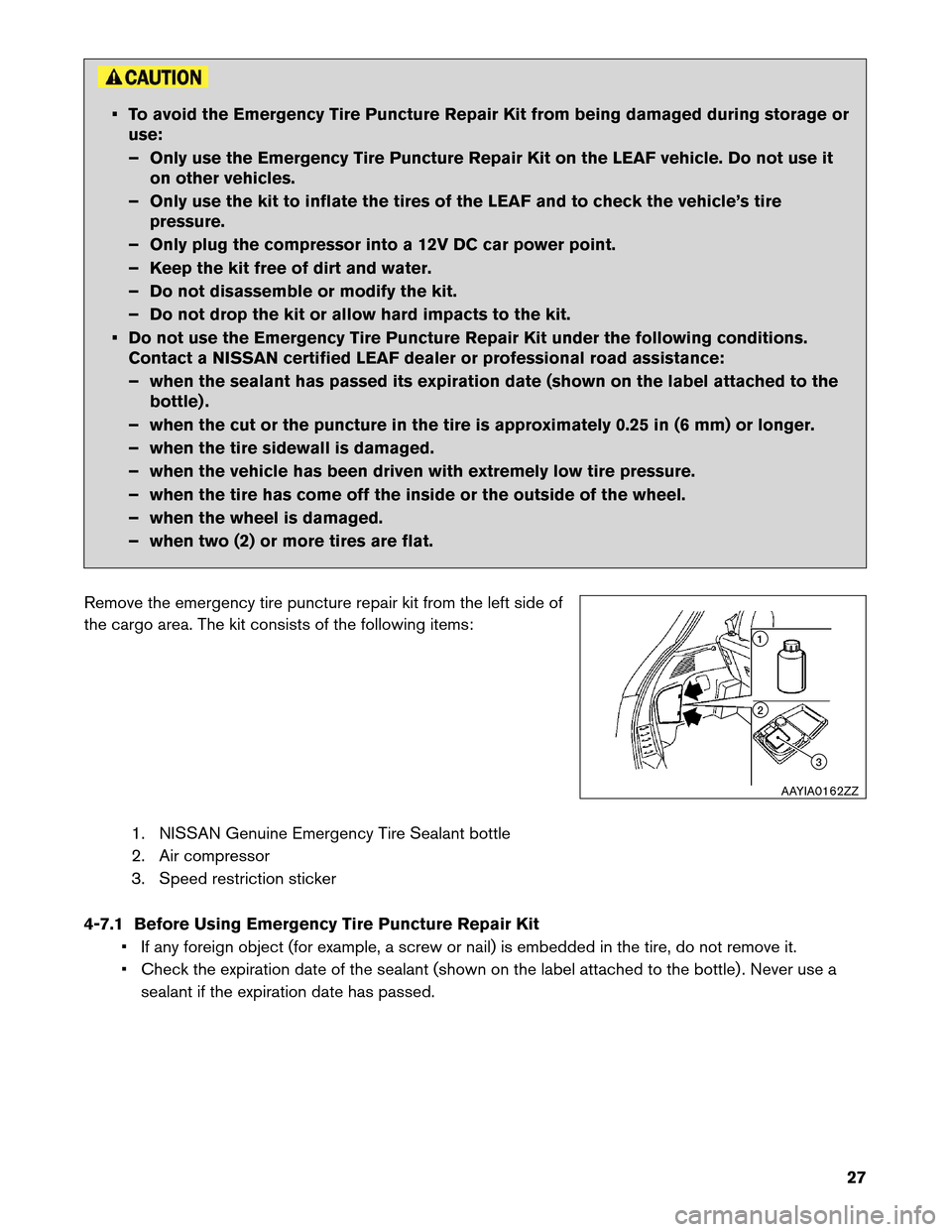
Remove the emergency tire puncture repair kit from the left side of
the cargo area. The kit consists of the following items:
1. NISSAN Genuine Emergency Tire Sealant bottle
2. Air compressor
3. Speed restriction sticker
4-7.1 Before Using Emergency Tire Puncture Repair Kit • If any foreign object (for example, a screw or nail) is embedded in the tire, do not remove it.
• Check the expiration date of the sealant (shown on the label attached to the bottle) . Never use asealant if the expiration date has passed. 321
AAYIA0162ZZ
27
Page 28 of 37
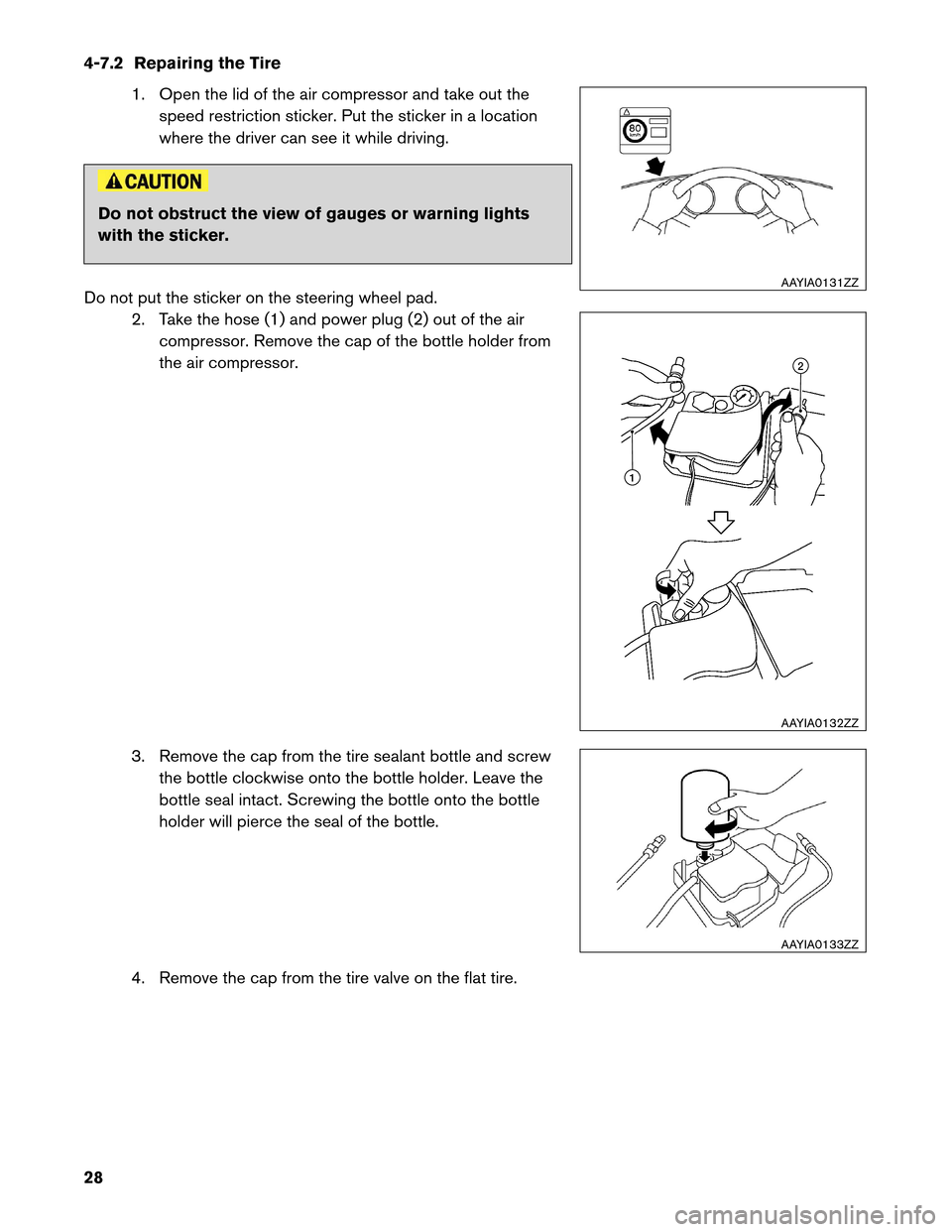
4-7.2 Repairing the Tire
1. Open the lid of the air compressor and take out the
speed restriction sticker. Put the sticker in a location
where the driver can see it while driving. Do not obstruct the view of gauges or warning lights
with
the sticker.
Do not put the sticker on the steering wheel pad. 2. Take the hose (1) and power plug (2) out of the aircompressor. Remove the cap of the bottle holder from
the air compressor.
3. Remove the cap from the tire sealant bottle and screw the bottle clockwise onto the bottle holder. Leave the
bottle seal intact. Screwing the bottle onto the bottle
holder will pierce the seal of the bottle.
4. Remove the cap from the tire valve on the flat tire. AAYIA0131ZZ
2
1
AAYIA0132ZZ AAYIA0133ZZ
28