headrest NISSAN LEAF 2014 1.G User Guide
[x] Cancel search | Manufacturer: NISSAN, Model Year: 2014, Model line: LEAF, Model: NISSAN LEAF 2014 1.GPages: 397, PDF Size: 9.45 MB
Page 120 of 397
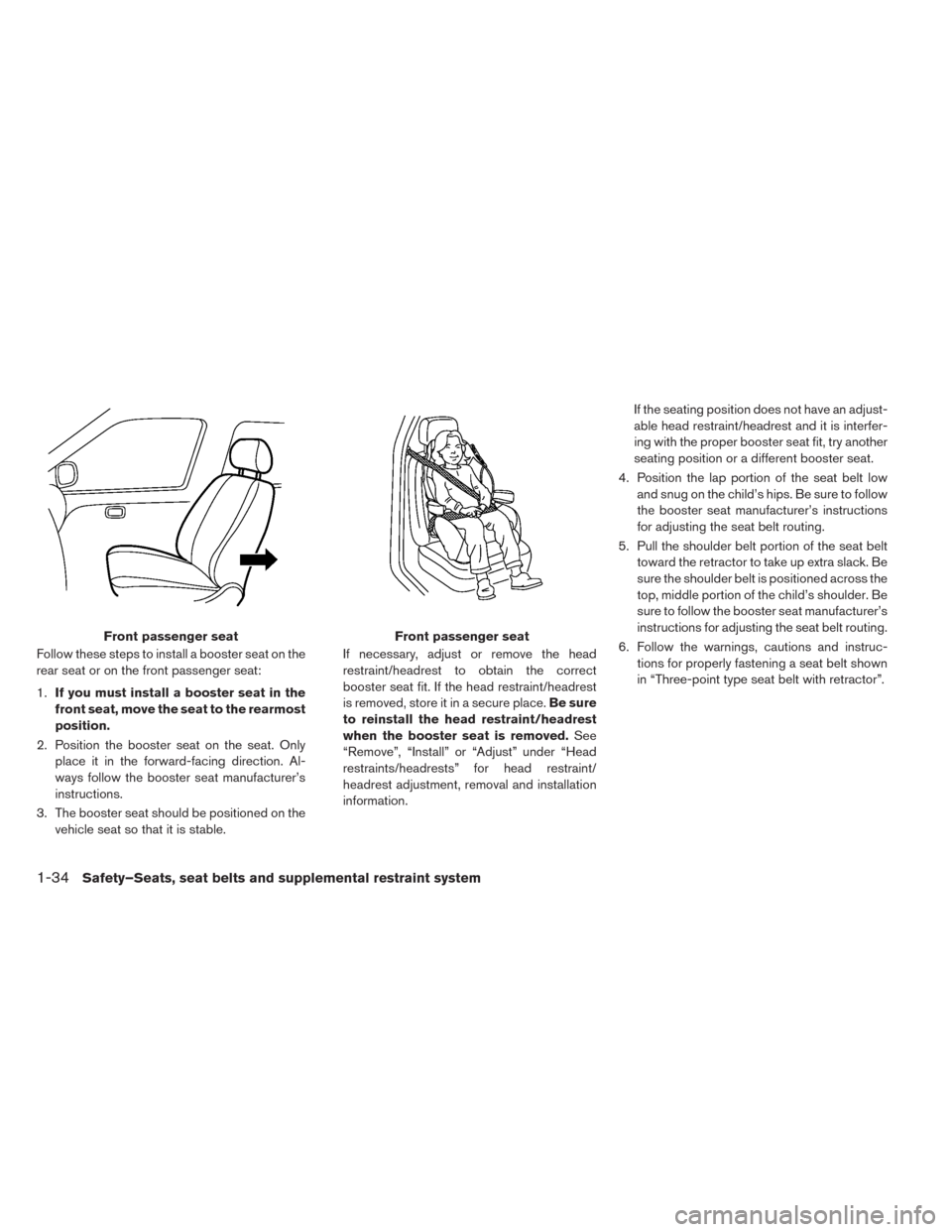
Follow these steps to install a booster seat on the
rear seat or on the front passenger seat:
1.If you must install a booster seat in the
front seat, move the seat to the rearmost
position.
2. Position the booster seat on the seat. Only
place it in the forward-facing direction. Al-
ways follow the booster seat manufacturer’s
instructions.
3. The booster seat should be positioned on the
vehicle seat so that it is stable.If necessary, adjust or remove the head
restraint/headrest to obtain the correct
booster seat fit. If the head restraint/headrest
is removed, store it in a secure place.Be sure
to reinstall the head restraint/headrest
when the booster seat is removed.See
“Remove”, “Install” or “Adjust” under “Head
restraints/headrests” for head restraint/
headrest adjustment, removal and installation
information.If the seating position does not have an adjust-
able head restraint/headrest and it is interfer-
ing with the proper booster seat fit, try another
seating position or a different booster seat.
4. Position the lap portion of the seat belt low
and snug on the child’s hips. Be sure to follow
the booster seat manufacturer’s instructions
for adjusting the seat belt routing.
5. Pull the shoulder belt portion of the seat belt
toward the retractor to take up extra slack. Be
sure the shoulder belt is positioned across the
top, middle portion of the child’s shoulder. Be
sure to follow the booster seat manufacturer’s
instructions for adjusting the seat belt routing.
6. Follow the warnings, cautions and instruc-
tions for properly fastening a seat belt shown
in “Three-point type seat belt with retractor”.
Front passenger seatFront passenger seat
1-34Safety–Seats, seat belts and supplemental restraint system
Page 127 of 397
NISSAN ADVANCED AIR BAG
SYSTEM (FRONT SEATS)
WARNING
To ensure proper operation of the pas-
senger’s advanced air bag system, please
observe the following items.
• Do not allow a passenger in the rear
seat to push or pull on the seatback
pocket.
• Do not place heavy loads heavier than
9lb (4 kg) on the seatback, head
restraint/headrest or in the seatback
pocket.
• Do not store luggage behind the seat
that can press into the seatback.
• Confirm the operating condition with
the front passenger air bag status
light.
• If you notice that the front passenger
air bag status light is not operating as
described later in this section, please
take your vehicle to your NISSAN cer-
tified LEAF dealer to check the occu-
pant classification system.• Until you have confirmed with your
dealer that your passenger seat occu-
pant classification system is working
properly, position the occupants in the
rear seating positions.
This vehicle is equipped with the NISSAN Ad-
vanced Air Bag System for the driver and front
passenger seats. This system is designed to
meet certification requirements under U.S. regu-
lations. It is also permitted in Canada.All of the
information, cautions and warnings in this
manual apply and must be followed.
The driver supplemental front-impact air bag is
located in the center of the steering wheel. The
passenger supplemental front-impact air bag is
mounted in the instrument panel above the glove
box. The front air bags are designed to inflate in
higher severity frontal collisions, although they
may inflate if the forces in another type of collision
are similar to those of a higher severity frontal
impact. They may not inflate in certain frontal
collisions. Vehicle damage (or lack of it) is not
always an indication of proper front air bag op-
eration.
The NISSAN Advanced Air Bag System has dual
stage air bag inflators. The system monitors infor-
mation from the Air bag Control Unit (ACU) , seatbelt buckle sensors and the occupant classifica-
tion sensors (weight sensors) . Inflator operation
is based on the severity of a collision and seat
belt usage for the driver. For the front passenger,
the occupant classification sensors are also
monitored. Based on information from the sen-
sors, only one front air bag may inflate in a crash,
depending on the crash severity and whether the
front occupants are belted or unbelted. Addition-
ally, the front passenger air bag may be automati-
cally turned OFF under some conditions, de-
pending on the information provided by the
occupant classification sensors. If the front pas-
senger air bag is OFF, the passenger air bag
status light will be illuminated (if the seat is unoc-
cupied, the light will not be illuminated, but the air
bag will be off) . See “Front passenger air bag and
status light” for further details. One front air bag
inflating does not indicate improper performance
of the system.
If you have any questions about your air bag
system, contact NISSAN or a NISSAN certified
LEAF dealer. If you are considering modification
of your vehicle due to a disability, you may also
contact NISSAN. Contact information is con-
tained in the front of this Owner’s Manual.
Safety–Seats, seat belts and supplemental restraint system1-41
Page 290 of 397
NISSAN INTELLIGENT KEY®
BATTERY DISCHARGE
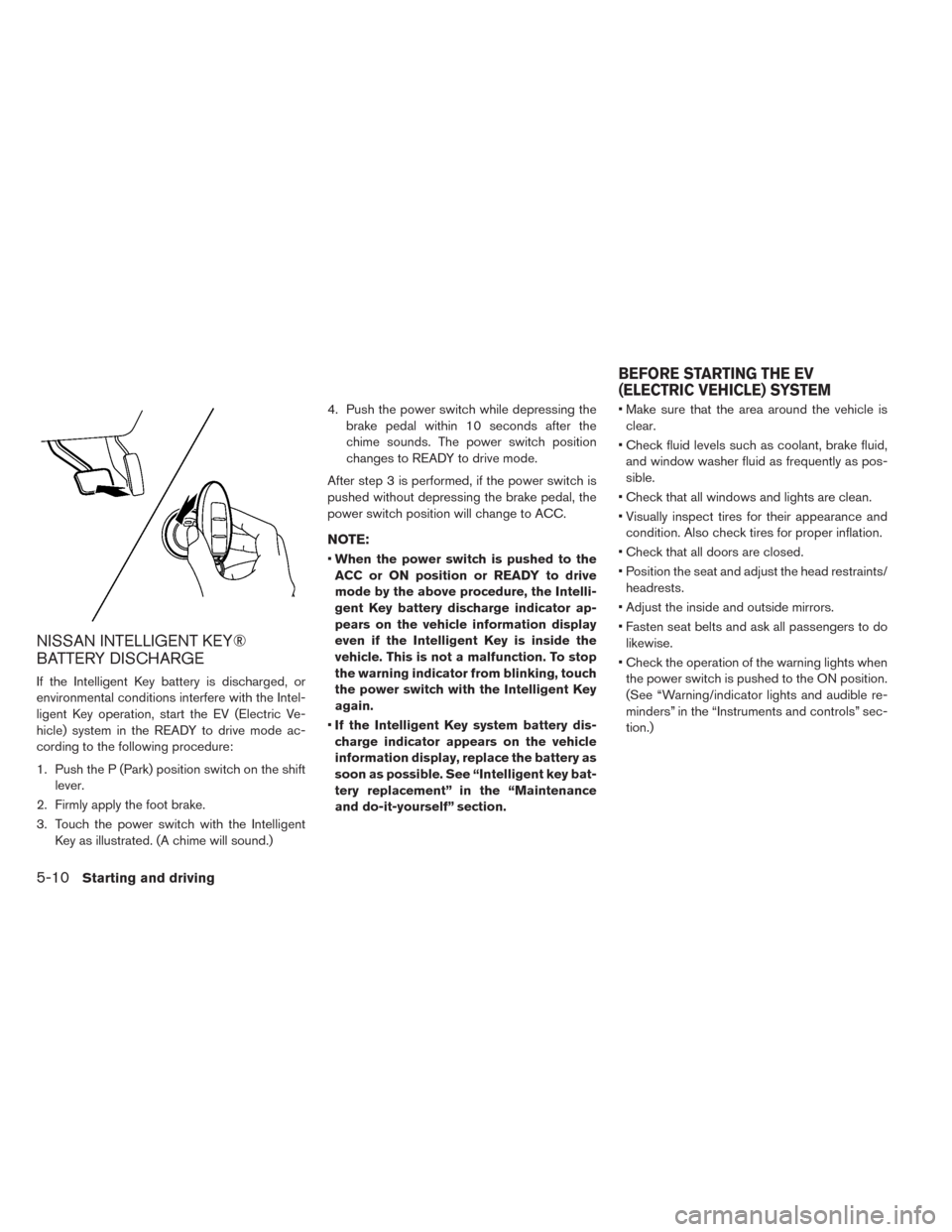
If the Intelligent Key battery is discharged, or
environmental conditions interfere with the Intel-
ligent Key operation, start the EV (Electric Ve-
hicle) system in the READY to drive mode ac-
cording to the following procedure:
1. Push the P (Park) position switch on the shift
lever.
2. Firmly apply the foot brake.
3. Touch the power switch with the Intelligent
Key as illustrated. (A chime will sound.)4. Push the power switch while depressing the
brake pedal within 10 seconds after the
chime sounds. The power switch position
changes to READY to drive mode.
After step 3 is performed, if the power switch is
pushed without depressing the brake pedal, the
power switch position will change to ACC.
NOTE:
•When the power switch is pushed to the
ACC or ON position or READY to drive
mode by the above procedure, the Intelli-
gent Key battery discharge indicator ap-
pears on the vehicle information display
even if the Intelligent Key is inside the
vehicle. This is not a malfunction. To stop
the warning indicator from blinking, touch
the power switch with the Intelligent Key
again.
•If the Intelligent Key system battery dis-
charge indicator appears on the vehicle
information display, replace the battery as
soon as possible. See “Intelligent key bat-
tery replacement” in the “Maintenance
and do-it-yourself” section.• Make sure that the area around the vehicle is
clear.
• Check fluid levels such as coolant, brake fluid,
and window washer fluid as frequently as pos-
sible.
• Check that all windows and lights are clean.
• Visually inspect tires for their appearance and
condition. Also check tires for proper inflation.
• Check that all doors are closed.
• Position the seat and adjust the head restraints/
headrests.
• Adjust the inside and outside mirrors.
• Fasten seat belts and ask all passengers to do
likewise.
• Check the operation of the warning lights when
the power switch is pushed to the ON position.
(See “Warning/indicator lights and audible re-
minders” in the “Instruments and controls” sec-
tion.)
BEFORE STARTING THE EV
(ELECTRIC VEHICLE) SYSTEM
5-10Starting and driving
Page 335 of 397
When driving in areas using road salt or other
corrosive materials, check lubrication frequently.
Lights*:Clean the headlights on a regular basis.
Make sure that the headlights, stop lights, tail
lights, turn signal lights and other lights are all
operating properly and installed securely. Also
check the aim of the headlights.
Road wheel nuts (lug nuts)*:When checking
the tires, make sure that no wheel nuts are miss-
ing, and check for any loose wheel nuts. Tighten
if necessary.
Tire rotation*:Tires should be rotated every
7,500 miles (12,000 km) .
Tires*:Check the pressure with a gauge often
and always prior to long distance trips. If neces-
sary, adjust the pressure in all tires to the pres-
sure specified. Check carefully for damage, cuts
or excessive wear.
Tire Pressure Monitoring System (TPMS)
transmitter components:Replace the TPMS
transmitter grommet seal, valve core and cap
when the tires are replaced due to wear or age.
Wheel alignment and balance:If the vehicle
pulls to either side while driving on a straight and
level road, or if you detect uneven or abnormal tire
wear, there may be a need for wheel alignment.If the steering wheel or seat vibrates at normal
highway speeds, wheel balancing may be
needed.
For additional information regarding tires, refer to
“Important Tire Safety Information” (US) or “Tire
Safety Information” (Canada) in the Warranty In-
formation Booklet.
Windshield:Clean the windshield on a regular
basis. Check the windshield at least every six
months for cracks or other damage. Have a dam-
aged windshield repaired by a qualified repair
facility.
Windshield wiper blades*:Check for cracks
or wear if they do not wipe properly.
Inside vehicle
The maintenance items listed here should be
checked on a regular basis, such as when per-
forming scheduled maintenance, cleaning the ve-
hicle, etc.
Accelerator pedal:Check the pedal for smooth
operation and make sure that the pedal does not
catch or require uneven effort. Keep the floor mat
away from the pedal.
Brake pedal:Check the pedal for smooth op-
eration and make sure that it has the properdistance under it when depressed fully. Check
the brake booster function. If the brake pedal
suddenly goes down further than normal, the
pedal feels spongy or the vehicle seems to take
longer to stop, contact a NISSAN certified LEAF
dealer immediately. Keep the floor mat away from
the pedal.
Brakes:Check that the brakes do not pull the
vehicle to one side when applied.
Electric shift P (Park) position mechanis-
m:On a steep hill, check that the vehicle is held
securely while the vehicle is in the P (Park) posi-
tion without applying the brakes.
Parking brake:Check the parking brake opera-
tion regularly. The vehicle should be securely held
on a steep hill with only the parking brake applied.
If the parking brake cannot keep a vehicle posi-
tion contact a NISSAN certified LEAF dealer.
Seat:Check seat position controls such as the
seat adjusters, seatback recliners, etc. to ensure
that they operate smoothly and that all latches
lock securely in every position. Check that the
head restraints/headrests move up and down
smoothly and that the locks (if so equipped) hold
securely in all latched positions.
Maintenance and do-it yourself8-3