ECU NISSAN LEAF 2014 1.G Owner's Manual
[x] Cancel search | Manufacturer: NISSAN, Model Year: 2014, Model line: LEAF, Model: NISSAN LEAF 2014 1.GPages: 397, PDF Size: 9.45 MB
Page 112 of 397
FORWARD-FACING CHILD
RESTRAINT INSTALLATION USING
LATCH
Refer to all Warnings and Cautions in “Child
safety” and “Child restraints” earlier in this sec-
tion before installing a child restraint.
Follow these steps to install a forward-facing
child restraint using the LATCH system.
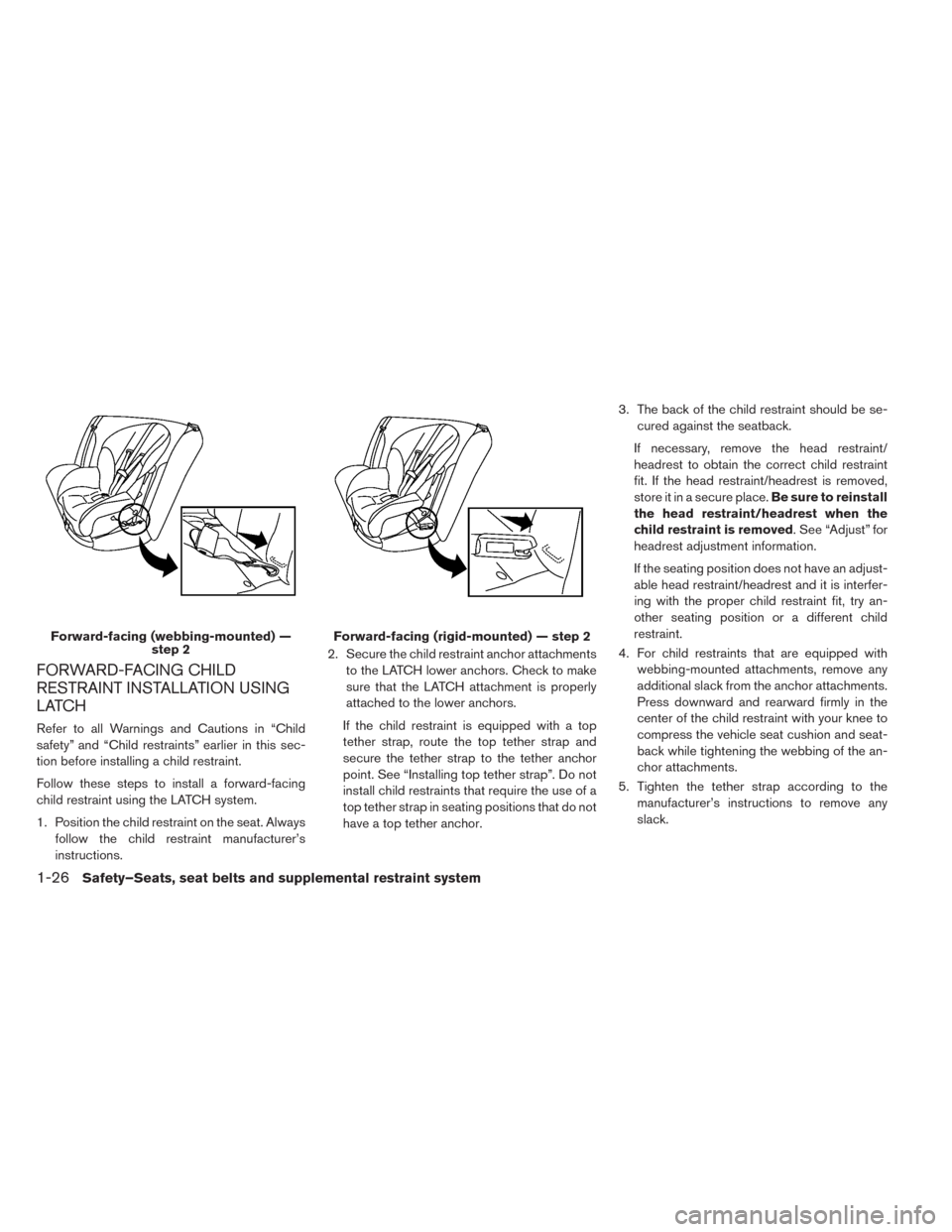
1. Position the child restraint on the seat. Always
follow the child restraint manufacturer’s
instructions.2. Secure the child restraint anchor attachments
to the LATCH lower anchors. Check to make
sure that the LATCH attachment is properly
attached to the lower anchors.
If the child restraint is equipped with a top
tether strap, route the top tether strap and
secure the tether strap to the tether anchor
point. See “Installing top tether strap”. Do not
install child restraints that require the use of a
top tether strap in seating positions that do not
have a top tether anchor.3. The back of the child restraint should be se-
cured against the seatback.
If necessary, remove the head restraint/
headrest to obtain the correct child restraint
fit. If the head restraint/headrest is removed,
store it in a secure place.Be sure to reinstall
the head restraint/headrest when the
child restraint is removed. See “Adjust” for
headrest adjustment information.
If the seating position does not have an adjust-
able head restraint/headrest and it is interfer-
ing with the proper child restraint fit, try an-
other seating position or a different child
restraint.
4. For child restraints that are equipped with
webbing-mounted attachments, remove any
additional slack from the anchor attachments.
Press downward and rearward firmly in the
center of the child restraint with your knee to
compress the vehicle seat cushion and seat-
back while tightening the webbing of the an-
chor attachments.
5. Tighten the tether strap according to the
manufacturer’s instructions to remove any
slack.
Forward-facing (webbing-mounted) —
step 2Forward-facing (rigid-mounted) — step 2
1-26Safety–Seats, seat belts and supplemental restraint system
Page 113 of 397
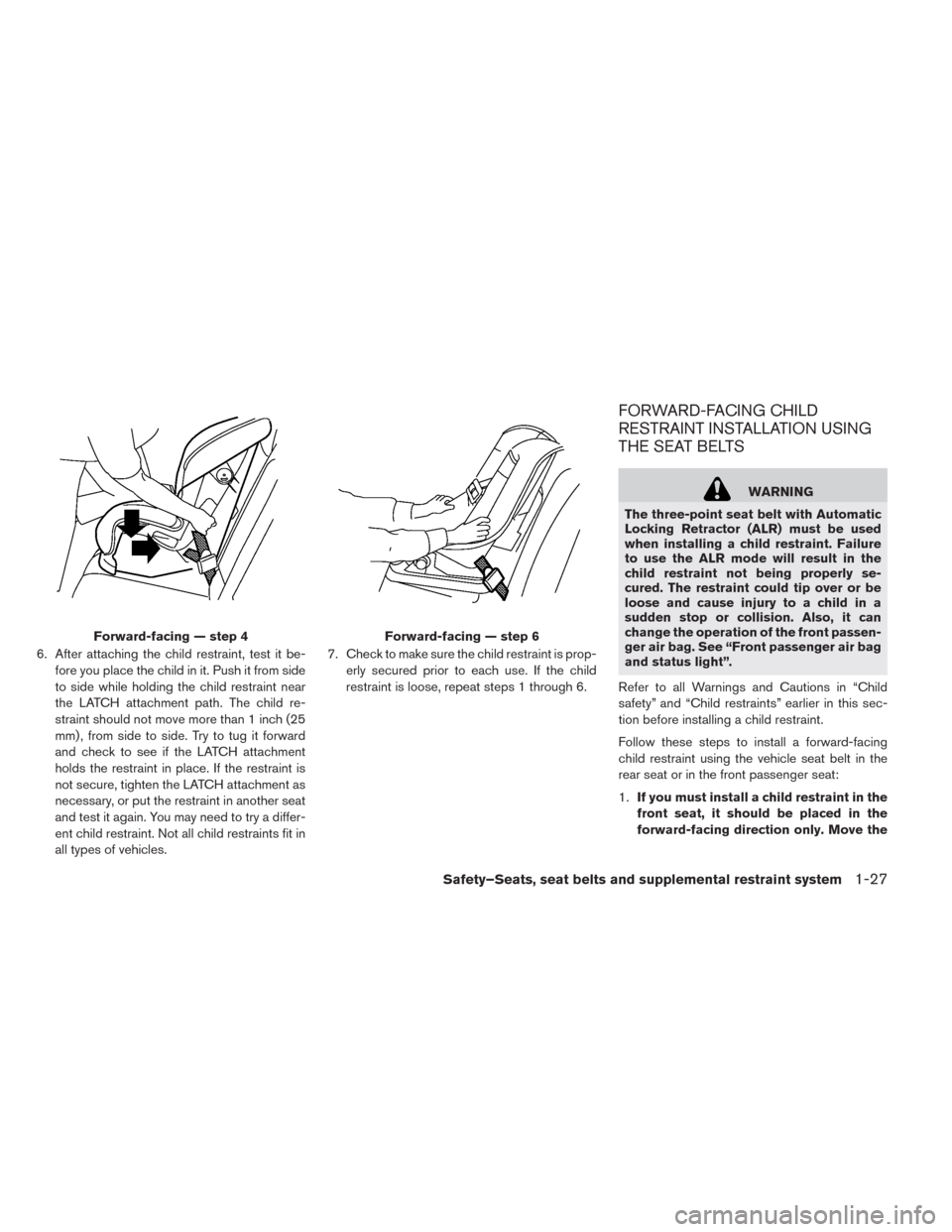
6. After attaching the child restraint, test it be-
fore you place the child in it. Push it from side
to side while holding the child restraint near
the LATCH attachment path. The child re-
straint should not move more than 1 inch (25
mm) , from side to side. Try to tug it forward
and check to see if the LATCH attachment
holds the restraint in place. If the restraint is
not secure, tighten the LATCH attachment as
necessary, or put the restraint in another seat
and test it again. You may need to try a differ-
ent child restraint. Not all child restraints fit in
all types of vehicles.7. Check to make sure the child restraint is prop-
erly secured prior to each use. If the child
restraint is loose, repeat steps 1 through 6.
FORWARD-FACING CHILD
RESTRAINT INSTALLATION USING
THE SEAT BELTS
WARNING
The three-point seat belt with Automatic
Locking Retractor (ALR) must be used
when installing a child restraint. Failure
to use the ALR mode will result in the
child restraint not being properly se-
cured. The restraint could tip over or be
loose and cause injury to a child in a
sudden stop or collision. Also, it can
change the operation of the front passen-
ger air bag. See “Front passenger air bag
and status light”.
Refer to all Warnings and Cautions in “Child
safety” and “Child restraints” earlier in this sec-
tion before installing a child restraint.
Follow these steps to install a forward-facing
child restraint using the vehicle seat belt in the
rear seat or in the front passenger seat:
1.If you must install a child restraint in the
front seat, it should be placed in the
forward-facing direction only. Move the
Forward-facing — step 4Forward-facing — step 6
Safety–Seats, seat belts and supplemental restraint system1-27
Page 114 of 397
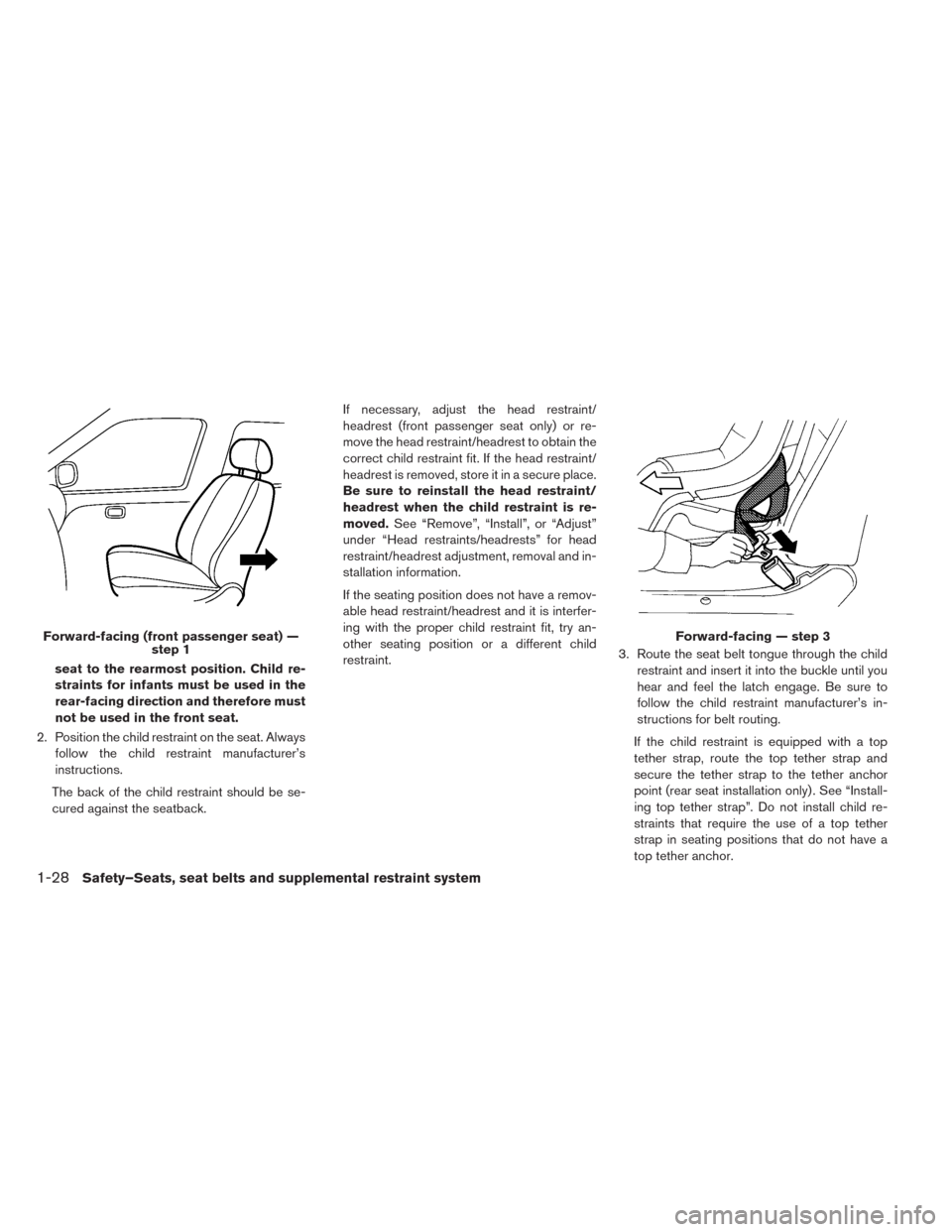
seat to the rearmost position. Child re-
straints for infants must be used in the
rear-facing direction and therefore must
not be used in the front seat.
2. Position the child restraint on the seat. Always
follow the child restraint manufacturer’s
instructions.
The back of the child restraint should be se-
cured against the seatback.If necessary, adjust the head restraint/
headrest (front passenger seat only) or re-
move the head restraint/headrest to obtain the
correct child restraint fit. If the head restraint/
headrest is removed, store it in a secure place.
Be sure to reinstall the head restraint/
headrest when the child restraint is re-
moved.See “Remove”, “Install”, or “Adjust”
under “Head restraints/headrests” for head
restraint/headrest adjustment, removal and in-
stallation information.
If the seating position does not have a remov-
able head restraint/headrest and it is interfer-
ing with the proper child restraint fit, try an-
other seating position or a different child
restraint.3. Route the seat belt tongue through the child
restraint and insert it into the buckle until you
hear and feel the latch engage. Be sure to
follow the child restraint manufacturer’s in-
structions for belt routing.
If the child restraint is equipped with a top
tether strap, route the top tether strap and
secure the tether strap to the tether anchor
point (rear seat installation only) . See “Install-
ing top tether strap”. Do not install child re-
straints that require the use of a top tether
strap in seating positions that do not have a
top tether anchor.
Forward-facing (front passenger seat) —
step 1Forward-facing — step 3
1-28Safety–Seats, seat belts and supplemental restraint system
Page 116 of 397
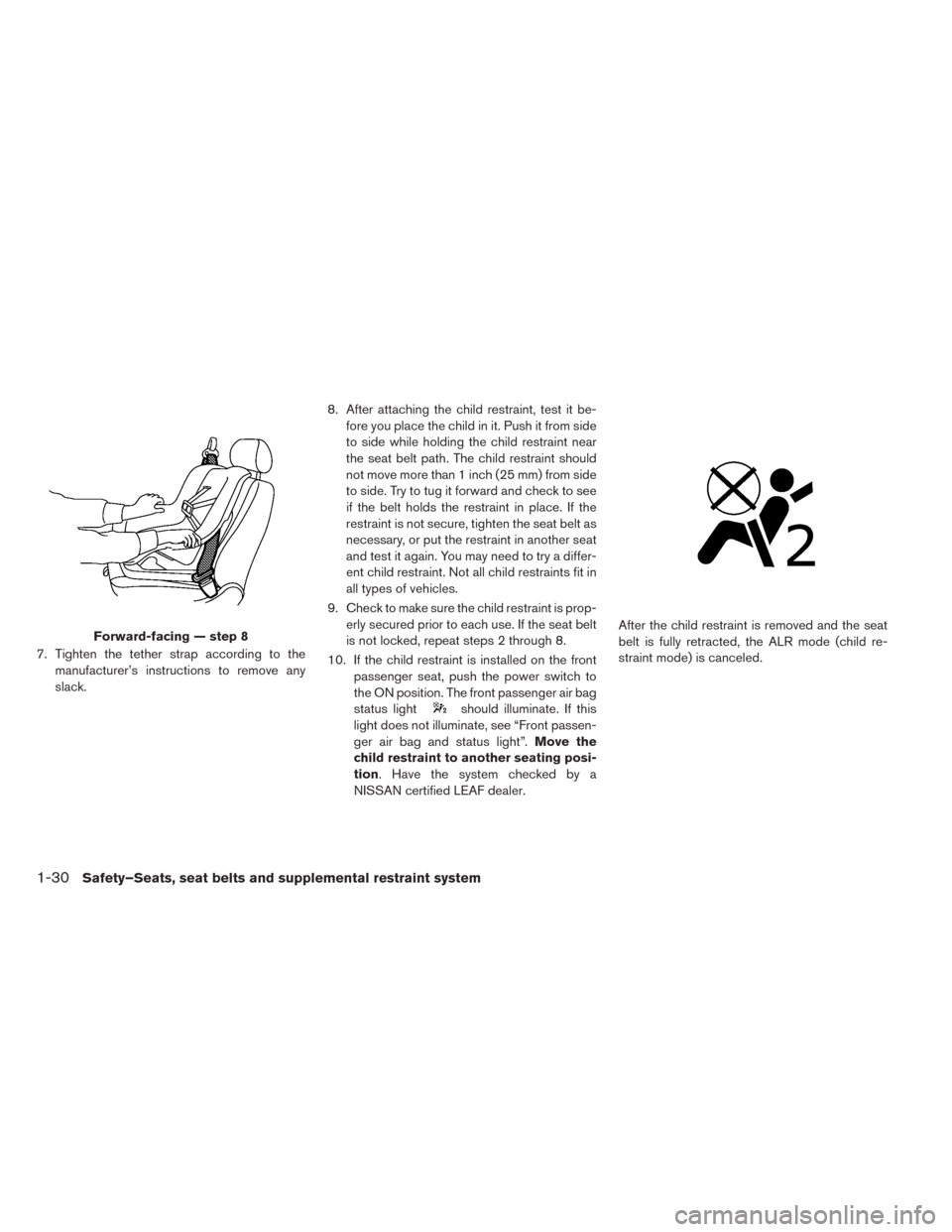
7. Tighten the tether strap according to the
manufacturer’s instructions to remove any
slack.8. After attaching the child restraint, test it be-
fore you place the child in it. Push it from side
to side while holding the child restraint near
the seat belt path. The child restraint should
not move more than 1 inch (25 mm) from side
to side. Try to tug it forward and check to see
if the belt holds the restraint in place. If the
restraint is not secure, tighten the seat belt as
necessary, or put the restraint in another seat
and test it again. You may need to try a differ-
ent child restraint. Not all child restraints fit in
all types of vehicles.
9. Check to make sure the child restraint is prop-
erly secured prior to each use. If the seat belt
is not locked, repeat steps 2 through 8.
10. If the child restraint is installed on the front
passenger seat, push the power switch to
the ON position. The front passenger air bag
status light
should illuminate. If this
light does not illuminate, see “Front passen-
ger air bag and status light”.Move the
child restraint to another seating posi-
tion. Have the system checked by a
NISSAN certified LEAF dealer.After the child restraint is removed and the seat
belt is fully retracted, the ALR mode (child re-
straint mode) is canceled.
Forward-facing — step 8
1-30Safety–Seats, seat belts and supplemental restraint system
Page 117 of 397
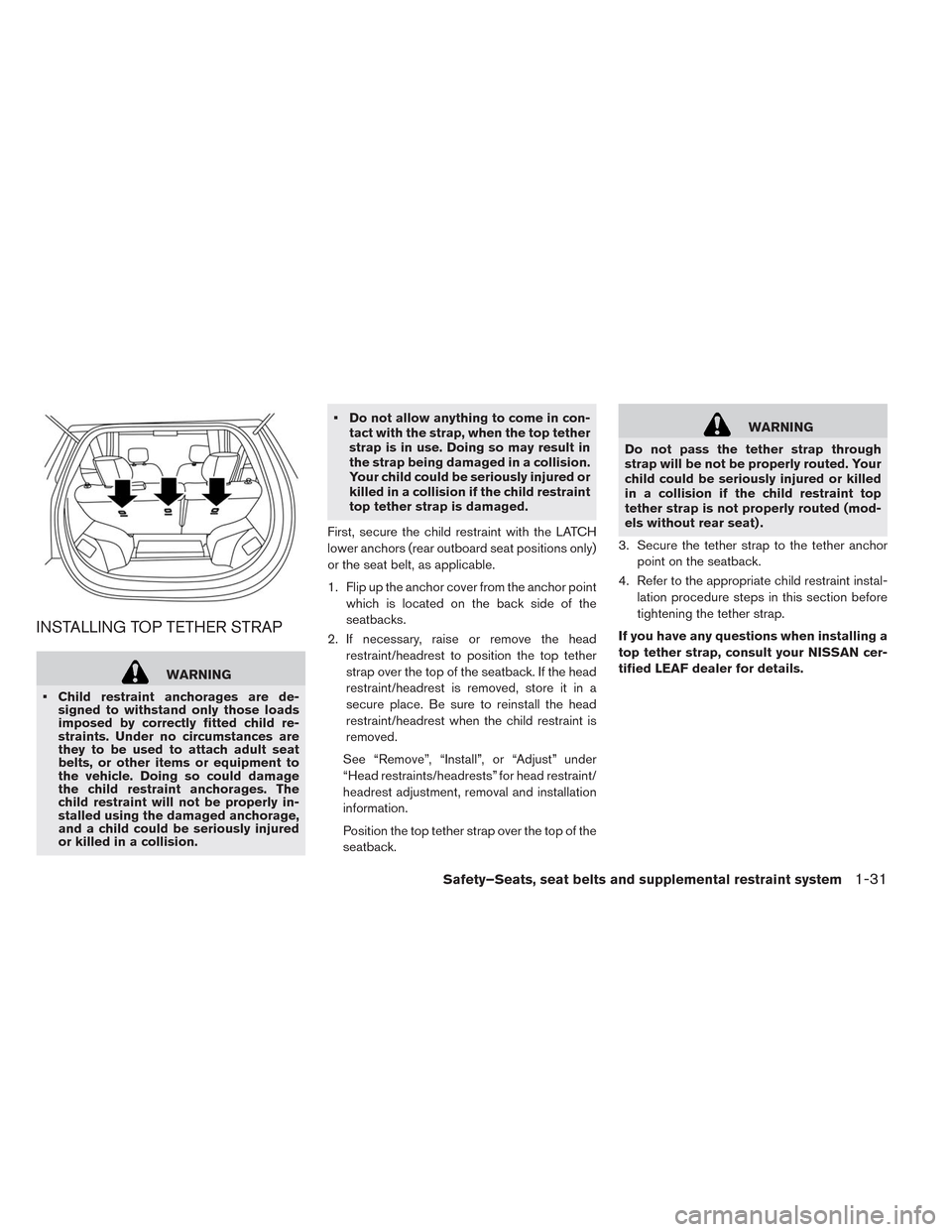
INSTALLING TOP TETHER STRAP
WARNING
• Child restraint anchorages are de-
signed to withstand only those loads
imposed by correctly fitted child re-
straints. Under no circumstances are
they to be used to attach adult seat
belts, or other items or equipment to
the vehicle. Doing so could damage
the child restraint anchorages. The
child restraint will not be properly in-
stalled using the damaged anchorage,
and a child could be seriously injured
or killed in a collision.• Do not allow anything to come in con-
tact with the strap, when the top tether
strap is in use. Doing so may result in
the strap being damaged in a collision.
Your child could be seriously injured or
killed in a collision if the child restraint
top tether strap is damaged.
First, secure the child restraint with the LATCH
lower anchors (rear outboard seat positions only)
or the seat belt, as applicable.
1. Flip up the anchor cover from the anchor point
which is located on the back side of the
seatbacks.
2. If necessary, raise or remove the head
restraint/headrest to position the top tether
strap over the top of the seatback. If the head
restraint/headrest is removed, store it in a
secure place. Be sure to reinstall the head
restraint/headrest when the child restraint is
removed.
See “Remove”, “Install”, or “Adjust” under
“Head restraints/headrests” for head restraint/
headrest adjustment, removal and installation
information.
Position the top tether strap over the top of the
seatback.
WARNING
Do not pass the tether strap through
strap will be not be properly routed. Your
child could be seriously injured or killed
in a collision if the child restraint top
tether strap is not properly routed (mod-
els without rear seat) .
3. Secure the tether strap to the tether anchor
point on the seatback.
4. Refer to the appropriate child restraint instal-
lation procedure steps in this section before
tightening the tether strap.
If you have any questions when installing a
top tether strap, consult your NISSAN cer-
tified LEAF dealer for details.
Safety–Seats, seat belts and supplemental restraint system1-31
Page 120 of 397
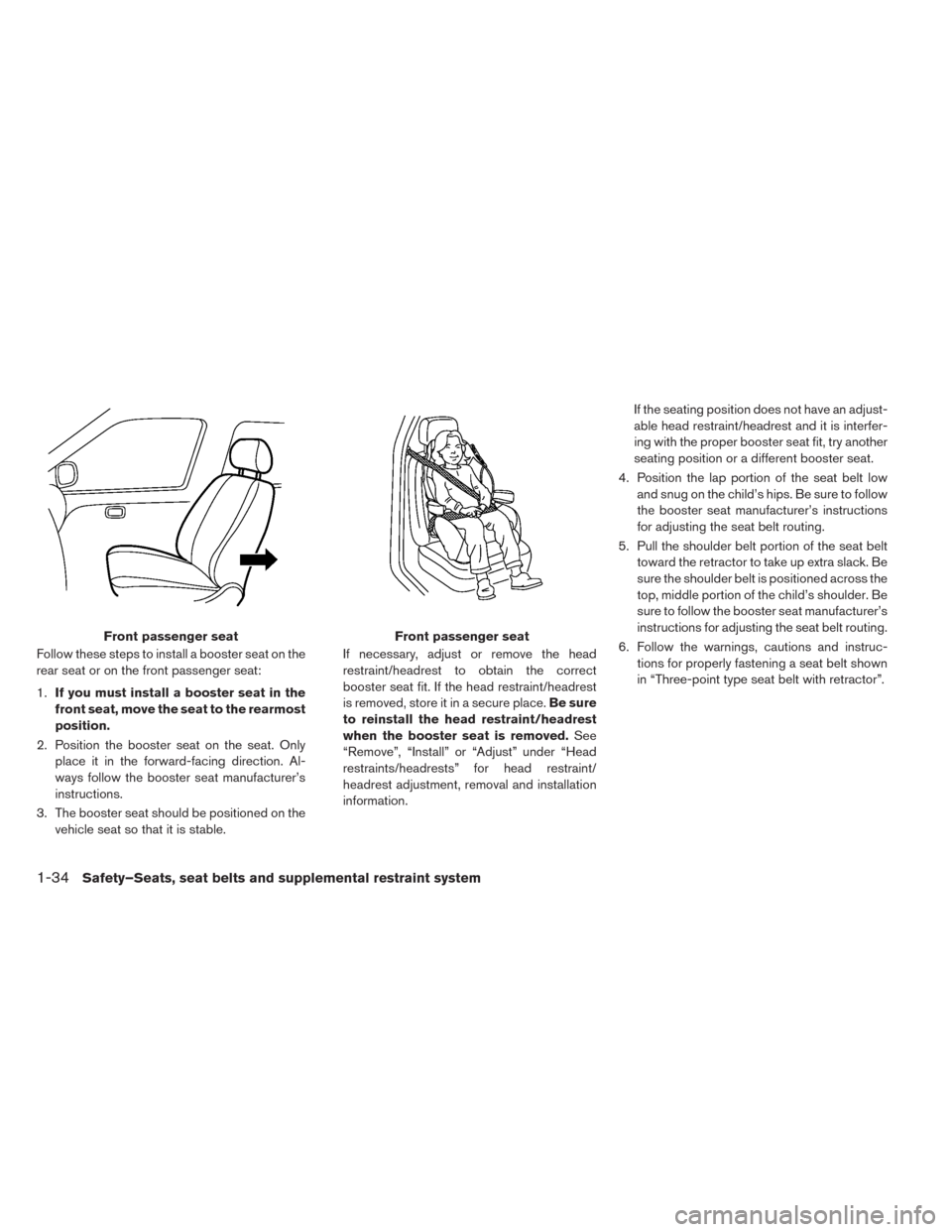
Follow these steps to install a booster seat on the
rear seat or on the front passenger seat:
1.If you must install a booster seat in the
front seat, move the seat to the rearmost
position.
2. Position the booster seat on the seat. Only
place it in the forward-facing direction. Al-
ways follow the booster seat manufacturer’s
instructions.
3. The booster seat should be positioned on the
vehicle seat so that it is stable.If necessary, adjust or remove the head
restraint/headrest to obtain the correct
booster seat fit. If the head restraint/headrest
is removed, store it in a secure place.Be sure
to reinstall the head restraint/headrest
when the booster seat is removed.See
“Remove”, “Install” or “Adjust” under “Head
restraints/headrests” for head restraint/
headrest adjustment, removal and installation
information.If the seating position does not have an adjust-
able head restraint/headrest and it is interfer-
ing with the proper booster seat fit, try another
seating position or a different booster seat.
4. Position the lap portion of the seat belt low
and snug on the child’s hips. Be sure to follow
the booster seat manufacturer’s instructions
for adjusting the seat belt routing.
5. Pull the shoulder belt portion of the seat belt
toward the retractor to take up extra slack. Be
sure the shoulder belt is positioned across the
top, middle portion of the child’s shoulder. Be
sure to follow the booster seat manufacturer’s
instructions for adjusting the seat belt routing.
6. Follow the warnings, cautions and instruc-
tions for properly fastening a seat belt shown
in “Three-point type seat belt with retractor”.
Front passenger seatFront passenger seat
1-34Safety–Seats, seat belts and supplemental restraint system
Page 129 of 397
• Passenger’s seat occupied by a small adult,
child or child restraint as outlined in this section:
The
light illuminates to indicate that the
front passenger air bag is OFF and will not
inflate in a crash.
• Occupied passenger seat and the passenger
meets the conditions outlined in this section:
The
light is OFF to indicate that the front
passenger air bag is operational.
Front passenger air bag:
The front passenger air bag is designed to auto-
matically turn OFF when the vehicle is operated
under some conditions as described below as
permitted by U.S. regulations. If the front passen-
ger air bag is OFF, it will not inflate in a crash. The
driver air bag and other air bags in your vehicle
are not part of this system.
The purpose of the regulation is to help reduce
the risk of injury or death from an inflating air bag
to certain front passenger seat occupants, such
as children, by requiring the air bag to be auto-
matically turned OFF.
One sensor used is the occupant classification
sensor (weight sensor) . Its is designed to detect
an occupant and objects on the seat by weight.
For example, if a child is in the front passengerseat, the Advanced Air Bag System is designed
to turn the passenger air bag OFF in accordance
with the regulations. Also, if a child restraint of the
type specified in the regulations is on the seat, its
weight and the child’s weight can be detected
and cause the air bag to turn OFF.
Front passenger seat adult occupants who are
properly seated and using the seat belt as out-
lined in this manual should not cause the passen-
ger air bag to be automatically turned OFF. For
small adults it may be turned OFF, however, if the
occupant does not sit in the seat properly (for
example, by not sitting upright, by sitting on an
edge of the seat, or by otherwise being out of
position) , this could cause the sensors to turn the
air bag OFF. Always be sure to be seated and
wearing the seat belt properly for the most effec-
tive protection by the seat belt and supplemental
air bag.
NISSAN recommends that pre-teens and chil-
dren be properly restrained in a rear seat.
NISSAN also recommends that appropriate child
restraints and booster seats be properly installed
in a rear seat. If this is not possible, the occupant
classification sensors are designed to operate as
described above to turn the front passenger air
bag OFF for specified child restraints. Failing toproperly secure child restraints and to use the
Automatic Locking Retractor (ALR) mode (child
restraint mode) may allow the restraint to tip or
move in an accident or sudden stop. This can
also result in the passenger air bag inflating in a
crash instead of being OFF. See “Child re-
straints” for proper use and installation.
If the front passenger seat is not occupied, the
passenger air bag is designed not to inflate in a
crash. However, heavy objects placed on the
seat could result in air bag inflation, because of
the object being detected by the occupant clas-
sification sensors. Other conditions could also
result in air bag inflation, such as if a child is
standing on the seat, or if two children are on the
seat, contrary to the instructions in this manual.
Always be sure that you and all vehicle occupants
are seated and restrained properly.
Using the passenger air bag status light, you can
monitor when the front passenger air bag is au-
tomatically turned OFF with the seat occupied.
The light will not illuminate when the front pas-
senger seat is unoccupied.
If an adult occupant is in the seat but the passen-
ger air bag status light is illuminated (indicating
that the air bag is OFF) , it could be that the
Safety–Seats, seat belts and supplemental restraint system1-43
Page 137 of 397
2 Instruments and controls
Cockpit.............................2-3
Instrument panel........................2-4
Meters and gauges......................2-5
Speedometer and odometer...............2-6
Li-ion battery temperature gauge............2-7
Power meter........................2-7
Driving range........................2-8
Li-ion battery available charge gauge.........2-9
Li-ion battery capacity level gauge..........2-10
Outside air temperature................2-10
ECO indicator......................2-10
Clock...........................2-11
Warning/indicator lights and audible reminders.....2-13
Checking bulbs.....................2-14
Warning lights......................2-14
Indicator lights......................2-20
Audible reminders....................2-22
Vehicle information display.................2-23
Indicators for operation.................2-24
Trip computer......................2-28
Warning information displays.............2-33
Indicators for maintenance...............2-35
Indicator for timer....................2-36
Security systems......................2-36Vehicle security system.................2-37
NISSAN Vehicle Immobilizer System.........2-38
Windshield wiper and washer switch...........2-39
Washer operation....................2-40
Rear window wiper and washer switch.........2-41
Rear window and outside mirror defroster switch . . .2-42
Instrument brightness control...............2-42
Headlight and turn signal switch.............2-43
Headlight switch.....................2-43
Turn signal switch....................2-45
Fog light switch (if so equipped)............
.2-45
Heated steering wheel switch...............2-46
Horn..............................2-47
ECO switch.........................2-47
Heated seat switch.....................2-47
Vehicle Dynamic Control (VDC) OFF switch......2-49
Charge port lid switch...................2-49
Charge connector lock switch...............2-50
Charge timer OFF switch.................2-50
Power outlet.........................2-50
Storage............................2-51
Cup holders.......................2-51
Sunglasses holder....................2-52
Glove box.........................2-53
Console box.......................2-53
Page 149 of 397
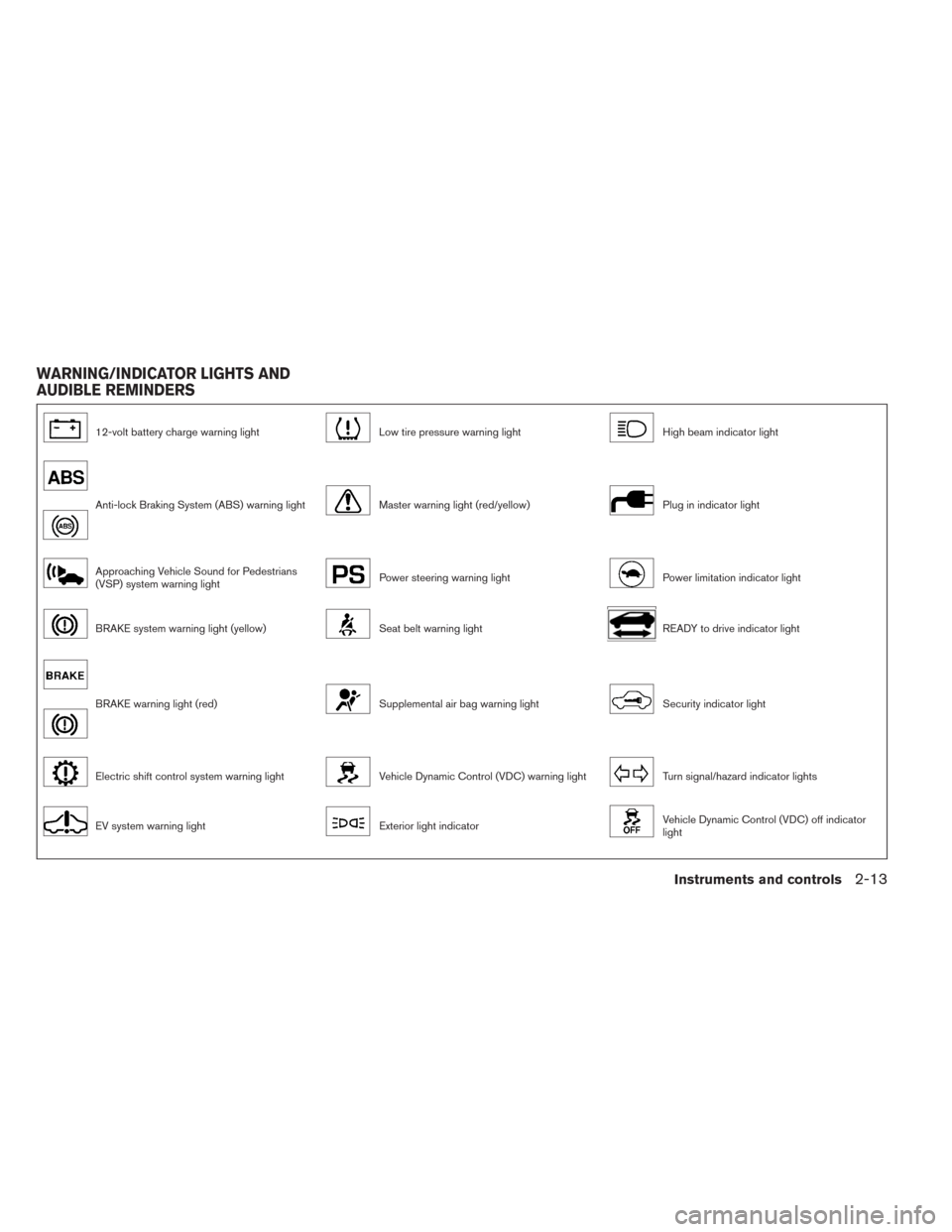
12-volt battery charge warning lightLow tire pressure warning lightHigh beam indicator light
Anti-lock Braking System (ABS) warning lightMaster warning light (red/yellow)Plug in indicator light
Approaching Vehicle Sound for Pedestrians
(VSP) system warning lightPower steering warning lightPower limitation indicator light
BRAKE system warning light (yellow)Seat belt warning lightREADY to drive indicator light
BRAKE warning light (red)Supplemental air bag warning lightSecurity indicator light
Electric shift control system warning lightVehicle Dynamic Control (VDC) warning lightTurn signal/hazard indicator lights
EV system warning lightExterior light indicatorVehicle Dynamic Control (VDC) off indicator
light
WARNING/INDICATOR LIGHTS AND
AUDIBLE REMINDERS
Instruments and controls2-13
Page 155 of 397
• If the vehicle is being driven at speeds
of less than 16 MPH (25 km/h) , the
TPMS may not operate correctly.
• Be sure to install the specified size of
tires to the four wheels correctly.
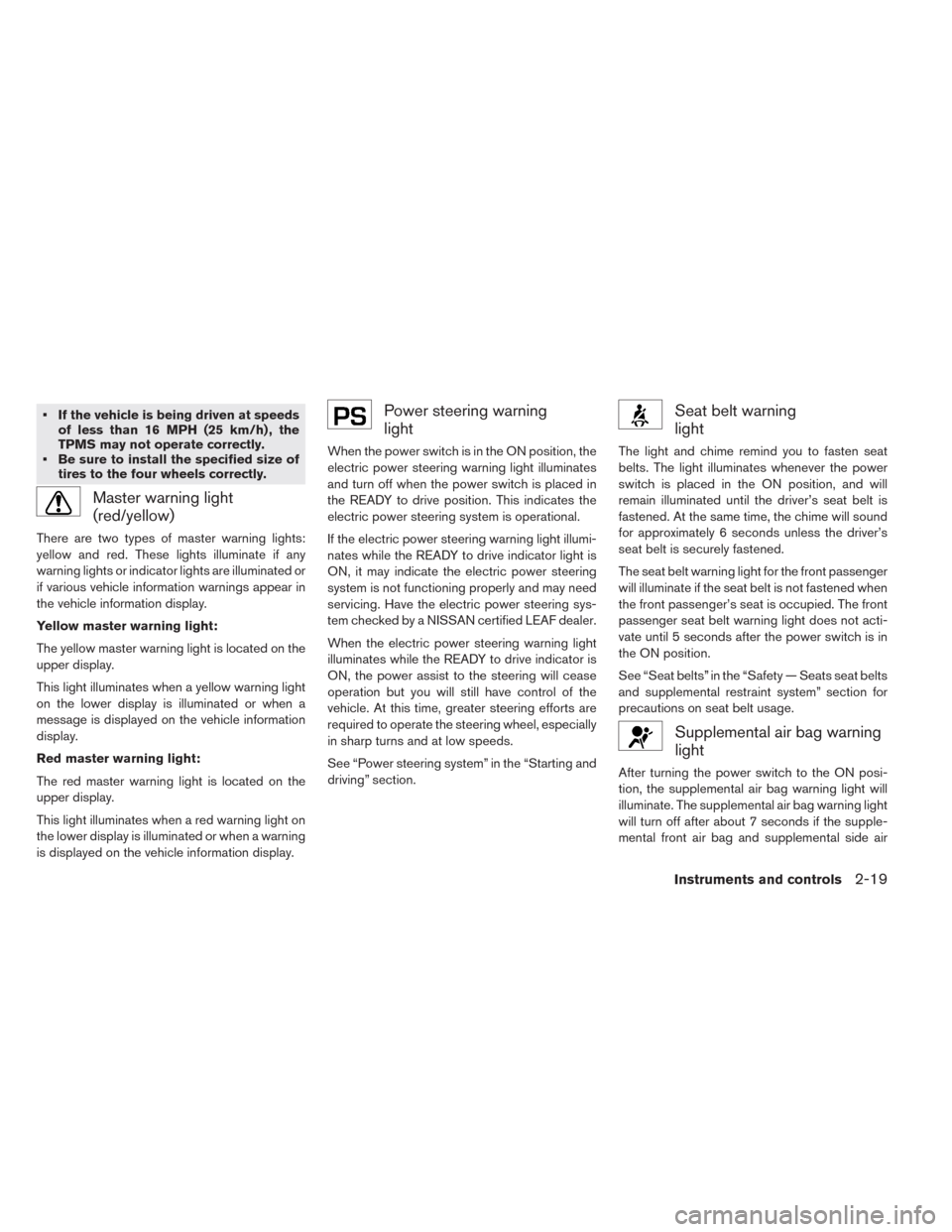
Master warning light
(red/yellow)
There are two types of master warning lights:
yellow and red. These lights illuminate if any
warning lights or indicator lights are illuminated or
if various vehicle information warnings appear in
the vehicle information display.
Yellow master warning light:
The yellow master warning light is located on the
upper display.
This light illuminates when a yellow warning light
on the lower display is illuminated or when a
message is displayed on the vehicle information
display.
Red master warning light:
The red master warning light is located on the
upper display.
This light illuminates when a red warning light on
the lower display is illuminated or when a warning
is displayed on the vehicle information display.
Power steering warning
light
When the power switch is in the ON position, the
electric power steering warning light illuminates
and turn off when the power switch is placed in
the READY to drive position. This indicates the
electric power steering system is operational.
If the electric power steering warning light illumi-
nates while the READY to drive indicator light is
ON, it may indicate the electric power steering
system is not functioning properly and may need
servicing. Have the electric power steering sys-
tem checked by a NISSAN certified LEAF dealer.
When the electric power steering warning light
illuminates while the READY to drive indicator is
ON, the power assist to the steering will cease
operation but you will still have control of the
vehicle. At this time, greater steering efforts are
required to operate the steering wheel, especially
in sharp turns and at low speeds.
See “Power steering system” in the “Starting and
driving” section.
Seat belt warning
light
The light and chime remind you to fasten seat
belts. The light illuminates whenever the power
switch is placed in the ON position, and will
remain illuminated until the driver’s seat belt is
fastened. At the same time, the chime will sound
for approximately 6 seconds unless the driver’s
seat belt is securely fastened.
The seat belt warning light for the front passenger
will illuminate if the seat belt is not fastened when
the front passenger’s seat is occupied. The front
passenger seat belt warning light does not acti-
vate until 5 seconds after the power switch is in
the ON position.
See “Seat belts” in the “Safety — Seats seat belts
and supplemental restraint system” section for
precautions on seat belt usage.
Supplemental air bag warning
light
After turning the power switch to the ON posi-
tion, the supplemental air bag warning light will
illuminate. The supplemental air bag warning light
will turn off after about 7 seconds if the supple-
mental front air bag and supplemental side air
Instruments and controls2-19