battery NISSAN LEAF 2016 1.G Dismantling Guide
[x] Cancel search | Manufacturer: NISSAN, Model Year: 2016, Model line: LEAF, Model: NISSAN LEAF 2016 1.GPages: 46, PDF Size: 1.63 MB
Page 15 of 46
Please contact following number if the high voltage battery cannot be discharged.
• Nissan EV Customer Support: 1-877-664-2738 (Hours of operation are Monday - Friday
7am - 7pm, Saturday 8am - 4:30pm Central time zone)
• Nissan Consumer Affairs: 1-800-647-7261 (US) or 1-800-387-0122 (Canada) (Hours of operation are 8am - 5pm (Monday - Friday) Eastern, Central and Pacific time zones)
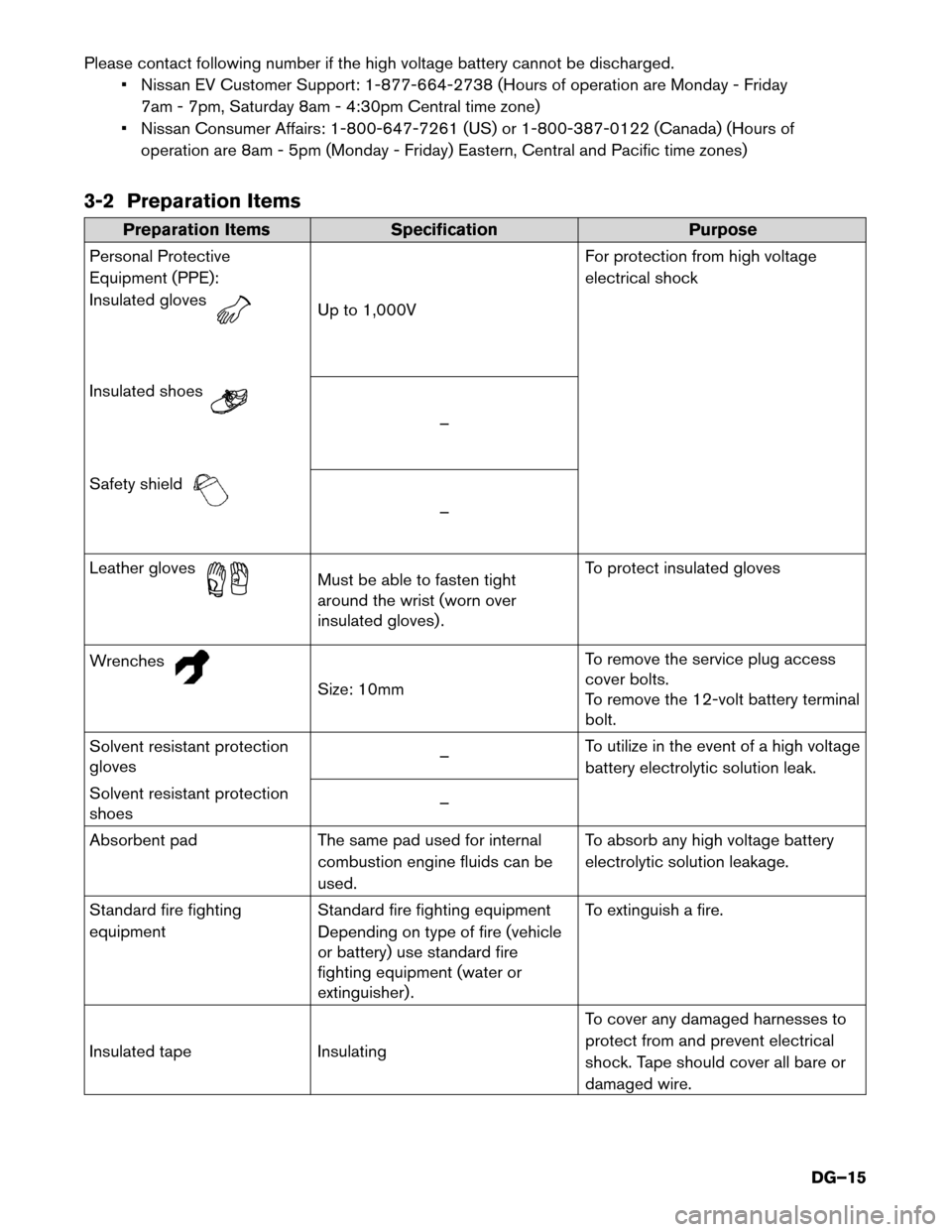
3-2 Preparation Items Preparation Items
Specification Purpose
Personal
Protective
Equipment (PPE):
Insulated gloves Up to 1,000V
For
protection from high voltage
electrical shock
Insulated shoes –
Safety
shield –
Leather
gloves Must be able to fasten tight
around
the wrist (worn over
insulated gloves) . To protect insulated gloves
Wrenches Size: 10mm
T
o remove the service plug access
cover bolts.
To remove the 12-volt battery terminal
bolt.
Solvent resistant protection
gloves –
To utilize in the event of a high voltage
battery electrolytic solution leak.
Solvent resistant protection
shoes –
Absorbent pad The same pad used for internal
combustion engine fluids can be
used. To absorb any high voltage battery
electrolytic solution leakage.
Standard fire fighting
equipment Standard fire fighting equipment
Depending on type of fire (vehicle
or battery) use standard fire
fighting equipment (water or
extinguisher) . To extinguish a fire.
Insulated tape Insulating To cover any damaged harnesses to
protect from and prevent electrical
shock. Tape should cover all bare or
damaged wire.
DG–15
Page 16 of 46
3-3 Personal Protective Equipment (PPE) and Insulated Tools
3-3.1
Personal Protective Equipment (PPE) Protective Wear Control
Perform an inspection of the Personal Protective Equipment (PPE) items before beginning work. Do not use
any damaged PPE items.
3-3.2 Daily Inspection
This inspection is performed before and after use. The worker who will be using the items should perform
the inspection and check for deterioration and damage. • Insulated rubber gloves should be inspected for scratches, holes and tears. (Visual check and airleakage test)
• Insulated safety boots should be inspected for holes, damage, nails, metal pieces, wear or other problems on the soles. (Visual check)
• Insulated rubber sheet should be inspected for tears. (Visual check)
3-3.3 Insulated Tools
When performing work at locations where high voltage is applied (such as terminals) , use insulated tools
meeting 1,000V/300A specifications.
3-4 High Voltage System Shut-Down Procedures
Once the high voltage battery is properly discharged, any of the following procedures can shut down and
isolate the high voltage system. The dismantling operation can only begin after shutting down the high
voltage system. If the vehicle is heavily damaged, for example the high voltage battery is deformed, broken
or cracked, appropriate Personal Protective Equipment (PPE) must always be used and the high voltage
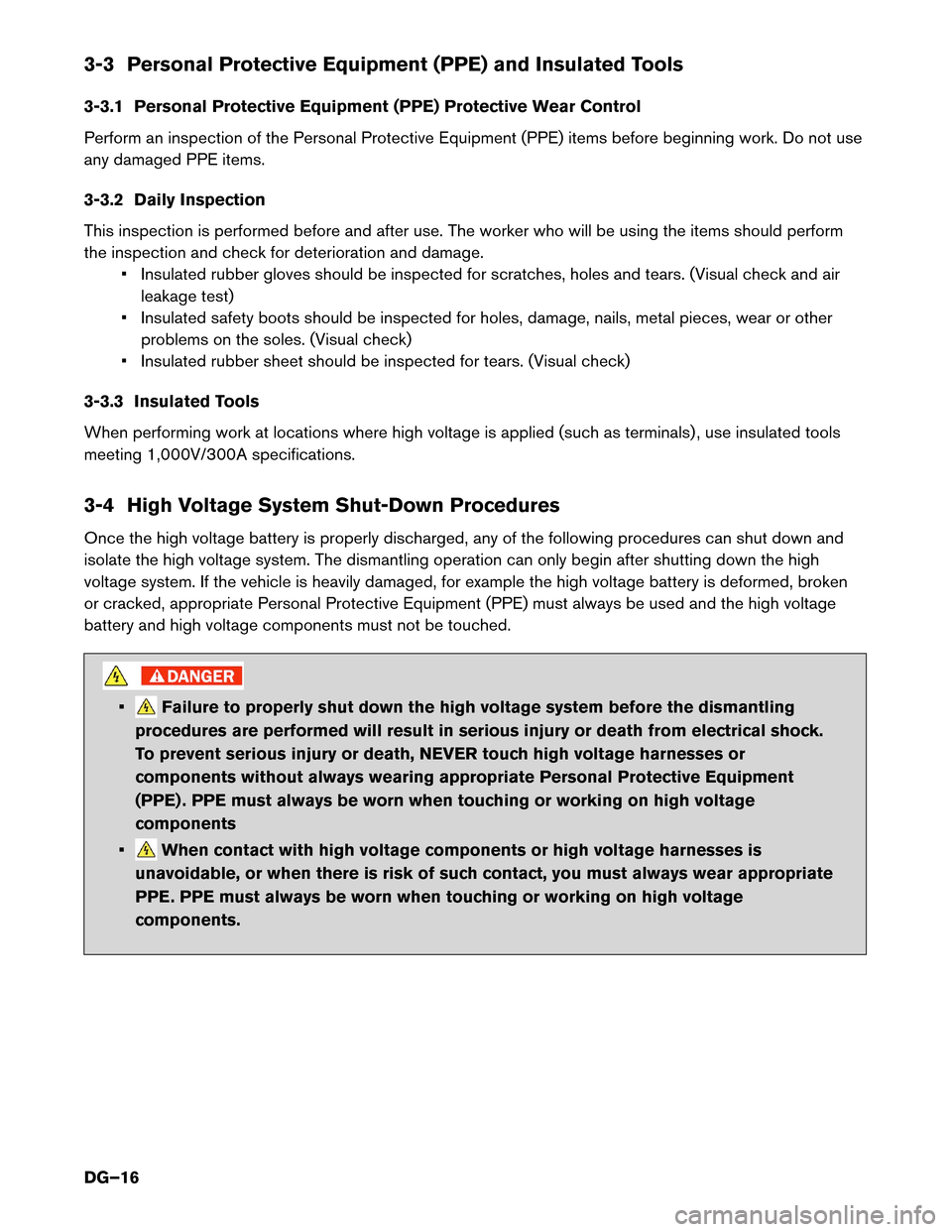
battery and high voltage components must not be touched. • Failure to properly shut down the high voltage system before the dismantling
procedures
are performed will result in serious injury or death from electrical shock.
To prevent serious injury or death, NEVER touch high voltage harnesses or
components without always wearing appropriate Personal Protective Equipment
(PPE) . PPE must always be worn when touching or working on high voltage
components
• When contact with high voltage components or high voltage harnesses is
unavoidable,
or when there is risk of such contact, you must always wear appropriate
PPE. PPE must always be worn when touching or working on high voltage
components.
DG–16
Page 17 of 46
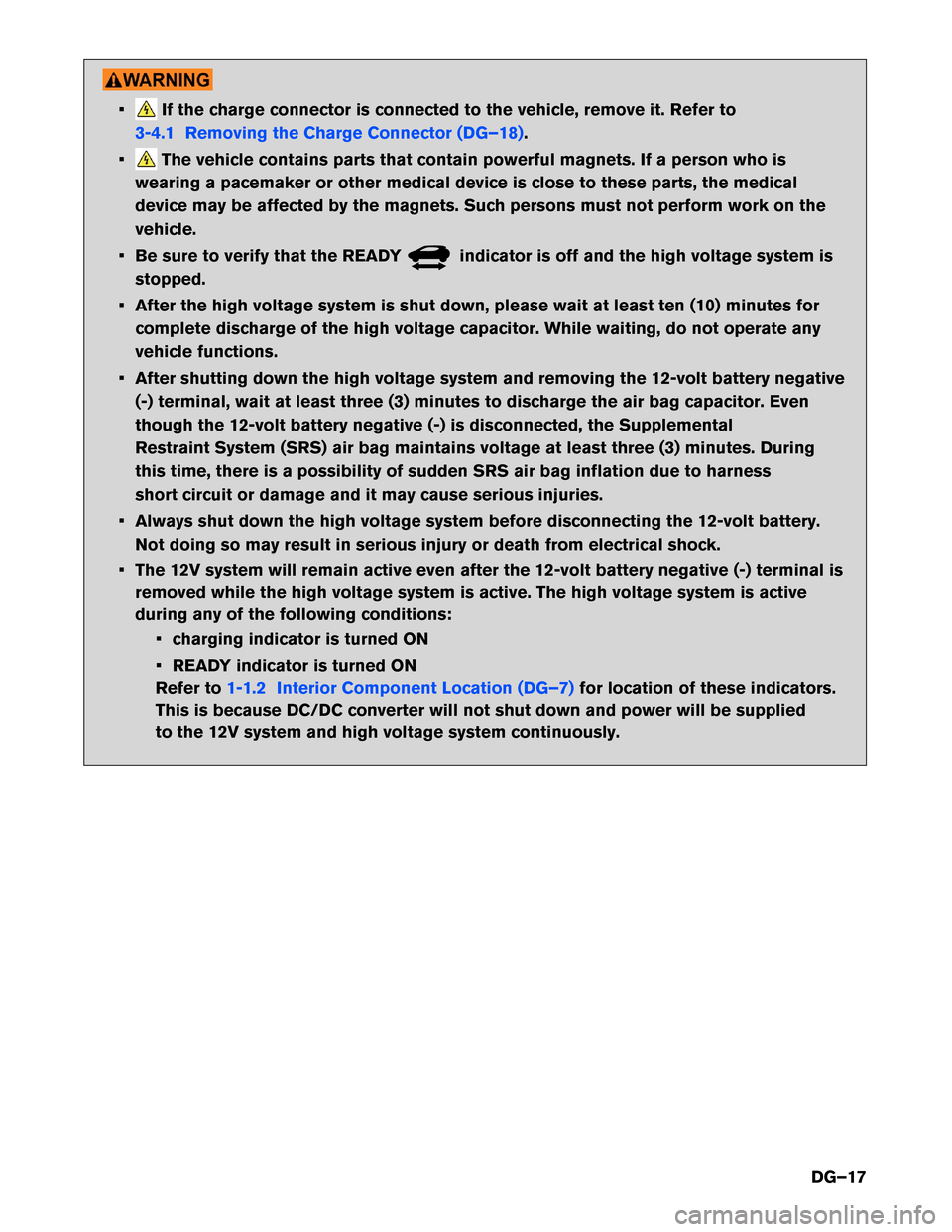
• If the charge connector is connected to the vehicle, remove it. Refer to
3-4.1 Removing the Charge Connector (DG–18).
• The vehicle contains parts that contain powerful magnets. If a person who is
wearing a pacemaker or other medical device is close to these parts, the medical
device may be affected by the magnets. Such persons must not perform work on the
vehicle.
• Be sure to verify that the READY indicator is off and the high voltage system is
stopped.
•
After the high voltage system is shut down, please wait at least ten (10) minutes for
complete discharge of the high voltage capacitor. While waiting, do not operate any
vehicle functions.
• After shutting down the high voltage system and removing the 12-volt battery negative (-) terminal, wait at least three (3) minutes to discharge the air bag capacitor. Even
though the 12-volt battery negative (-) is disconnected, the Supplemental
Restraint System (SRS) air bag maintains voltage at least three (3) minutes. During
this time, there is a possibility of sudden SRS air bag inflation due to harness
short circuit or damage and it may cause serious injuries.
• Always shut down the high voltage system before disconnecting the 12-volt battery. Not doing so may result in serious injury or death from electrical shock.
• The 12V system will remain active even after the 12-volt battery negative (-) terminal is removed while the high voltage system is active. The high voltage system is active
during any of the following conditions:
• charging indicator is turned ON
• READY indicator is turned ON
Refer to 1-1.2 Interior Component Location (DG–7)
for location of these indicators.
This
is because DC/DC converter will not shut down and power will be supplied
to the 12V system and high voltage system continuously.
DG–17
Page 20 of 46
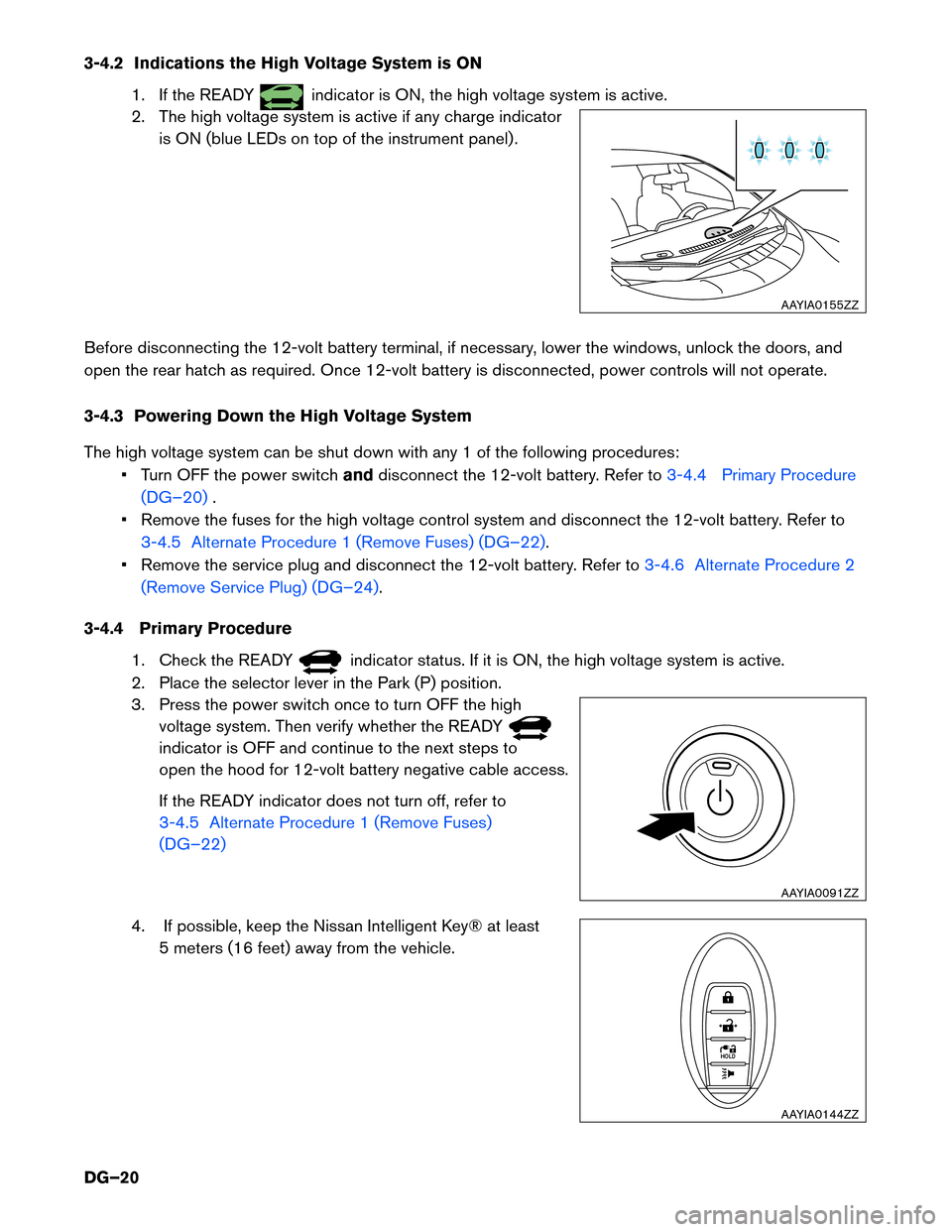
3-4.2 Indications the High Voltage System is ON
1. If the READY indicator is ON, the high voltage system is active.
2.
The high voltage system is active if any charge indicator
is ON (blue LEDs on top of the instrument panel) .
Before disconnecting the 12-volt battery terminal, if necessary, lower the windows, unlock the doors, and
open the rear hatch as required. Once 12-volt battery is disconnected, power controls will not operate.
3-4.3 Powering Down the High Voltage System
The high voltage system can be shut down with any 1 of the following procedures: • Turn OFF the power switch anddisconnect the 12-volt battery. Refer to
3-4.4 Primary Procedure
(DG–20) .
•
Remove the fuses for the high voltage control system and disconnect the 12-volt battery. Refer to
3-4.5 Alternate Procedure 1 (Remove Fuses) (DG–22).
•
Remove the service plug and disconnect the 12-volt battery. Refer to 3-4.6 Alternate Procedure 2
(Remove
Service Plug) (DG–24) .
3-4.4
Primary Procedure
1. Check the READY indicator status. If it is ON, the high voltage system is active.
2.
Place the selector lever in the Park (P) position.
3. Press the power switch once to turn OFF the high voltage system. Then verify whether the READY indicator is OFF and continue to the next steps to
open
the hood for 12-volt battery negative cable access.
If the READY indicator does not turn off, refer to
3-4.5 Alternate Procedure 1 (Remove Fuses)
(DG–22)
4. If possible, keep the Nissan Intelligent Key® at least 5
meters (16 feet) away from the vehicle. AAYIA0155ZZ
AAYIA0091ZZ
HOLD
AAYIA0144ZZ
DG–20
Page 21 of 46
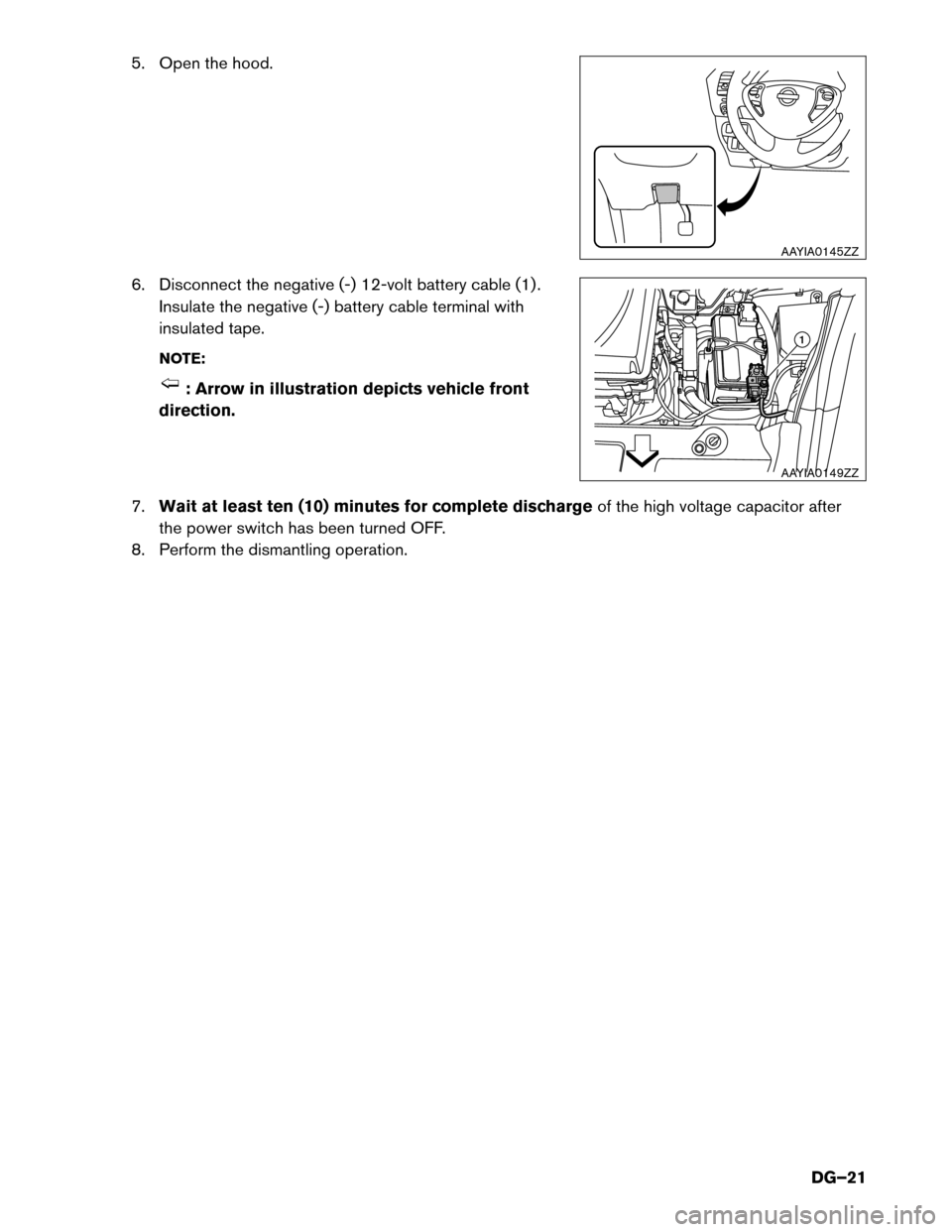
5. Open the hood.
6.
Disconnect the negative (-) 12-volt battery cable (1) .
Insulate the negative (-) battery cable terminal with
insulated tape.
NOTE: : Arrow in illustration depicts vehicle front
direction.
7. Wait
at least ten (10) minutes for complete discharge of the high voltage capacitor after
the power switch has been turned OFF.
8. Perform the dismantling operation. AAYIA0145ZZ
1
AAYIA0149ZZ
DG–21
Page 24 of 46
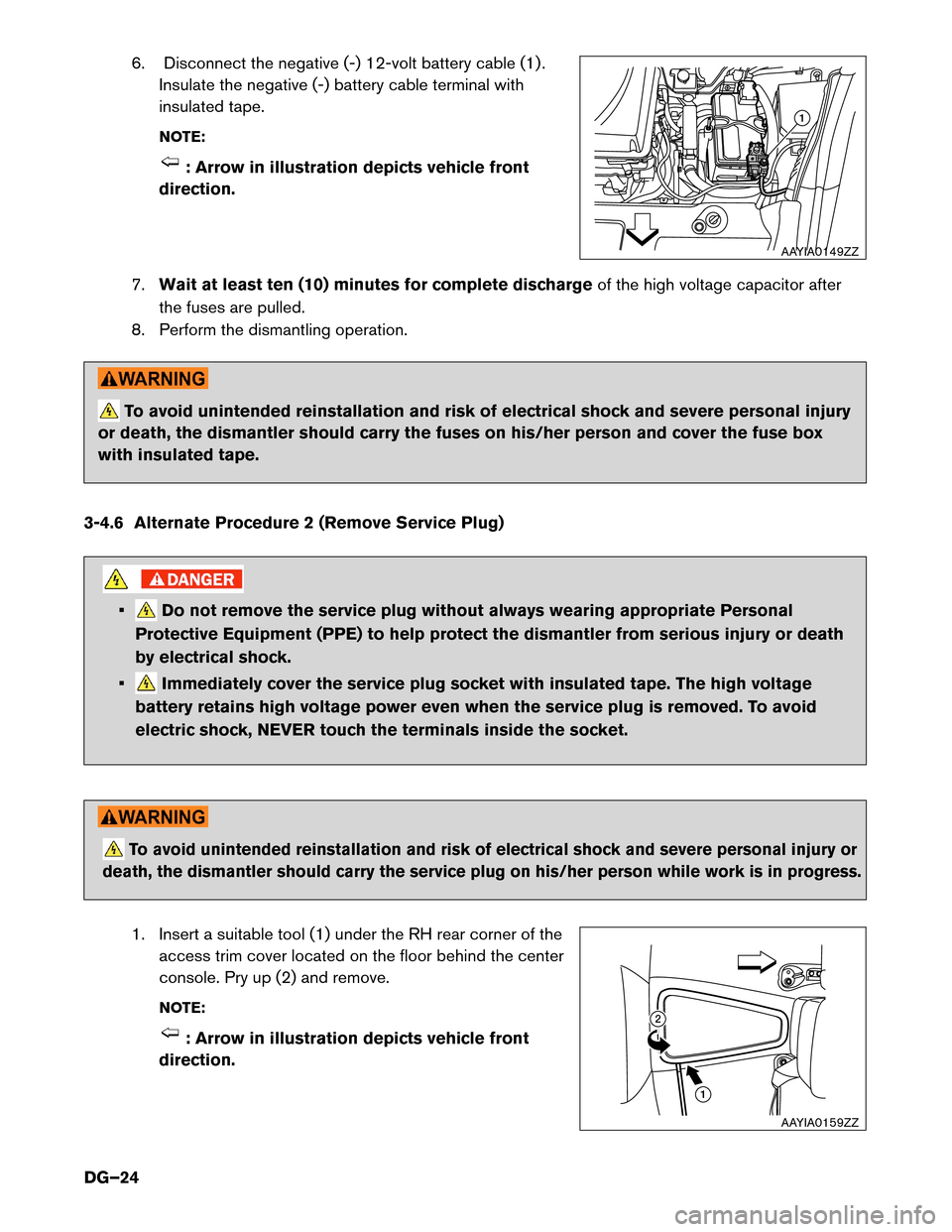
6. Disconnect the negative (-) 12-volt battery cable (1) .
Insulate the negative (-) battery cable terminal with
insulated tape.
NOTE: : Arrow in illustration depicts vehicle front
direction.
7. Wait
at least ten (10) minutes for complete discharge of the high voltage capacitor after
the fuses are pulled.
8. Perform the dismantling operation. To avoid unintended reinstallation and risk of electrical shock and severe personal injury
or
death, the dismantler should carry the fuses on his/her person and cover the fuse box
with insulated tape.
3-4.6 Alternate Procedure 2 (Remove Service Plug) • Do not remove the service plug without always wearing appropriate Personal
Protective
Equipment (PPE) to help protect the dismantler from serious injury or death
by electrical shock.
• Immediately cover the service plug socket with insulated tape. The high voltage
battery
retains high voltage power even when the service plug is removed. To avoid
electric shock, NEVER touch the terminals inside the socket.
To avoid unintended reinstallation and risk of electrical shock and severe personal injury or
death, the dismantler should carry the service plug on his/her person while work is in progress.
1. Insert a suitable tool (1) under the RH rear corner of the access trim cover located on the floor behind the center
console. Pry up (2) and remove.
NOTE: : Arrow in illustration depicts vehicle front
direction. 1
AAYIA0149ZZ 12
AAYIA0159ZZ
DG–24
Page 26 of 46
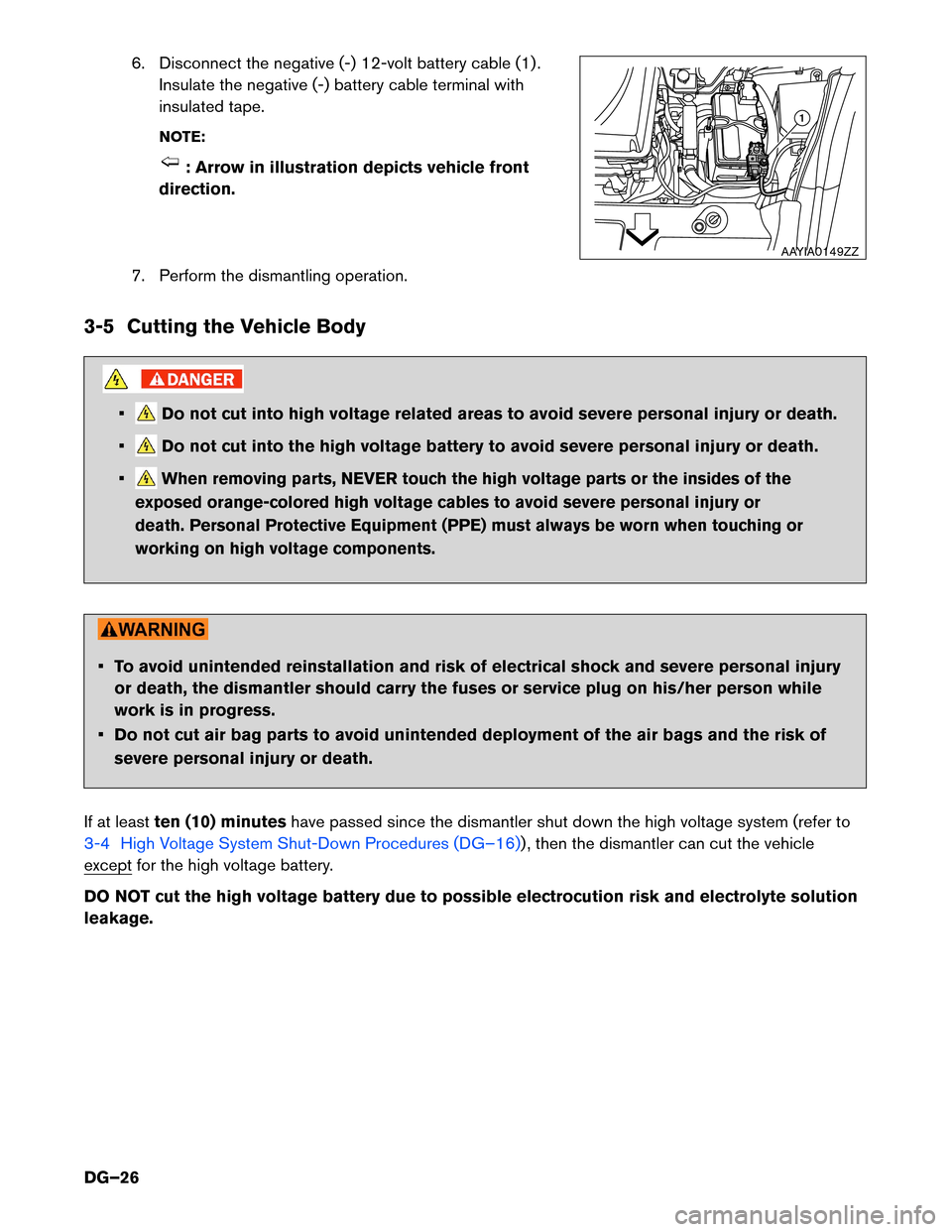
6. Disconnect the negative (-) 12-volt battery cable (1) .
Insulate the negative (-) battery cable terminal with
insulated tape.
NOTE: : Arrow in illustration depicts vehicle front
direction.
7.
Perform the dismantling operation.
3-5 Cutting the Vehicle Body • Do not cut into high voltage related areas to avoid severe personal injury or death.
• Do not cut into the high voltage battery to avoid severe personal injury or death.
•
When removing parts, NEVER touch the high voltage parts or the insides of the
exposed orange-colored high voltage cables to avoid severe personal injury or
death. Personal Protective Equipment (PPE) must always be worn when touching or
working on high voltage components. • To avoid unintended reinstallation and risk of electrical shock and severe personal injury
or
death, the dismantler should carry the fuses or service plug on his/her person while
work is in progress.
• Do not cut air bag parts to avoid unintended deployment of the air bags and the risk of severe personal injury or death.
If at least ten (10) minutes have passed since the dismantler shut down the high voltage system (refer to
3-4 High Voltage System Shut-Down Procedures (DG–16)) , then the dismantler can cut the vehicle
except
for the high voltage battery. DO NOT cut the high voltage battery due to possible electrocution risk and electrolyte solution
leakage. 1
AAYIA0149ZZ
DG–26
Page 27 of 46
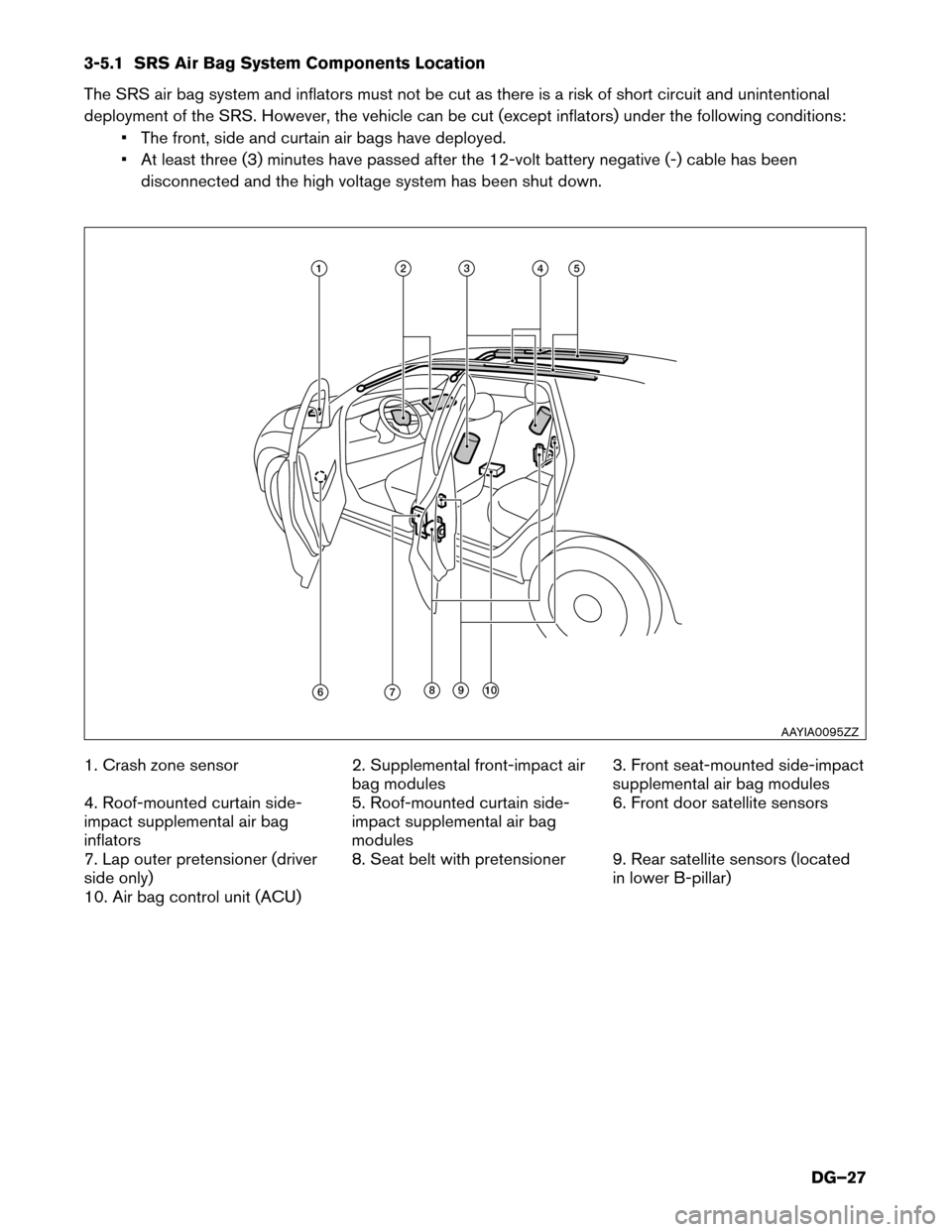
3-5.1 SRS Air Bag System Components Location
The
SRS air bag system and inflators must not be cut as there is a risk of short circuit and unintentional
deployment of the SRS. However, the vehicle can be cut (except inflators) under the following conditions: • The front, side and curtain air bags have deployed.
• At least three (3) minutes have passed after the 12-volt battery negative (-) cable has beendisconnected and the high voltage system has been shut down.
1. Crash zone sensor 2. Supplemental front-impact air
bag modules 3. Front seat-mounted side-impact
supplemental air bag modules
4. Roof-mounted curtain side-
impact supplemental air bag
inflators 5. Roof-mounted curtain side-
impact supplemental air bag
modules6. Front door satellite sensors
7. Lap outer pretensioner (driver
side only) 8. Seat belt with pretensioner 9. Rear satellite sensors (located
in lower B-pillar)
10. Air bag control unit (ACU) 11 2 3 4 5
6 7 8 9 10
AAYIA0095ZZ
DG–27
Page 28 of 46
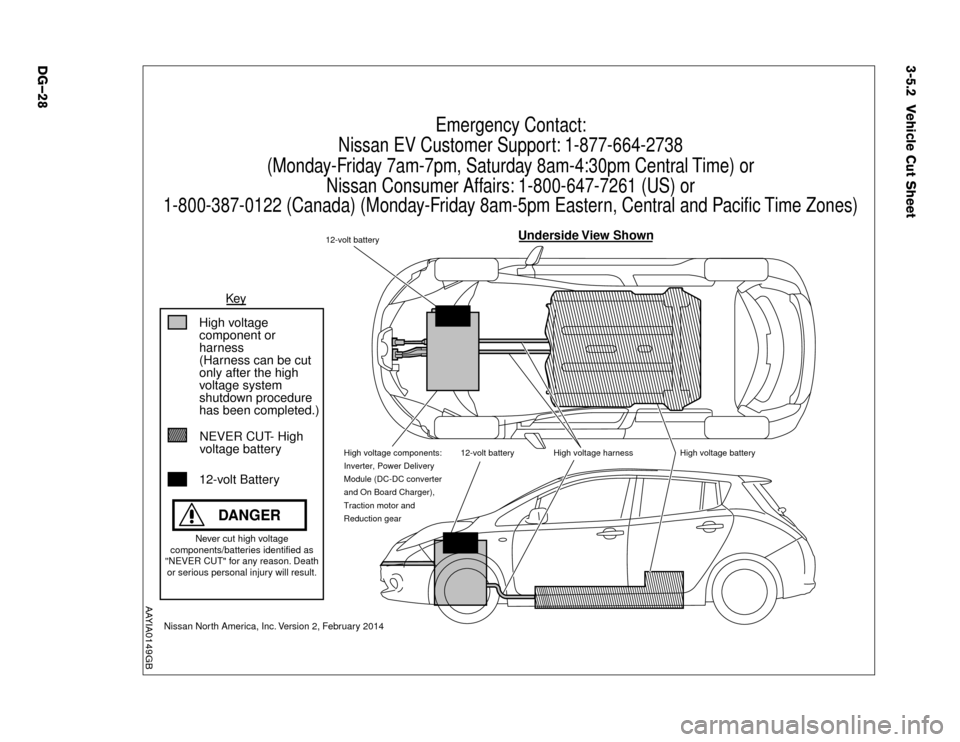
3-5.2 Vehicle Cut Sheet12-volt Battery
Nissan North America, Inc. Version 2, February 2014 DANGER
High voltage battery
High voltage harness
12-volt battery
12-volt battery
1-800-387-0122 (Canada) (Monday-Friday 8am-5pm Eastern, Central and Pacific Time Zones) Nissan Consumer Affairs: 1-800-647-7261 (US) or
(Monday-Friday 7am-7pm, Saturday 8am-4:30pm Central Time) or Nissan EV Customer Support: 1-877-664-2738
Emergency Contact:
NEVER CUT- High
voltage battery
High voltage
component or
harness
(Harness can be cut
only after the high
voltage system
shutdown procedure
has been completed.)
Never cut high voltage
components/batteries identified as
"NEVER CUT" for any reason. Death or serious personal injury will result. High voltage components:
Inverter, Power Delivery
Module (DC-DC converter
and On Board Charger),
Traction motor and
Reduction gear
Key
Under
side View Shown
AAYIA0149GB
DG–28
Page 30 of 46
3-6 High Voltage Battery Damage and Fluid Leaks
The high voltage battery contains electrolyte solution. To avoid exposure to electrolyte
solution
and serious personal injury, always wear appropriate solvent resistant Personal
Protective Equipment (PPE) and read the following precautions:
• Electrolyte solution is a skin irritant.
• Electrolyte solution is an eye irritant – If contact with eyes, rinse with plenty of water and see a doctor immediately.
• If electrolyte leak occurs, wear appropriate solvent resistant PPE and use a dry cloth to clean up the spilled electrolyte. Be sure to adequately ventilate the area.
• Electrolyte solution is highly flammable
• Electrolyte liquid or fumes that have come into contact with water vapors in the air will create an oxidized substance. This substance may irritate skin and eyes. In these
cases, rinse with plenty of water and see a doctor immediately.
• Electrolyte fumes (when inhaled) can cause respiratory irritation and acute intoxication. Move to fresh air and wash mouth with water. See a doctor immediately.
In cases of battery case breach or electrolyte leakage, contact the fire department immediately. If you must
walk away from the vehicle, notify an appropriate responder of the fact that the vehicle is an electric car and
contains a high voltage system and warn all others.
High voltage Battery Electrolyte Solution Characteristics: • Clear in color
• Sweet odor
• Similar viscosity to water
• Since the high voltage battery is made up of many small sealed battery modules, electrolyte solutionleakage should be minimal.
NOTE:
Other fluids in the vehicle are the same as those in a conventional internal combustion
vehicle.
DG–30