wheel nuts NISSAN LEAF 2016 1.G Owners Manual
[x] Cancel search | Manufacturer: NISSAN, Model Year: 2016, Model line: LEAF, Model: NISSAN LEAF 2016 1.GPages: 437, PDF Size: 4.56 MB
Page 356 of 437
keeps the motor hood from opening when the
primary latch is released.
When driving in areas using road salt or other
corrosive materials, check lubrication frequently.
Lights*:Clean the headlights on a regular basis.
Make sure that the headlights, stop lights, tail
lights, turn signal lights and other lights are all
operating properly and installed securely. Also
check the aim of the headlights.
Road wheel nuts (lug nuts)*: When checking
the tires, make sure that no wheel nuts are miss-
ing, and check for any loose wheel nuts. Tighten
if necessary.
Tire rotation*: Tires should be rotated every
5,000 miles (8,000 km) .
Tires*: Check the pressure with a gauge often
and always prior to long distance trips. If neces-
sary, adjust the pressure in all tires to the pres-
sure specified. Check carefully for damage, cuts
or excessive wear.
Tire Pressure Monitoring System (TPMS)
transmitter components: Replace the TPMS
transmitter grommet seal, valve core and cap
when the tires are replaced due to wear or age. Wheel alignment and balance:
If the vehicle
pulls to either side while driving on a straight and
level road, or if you detect uneven or abnormal tire
wear, there may be a need for wheel alignment.
If the steering wheel or seat vibrates at normal
highway speeds, wheel balancing may be
needed.
For additional information regarding tires, refer to
“Important Tire Safety Information” (US) or “Tire
Safety Information” (Canada) in the Warranty In-
formation Booklet.
Windshield: Clean the windshield on a regular
basis. Check the windshield at least every six
months for cracks or other damage. Have a dam-
aged windshield repaired by a qualified repair
facility.
Wiper blades*: Check for cracks or wear if they
do not wipe properly.
Inside vehicle
The maintenance items listed here should be
checked on a regular basis, such as when per-
forming scheduled maintenance, cleaning the ve-
hicle, etc.
Accelerator pedal: Check the pedal for smooth
operation and make sure that the pedal does not catch or require uneven effort. Keep the floor mat
away from the pedal.
Brake pedal:
Check the pedal for smooth op-
eration. If the brake pedal suddenly goes down
further than normal, the pedal feels spongy or the
vehicle seems to take longer to stop, see a
NISSAN certified LEAF dealer immediately. Keep
the floor mat away from the pedal.
Brakes: Check that the brakes do not pull the
vehicle to one side when applied.
Electric shift P (Park) position mechanism:
On a steep hill, check that the vehicle is held
securely while the vehicle is in the P (Park) posi-
tion without applying the brakes.
Parking brake: Check the parking brake opera-
tion regularly. The vehicle should be securely held
on a steep hill with only the parking brake applied.
If the parking brake cannot keep a vehicle posi-
tion contact a NISSAN certified LEAF dealer.
Seat: Check seat position controls such as the
seat adjusters, seatback recliners, etc. to ensure
that they operate smoothly and that all latches
lock securely in every position. Check that the
head restraints/headrests move up and down
smoothly and that the locks (if so equipped) hold
securely in all latched positions.
Maintenance and do-it yourself8-3
Page 387 of 437

TIRE CHAINS
Use of tire chains may be prohibited according to
location. Check the local laws before installing
tire chains. When installing tire chains, make sure
they are the proper size for the tires on your
vehicle and are installed according to the chain
manufacturer’s suggestions.
Use only SAE Class S chains.Class “S”
chains are used on vehicles with restricted tire to
vehicle clearance. Vehicles that can use Class
“S” chains are designed to meet the SAE stan-
dard minimum clearances between the tire and
the closest vehicle suspension or body compo-
nent required to accommodate the use of a win-
ter traction device (tire chains or cables) . The
minimum clearances are determined using the
factory equipped tire size. Other types may dam-
age your vehicle.
Use chain tensioners when recommended by the
tire chain manufacturer to ensure a tight fit. Loose
end links of the tire chain must be secured or
removed to prevent the possibility of whipping
action damage to the fenders or underbody. If
possible, avoid fully loading your vehicle when
using tire chains. In addition, drive at a reduced
speed. Otherwise, your vehicle may be damaged and/or vehicle handling and performance may be
adversely affected.
Tire chains must be installed only on the
front wheels and not on the rear wheels.
Do not use tire chains on dry roads. Driving with
tire chains in such conditions can cause damage
to the various mechanisms of the vehicle due to
some overstress.
CHANGING WHEELS AND TIRES
Tire rotation
NISSAN recommends rotating the tires
every 5,000 miles (8,000 km) .
As soon as possible, tighten the
wheel nuts to the specified torque
using a torque wrench.
Wheel nut tightening torque:83 ft-lb (112 N·m)
8-34Maintenance and do-it yourself
Page 388 of 437
The wheel nuts must be kept tight-
ened to the specification at all times.
It is recommended that wheel nuts
be tightened to the specification at
each tire rotation interval.
WARNING
•
After rotating the tires, check
and adjust the tire pressure.
•Retighten the wheel nuts when
the vehicle has been driven for
600 miles (1,000 km) (also in
cases of a flat tire, etc.) .
•For additional information re-
garding tires, refer to “Important
Tire Safety Information” (US) or
“Tire Safety Information”
(Canada) in the Warranty Infor-
mation Booklet.
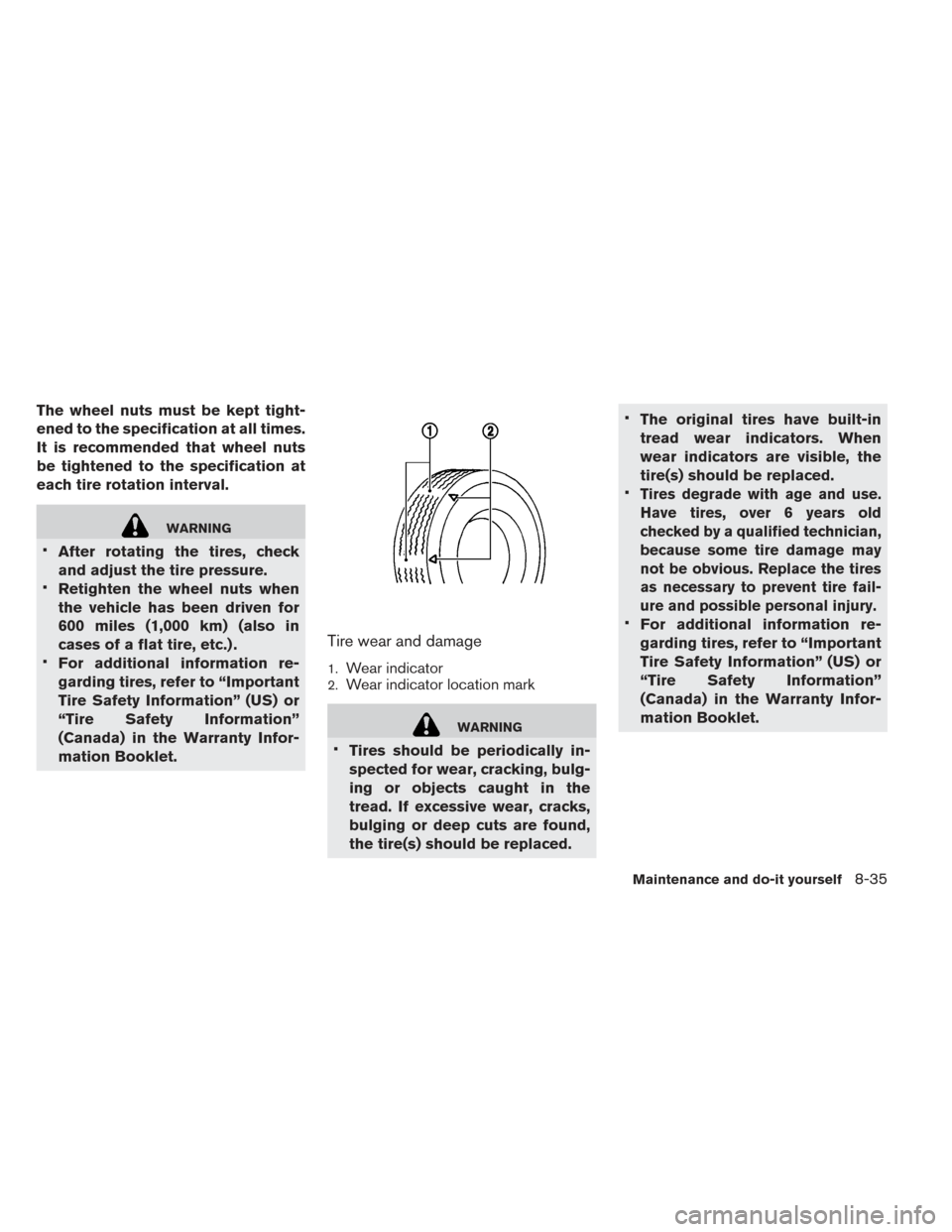
Tire wear and damage
1.Wear indicator
2.Wear indicator location mark
WARNING
•
Tires should be periodically in-
spected for wear, cracking, bulg-
ing or objects caught in the
tread. If excessive wear, cracks,
bulging or deep cuts are found,
the tire(s) should be replaced.
•The original tires have built-in
tread wear indicators. When
wear indicators are visible, the
tire(s) should be replaced.
•Tires degrade with age and use.
Have tires, over 6 years old
checked by a qualified technician,
because some tire damage may
not be obvious. Replace the tires
as necessary to prevent tire fail-
ure and possible personal injury.
•For additional information re-
garding tires, refer to “Important
Tire Safety Information” (US) or
“Tire Safety Information”
(Canada) in the Warranty Infor-
mation Booklet.
Maintenance and do-it yourself8-35