display NISSAN LEAF 2018 Owner´s Manual
[x] Cancel search | Manufacturer: NISSAN, Model Year: 2018, Model line: LEAF, Model: NISSAN LEAF 2018Pages: 435, PDF Size: 5.48 MB
Page 326 of 435
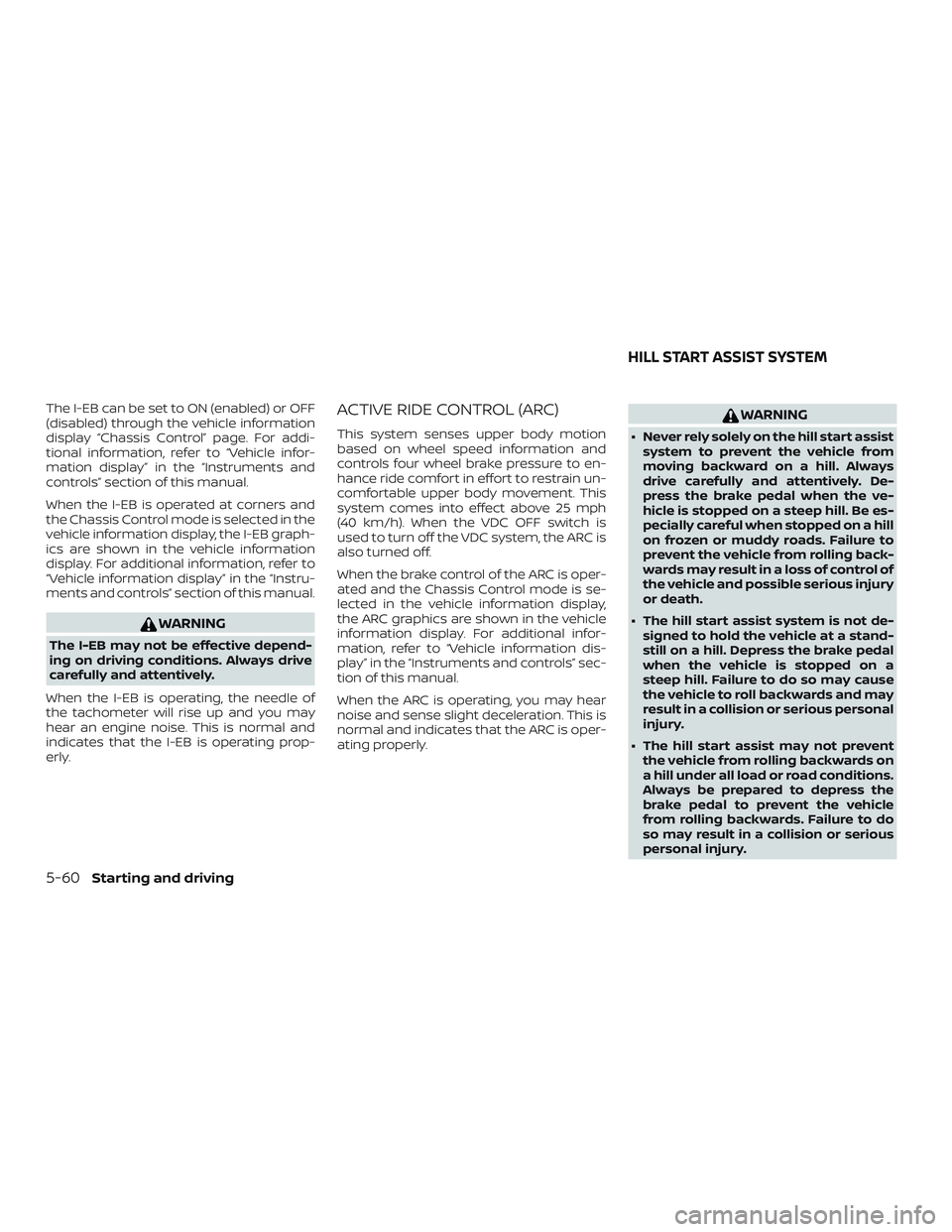
The I-EB can be set to ON (enabled) or OFF
(disabled) through the vehicle information
display “Chassis Control” page. For addi-
tional information, refer to “Vehicle infor-
mation display” in the “Instruments and
controls” section of this manual.
When the I-EB is operated at corners and
the Chassis Control mode is selected in the
vehicle information display, the I-EB graph-
ics are shown in the vehicle information
display. For additional information, refer to
“Vehicle information display” in the “Instru-
ments and controls” section of this manual.
WARNING
The I-EB may not be effective depend-
ing on driving conditions. Always drive
carefully and attentively.
When the I-EB is operating, the needle of
the tachometer will rise up and you may
hear an engine noise. This is normal and
indicates that the I-EB is operating prop-
erly.
ACTIVE RIDE CONTROL (ARC)
This system senses upper body motion
based on wheel speed information and
controls four wheel brake pressure to en-
hance ride comfort in effort to restrain un-
comfortable upper body movement. This
system comes into effect above 25 mph
(40 km/h). When the VDC OFF switch is
used to turn off the VDC system, the ARC is
also turned off.
When the brake control of the ARC is oper-
ated and the Chassis Control mode is se-
lected in the vehicle information display,
the ARC graphics are shown in the vehicle
information display. For additional infor-
mation, refer to “Vehicle information dis-
play” in the “Instruments and controls” sec-
tion of this manual.
When the ARC is operating, you may hear
noise and sense slight deceleration. This is
normal and indicates that the ARC is oper-
ating properly.
WARNING
∙ Never rely solely on the hill start assist system to prevent the vehicle from
moving backward on a hill. Always
drive carefully and attentively. De-
press the brake pedal when the ve-
hicle is stopped on a steep hill. Be es-
pecially careful when stopped on a hill
on frozen or muddy roads. Failure to
prevent the vehicle from rolling back-
wards may result in a loss of control of
the vehicle and possible serious injury
or death.
∙ The hill start assist system is not de- signed to hold the vehicle at a stand-
still on a hill. Depress the brake pedal
when the vehicle is stopped on a
steep hill. Failure to do so may cause
the vehicle to roll backwards and may
result in a collision or serious personal
injury.
∙ The hill start assist may not prevent the vehicle from rolling backwards on
a hill under all load or road conditions.
Always be prepared to depress the
brake pedal to prevent the vehicle
from rolling backwards. Failure to do
so may result in a collision or serious
personal injury.
HILL START ASSIST SYSTEM
5-60Starting and driving
Page 331 of 435
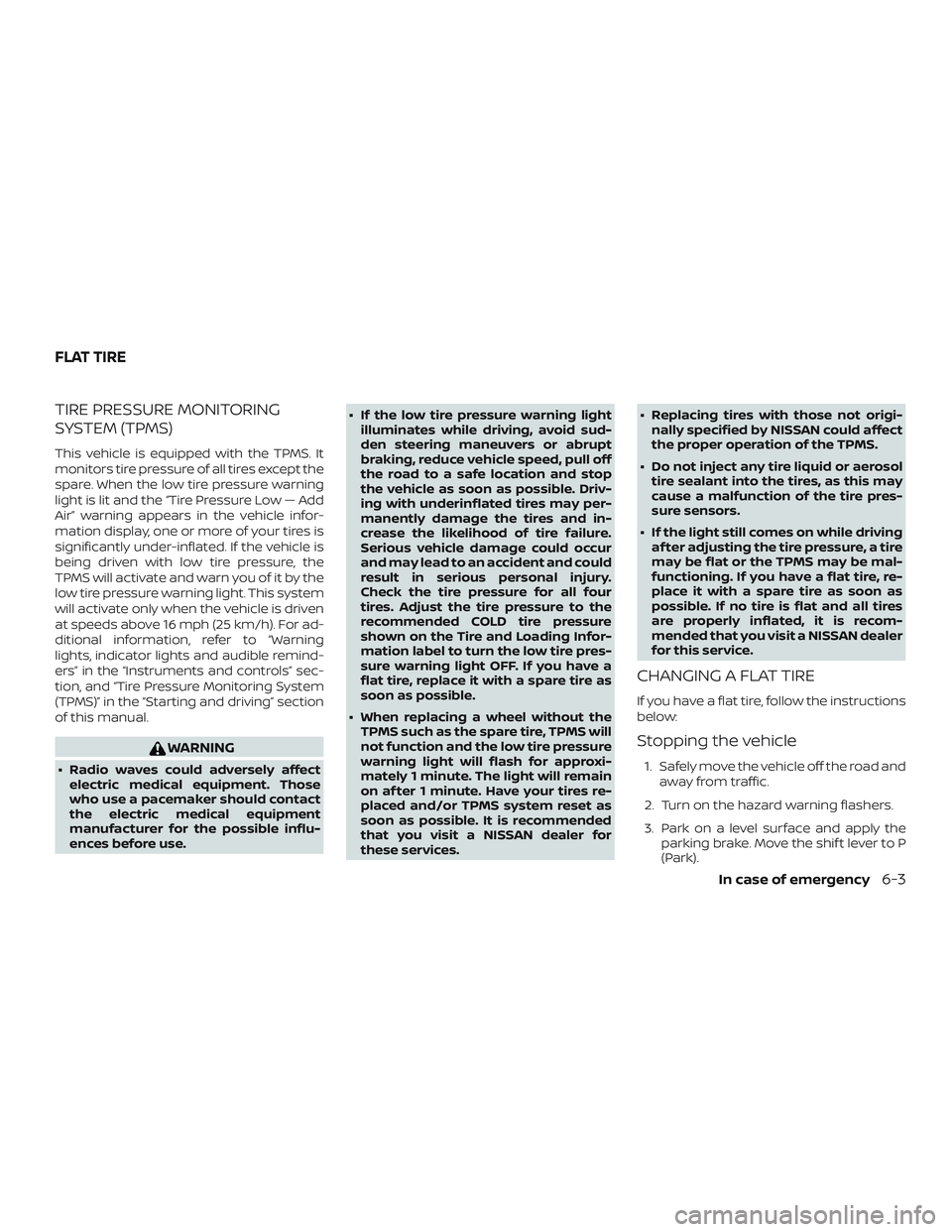
TIRE PRESSURE MONITORING
SYSTEM (TPMS)
This vehicle is equipped with the TPMS. It
monitors tire pressure of all tires except the
spare. When the low tire pressure warning
light is lit and the “Tire Pressure Low — Add
Air” warning appears in the vehicle infor-
mation display, one or more of your tires is
significantly under-inflated. If the vehicle is
being driven with low tire pressure, the
TPMS will activate and warn you of it by the
low tire pressure warning light. This system
will activate only when the vehicle is driven
at speeds above 16 mph (25 km/h). For ad-
ditional information, refer to “Warning
lights, indicator lights and audible remind-
ers” in the “Instruments and controls” sec-
tion, and “Tire Pressure Monitoring System
(TPMS)” in the “Starting and driving” section
of this manual.
WARNING
∙ Radio waves could adversely affectelectric medical equipment. Those
who use a pacemaker should contact
the electric medical equipment
manufacturer for the possible influ-
ences before use. ∙ If the low tire pressure warning light
illuminates while driving, avoid sud-
den steering maneuvers or abrupt
braking, reduce vehicle speed, pull off
the road to a safe location and stop
the vehicle as soon as possible. Driv-
ing with underinflated tires may per-
manently damage the tires and in-
crease the likelihood of tire failure.
Serious vehicle damage could occur
and may lead to an accident and could
result in serious personal injury.
Check the tire pressure for all four
tires. Adjust the tire pressure to the
recommended COLD tire pressure
shown on the Tire and Loading Infor-
mation label to turn the low tire pres-
sure warning light OFF. If you have a
flat tire, replace it with a spare tire as
soon as possible.
∙ When replacing a wheel without the TPMS such as the spare tire, TPMS will
not function and the low tire pressure
warning light will flash for approxi-
mately 1 minute. The light will remain
on af ter 1 minute. Have your tires re-
placed and/or TPMS system reset as
soon as possible. It is recommended
that you visit a NISSAN dealer for
these services. ∙ Replacing tires with those not origi-
nally specified by NISSAN could affect
the proper operation of the TPMS.
∙ Do not inject any tire liquid or aerosol tire sealant into the tires, as this may
cause a malfunction of the tire pres-
sure sensors.
∙ If the light still comes on while driving af ter adjusting the tire pressure, a tire
may be flat or the TPMS may be mal-
functioning. If you have a flat tire, re-
place it with a spare tire as soon as
possible. If no tire is flat and all tires
are properly inflated, it is recom-
mended that you visit a NISSAN dealer
for this service.
CHANGING A FLAT TIRE
If you have a flat tire, follow the instructions
below:
Stopping the vehicle
1. Safely move the vehicle off the road and
away from traffic.
2. Turn on the hazard warning flashers.
3. Park on a level surface and apply the parking brake. Move the shif t lever to P
(Park).
FLAT TIRE
In case of emergency6-3
Page 377 of 435

If you have a flat tire, refer to “Flat tire” in
the “In case of emergency ” section of
this manual.
TIRE PRESSURE
Tire Pressure Monitoring System
(TPMS)
WARNING
Radio waves could adversely af-
fect electric medical equipment.
Those who use a pacemaker
should contact the electric medi-
cal equipment manufacturer for
the possible influences before
use.
This vehicle is equipped with the Tire
Pressure Monitoring System (TPMS).
It monitors tire pressure of all tires
except the spare. When the low tire
pressure warning light is lit and the
“Tire Pressure Low – Add Air” warning
appears in the vehicle information
display, one or more of your tires is
significantly under-inflated. If
equipped, the system also displays
pressure of all tires (except the spare tire) on the display screen by send-
ing a signal from a sensor that is
installed in each wheel.
The TPMS will activate only when the
vehicle is driven at speeds above
16 mph (25 km/h). Also, this system
may not detect a sudden drop in tire
pressure (for example a flat tire while
driving).
For additional information, refer to
“Low tire pressure warning light” in
the “Instruments and controls” sec-
tion, “Tire Pressure Monitoring Sys-
tem (TPMS)” in the “Starting and driv-
ing” section and “Flat tire” in the “In
case of emergency” section of this
manual.
Tire inflation pressure
Check the tire pressures (including
the spare) of ten and always prior to
long distance trips. The recom-
mended tire pressure specifications
are shown on the F.M.V.S.S./C.M.V.S.S.
certification label or the Tire and
Loading Information label under theLicense plate light
JVC0014X
WHEELS AND TIRES
Do-it-yourself8-27
Page 428 of 435
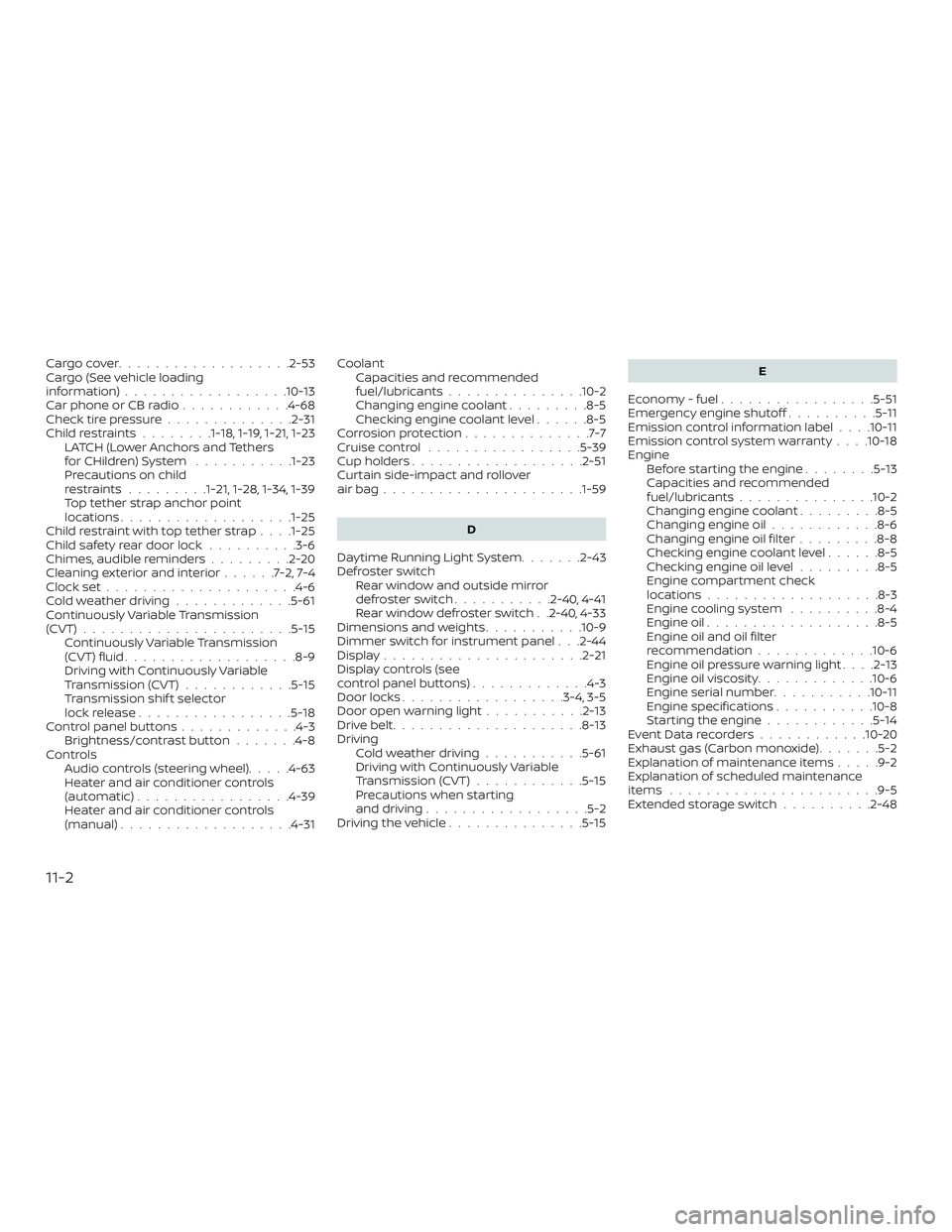
Cargocover...................2-53
Cargo (See vehicle loading
information)..................10-13
Car phone or CB radio............4-68
Check tire pressure ..............2-31
Childrestraints........1-18, 1-19, 1-21, 1-23 LATCH (Lower Anchors and Tethers
forCHildren)System ...........1-23
Precautions on child
restraints.........1-21, 1-28, 1-34, 1-39
Top tether strap anchor point
locations.................. .1-25
Child restraint with top tether strap . . . .1-25
Child safety rear door lock ..........3-6
Chimes, audible reminders .........2-20
Cleaningexteriorandinterior......7-2,7-4
Clockset.....................4-6
Coldweatherdriving.............5-61
Continuously Variable Transmission
(CVT) .......................5-15
Continuously Variable Transmission
(CVT) fluid ...................8-9
Driving with Continuously Variable
Transmission (CVT) ............5-15
Transmission shif t selector
lockrelease.................5-18
Control panel buttons .............4-3
Brightness/contrast button .......4-8
Controls Audio controls (steering wheel) .....4-63
Heater and air conditioner controls
(automatic).................4-39
Heater and air conditioner controls
(manual) ...................4-31 Coolant
Capacities and recommended
fuel/lubricants...............10-2
Changing engine coolant .........8-5
Checking engine coolant level ......8-5
Corrosionprotection..............7-7
Cruisecontrol .................5-39
Cupholders...................2-51
Curtain side-impact and rollover
airbag..................... .1-59
D
Daytime Running Light System .......2-43
Defroster switch Rear window and outside mirror
defrosterswitch...........2-40,4-41
Rear window defroster switch . .2-40, 4-33
Dimensions and weights ...........10-9
Dimmer switch for instrument panel . . .2-44
Display......................2-21
Display controls (see
control panel buttons) .............4-3
Door locks ..................3-4,3-5
Door open warning light ...........2-13
Drivebelt.....................8-13
Driving Cold weather driving ...........5-61
Driving with Continuously Variable
Transmission (CVT) ............5-15
Precautions when starting
anddriving..................5-2
Drivingthevehicle...............5-15 E
Economy - fuel .................5-51
Emergency engine shutoff ..........5-11
Emission control information label . . . .10-11
Emission control system warranty . . . .10-18
Engine Before starting the engine ........5-13
Capacities and recommended
fuel/lubricants...............10-2
Changing engine coolant .........8-5
Changing engine oil ............8-6
Changing engine oil filter .........8-8
Checking engine coolant level ......8-5
Checking engine oil level .........8-5
Engine compartment check
locations...................8-3
Engine cooling system ..........8-4
Engine oil ...................8-5
Engine oil and oil filter
recommendation .............10-6
Engine oil pressure warning light ....2-13
Engine oil viscosity .............10-6
Engine serial number ...........10-11
Engine specifications ...........10-8
Starting the engine ............5-14
EventDatarecorders............10-20
Exhaust gas (Carbon monoxide) .......
5-2
Explanation of maintenance items .....9-2
Explanation of scheduled maintenance
items .......................9-5
Extended storage switch ..........2-48
11-2
Page 429 of 435
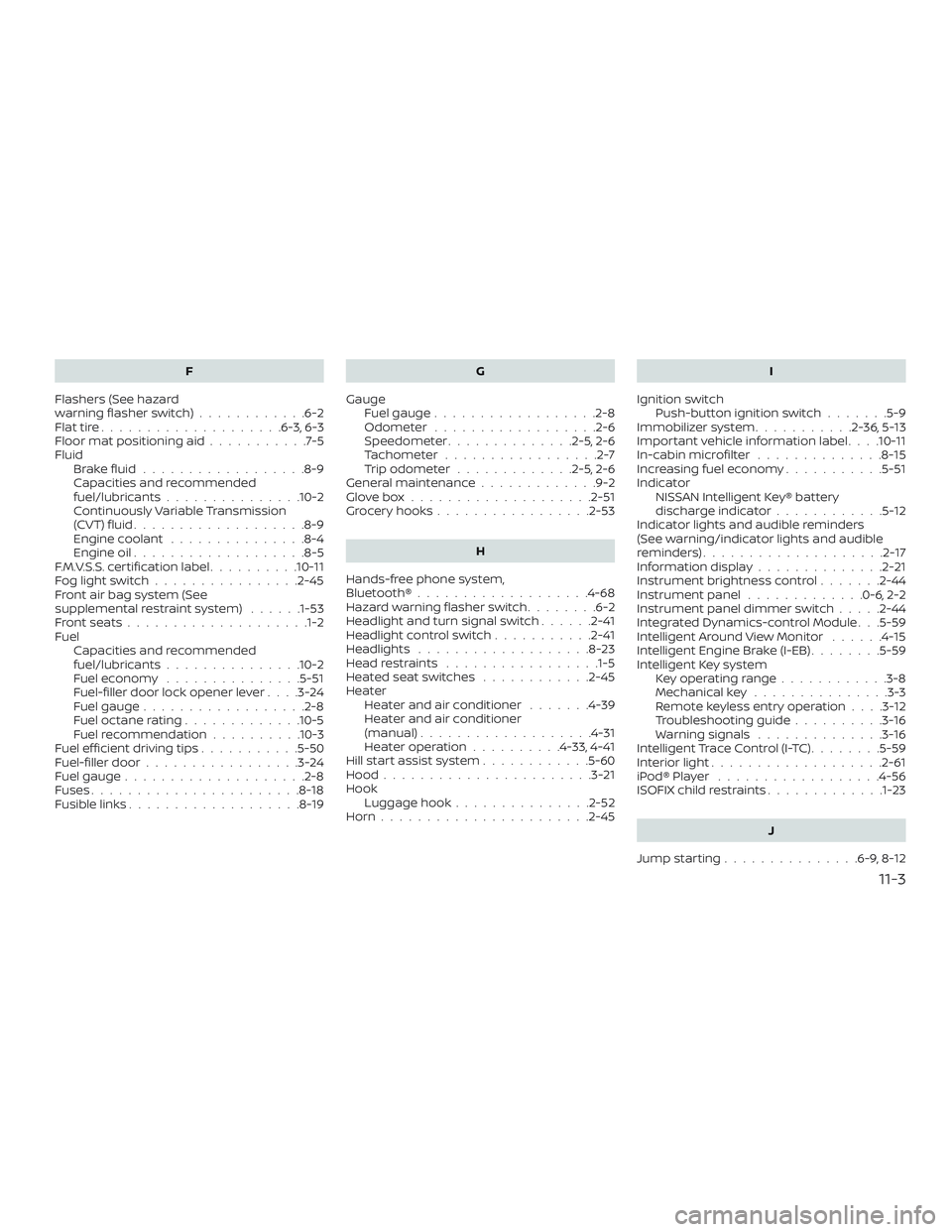
F
Flashers (See hazard
warning flasher switch) ............6-2
Flattire....................6-3,6-3
Floormatpositioningaid...........7-5
Fluid Brakefluid..................8-9
Capacities and recommended
fuel/lubricants...............10-2
Continuously Variable Transmission
(CVT) fluid ...................8-9
Engine coolant ...............8-4
Engine oil ...................8-5
F.M.V.S.S. certification label ..........10-11
Foglightswitch................2-45
Front air bag system (See
supplemental restraint system) ......1-53
Frontseats................... .1-2
Fuel Capacities and recommended
fuel/lubricants...............10-2
Fuel economy ...............5-51
Fuel-filler door lock opener lever ....3-24
Fuel gauge ..................2-8
Fueloctanerating.............10-5
Fuel recommendation ..........10-3
Fuelefficientdrivingtips...........5-50
Fuel-filler door .................3-24
Fuel gauge ....................2-8
Fuses .......................8-18
Fusiblelinks...................8-19 G
Gauge Fuel gauge ..................2-8
Odometer ..................2-6
Speedometer ..............2-5,2-6
Tachometer .................2-7
Trip odometer .............2-5,2-6
General maintenance .............9-2
Glovebox....................2-51
Grocery hooks .................2-53
H
Hands-free phone system,
Bluetooth®...................4-68
Hazard warning flasher switch ........6-2
Headlight and turn signal switch ......2-41
Headlightcontrolswitch...........2-41
Headlights ...................8-23
Headrestraints ................ .1-5
Heated seat switches ............2-45
Heater Heater and air conditioner .......4-39
Heater and air conditioner
(manual) ...................4-31
Heater operation ..........4-33,4-41
Hill start assist system ............5-60
Hood ...................... .3-21
Hook Luggage hook ...............2-52
Horn.......................2-45 I
Ignition switch Push-button ignition switch .......5-9
Immobilizer system ...........2-36,5-13
Important vehicle information label . . . .10-11
In-cabinmicrofilter ..............8-15
Increasing fuel economy ...........5-51
Indicator NISSAN Intelligent Key® battery
discharge indicator ............5-12
Indicator lights and audible reminders
(See warning/indicator lights and audible
reminders) ....................2-17
Informationdisplay............. .2-21
Instrument brightness control .......2-44
Instrument panel .............0-6,2-2
Instrument panel dimmer switch .....2-44
Integr
ated Dynamics-control Module . . .5-59
Intelligent Around View Monitor ......4-15
Intelligent Engine Brake (I-EB) ........5-59
Intelligent Key system Key operating range ............3-8
Mechanical key ...............3-3
Remote keyless entry operation ....3-12
Troubleshooting guide ..........3-16
Warning signals ..............3-16
Intelligent Trace Control (I-TC) ........5-59
Interiorlight...................2-61
iPod®Player ..................4-56
ISOFIX child restraints .............1-23
J
Jumpstarting...............6-9,8-12
11-3
Page 433 of 435
Towing4-wheel drive models ...........6-13
Flattowing.................10-17
Trailertowing ...............10-17
Towingatrailer................10-17
Towingyourvehicle..............6-12
Transmission Continuously Variable Transmission
(CVT) fluid ...................8-9
Driving with Continuously Variable
Transmission (CVT) ............5-15
Travel (See registering a vehicle in
another country) ...............10-10
Trip odometer ...............2-5,2-6
Trunklight....................2-63
Turn signal switch ...............2-44
U
Uniform tire quality grading .........10-17
USB/iPod® Charging Ports .........4-64
USB (Universal Serial Bus) Connection Port
(models without Navigation System) . . .4-53
V
Vanitymirror..................3-27
Variable voltage control system ......8-13
Vehicle dimensions and weights ......10-9
Vehicle Dynamic Control (VDC)
OFFswitch...................2-47
Vehicle dynamic control (VDC) system . .5-56
Vehicle Dynamic Control (VDC) system . .5-56
Vehicle identification .............10-10 Vehicle identification number (VIN)
. . . .10-10
Vehicle identification number (VIN)
(Chassis number) ...............10-10
Vehicle identification number (VIN)
plate.......................10-10
Vehicle immobilizer system ......2-36,5-13
VehicleInformationDisplay.........2-21
Vehicle loading information ........10-13
Vehiclerecovery................6-13
Vehicle security system ...........2-34
Vehicle security system (NISSAN
Anti-Thef t System), engine start . . .2-35, 5-12
Vehicle security system (NISSAN Vehicle
Immobilizer System), engine start . .2-36, 5-13
Vents.......................4-30
Visors ......................3-26
Voice Prompt Interrupt ............4-71
W
Warning Airbagwarninglight........1-63, 2-17
Anti-lock brake warning light ......2-11
Battery charge warning light ......2-12
Brakewarninglight ............2-11
Door open warning light .........2-13
Engine oil pressure warning light ....2-13
Hazard warning flasher switch ......6-2
Lowfuelwarninglight ....2-13,2-15,2-31
Lowtirepressurewarninglight.....2-13
Low windshield-washer fluid
warninglight................2-15
Passenger air bag and status light . . .1-53
Seatbeltwarninglight.......1-13, 2-16 Supplemental air bag
warninglight.............1-63, 2-17
Vehicle security system
.........2-34
Warning/indicator lights and
audible reminders .............2-17
Warning labels (for SRS) ..........1-63
Warning/indicator lights and audible
reminders ....................2-17
Audible reminders .............2-17
Indicatorlights...............2-17
Warninglights................2-17
Warninglights..................2-17
Warning lights, indicator lights and
audible reminders ............0-9,2-10
Warningsystemsswitch...........2-46
Washer switch Rear window wiper and washer
switches ...................2-39
Weights (See dimensions and
weights).....................10-9
Wheels and tires .............8-27,10-9
Wheel/tire size .................10-9
When traveling or registering in
another country ...............10-10
Windows ....................2-58 Locking passengers' windows .....2-59
Powerrearwindows...........2-59
Powerwindows..............2-58
Rearpowerwindows...........2-59
Windshield-washer fluid ...........8-10
Windshield wiper blades ...........8-16
Wiper Rear window wiper and washer
switches ...................2-39
Wiper blades ................8-16
Wiper and washer switch ..........2-37
11-7