seats NISSAN LEAF 2019 Owner´s Manual
[x] Cancel search | Manufacturer: NISSAN, Model Year: 2019, Model line: LEAF, Model: NISSAN LEAF 2019Pages: 610, PDF Size: 7.11 MB
Page 535 of 610
CHROME PARTS
Clean chrome parts regularly with a non-
abrasive chrome polish to maintain the fin-
ish.
TIRE DRESSING
NISSAN does not recommend the use of
tire dressings. Tire manufacturers apply a
coating to the tires to help reduce discolor-
ation of the rubber. If a tire dressing is ap-
plied to the tires, it may react with the coat-
ing and form a compound. This compound
may come off the tire while driving and
stain the vehicle paint.
If you choose to use a tire dressing, take the
following precautions:
• Use a water-based tire dressing. The coat-ing on the tire dissolves more easily with
an oil-based tire dressing.
• Apply a light coat of tire dressing to help prevent it from entering the tire tread/
grooves (where it would be difficult to
remove). • Wipe off excess tire dressing using a dry
towel. Make sure the tire dressing is
completely removed from the tire
tread/grooves.
•
Allow the tire dressing to dry as recom-
mended by the tire dressing manufacturer.
Occasionally remove loose dust from the
interior trim, plastic parts and seats using
a vacuum cleaner or sof t bristled brush.
Wipe the vinyl and leather surfaces (if so
equipped) with a clean, sof t cloth damp-
ened in mild soap solution, then wipe clean
with a dry sof t cloth.
Regular care and cleaning is required in
order to maintain the appearance of the
leather (if so equipped).
Before using any fabric protector, read the
manufacturer’s recommendations. Some
fabric protectors contain chemicals that
may stain or bleach the seat material.
Use a cloth dampened only with water to
clean the meter and gauge lens.
WARNING
Do not use water or acidic cleaners (hot
steam cleaners) on the seat. This can
damage the seat or occupant classifi-
cation sensor (weight sensor). This can
also affect the operation of the air bag
system and result in serious personal
injury.
CLEANING INTERIOR
7-4Appearance and care
Page 538 of 610
SEAT BELTS
The seat belts can be cleaned by wiping
them with a sponge dampened in a mild
soap solution. Allow the belts to dry com-
pletely in the shade before using them.
For additional information, refer to “Seat
belts” in the “Safety—Seats, seat belts and
supplemental restraint system” section of
this manual.
WARNING
Do not allow wet seat belts to roll up in
the retractor. NEVER use bleach, dye, or
chemical solvents to clean the seat
belts, since these materials may se-
verely weaken the seat belt webbing.
MOST COMMON FACTORS
CONTRIBUTING TO VEHICLE
CORROSION
• The accumulation of moisture-retaining dirt and debris in body panel sections,
cavities, and other areas.
• Damage to paint and other protective coatings caused by gravel and stone
chips or minor traffic accidents.
ENVIRONMENTAL FACTORS
INFLUENCE THE RATE OF
CORROSION
Moisture
Accumulation of sand, dirt and water on
the vehicle body underside can accelerate
corrosion. Wet floor coverings will not dry
completely inside the vehicle, and should
be removed for drying to avoid floor panel
corrosion.
Relative humidity
Corrosion will be accelerated in areas of
high relative humidity, especially those ar-
eas where the temperatures stay above
freezing, where atmospheric pollution ex-
ists, or where road salt is used.
Temperature
A temperature increase will accelerate the
rate of corrosion to those parts which are
not well ventilated.
Air pollution
Industrial pollution, the presence of salt in
the air in coastal areas, or heavy road salt
use will accelerate the corrosion process.
Road salt will also accelerate the disinte-
gration of paint surfaces.
PROTECT YOUR VEHICLE FROM
CORROSION
• Wash and wax your vehicle of ten to keepthe vehicle clean.
• Always check for minor damage to the paint and repair it as soon as possible.
• Keep drain holes at the bottom of the doors open to avoid water accumulation.
• Check the underbody for accumulation of sand, dirt or salt. If present, wash with wa-
ter as soon as possible.
CORROSION PROTECTION
Appearance and care7-7
Page 589 of 610
WARNING
•
It is extremely dangerous to ride
in the cargo area inside the ve-
hicle. In a collision, people riding
in these areas are more likely to
be seriously injured or killed.
•Do not allow people to ride in
any area of your vehicle that is
not equipped with seats and
seat belts.
•Be sure everyone in your ve-
hicle is in a seat and using a
seat belt properly.
TERMS
It is important to familiarize yourself
with the following terms before
loading your vehicle:
• Curb Weight (actual weight of your vehicle) - vehicle weight including:
standard and optional equipment,
fluids and emergency tools. This
weight does not
include passengers
and cargo.
• GVW (Gross Vehicle Weight) - curb weight plus the combined weight
of passengers and cargo.
•
GVWR (Gross Vehicle Weight Rating) -
maximum total combined weight of
the unloaded vehicle, passengers,
luggage, hitch, trailer tongue load
and any other optional equipment.
• GAWR (Gross Axle Weight Rating) - maximum weight (load) limit speci-
fied for the front or rear axle.
•This information is located on the
F.M.V.S.S./C.M.V.S.S. label.
•
GCWR (Gross Combined Weight
Rating) - The maximum total weight
rating of the vehicle, passengers,
cargo, and trailer.
• Vehicle Capacity Weight, Load limit, Total load capacity - maximum to-
tal weight limit specified of the load
(passengers and cargo) for the ve-
hicle. This is the maximum com-
bined weight of occupants and
cargo that can be loaded into the vehicle. If the vehicle is used to tow
a trailer, the trailer tongue weight
must be included as part of the
cargo load. This information is lo-
cated on the Tire and Loading Infor-
mation label.
•
Cargo capacity - permissible weight
of cargo, the subtracted weight of
occupants from the load limit.
VEHICLE LOAD CAPACITY
Do not exceed the load limit of your
vehicle shown as “The combined
weight of occupants and cargo” on
the Tire and Loading Information
label. Do not exceed the number
of occupants shown as “Seating
Capacity” on the Tire and Loading
Information label.
To get “the combined weight of occu-
pants and cargo”, add the weight of all
occupants, then add the total lug-
gage weight. Examples are shown in
the following illustration.
VEHICLE LOADING INFORMATION
9-10Technical and consumer information
Page 604 of 610
10 Index
1
12-volt battery.................8-12
A
ABS (Anti-lock Braking System) ......5-148
ADDITIONAL DATA RECORDING (on vehicles
equipped with optional ProPILOT Assist) . .9-20
Advanced air bag system..........1-49
Air bag system ...........1-49, 1-52, 1-58
Air bag warning labels ............1-61
Air bag warning light ..........1-61, 2-24
Air conditioner ............4-31, 9-3, 9-9
Air conditioner specification label ......9-9
Air conditioning system refrigerant and
lubricant recommendations .........9-3
Alarm, How to stop alarm
(refer to, vehicle security system) ......2-49
Alcohol, drugs and driving ..........5-9
Antenna .....................4-67
Anti-lock Braking System (ABS) ......5-148
Anti-lock braking system (ABS) warning
light .......................2-18
Anti-lock Braking System (ABS) warning
light .......................2-18
Antifreeze ...................5-155
Appearance care ..............7-2,7-4 At home af ter driving
............EV-22
Audible reminders...............2-27
Audio System (models without Navigation
System) .....................4-46
Autolight switch ................2-54
Autolight system ...............2-54
Automatic ....................3-6
Automatic climate control
(models with Navigation System) .....4-38
Automatic climate control
(models without Navigation System) . . .4-35
Automatic door locks .............3-6
Automatic Emergency Braking (AEB) . . .5-112
Automatic Emergency Braking (AEB)
with Pedestrian Detection .........5-119
Avoiding collision and rollover ........5-7
B
Battery.........EV-2, 2-8, 2-57, 8-12, 8-22
Battery saver system.............2-57
Before driving your vehicle
(models with navigation system) .....EV-15
Before starting system ............5-14
Blind Spot Warning (BSW) ..........5-37
Bluetooth® hands-free phone system
without navigation system .........4-68
Bluetooth® streaming audio ........4-65Booster seats
.................1-39
Brake.....2-19, 2-20, 5-19, 5-20, 5-146, 5-148, 8-10, 8-17
Brake fluid ...................8-10
Brake precautions ..............5-146
Brake system .................5-146
BRAKE system warning light (yellow) . . . .2-19
BRAKE warning light (red) ..........2-20
Brakes......................8-17
Bulb replacement ...........8-25, 8-26
C
Car phone or CB radio ............4-68
Care of wheels .................7-3
Ceiling light ...................2-74
Changing coolant ...............8-9
Charge .....................2-63
Charge port lid .................3-20
Charge port lid switch ............2-63
Charging . . .CH-2, CH-10, CH-11, CH-17, CH-25, CH-35, CH-38, CH-51, 3-20, 9-4
Charging information .............9-21
Charging methods .............CH-44
Charging related indicator light ......CH-51
Charging related remote function . . . .CH-50
Charging status indicator light ......CH-51
Charging the Li-ion battery ........EV-12
Page 606 of 610
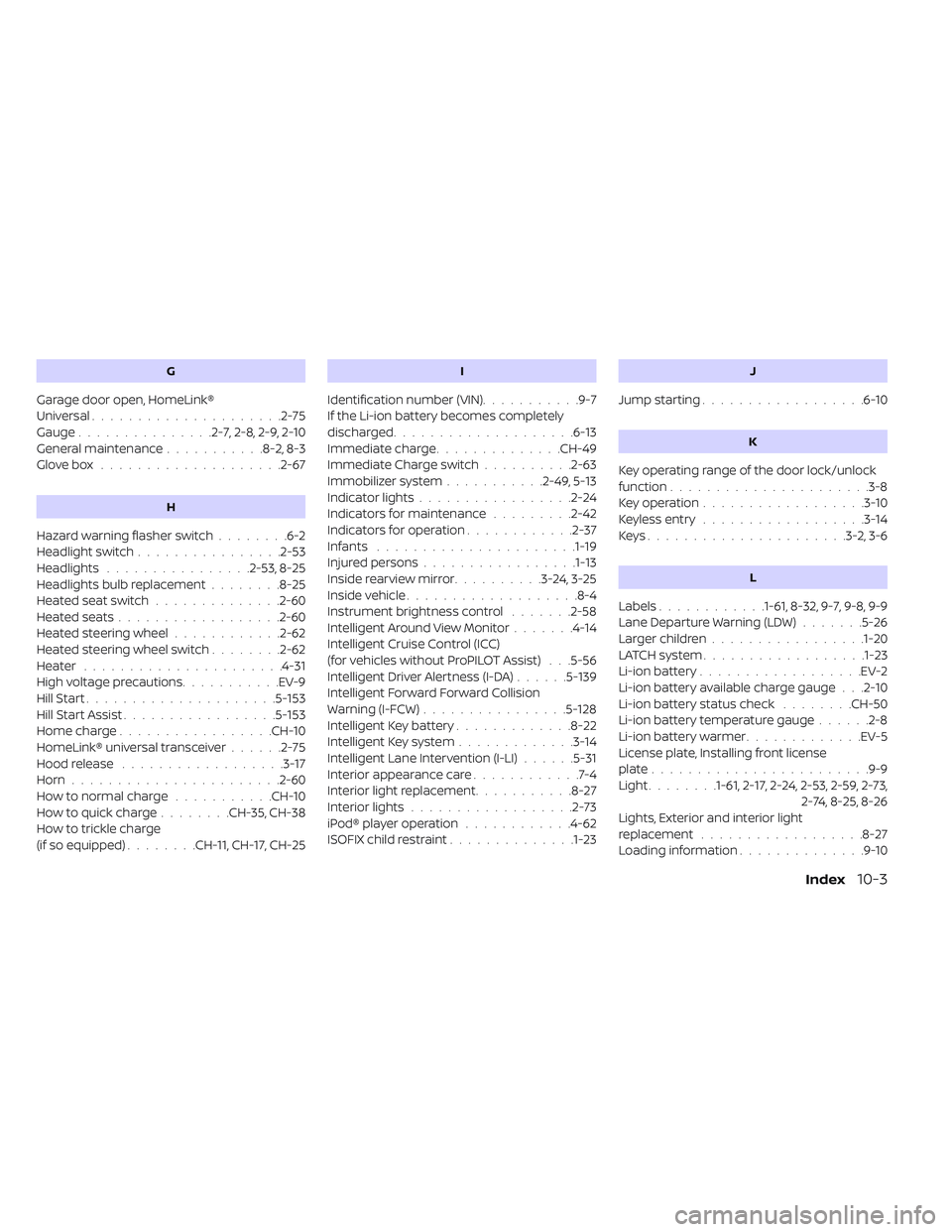
G
Garage door open, HomeLink®
Universal.....................2-75
Gauge ...............2-7, 2-8, 2-9, 2-10
General maintenance ...........8-2, 8-3
Glovebox ....................2-67
H
Hazard warning flasher switch ........6-2
Headlight switch ................2-53
Headlights ................2-53, 8-25
Headlights bulb replacement ........8-25
Heated seat switch ..............2-60
Heated seats ..................2-60
Heated steering wheel ............2-62
Heated steering wheel switch ........2-62
Heater ......................4-31
High voltage precautions ...........EV-9
HillStart.....................5-153
Hill Start Assist .................5-153
Home charge .................CH-10
HomeLink® universal transceiver ......2-75
Hood release ..................3-17
Horn .......................2-60
How to normal charge ...........CH-10
How to quick charge ........CH-35, CH-38
How to trickle charge
(if so equipped) ........CH-11, CH-17, CH-25
I
Identification number (VIN) ...........9-7
If the Li-ion battery becomes completely
discharged ....................6-13
Immediate charge ..............CH-49
Immediate Charge switch ..........2-63
Immobilizer system ...........2-49, 5-13
Indicator lights .................2-24
Indicators for maintenance .........2-42
Indicators for operation ............2-37
Infants ......................1-19
Injured persons .................1-13
Inside rearview mirror ..........3-24, 3-25
Inside vehicle ...................8-4
Instrument brightness control .......2-58
Intelligent Around View Monitor .......4-14
Intelligent Cruise Control (ICC)
(for vehicles without ProPILOT Assist) . . .5-56
Intelligent Driver Alertness (I-DA) ......5-139
Intelligent Forward Forward Collision
Warning (I-FCW) ................5-128
Intelligent Key battery .............8-22
Intelligent Key system .............3-14
Intelligent Lane Intervention (I-LI) ......5-31
Interior appearance care ............7-4
Interior light replacement ...........8-27
Interior lights ..................2-73
iPod® player operation ............4-62
ISOFIX child restraint ..............1-23
J
Jump starting..................6-10
K
Key operating range of the door lock/unlock
function......................3-8
Key operation ..................3-10
Keyless entry ..................3-14
Keys......................3-2, 3-6
L
Labels ............1-61, 8-32, 9-7, 9-8, 9-9
Lane Departure Warning (LDW) .......5-26
Larger children .................1-20
LATCH system ..................1-23
Li-ion battery ..................EV-2
Li-ion battery available charge gauge . . .2-10
Li-ion battery status check ........CH-50
Li-ion battery temperature gauge ......2-8
Li-ion battery warmer .............EV-5
License plate, Installing front license
plate ........................9-9
Light ........1-61, 2-17, 2-24, 2-53, 2-59, 2-73,
2-74, 8-25, 8-26
Lights, Exterior and interior light
replacement ..................8-27
Loading information ..............9-10
Index10-3
Page 607 of 610
Loading information (Refer to vehicle loading
information)...................9-10
Lock...................3-4, 3-6, 3-18
Low tire pressure warning light .......2-21
Low tire pressure warning system ......5-4
Low tire pressure warning system (Refer to
Tire Pressure Monitoring System (TPMS)) . .5-4
M
Maintenance . .1-18, 2-42, 8-2, 8-3, 8-4, 8-5, 8-12
Maintenance precautions ...........8-5
Maintenance requirements ..........8-2
Map lights ....................2-74
Mechanical key (Intelligent Key system) . . .3-3
Mirror ................3-24, 3-25, 3-26
Motor ....................5-14, 9-5
Motor compartment ..............8-7
Motor serial number ..............9-8
Moving Object Detection (MOD) .......4-26
N
NISSAN Intelligent Key® system . .3-6, 3-8, 3-10
NISSAN Vehicle Immobilizer
System...................2-49, 5-13
NissanConnect® Manual (for Leaf ) ......4-3
Normal charge ................CH-10
O
Occasional charge ..............CH-10
Odometer .....................2-7
Off-roadrecovery................5-8
Oil..........................9-2
Opening rear hatch ...............3-11
Outside air temperature ............2-13
Outside mirrors .................3-26
Outside vehicle ..................8-3
Owner’s Manual/Service Manual order
information ...................9-20
P
Panic alarm ...................3-15
Parking ...............5-19, 5-20, 5-144
Parking brake ..................5-19
Parking brake break-in ............5-148
Parking on hills ................5-144
Parking the vehicle ..............EV-21
Power................2-70, 3-4, 5-146
Power door lock .................3-4
Power door lock switch .............3-5
Power economy ................5-142
Power meter ...................2-9
Power Meter ...................2-9
Power outlet ..................2-65
Power steering system ...........5-146
Power switch ................5-9, 5-11 Power windows
.................2-70
Precautions. . .EV-9, EV-10, CH-2, 1-11, 1-21, 1-43, 5-4, 5-54, 5-146, 8-5
Precautions on charging ...........CH-2
Precautions on child restraints ........1-21
Precautions on seat belt usage ........1-11
Precautions on supplemental restraint
system ......................1-43
Precautions when starting and driving . . .5-4
Pregnant women ................1-13
ProPILOT Assist .................5-80
Public charge .................CH-10
Pulling up the wiper arm ...........8-15
Push starting ..................6-14Q
Quick charge.............CH-35, CH-38
R
Rapid air pressure loss .............5-8
Rear center seat belt ..............1-16
RearCrossTrafficAlert(RCTA)........5-46
Rear door lock, Child safety rear door
lock .........................3-6
Rear hatch ....................3-18
Rear hatch lock .................3-18
Rearseats.....................1-6
10-4Index
Page 608 of 610
Rear window and outside mirror defroster
switch......................2-53
Rear window wiper and washer switch . .2-52
Rear window wiper and washer switch . .2-52
Rear window wiper blade ...........8-17
RearView Monitor ................4-4
Recommended fluids/lubricants and
capacities .....................9-2
Reduction gear fluid ..............8-10
Remote charge ...............CH-50
Remote climate control ............4-44
Remote keyless entry function,
For Intelligent Key system ...........3-14
Remote keyless operation ..........3-14
Repairing flat tire.................6-4
Repairing tire ...................6-6
Replacement ..................8-25
Reporting safety defects ...........9-14
Road accident precautions .........EV-10
Roadside assistance program ........6-2
Rollover......................5-7
Roof-mounted curtain side-impact
supplemental air bag system ........1-58
S
Safety....................1-18, 9-14
Scene guide......EV-12, EV-15, EV-17, EV-18,
EV-21, EV-22
Seat belt cleaning ................7-7 Seat belt extenders
...............1-17
Seat belt hook ..................1-17
Seat belt maintenance .............1-18
Seat belt usage .................1-11
Seat belt warning light ............2-23
Seat belt(s) . . .1-11, 1-13, 1-14, 1-16, 1-17, 1-18, 1-19, 1-20, 1-60, 2-23, 7-7
Seatbelts.....................1-11
Seat belts with pretensioners ........1-60
Seat(s), Seats ................1-2, 2-60
Security system ................2-48
Security system (NISSAN Vehicle Immobilizer
System), EV system start ........2-49, 5-13
Servicing climate control ...........4-46
Shif ting ......................5-15
Shoulder belt height adjustment .......1-17
Shoulder belt height adjustment,
Forfrontseats..................1-17
Small children ..................1-19
Specifications ..................9-4
Speedometer ...................2-7
Starting .............5-4, 5-14, 6-10, 6-14
Starting your vehicle .............EV-17
Status light, Front passenger air bag . . . .1-52
Steering ..............2-62, 3-23, 5-146
Steering wheel switch for audio control . .4-66
Stopping the vehicle ..............6-5
Storage .....................2-66
Stowing golf bags ...............2-70
Sun visors ....................3-23
Supplemental air bag warning labels . . . .1-61Supplemental air bag warning light. .1-61, 2-24
Supplemental restraint system
.......1-43
Switch . . . .2-53, 2-54, 2-59, 2-60, 2-63, 3-5, 6-2
T
Telematic Control Unit Gen2K ........9-17
Telematics overview ..............9-15
Temperature ...................2-8
Tether strap child restraints .........1-25
Thef t (NISSAN Vehicle Immobilizer System),
traction motor start ...........2-49, 5-13
Three-point type ................1-14
Tilt steering column ..............3-23
Tilting steering column ............3-23
Tire........................2-21
Tire and Loading information label ......9-9
Tire and Loading Information label .....8-32
Tire chains ....................8-37
Tire dressing ...................7-4
Tire pressure ..................8-33
Tire pressure monitoring system (TPMS) . .6-3
Tire Pressure Monitoring System (TPMS) . .5-4
Tire rotation ...................8-38
Tires. . .5-4, 6-3, 7-4, 8-30, 8-32, 8-33, 8-36, 8-37, 8-38, 9-5, 9-9, 9-13
Tonneau cover .................2-69
Top........................1-25
Top tether strap .................1-25
Tow truck towing ................6-14
Index10-5