seats NISSAN LEAF 2019 Owner´s Manual
[x] Cancel search | Manufacturer: NISSAN, Model Year: 2019, Model line: LEAF, Model: NISSAN LEAF 2019Pages: 610, PDF Size: 7.11 MB
Page 169 of 610
Front seat-mounted side-impact
supplemental air bag and
roof-mounted curtain
side-impact and rollover
supplemental air bag systems
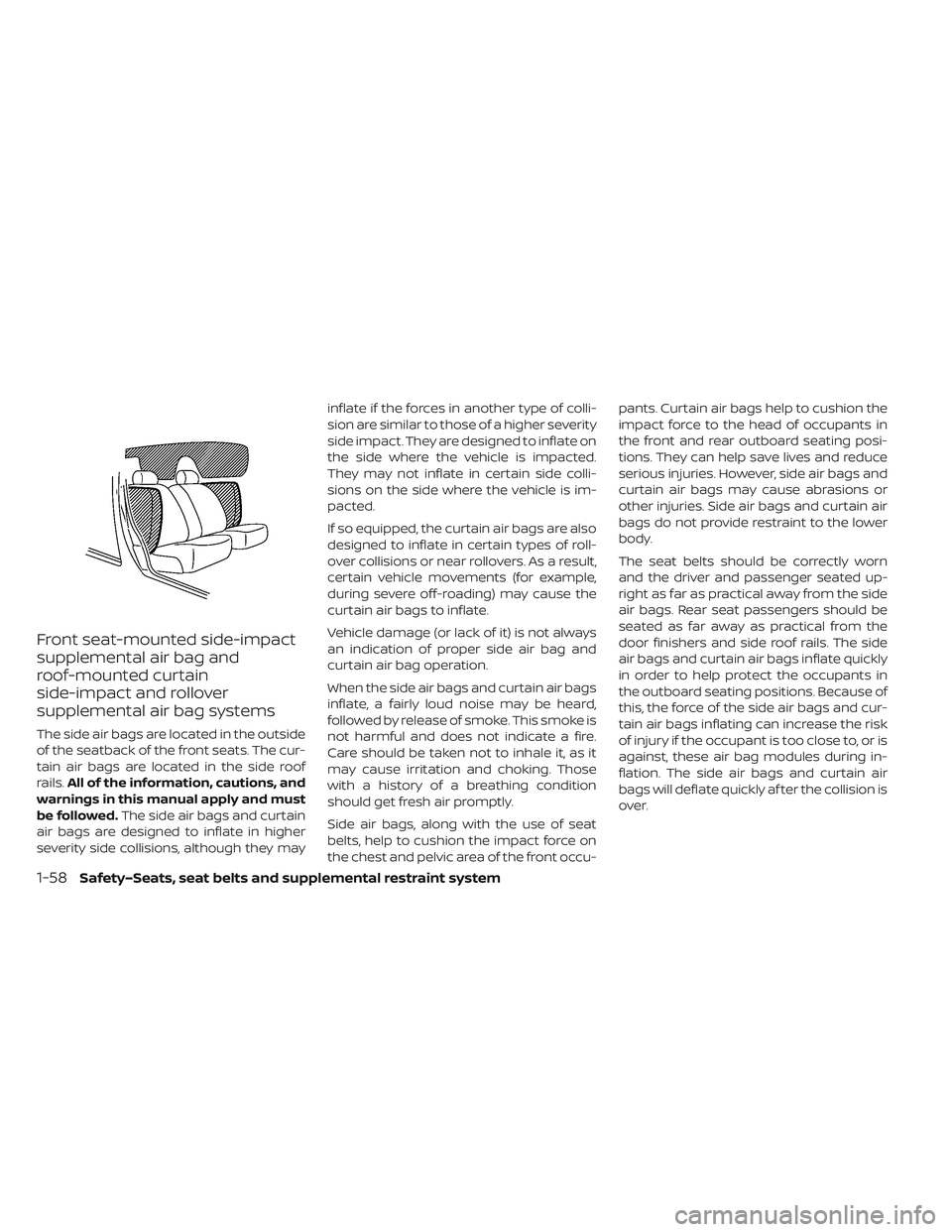
The side air bags are located in the outside
of the seatback of the front seats. The cur-
tain air bags are located in the side roof
rails.All of the information, cautions, and
warnings in this manual apply and must
be followed. The side air bags and curtain
air bags are designed to inflate in higher
severity side collisions, although they may inflate if the forces in another type of colli-
sion are similar to those of a higher severity
side impact. They are designed to inflate on
the side where the vehicle is impacted.
They may not inflate in certain side colli-
sions on the side where the vehicle is im-
pacted.
If so equipped, the curtain air bags are also
designed to inflate in certain types of roll-
over collisions or near rollovers. As a result,
certain vehicle movements (for example,
during severe off-roading) may cause the
curtain air bags to inflate.
Vehicle damage (or lack of it) is not always
an indication of proper side air bag and
curtain air bag operation.
When the side air bags and curtain air bags
inflate, a fairly loud noise may be heard,
followed by release of smoke. This smoke is
not harmful and does not indicate a fire.
Care should be taken not to inhale it, as it
may cause irritation and choking. Those
with a history of a breathing condition
should get fresh air promptly.
Side air bags, along with the use of seat
belts, help to cushion the impact force on
the chest and pelvic area of the front occu-pants. Curtain air bags help to cushion the
impact force to the head of occupants in
the front and rear outboard seating posi-
tions. They can help save lives and reduce
serious injuries. However, side air bags and
curtain air bags may cause abrasions or
other injuries. Side air bags and curtain air
bags do not provide restraint to the lower
body.
The seat belts should be correctly worn
and the driver and passenger seated up-
right as far as practical away from the side
air bags. Rear seat passengers should be
seated as far away as practical from the
door finishers and side roof rails. The side
air bags and curtain air bags inflate quickly
in order to help protect the occupants in
the outboard seating positions. Because of
this, the force of the side air bags and cur-
tain air bags inflating can increase the risk
of injury if the occupant is too close to, or is
against, these air bag modules during in-
flation. The side air bags and curtain air
bags will deflate quickly af ter the collision is
over.
1-58Safety–Seats, seat belts and supplemental restraint system
Page 170 of 610
The side air bags and curtain air bags
operate only when the power switch is in
the ON position.
Af ter turning the power switch to the ON
position, the supplemental air bag warn-
ing light illuminates. The supplemental
air bag warning light will turn off af ter
about 7 seconds if the systems are op-
erational.
WARNING
• Do not place any objects near the seatback of the front seats. Also, do
not place any objects (an umbrella,
bag, etc.) between the front door fin-
isher and the front seat. Such ob-
jects may become dangerous pro-
jectiles and cause injury if a side air
bag inflates.
• Right af ter inflation, several side air bag and curtain air bag system com-
ponents will be hot. Do not touch
them; you may severely burn your-
self. • No unauthorized changes should be
made to any components or wiring
of the side air bag and curtain air
bag systems. This is to prevent dam-
age to or accidental inflation of the
side air bag and curtain air bag sys-
tems.
• Do not make unauthorized changes to your vehicle’s electrical system,
suspension system or side panel.
This could affect proper operation of
the side air bag and curtain air bag
systems.
• Tampering with the side air bag sys- tem may result in serious personal
injury. For example, do not change
the front seats by placing material
near the seatbacks or by installing
additional trim material, such as
seat covers, around the side air bag. • It is recommended that you visit a
NISSAN certified LEAF dealer for
work around and on the side air bag
and curtain air bag systems. It is also
recommended that you visit a
NISSAN certified LEAF dealer for in-
stallation of electrical equipment.
The Supplemental Restraint System
(SRS) wiring harnesses* should not
be modified or disconnected. Unau-
thorized electrical test equipment
and probing devices should not be
used on the side air bag and curtain
supplemental air bag systems.
*The SRS wiring harness connectors are
yellow and orange for easy identifica-
tion.
When selling your vehicle, we request that
you inform the buyer about the side air bag
and curtain air bag systems and guide the
buyer to the appropriate sections in this
Owner’s Manual.
Safety–Seats, seat belts and supplemental restraint system1-59
Page 171 of 610
Seat belt with pretensioner(s)
(front seats)
WARNING
• The pretensioner(s) cannot be re- used af ter activation. They must be
replaced together with the retractor
and buckle as a unit.
• If the vehicle becomes involved in a collision but pretensioner(s) are not
activated, be sure to have the pre-
tensioner system checked and, if
necessary, replaced. It is recom-
mended that you visit a NISSAN cer-
tified LEAF dealer for this service.
• No unauthorized changes should be made to any components or wiring
of the pretensioner system. This is to
prevent damage to or accidental ac-
tivation of the pretensioner(s). Tam-
pering with the pretensioner system
may result in serious personal injury. • It is recommended that you visit a
NISSAN certified LEAF dealer for
work around and on the preten-
sioner system. It is also recom-
mended that you visit a NISSAN cer-
tified LEAF dealer for installation of
electrical equipment. Unauthorized
electrical test equipment and prob-
ing devices should not be used on
the pretensioner system.
• If you need to dispose of the preten- sioner(s) or scrap the vehicle, it is
recommended that you visit a
NISSAN certified LEAF dealer for this
service. Incorrect disposal proce-
dures could cause personal injury.
The pretensioner system may activate with
the supplemental air bag system in certain
types of collisions. Working with the seat belt
retractor, the pretensioner(s) help tighten
the seat belt when the vehicle becomes in-
volved in certain types of collisions, helping
to restrain front seat occupants.
The pretensioner(s) are encased with the
seat belt retractor and to the seat belt an-
chor affixed to the floor of the vehicle.
These seat belts are used the same way as
conventional seat belts. When pretensioner(s) activate, smoke is re-
leased and a loud noise may be heard. This
smoke is not harmful and does not indi-
cate a fire. Care should be taken not to
inhale it, as it may cause irritation and
choking. Those with a history of a breath-
ing condition should get fresh air promptly.
Af ter the pretensioner(s’) activation, load
limiters allow the seat belt to release web-
bing (if necessary) to reduce forces against
the chest.
The supplemental air bag warning light
is used to indicate malfunctions in
the pretensioner system. For additional in-
formation, refer to “Supplemental air bag
warning light” in this section. If the opera-
tion of the supplemental air bag warning
light indicates there is a malfunction, have
the system checked. It is recommended
that you visit a NISSAN certified LEAF dealer
for this service.
When selling your vehicle, we request that
you inform the buyer about the pretensioner
system and guide the buyer to the appropri-
ate sections in this Owner’s Manual.
1-60Safety–Seats, seat belts and supplemental restraint system
Page 172 of 610
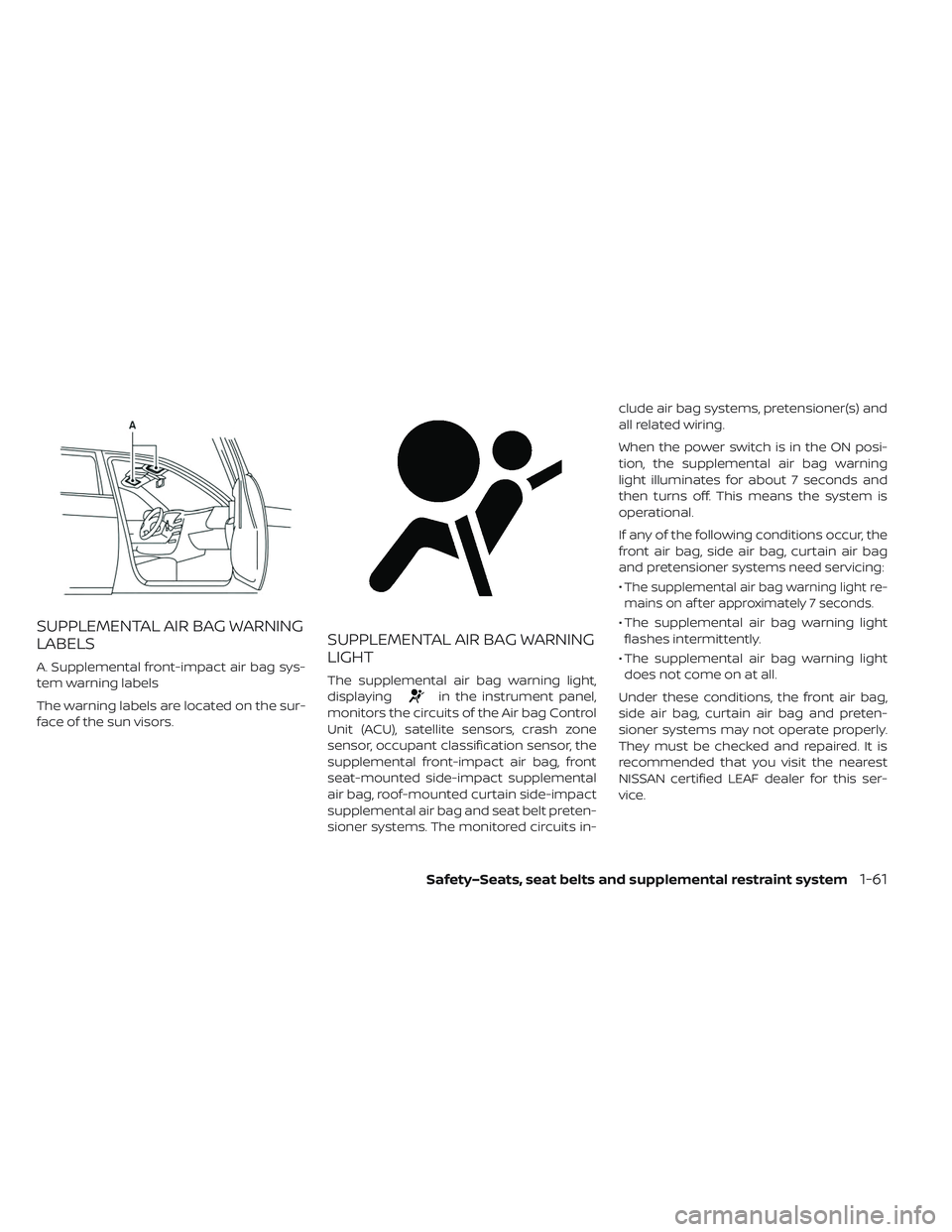
SUPPLEMENTAL AIR BAG WARNING
LABELS
A. Supplemental front-impact air bag sys-
tem warning labels
The warning labels are located on the sur-
face of the sun visors.
SUPPLEMENTAL AIR BAG WARNING
LIGHT
The supplemental air bag warning light,
displaying
in the instrument panel,
monitors the circuits of the Air bag Control
Unit (ACU), satellite sensors, crash zone
sensor, occupant classification sensor, the
supplemental front-impact air bag, front
seat-mounted side-impact supplemental
air bag, roof-mounted curtain side-impact
supplemental air bag and seat belt preten-
sioner systems. The monitored circuits in- clude air bag systems, pretensioner(s) and
all related wiring.
When the power switch is in the ON posi-
tion, the supplemental air bag warning
light illuminates for about 7 seconds and
then turns off. This means the system is
operational.
If any of the following conditions occur, the
front air bag, side air bag, curtain air bag
and pretensioner systems need servicing:
•
The supplemental air bag warning light re-
mains on af ter approximately 7 seconds.
• The supplemental air bag warning light
flashes intermittently.
• The supplemental air bag warning light does not come on at all.
Under these conditions, the front air bag,
side air bag, curtain air bag and preten-
sioner systems may not operate properly.
They must be checked and repaired. It is
recommended that you visit the nearest
NISSAN certified LEAF dealer for this ser-
vice.
Safety–Seats, seat belts and supplemental restraint system1-61
Page 173 of 610
WARNING
If the supplemental air bag warning
light is on, it could mean that the front
air bag, side air bag, curtain air bag
and/or pretensioner systems will not
operate in an accident. To help avoid
injury to yourself or others, have your
vehicle checked as soon as possible. It
is recommended that you visit a
NISSAN certified LEAF dealer for this
service.
Repair and replacement
procedure
The front air bags, side air bags, curtain air
bags and pretensioner(s) are designed to
activate on a one-time-only basis. As a re-
minder, unless it is damaged, the supple-
mental air bag warning light will remain
illuminated af ter inflation has occurred.
These systems should be repaired and/or
replaced as soon as possible. It is recom-
mended that you visit a NISSAN certified
LEAF dealer for this service.
When maintenance work is required on the
vehicle, the front air bags, side air bags,
curtain air bags and pretensioner(s) and related parts should be pointed out to the
person performing the maintenance. The
power switch should always be in the LOCK
position when working under the hood or
inside the vehicle.
WARNING
• Once a front air bag, side air bag or curtain air bag has inflated, the air
bag module will not function again
and must be replaced. Additionally,
the activated pretensioner(s) must
also be replaced. The air bag module
and pretensioner(s) should be re-
placed. It is recommended that you
visit a NISSAN certified LEAF dealer
for this service. The air bag modules
and pretensioner system cannot be
repaired.
• The front air bag, side air bag and curtain air bag systems, and preten-
sioner system should be inspected if
there is any damage to the front end
or side portion of the vehicle. It is
recommended that you visit a
NISSAN certified LEAF dealer for this
service. • If you need to dispose of a supple-
mental air bag or pretensioner sys-
tem or scrap the vehicle, it is recom-
mended that you visit a NISSAN
certified LEAF dealer for this service.
Correct supplemental air bag and
pretensioner system disposal pro-
cedures are set forth in the appro-
priate NISSAN Service Manual. Incor-
rect disposal procedures could
cause personal injury.
• If there is an impact to your vehicle from any direction, your Occupant
Classification Sensor (OCS) should
be checked. It is recommended that
you visit a NISSAN certified LEAF
dealer to verif y it is still functioning
correctly. The OCS should be
checked even if no air bags deploy
as a result of the impact. Failure to
verif y proper OCS function may re-
sult in an improper air bag deploy-
ment resulting in injury or death.
1-62Safety–Seats, seat belts and supplemental restraint system
Page 196 of 610
CAUTION
• The TPMS is not a substitute for the regular tire pressure check. Be sure
to check the tire pressure regularly.
• If the vehicle is being driven at speeds of less than 16 mph
(25 km/h), the TPMS may not oper-
ate correctly.
• Be sure to install the specified size of tires to the four wheels correctly.
Master warning light
(red/yellow)
There are two types of master warning
lights: yellow and red. These lights illumi-
nate if any warning lights or indicator lights
are illuminated or if various vehicle infor-
mation warnings appear in the vehicle in-
formation display.
Yellow master warning light
This light illuminates when a yellow warn-
ing light within the vehicle information dis-
play is illuminated or when a message is
displayed on the vehicle information dis-
play. Red master warning light
This light illuminates when a red warning
light within the vehicle information display
is illuminated or when a warning is dis-
played on the vehicle information display.
Power steering warning
light
When the power switch is in the ON posi-
tion, the electric power steering warning
light illuminates and turns off when the
power switch is placed in the READY to
drive position. This indicates the electric
power steering system is operational.
If the electric power steering warning light
illuminates while the READY to drive indica-
tor light is ON, it may indicate the electric
power steering system is not functioning
properly and may need servicing. Have the
electric power steering system checked. It
is recommended that you visit a NISSAN
certified LEAF dealer for this service.
When the electric power steering warning
light illuminates while the READY to drive
indicator is ON, the power assist to the
steering will cease operation but you will
still have control of the vehicle. At this time,greater steering efforts are required to
operate the steering wheel, especially in
sharp turns and at low speeds.
For additional information, refer to “Power
steering system” in the “Starting and driv-
ing” section of this manual.
Seat belt warning light
The light and chime remind you to fasten
your seat belts. The light illuminates when-
ever the power switch is placed in the ON
position, and will remain illuminated until
the driver’s seat belt is fastened. At the
same time, the chime will sound for ap-
proximately 6 seconds unless the driver’s
seat belt is securely fastened.
The seat belt warning light for the front
passenger will illuminate if the seat belt is
not fastened when the front passenger’s
seat is occupied. The front passenger seat
belt warning light does not activate until
5 seconds af ter the power switch is in the
ON position.
For additional information, refer to “Seat belts”
in the “Safety — Seats, seat belts and supple-
mental restraint system” section of this
manual for precautions on seat belt usage.
Instruments and controls2-23
Page 197 of 610
Supplemental air bag
warning light
Af ter turning the power switch to the ON
position, the supplemental air bag warning
light will illuminate. The supplemental air
bag warning light will turn off af ter about
7 seconds if the supplemental front air bag
and supplemental side air bag, curtain
side-impact air bag systems and/or pre-
tensioner seat belt are operational.
If any of the following conditions occur, the
front air bag, side air bag, curtain air bag
and pretensioner systems need servicing
and your vehicle must be taken to your
nearest NISSAN certified LEAF dealer.
•
The supplemental air bag warning light re-
mains on af ter approximately 7 seconds.
• The supplemental air bag warning lightflashes intermittently.
• The supplemental air bag warning light does not illuminate at all.
Unless checked and repaired, the Supple-
mental Restraint Systems and/or the pre-
tensioners may not function properly. For additional information, refer to “Supple-
mental restraint system (SRS)” in the “Safety
— Seats, seat belts and supplemental re-
straint system” section of this manual.
WARNING
If the supplemental air bag warning
light is on, it could mean that the front
air bag, side air bag, curtain air bag
and/or pretensioner systems will not
operate in an accident. To help avoid
injury to yourself or others, have your
vehicle checked. It is recommended
that you visit a NISSAN certified LEAF
dealer as soon as possible for this ser-
vice.
INDICATOR LIGHTS
For additional information, refer to “Vehicle
information display” in this section.
orElectronic parking
brake indicator light
When the power switch is placed in the ON
position, the light comes on when the park-
ing brake is applied.
Exterior light indicator light
This indicator illuminates when the head-
light switch is turned to the AUTO,
or
position and the front parking lights,
side marker lights, tail and license plate
lights are on. The indicator turns off when
these lights are turned off.
Front fog light indicator light
(if so equipped)
The front fog indicator light illuminates
when the front fog lights are on. For addi-
tional information, refer to “Fog light switch”
in this section.
Front passenger air bag
status light
The front passenger air bag status light
(located on the center of the instrument
panel) will be lit and the passenger front air
bag will be turned off depending on how
the front passenger seat is being used.
For front passenger air bag status light op-
eration, refer to “NISSAN Advanced Air Bag
System (front seats)” in the “Safety — Seats,
seat belts and supplemental restraint sys-
tem” section of this manual.
2-24Instruments and controls
Page 234 of 610
The front seats and the rear outboard
seats (if so equipped) can be warmed by
built-in heaters. The switches, located on
the center console and at the side of the
front passenger seatback, can be operated
independently of each other.
1.
Place the power switch in the ON position.
2. Push the LO or HI position of the switch,as desired, depending on the tempera-
ture. The indicator light in the switch will
illuminate.
3. To turn off the heater, return the switch to the level position. Make sure the indi-
cator light goes off.
The heater is controlled by a thermostat,
automatically turning the heater on and
off. The indicator light will remain on as long
as the switch is on.
When the vehicle’s interior is warmed, or
before you leave the vehicle, be sure to turn
the switch off.
NOTE:
The heated seats consume less power
than the heater and can be used to either
help extend vehicle range by reducing
heater use or to maximize comfort by
supplementing the heater.
WARNING
Do not use or allow occupants to use
the seat heater if you or the occupants
cannot monitor elevated seat tem-
peratures or have an inability to feel
pain in those body parts in contact
with the seat. Use of the seat heater by
such people could result in serious in-
jury.
CAUTION
• Do not use the seat heater for ex- tended periods or when no one is
using the seat.
• Do not put anything on the seat which insulates heat, such as a blan-
ket, cushion, seat cover, etc. Other-
wise, the seat may become over-
heated. • Do not place anything hard or heavy
on the seat or pierce it with a pin or
similar object. This may result in
damage to the heater.
• Any liquid spilled on the heated seat should be removed immediately
with a dry cloth.
• When cleaning the seat, never use gasoline, thinner, or any similar ma-
terials.
• If any malfunctions are found or the heated seat does not operate, turn
the switch off and have the system
checked. It is recommended that
you visit a NISSAN certified LEAF
dealer for this service.
Instruments and controls2-61
Page 332 of 610
USB (Universal Serial Bus)
connection port
WARNING
Do not connect, disconnect or operate
the USB device while driving. Doing so
can be a distraction. If distracted you
could lose control of your vehicle and
cause an accident or serious injury.
CAUTION
• Do not force the USB device into the USB port. Inserting the USB device
tilted or up-side-down into the port
may damage the port. Make sure
that the USB device is connected
correctly into the USB port.
• Do not grab the USB port cover (if so equipped) when pulling the USB de-
vice out of the port. This could dam-
age the port and the cover.
• Do not leave the USB cable in a place where it can be pulled unintention-
ally. Pulling the cable may damage
the port. The vehicle is not equipped with a USB de-
vice. USB devices should be purchased
separately as necessary. This system can-
not be used to format USB devices. To for-
mat a USB device, use a personal com-
puter. In some states/area, the USB device
for the front seats plays only sound without
images for regulatory reasons, even when
the vehicle is parked.
This system supports various USB
memory devices, USB hard drives and
iPod® players. Some USB devices may not
be supported by this system.
Partitioned USB devices may not play cor-
rectly.
Some characters used in other languages
(Chinese, Japanese, etc.) may not appear
properly in the display. Using English lan-
guage characters with a USB device is rec-
ommended.
General notes for USB use:
For additional information refer to your de-
vice manufacturer’s owner information re-
garding the proper use and care of the
device. Notes for iPod® use:
iPod® is a trademark of Apple Inc., regis-
tered in the U.S. and other countries.
• Improperly plugging in the iPod® may
cause a checkmark to be displayed on
and off (flickering). Always make sure that
the iPod® is connected properly.
• An iPod® nano (1st Generation) may re- main in fast forward or rewind mode if it is
connected during a seek operation. In this
case, please manually reset the iPod®.
• An iPod® nano (2nd Generation) will con- tinue to fast-forward or rewind if it is dis-
connected during a seek operation.
• An incorrect song title may appear when the Play Mode is changed while using an
iPod® nano (2nd Generation).
• Audiobooks may not play in the same or- der as they appear on an iPod®.
•
Large video files cause slow responses in an
iPod®. The vehicle center display may mo-
mentarily black out, but will soon recover.
• If an iPod® automatically selects large video files while in the shuffle mode, the
vehicle center display may momentarily
black out, but will soon recover.
Monitor, climate, audio, phone and voice recognition systems4-53
Page 366 of 610
TPMS with Easy-Fill Tire Alert
When tire pressure is low, the low tire pres-
sure warning light illuminates.
This vehicle provides visual and audible
signals to help you inflate the tires to the
recommended COLD tire pressure.
Vehicle set-up:
1. Park the vehicle in a safe and level place.
2. Apply the parking brake and push the P(Park) position switch on the shif t lever.
3. Place the power switch in the ON posi- tion. Do not place in the READY to drive
mode.
Operation:
1. Add air to the tire.
2. Af ter a few seconds, the hazard indica- tors will start flashing.
3. When the designated pressure is reached, the horn beeps once and the
hazard indicators stop flashing.
4. Perform the above steps for each tire.
• If the tire is over-inflated more than ap- proximately 4 psi (30 kPa), the horn beeps
and the hazard indicators flash three
times. To correct the pressure, push the core of the valve stem on the tire briefly to
release pressure. When the pressure
reaches the designated pressure, the
horn beeps once.
• If the hazard indicator does not flash within approximately 15 seconds af ter
starting to inflate the tire, it indicates that
the Easy-Fill Tire Alert is not operating.
• The TPMS will not activate the Easy-Fill Tire Alert under the following conditions: – If there is interference from an externaldevice or transmitter.
– The air pressure from the inflation de- vice is not sufficient to inflate the tire,
such as those using a power socket.
– If electrical equipment is being used in or near the vehicle.
– There is a malfunction in the TPMS.
– There is a malfunction in the horn or hazard indicators.
– If the Easy-Fill Tire Alert does not oper- ate due to TPMS interference, move the
vehicle about 3 f t (1 m) backward or
forward and try again.
If the Easy-Fill Tire Alert is not working, use a
tire pressure gauge.
AVOIDING COLLISION AND
ROLLOVER
WARNING
Failure to operate this vehicle in a safe
and prudent manner may result in loss
of control or an accident.
Be alert and drive defensively at all times.
Obey all traffic regulations. Avoid excessive
speed, high speed cornering, or sudden
steering maneuvers because these driving
practices could cause you to lose control of
your vehicle. As with any vehicle, a loss of
control could result in a collision with
other vehicles or objects or cause the ve-
hicle to rollover, particularly if the loss of
control causes the vehicle to slide side-
ways. Be attentive at all times, and avoid
driving when tired. Never drive when under
the influence of alcohol or drugs (including
prescription or over-the-counter drugs
which may cause drowsiness). Always
wear your seat belt as outlined in “Seat
belts” in the “Safety — Seats, seat belts and
supplemental restraint system” section of
this manual, and also instruct your passen-
gerstodoso.
Starting and driving5-7