air bag NISSAN LEAF 2019 Owner´s Manual
[x] Cancel search | Manufacturer: NISSAN, Model Year: 2019, Model line: LEAF, Model: NISSAN LEAF 2019Pages: 610, PDF Size: 7.11 MB
Page 9 of 610
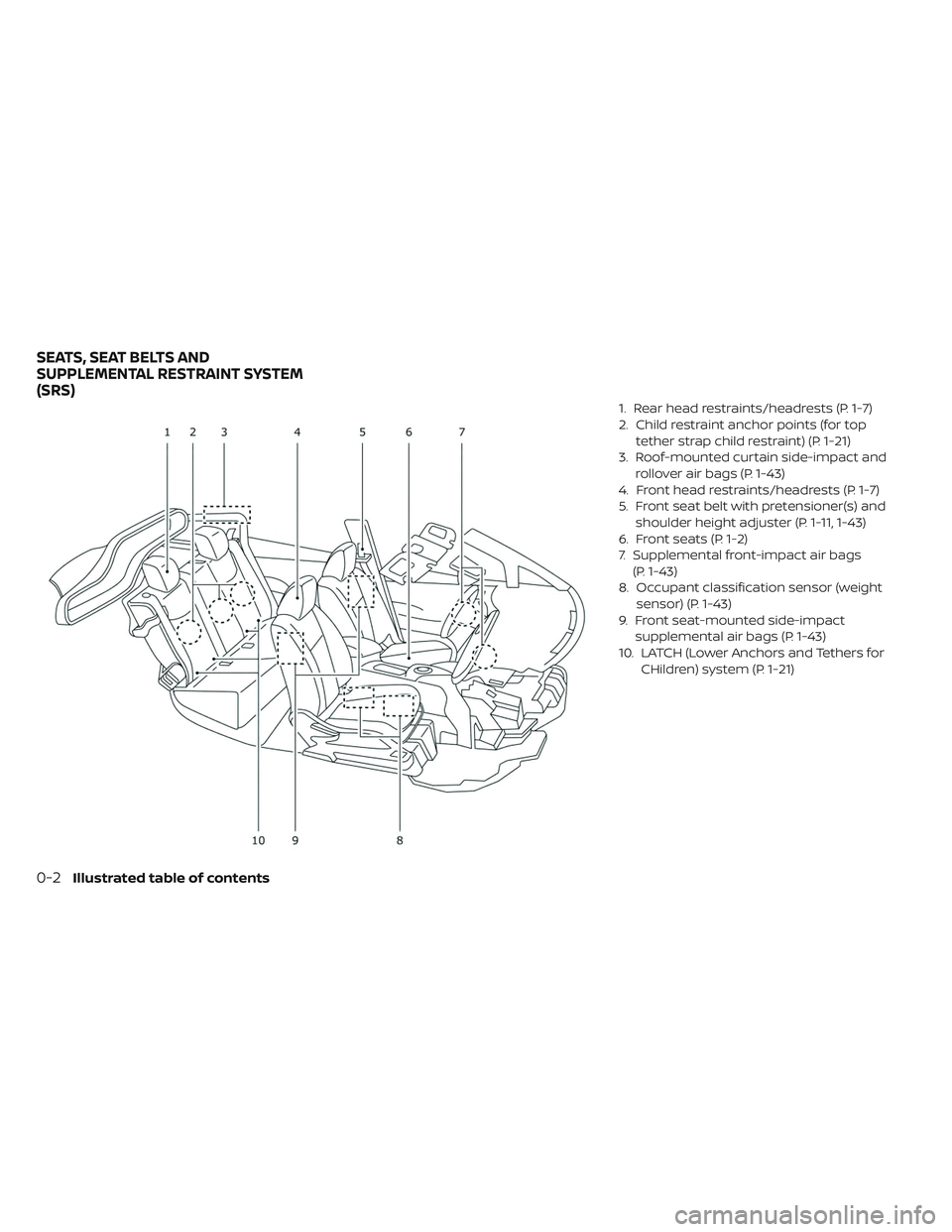
1. Rear head restraints/headrests (P. 1-7)
2. Child restraint anchor points (for toptether strap child restraint) (P. 1-21)
3. Roof-mounted curtain side-impact and rollover air bags (P. 1-43)
4. Front head restraints/headrests (P. 1-7)
5. Front seat belt with pretensioner(s) and shoulder height adjuster (P. 1-11, 1-43)
6. Front seats (P. 1-2)
7. Supplemental front-impact air bags (P. 1-43)
8. Occupant classification sensor (weight sensor) (P. 1-43)
9. Front seat-mounted side-impact supplemental air bags (P. 1-43)
10. LATCH (Lower Anchors and Tethers for CHildren) system (P. 1-21)
SEATS, SEAT BELTS AND
SUPPLEMENTAL RESTRAINT SYSTEM
(SRS)
0-2Illustrated table of contents
Page 14 of 610
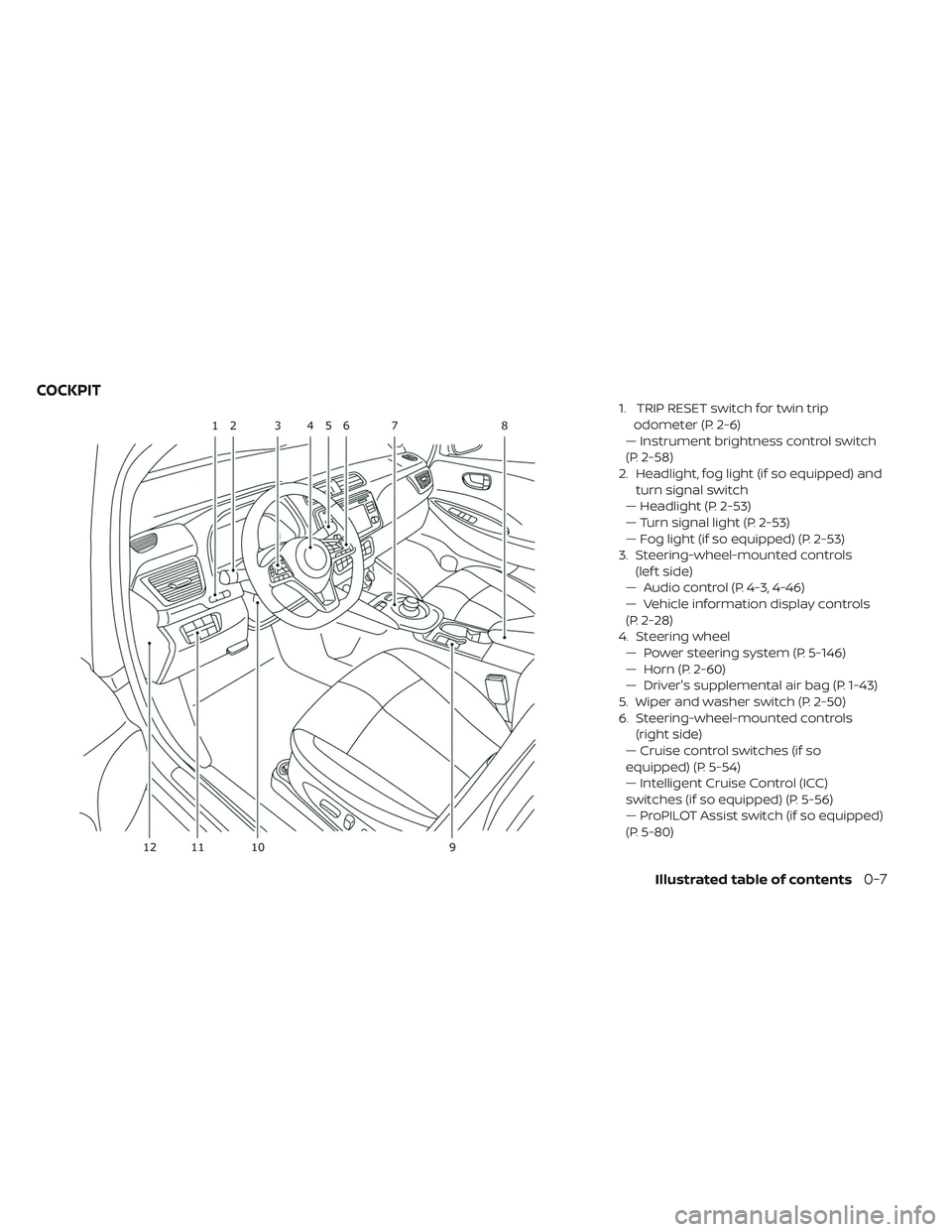
1. TRIP RESET switch for twin tripodometer (P. 2-6)
— Instrument brightness control switch
(P. 2-58)
2. Headlight, fog light (if so equipped) and turn signal switch
— Headlight (P. 2-53)
— Turn signal light (P. 2-53)
— Fog light (if so equipped) (P. 2-53)
3. Steering-wheel-mounted controls (lef t side)
— Audio control (P. 4-3, 4-46)
— Vehicle information display controls
(P. 2-28)
4. Steering wheel — Power steering system (P. 5-146)
— Horn (P. 2-60)
— Driver's supplemental air bag (P. 1-43)
5. Wiper and washer switch (P. 2-50)
6. Steering-wheel-mounted controls (right side)
— Cruise control switches (if so
equipped) (P. 5-54)
— Intelligent Cruise Control (ICC)
switches (if so equipped) (P. 5-56)
— ProPILOT Assist switch (if so equipped)
(P. 5-80)
COCKPIT
Illustrated table of contents0-7
Page 16 of 610
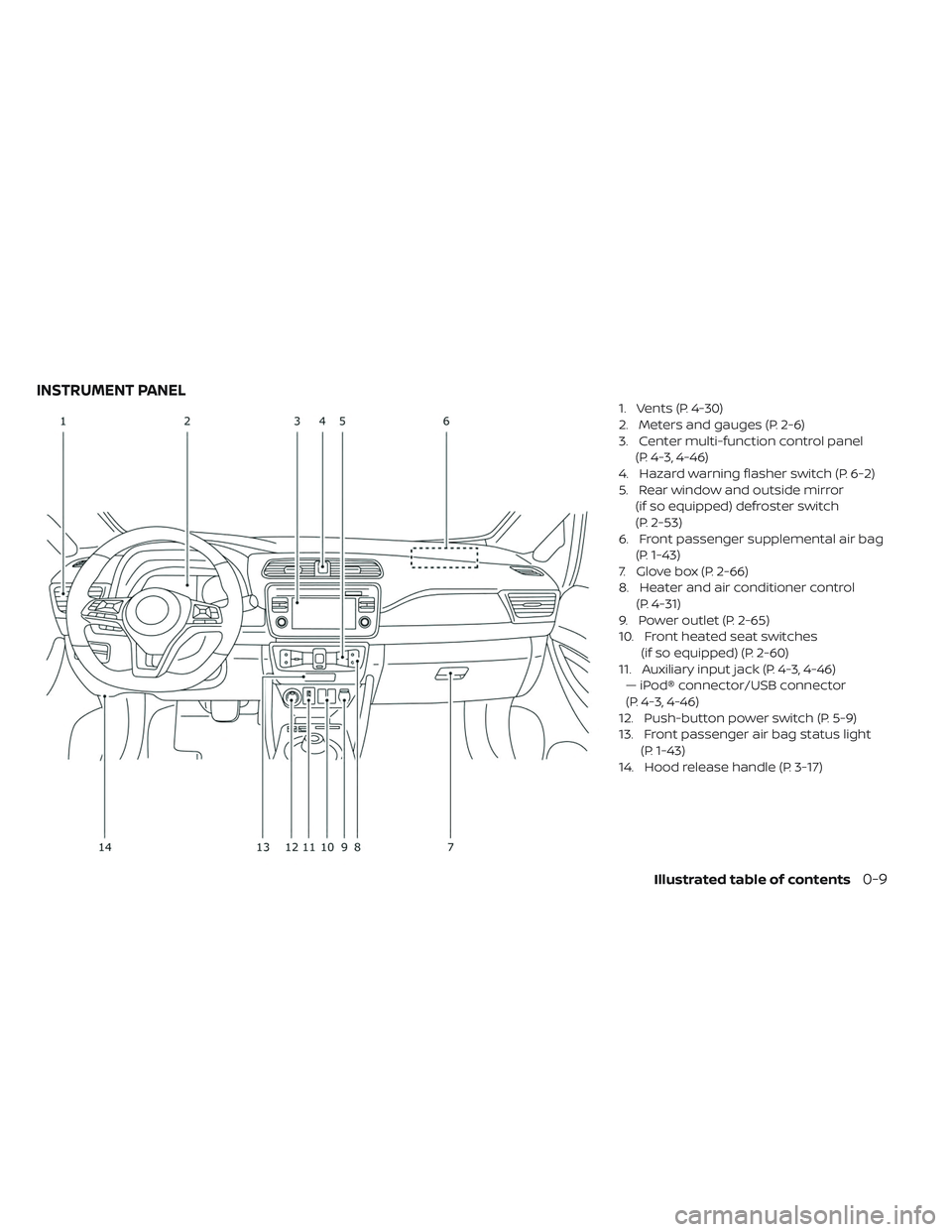
1. Vents (P. 4-30)
2. Meters and gauges (P. 2-6)
3. Center multi-function control panel(P. 4-3, 4-46)
4. Hazard warning flasher switch (P. 6-2)
5. Rear window and outside mirror (if so equipped) defroster switch
(P. 2-53)
6. Front passenger supplemental air bag (P. 1-43)
7. Glove box (P. 2-66)
8. Heater and air conditioner control (P. 4-31)
9. Power outlet (P. 2-65)
10. Front heated seat switches (if so equipped) (P. 2-60)
11. Auxiliary input jack (P. 4-3, 4-46) — iPod® connector/USB connector
(P. 4-3, 4-46)
12. Push-button power switch (P. 5-9)
13. Front passenger air bag status light (P. 1-43)
14. Hood release handle (P. 3-17)
INSTRUMENT PANEL
Illustrated table of contents0-9
Page 19 of 610
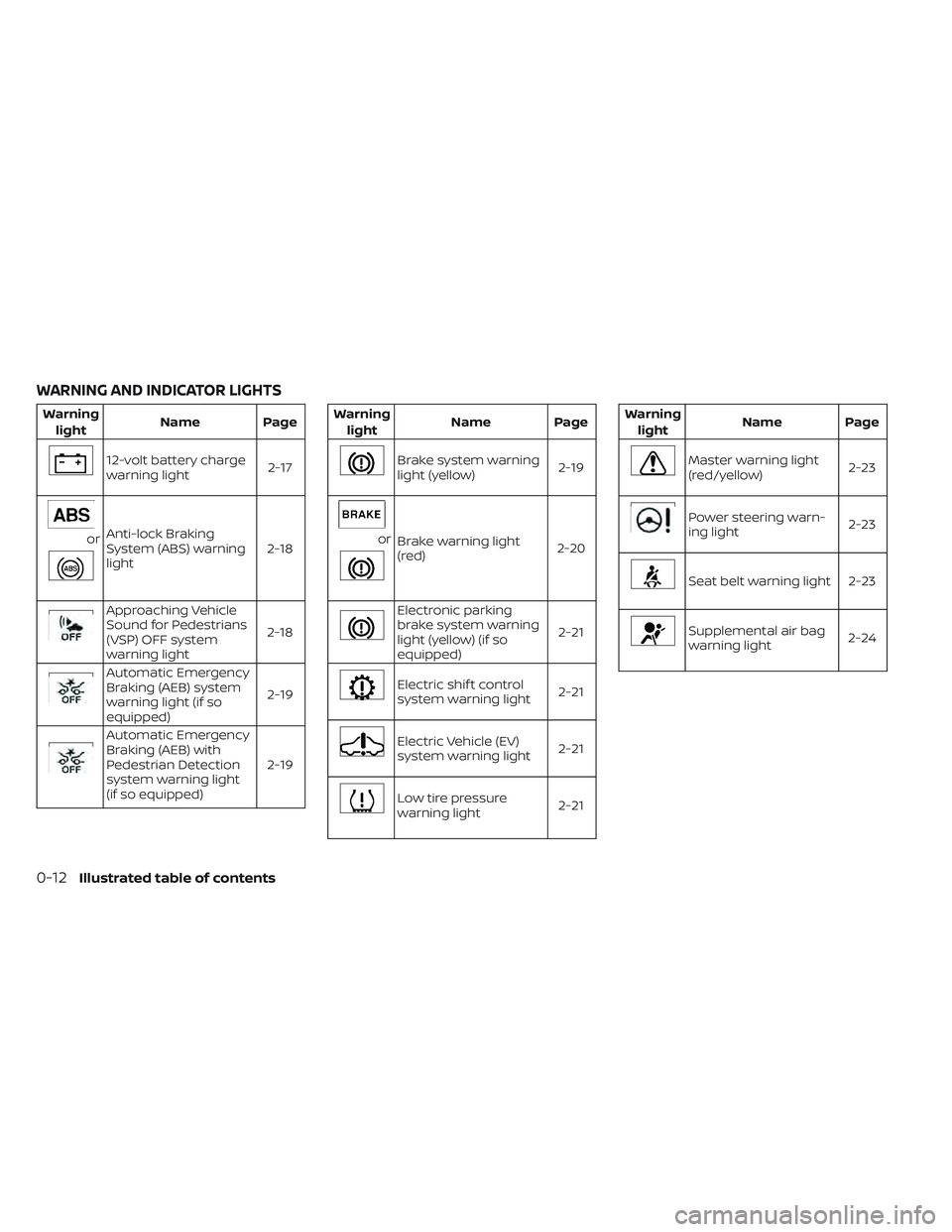
Warninglight Name Page
12-volt battery charge
warning light
2-17
orAnti-lock Braking
System (ABS) warning
light2-18
Approaching Vehicle
Sound for Pedestrians
(VSP) OFF system
warning light2-18
Automatic Emergency
Braking (AEB) system
warning light (if so
equipped) 2-19
Automatic Emergency
Braking (AEB) with
Pedestrian Detection
system warning light
(if so equipped)2-19
Warning
light Name Page
Brake system warning
light (yellow)
2-19
orBrake warning light
(red)2-20
Electronic parking
brake system warning
light (yellow) (if so
equipped) 2-21
Electric shif t control
system warning light
2-21
Electric Vehicle (EV)
system warning light2-21
Low tire pressure
warning light2-21
Warning
light Name Page
Master warning light
(red/yellow)
2-23
Power steering warn-
ing light2-23
Seat belt warning light 2-23
Supplemental air bag
warning light2-24
WARNING AND INDICATOR LIGHTS
0-12Illustrated table of contents
Page 20 of 610
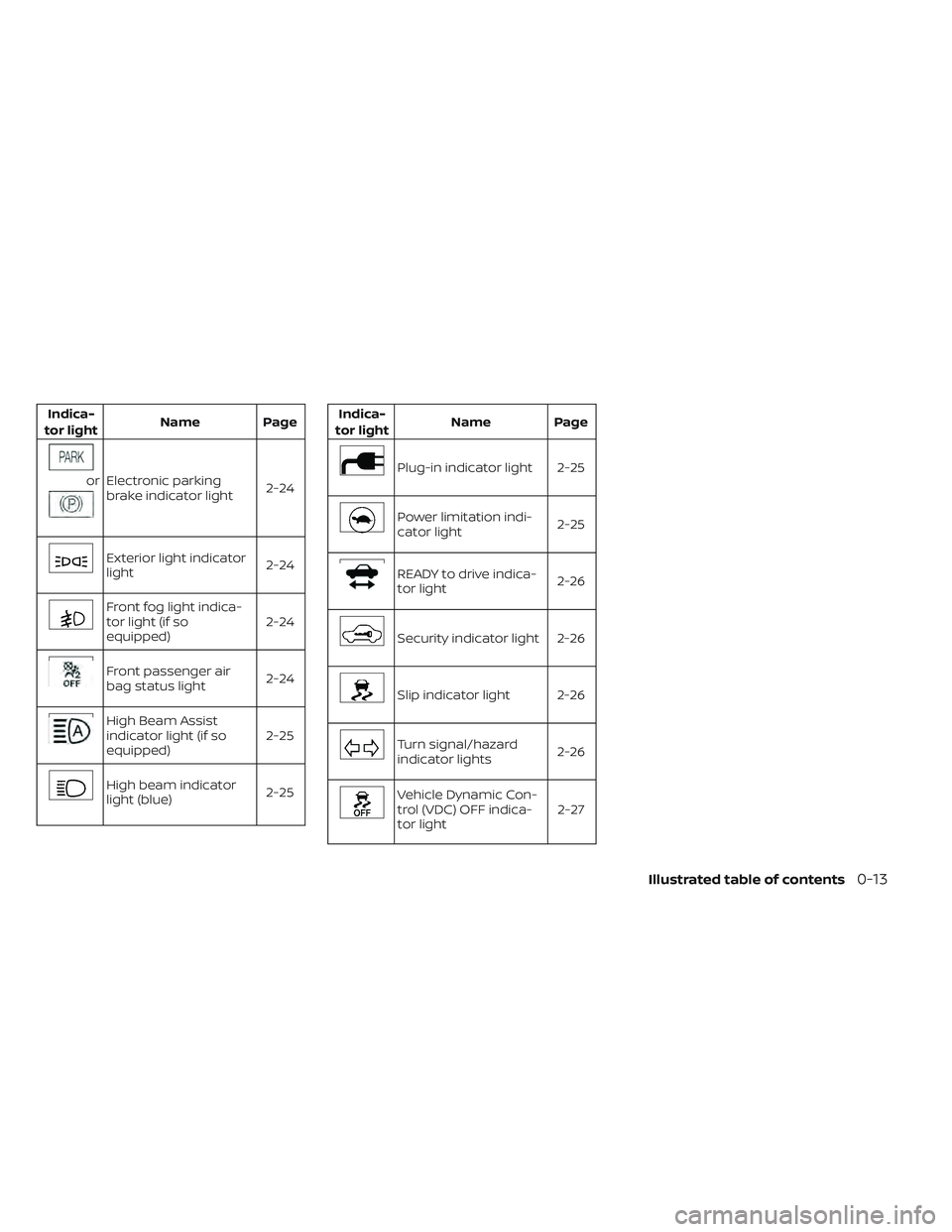
Indica-
tor light Name Page
orElectronic parking
brake indicator light
2-24
Exterior light indicator
light2-24
Front fog light indica-
tor light (if so
equipped)2-24
Front passenger air
bag status light
2-24
High Beam Assist
indicator light (if so
equipped) 2-25
High beam indicator
light (blue)
2-25
Indica-
tor light Name Page
Plug-in indicator light 2-25
Power limitation indi-
cator light
2-25
READY to drive indica-
tor light2-26
Security indicator light 2-26
Slip indicator light 2-26
Turn signal/hazard
indicator lights2-26
Vehicle Dynamic Con-
trol (VDC) OFF indica-
tor light 2-27
Illustrated table of contents0-13
Page 31 of 610
WARNING
In case of a collision:
• If your vehicle is drivable, pull your vehicle off the road, push the P
(Park) position switch on the shif t
lever, apply the parking brake and
turn the EV system off.
• Check your vehicle to see if there are exposed high-voltage parts or
cables. For their locations, refer to
“High voltage components” in this
section. To avoid personal injury,
never touch high-voltage wiring,
connectors, and other high-voltage
parts, such as inverter unit and Li-
ion battery. An electric shock may
occur if exposed electric wires are
visible when viewed from inside or
outside of your vehicle. Therefore,
never touch exposed electric wires.
• If the vehicle receives a strong im- pact to the floor while driving, stop
the vehicle in a safe location and
check the floor.
• Leaks or damage to the Li-ion bat- tery may result in a fire. If you dis-
cover them, contact emergency ser-
vices immediately. Since the fluid
leak may be lithium manganate from the Li-ion battery, never touch
the fluid leak inside or outside the
vehicle. If the fluid contacts your
skin or eyes, wash it off immediately
with a large amount of water and
receive immediate medical atten-
tion to help avoid serious injury.
• If a fire occurs in the EV, leave the vehicle as soon as possible. Only use
a type ABC, BC or C fire extinguisher
that is meant for use on electrical
fires. Using a small amount of water
or the incorrect fire extinguisher can
result in serious injury or death from
electrical shock.
• If your vehicle needs to be towed, do it with the front wheels raised. If the
front wheels are on the ground
when towing, the traction motor
may generate electricity. This may
damage the components of the EV
system and cause a fire.
• If you are not able to safely assess the vehicle due to vehicle damage,
do not touch the vehicle. Leave the
vehicle and contact emergency ser-
vices. Advise first responders that
this is an electric vehicle. • In the event of an accident that re-
quires body repair and painting, the
Li-ion battery pack and high voltage
parts such as the inverter, including
the wire harness, should be re-
moved prior to painting. It is recom-
mended that you visit a NISSAN cer-
tified LEAF dealer for this service.
Li-ion battery packs exposed to heat
in the paint booth will experience
capacity loss. Damaged Li-ion bat-
tery packs may also pose safety
risks to untrained mechanics and re-
pair personnel.
EMERGENCY SHUT-OFF SYSTEM
The emergency shut-off system is acti-
vated and the high-voltage system auto-
matically turns off in the following condi-
tions:
- Front and side collisions in which the air
bags are deployed.
- Certain rear collisions.
- Certain EV system malfunctions.
ROAD ACCIDENT PRECAUTIONS
EV-10EV Overview
Page 112 of 610
1 Safety–Seats, seat belts and
supplemental restraint system
Seats..............................1-2Front manual seat adjustment (for passenger’s
seat and if so equipped for driver’s seat) .....1-3
Front power seat adjustment
(if so equipped for driver’s seat) ...........1-4
Rearseats ....................... .1-6
Head restraints/headrests ................1-7
Adjustable head restraint/headrest
components .......................1-8
Non-adjustable head restraint/headrest
components .......................1-8
Remove..........................1-9
Install ........................... .1-9
Adjust .......................... .1-9
Seatbelts.......................... .1-11
Precautions on seat belt usage ..........1-11
Seat belt warning light ................1-13
Pregnant women .................. .1-13
Injured persons .................... .1-13
Three-point type seat belt with retractor . . . .1-14
Seat belt extenders ................. .1-17
Seat belt maintenance ................1-18 Child safety
.........................1-18
Infants ......................... .1-19
Small children ......................1-19
Larger children .................... .1-20
Child restraints .......................1-21
Precautions on child restraints ...........1-21
LATCH (Lower Anchors and Tethers for CHildren)
system ......................... .1-23
Rear-facing child restraint installation using
LATCH.......................... .1-26
Rear-facing child restraint installation using
theseatbelts..................... .1-28
Forward-facing child restraint installation
using LATCH .......................1-31
Forward-facing child restraint installation
using the seat belts ................. .1-34
Booster seats ......................1-39
Supplemental Restraint System (SRS) ........1-43
Precautions on SRS ................. .1-43
Supplemental air bag warning labels ......1-61
Supplemental air bag warning light .......1-61
Page 122 of 610
PRECAUTIONS ON SEAT BELT
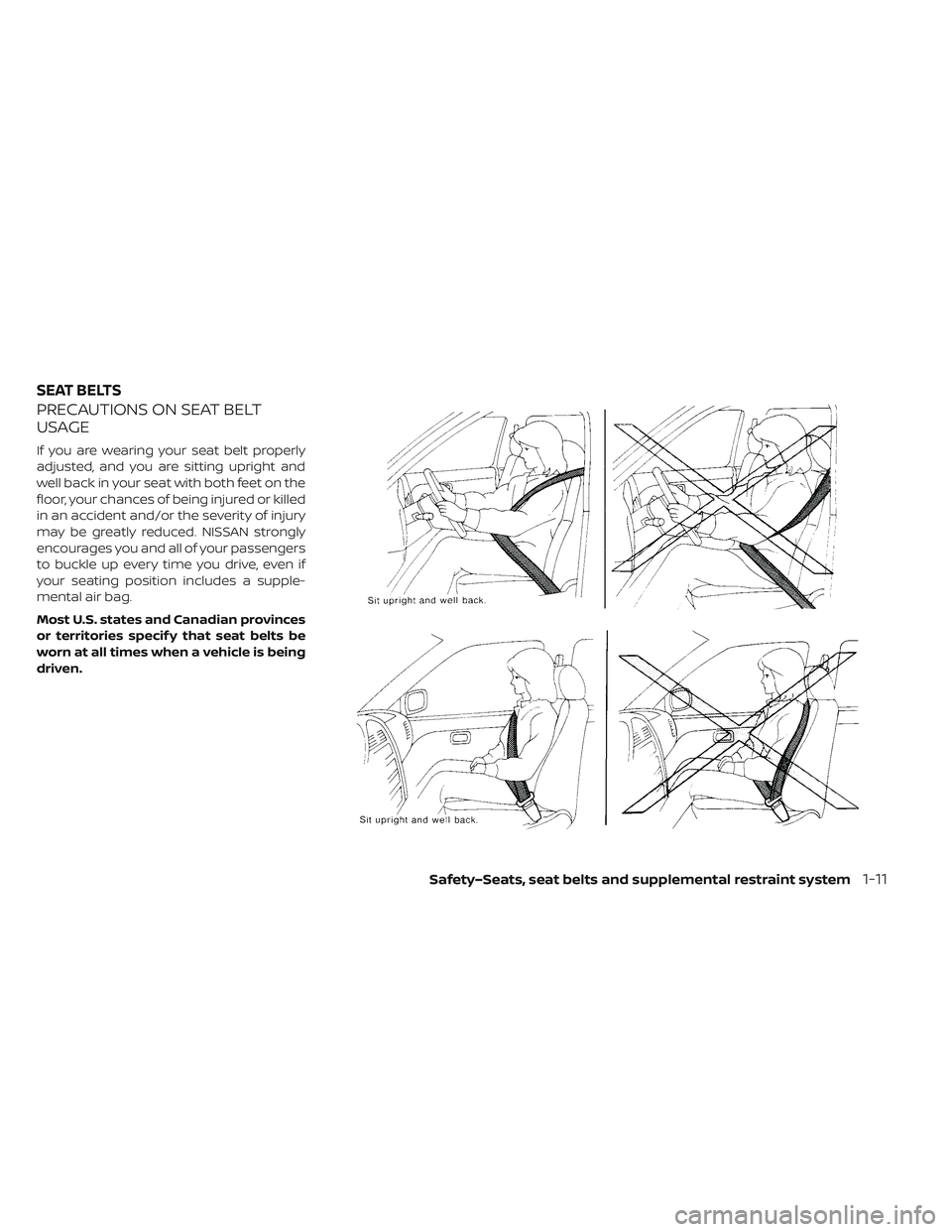
USAGE
If you are wearing your seat belt properly
adjusted, and you are sitting upright and
well back in your seat with both feet on the
floor, your chances of being injured or killed
in an accident and/or the severity of injury
may be greatly reduced. NISSAN strongly
encourages you and all of your passengers
to buckle up every time you drive, even if
your seating position includes a supple-
mental air bag.
Most U.S. states and Canadian provinces
or territories specif y that seat belts be
worn at all times when a vehicle is being
driven.
SEAT BELTS
Safety–Seats, seat belts and supplemental restraint system1-11
Page 126 of 610
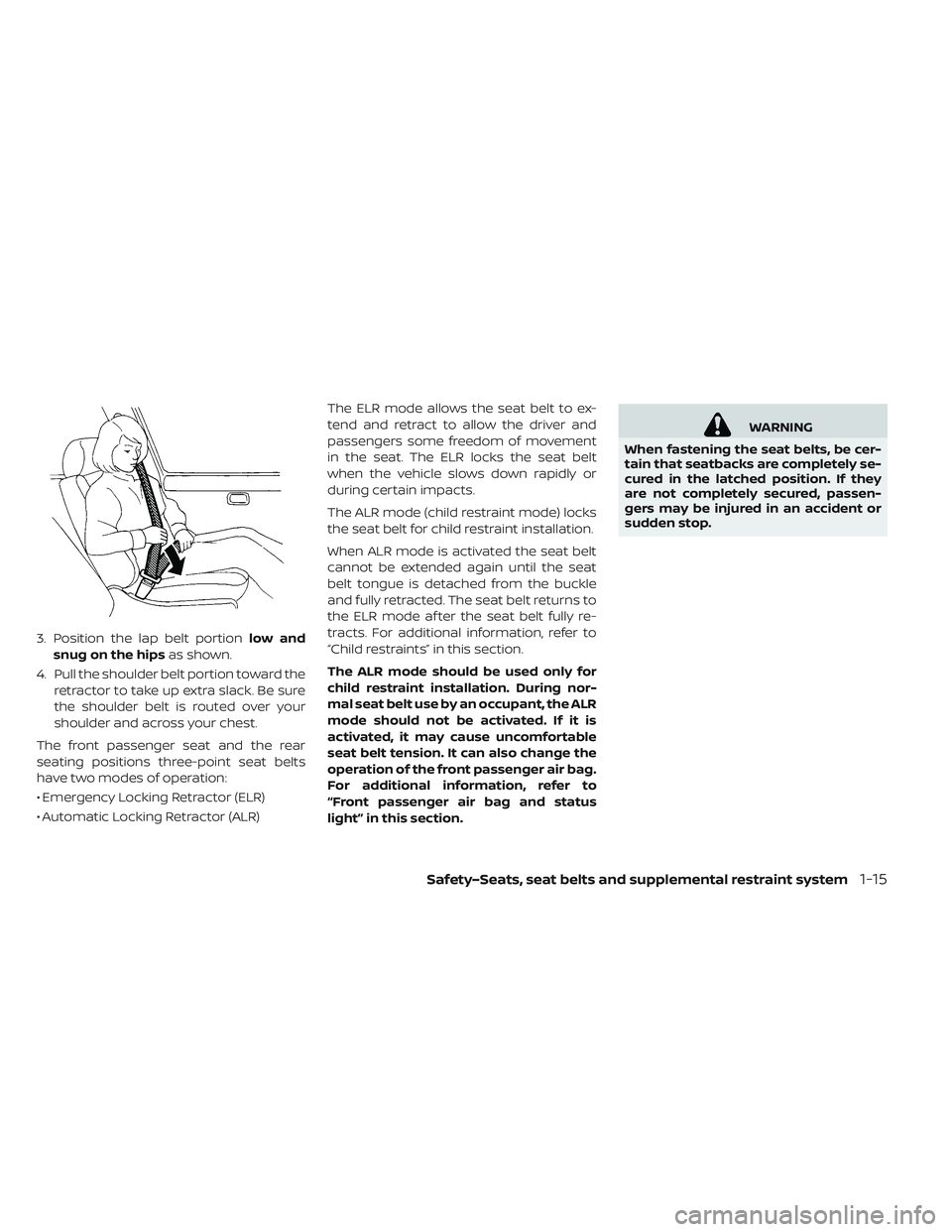
3. Position the lap belt portionlow and
snug on the hips as shown.
4. Pull the shoulder belt portion toward the retractor to take up extra slack. Be sure
the shoulder belt is routed over your
shoulder and across your chest.
The front passenger seat and the rear
seating positions three-point seat belts
have two modes of operation:
• Emergency Locking Retractor (ELR)
• Automatic Locking Retractor (ALR) The ELR mode allows the seat belt to ex-
tend and retract to allow the driver and
passengers some freedom of movement
in the seat. The ELR locks the seat belt
when the vehicle slows down rapidly or
during certain impacts.
The ALR mode (child restraint mode) locks
the seat belt for child restraint installation.
When ALR mode is activated the seat belt
cannot be extended again until the seat
belt tongue is detached from the buckle
and fully retracted. The seat belt returns to
the ELR mode af ter the seat belt fully re-
tracts. For additional information, refer to
“Child restraints” in this section.
The ALR mode should be used only for
child restraint installation. During nor-
mal seat belt use by an occupant, the ALR
mode should not be activated. If it is
activated, it may cause uncomfortable
seat belt tension. It can also change the
operation of the front passenger air bag.
For additional information, refer to
“Front passenger air bag and status
light” in this section.
WARNING
When fastening the seat belts, be cer-
tain that seatbacks are completely se-
cured in the latched position. If they
are not completely secured, passen-
gers may be injured in an accident or
sudden stop.
Safety–Seats, seat belts and supplemental restraint system1-15
Page 130 of 610
There are three basic types of child re-
straint systems:
• Rear-facing child restraint
• Forward-facing child restraint
• Booster seat
The proper restraint depends on the child’s
size. Generally, infants up to about 1 year
and less than 20 lbs. (9 kg) should be placed
in rear-facing child restraints. Forward-
facing child restraints are available for chil-
dren who outgrow rear-facing child re-
straints and are at least 1 year old. Booster
seats are used to help position a vehicle
lap/shoulder belt on a child who can no
longer use a forward-facing child restraint.
WARNING
Infants and children need special pro-
tection. The vehicle’s seat belts may
not fit them properly. The shoulder belt
may come too close to the face or neck.
The lap belt may not fit over their small
hip bones. In an accident, an improp-
erly fitting seat belt could cause seri-
ous or fatal injury. Always use appro-
priate child restraints. All U.S. states and Canadian provinces or
territories require the use of approved child
restraints for infants and small children. For
additional information, refer to “Child re-
straints” in this section.
A child restraint may be secured in the ve-
hicle by using either the LATCH (Lower An-
chor and Tethers for CHildren) system or
with the vehicle seat belt. For additional
information, refer to “Child restraints” in this
section.
NISSAN recommends that all pre-teens
and children be restrained in the rear
seat. According to accident statistics,
children are safer when properly re-
strained in the rear seat than in the front
seat.
This is especially important because
your vehicle has a supplemental re-
straint system (air bag system) for the
front passenger. For additional informa-
tion, refer to “Supplemental Restraint
System (SRS)” in this section.
INFANTS
Infants up to at least 1 year old should be
placed in a rear-facing child restraint.
NISSAN recommends that infants be
placed in child restraints that comply with
Federal Motor Vehicle Safety Standards or
Canadian Motor Vehicle Safety Standards.
You should choose a child restraint that fits
your vehicle and always follow the manu-
facturer’s instructions for installation and
use.
SMALL CHILDREN
Children that are over 1 year old and weigh
at least 20 lbs. (9 kg) should remain in a
rear-facing child restraint as long as pos-
sible up to the height or weight limit of the
child restraint. Children who outgrow the
height or weight limit of the rear-facing
child restraint and are at least 1 year old
should be secured in a forward-facing child
restraint with a harness. Refer to the manu-
facturer’s instructions for minimum and
maximum weight and height recommen-
dations. NISSAN recommends that small
children be placed in child restraints that
comply with Federal Motor Vehicle Safety
Safety–Seats, seat belts and supplemental restraint system1-19